PRESENTATION ON
TECHNICAL APPLICATION
OF NONWOVEN
Submitted by
NIBEDITA NANDI
JFT -17
Under Guidance of
KOUSIK BAL
They are not made by weaving or knitting and
do not require converting the fibers to yarn.
 Nonwoven fabrics are flat structures mainly
defined as sheets or webs made by bonding and
entangling fibers or filaments by mechanical,
thermal or chemical means.
NONWOVEN FABRIC
Ref-INDA LOGO-About nonwoven
Technical Textiles are defined as Textile
material and products manufactured
primarily for their Technical performance
and functional properties rather than
aesthetic and decorative characteristics.
TECHNICAL TEXTILE
Ref:- Technical textile and nonwoven
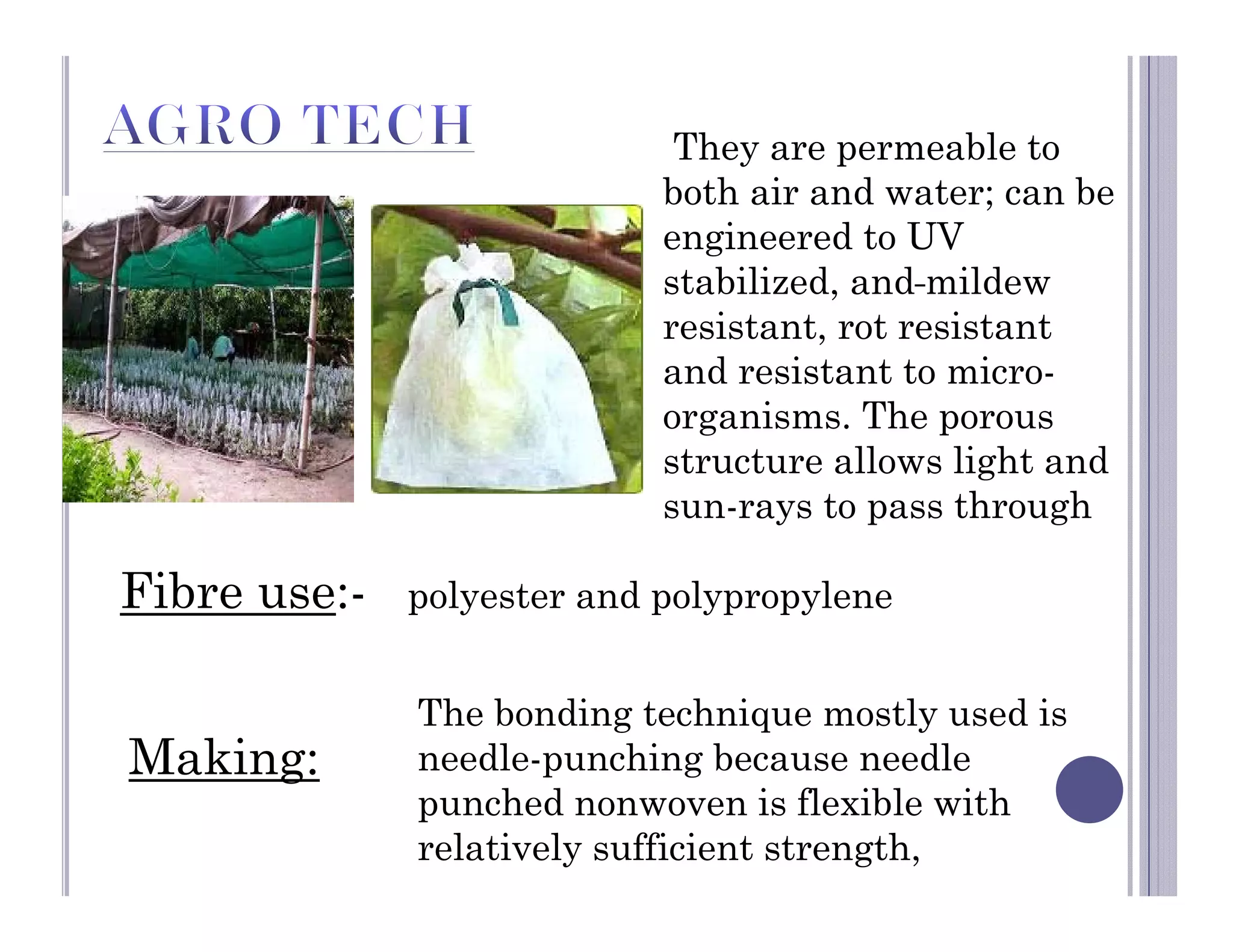
Fibre use:- polyester and polypropylene
The bonding technique mostly used is
needle-punching because needle
punched nonwoven is flexible with
relatively sufficient strength,
Making:
They are permeable to
both air and water; can be
engineered to UV
stabilized, and mildew
resistant, rot resistant
and resistant to micro-
organisms. The porous
structure allows light and
sun-rays to pass through
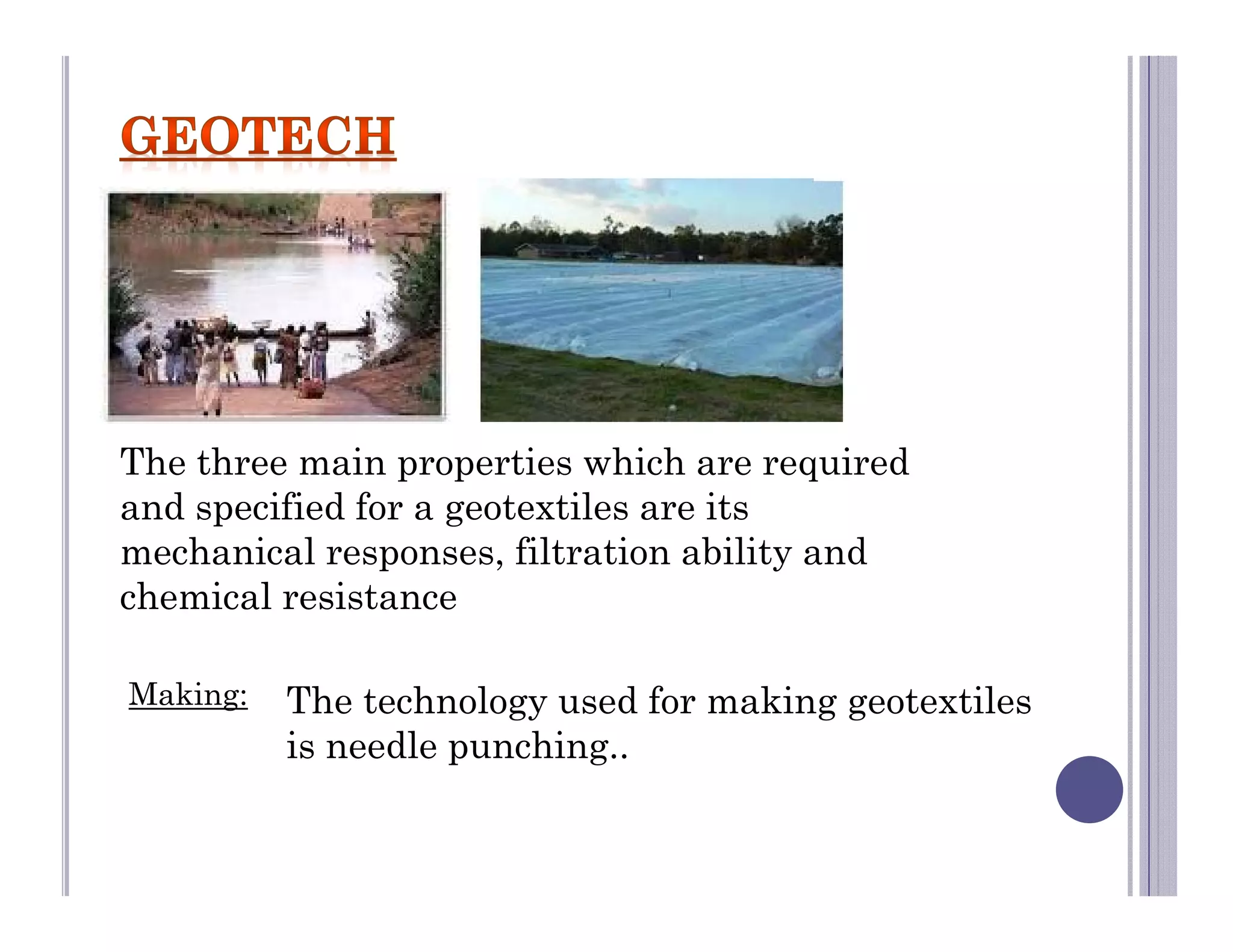
Making: The technology used for making geotextiles
is needle punching..
The three main properties which are required
and specified for a geotextiles are its
mechanical responses, filtration ability and
chemical resistance
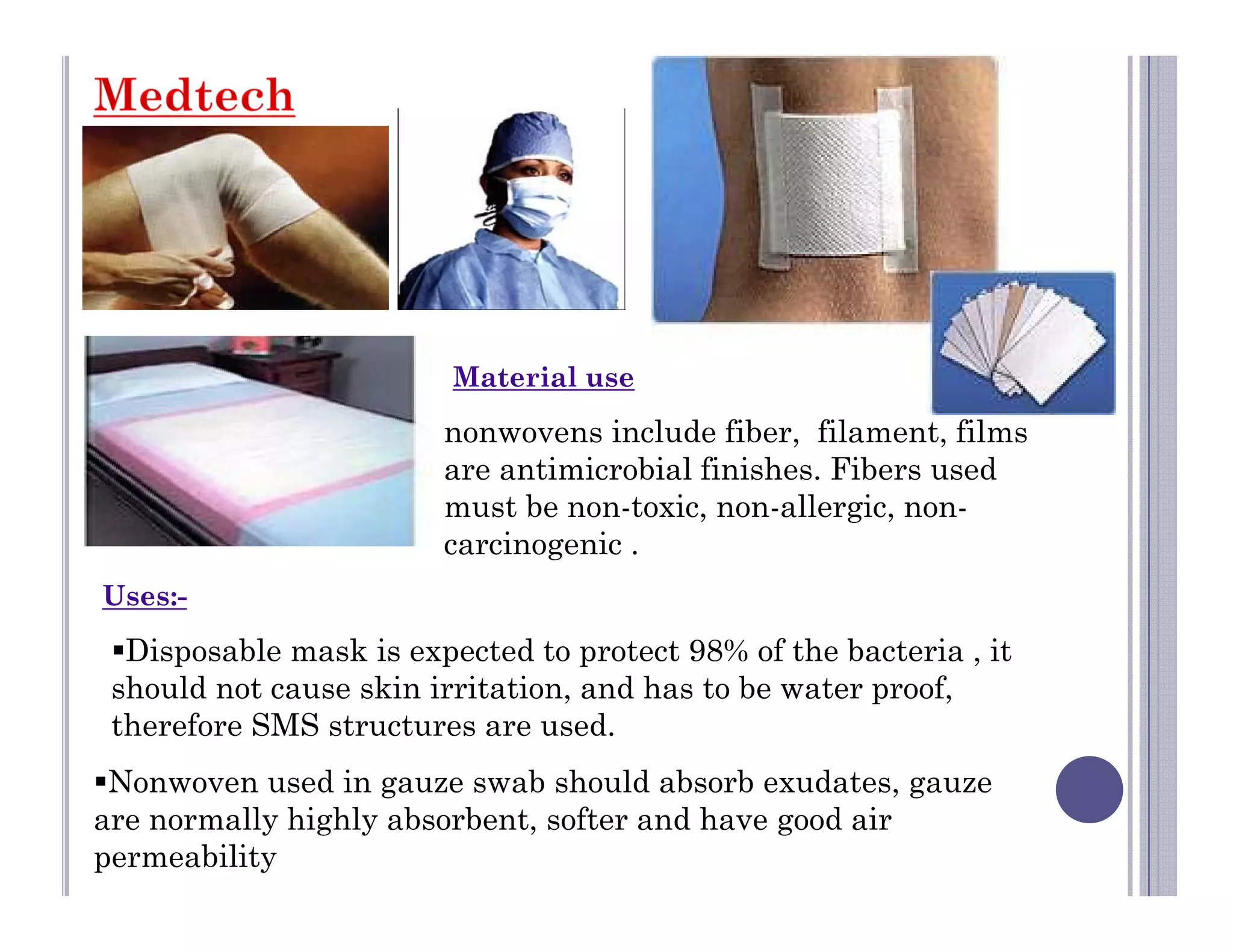
Material use
nonwovens include fiber, filament, films
are antimicrobial finishes. Fibers used
must be non-toxic, non-allergic, non-
carcinogenic .
Disposable mask is expected to protect 98% of the bacteria , it
should not cause skin irritation, and has to be water proof,
therefore SMS structures are used.
Uses:-
Nonwoven used in gauze swab should absorb exudates, gauze
are normally highly absorbent, softer and have good air
permeability
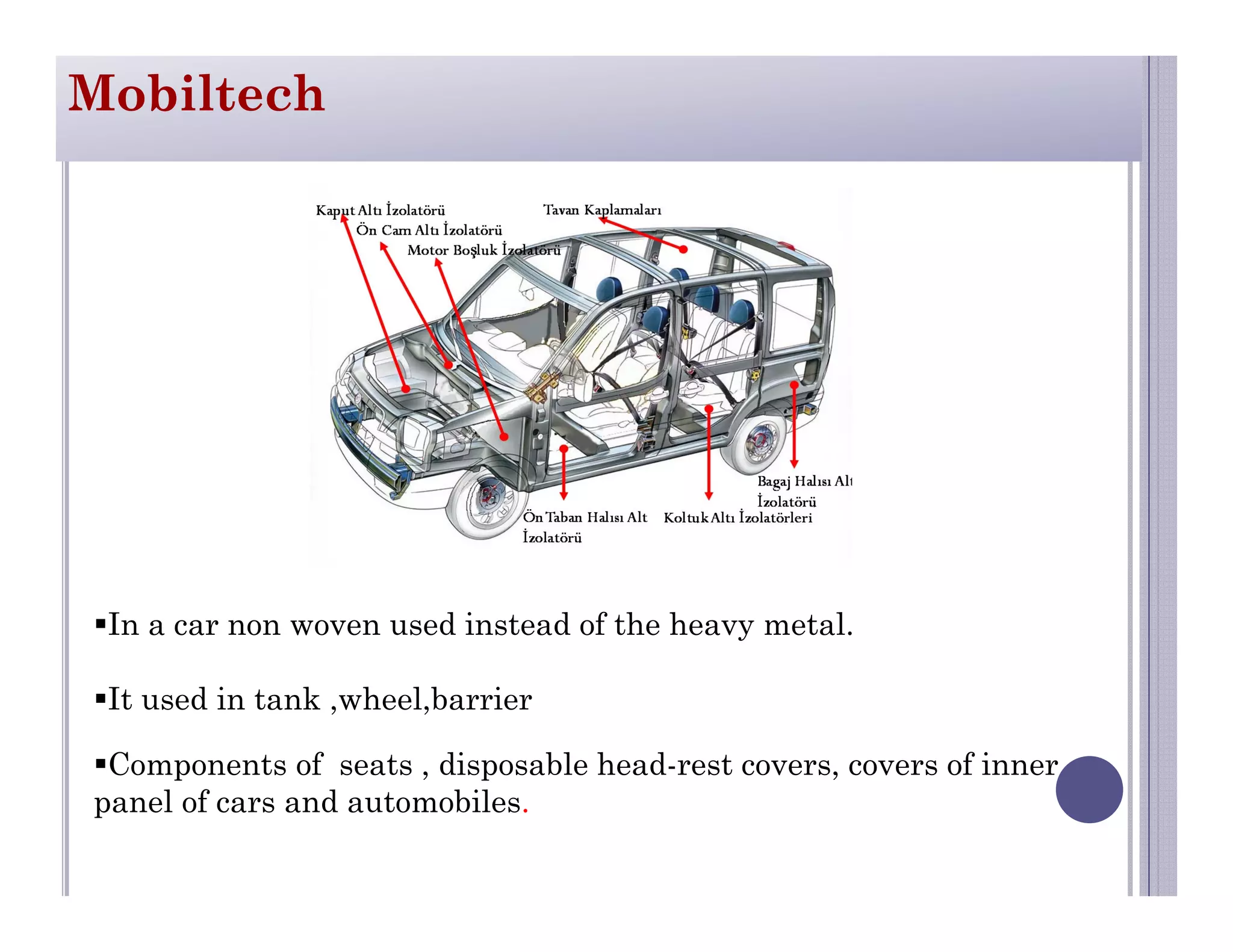
In a car non woven used instead of the heavy metal.
It used in tank ,wheel,barrier
Mobiltech
Components of seats , disposable head-rest covers, covers of inner
panel of cars and automobiles.
Home textile
•The clean room clothes
•Floor coatings made of antibacterial special mattress fabric.
•Special towels,scrub.
•Carpet components, furniture components, consumer
wipes (baby and household wipes), and interior decoration components.
Sporttech
sports equipment, sportswear,wipes, covers, camping
equipment.
Packtech
Bulk packaging with predefined 3D structure, scrap
and disposablefood pads, luggage components
Indutech:
Industrial wipes (food service) air and water filtration,
etc.
Clothtech
Shoe components, insulation and structure,
sewing products, interlining, cleanroom garments.
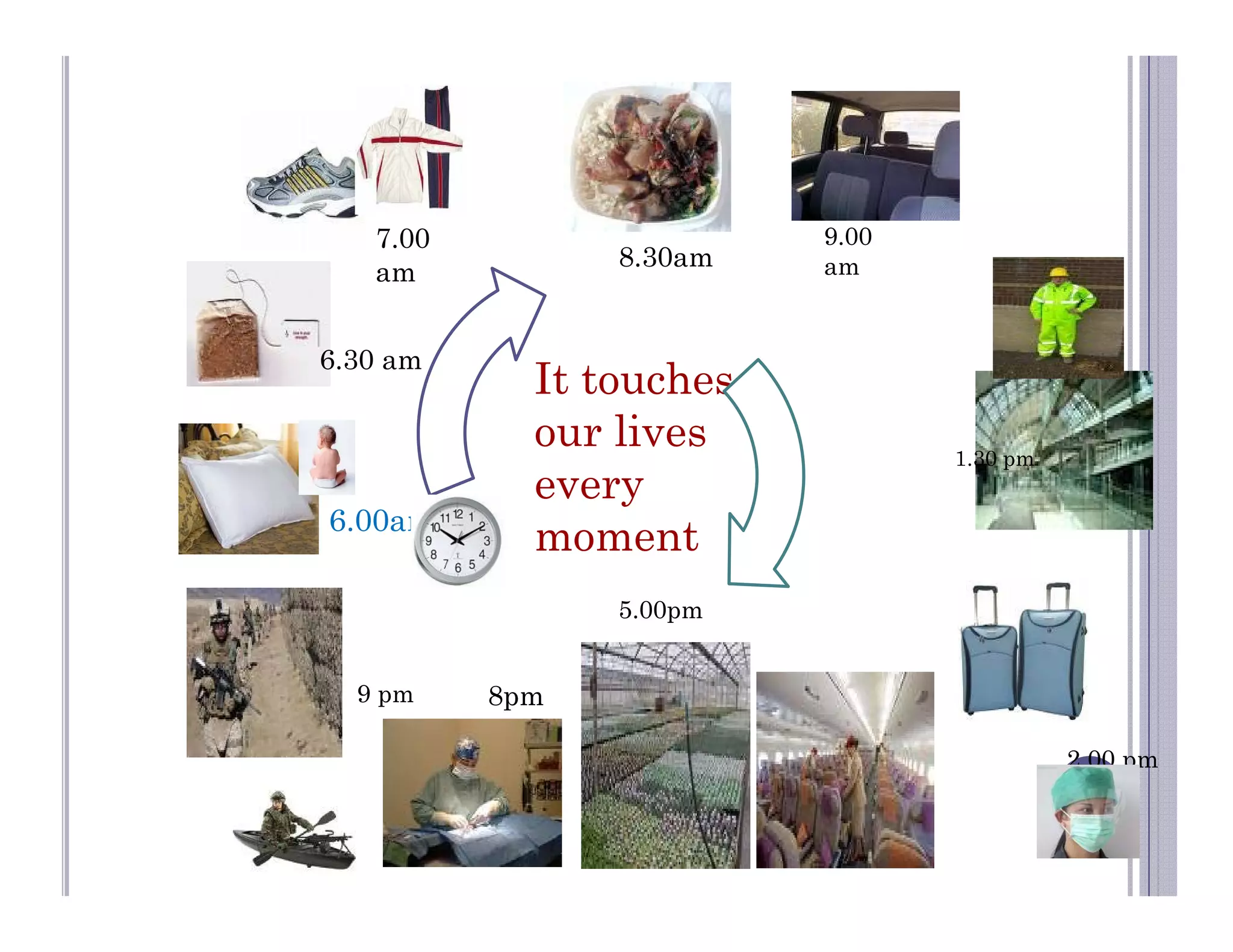
6.00am
6.30 am
7.00
am
8.30am
9.00
am
2.00 pm
1.30 pm
5.00pm
8pm9 pm
It touches
our lives
every
moment
CONCLUTION
 Technical textiles are generally recognised to be one of
the most dynamic and promising area for the future of
the textiles industry.
 Improvement in nonwoven technology is leading to
significant cost savings in some cases and enhanced
performance and durability in a vast array of
applications.
 Nonwoven fabric gives options of having very light
weight, thin, porous material at reasonable price
performance ratio for various technical applications.
 Eco friendly products may be developed from natural
fibres.
 Versatility.
REFERENCES
 Technical textile and nonwoven.byMuhammad
kamran Iqbal.pageno-35-39.december-2009
 A.Horroks ,S .Anand,Hanbook on technical
textiles.
 The Indian textile journal.September-2008
 Google.in
Technical application of nonwoven

Technical application of nonwoven

  • 1.
    PRESENTATION ON TECHNICAL APPLICATION OFNONWOVEN Submitted by NIBEDITA NANDI JFT -17 Under Guidance of KOUSIK BAL
  • 2.
    They are notmade by weaving or knitting and do not require converting the fibers to yarn.  Nonwoven fabrics are flat structures mainly defined as sheets or webs made by bonding and entangling fibers or filaments by mechanical, thermal or chemical means. NONWOVEN FABRIC Ref-INDA LOGO-About nonwoven
  • 3.
    Technical Textiles aredefined as Textile material and products manufactured primarily for their Technical performance and functional properties rather than aesthetic and decorative characteristics. TECHNICAL TEXTILE Ref:- Technical textile and nonwoven
  • 4.
    Fibre use:- polyesterand polypropylene The bonding technique mostly used is needle-punching because needle punched nonwoven is flexible with relatively sufficient strength, Making: They are permeable to both air and water; can be engineered to UV stabilized, and mildew resistant, rot resistant and resistant to micro- organisms. The porous structure allows light and sun-rays to pass through
  • 5.
    Making: The technologyused for making geotextiles is needle punching.. The three main properties which are required and specified for a geotextiles are its mechanical responses, filtration ability and chemical resistance
  • 6.
    Material use nonwovens includefiber, filament, films are antimicrobial finishes. Fibers used must be non-toxic, non-allergic, non- carcinogenic . Disposable mask is expected to protect 98% of the bacteria , it should not cause skin irritation, and has to be water proof, therefore SMS structures are used. Uses:- Nonwoven used in gauze swab should absorb exudates, gauze are normally highly absorbent, softer and have good air permeability
  • 7.
    In a carnon woven used instead of the heavy metal. It used in tank ,wheel,barrier Mobiltech Components of seats , disposable head-rest covers, covers of inner panel of cars and automobiles.
  • 8.
    Home textile •The cleanroom clothes •Floor coatings made of antibacterial special mattress fabric. •Special towels,scrub. •Carpet components, furniture components, consumer wipes (baby and household wipes), and interior decoration components. Sporttech sports equipment, sportswear,wipes, covers, camping equipment. Packtech Bulk packaging with predefined 3D structure, scrap and disposablefood pads, luggage components Indutech: Industrial wipes (food service) air and water filtration, etc. Clothtech Shoe components, insulation and structure, sewing products, interlining, cleanroom garments.
  • 9.
    6.00am 6.30 am 7.00 am 8.30am 9.00 am 2.00 pm 1.30pm 5.00pm 8pm9 pm It touches our lives every moment
  • 10.
    CONCLUTION  Technical textilesare generally recognised to be one of the most dynamic and promising area for the future of the textiles industry.  Improvement in nonwoven technology is leading to significant cost savings in some cases and enhanced performance and durability in a vast array of applications.  Nonwoven fabric gives options of having very light weight, thin, porous material at reasonable price performance ratio for various technical applications.  Eco friendly products may be developed from natural fibres.  Versatility.
  • 11.
    REFERENCES  Technical textileand nonwoven.byMuhammad kamran Iqbal.pageno-35-39.december-2009  A.Horroks ,S .Anand,Hanbook on technical textiles.  The Indian textile journal.September-2008  Google.in