Wilcoxon & Kruskal-Wallis
      Dr Azmi Mohd Tamil
Explore
• It is the first step in the analytic process
• to explore the characteristics of the data
• to screen for errors and correct them
• to look for distribution patterns - normal
  distribution or not
• May require transformation before further
  analysis using parametric methods
• Or may need analysis using non-parametric
  techniques
Choosing an appropriate method

• Number of groups of observations
• Independent or dependent groups of
  observations
• Type of data
• Distribution of data
• Objective of analysis
Nonparametric Test
              Procedures
• Statistic does not depend on population
  distribution
• Data may be nominally or ordinally scaled
  – Example: Male-female
• May involve population parameters such
  as median
• Based on analysis of ranks
• Example: Wilcoxon rank sum test
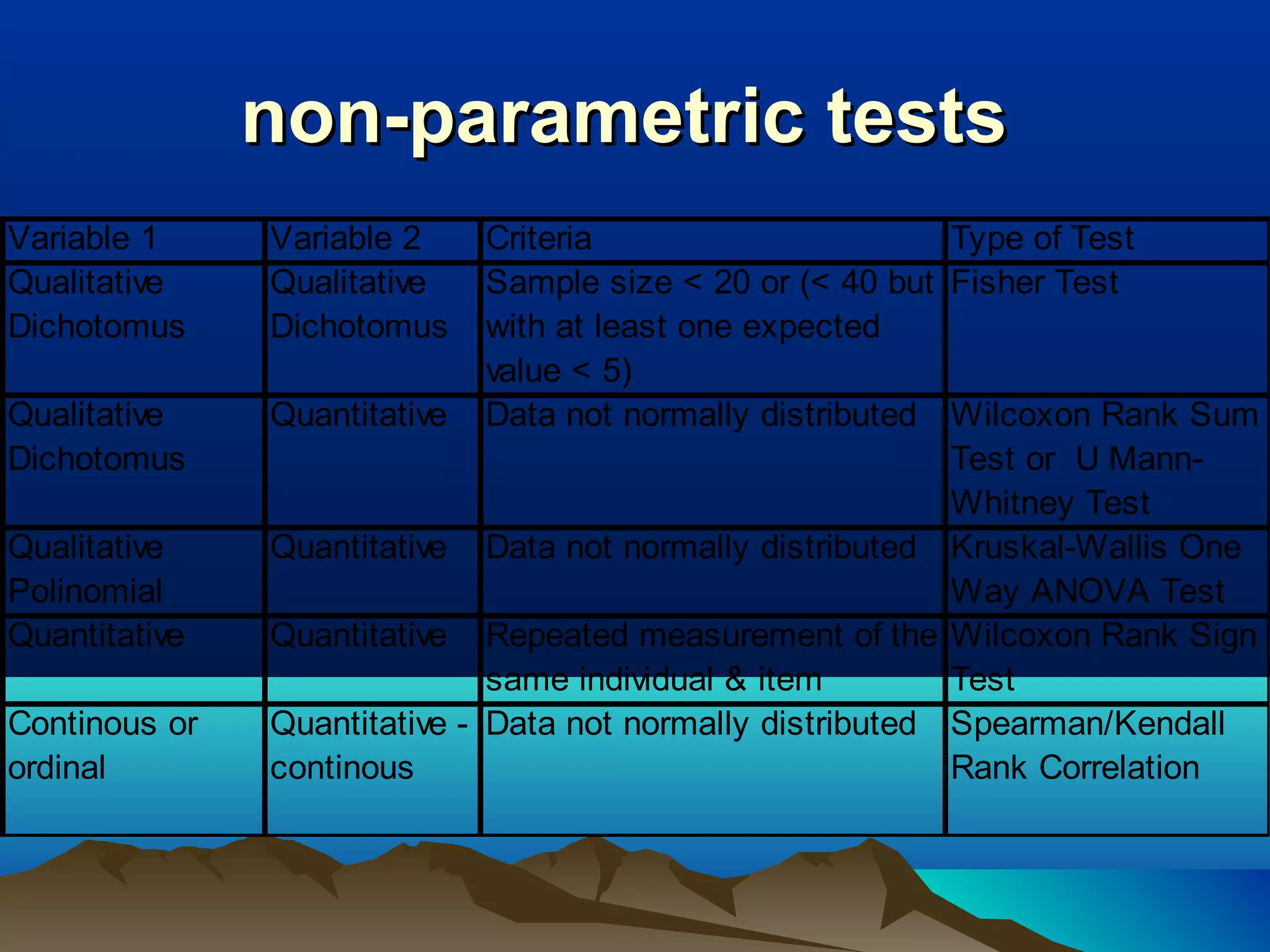
non-parametric tests
Variable 1     Variable 2     Criteria                      Type of Test
Qualitative    Qualitative    Sample size < 20 or (< 40 but Fisher Test
Dichotomus     Dichotomus     with at least one expected
                              value < 5)
Qualitative    Quantitative Data not normally distributed Wilcoxon Rank Sum
Dichotomus                                                  Test or U Mann-
                                                            Whitney Test
Qualitative    Quantitative Data not normally distributed Kruskal-Wallis One
Polinomial                                                  Way ANOVA Test
Quantitative   Quantitative Repeated measurement of the Wilcoxon Rank Sign
                              same individual & item        Test
Continous or   Quantitative - Data not normally distributed Spearman/Kendall
ordinal        continous                                    Rank Correlation
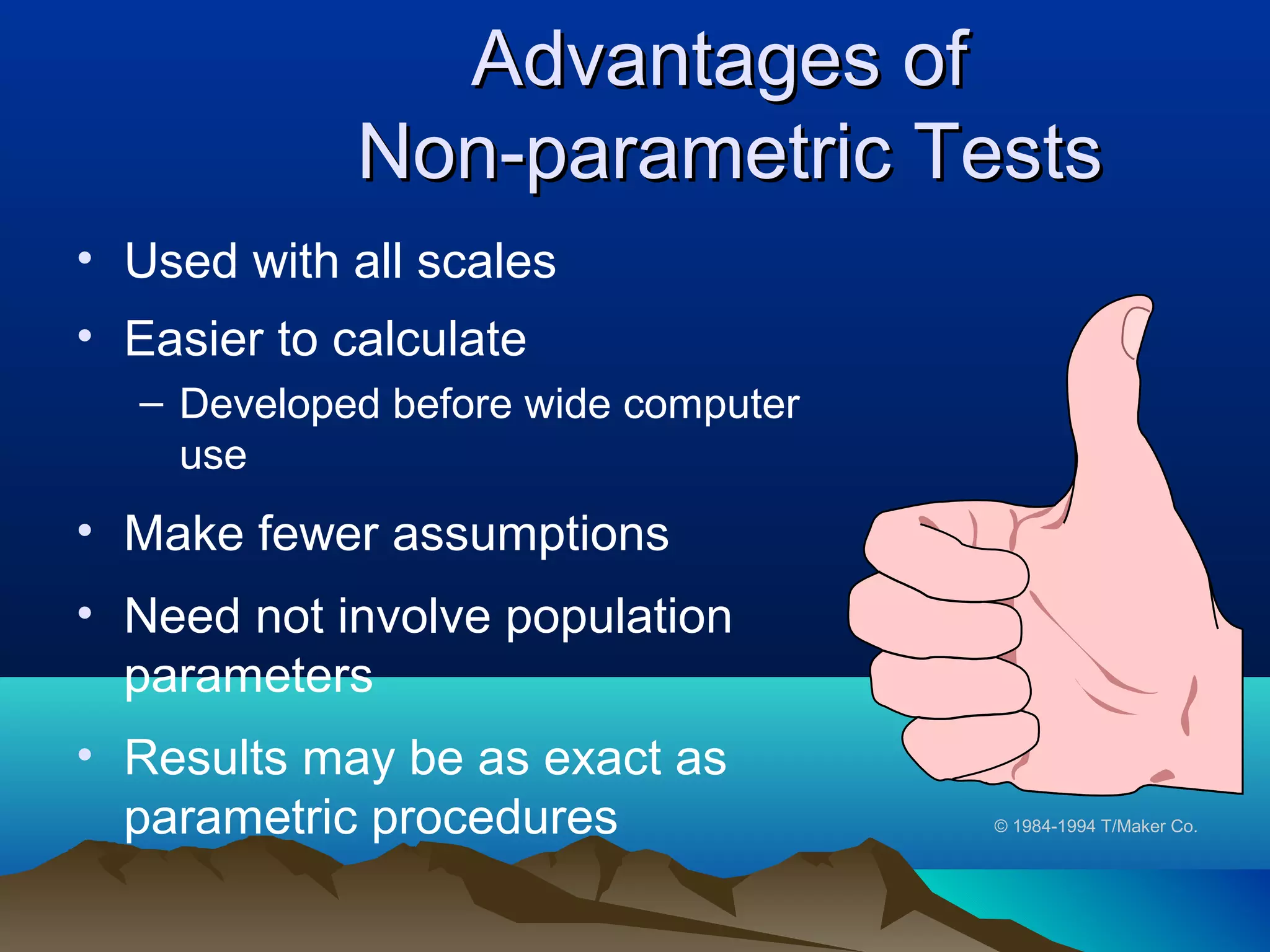
Advantages of
             Non-parametric Tests
• Used with all scales
• Easier to calculate
  – Developed before wide computer
    use
• Make fewer assumptions
• Need not involve population
  parameters
• Results may be as exact as
  parametric procedures              © 1984-1994 T/Maker Co.
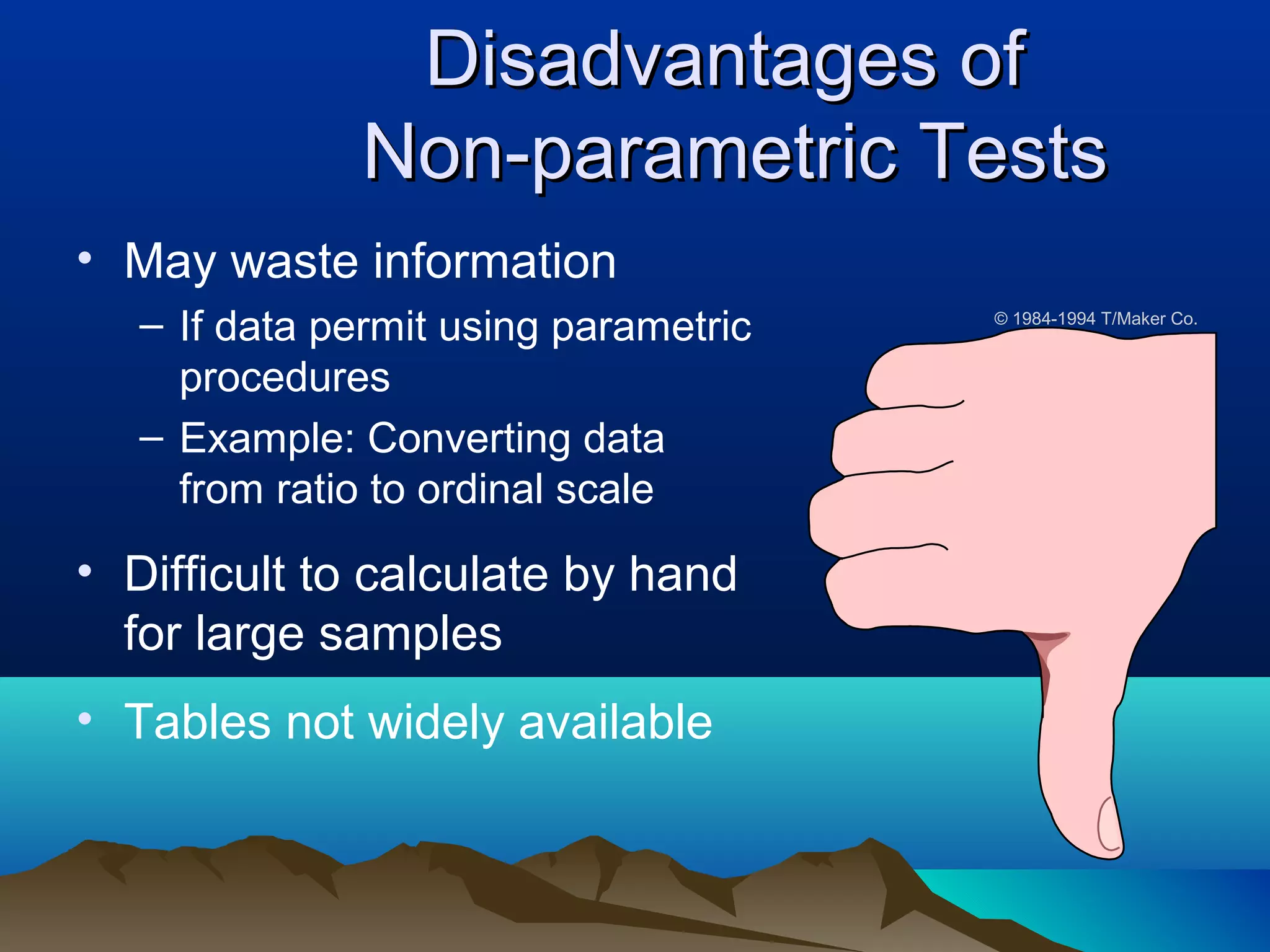
Disadvantages of
              Non-parametric Tests
• May waste information
   – If data permit using parametric   © 1984-1994 T/Maker Co.


     procedures
   – Example: Converting data
     from ratio to ordinal scale

• Difficult to calculate by hand
  for large samples
• Tables not widely available
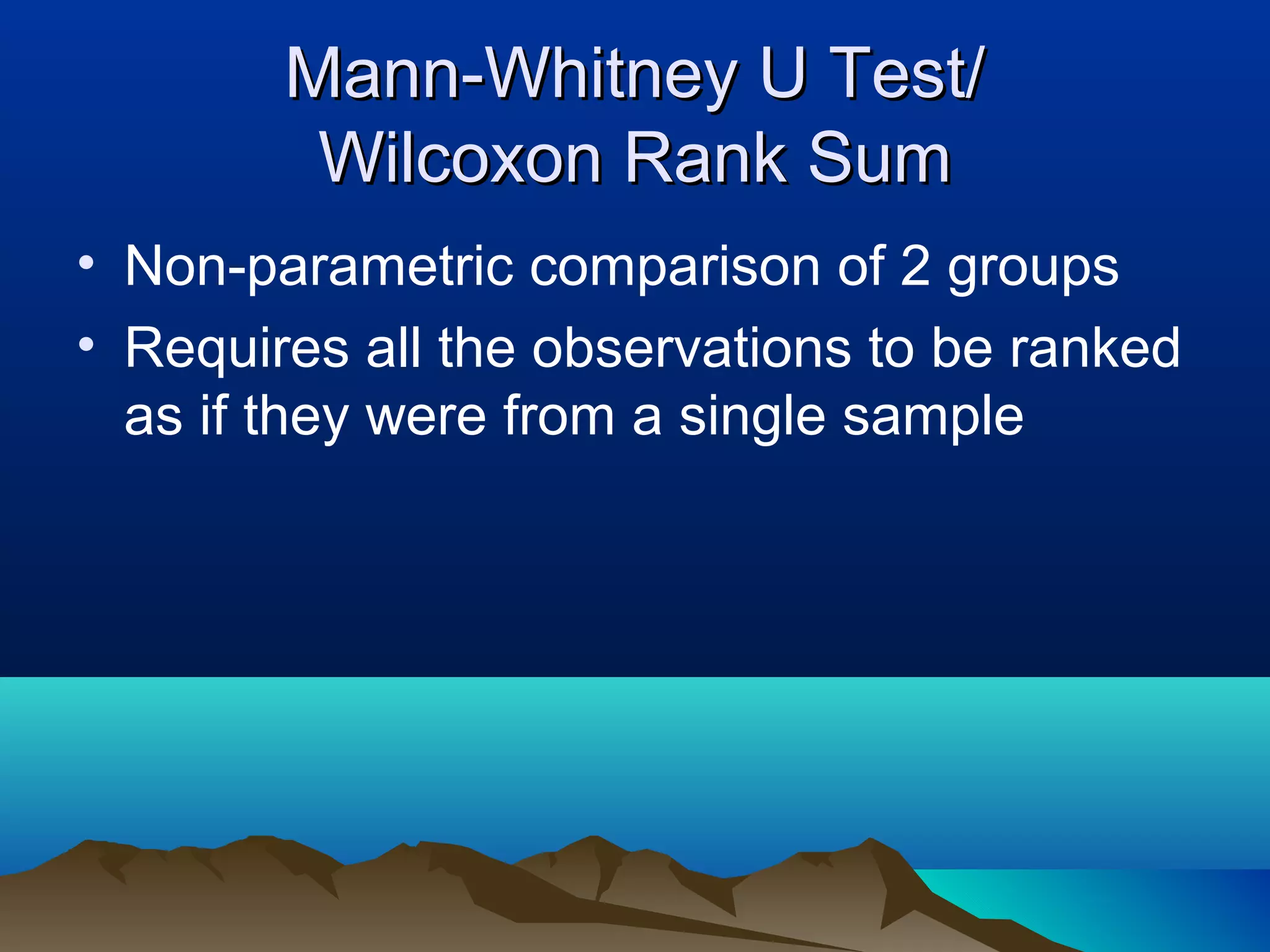
Mann-Whitney U Test/
         Wilcoxon Rank Sum
• Non-parametric comparison of 2 groups
• Requires all the observations to be ranked
  as if they were from a single sample
Mann-Whitney U Test/
      Wilcoxon Rank Sum
• Tests two independent population medians
• Non-parametric test procedure
• Assumptions
  – Ordinal, interval, or ratio scaled data
  – Population is nearly symmetrical
     • Bell-shaped, rectangular etc.
• Can use normal approximation if ni > 10
Mann-Whitney U Test/
Wilcoxon Rank Sum Procedure
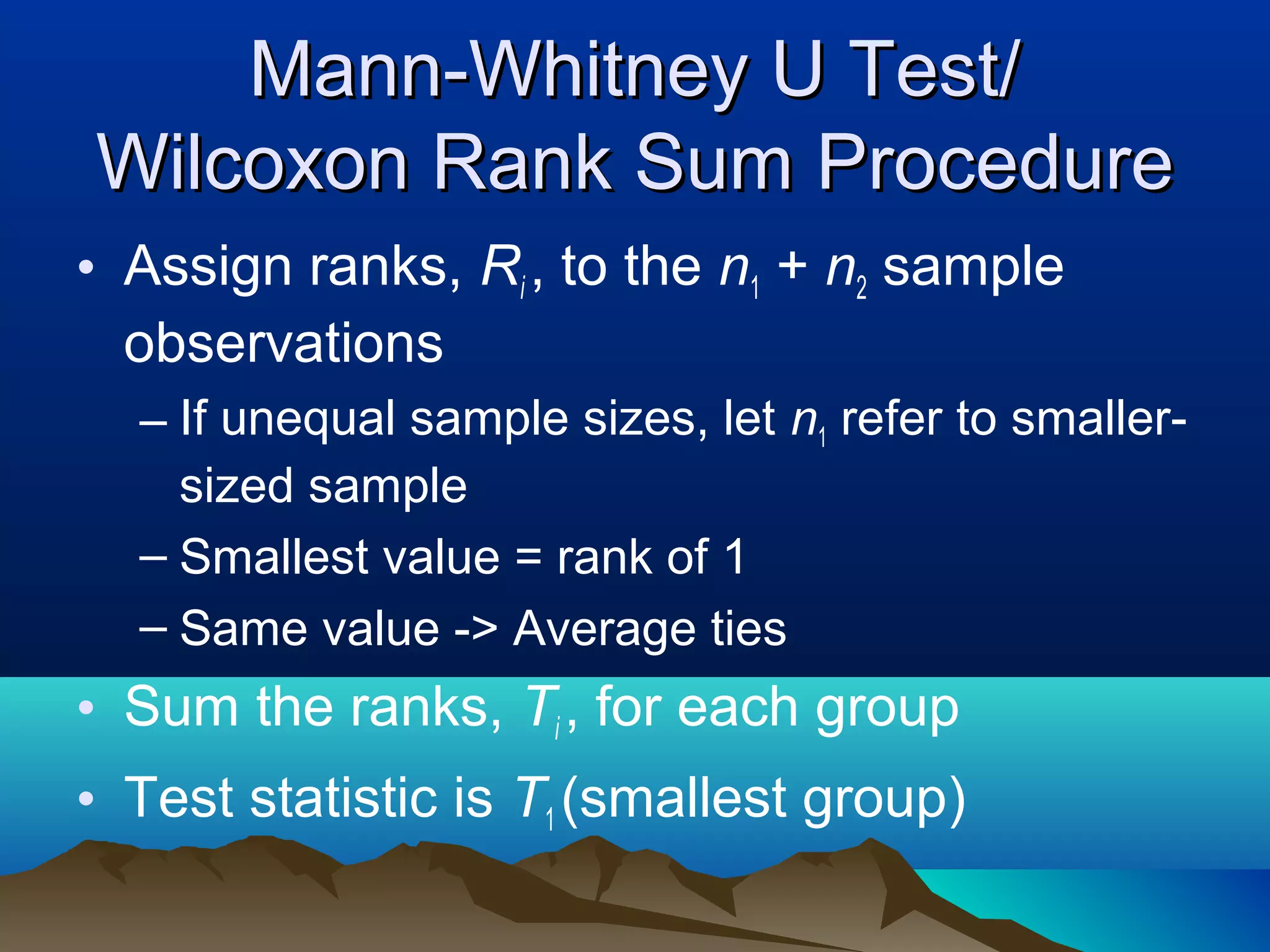
• Assign ranks, Ri , to the n1 + n2 sample
  observations
  – If unequal sample sizes, let n1 refer to smaller-
    sized sample
  – Smallest value = rank of 1
  – Same value -> Average ties
• Sum the ranks, Ti , for each group
• Test statistic is T1 (smallest group)
Example
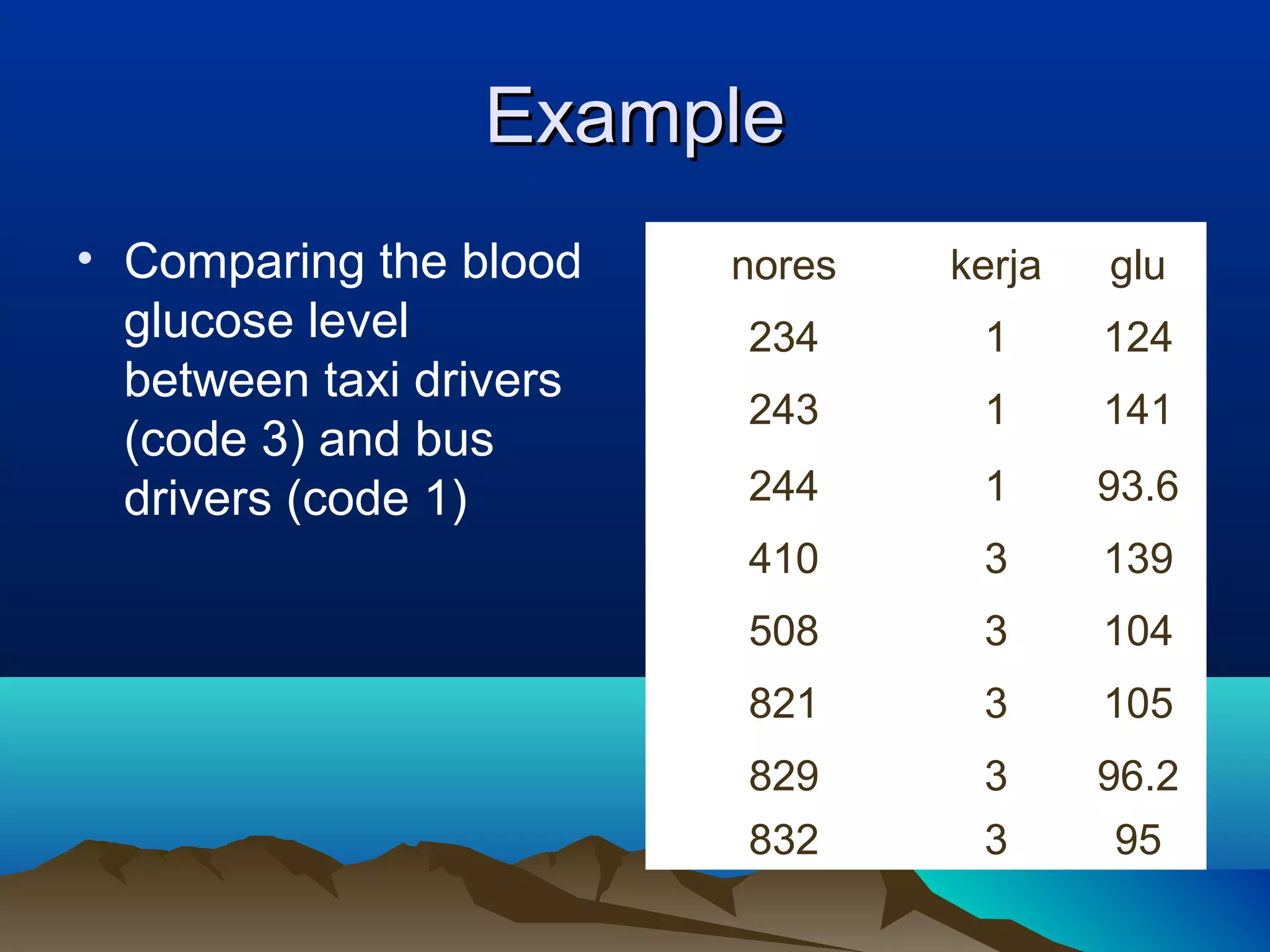
• Comparing the blood    nores   kerja   glu
  glucose level          234      1      124
  between taxi drivers
                         243      1      141
  (code 3) and bus
  drivers (code 1)       244      1      93.6
                         410      3      139
                         508      3      104
                         821      3      105
                         829      3      96.2
                         832      3      95
Example step 2
                        nores   kerja   glu    rank
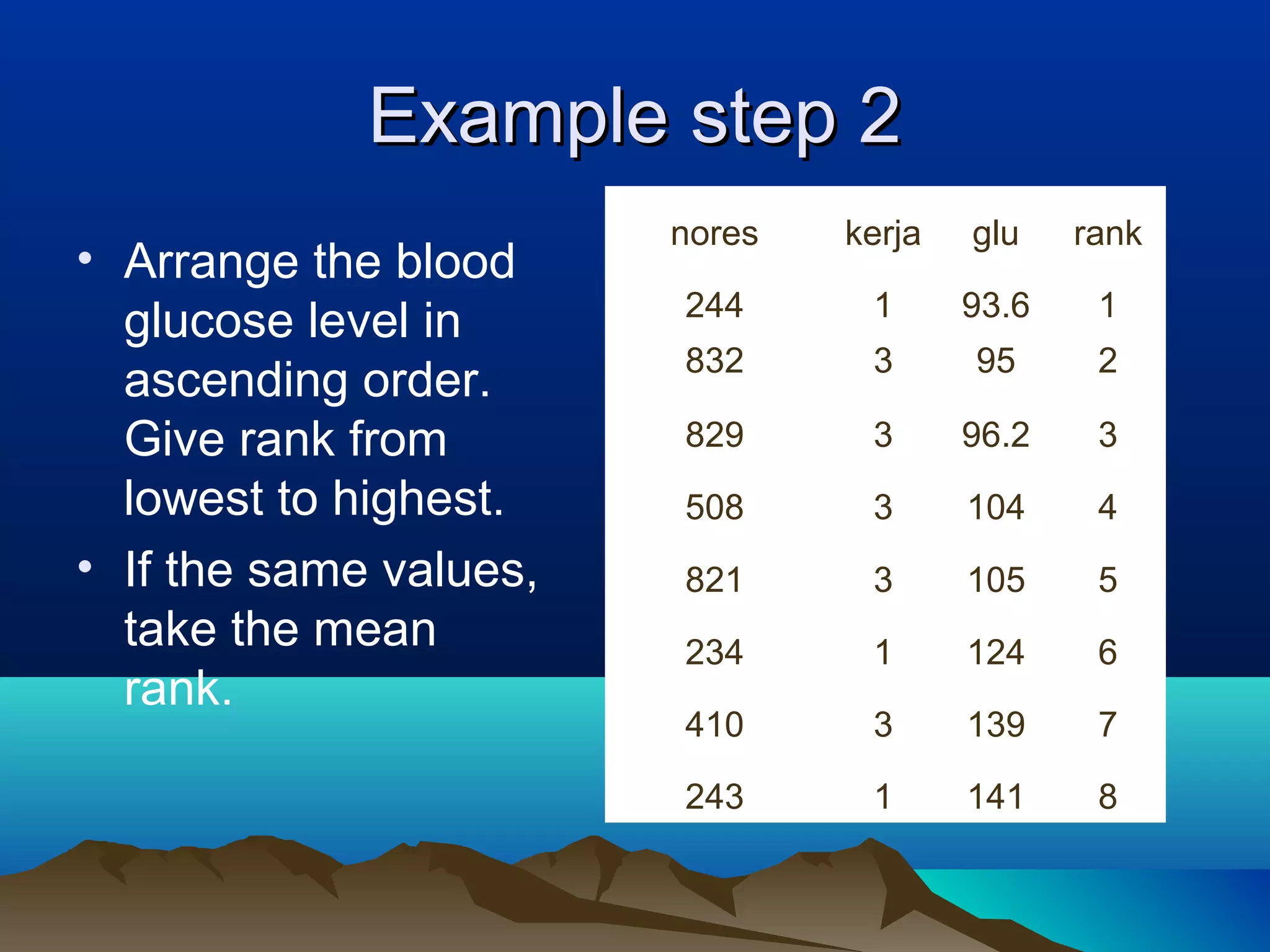
• Arrange the blood
                        244      1      93.6    1
  glucose level in
                        832      3      95      2
  ascending order.
  Give rank from        829      3      96.2    3
  lowest to highest.    508      3      104     4
• If the same values,   821      3      105     5
  take the mean         234      1      124     6
  rank.
                        410      3      139     7

                        243      1      141     8
Example step 3
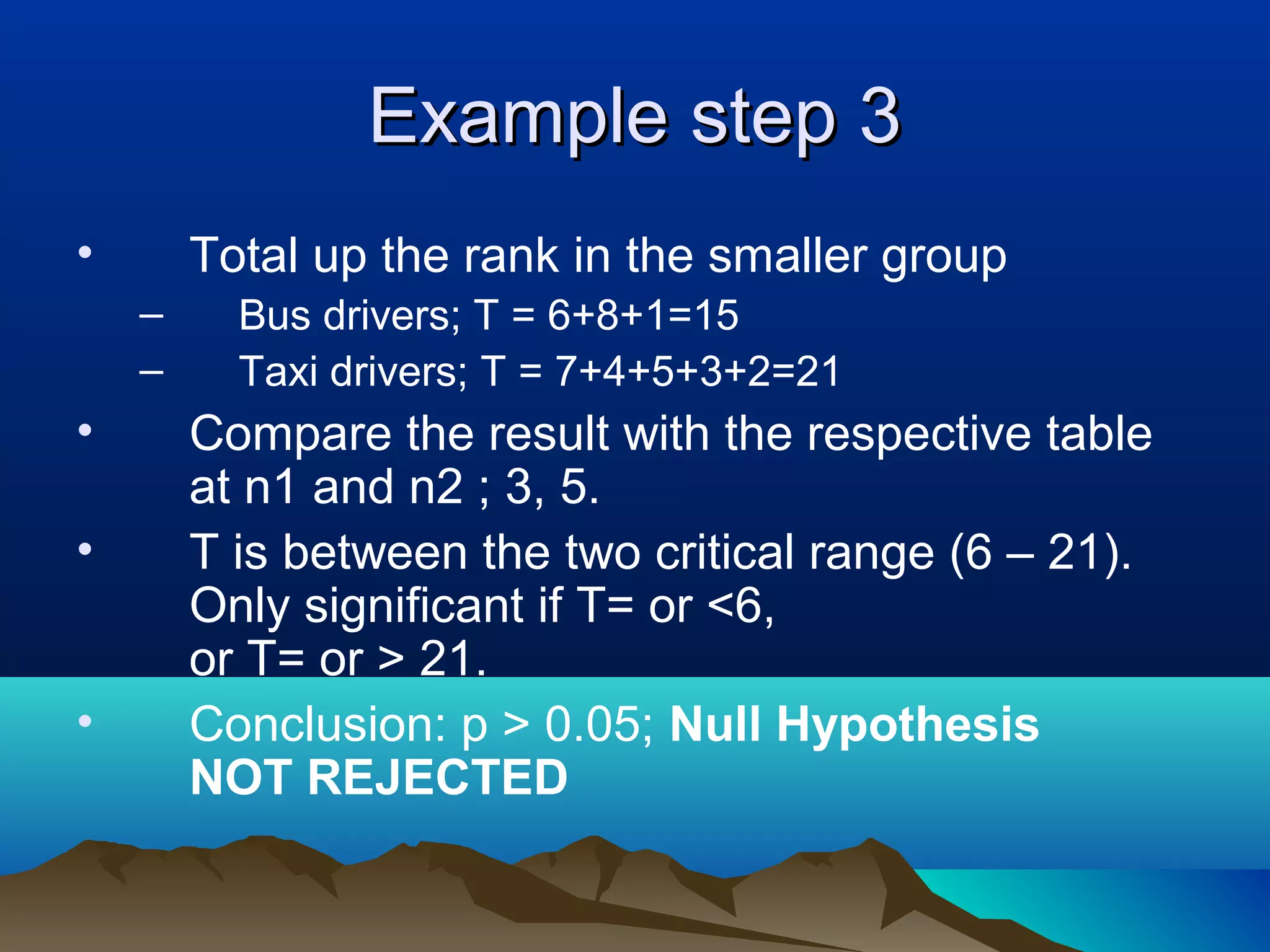
•       Total up the rank in the smaller group
    –     Bus drivers; T = 6+8+1=15
    –     Taxi drivers; T = 7+4+5+3+2=21
•       Compare the result with the respective table
        at n1 and n2 ; 3, 5.
•       T is between the two critical range (6 – 21).
        Only significant if T= or <6,
        or T= or > 21.
•       Conclusion: p > 0.05; Null Hypothesis
        NOT REJECTED
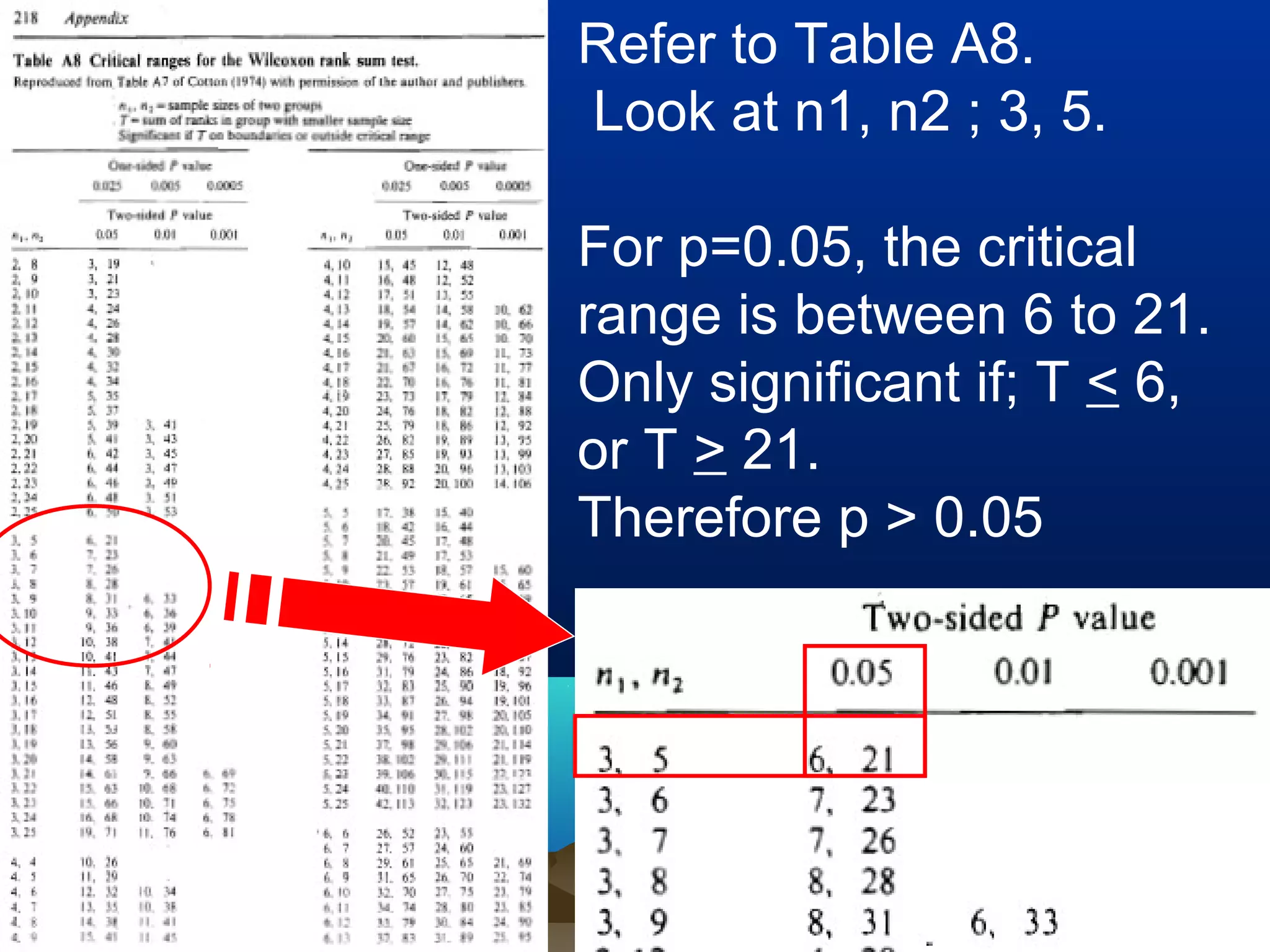
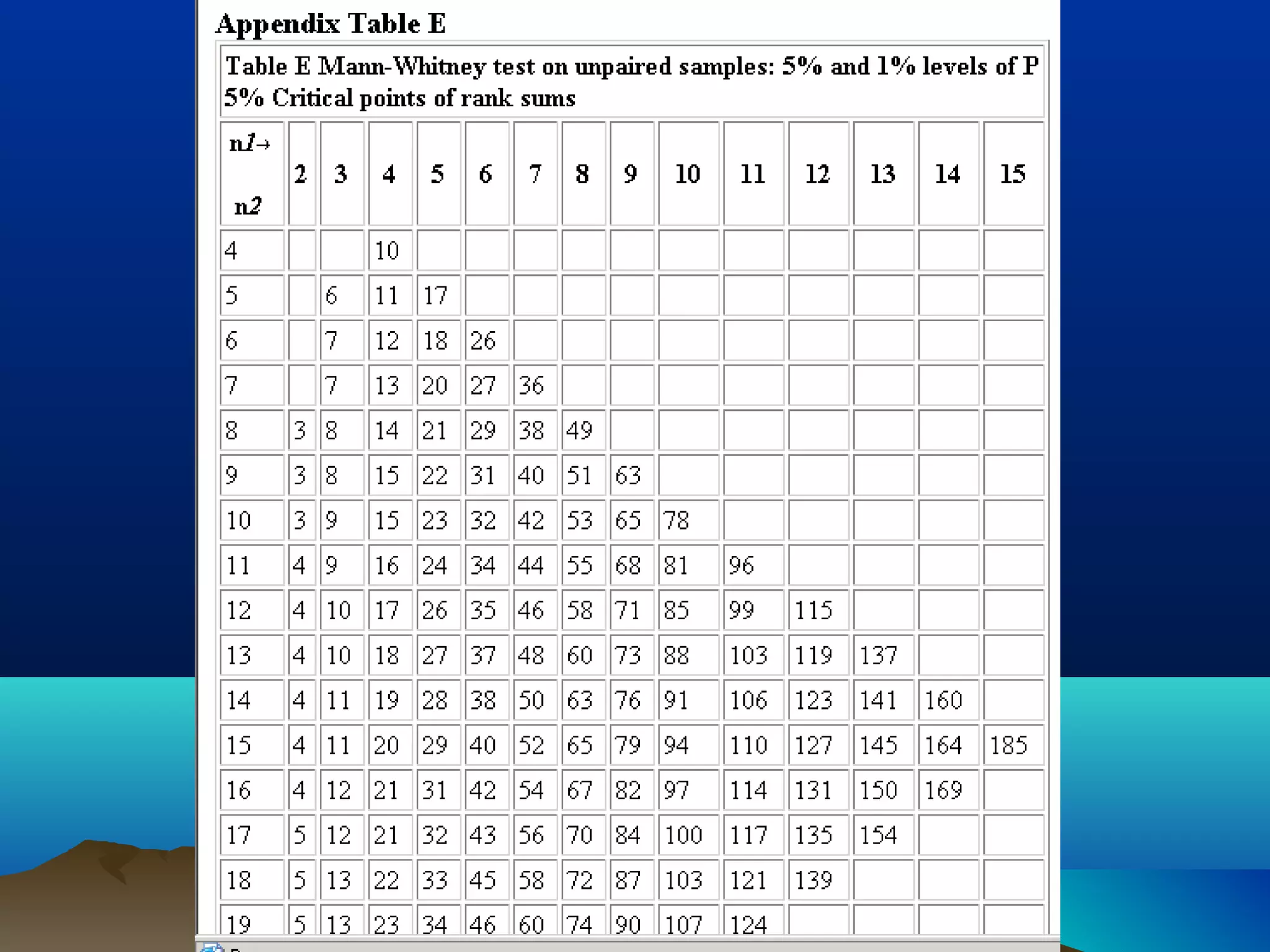
Refer to Table A8.
Look at n1, n2 ; 3, 5.

For p=0.05, the critical
range is between 6 to 21.
Only significant if; T < 6,
or T > 21.
Therefore p > 0.05
SPSS Output
                         Ranks

      KERJA         N          Mean Rank            Sum of Ranks
GLU   1.00                3          5.00                   15.00
      3.00                5          4.20                   21.00
      Total               8


                        Test Statisticsb

                                           GLU
              Mann-Whitney U                6.000
              Wilcoxon W                   21.000
              Z                             -.447
              Asymp. Sig. (2-tailed)         .655
              Exact Sig. [2*(1-tailed           a
                                             .786
              Sig.)]
                a. Not corrected for ties.
                b. Grouping Variable: KERJA
The only way for the result
     to be significant
   Is for all the data of the smallest
     group to be at one end or the
                  other.
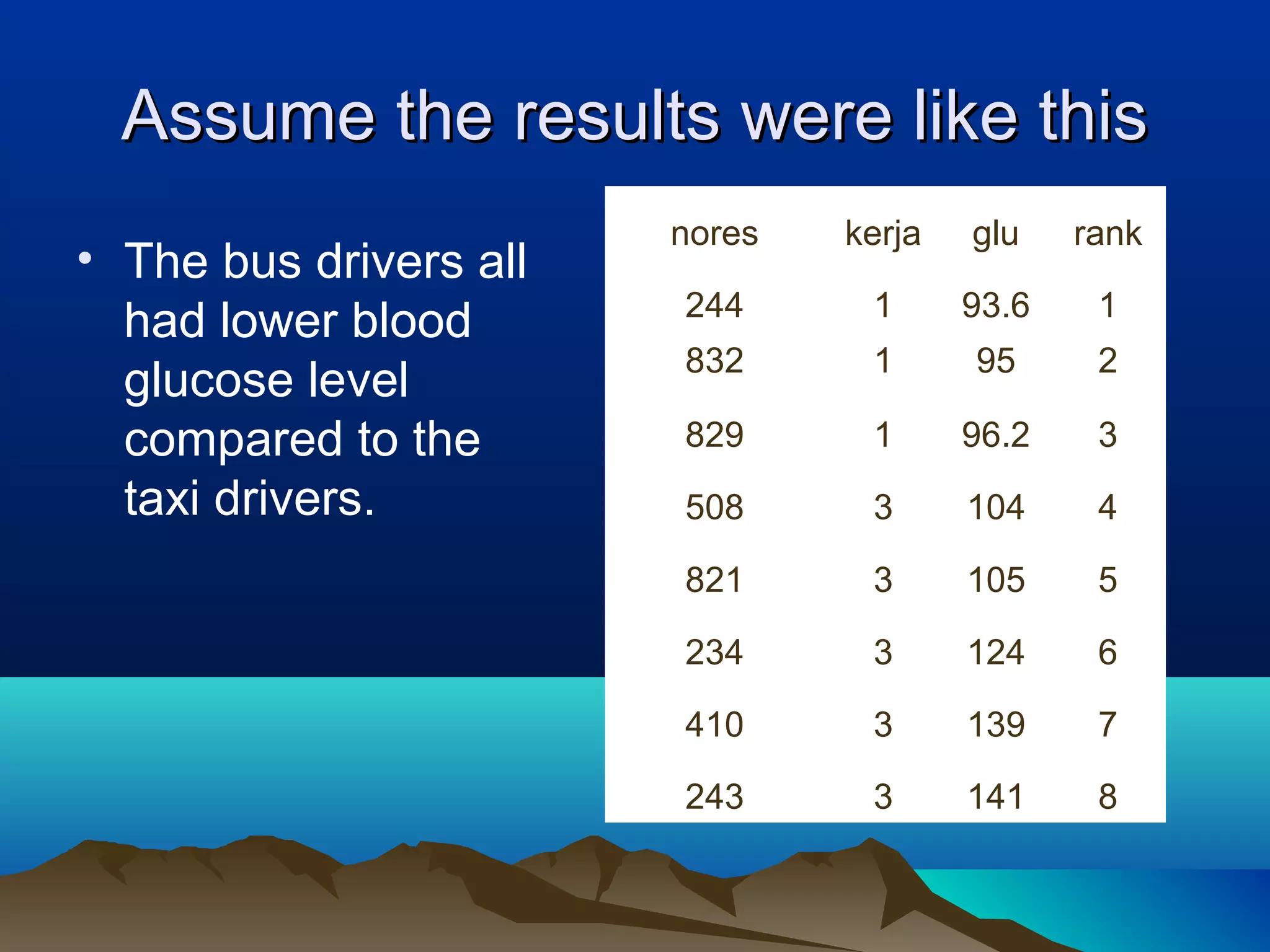
Assume the results were like this
                        nores   kerja   glu    rank
• The bus drivers all
                        244      1      93.6    1
  had lower blood
                        832      1      95      2
  glucose level
  compared to the       829      1      96.2    3
  taxi drivers.         508      3      104     4

                        821      3      105     5

                        234      3      124     6

                        410      3      139     7

                        243      3      141     8
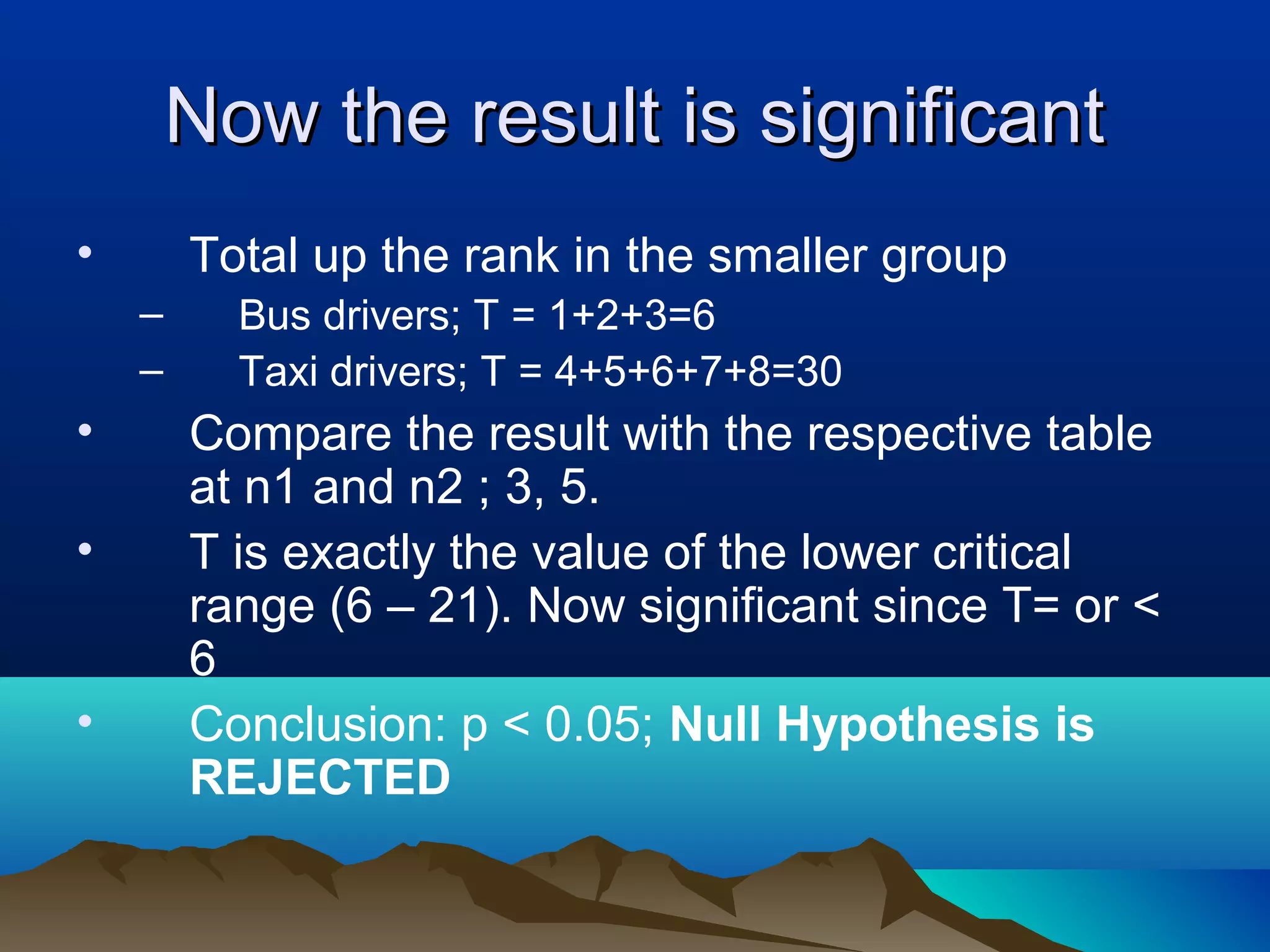
Now the result is significant
•       Total up the rank in the smaller group
    –     Bus drivers; T = 1+2+3=6
    –     Taxi drivers; T = 4+5+6+7+8=30
•       Compare the result with the respective table
        at n1 and n2 ; 3, 5.
•       T is exactly the value of the lower critical
        range (6 – 21). Now significant since T= or <
        6
•       Conclusion: p < 0.05; Null Hypothesis is
        REJECTED
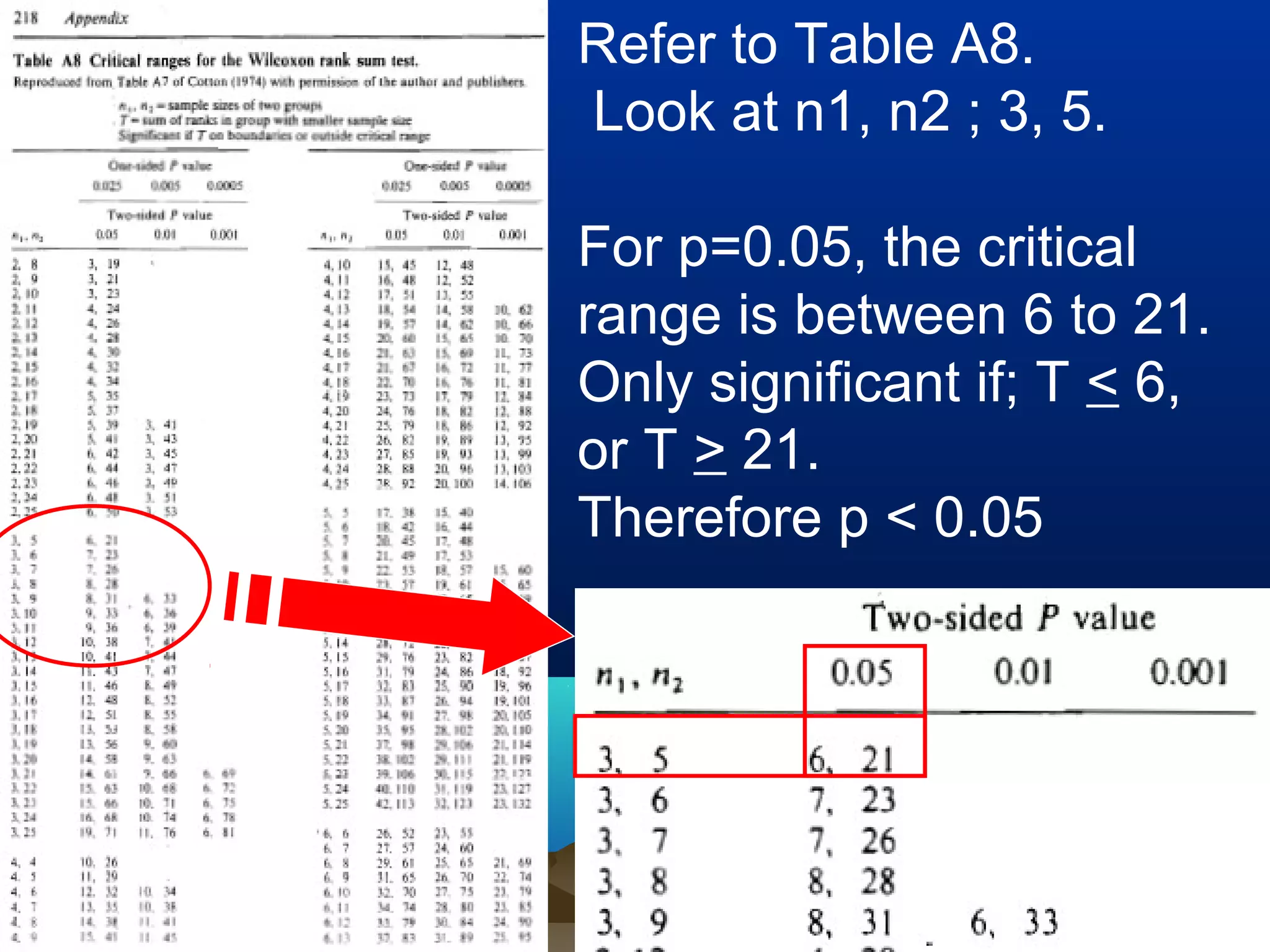
Refer to Table A8.
Look at n1, n2 ; 3, 5.

For p=0.05, the critical
range is between 6 to 21.
Only significant if; T < 6,
or T > 21.
Therefore p < 0.05
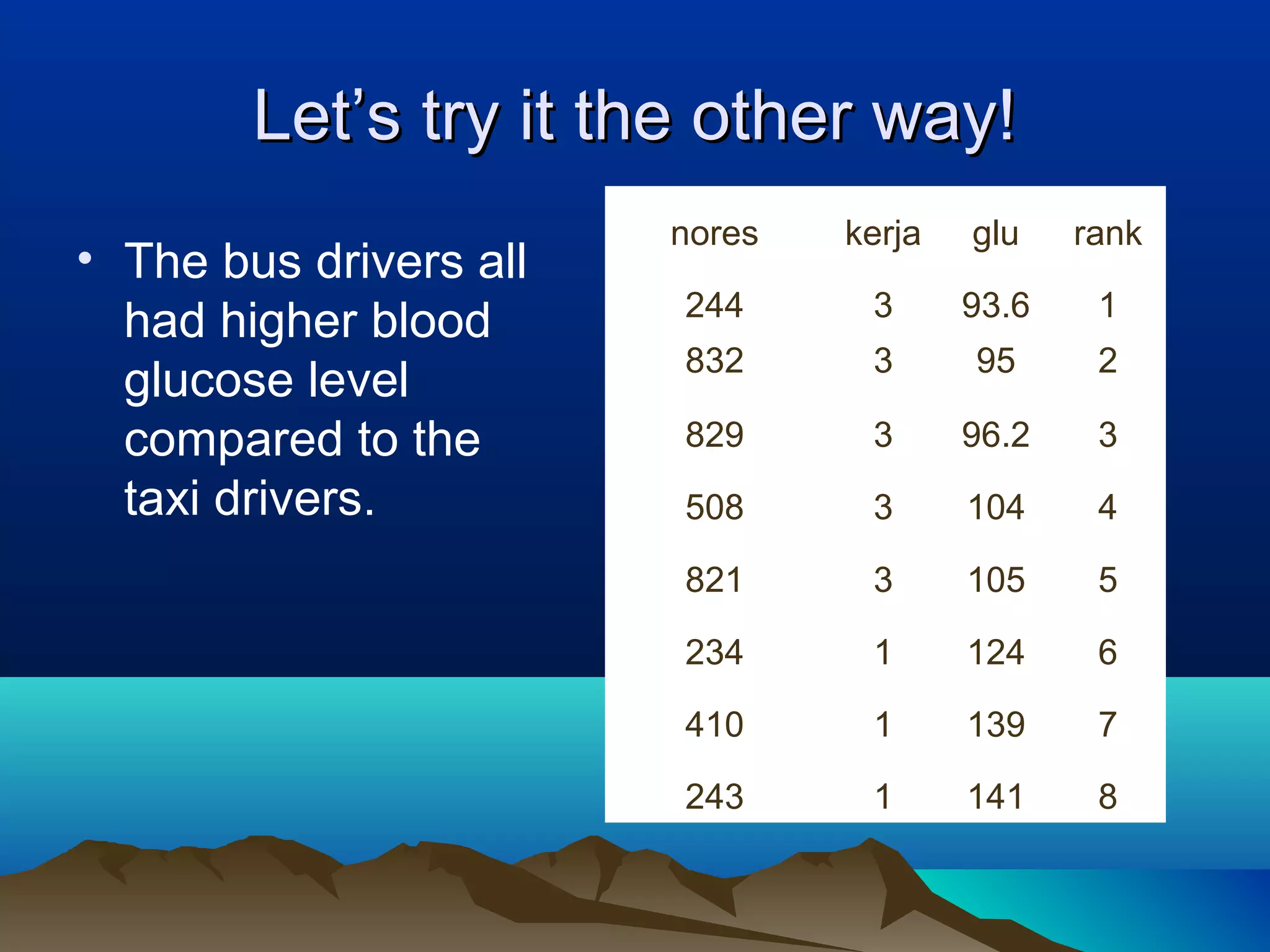
Let’s try it the other way!
                        nores   kerja   glu    rank
• The bus drivers all
                        244      3      93.6    1
  had higher blood
                        832      3      95      2
  glucose level
  compared to the       829      3      96.2    3
  taxi drivers.         508      3      104     4

                        821      3      105     5

                        234      1      124     6

                        410      1      139     7

                        243      1      141     8
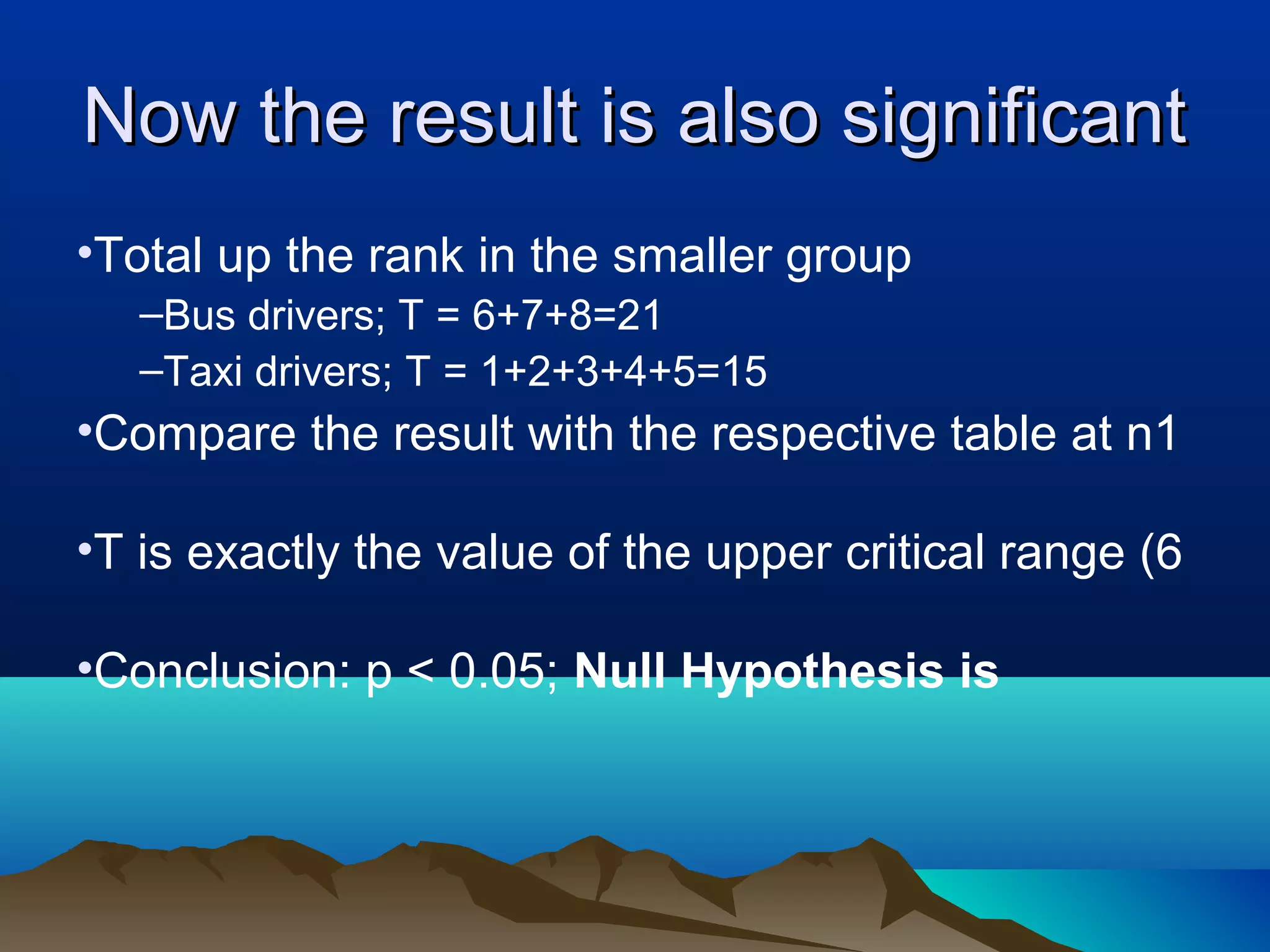
Now the result is also significant
•Total up the rank in the smaller group
   –Bus drivers; T = 6+7+8=21
   –Taxi drivers; T = 1+2+3+4+5=15
•Compare the result with the respective table at n1

•T is exactly the value of the upper critical range (6

•Conclusion: p < 0.05; Null Hypothesis is
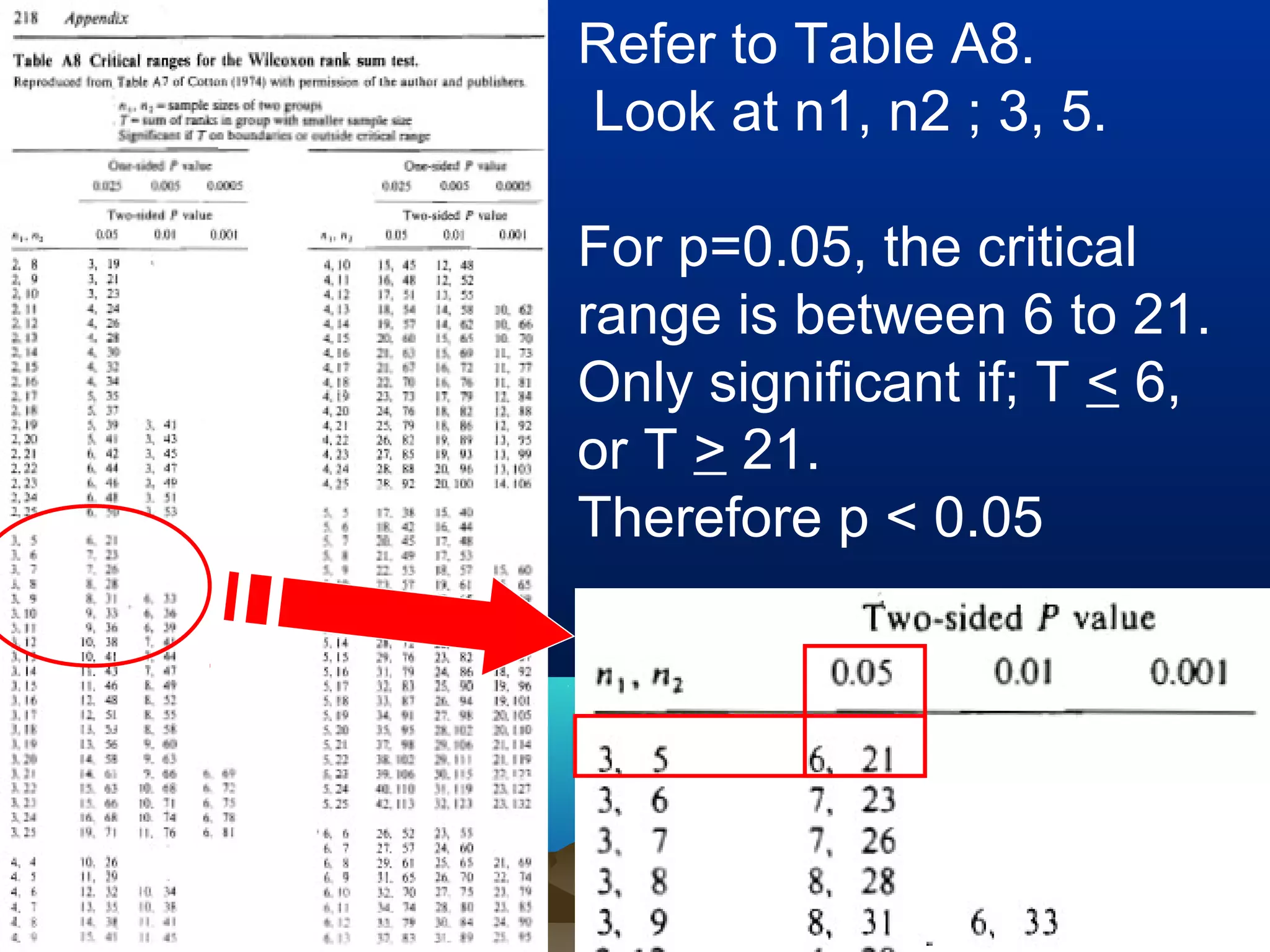
Refer to Table A8.
Look at n1, n2 ; 3, 5.

For p=0.05, the critical
range is between 6 to 21.
Only significant if; T < 6,
or T > 21.
Therefore p < 0.05
Kruskal-Wallis test
• When there is 3 or more independent
  groups of observation
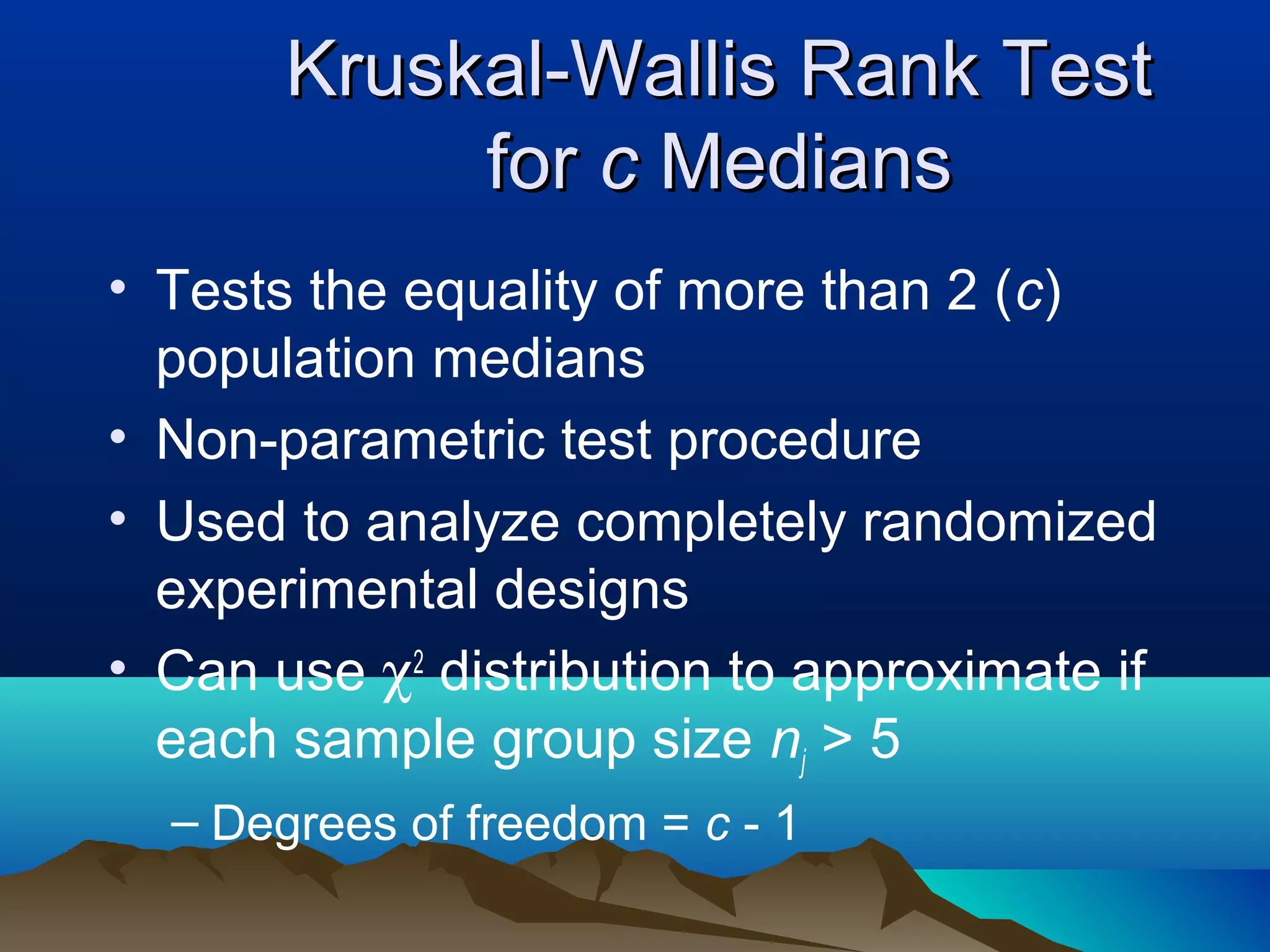
Kruskal-Wallis Rank Test
            for c Medians
• Tests the equality of more than 2 (c)
  population medians
• Non-parametric test procedure
• Used to analyze completely randomized
  experimental designs
• Can use χ2 distribution to approximate if
  each sample group size nj > 5
  – Degrees of freedom = c - 1
Kruskal-Wallis Rank Test
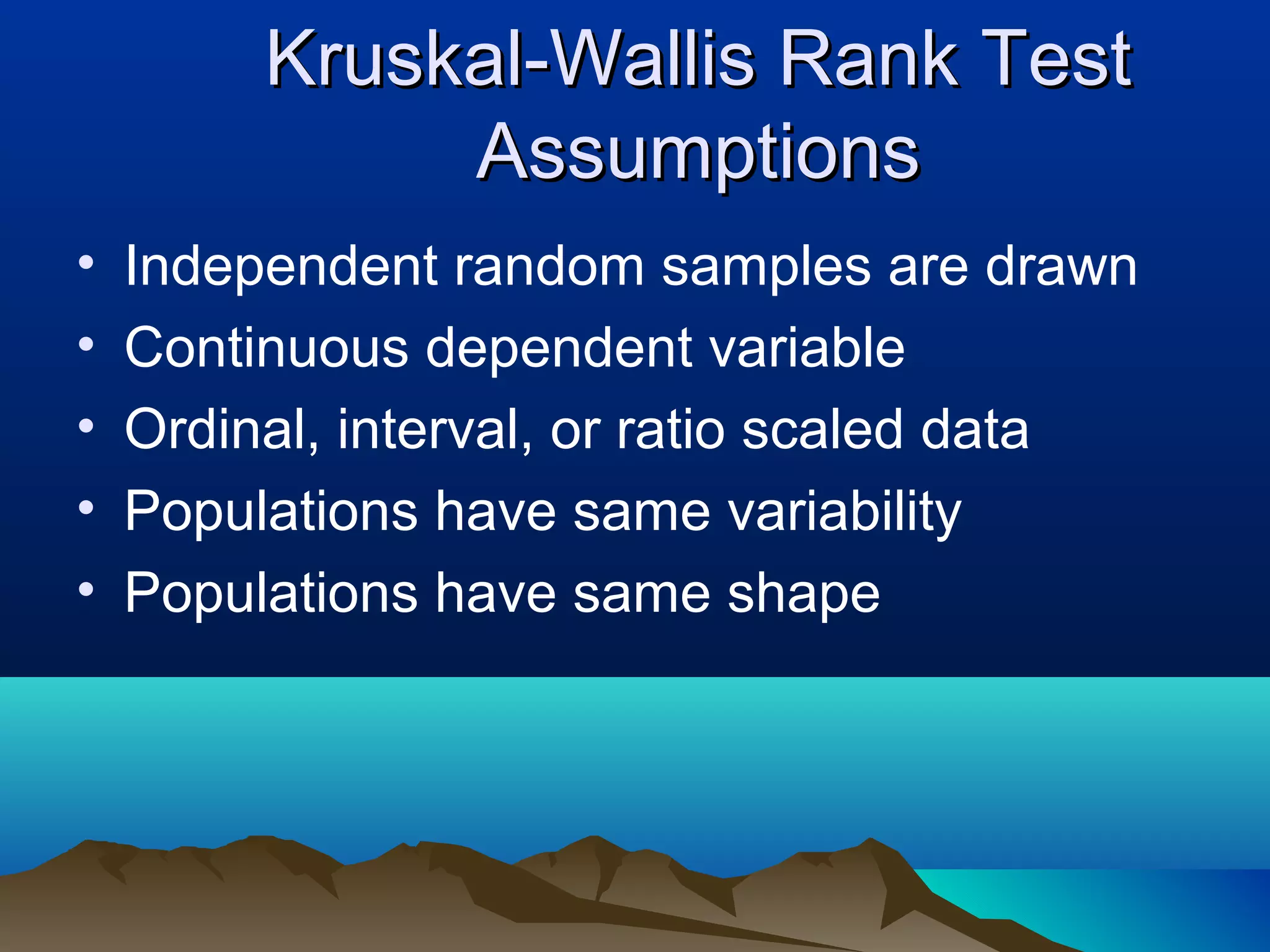
              Assumptions
•   Independent random samples are drawn
•   Continuous dependent variable
•   Ordinal, interval, or ratio scaled data
•   Populations have same variability
•   Populations have same shape
Kruskal-Wallis Rank Test
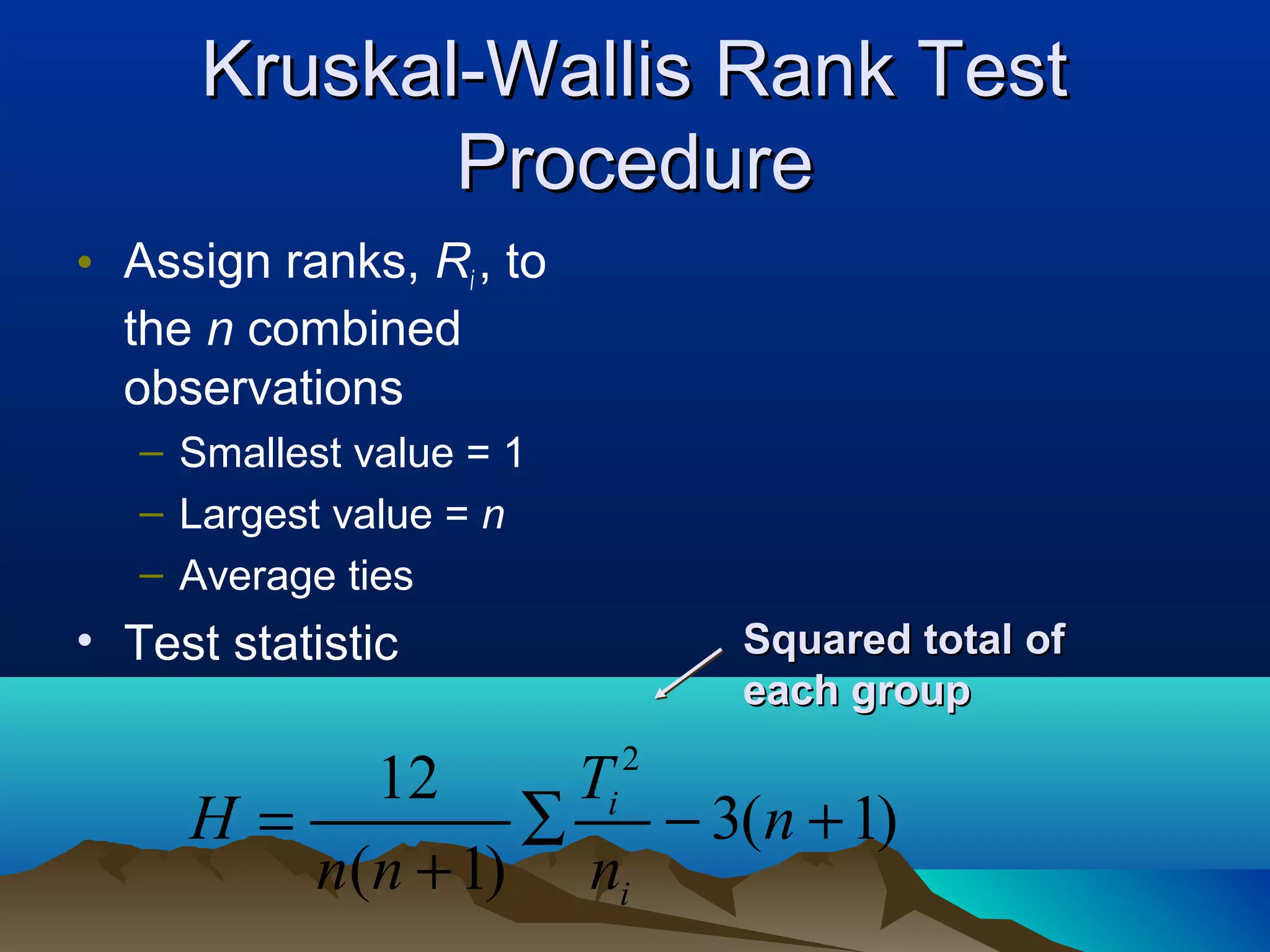
             Procedure
• Assign ranks, Ri , to
  the n combined
  observations
   – Smallest value = 1
   – Largest value = n
   – Average ties
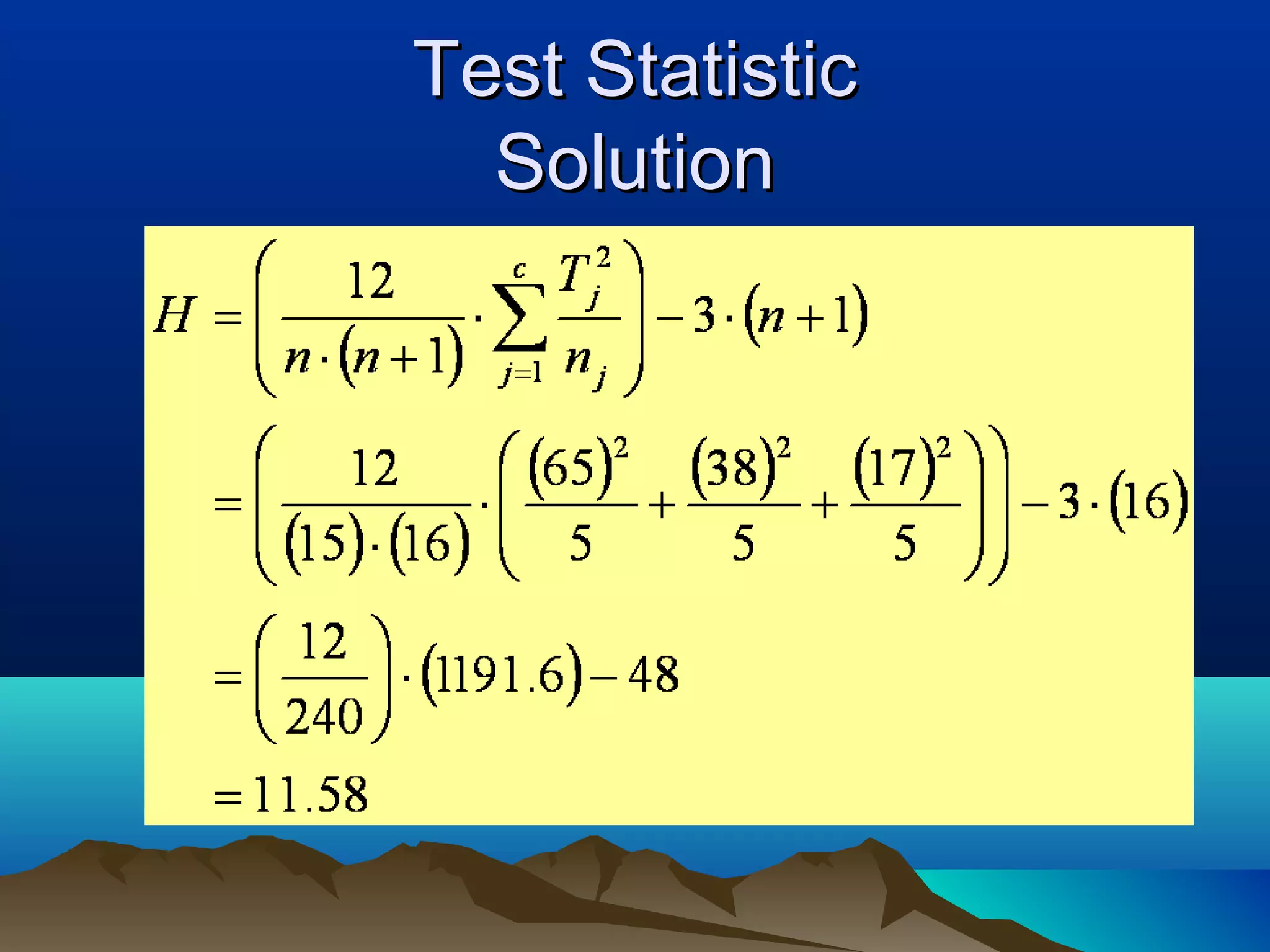
• Test statistic              Squared total of
                              each group
                          2
          12      Ti
     H=         ∑    − 3(n + 1)
        n(n + 1) ni
Kruskal-Wallis Rank Test
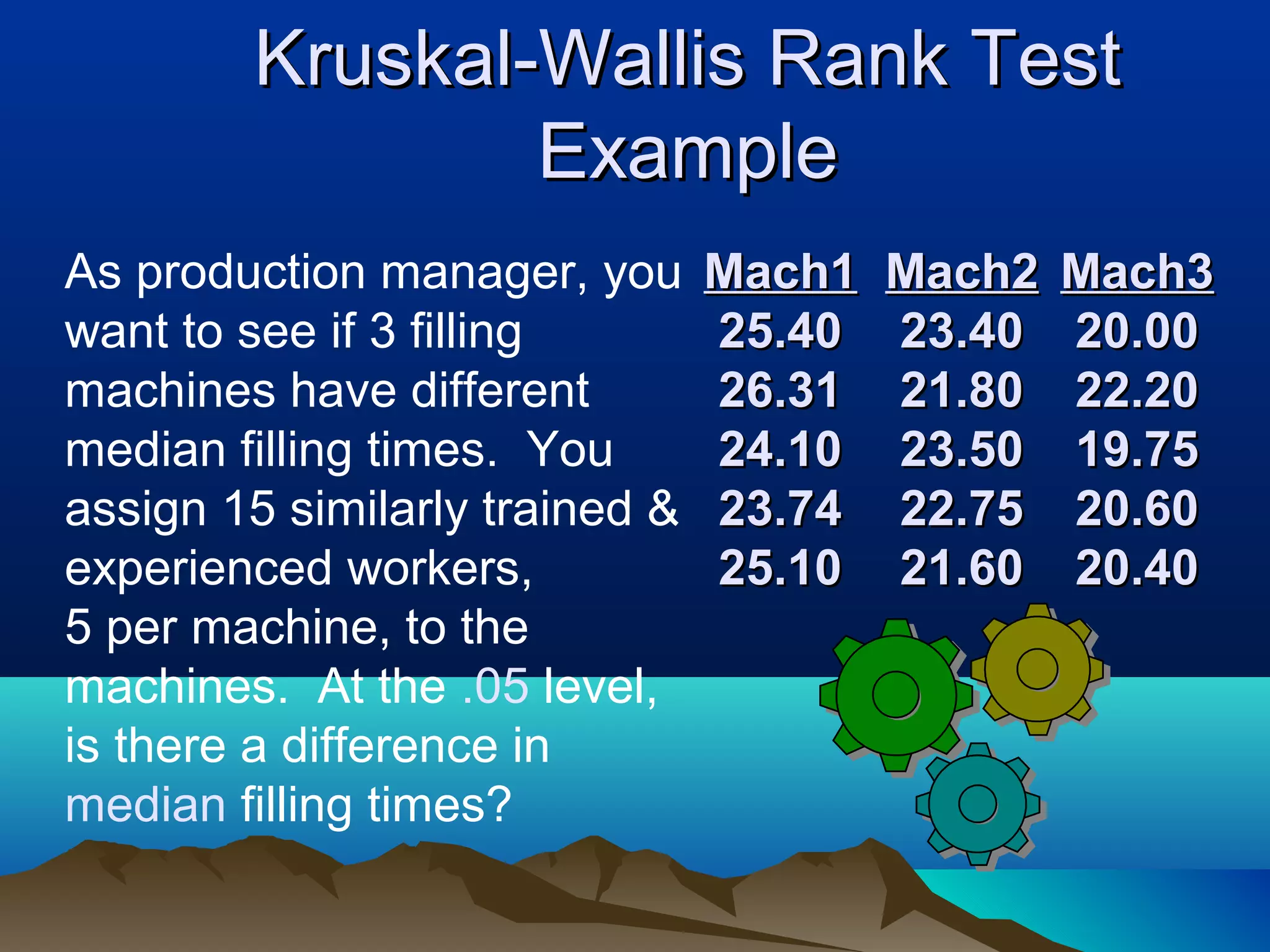
                Example
As production manager, you      Mach1   Mach2   Mach3
want to see if 3 filling        25.40   23.40   20.00
machines have different         26.31   21.80   22.20
median filling times. You       24.10   23.50   19.75
assign 15 similarly trained &   23.74   22.75   20.60
experienced workers,            25.10   21.60   20.40
5 per machine, to the
machines. At the .05 level,
is there a difference in
median filling times?
Kruskal-Wallis Rank Test
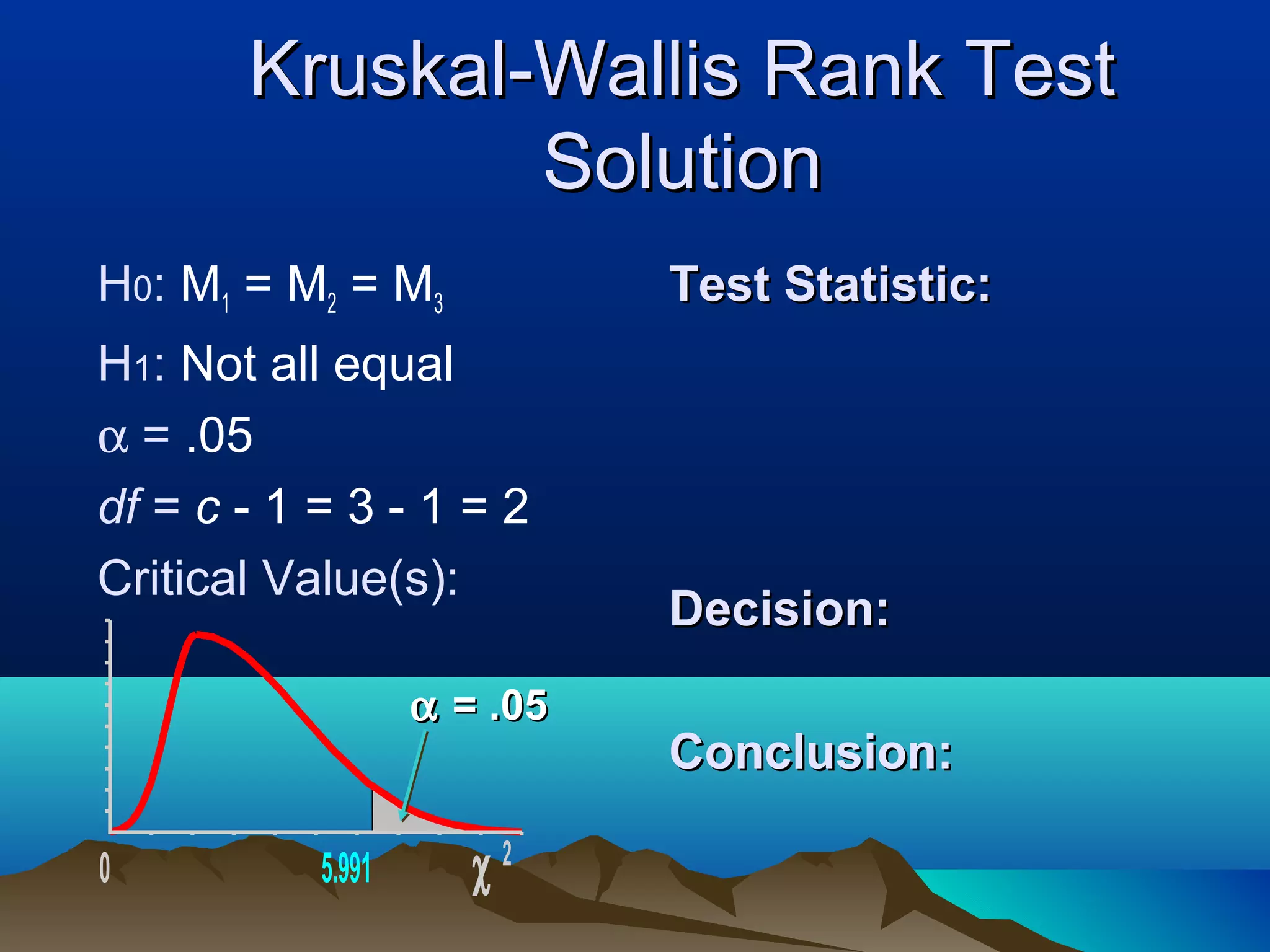
               Solution
H0: M1 = M2 = M3             Test Statistic:
H1: Not all equal
α = .05
df = c - 1 = 3 - 1 = 2
Critical Value(s):
                             Decision:
                   α = .05
                             Conclusion:

0          5.991      χ2
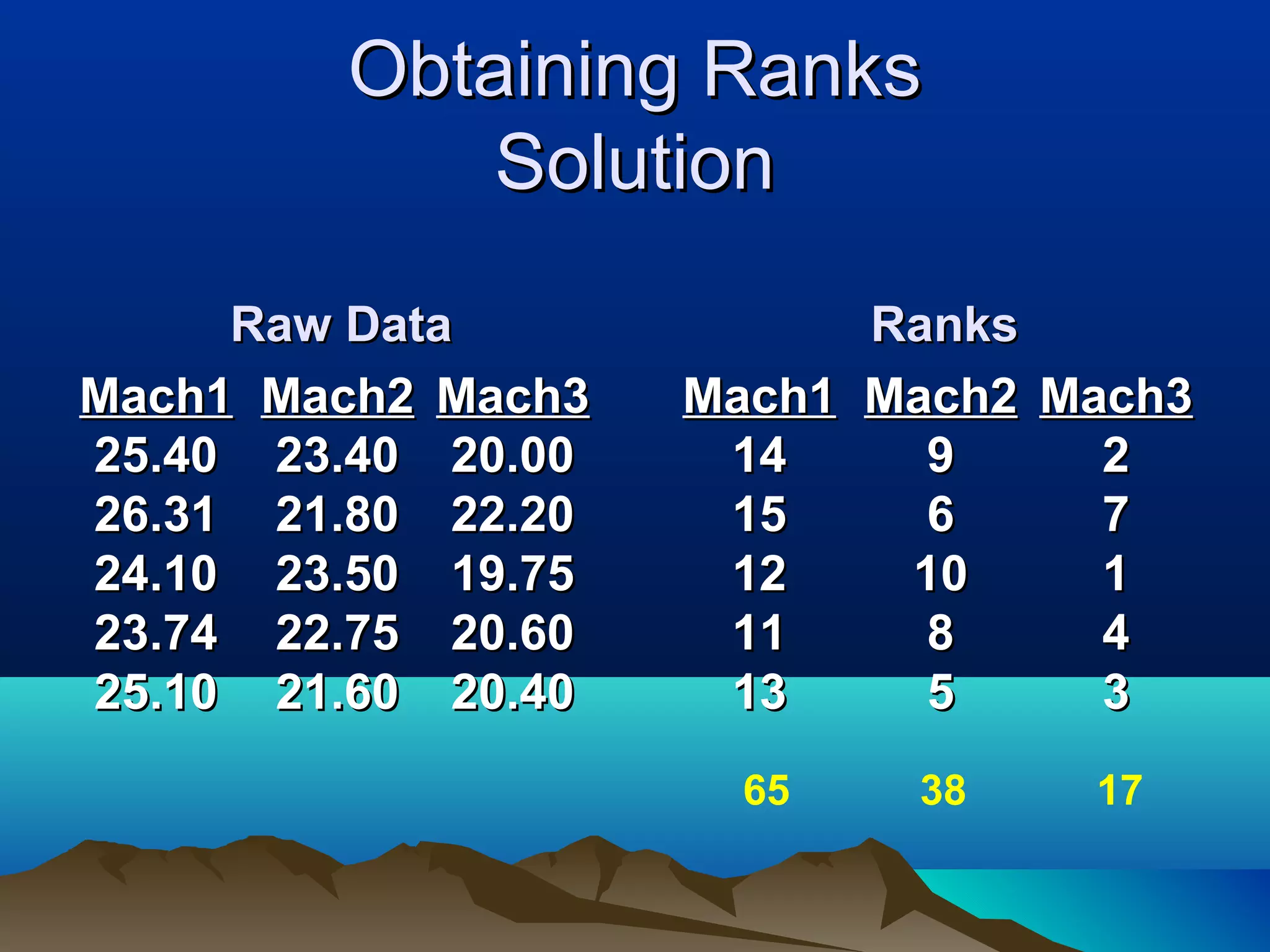
Obtaining Ranks
            Solution
     Raw Data             Ranks
Mach1 Mach2 Mach3   Mach1 Mach2 Mach3
25.40 23.40 20.00    14     9     2
26.31 21.80 22.20    15     6     7
24.10 23.50 19.75    12    10     1
23.74 22.75 20.60    11     8     4
25.10 21.60 20.40    13     5     3
                      65   38    17
Test Statistic
  Solution
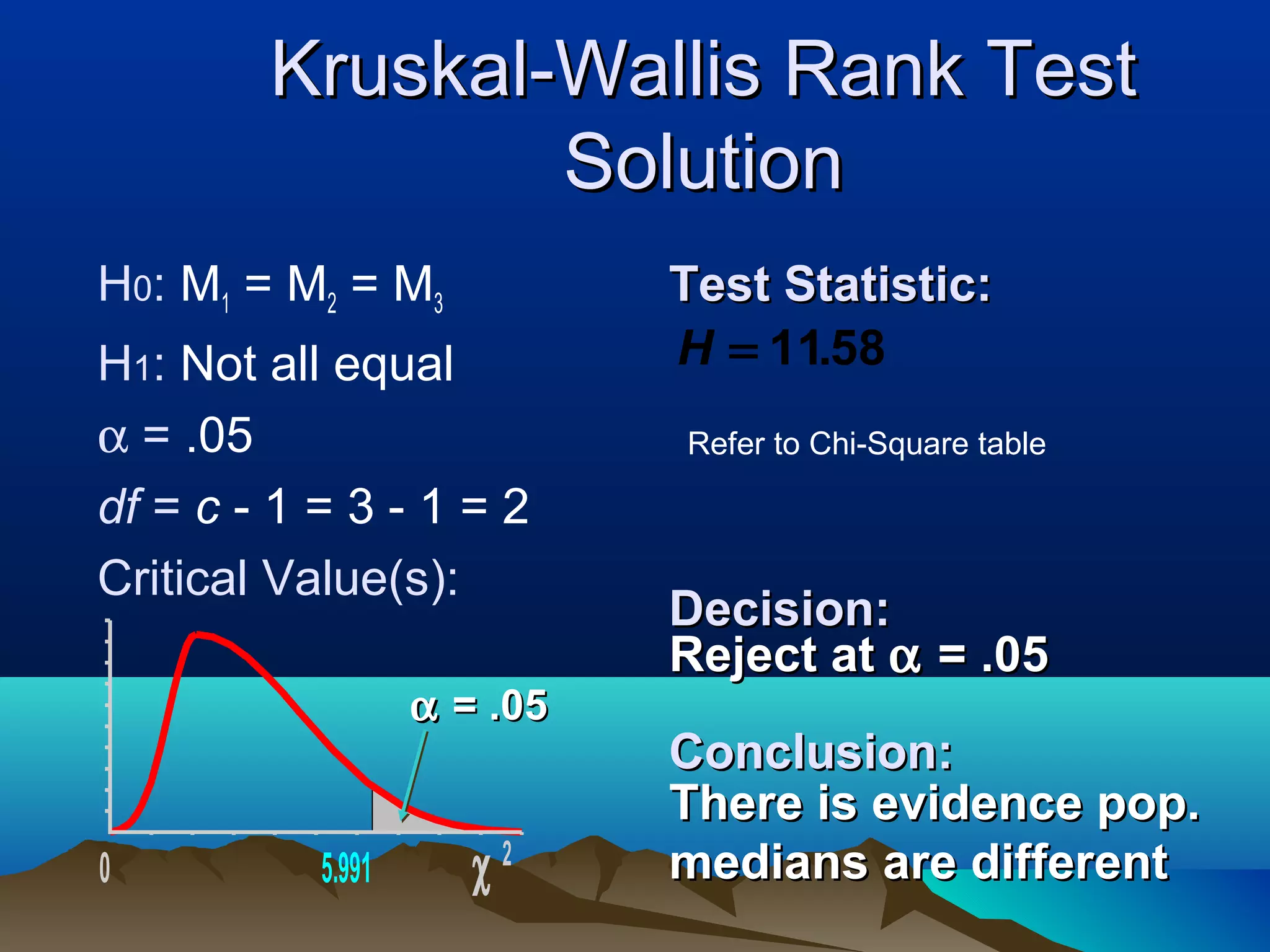
Kruskal-Wallis Rank Test
                Solution
H0: M1 = M2 = M3             Test Statistic:
H1: Not all equal            H = 11.58
α = .05                      Refer to Chi-Square table

df = c - 1 = 3 - 1 = 2
Critical Value(s):
                             Decision:
                             Reject at α = .05
                   α = .05
                             Conclusion:
                             There is evidence pop.
0          5.991      χ2     medians are different
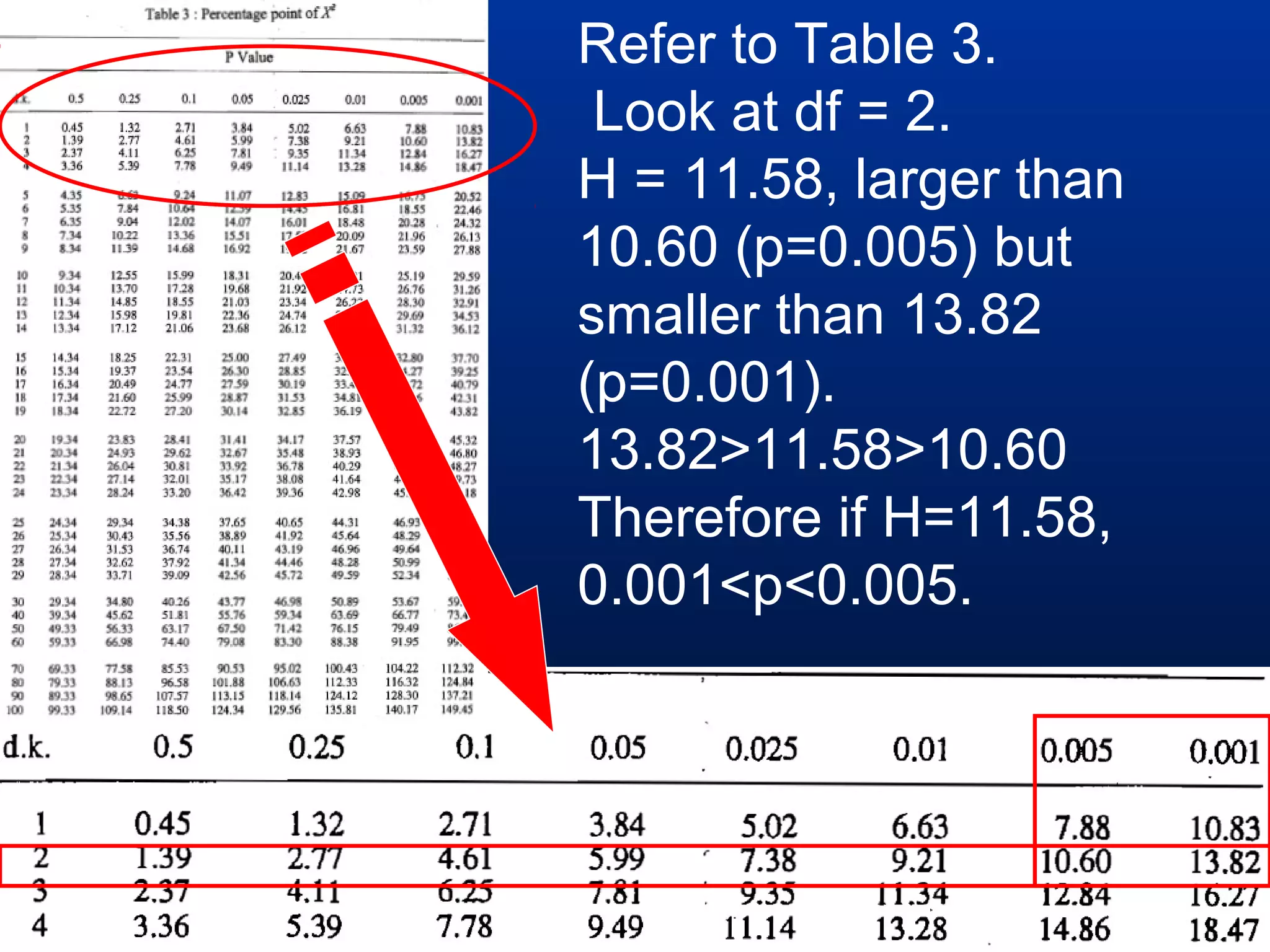
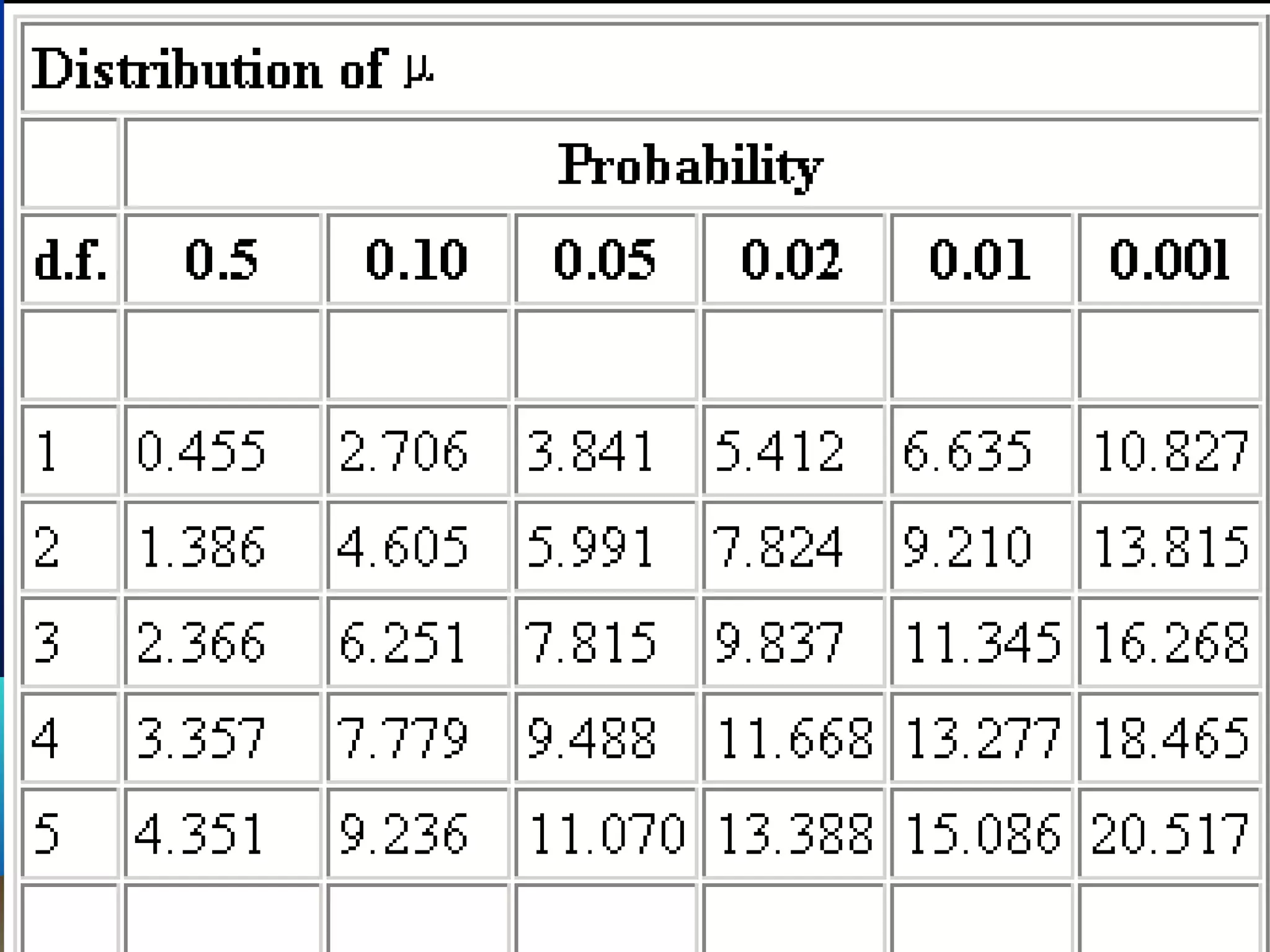
Refer to Table 3.
 Look at df = 2.
H = 11.58, larger than
10.60 (p=0.005) but
smaller than 13.82
(p=0.001).
13.82>11.58>10.60
Therefore if H=11.58,
0.001<p<0.005.
SPSS Output
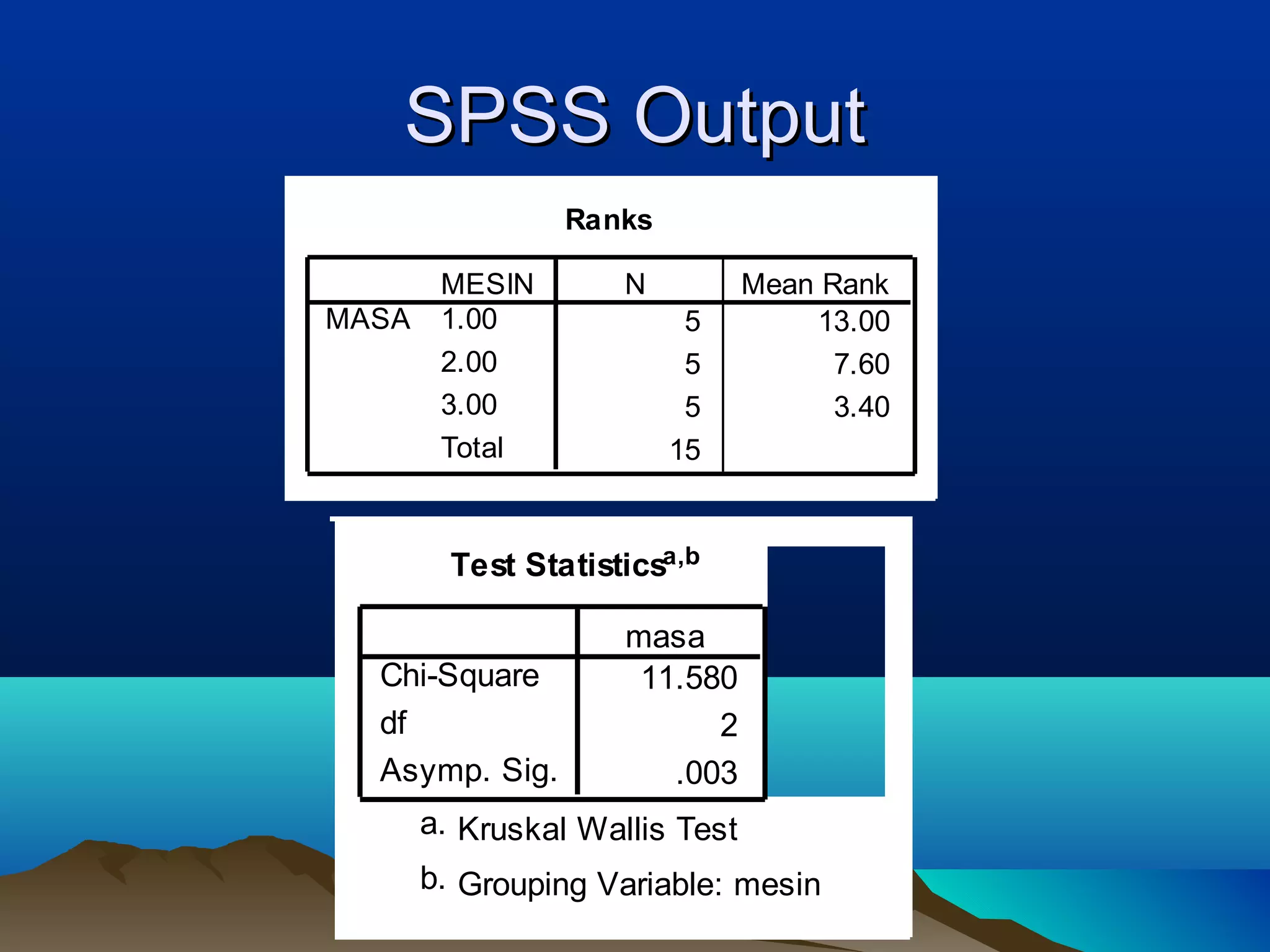
                 Ranks

        MESIN        N         Mean Rank
MASA    1.00              5        13.00
        2.00              5          7.60
        3.00              5          3.40
        Total            15


         Test Statisticsa,b

                     masa
  Chi-Square          11.580
  df                       2
  Asymp. Sig.           .003
       a. Kruskal Wallis Test
       b. Grouping Variable: mesin
Wilcoxon Signed Rank Test
• Two groups of paired observations
Example
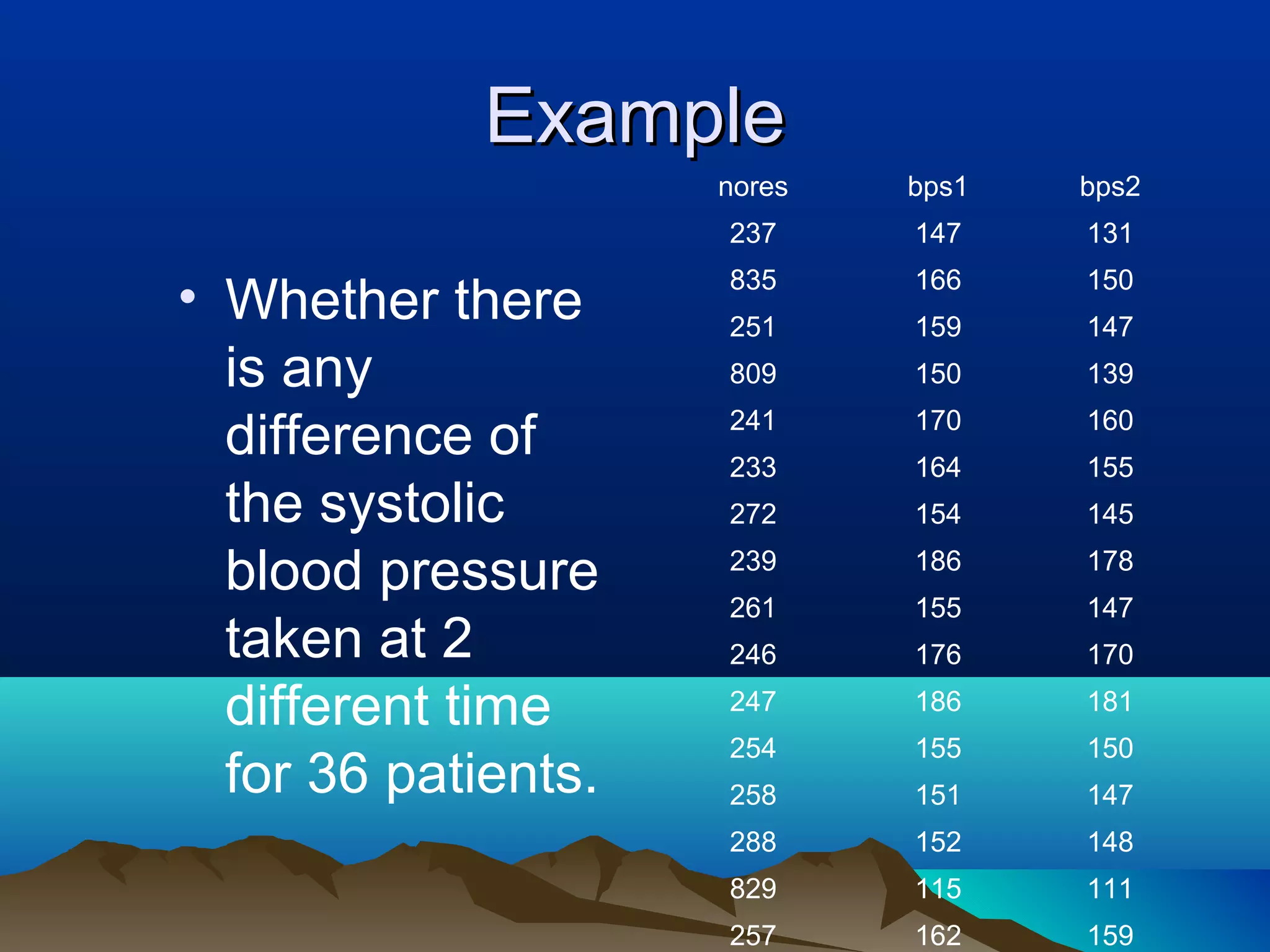
                     nores   bps1   bps2
                     237     147    131
                     835     166    150
• Whether there      251     159    147
  is any             809     150    139

  difference of      241
                     233
                             170
                             164
                                    160
                                    155
  the systolic       272     154    145

  blood pressure     239
                     261
                             186
                             155
                                    178
                                    147
  taken at 2         246     176    170

  different time     247     186    181
                     254     155    150
  for 36 patients.   258     151    147
                     288     152    148
                     829     115    111
                     257     162    159
Step 2
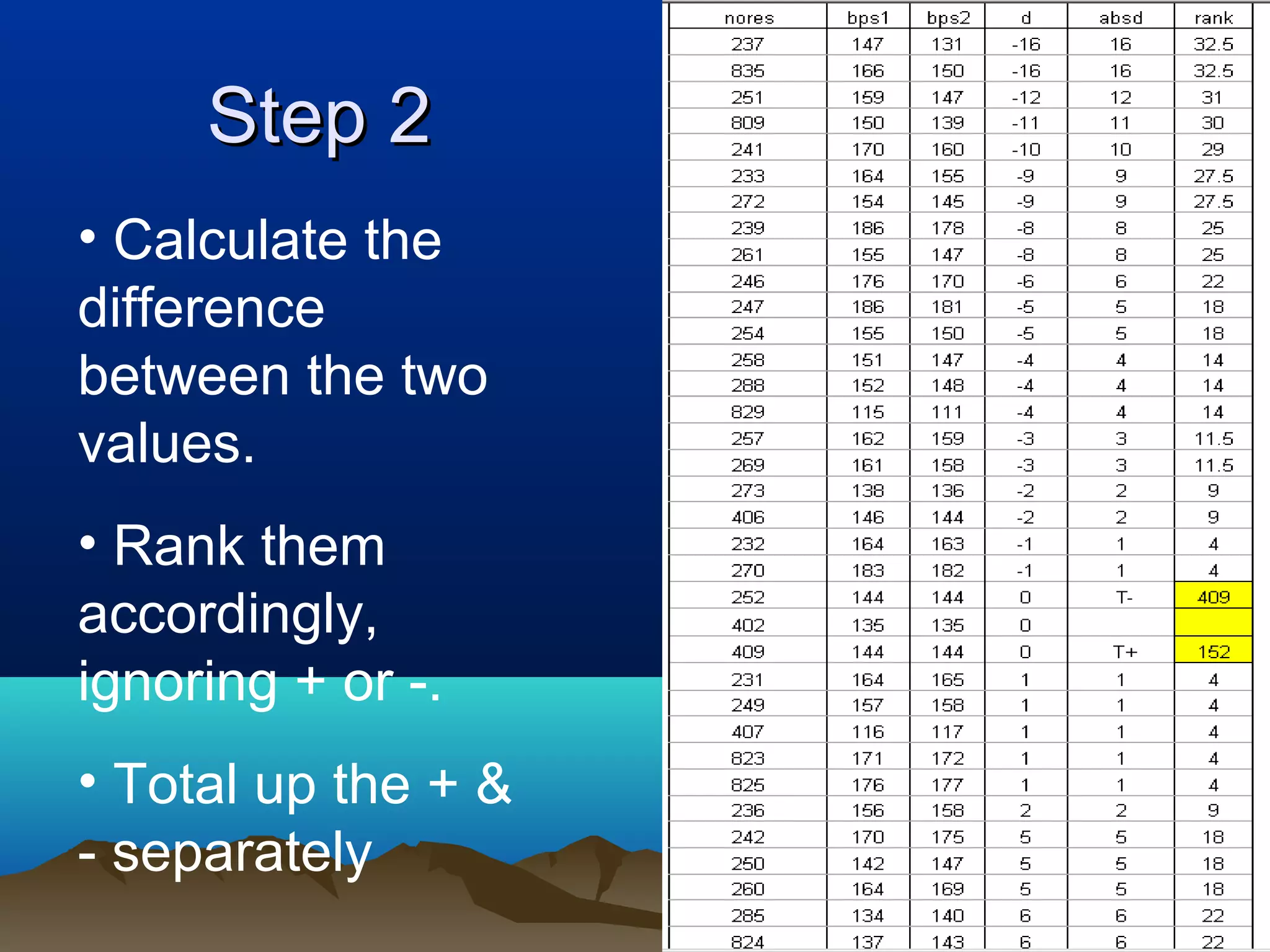
• Calculate the
difference
between the two
values.
• Rank them
accordingly,
ignoring + or -.
• Total up the + &
- separately
Step 3
•   Total up the ranks of the positives and the
    negatives. These are T+ dan T-.
•   T+ = 152 and T- = 409
•   Take the smallest value i.e. 152 and refer to
    the appropriate table. Critical value for n = 33
    (3 zero values so 36 - 3) for significance at
    0.05 is 171. Therefore < critical range.
•   Therefore : Null hypothesis rejected.
•   Conclusion: There is a difference of blood
    pressure measured at two different times.
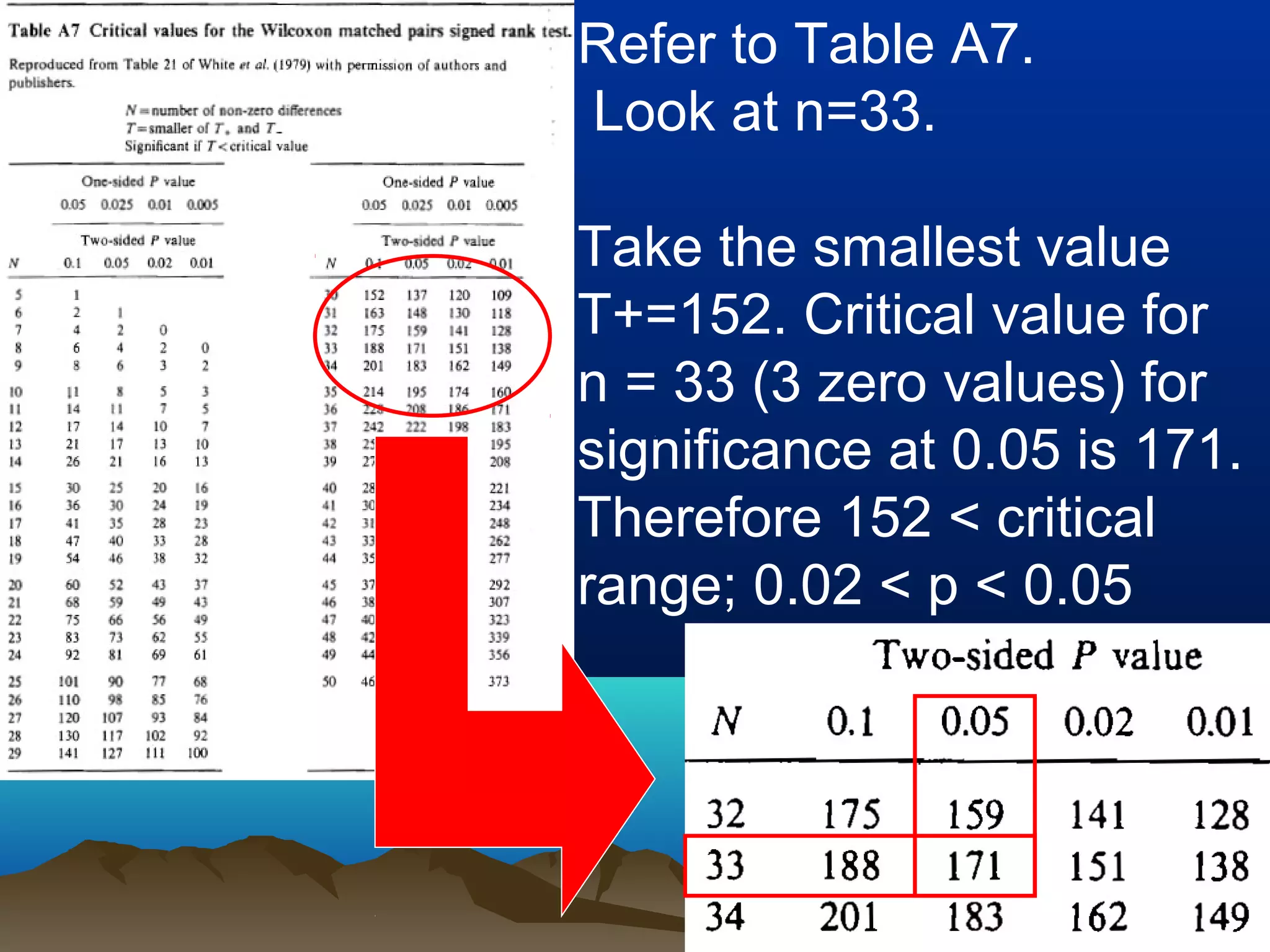
Refer to Table A7.
Look at n=33.

Take the smallest value
T+=152. Critical value for
n = 33 (3 zero values) for
significance at 0.05 is 171.
Therefore 152 < critical
range; 0.02 < p < 0.05
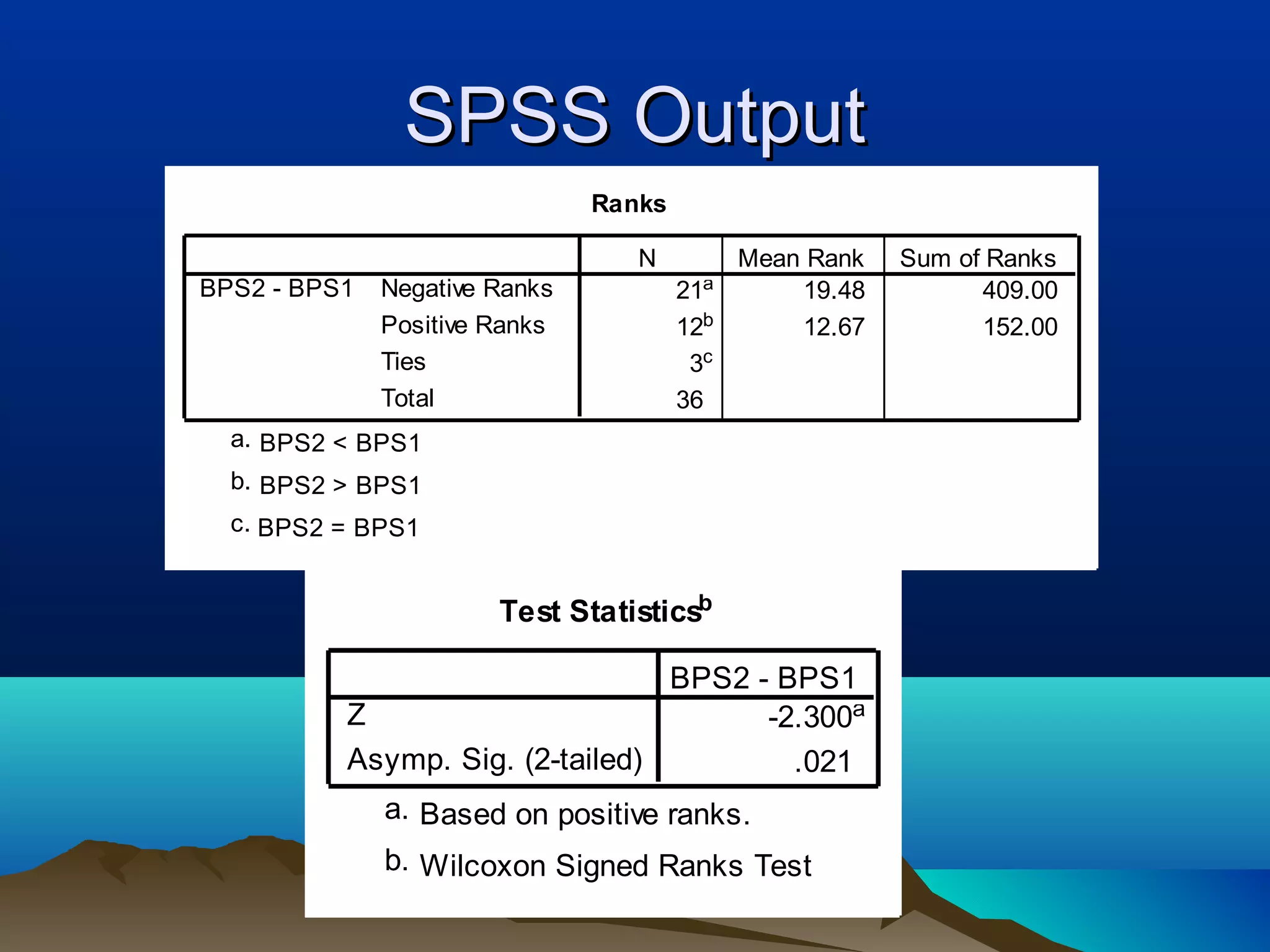
SPSS Output
                               Ranks

                                  N          Mean Rank   Sum of Ranks
BPS2 - BPS1   Negative Ranks           21a       19.48         409.00
              Positive Ranks           12b       12.67         152.00
              Ties                      3c
              Total                    36
  a. BPS2 < BPS1
  b. BPS2 > BPS1
  c. BPS2 = BPS1


                       Test Statisticsb

                                 BPS2 - BPS1
          Z                            -2.300a
          Asymp. Sig. (2-tailed)         .021
              a. Based on positive ranks.
              b. Wilcoxon Signed Ranks Test
Spearman/Kendall Correlation
• To find correlation between a related pair
  of continuous data; or
• Between 1 Continuous, 1 Categorical
  Variable (Ordinal)
     • e.g., association between Likert Scale on work
       satisfaction and work output.
Spearman's rank correlation
           coefficient
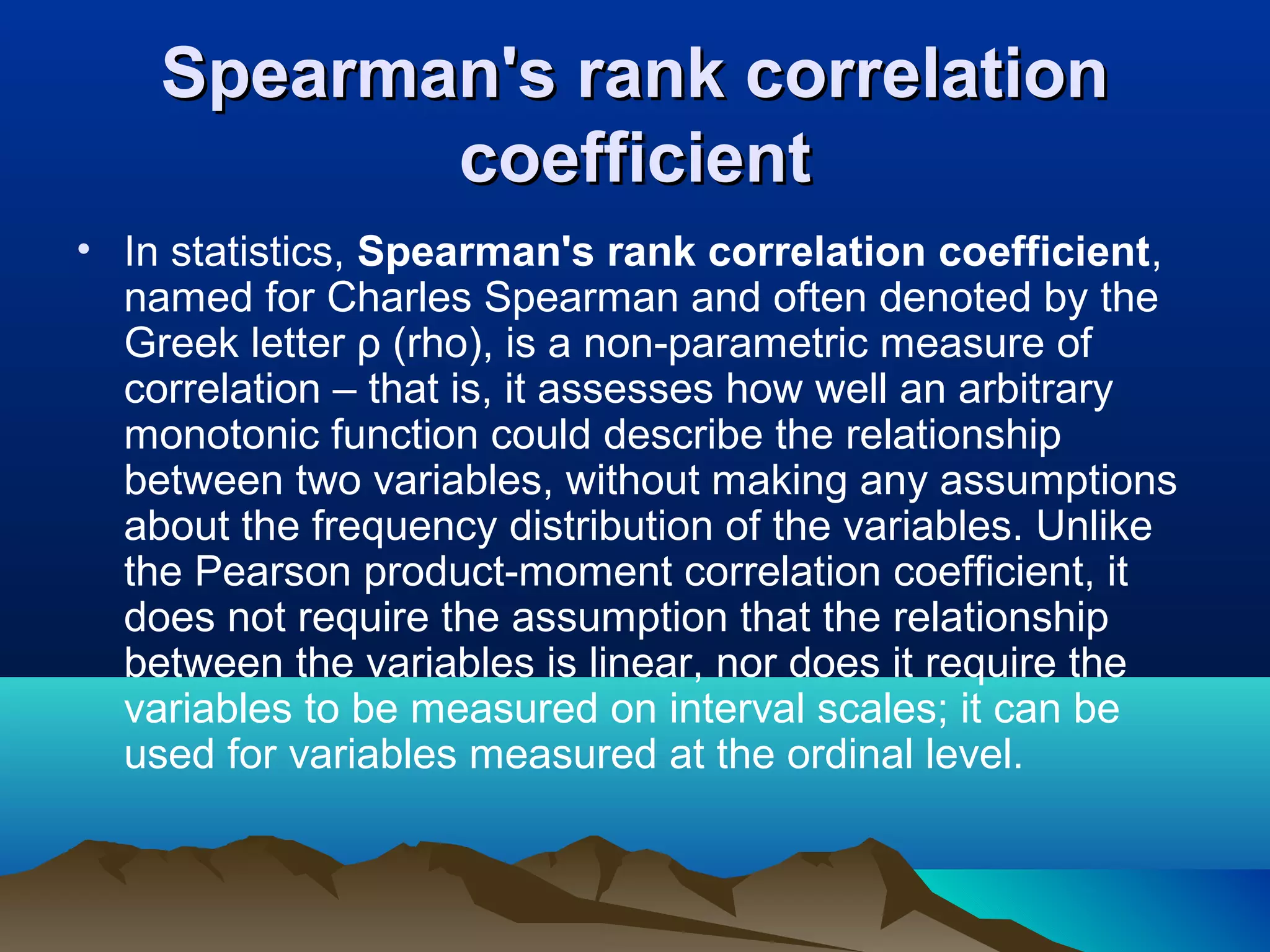
• In statistics, Spearman's rank correlation coefficient,
  named for Charles Spearman and often denoted by the
  Greek letter ρ (rho), is a non-parametric measure of
  correlation – that is, it assesses how well an arbitrary
  monotonic function could describe the relationship
  between two variables, without making any assumptions
  about the frequency distribution of the variables. Unlike
  the Pearson product-moment correlation coefficient, it
  does not require the assumption that the relationship
  between the variables is linear, nor does it require the
  variables to be measured on interval scales; it can be
  used for variables measured at the ordinal level.
Example
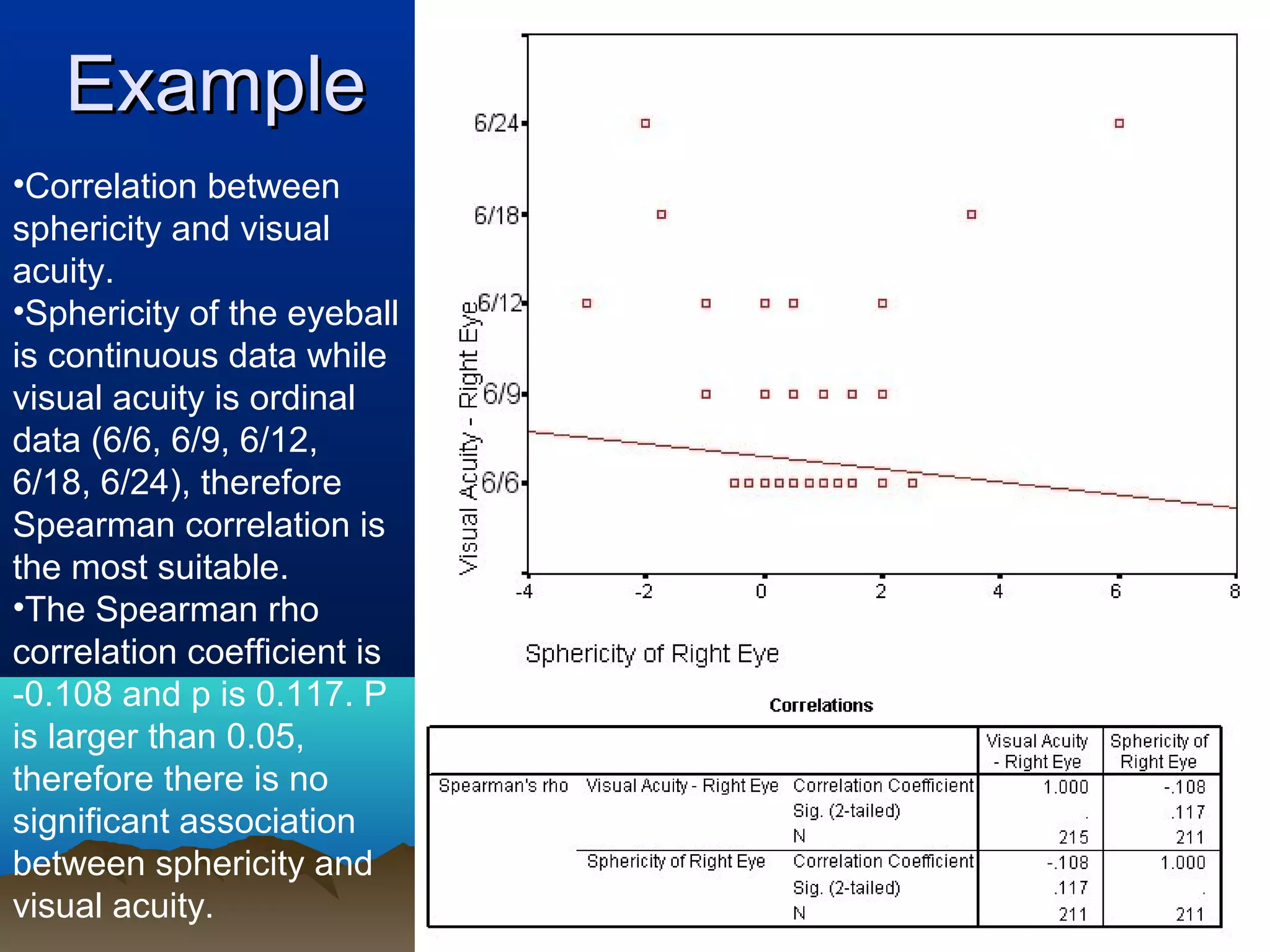
•Correlation between
sphericity and visual
acuity.
•Sphericity of the eyeball
is continuous data while
visual acuity is ordinal
data (6/6, 6/9, 6/12,
6/18, 6/24), therefore
Spearman correlation is
the most suitable.
•The Spearman rho
correlation coefficient is
-0.108 and p is 0.117. P
is larger than 0.05,
therefore there is no
significant association
between sphericity and
visual acuity.
Example 2
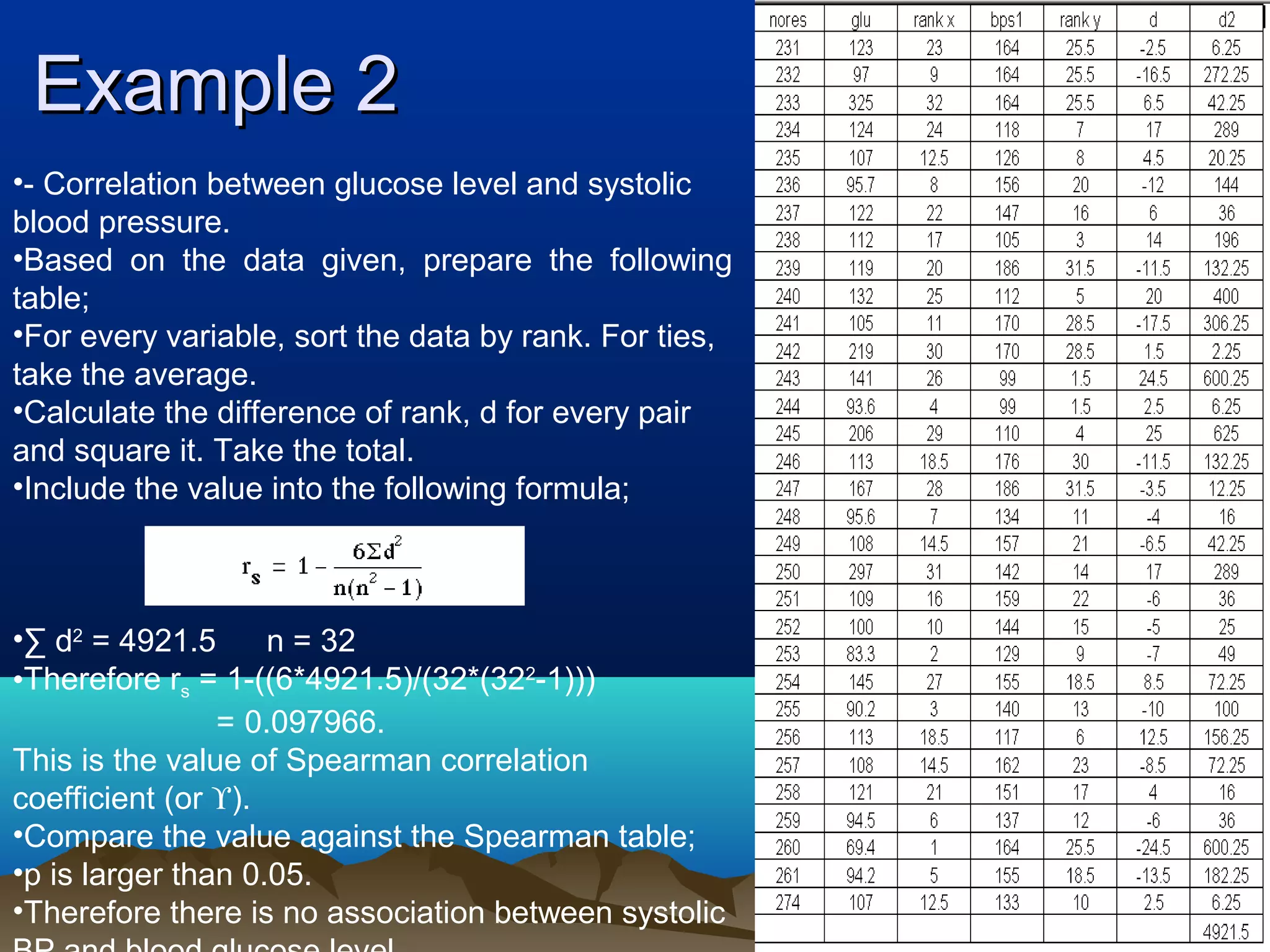
•- Correlation between glucose level and systolic
blood pressure.
•Based on the data given, prepare the following
table;
•For every variable, sort the data by rank. For ties,
take the average.
•Calculate the difference of rank, d for every pair
and square it. Take the total.
•Include the value into the following formula;


•∑ d2 = 4921.5      n = 32
•Therefore rs = 1-((6*4921.5)/(32*(322-1)))
                = 0.097966.
This is the value of Spearman correlation
coefficient (or ϒ).
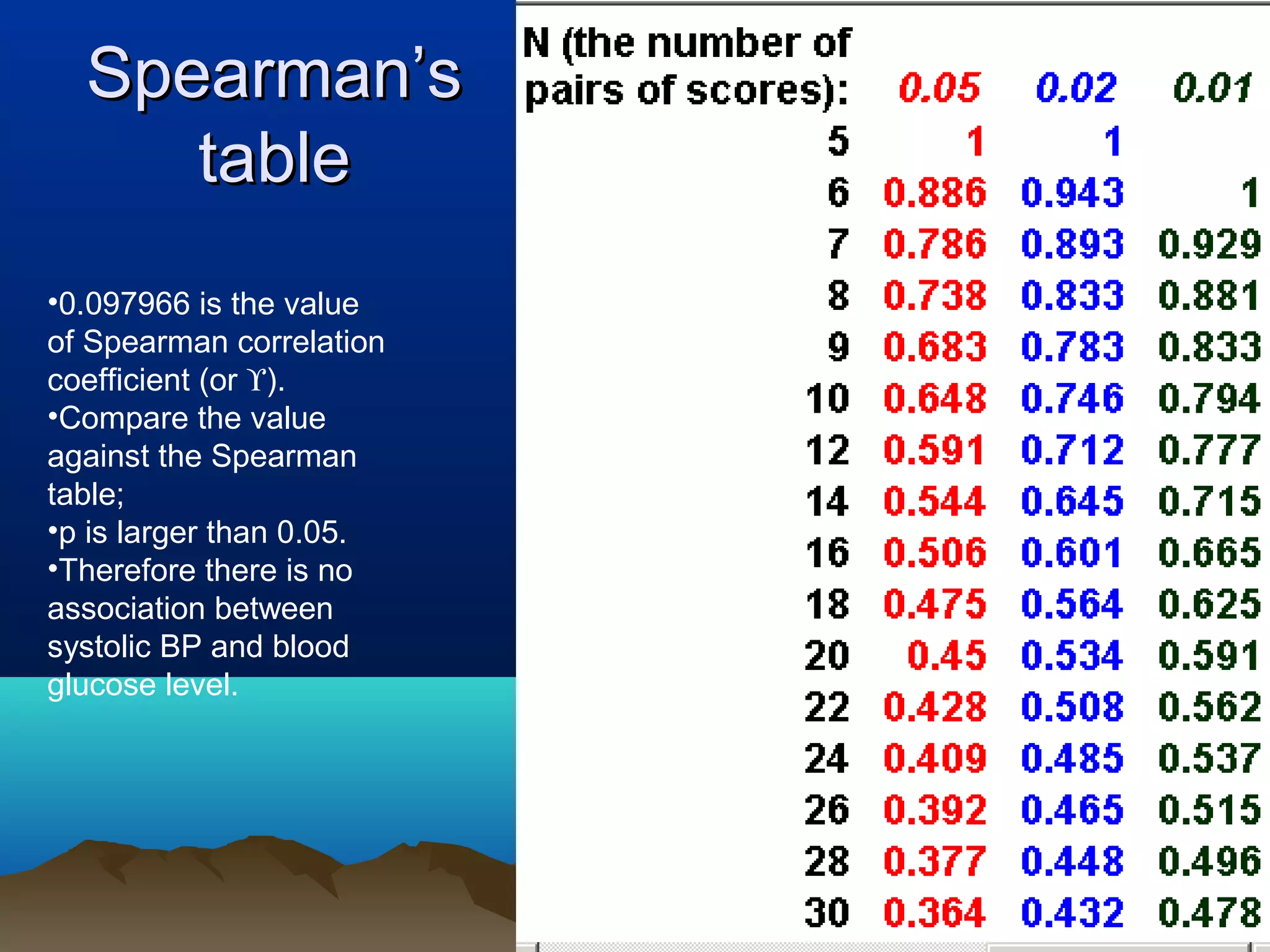
•Compare the value against the Spearman table;
•p is larger than 0.05.
•Therefore there is no association between systolic
Spearman’s
     table
•0.097966 is the value
of Spearman correlation
coefficient (or ϒ).
•Compare the value
against the Spearman
table;
•p is larger than 0.05.
•Therefore there is no
association between
systolic BP and blood
glucose level.
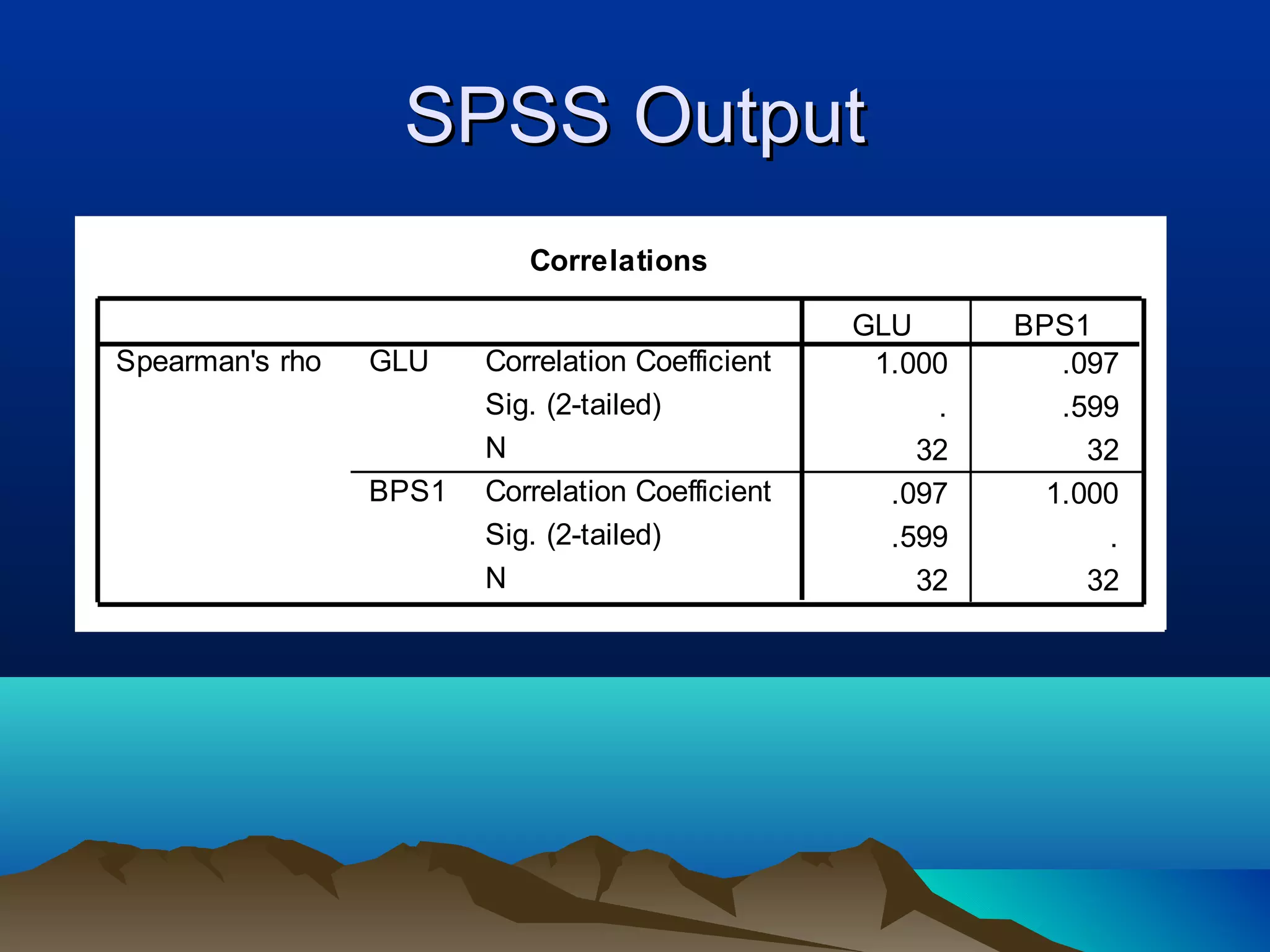
SPSS Output
                           Correlations

                                                  GLU      BPS1
Spearman's rho   GLU    Correlation Coefficient    1.000      .097
                        Sig. (2-tailed)                .      .599
                        N                             32        32
                 BPS1   Correlation Coefficient     .097     1.000
                        Sig. (2-tailed)             .599         .
                        N                             32        32
Presentation
• Never sufficient to present the results
  solely as a p value
• Median and quartiles should be given
• For small samples, the median and range
  can be given
Take Home Message
• Both parametric & non-parametric
  methods can be used for continuous data
• Parametric methods are preferred if all
  assumptions are met
• Reasons
  – Amenable to estimation and confidence
    interval
  – Readily extended to the more complicated
    data structures
Take Home Message
• We should carry out either parametric or non-
  parametric test on a set of data, not both.
• When there are doubts of the validity of the
  assumptions for the parametric method, a non
  parametric analysis is carried out
• If the assumptions are met, the two methods
  should give very similar answers
• If the answers differ, then the non-parametric
  method is more likely to be reliable

Non-parametric analysis: Wilcoxon, Kruskal Wallis & Spearman

  • 1.
    Wilcoxon & Kruskal-Wallis Dr Azmi Mohd Tamil
  • 2.
    Explore • It isthe first step in the analytic process • to explore the characteristics of the data • to screen for errors and correct them • to look for distribution patterns - normal distribution or not • May require transformation before further analysis using parametric methods • Or may need analysis using non-parametric techniques
  • 3.
    Choosing an appropriatemethod • Number of groups of observations • Independent or dependent groups of observations • Type of data • Distribution of data • Objective of analysis
  • 4.
    Nonparametric Test Procedures • Statistic does not depend on population distribution • Data may be nominally or ordinally scaled – Example: Male-female • May involve population parameters such as median • Based on analysis of ranks • Example: Wilcoxon rank sum test
  • 5.
    non-parametric tests Variable 1 Variable 2 Criteria Type of Test Qualitative Qualitative Sample size < 20 or (< 40 but Fisher Test Dichotomus Dichotomus with at least one expected value < 5) Qualitative Quantitative Data not normally distributed Wilcoxon Rank Sum Dichotomus Test or U Mann- Whitney Test Qualitative Quantitative Data not normally distributed Kruskal-Wallis One Polinomial Way ANOVA Test Quantitative Quantitative Repeated measurement of the Wilcoxon Rank Sign same individual & item Test Continous or Quantitative - Data not normally distributed Spearman/Kendall ordinal continous Rank Correlation
  • 6.
    Advantages of Non-parametric Tests • Used with all scales • Easier to calculate – Developed before wide computer use • Make fewer assumptions • Need not involve population parameters • Results may be as exact as parametric procedures © 1984-1994 T/Maker Co.
  • 7.
    Disadvantages of Non-parametric Tests • May waste information – If data permit using parametric © 1984-1994 T/Maker Co. procedures – Example: Converting data from ratio to ordinal scale • Difficult to calculate by hand for large samples • Tables not widely available
  • 8.
    Mann-Whitney U Test/ Wilcoxon Rank Sum • Non-parametric comparison of 2 groups • Requires all the observations to be ranked as if they were from a single sample
  • 9.
    Mann-Whitney U Test/ Wilcoxon Rank Sum • Tests two independent population medians • Non-parametric test procedure • Assumptions – Ordinal, interval, or ratio scaled data – Population is nearly symmetrical • Bell-shaped, rectangular etc. • Can use normal approximation if ni > 10
  • 10.
    Mann-Whitney U Test/ WilcoxonRank Sum Procedure • Assign ranks, Ri , to the n1 + n2 sample observations – If unequal sample sizes, let n1 refer to smaller- sized sample – Smallest value = rank of 1 – Same value -> Average ties • Sum the ranks, Ti , for each group • Test statistic is T1 (smallest group)
  • 11.
    Example • Comparing theblood nores kerja glu glucose level 234 1 124 between taxi drivers 243 1 141 (code 3) and bus drivers (code 1) 244 1 93.6 410 3 139 508 3 104 821 3 105 829 3 96.2 832 3 95
  • 12.
    Example step 2 nores kerja glu rank • Arrange the blood 244 1 93.6 1 glucose level in 832 3 95 2 ascending order. Give rank from 829 3 96.2 3 lowest to highest. 508 3 104 4 • If the same values, 821 3 105 5 take the mean 234 1 124 6 rank. 410 3 139 7 243 1 141 8
  • 13.
    Example step 3 • Total up the rank in the smaller group – Bus drivers; T = 6+8+1=15 – Taxi drivers; T = 7+4+5+3+2=21 • Compare the result with the respective table at n1 and n2 ; 3, 5. • T is between the two critical range (6 – 21). Only significant if T= or <6, or T= or > 21. • Conclusion: p > 0.05; Null Hypothesis NOT REJECTED
  • 14.
    Refer to TableA8. Look at n1, n2 ; 3, 5. For p=0.05, the critical range is between 6 to 21. Only significant if; T < 6, or T > 21. Therefore p > 0.05
  • 16.
    SPSS Output Ranks KERJA N Mean Rank Sum of Ranks GLU 1.00 3 5.00 15.00 3.00 5 4.20 21.00 Total 8 Test Statisticsb GLU Mann-Whitney U 6.000 Wilcoxon W 21.000 Z -.447 Asymp. Sig. (2-tailed) .655 Exact Sig. [2*(1-tailed a .786 Sig.)] a. Not corrected for ties. b. Grouping Variable: KERJA
  • 17.
    The only wayfor the result to be significant Is for all the data of the smallest group to be at one end or the other.
  • 18.
    Assume the resultswere like this nores kerja glu rank • The bus drivers all 244 1 93.6 1 had lower blood 832 1 95 2 glucose level compared to the 829 1 96.2 3 taxi drivers. 508 3 104 4 821 3 105 5 234 3 124 6 410 3 139 7 243 3 141 8
  • 19.
    Now the resultis significant • Total up the rank in the smaller group – Bus drivers; T = 1+2+3=6 – Taxi drivers; T = 4+5+6+7+8=30 • Compare the result with the respective table at n1 and n2 ; 3, 5. • T is exactly the value of the lower critical range (6 – 21). Now significant since T= or < 6 • Conclusion: p < 0.05; Null Hypothesis is REJECTED
  • 20.
    Refer to TableA8. Look at n1, n2 ; 3, 5. For p=0.05, the critical range is between 6 to 21. Only significant if; T < 6, or T > 21. Therefore p < 0.05
  • 21.
    Let’s try itthe other way! nores kerja glu rank • The bus drivers all 244 3 93.6 1 had higher blood 832 3 95 2 glucose level compared to the 829 3 96.2 3 taxi drivers. 508 3 104 4 821 3 105 5 234 1 124 6 410 1 139 7 243 1 141 8
  • 22.
    Now the resultis also significant •Total up the rank in the smaller group –Bus drivers; T = 6+7+8=21 –Taxi drivers; T = 1+2+3+4+5=15 •Compare the result with the respective table at n1 •T is exactly the value of the upper critical range (6 •Conclusion: p < 0.05; Null Hypothesis is
  • 23.
    Refer to TableA8. Look at n1, n2 ; 3, 5. For p=0.05, the critical range is between 6 to 21. Only significant if; T < 6, or T > 21. Therefore p < 0.05
  • 24.
    Kruskal-Wallis test • Whenthere is 3 or more independent groups of observation
  • 25.
    Kruskal-Wallis Rank Test for c Medians • Tests the equality of more than 2 (c) population medians • Non-parametric test procedure • Used to analyze completely randomized experimental designs • Can use χ2 distribution to approximate if each sample group size nj > 5 – Degrees of freedom = c - 1
  • 26.
    Kruskal-Wallis Rank Test Assumptions • Independent random samples are drawn • Continuous dependent variable • Ordinal, interval, or ratio scaled data • Populations have same variability • Populations have same shape
  • 27.
    Kruskal-Wallis Rank Test Procedure • Assign ranks, Ri , to the n combined observations – Smallest value = 1 – Largest value = n – Average ties • Test statistic Squared total of each group 2 12 Ti H= ∑ − 3(n + 1) n(n + 1) ni
  • 28.
    Kruskal-Wallis Rank Test Example As production manager, you Mach1 Mach2 Mach3 want to see if 3 filling 25.40 23.40 20.00 machines have different 26.31 21.80 22.20 median filling times. You 24.10 23.50 19.75 assign 15 similarly trained & 23.74 22.75 20.60 experienced workers, 25.10 21.60 20.40 5 per machine, to the machines. At the .05 level, is there a difference in median filling times?
  • 29.
    Kruskal-Wallis Rank Test Solution H0: M1 = M2 = M3 Test Statistic: H1: Not all equal α = .05 df = c - 1 = 3 - 1 = 2 Critical Value(s): Decision: α = .05 Conclusion: 0 5.991 χ2
  • 30.
    Obtaining Ranks Solution Raw Data Ranks Mach1 Mach2 Mach3 Mach1 Mach2 Mach3 25.40 23.40 20.00 14 9 2 26.31 21.80 22.20 15 6 7 24.10 23.50 19.75 12 10 1 23.74 22.75 20.60 11 8 4 25.10 21.60 20.40 13 5 3 65 38 17
  • 31.
  • 32.
    Kruskal-Wallis Rank Test Solution H0: M1 = M2 = M3 Test Statistic: H1: Not all equal H = 11.58 α = .05 Refer to Chi-Square table df = c - 1 = 3 - 1 = 2 Critical Value(s): Decision: Reject at α = .05 α = .05 Conclusion: There is evidence pop. 0 5.991 χ2 medians are different
  • 33.
    Refer to Table3. Look at df = 2. H = 11.58, larger than 10.60 (p=0.005) but smaller than 13.82 (p=0.001). 13.82>11.58>10.60 Therefore if H=11.58, 0.001<p<0.005.
  • 35.
    SPSS Output Ranks MESIN N Mean Rank MASA 1.00 5 13.00 2.00 5 7.60 3.00 5 3.40 Total 15 Test Statisticsa,b masa Chi-Square 11.580 df 2 Asymp. Sig. .003 a. Kruskal Wallis Test b. Grouping Variable: mesin
  • 36.
    Wilcoxon Signed RankTest • Two groups of paired observations
  • 37.
    Example nores bps1 bps2 237 147 131 835 166 150 • Whether there 251 159 147 is any 809 150 139 difference of 241 233 170 164 160 155 the systolic 272 154 145 blood pressure 239 261 186 155 178 147 taken at 2 246 176 170 different time 247 186 181 254 155 150 for 36 patients. 258 151 147 288 152 148 829 115 111 257 162 159
  • 38.
    Step 2 • Calculatethe difference between the two values. • Rank them accordingly, ignoring + or -. • Total up the + & - separately
  • 39.
    Step 3 • Total up the ranks of the positives and the negatives. These are T+ dan T-. • T+ = 152 and T- = 409 • Take the smallest value i.e. 152 and refer to the appropriate table. Critical value for n = 33 (3 zero values so 36 - 3) for significance at 0.05 is 171. Therefore < critical range. • Therefore : Null hypothesis rejected. • Conclusion: There is a difference of blood pressure measured at two different times.
  • 40.
    Refer to TableA7. Look at n=33. Take the smallest value T+=152. Critical value for n = 33 (3 zero values) for significance at 0.05 is 171. Therefore 152 < critical range; 0.02 < p < 0.05
  • 42.
    SPSS Output Ranks N Mean Rank Sum of Ranks BPS2 - BPS1 Negative Ranks 21a 19.48 409.00 Positive Ranks 12b 12.67 152.00 Ties 3c Total 36 a. BPS2 < BPS1 b. BPS2 > BPS1 c. BPS2 = BPS1 Test Statisticsb BPS2 - BPS1 Z -2.300a Asymp. Sig. (2-tailed) .021 a. Based on positive ranks. b. Wilcoxon Signed Ranks Test
  • 43.
    Spearman/Kendall Correlation • Tofind correlation between a related pair of continuous data; or • Between 1 Continuous, 1 Categorical Variable (Ordinal) • e.g., association between Likert Scale on work satisfaction and work output.
  • 44.
    Spearman's rank correlation coefficient • In statistics, Spearman's rank correlation coefficient, named for Charles Spearman and often denoted by the Greek letter ρ (rho), is a non-parametric measure of correlation – that is, it assesses how well an arbitrary monotonic function could describe the relationship between two variables, without making any assumptions about the frequency distribution of the variables. Unlike the Pearson product-moment correlation coefficient, it does not require the assumption that the relationship between the variables is linear, nor does it require the variables to be measured on interval scales; it can be used for variables measured at the ordinal level.
  • 45.
    Example •Correlation between sphericity andvisual acuity. •Sphericity of the eyeball is continuous data while visual acuity is ordinal data (6/6, 6/9, 6/12, 6/18, 6/24), therefore Spearman correlation is the most suitable. •The Spearman rho correlation coefficient is -0.108 and p is 0.117. P is larger than 0.05, therefore there is no significant association between sphericity and visual acuity.
  • 46.
    Example 2 •- Correlationbetween glucose level and systolic blood pressure. •Based on the data given, prepare the following table; •For every variable, sort the data by rank. For ties, take the average. •Calculate the difference of rank, d for every pair and square it. Take the total. •Include the value into the following formula; •∑ d2 = 4921.5 n = 32 •Therefore rs = 1-((6*4921.5)/(32*(322-1))) = 0.097966. This is the value of Spearman correlation coefficient (or ϒ). •Compare the value against the Spearman table; •p is larger than 0.05. •Therefore there is no association between systolic
  • 47.
    Spearman’s table •0.097966 is the value of Spearman correlation coefficient (or ϒ). •Compare the value against the Spearman table; •p is larger than 0.05. •Therefore there is no association between systolic BP and blood glucose level.
  • 48.
    SPSS Output Correlations GLU BPS1 Spearman's rho GLU Correlation Coefficient 1.000 .097 Sig. (2-tailed) . .599 N 32 32 BPS1 Correlation Coefficient .097 1.000 Sig. (2-tailed) .599 . N 32 32
  • 49.
    Presentation • Never sufficientto present the results solely as a p value • Median and quartiles should be given • For small samples, the median and range can be given
  • 50.
    Take Home Message •Both parametric & non-parametric methods can be used for continuous data • Parametric methods are preferred if all assumptions are met • Reasons – Amenable to estimation and confidence interval – Readily extended to the more complicated data structures
  • 51.
    Take Home Message •We should carry out either parametric or non- parametric test on a set of data, not both. • When there are doubts of the validity of the assumptions for the parametric method, a non parametric analysis is carried out • If the assumptions are met, the two methods should give very similar answers • If the answers differ, then the non-parametric method is more likely to be reliable

Editor's Notes