ASSIGNMENT ON
Non- Rigid Rotator
Rotational spectroscopy
 Rotational spectroscopy is concerned with the measurement of
the energies of transitions between quantized rotational states
of molecules in the gas phase. The spectra of polar molecules can
be measured in absorption or emission by microwave spectroscopy
or by far infrared spectroscopy.
 The rotational spectra of non-polar molecules cannot be observed
by those methods, but can be observed and measured by Raman
spectroscopy.
 Rotational spectroscopy is sometimes referred to as pure rotational
spectroscopy to distinguish it from rotational-vibrational
spectroscopy where changes in rotational energy occur together
with changes in vibrational energy, and also from ro-vibronic
spectroscopy where rotational, vibrational and electronic energy
changes occur simultaneously
Types of molecule
 Linear molecule
 Symmetric top Molecule
 Spherical top molecule
 Asymmetric top Molecule
Rotational Spectra
Simplest Case: Diatomic or Linear Polyatomic molecule
Rigid Rotor Model: Two nuclei joined by a weightless rod
J = Rotational quantum number (J = 0, 1, 2, …)
I = Moment of inertia = mr2
m = reduced mass = m1m2 / (m1 + m2)
r = internuclear distance
m1
m2
 1JJ
I2
E
2
J 

Rigid Rotor Model
In wavenumbers (cm-1):
 1JJ
Ic8
h
F 2J 

 1JJBFJ 
Separation between adjacent levels:
F(J) – F(J-1) = 2BJ
Rotational
Energy Levels
Selection Rules:
Molecule must have a
permanent dipole.
DJ = 1
J. Michael Hollas, Modern Spectroscopy,
John Wiley & Sons, New York, 1992.
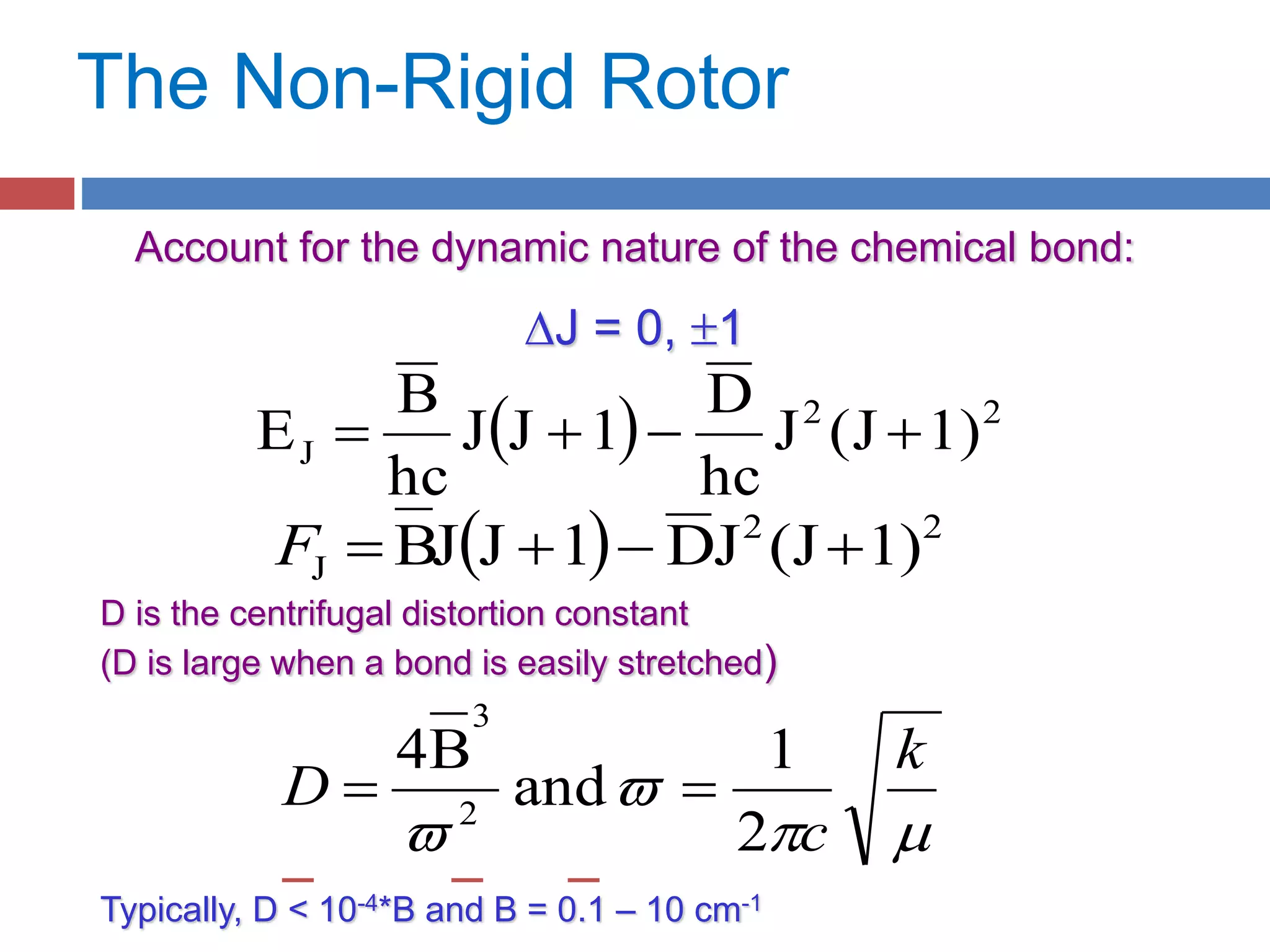
The Non-Rigid Rotor
Account for the dynamic nature of the chemical bond:
DJ = 0, 1
  22
J 1)(JJ
hc
D
1JJ
hc
B
E 
D is the centrifugal distortion constant
(D is large when a bond is easily stretched)
Typically, D < 10-4*B and B = 0.1 – 10 cm-1
  22
J 1)(JJD1JJB F
m


k
c
D
2
1
and
B4
2
3

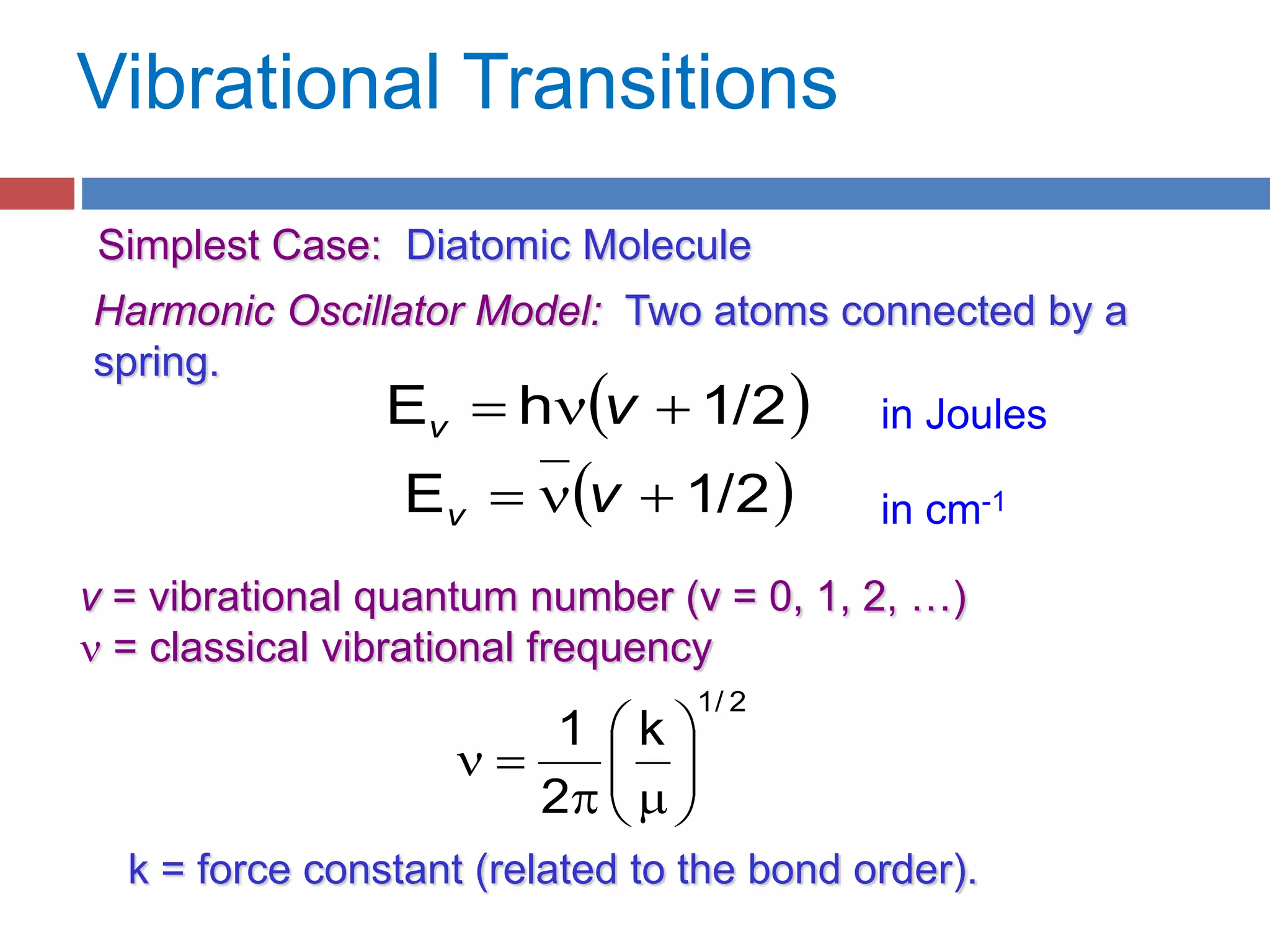
Vibrational Transitions
Simplest Case: Diatomic Molecule
Harmonic Oscillator Model: Two atoms connected by a
spring.
 1/2E  vv
 1/2hE  vv
v = vibrational quantum number (v = 0, 1, 2, …)
 = classical vibrational frequency
2/1
k
2
1






m

k = force constant (related to the bond order).
in Joules
in cm-1
Vibrational Energy Levels
J. Michael Hollas, Modern Spectroscopy, John Wiley & Sons, New York, 1992.
Selection Rules:
1) Must have a change in dipole moment (for IR).
2) Dv = 1
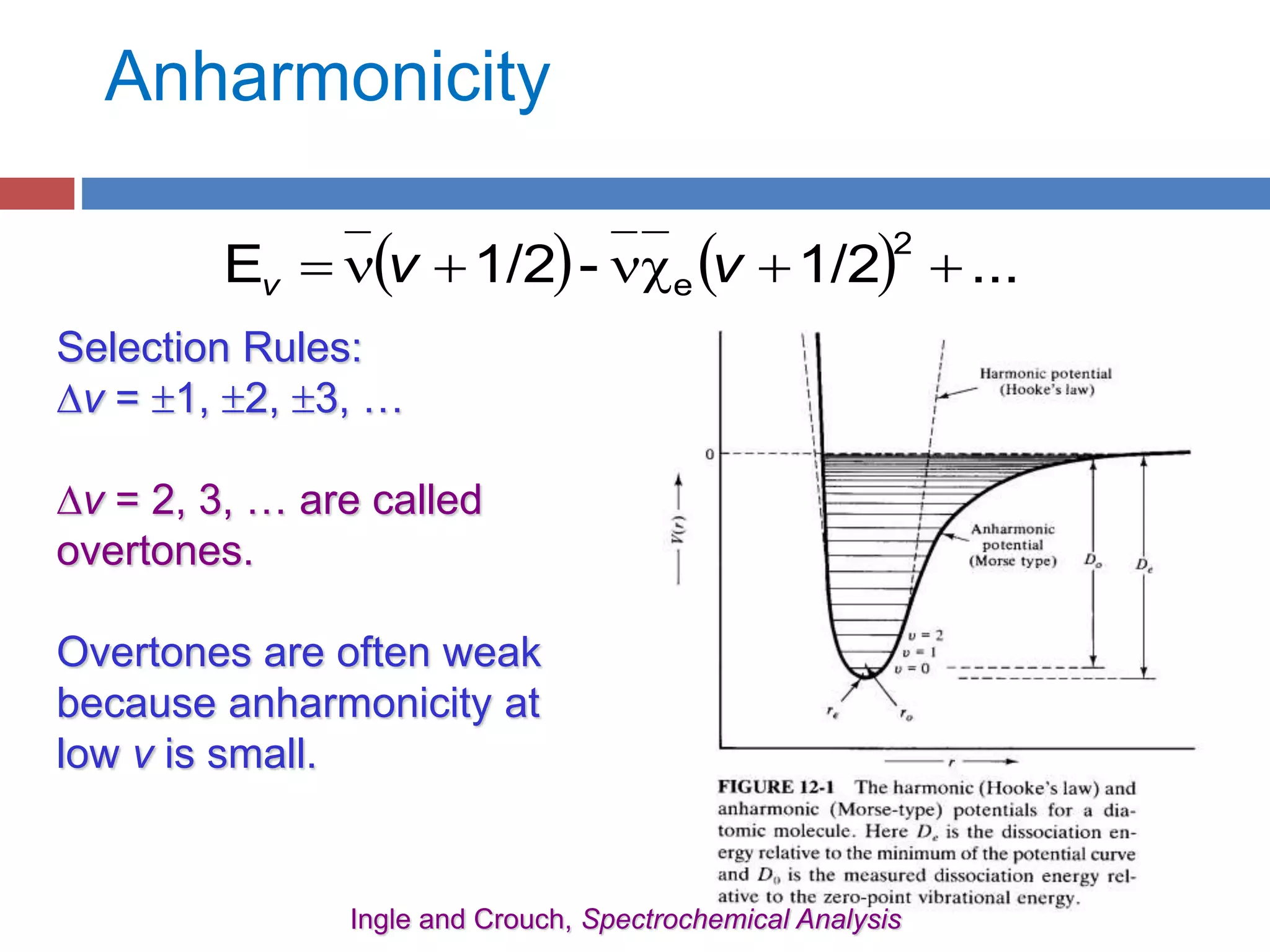
Anharmonicity
Ingle and Crouch, Spectrochemical Analysis
    ...1/2-1/2E
2
e  vvv
Selection Rules:
Dv = 1, 2, 3, …
Dv = 2, 3, … are called
overtones.
Overtones are often weak
because anharmonicity at
low v is small.
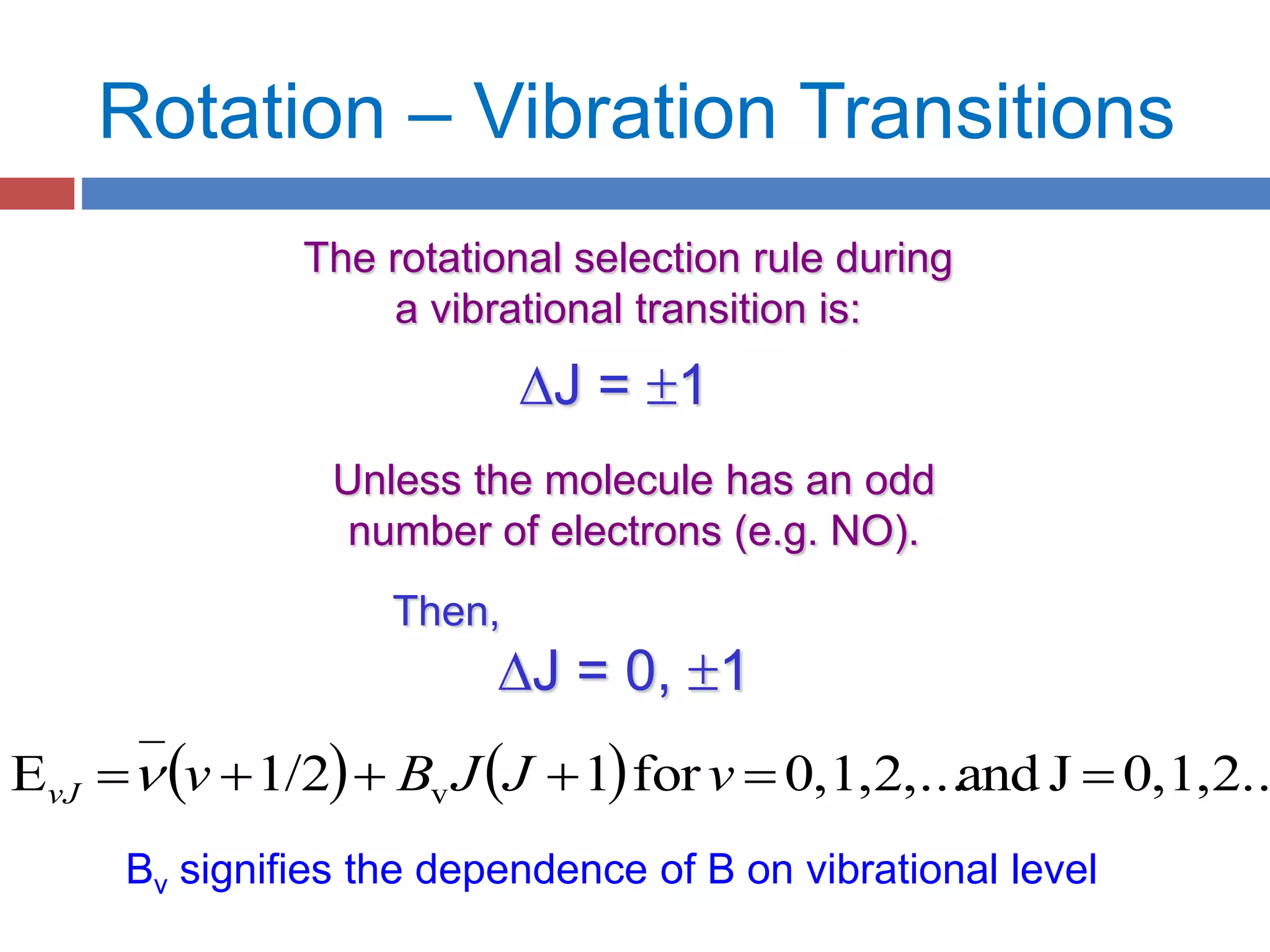
Rotation – Vibration Transitions
The rotational selection rule during
a vibrational transition is:
DJ = 1
Unless the molecule has an odd
number of electrons (e.g. NO).
Then,
DJ = 0, 1
    0,1,2..Jand0,1,2,...for11/2E v  vJJBvvJ 
Bv signifies the dependence of B on vibrational level
Rotation – Vibration
Transitions
Ingle and Crouch, Spectrochemical Analysis
If DJ = -1  P – Branch
If DJ = 0  Q – Branch
If DJ = +1  R – Branch
Thank you

Non Rigid Rotator

  • 1.
  • 2.
    Rotational spectroscopy  Rotationalspectroscopy is concerned with the measurement of the energies of transitions between quantized rotational states of molecules in the gas phase. The spectra of polar molecules can be measured in absorption or emission by microwave spectroscopy or by far infrared spectroscopy.  The rotational spectra of non-polar molecules cannot be observed by those methods, but can be observed and measured by Raman spectroscopy.  Rotational spectroscopy is sometimes referred to as pure rotational spectroscopy to distinguish it from rotational-vibrational spectroscopy where changes in rotational energy occur together with changes in vibrational energy, and also from ro-vibronic spectroscopy where rotational, vibrational and electronic energy changes occur simultaneously
  • 3.
    Types of molecule Linear molecule  Symmetric top Molecule  Spherical top molecule  Asymmetric top Molecule
  • 4.
    Rotational Spectra Simplest Case:Diatomic or Linear Polyatomic molecule Rigid Rotor Model: Two nuclei joined by a weightless rod J = Rotational quantum number (J = 0, 1, 2, …) I = Moment of inertia = mr2 m = reduced mass = m1m2 / (m1 + m2) r = internuclear distance m1 m2  1JJ I2 E 2 J  
  • 5.
    Rigid Rotor Model Inwavenumbers (cm-1):  1JJ Ic8 h F 2J    1JJBFJ  Separation between adjacent levels: F(J) – F(J-1) = 2BJ
  • 6.
    Rotational Energy Levels Selection Rules: Moleculemust have a permanent dipole. DJ = 1 J. Michael Hollas, Modern Spectroscopy, John Wiley & Sons, New York, 1992.
  • 7.
    The Non-Rigid Rotor Accountfor the dynamic nature of the chemical bond: DJ = 0, 1   22 J 1)(JJ hc D 1JJ hc B E  D is the centrifugal distortion constant (D is large when a bond is easily stretched) Typically, D < 10-4*B and B = 0.1 – 10 cm-1   22 J 1)(JJD1JJB F m   k c D 2 1 and B4 2 3 
  • 8.
    Vibrational Transitions Simplest Case:Diatomic Molecule Harmonic Oscillator Model: Two atoms connected by a spring.  1/2E  vv  1/2hE  vv v = vibrational quantum number (v = 0, 1, 2, …)  = classical vibrational frequency 2/1 k 2 1       m  k = force constant (related to the bond order). in Joules in cm-1
  • 9.
    Vibrational Energy Levels J.Michael Hollas, Modern Spectroscopy, John Wiley & Sons, New York, 1992. Selection Rules: 1) Must have a change in dipole moment (for IR). 2) Dv = 1
  • 10.
    Anharmonicity Ingle and Crouch,Spectrochemical Analysis     ...1/2-1/2E 2 e  vvv Selection Rules: Dv = 1, 2, 3, … Dv = 2, 3, … are called overtones. Overtones are often weak because anharmonicity at low v is small.
  • 11.
    Rotation – VibrationTransitions The rotational selection rule during a vibrational transition is: DJ = 1 Unless the molecule has an odd number of electrons (e.g. NO). Then, DJ = 0, 1     0,1,2..Jand0,1,2,...for11/2E v  vJJBvvJ  Bv signifies the dependence of B on vibrational level
  • 12.
    Rotation – Vibration Transitions Ingleand Crouch, Spectrochemical Analysis If DJ = -1  P – Branch If DJ = 0  Q – Branch If DJ = +1  R – Branch
  • 13.