Shri Shivaji Education Society Amravati’s
Shri Shivaji Arts, Commerce & Science
College Motala,
Dist. Buldana
Molecular Spectroscopy
Part-2
By
Mr. Bhaskarrao Subhashrao Bhise
Assistant Professor
Head Department of Chemistry
Shri Shivaji Arts, Commerce & Science College Motala
Dist. Buldana
Contents
1)Energy Level Diagram of Transitions
2)Rotational ( Microwave) Spectroscopy
3)Condition for Microwave Active Molecules
4)Expression for Moment of Inertia
5)Selection Rule for Rotational Transition
6)Isotopic Effect
1. Energy level diagram of a molecule indicating electronic,
vibrational and rotational transitions:-
Molecules absorb band spectrum under high resolution.
It is found that band contains large number of fine lines
The molecule can process discrete values of rotational, vibrational and electronic
energies.
The group of energy designated by quantum number ‘n’ is the energy level of
molecule.
Similarly vibrational energy are given by vibrational quantum energy ‘v’.
Rotational energy designated by rotational quantum number ‘j’, shown in the
diagram.
V=0
V=1
V=2
V=3
V=4
V=0
V=1
V=2
V=3
V=4
EN
EG
RY
J=0
J=1
J=2
J=0
J=1
J=2 4
3
2
1
4
3
2
1
B
A C
D
Electronic Transition
Vibrational Transition Rotational Tran.
Each electronic energy level contain several vibrational energy levels and each vibrational
energy level contain several rotational level.
ΔE (Electronic) >> ΔE (Vibrational) >> ΔE( Rotational).
1. Rotational Transition:-
1. When a molecule absorb electromagnetic radiation nearly 0.005ev, the molecule is
excited from lower rotational level to higher energy level.
2. The selection rule, Δj=+1.
3. The branch of molecular spectroscopy involving rotational transitions only called
as rotational or microwave spectroscopy.
2. Vibrational Transitions:-
1. When a molecules absorb electromagnetic radiation nearly 0.1ev, the molecule
excited from lower level to higher energy level.
2. The selection rule for this transition Δv=+1.
3. A branch of spectroscopy involving vibrational transition is called as vibrational
transition.
3. Electronic Transition:-
1. When molecule absorb energy nearly 50 to 100 ev, then there is an electronic
transition from lower ( ground state) energy level to higher ( excited state)
energy level.
Rotational ( Microwave) Spectroscopy:-
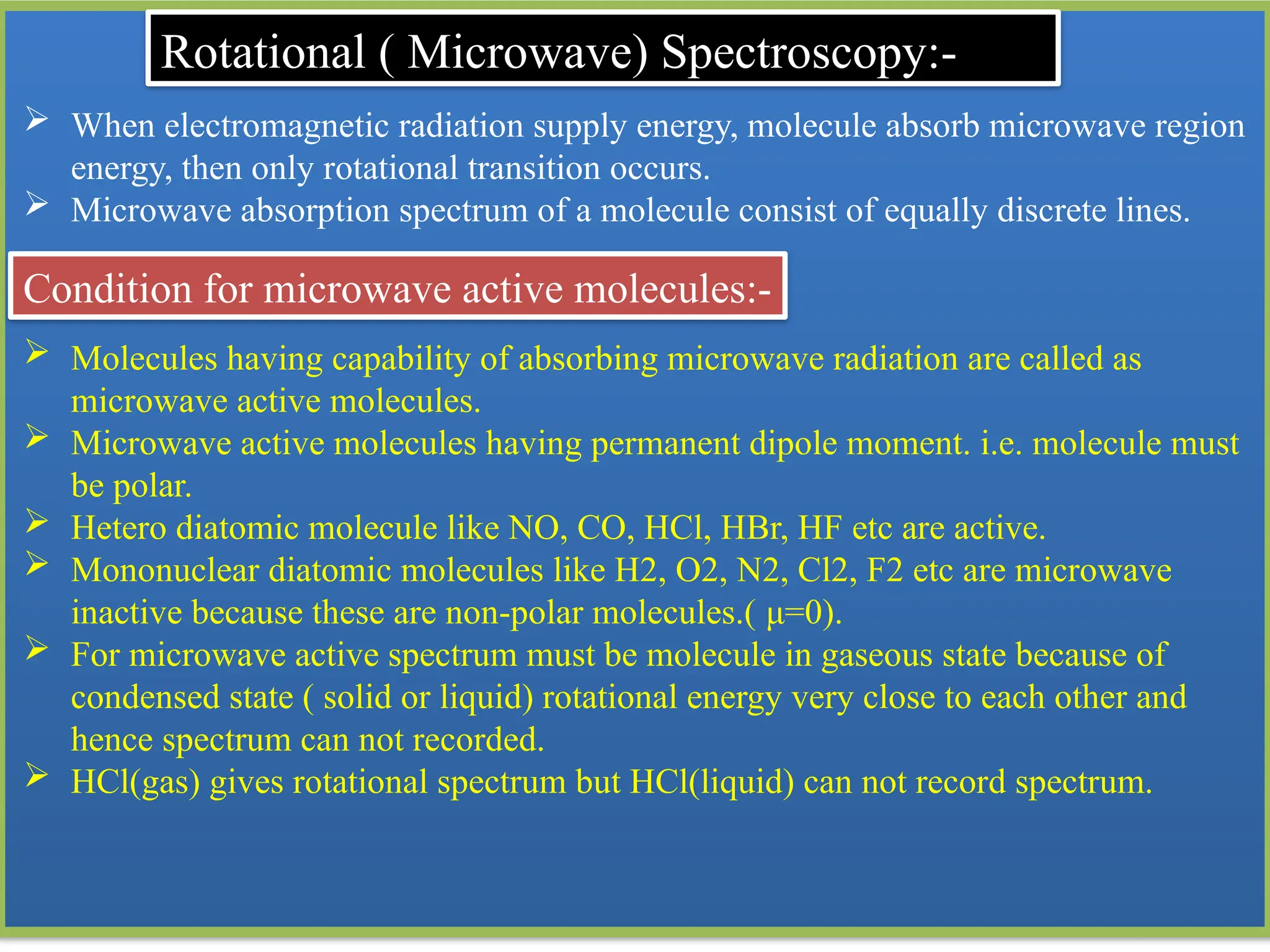
 When electromagnetic radiation supply energy, molecule absorb microwave region
energy, then only rotational transition occurs.
 Microwave absorption spectrum of a molecule consist of equally discrete lines.
Condition for microwave active molecules:-
 Molecules having capability of absorbing microwave radiation are called as
microwave active molecules.
 Microwave active molecules having permanent dipole moment. i.e. molecule must
be polar.
 Hetero diatomic molecule like NO, CO, HCl, HBr, HF etc are active.
 Mononuclear diatomic molecules like H2, O2, N2, Cl2, F2 etc are microwave
inactive because these are non-polar molecules.( μ=0).
 For microwave active spectrum must be molecule in gaseous state because of
condensed state ( solid or liquid) rotational energy very close to each other and
hence spectrum can not recorded.
 HCl(gas) gives rotational spectrum but HCl(liquid) can not record spectrum.
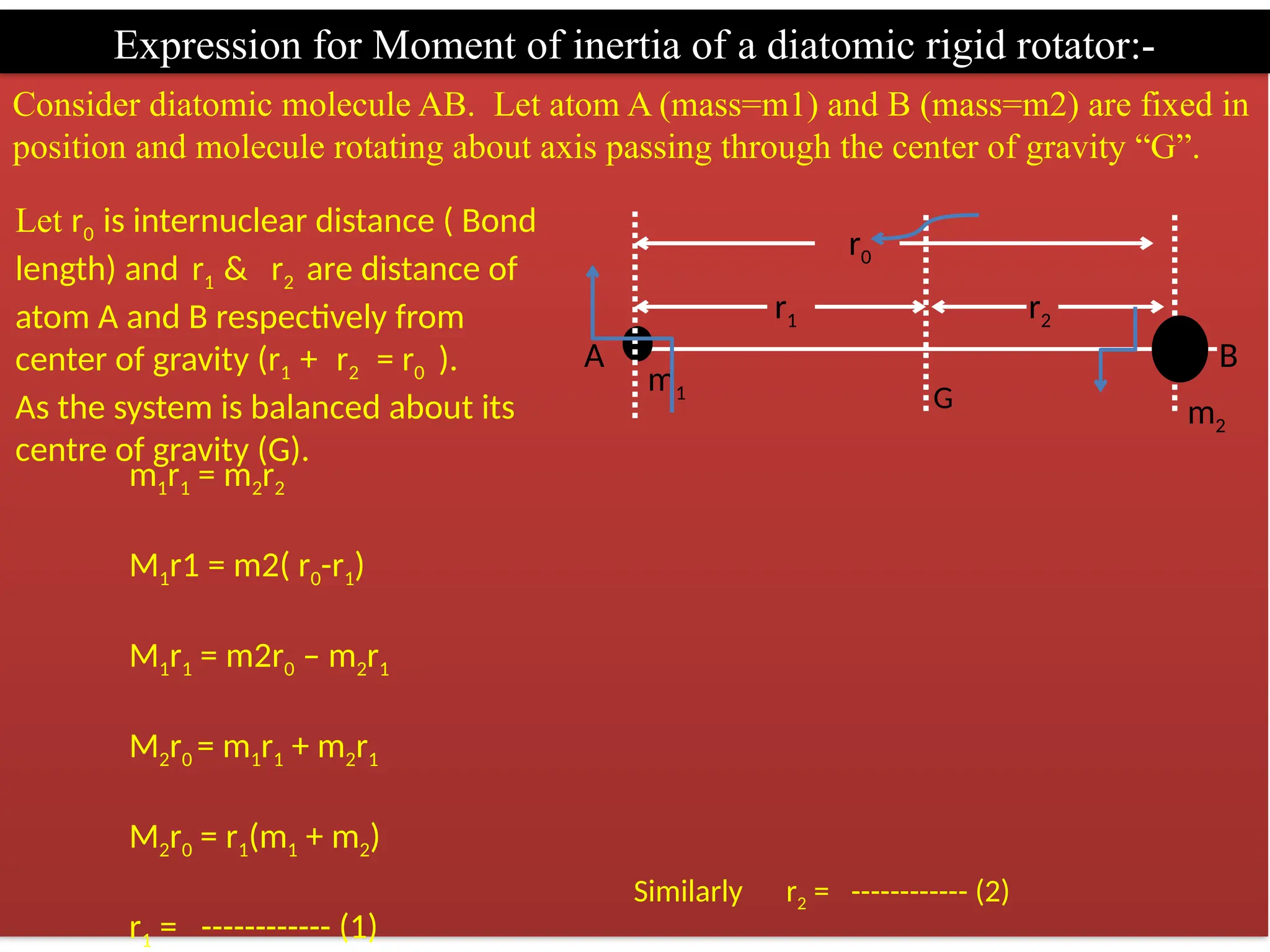
Expression for Moment of inertia of a diatomic rigid rotator:-
Consider diatomic molecule AB. Let atom A (mass=m1) and B (mass=m2) are fixed in
position and molecule rotating about axis passing through the center of gravity “G”.
A B
r1 r2
m1
m2
G
r0
Let r0 is internuclear distance ( Bond
length) and r1 & r2 are distance of
atom A and B respectively from
center of gravity (r1 + r2 = r0 ).
As the system is balanced about its
centre of gravity (G).
m1r1 = m2r2
M1r1 = m2( r0-r1)
M1r1 = m2r0 – m2r1
M2r0 = m1r1 + m2r1
M2r0 = r1(m1 + m2)
r1 = ------------ (1)
Similarly r2 = ------------ (2)
Moment of inertia ( I ) of molecule AB is given by r1 = ------------ (1)
I = m1r1
2
+ m2r2
2
-------------( 3) r2 = ------------ (2)
Substituting the values of r1 and r2 in equation (3) ,
we get
I = m1 2
+ m2 2
I = +
I =
I = x r0
2
= μr0
2
Where, μ is the reduce mass of diatomic molecule and its value is
μ=
Rotational Spectrum of Diatomic Rigid Rotator:-
Rotational energy ( Ej) of diatomic rigid rotator is obtained by solving Schrondinger
wave equation and given by
Ej = J(J+1) where, J= rotational quantum number
J=0, 1, 2, 3 --------, h= planks constant and I= moment of inertia
In microwave spectroscopy, position of lines usually expressed in cm-1
and hence
rotational energy (j) in cm-1
, which is given by
j= =J(J+1)
j= J(J+1) cm-1
[h=js, I= kgm2
, c= cm/s ]
= BJ ( J+1) cm-1
, where J=0, 1, 2, -----, and B= cm-1
For a given molecule‘ B’ is constant and is called as rotational constant of the
molecule
The value of rotational energy (
Rotational Quantum Number (J) Rotational energy (
J=O 0=0
J=1 =2B
J=2 =6B
J=3 3=12B
J=4 =20B
J=5 30B
Ex.1 J=O Ex.2 J=1
=BJ (J+1) =BJ (J+1)
=0 (0+1)B =1 (1+1)B
=0 =2B
Ex.3 J=2 Ex.4 J=3 Ex.5 J=4
=BJ (J+1) =BJ (J+1) =BJ (J+1)
=2 (2+1)B =3 (3+1)B =4 (4+1)B
=6B =12B =20B
J=3
J=2
J=1
J=0
0
2B
6B
12B
E
n
e
r
g
y
Rotational energy level diagram
Selection Rule for Rotational Transitions
 Only those rotational transition allowed for which
 ΔJ=+1 for absorption of spectrum and ΔJ=-1 for emission of spectrum.
 In microwave spectroscopy, usually ΔJ=+1 study the absorption spectrum.
Origin of line in the Rotational Spectrum of diatomic rigid rotator:-
According to selection rule, the absorption of spectrum transition arises from lower
level to higher level ( Δj= +1).
Allowed transition and lines are shown in the table.
Line Number Allowed Rotational
Transition ( Δj=+1)
Position of absorption lines
( cm-1
)
First Line J=o j=1 Position=
=2B-0 =2Bcm-1
Second Line J=1 j=2 Position=
=4Bcm-1
Third Line J=2 j=3
=6Bcm-1
Fourth Line J=3 j=4 Position=
The position of spectral lines obtained by deriving following equation
Suppose molecule absorb energy which obtained rotational transition from lower
energy level J’ to higher energy level J.
Therefore lower energy given by, EJ’=J’(J’+1)
And higher energy level given by, EJ=J(J+1)
The difference between two levels given by
ΔEr = EJ-EJ’
= =J’2
-J’]
=J’) + (J-J’)] =J’) (J-J’) + (J-J’)]
=J’) (J+J’+1)] --------------------(1)
According to selection rule for rigid rotator diatomic molecule value J change only
only one unit. Therefore
ΔJ= J-J’ =
If molecule jump from lower energy level to higher energy level, then ΔJ= +1.
If transition from higher level to lower level , then ΔJ=-1
For absorption, J-J’=+1
⁖
J’=J-1
EJ-EJ’ = [+1(J+J-1+1)
= (2J)
= J But
ΔE= h⊽c
h⊽c = J
⁖ ⊽= J = 2 J = 2B. J ---------------(2)
Where, B = This gives frequency of radiation absorbed in term
wave number the value of J= 1, 2, 3, …., in eq.2
The frequency of spectral lines come out to be 2B, 4B, 6B etc. It means that spacing
between lines is equal to ( 2B).
This is called frequency separation.
Frequency separation(2B) =
Absorption rotational spectrum of rigid rotator as shown in figure.
2B 4B 6B 8B 10B
2B 2B
2B 2B
⊽1 ⊽2 ⊽3 ⊽4 ⊽5
Fig. Absorption rotational spectrum of diatomic rigid rotator.
It is clear that the on above figure and derivation lines in absorption rotational
spectrum of diatomic rigid rotator are equal spaced and separated by 2B cm-1
Isotope Effect
 Same atomic number but different atomic mass called as isotope.
 If hetero diatomic molecule ( AB) is substituted by isotope of same element with
higher mass number ( A’B) then position of absorption spectra of two molecules
will be different.
 This phenomenon called as isotope effect.
 Isotope ( A’B) will have higher reduce mass than AB. μ=
 Bond length ( r0) is same for both.
 A’B will have high moment of inertia than AB.
 Rotational constant is inversely proportional to the moment of inertia.
 Rotational constant of A’B will lower than of AB.
 Rotational spectra of two these molecules shown in figure.
2B 4B 6B 8B
2B 2B
AB Molecule
2B
2B’ 4B’ 6B’ 8B’
2B 2B
AB’ Molecule
2B
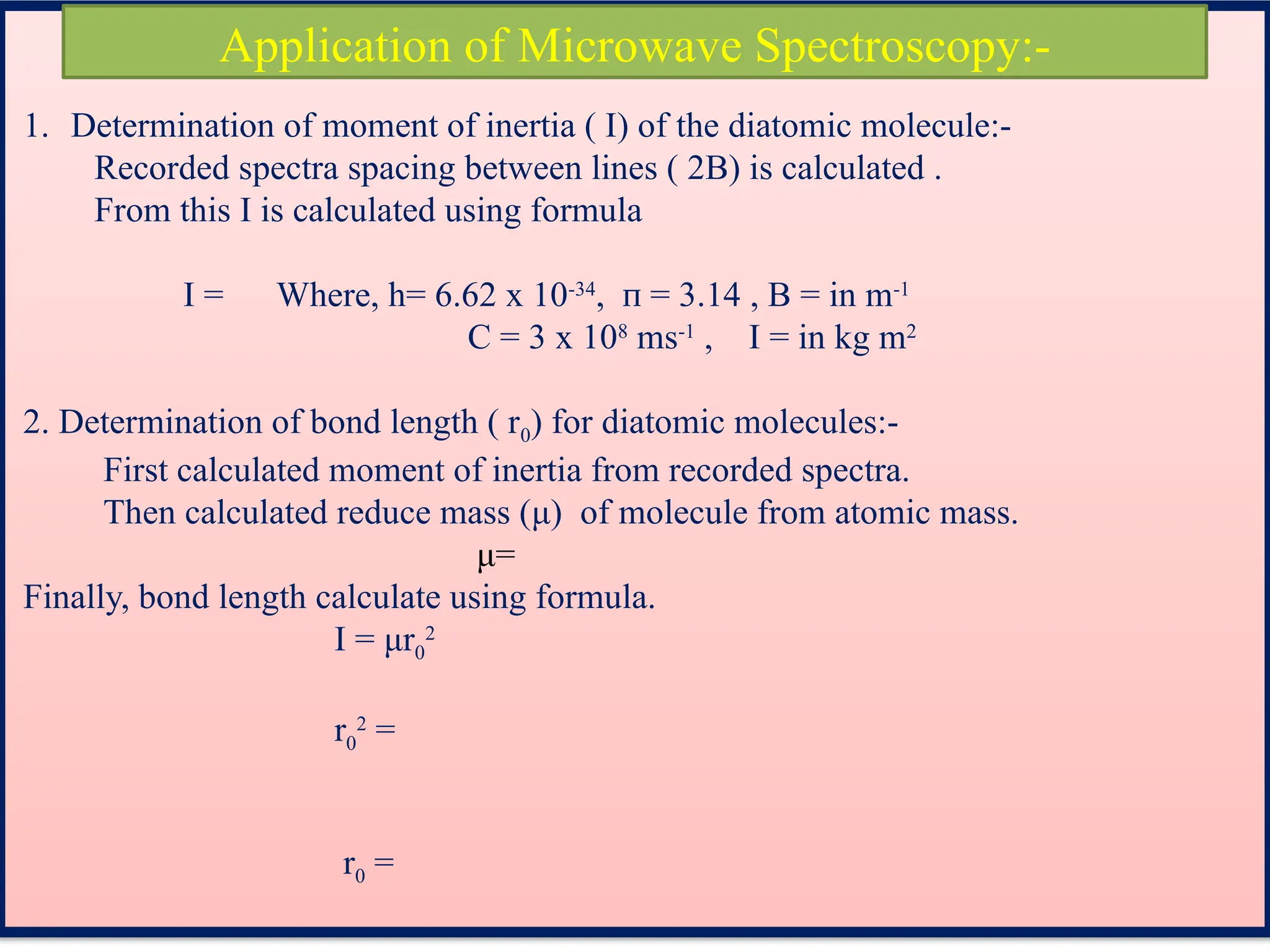
Application of Microwave Spectroscopy:-
1. Determination of moment of inertia ( I) of the diatomic molecule:-
Recorded spectra spacing between lines ( 2B) is calculated .
From this I is calculated using formula
I = Where, h= 6.62 x 10⁻³⁴
, ᴨ = 3.14 , B = in m-1
C = 3 x 10⁸
ms-1
, I = in kg m2
2. Determination of bond length ( r0) for diatomic molecules:-
First calculated moment of inertia from recorded spectra.
Then calculated reduce mass (μ) of molecule from atomic mass.
μ=
Finally, bond length calculate using formula.
I = μr0
2
r0
2
=
r0 =
THANK
YOU

Molecular Spectroscopy For UG and PG Students Part 2.pptx

  • 1.
    Shri Shivaji EducationSociety Amravati’s Shri Shivaji Arts, Commerce & Science College Motala, Dist. Buldana
  • 2.
    Molecular Spectroscopy Part-2 By Mr. BhaskarraoSubhashrao Bhise Assistant Professor Head Department of Chemistry Shri Shivaji Arts, Commerce & Science College Motala Dist. Buldana
  • 3.
    Contents 1)Energy Level Diagramof Transitions 2)Rotational ( Microwave) Spectroscopy 3)Condition for Microwave Active Molecules 4)Expression for Moment of Inertia 5)Selection Rule for Rotational Transition 6)Isotopic Effect
  • 4.
    1. Energy leveldiagram of a molecule indicating electronic, vibrational and rotational transitions:- Molecules absorb band spectrum under high resolution. It is found that band contains large number of fine lines The molecule can process discrete values of rotational, vibrational and electronic energies. The group of energy designated by quantum number ‘n’ is the energy level of molecule. Similarly vibrational energy are given by vibrational quantum energy ‘v’. Rotational energy designated by rotational quantum number ‘j’, shown in the diagram.
  • 5.
    V=0 V=1 V=2 V=3 V=4 V=0 V=1 V=2 V=3 V=4 EN EG RY J=0 J=1 J=2 J=0 J=1 J=2 4 3 2 1 4 3 2 1 B A C D ElectronicTransition Vibrational Transition Rotational Tran. Each electronic energy level contain several vibrational energy levels and each vibrational energy level contain several rotational level. ΔE (Electronic) >> ΔE (Vibrational) >> ΔE( Rotational).
  • 6.
    1. Rotational Transition:- 1.When a molecule absorb electromagnetic radiation nearly 0.005ev, the molecule is excited from lower rotational level to higher energy level. 2. The selection rule, Δj=+1. 3. The branch of molecular spectroscopy involving rotational transitions only called as rotational or microwave spectroscopy. 2. Vibrational Transitions:- 1. When a molecules absorb electromagnetic radiation nearly 0.1ev, the molecule excited from lower level to higher energy level. 2. The selection rule for this transition Δv=+1. 3. A branch of spectroscopy involving vibrational transition is called as vibrational transition. 3. Electronic Transition:- 1. When molecule absorb energy nearly 50 to 100 ev, then there is an electronic transition from lower ( ground state) energy level to higher ( excited state) energy level.
  • 7.
    Rotational ( Microwave)Spectroscopy:-  When electromagnetic radiation supply energy, molecule absorb microwave region energy, then only rotational transition occurs.  Microwave absorption spectrum of a molecule consist of equally discrete lines. Condition for microwave active molecules:-  Molecules having capability of absorbing microwave radiation are called as microwave active molecules.  Microwave active molecules having permanent dipole moment. i.e. molecule must be polar.  Hetero diatomic molecule like NO, CO, HCl, HBr, HF etc are active.  Mononuclear diatomic molecules like H2, O2, N2, Cl2, F2 etc are microwave inactive because these are non-polar molecules.( μ=0).  For microwave active spectrum must be molecule in gaseous state because of condensed state ( solid or liquid) rotational energy very close to each other and hence spectrum can not recorded.  HCl(gas) gives rotational spectrum but HCl(liquid) can not record spectrum.
  • 8.
    Expression for Momentof inertia of a diatomic rigid rotator:- Consider diatomic molecule AB. Let atom A (mass=m1) and B (mass=m2) are fixed in position and molecule rotating about axis passing through the center of gravity “G”. A B r1 r2 m1 m2 G r0 Let r0 is internuclear distance ( Bond length) and r1 & r2 are distance of atom A and B respectively from center of gravity (r1 + r2 = r0 ). As the system is balanced about its centre of gravity (G). m1r1 = m2r2 M1r1 = m2( r0-r1) M1r1 = m2r0 – m2r1 M2r0 = m1r1 + m2r1 M2r0 = r1(m1 + m2) r1 = ------------ (1) Similarly r2 = ------------ (2)
  • 9.
    Moment of inertia( I ) of molecule AB is given by r1 = ------------ (1) I = m1r1 2 + m2r2 2 -------------( 3) r2 = ------------ (2) Substituting the values of r1 and r2 in equation (3) , we get I = m1 2 + m2 2 I = + I = I = x r0 2 = μr0 2 Where, μ is the reduce mass of diatomic molecule and its value is μ=
  • 10.
    Rotational Spectrum ofDiatomic Rigid Rotator:- Rotational energy ( Ej) of diatomic rigid rotator is obtained by solving Schrondinger wave equation and given by Ej = J(J+1) where, J= rotational quantum number J=0, 1, 2, 3 --------, h= planks constant and I= moment of inertia In microwave spectroscopy, position of lines usually expressed in cm-1 and hence rotational energy (j) in cm-1 , which is given by j= =J(J+1) j= J(J+1) cm-1 [h=js, I= kgm2 , c= cm/s ] = BJ ( J+1) cm-1 , where J=0, 1, 2, -----, and B= cm-1 For a given molecule‘ B’ is constant and is called as rotational constant of the molecule
  • 11.
    The value ofrotational energy ( Rotational Quantum Number (J) Rotational energy ( J=O 0=0 J=1 =2B J=2 =6B J=3 3=12B J=4 =20B J=5 30B Ex.1 J=O Ex.2 J=1 =BJ (J+1) =BJ (J+1) =0 (0+1)B =1 (1+1)B =0 =2B Ex.3 J=2 Ex.4 J=3 Ex.5 J=4 =BJ (J+1) =BJ (J+1) =BJ (J+1) =2 (2+1)B =3 (3+1)B =4 (4+1)B =6B =12B =20B J=3 J=2 J=1 J=0 0 2B 6B 12B E n e r g y Rotational energy level diagram
  • 12.
    Selection Rule forRotational Transitions  Only those rotational transition allowed for which  ΔJ=+1 for absorption of spectrum and ΔJ=-1 for emission of spectrum.  In microwave spectroscopy, usually ΔJ=+1 study the absorption spectrum. Origin of line in the Rotational Spectrum of diatomic rigid rotator:- According to selection rule, the absorption of spectrum transition arises from lower level to higher level ( Δj= +1). Allowed transition and lines are shown in the table. Line Number Allowed Rotational Transition ( Δj=+1) Position of absorption lines ( cm-1 ) First Line J=o j=1 Position= =2B-0 =2Bcm-1 Second Line J=1 j=2 Position= =4Bcm-1 Third Line J=2 j=3 =6Bcm-1 Fourth Line J=3 j=4 Position=
  • 13.
    The position ofspectral lines obtained by deriving following equation Suppose molecule absorb energy which obtained rotational transition from lower energy level J’ to higher energy level J. Therefore lower energy given by, EJ’=J’(J’+1) And higher energy level given by, EJ=J(J+1) The difference between two levels given by ΔEr = EJ-EJ’ = =J’2 -J’] =J’) + (J-J’)] =J’) (J-J’) + (J-J’)] =J’) (J+J’+1)] --------------------(1) According to selection rule for rigid rotator diatomic molecule value J change only only one unit. Therefore ΔJ= J-J’ =
  • 14.
    If molecule jumpfrom lower energy level to higher energy level, then ΔJ= +1. If transition from higher level to lower level , then ΔJ=-1 For absorption, J-J’=+1 ⁖ J’=J-1 EJ-EJ’ = [+1(J+J-1+1) = (2J) = J But ΔE= h⊽c h⊽c = J ⁖ ⊽= J = 2 J = 2B. J ---------------(2) Where, B = This gives frequency of radiation absorbed in term wave number the value of J= 1, 2, 3, …., in eq.2
  • 15.
    The frequency ofspectral lines come out to be 2B, 4B, 6B etc. It means that spacing between lines is equal to ( 2B). This is called frequency separation. Frequency separation(2B) = Absorption rotational spectrum of rigid rotator as shown in figure. 2B 4B 6B 8B 10B 2B 2B 2B 2B ⊽1 ⊽2 ⊽3 ⊽4 ⊽5 Fig. Absorption rotational spectrum of diatomic rigid rotator. It is clear that the on above figure and derivation lines in absorption rotational spectrum of diatomic rigid rotator are equal spaced and separated by 2B cm-1
  • 16.
    Isotope Effect  Sameatomic number but different atomic mass called as isotope.  If hetero diatomic molecule ( AB) is substituted by isotope of same element with higher mass number ( A’B) then position of absorption spectra of two molecules will be different.  This phenomenon called as isotope effect.  Isotope ( A’B) will have higher reduce mass than AB. μ=  Bond length ( r0) is same for both.  A’B will have high moment of inertia than AB.  Rotational constant is inversely proportional to the moment of inertia.  Rotational constant of A’B will lower than of AB.  Rotational spectra of two these molecules shown in figure. 2B 4B 6B 8B 2B 2B AB Molecule 2B 2B’ 4B’ 6B’ 8B’ 2B 2B AB’ Molecule 2B
  • 17.
    Application of MicrowaveSpectroscopy:- 1. Determination of moment of inertia ( I) of the diatomic molecule:- Recorded spectra spacing between lines ( 2B) is calculated . From this I is calculated using formula I = Where, h= 6.62 x 10⁻³⁴ , ᴨ = 3.14 , B = in m-1 C = 3 x 10⁸ ms-1 , I = in kg m2 2. Determination of bond length ( r0) for diatomic molecules:- First calculated moment of inertia from recorded spectra. Then calculated reduce mass (μ) of molecule from atomic mass. μ= Finally, bond length calculate using formula. I = μr0 2 r0 2 = r0 =
  • 18.