NEUTRON DIFFRACTION
Presented by-
Nirmal Urma
Jayashree Sa
Rajashree khatua
Contents-
• Introduction
• XRD
• Neutron Diffraction
• Principle
• Instrumentation
• Working
• Application
• Future
Introduction-
• A phenomena that occurs when a wave encounters
an obstacle
• When collimated beam of waves strikes pair of
parallel lattice planes in a crystal, each atom acts as
a scattering center
• The secondary waves from the diffraction interfere
with each other to produce diffracted images
• Three types of diffraction techniques
- XRD
- Neutron diffraction
- Electron diffraction
XRD-
• XRD is a common analytical technique used for the study of
crystal structures and atomic spacing. It is used to identify
the degree of crystallinity of a material which provides
information on unit cell dimension. This technique is based
on the principle of interference.
• XRD has size limitation. It is much more accurate for
measuring large crystalline structures rather than small
ones.
• It does not interact strongly with lighter elements.
• It is relatively low in sensitivity.
• It cannot explain the magnetic properties.
Why neutrons?
- Wave length comparable with inter atomic spacing
- Kinetic energy is comparable with the interaction
energy in solid
- Isotopic sensitivity allows contrast variation
- Neutrons has both wave and particle properties
- Penetrating => bulk properties are measured
- Neutron possesses spin
Neutron diffraction-
• Neutron diffraction is the application of neutron
scattering to the determination of the atomic
and/or magnetic structure of a material. It can
be equally well applied to study crystalline solid,
gases, liquids or amorphous materials.
• The technique is similar to X-ray diffraction but
the different type of radiation gives
complementary information.
• As neutrons have high penetration depth are
suited for the analysis of bulk samples.
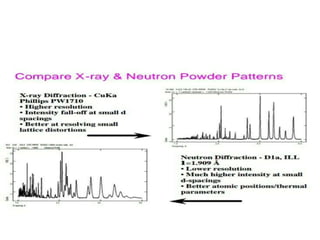
XRD vs NEUTRON DIFFRACTION
NEUTRON DIFFRACTION
 Neighbours and isotopes
can be discriminated
 Light elements can be
detected
 Magnetic structures can be
investigated
 Lower absorption
XRD
 Neighbours and isotopes
cannot be discriminated
 Light elements hard to detect
 Magnetic properties cannot
be investigated
 Strong absorption
Different modes in neutron scattering-
1. Nuclear scattering-
It involves the interaction of a neutron with
the nucleus of the atom, so scattering is isotopic
2. Magnetic scattering-
It involves the interaction of a neutron with
the extended atomic electron distribution, so
the form factor is more like that seen for XRD
and it revels the microscopic magnetic structure
of material
 The magnetic scattering length is comparable to
the nuclear scattering length, i.e the magnetic
and nuclear signals have comparable strengths.
Importance-
• Nuclear neutron scattering:
- Elastic scattering
diffraction-crystal structure
- Inelastic scattering
excitations-phonons
• Magnetic neutron scattering:
-Elastic scattering
diffraction- spin structure
-Inelastic scattering
Excitations- magnons
Principle-
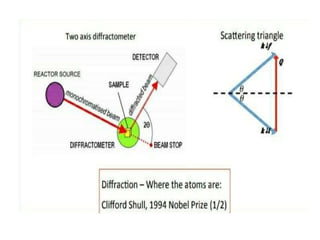
• When a monochromatic radiation fall on sample,
the diffraction from a Bragg plane results in the
form of a cone ( Debye Scherer cone) with angle
2θ.
• The diffracted beam is shaped using suitable optical
devices. The intensity profile is recorded in the
detector.
Instrumentation-
• Neutron source- produce neutrons
• Monochromator
• Diffractometer or spectrometer
-allows neutron to interact with sample
- sorts out discrete wave length by monochromator
• Detector- detectors pick up neutrons scattered from
sample
• Analysis methods to determine material properties
• Brain power to interpret results
Working-
• This techniques requires a source of neutron. Neutrons
usually produced in a nuclear reactor or spallation
source.
• The source of neutron passed through the
monochromator , the monochromatized beam is
subjected to fall on diffractometer.
• Filters are also used to select desired neutron
wavelength.
• The sample is placed within a neutron beam and the
angles at which the neutrons are deflected or scattered
by the material are recorded to generate a “diffraction
pattern” from which structural information can be
extracted.
Application-
Used for determination of structure
Locating light atoms
Heavy atoms that absorb x-ray strongly
Similar atomic no/ isotopes
Magnetic properties
Single crystal study analysis
Inelastic scattering used for study of atomic
vibration and other excitations
Future of neutron diffraction-
• Neutron diffraction is now a tried-and tested
technique in strong demand by researchers
investigating the structure of material.
• Neutron diffraction is also being used to develop
technologies for electrical energy storage :
researchers are investigating the light elements
present in compounds suitable for ion exchange
systems.
• As the technique advances and wider ranges of
temperature and pressure are incorporated , the
research condition will improve, opening the
doors for new investigation.

Neutron diffraction

  • 1.
    NEUTRON DIFFRACTION Presented by- NirmalUrma Jayashree Sa Rajashree khatua
  • 2.
    Contents- • Introduction • XRD •Neutron Diffraction • Principle • Instrumentation • Working • Application • Future
  • 3.
    Introduction- • A phenomenathat occurs when a wave encounters an obstacle • When collimated beam of waves strikes pair of parallel lattice planes in a crystal, each atom acts as a scattering center • The secondary waves from the diffraction interfere with each other to produce diffracted images • Three types of diffraction techniques - XRD - Neutron diffraction - Electron diffraction
  • 4.
    XRD- • XRD isa common analytical technique used for the study of crystal structures and atomic spacing. It is used to identify the degree of crystallinity of a material which provides information on unit cell dimension. This technique is based on the principle of interference. • XRD has size limitation. It is much more accurate for measuring large crystalline structures rather than small ones. • It does not interact strongly with lighter elements. • It is relatively low in sensitivity. • It cannot explain the magnetic properties.
  • 5.
    Why neutrons? - Wavelength comparable with inter atomic spacing - Kinetic energy is comparable with the interaction energy in solid - Isotopic sensitivity allows contrast variation - Neutrons has both wave and particle properties - Penetrating => bulk properties are measured - Neutron possesses spin
  • 6.
    Neutron diffraction- • Neutrondiffraction is the application of neutron scattering to the determination of the atomic and/or magnetic structure of a material. It can be equally well applied to study crystalline solid, gases, liquids or amorphous materials. • The technique is similar to X-ray diffraction but the different type of radiation gives complementary information. • As neutrons have high penetration depth are suited for the analysis of bulk samples.
  • 7.
    XRD vs NEUTRONDIFFRACTION NEUTRON DIFFRACTION  Neighbours and isotopes can be discriminated  Light elements can be detected  Magnetic structures can be investigated  Lower absorption XRD  Neighbours and isotopes cannot be discriminated  Light elements hard to detect  Magnetic properties cannot be investigated  Strong absorption
  • 8.
    Different modes inneutron scattering- 1. Nuclear scattering- It involves the interaction of a neutron with the nucleus of the atom, so scattering is isotopic 2. Magnetic scattering- It involves the interaction of a neutron with the extended atomic electron distribution, so the form factor is more like that seen for XRD and it revels the microscopic magnetic structure of material  The magnetic scattering length is comparable to the nuclear scattering length, i.e the magnetic and nuclear signals have comparable strengths.
  • 9.
    Importance- • Nuclear neutronscattering: - Elastic scattering diffraction-crystal structure - Inelastic scattering excitations-phonons • Magnetic neutron scattering: -Elastic scattering diffraction- spin structure -Inelastic scattering Excitations- magnons
  • 10.
    Principle- • When amonochromatic radiation fall on sample, the diffraction from a Bragg plane results in the form of a cone ( Debye Scherer cone) with angle 2θ. • The diffracted beam is shaped using suitable optical devices. The intensity profile is recorded in the detector.
  • 11.
    Instrumentation- • Neutron source-produce neutrons • Monochromator • Diffractometer or spectrometer -allows neutron to interact with sample - sorts out discrete wave length by monochromator • Detector- detectors pick up neutrons scattered from sample • Analysis methods to determine material properties • Brain power to interpret results
  • 13.
    Working- • This techniquesrequires a source of neutron. Neutrons usually produced in a nuclear reactor or spallation source. • The source of neutron passed through the monochromator , the monochromatized beam is subjected to fall on diffractometer. • Filters are also used to select desired neutron wavelength. • The sample is placed within a neutron beam and the angles at which the neutrons are deflected or scattered by the material are recorded to generate a “diffraction pattern” from which structural information can be extracted.
  • 15.
    Application- Used for determinationof structure Locating light atoms Heavy atoms that absorb x-ray strongly Similar atomic no/ isotopes Magnetic properties Single crystal study analysis Inelastic scattering used for study of atomic vibration and other excitations
  • 16.
    Future of neutrondiffraction- • Neutron diffraction is now a tried-and tested technique in strong demand by researchers investigating the structure of material. • Neutron diffraction is also being used to develop technologies for electrical energy storage : researchers are investigating the light elements present in compounds suitable for ion exchange systems. • As the technique advances and wider ranges of temperature and pressure are incorporated , the research condition will improve, opening the doors for new investigation.