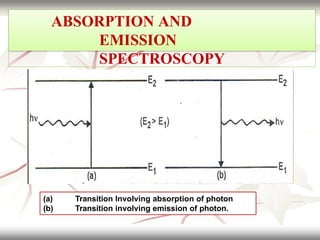
Spectroscopy is thatbranch of science which deals with the study
of interaction of electromagnetic radiations with matter.
ELECTROMAGNETIC RADIATION
The term electromagnetic radiation represents the radiant energy emitted
from any source in the form of light, heat etc. Some important
characteristics of these electromagnetic radiations are given below :
(i) They have dual character i.e. particle character as well as
wave character. For example, a beam of light is a stream of
particles called photons moving through the space in the form
of waves.
(ii) fields
to
These waves are associated with electric and
magnetic
oscillating perpendicular to each other and also perpendicular
the direction of propagation.
(iii) All electromagnetic radiations travel with the velocity of light.
According to Born-Oppenheimer
approximation,the total energy of a molecule is the
rotational, vibrational and
sum of translational,
electronic energies, i.e.
E = Et + Er + Ev + Ee
It is found that the translational energy is
negligibly small. Hence Born-Oppenheimer
approximation can be written as
E = Er + Ev + Ee
7.
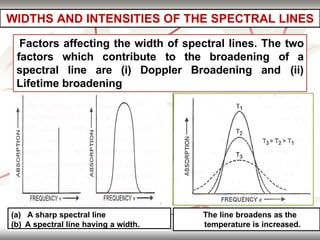
WIDTHS AND INTENSITIESOF THE SPECTRAL LINES
spectral line are (i) Doppler Broadening and
Factors affecting the width of spectral lines. The two
factors which contribute to the broadening of a
(ii)
Lifetime broadening
(a) A sharp spectral line
(b) A spectral line having a width.
The line broadens as the
temperature is increased.
8.
Microwave Spectroscopy
It isconcerned with transitions between rotational energy levels
in the molecules, the molecule gives a rotational spectrum only
If it has a permanent dipole moment:
A‾
B+
B+
A‾
Rotating molecule
H-Cl, and C=O give rotational spectrum (microwave active).
H-H and Cl-Cl don't give rotational spectrum (microwave inactive).
Rotational spectroscopy is only really practical in the gas phase
where the rotational motion is quantized. In solids or liquids the
rotational motion is usually quenched due to collisions between their
molecules.
9.
General features ofrotating
system:
1- Rotational motion in classical mechanics
Rigid Rotors: molecules in which bonds
don't distort under the stress of rotation.
Linear velocity (v) = ----------
Time
Distance
Angular velocity (ω) =
------------
Radians
Time
10.
Linear momentum (P)= m .
v
Angular momentum (J) = I . ω
Then; I = m .r2 Where;
the moment of inertia for a molecule (I) =
Σ m r2
Where: r is the
perpendicular distance of the atom from the axis of
rotation (bond length).
Moment of inertia (I),
also called mass moment of inertia which is a
11.
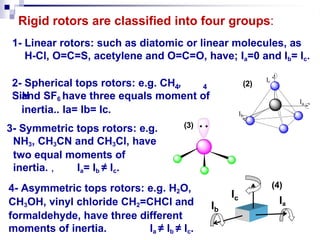
Rigid rotors areclassified into four groups:
1- Linear rotors: such as diatomic or linear molecules, as
H-Cl, O=C=S, acetylene and O=C=O, have; Ia=0 and Ib= Ic.
2- Spherical tops rotors: e.g. CH ,
SiH
4 4
and SF6 have three equals moment of
inertia.. Ia= Ib= Ic.
3- Symmetric tops rotors: e.g.
NH3, CH3CN and CH3Cl, have
two equal moments of
inertia. , Ia= Ib ≠ Ic.
(3)
4- Asymmetric tops rotors: e.g. H2O,
CH3OH, vinyl chloride CH2=CHCl and
formaldehyde, have three different
moments of inertia. Ia ≠ Ib ≠ Ic.
Ic
Ib
(4)
Ia
Ia
Ib
Ic
(2)
12.
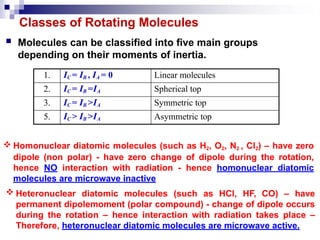
Classes of RotatingMolecules
Molecules can be classified into five main groups
depending on their moments of inertia.
1. IC = IB , IA = 0 Linear molecules
2. IC = IB =IA Spherical top
3. IC = IB >IA Symmetric top
5. IC > IB >IA Asymmetric top
Homonuclear diatomic molecules (such as H2, O2, N2 , Cl2) – have zero
dipole (non polar) - have zero change of dipole during the rotation,
hence NO interaction with radiation - hence homonuclear diatomic
molecules are microwave inactive
Heteronuclear diatomic molecules (such as HCl, HF, CO) – have
permanent dipolemoment (polar compound) - change of dipole occurs
during the rotation – hence interaction with radiation takes place –
Therefore, heteronuclear diatomic molecules are microwave active.
13.
From the momentof inertia one can calculate
the bond length as well as the atomic
For linear diatomic molecules, the moment of
inertia
can be calculated as follows;
14.
ROTATIONAL (MICROWAVE) SPECTRAOF DIATOMIC
MOLECULES
h2
Er = -------- j (J +1)
8π2 I
m1 and m2
are
the masses
of the
two
Where
atomic
atoms of the
diatomic molecule and
m1m2
------------ = µ
m1+m2
II
==
rr00
22 ==
µµrroo
22
m1m2
-------------
-----------
m1+m2
15.
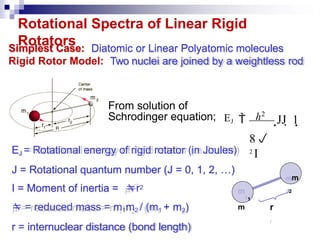
Simplest Case: Diatomicor Linear Polyatomic molecules
Rigid Rotor Model: Two nuclei are joined by a weightless rod
EJ = Rotational energy of rigid rotator (in Joules)
J = Rotational quantum number (J = 0, 1, 2, …)
I = Moment of inertia = r2
= reduced mass = m1m2 / (m1 + m2)
r = internuclear distance (bond length)
JJ 1
h2
8
2
I
From solution of
Schrodinger equation; EJ
mm
22
m
m
11
r
r
Rotational Spectra of Linear Rigid
Rotators
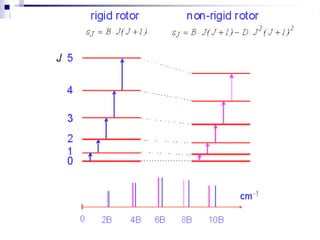
Rotational transitions inrigid diatomic molecule.
Selection rules:
1.molecule gives a
rotational spectrum only if it
has a permanent dipole
moment
2. Δ J = ± 1
+1 absorption.
-1 emission.
Separation between adjacent
levels:
EJ = E(J) – E(J-1) = 2BJ
Allowed transitions
and B can be obtained from the
spacing between rotational lines in
the spectra of molecules.
19.
Transitions observed inthe rotational spectrum
1
Then; Ej Ej 1 Ej 0 2B 0 2B cm
position of the first line in the spectrum
j 0 j 1
* For the transition; J 1 J 2
1
Ej Ej 2 Ej 1 6B 2B 4B cm
position of the second line in
the spectrum j 1 j 2
* For the transition; J 2 J 3
JJ 1
h
8
2
Ic
J
Since; E
* For the transition; J 0 J 1
and;
20.
Since, The allowedrotational energies are given by;
The wave numbers of the different rotational levels will
be; 0, 2B, 6B, 12B, 20B, 30B (cm-1),… and so on
And for two adjacent rotational states, the energy
1
Ej Ej 1 Ej 2B(J 1) cm
difference is given by;
Hence, the wave number of the lines observed in the
rotational spectrum will be; 2B, 4B, 6B, 8B (cm-1), …… and
so on.
And the various lines in the rotational spectra will be equally
spaced (separation between lines = 2B)..
22.
Microwave spectrum ofrigid rotator
Separation between adjacent lines = 2B
So, B can be obtained from the spacing between
rotational lines.
23.
Intensity of rotationalspectral
lines (Population of energy
levels)
Boltzmann
distribution
Number of degenerated
energy levels
Population of energy levels is affected by;
1 Boltzmann distribution
2 Number of degenerated energy levels
(levels which have the same energies)
24.
1-Boltzmann distribution
The numberof molecules in the first state
No
The number of molecules in any higher state
Nj
eEJ k T
eh k T ehc k T
No
j
B J (J 1)
So,
Nj
eBhcJ ( J 1)/ kT
eBJ ( J 1) hc kT
No
The population of the state decreases as the J –value increases.
N j
25.
I 2 2 P2
2 I
2 I
2
I
E
I I
2 P 2 E I
E
2
h2 2
h2 J (J 1)
4 2
2 E I P
is the fundamental angular momentum unit.
h
2
2
J ( J 1) unit.
J (J 1)
4 2I
P J (J 1)
h
2-Degeneracy
The existence of more than two energy states having the
same energy.
Kinetic energy (K.E) in rotational motion =½ I.ω2
and since, angular momentum (P) = I.ω then;
26.
Effect of isotopicsubstitution
12C16O 13C16O,
On changing from atomic mass
increases, B decreases ( 1/I), so energy of levels
becomes lower.
2B 4B 8B 12B
cm-1 spectrum
5
4
3
2
1
0
12CO J = 6
13CO
Energy
levels
27.
From comparison ofrotational energy levels of 12CO and
13CO
We can determine:
(i) isotopic masses accurately, to within 0.02% of other
methods for atoms in gaseous molecules;
(ii) isotopic abundances from the absorption relative intensities.
Example:
12CO
for the transition J=0 J=1 appears at 3.84235 cm-1
for 13CO the transition J=0 J=1 appears at
Given : 12C = 12.0000 ; O = 15.9994
3.67337 cm-1
amu
30.
Applications of microwavespectroscopy
Microwave spectroscopy has been used in monitoring
and control of industrial processes. It is an ideal
process analyzer as it is:
1. non-invasive: the measurement can be made
outside of the reaction chamber, eliminates
the need for sampling or physical removal of
sample.
2. non-destructive.
3. can be used for solids, liquids, gases and
suspensions .
4. can be used for dark coloured samples.
5. analyses large sample volumes, as microwaves
diffuse out from the transmitter though the
31.
Microwave spectroscopy hasbeen used in monitoring
and control of industrial processes, such as;
1. materials with low dielectric constants, such as
plastics, glass, ceramics and composite materials.
2. determination of moisture in various tobacco
types.
3. Monitoring of a batch esterification reaction as in
the esterification of butanol by acetic acid.
4. Monitoring of the drying process in industry as it
is one that is hard to monitor. For example, huge
cakes of wet material when dried in big vessels.
5. Astrophysical applications, radioastronomy: probe
of the molecular universe (molecular clouds)
using Telescope.