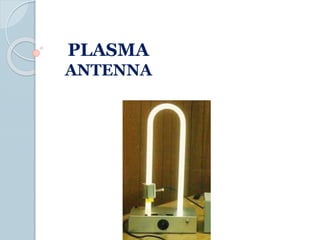
PLASMA
ANTENNA
CONTENTS
BRIEF INTRODUTION TO
PLASMA
ABOUT PLASMA ANTENNA
AND ITS PRINCIPAL
THEORY OF PLASMA
ANTENNA
WORKING
ADVANTAGES
APPLICATIONS
ABOUT THE DISCOVERERS OF
PLASMA
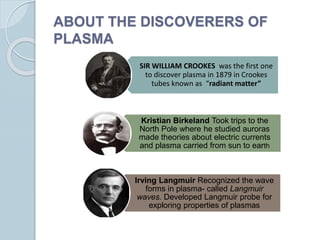
SIR WILLIAM CROOKES was the first one
to discover plasma in 1879 in Crookes
tubes known as “radiant matter”
Kristian Birkeland Took trips to the
North Pole where he studied auroras
made theories about electric currents
and plasma carried from sun to earth
Irving Langmuir Recognized the wave
forms in plasma- called Langmuir
waves. Developed Langmuir probe for
exploring properties of plasmas
4 STATES OF MATTERS
SOLID LIQUID GAS
PLASMA
WHAT IS PLASMA?
Plasma is the fourth state of matter ,the other three are
solid, liquid, and gas. A plasma is an ionized gas.
A gas becomes a plasma, when the addition of heat or other
energy causes a significant number of atoms to release some
or all of their electrons. The detached negative electrons are
free to move.
The atoms are left with positive charges The electrically
charged gas are said to be “ionized”.
CLASSIFICATION OF PLASMA
PLASMA
LOW TEMPERATURE
PLASMA
COLD PLASMA
(at room
temperature
HOT PLASMA
(at temperature
of 200-20000k)
HIGH TEMPERATURE
PLASMA(at
temperature of
10^8-10^9 K)
ANTENNA AND ITS PRINCIPLE
DEFINATION -Antenna is defined as an electrical conductor of
specific length that radiate radio waves generated by a
transmitter and collects that waves at receiver .
ANTENNA PRINCIPLE-
 When voltage is applied to an antenna, electric field is
produced
 It causes current to flow in antenna
 Due to current flow, magnetic field is produced.
 These two fields are emitted from an antenna and
propagate through space over very long distance.
Plasma antenna
Plasma antenna employs ionized
gas enclosed in a tube (or other
enclosure) as the conducting
element of an antenna. Plasma,
or ionized volume, simply
replaces a solid conductors.
A highly ionized plasma is a good
conductors, therefore plasma Filament
can serve as transmission line elements
for guiding waves. A ionized volume
can take a variety of forms. It can be
established in air at atmospheric
pressure by using Lasers, high power
microwave beams or ultraviolet rays.
A plasma might also be generated from
a gas filled tube containing a noble gas
like Neon or Argon. Using of tube
require less energy to excite and
maintain the plasma state, because the
gas is pure and the pressure of the tube
prevents dissipation.
PLASMA ANTENNA THEORY
 Let center-fed dipole plasma antenna
with triangular current and let plasma
dipole antenna oriented along the z-
axis.
 The dielectric constant for the plasma
is defined as-
Where,
is the plasma frequency and m is the mass of the
electron is the electron velocity ,e is the charge on electron is
the applied frequency in radian per second.
 


j
p


2
1
p
GENERATION OF ELECTRIC
AND MAGNETIC FIELD
When voltage
applied to an
antenna, electric
field produced.
Causes current
to flow in
antenna. Due to
current flow,
magnetic field
produced.
These two
fields are
emitted from
an antenna and
propagate
through space
over very long
distances.
FIELDS PRODUCED BY
ANTENNA
WORKING OF PLASMA
ANTENNA
-
• When supply is given to the tube, the gas inside it gets
ionized to plasma.
-
• When plasma is highly energized, it behaves as a
conductor.
-
• Antenna generates a localized concentration of plasma
to form a plasma mirror that deflects RF beam launched
from a central feed located at focus of mirror.
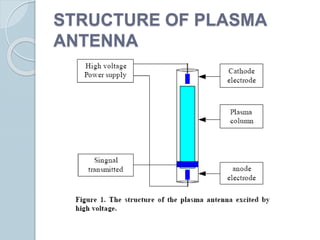
WORKING PRINCIPAL FIGURE
STRUCTURE OF PLASMA
ANTENNA
ADVANTAGES OF PLASMA
ANTENNA
1
• The length of an ionized filament can be changed rapidly, thereby “retuning” the
antenna to a new frequency
2
• The antenna can be “turned off” to make it electrically invisible . This reduce
scattering and eliminating coupling ,interference with other nearby antenna
3
• High gain , Wide bandwidth. and Compact and light weight.
4
• The design allows for extremely short pulse, important to many forms of digital
communication and radar.
5
• When a plasma element is not energized it is difficult to detect by radar. Even when it
is energized, it is transparent to the transmissions above the plasma frequency.
APPLICATIONS
1
• In high speed digital communication and radar system.
2
• In radio antenna.
3
• Stealth for military application.
4
• Used for transmission and modulation techniques(PM,AM,FM
5
• Defense, Space and Homeland Security.
CONCLUSION
It is more advantageous than other
antenna due to ionized gas.
Its action has many general with the
dielectric antenna action.
It helps in pulse operation.
THANK YOU
Made by
Anita Malviya

Plasma Antenna

  • 1.
  • 2.
    CONTENTS BRIEF INTRODUTION TO PLASMA ABOUTPLASMA ANTENNA AND ITS PRINCIPAL THEORY OF PLASMA ANTENNA WORKING ADVANTAGES APPLICATIONS
  • 3.
    ABOUT THE DISCOVERERSOF PLASMA SIR WILLIAM CROOKES was the first one to discover plasma in 1879 in Crookes tubes known as “radiant matter” Kristian Birkeland Took trips to the North Pole where he studied auroras made theories about electric currents and plasma carried from sun to earth Irving Langmuir Recognized the wave forms in plasma- called Langmuir waves. Developed Langmuir probe for exploring properties of plasmas
  • 4.
    4 STATES OFMATTERS SOLID LIQUID GAS PLASMA
  • 5.
    WHAT IS PLASMA? Plasmais the fourth state of matter ,the other three are solid, liquid, and gas. A plasma is an ionized gas. A gas becomes a plasma, when the addition of heat or other energy causes a significant number of atoms to release some or all of their electrons. The detached negative electrons are free to move. The atoms are left with positive charges The electrically charged gas are said to be “ionized”.
  • 6.
    CLASSIFICATION OF PLASMA PLASMA LOWTEMPERATURE PLASMA COLD PLASMA (at room temperature HOT PLASMA (at temperature of 200-20000k) HIGH TEMPERATURE PLASMA(at temperature of 10^8-10^9 K)
  • 7.
    ANTENNA AND ITSPRINCIPLE DEFINATION -Antenna is defined as an electrical conductor of specific length that radiate radio waves generated by a transmitter and collects that waves at receiver . ANTENNA PRINCIPLE-  When voltage is applied to an antenna, electric field is produced  It causes current to flow in antenna  Due to current flow, magnetic field is produced.  These two fields are emitted from an antenna and propagate through space over very long distance.
  • 8.
    Plasma antenna Plasma antennaemploys ionized gas enclosed in a tube (or other enclosure) as the conducting element of an antenna. Plasma, or ionized volume, simply replaces a solid conductors. A highly ionized plasma is a good conductors, therefore plasma Filament can serve as transmission line elements for guiding waves. A ionized volume can take a variety of forms. It can be established in air at atmospheric pressure by using Lasers, high power microwave beams or ultraviolet rays. A plasma might also be generated from a gas filled tube containing a noble gas like Neon or Argon. Using of tube require less energy to excite and maintain the plasma state, because the gas is pure and the pressure of the tube prevents dissipation.
  • 9.
    PLASMA ANTENNA THEORY Let center-fed dipole plasma antenna with triangular current and let plasma dipole antenna oriented along the z- axis.  The dielectric constant for the plasma is defined as- Where, is the plasma frequency and m is the mass of the electron is the electron velocity ,e is the charge on electron is the applied frequency in radian per second.     j p   2 1 p
  • 10.
    GENERATION OF ELECTRIC ANDMAGNETIC FIELD When voltage applied to an antenna, electric field produced. Causes current to flow in antenna. Due to current flow, magnetic field produced. These two fields are emitted from an antenna and propagate through space over very long distances.
  • 11.
  • 12.
    WORKING OF PLASMA ANTENNA - •When supply is given to the tube, the gas inside it gets ionized to plasma. - • When plasma is highly energized, it behaves as a conductor. - • Antenna generates a localized concentration of plasma to form a plasma mirror that deflects RF beam launched from a central feed located at focus of mirror.
  • 13.
  • 14.
  • 15.
    ADVANTAGES OF PLASMA ANTENNA 1 •The length of an ionized filament can be changed rapidly, thereby “retuning” the antenna to a new frequency 2 • The antenna can be “turned off” to make it electrically invisible . This reduce scattering and eliminating coupling ,interference with other nearby antenna 3 • High gain , Wide bandwidth. and Compact and light weight. 4 • The design allows for extremely short pulse, important to many forms of digital communication and radar. 5 • When a plasma element is not energized it is difficult to detect by radar. Even when it is energized, it is transparent to the transmissions above the plasma frequency.
  • 16.
    APPLICATIONS 1 • In highspeed digital communication and radar system. 2 • In radio antenna. 3 • Stealth for military application. 4 • Used for transmission and modulation techniques(PM,AM,FM 5 • Defense, Space and Homeland Security.
  • 17.
    CONCLUSION It is moreadvantageous than other antenna due to ionized gas. Its action has many general with the dielectric antenna action. It helps in pulse operation.
  • 18.