1
D. Sudha
21PGC29
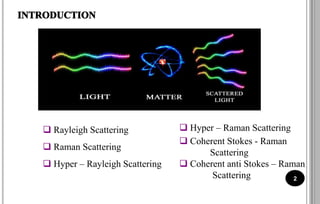
 Rayleigh Scattering
 Raman Scattering
 Hyper – Rayleigh Scattering
 Hyper – Raman Scattering
 Coherent Stokes - Raman
Scattering
 Coherent anti Stokes – Raman
Scattering 2
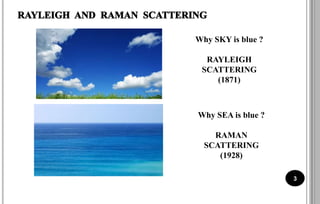
Why SKY is blue ?
RAYLEIGH
SCATTERING
(1871)
Why SEA is blue ?
RAMAN
SCATTERING
(1928)
3
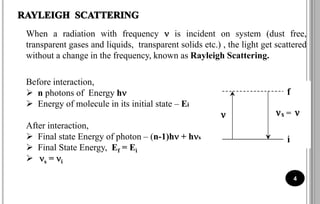
When a radiation with frequency  is incident on system (dust free,
transparent gases and liquids, transparent solids etc.) , the light get scattered
without a change in the frequency, known as Rayleigh Scattering.
Before interaction,
 n photons of Energy h
 Energy of molecule in its initial state – Ei
After interaction,
 Final state Energy of photon – (n-1)h + hs
 Final State Energy, Ef = Ei
 s = i
4
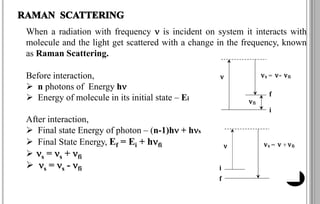
When a radiation with frequency  is incident on system it interacts with
molecule and the light get scattered with a change in the frequency, known
as Raman Scattering.
Before interaction,
 n photons of Energy h
 Energy of molecule in its initial state – Ei
After interaction,
 Final state Energy of photon – (n-1)h + hs
 Final State Energy, Ef = Ei + hfi
 s = s + fi
 s = s - fi
5

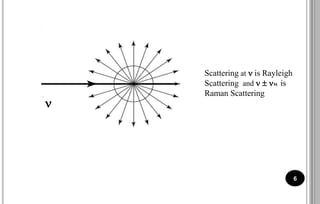
Scattering at  is Rayleigh
Scattering and   M is
Raman Scattering
6
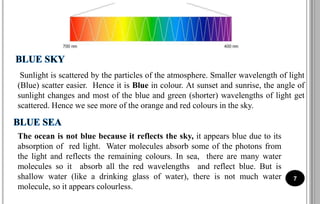
Sunlight is scattered by the particles of the atmosphere. Smaller wavelength of light
(Blue) scatter easier. Hence it is Blue in colour. At sunset and sunrise, the angle of
sunlight changes and most of the blue and green (shorter) wavelengths of light get
scattered. Hence we see more of the orange and red colours in the sky.
7
The ocean is not blue because it reflects the sky, it appears blue due to its
absorption of red light. Water molecules absorb some of the photons from
the light and reflects the remaining colours. In sea, there are many water
molecules so it absorb all the red wavelengths and reflect blue. But is
shallow water (like a drinking glass of water), there is not much water
molecule, so it appears colourless.
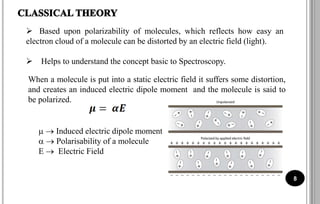
 Based upon polarizability of molecules, which reflects how easy an
electron cloud of a molecule can be distorted by an electric field (light).
 Helps to understand the concept basic to Spectroscopy.
When a molecule is put into a static electric field it suffers some distortion,
and creates an induced electric dipole moment and the molecule is said to
be polarized.
  Induced electric dipole moment
  Polarisability of a molecule
E  Electric Field
8
9
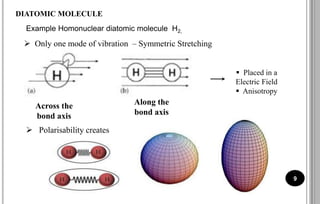
DIATOMIC MOLECULE
Example Homonuclear diatomic molecule H2,
 Only one mode of vibration – Symmetric Stretching
 Placed in a
Electric Field
 Anisotropy
 Polarisability creates
Across the
bond axis
Along the
bond axis
10
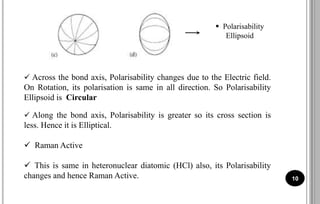
 Polarisability
Ellipsoid
 Across the bond axis, Polarisability changes due to the Electric field.
On Rotation, its polarisation is same in all direction. So Polarisability
Ellipsoid is Circular
 Along the bond axis, Polarisability is greater so its cross section is
less. Hence it is Elliptical.
 Raman Active
 This is same in heteronuclear diatomic (HCl) also, its Polarisability
changes and hence Raman Active.
11
POLYATOMIC MOLECULE
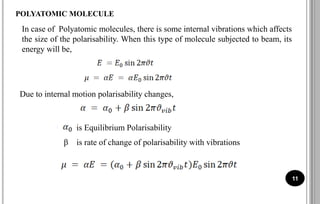
In case of Polyatomic molecules, there is some internal vibrations which affects
the size of the polarisability. When this type of molecule subjected to beam, its
energy will be,
Due to internal motion polarisability changes,
is Equilibrium Polarisability
β is rate of change of polarisability with vibrations
12
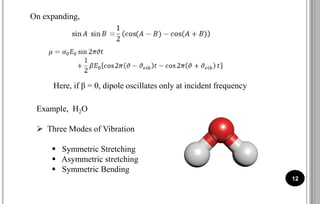
On expanding,
Here, if β = 0, dipole oscillates only at incident frequency
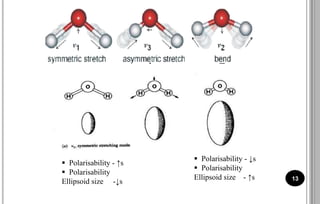
Example, H2O
 Three Modes of Vibration
 Symmetric Stretching
 Asymmetric stretching
 Symmetric Bending
13
 Polarisability - ↑s
 Polarisability
Ellipsoid size -↓s
 Polarisability - ↓s
 Polarisability
Ellipsoid size - ↑s
14
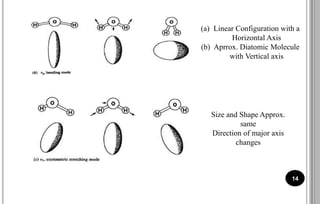
Size and Shape Approx.
same
Direction of major axis
changes
(a) Linear Configuration with a
Horizontal Axis
(b) Aprrox. Diatomic Molecule
with Vertical axis
15
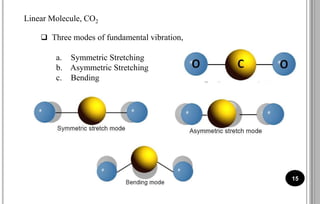
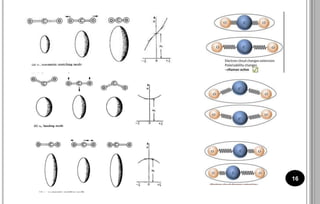
Linear Molecule, CO2
 Three modes of fundamental vibration,
a. Symmetric Stretching
b. Asymmetric Stretching
c. Bending
16
17
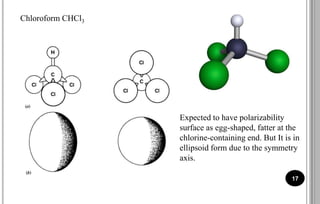
Chloroform CHCl3
Expected to have polarizability
surface as egg-shaped, fatter at the
chlorine-containing end. But It is in
ellipsoid form due to the symmetry
axis.
18
REFERENCE
• C.N. Banwell, Fundamentals of Molecular Spectroscopy, 4th edition, TMH,
1997.
• Derek A. Long, The Raman Effect: A Unified Treatment of the Theory of Raman
Scattering by Molecules, John Wiley & Sons Ltd, 2002.
• Gerhard Herzberg, Infrared and Raman Spectra of Polyatomic Molecule, 1st
edition, 1945.

CLASSICAL THEORY OF RAMAN EFFECT.pptx

  • 1.
  • 2.
     Rayleigh Scattering Raman Scattering  Hyper – Rayleigh Scattering  Hyper – Raman Scattering  Coherent Stokes - Raman Scattering  Coherent anti Stokes – Raman Scattering 2
  • 3.
    Why SKY isblue ? RAYLEIGH SCATTERING (1871) Why SEA is blue ? RAMAN SCATTERING (1928) 3
  • 4.
    When a radiationwith frequency  is incident on system (dust free, transparent gases and liquids, transparent solids etc.) , the light get scattered without a change in the frequency, known as Rayleigh Scattering. Before interaction,  n photons of Energy h  Energy of molecule in its initial state – Ei After interaction,  Final state Energy of photon – (n-1)h + hs  Final State Energy, Ef = Ei  s = i 4
  • 5.
    When a radiationwith frequency  is incident on system it interacts with molecule and the light get scattered with a change in the frequency, known as Raman Scattering. Before interaction,  n photons of Energy h  Energy of molecule in its initial state – Ei After interaction,  Final state Energy of photon – (n-1)h + hs  Final State Energy, Ef = Ei + hfi  s = s + fi  s = s - fi 5
  • 6.
     Scattering at is Rayleigh Scattering and   M is Raman Scattering 6
  • 7.
    Sunlight is scatteredby the particles of the atmosphere. Smaller wavelength of light (Blue) scatter easier. Hence it is Blue in colour. At sunset and sunrise, the angle of sunlight changes and most of the blue and green (shorter) wavelengths of light get scattered. Hence we see more of the orange and red colours in the sky. 7 The ocean is not blue because it reflects the sky, it appears blue due to its absorption of red light. Water molecules absorb some of the photons from the light and reflects the remaining colours. In sea, there are many water molecules so it absorb all the red wavelengths and reflect blue. But is shallow water (like a drinking glass of water), there is not much water molecule, so it appears colourless.
  • 8.
     Based uponpolarizability of molecules, which reflects how easy an electron cloud of a molecule can be distorted by an electric field (light).  Helps to understand the concept basic to Spectroscopy. When a molecule is put into a static electric field it suffers some distortion, and creates an induced electric dipole moment and the molecule is said to be polarized.   Induced electric dipole moment   Polarisability of a molecule E  Electric Field 8
  • 9.
    9 DIATOMIC MOLECULE Example Homonucleardiatomic molecule H2,  Only one mode of vibration – Symmetric Stretching  Placed in a Electric Field  Anisotropy  Polarisability creates Across the bond axis Along the bond axis
  • 10.
    10  Polarisability Ellipsoid  Acrossthe bond axis, Polarisability changes due to the Electric field. On Rotation, its polarisation is same in all direction. So Polarisability Ellipsoid is Circular  Along the bond axis, Polarisability is greater so its cross section is less. Hence it is Elliptical.  Raman Active  This is same in heteronuclear diatomic (HCl) also, its Polarisability changes and hence Raman Active.
  • 11.
    11 POLYATOMIC MOLECULE In caseof Polyatomic molecules, there is some internal vibrations which affects the size of the polarisability. When this type of molecule subjected to beam, its energy will be, Due to internal motion polarisability changes, is Equilibrium Polarisability β is rate of change of polarisability with vibrations
  • 12.
    12 On expanding, Here, ifβ = 0, dipole oscillates only at incident frequency Example, H2O  Three Modes of Vibration  Symmetric Stretching  Asymmetric stretching  Symmetric Bending
  • 13.
    13  Polarisability -↑s  Polarisability Ellipsoid size -↓s  Polarisability - ↓s  Polarisability Ellipsoid size - ↑s
  • 14.
    14 Size and ShapeApprox. same Direction of major axis changes (a) Linear Configuration with a Horizontal Axis (b) Aprrox. Diatomic Molecule with Vertical axis
  • 15.
    15 Linear Molecule, CO2 Three modes of fundamental vibration, a. Symmetric Stretching b. Asymmetric Stretching c. Bending
  • 16.
  • 17.
    17 Chloroform CHCl3 Expected tohave polarizability surface as egg-shaped, fatter at the chlorine-containing end. But It is in ellipsoid form due to the symmetry axis.
  • 18.
    18 REFERENCE • C.N. Banwell,Fundamentals of Molecular Spectroscopy, 4th edition, TMH, 1997. • Derek A. Long, The Raman Effect: A Unified Treatment of the Theory of Raman Scattering by Molecules, John Wiley & Sons Ltd, 2002. • Gerhard Herzberg, Infrared and Raman Spectra of Polyatomic Molecule, 1st edition, 1945.