PY3P05
Lecture 14: Molecularstructure
Lecture 14: Molecular structure
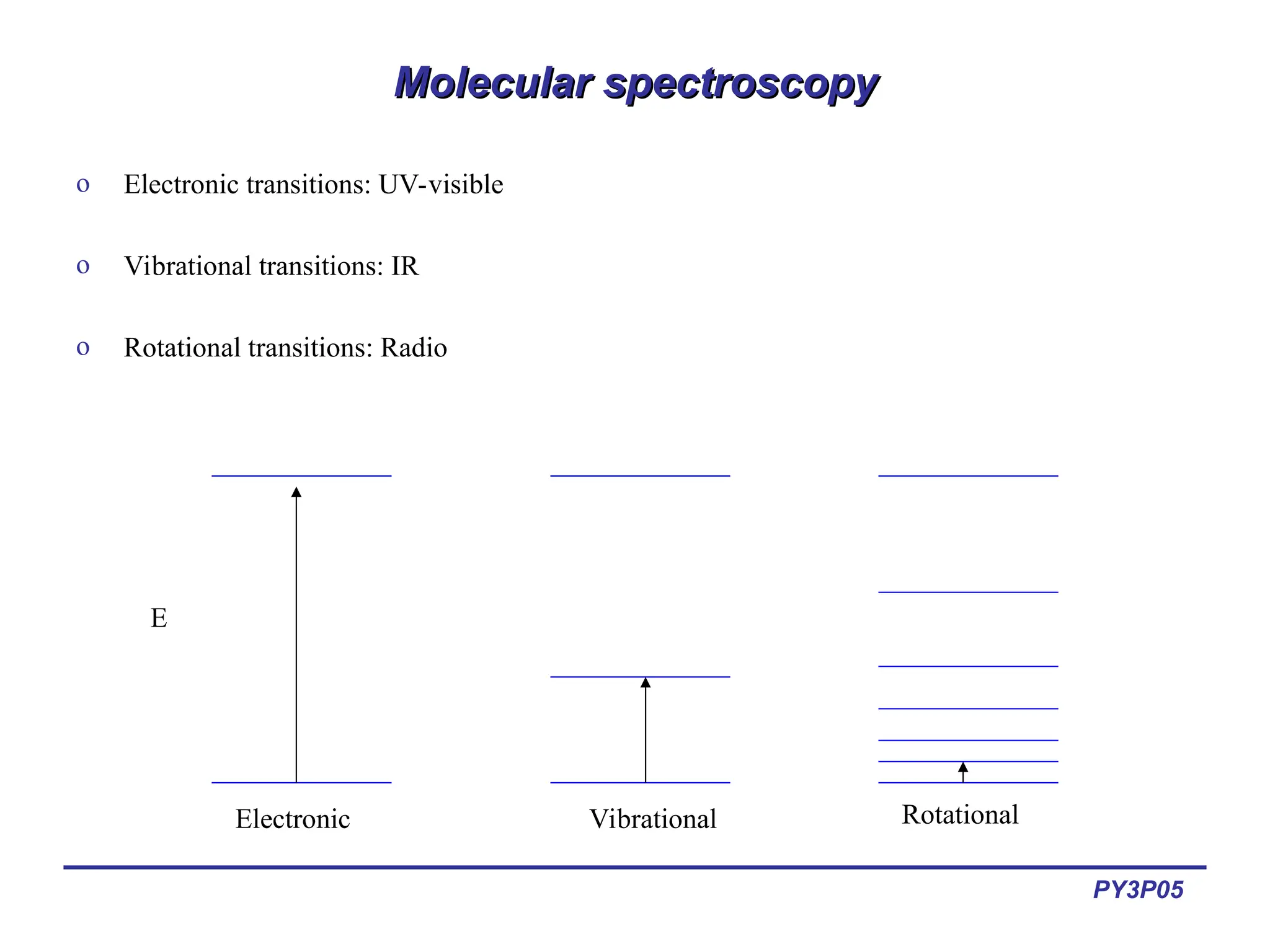
o Rotational transitions
o Vibrational transitions
o Electronic transitions
QuickTime™
and
a
TIFF
(Uncompressed)
decomp
are
needed
to
see
this
pict
QuickTime™ and a
TIFF (Uncompressed) decompressor
are needed to see this picture.
2.
PY3P05
Bohn-Oppenheimer Approximation
Bohn-Oppenheimer Approximation
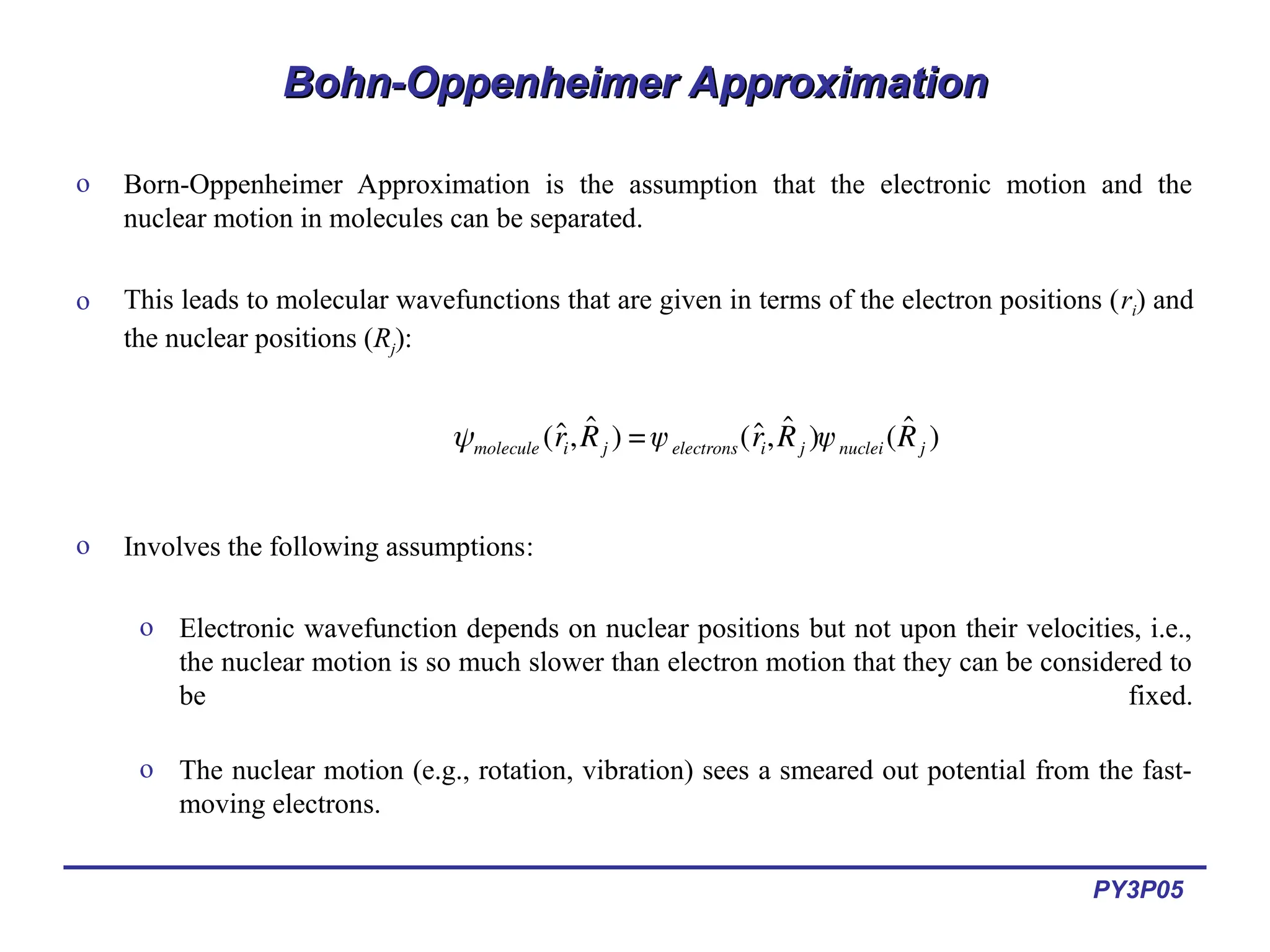
oBorn-Oppenheimer Approximation is the assumption that the electronic motion and the
nuclear motion in molecules can be separated.
o This leads to molecular wavefunctions that are given in terms of the electron positions (ri) and
the nuclear positions (Rj):
o Involves the following assumptions:
o Electronic wavefunction depends on nuclear positions but not upon their velocities, i.e.,
the nuclear motion is so much slower than electron motion that they can be considered to
be fixed.
o The nuclear motion (e.g., rotation, vibration) sees a smeared out potential from the fast-
moving electrons.
€
ψmolecule (ˆ
ri, ˆ
Rj ) =ψelectrons(ˆ
ri, ˆ
Rj )ψnuclei ( ˆ
Rj )
PY3P05
Rotational motion
Rotational motion
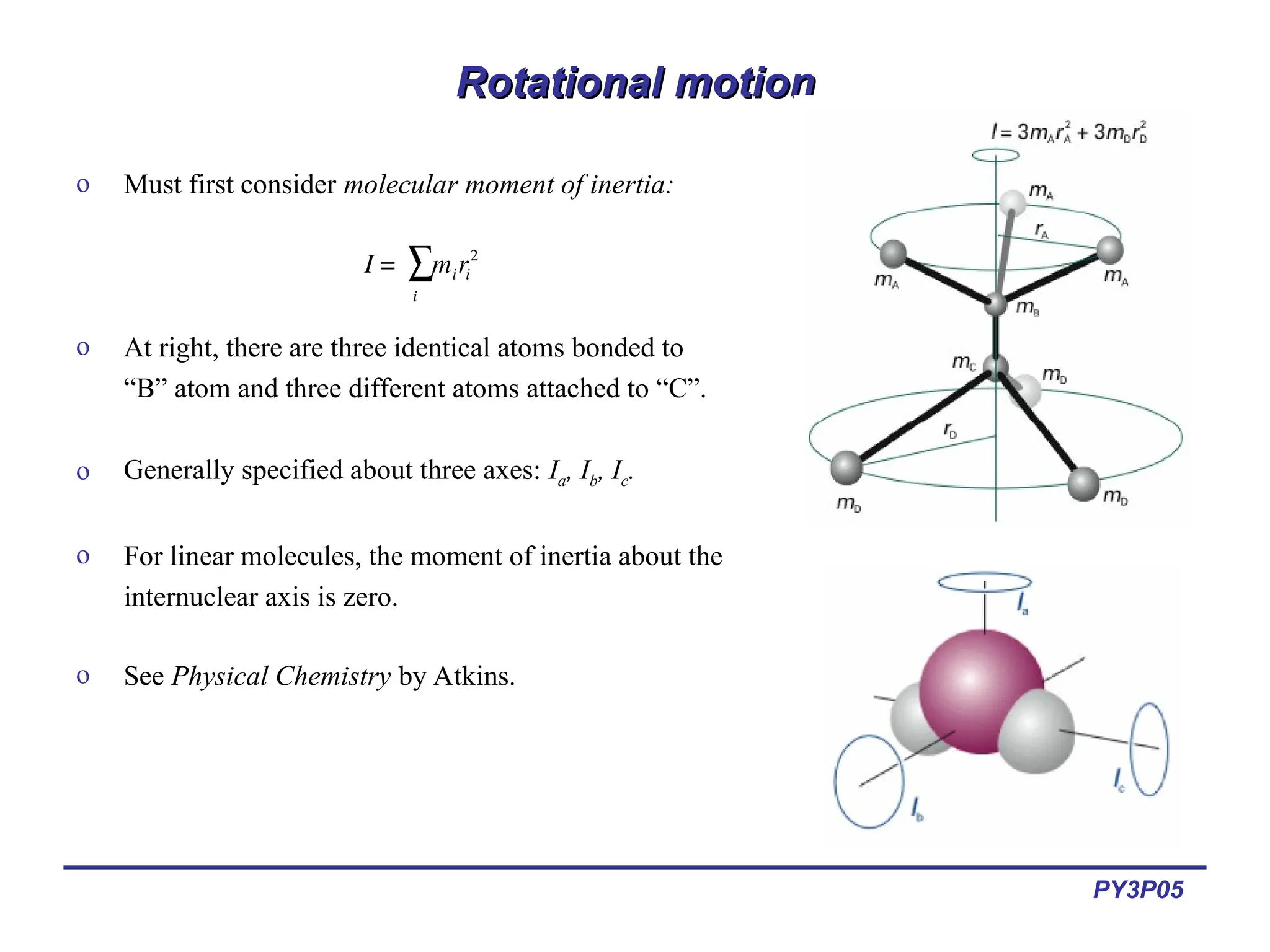
oMust first consider molecular moment of inertia:
o At right, there are three identical atoms bonded to
“B” atom and three different atoms attached to “C”.
o Generally specified about three axes: Ia, Ib, Ic.
o For linear molecules, the moment of inertia about the
internuclear axis is zero.
o See Physical Chemistry by Atkins.
€
I = miri
2
i
∑
5.
PY3P05
Rotational motion
Rotational motion
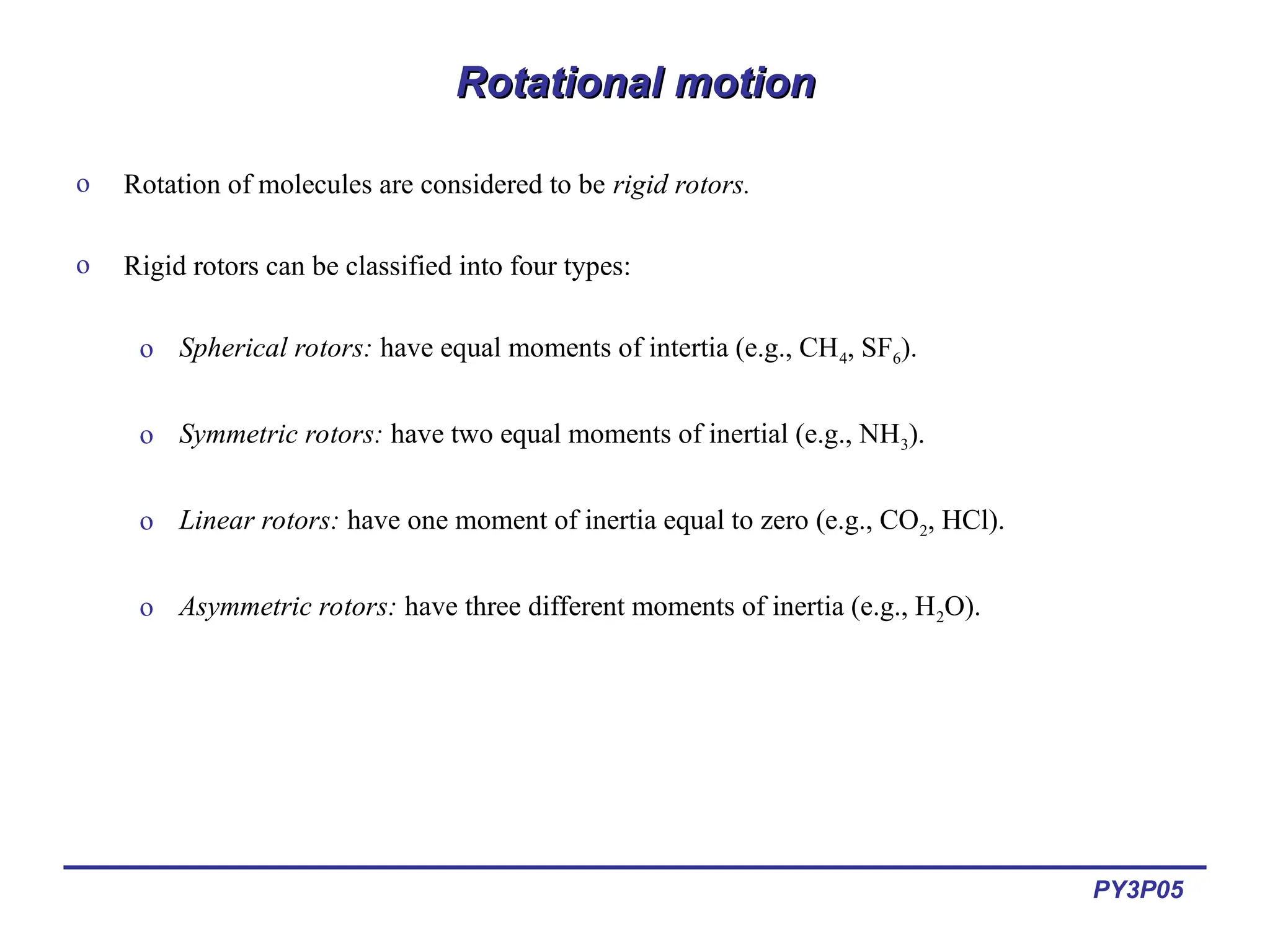
oRotation of molecules are considered to be rigid rotors.
o Rigid rotors can be classified into four types:
o Spherical rotors: have equal moments of intertia (e.g., CH4, SF6).
o Symmetric rotors: have two equal moments of inertial (e.g., NH3).
o Linear rotors: have one moment of inertia equal to zero (e.g., CO2, HCl).
o Asymmetric rotors: have three different moments of inertia (e.g., H2O).
6.
PY3P05
Quantized rotational energylevels
Quantized rotational energy levels
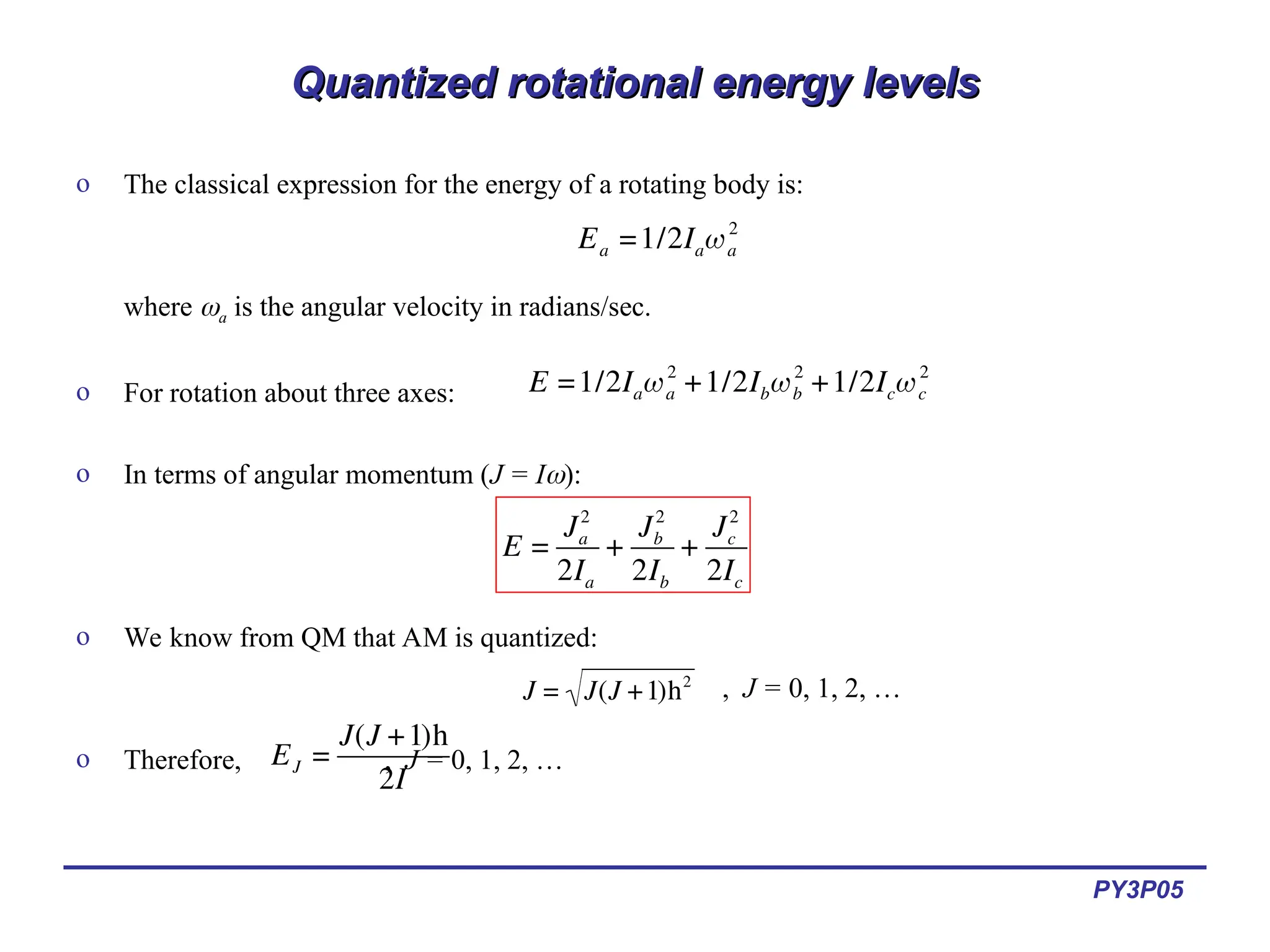
o The classical expression for the energy of a rotating body is:
where a is the angular velocity in radians/sec.
o For rotation about three axes:
o In terms of angular momentum (J = I):
o We know from QM that AM is quantized:
o Therefore, , J = 0, 1, 2, …
€
Ea =1/2Iaωa
2
€
E =1/2Iaωa
2
+1/2Ibωb
2
+1/2Icωc
2
€
E =
Ja
2
2Ia
+
Jb
2
2Ib
+
Jc
2
2Ic
€
J = J(J +1)h2
€
EJ =
J(J +1)h
2I
, J = 0, 1, 2, …
7.
PY3P05
Quantized rotational energylevels
Quantized rotational energy levels
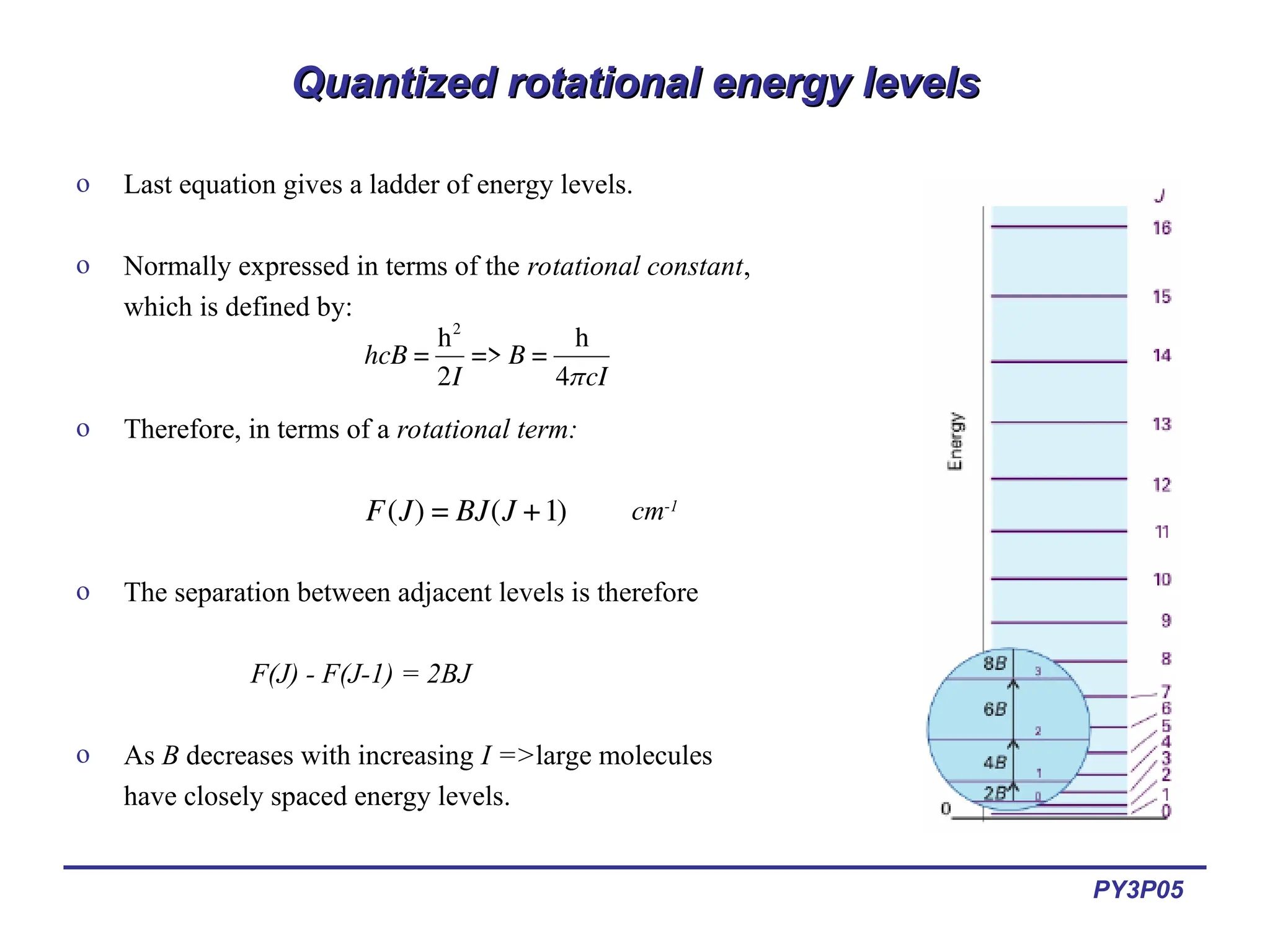
o Last equation gives a ladder of energy levels.
o Normally expressed in terms of the rotational constant,
which is defined by:
o Therefore, in terms of a rotational term:
cm-1
o The separation between adjacent levels is therefore
F(J) - F(J-1) = 2BJ
o As B decreases with increasing I =>large molecules
have closely spaced energy levels.
€
hcB =
h2
2I
=> B =
h
4πcI
€
F(J) = BJ(J +1)
8.
PY3P05
Rotational spectra selectionrules
Rotational spectra selection rules
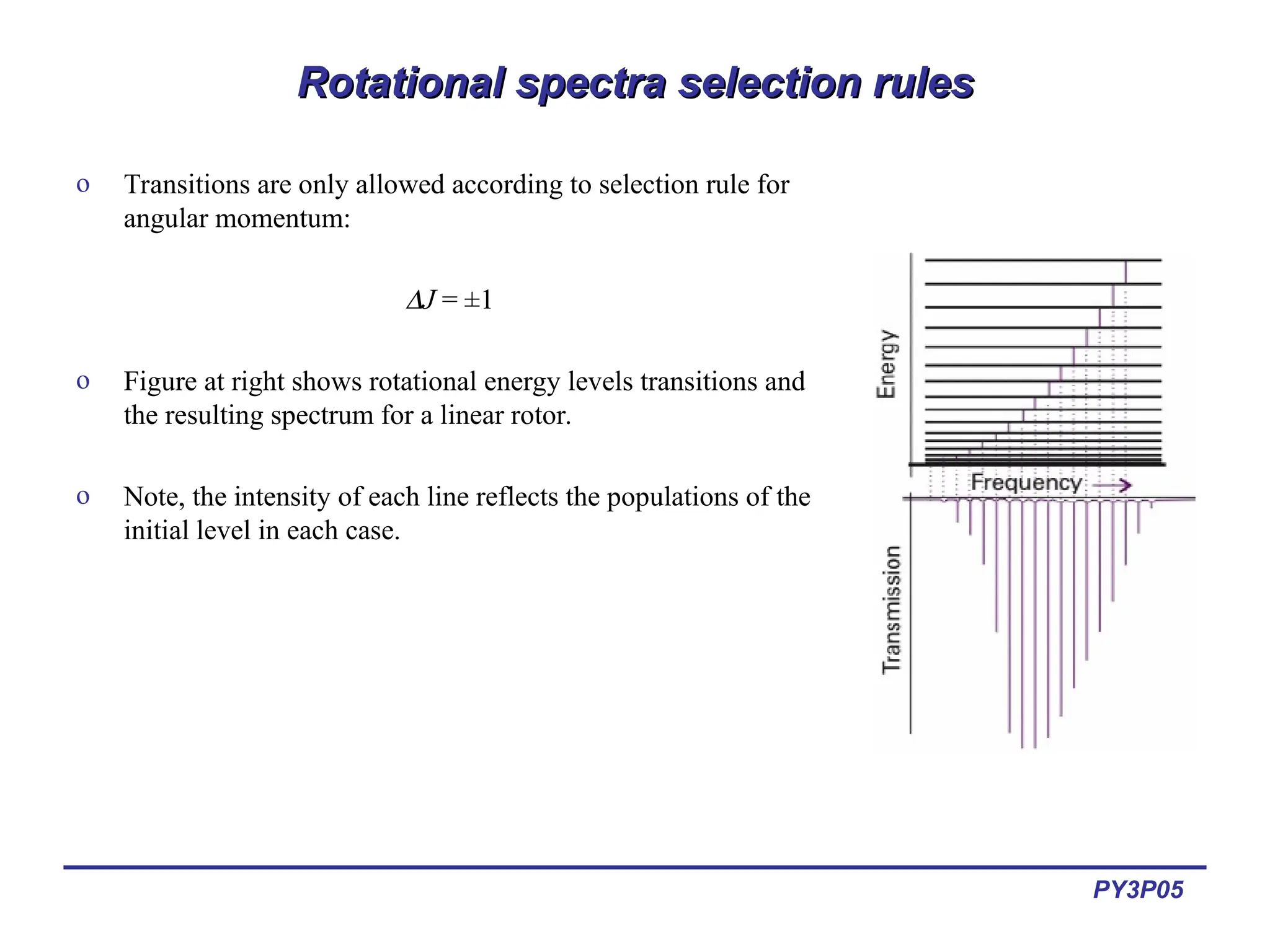
o Transitions are only allowed according to selection rule for
angular momentum:
J = ±1
o Figure at right shows rotational energy levels transitions and
the resulting spectrum for a linear rotor.
o Note, the intensity of each line reflects the populations of the
initial level in each case.
9.
PY3P05
Molecular vibrations
Molecular vibrations
oConsider simple case of a vibrating diatomic molecule,
where restoring force is proportional to displacement
(F = -kx). Potential energy is therefore
V = 1/2 kx2
o Can write the corresponding Schrodinger equation as
where
o The SE results in allowed energies
QuickTime™ and a
Graphics decompressor
are needed to see this picture.
€
h2
2μ
d2
ψ
dx2
+[E −V]ψ = 0
h2
2μ
d2
ψ
dx2
+[E −1/2kx2
]ψ = 0
€
μ =
m1m2
m1 + m2
€
Ev = (v +1/2)hω ω =
k
μ
⎛
⎝
⎜
⎞
⎠
⎟
1/ 2
v = 0, 1, 2, …
10.
PY3P05
Molecular vibrations
Molecular vibrations
oThe vibrational terms of a molecule can therefore
be given by
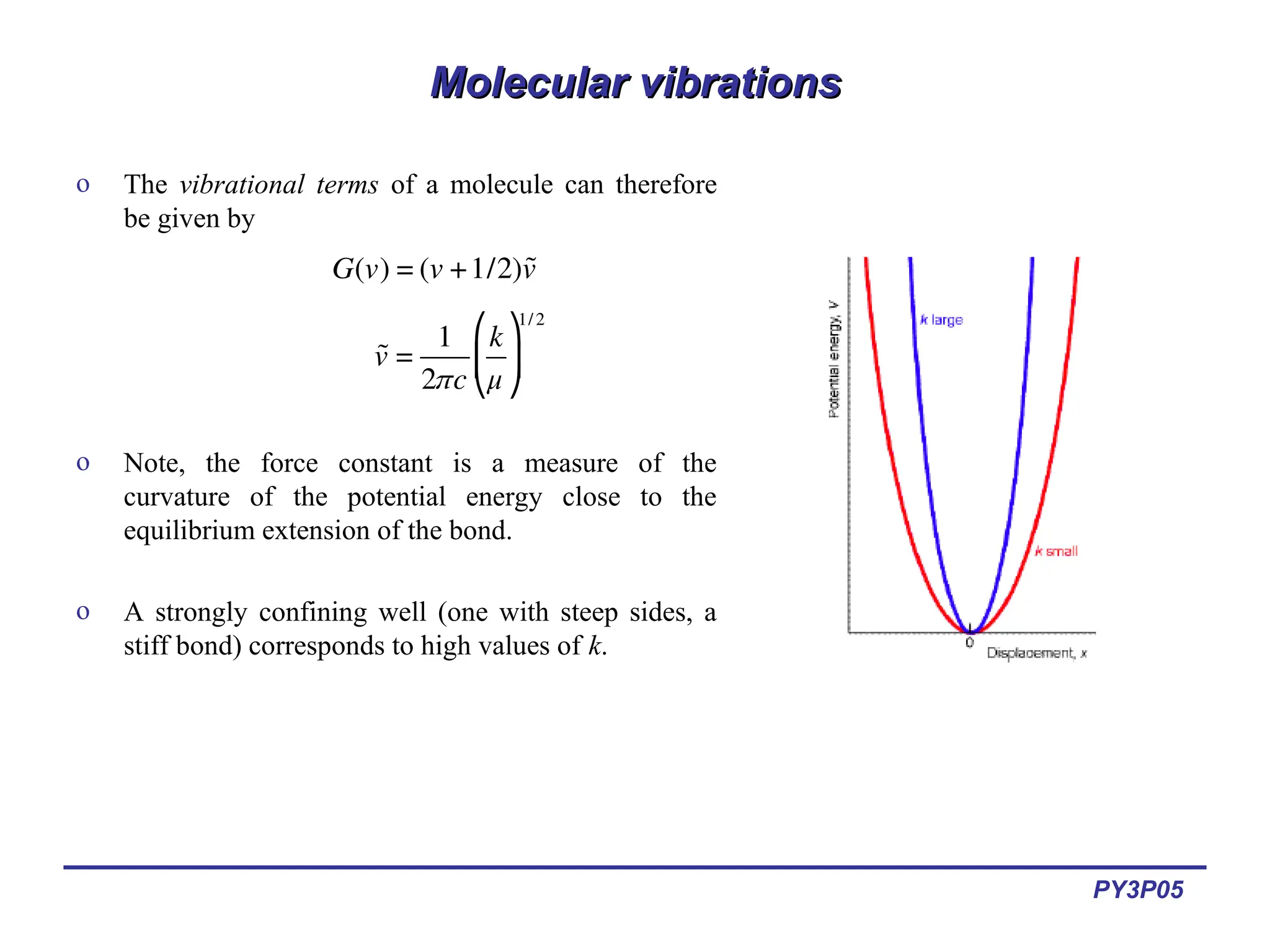
o Note, the force constant is a measure of the
curvature of the potential energy close to the
equilibrium extension of the bond.
o A strongly confining well (one with steep sides, a
stiff bond) corresponds to high values of k.
€
G(v) = (v +1/2)˜
v
€
˜
v =
1
2πc
k
μ
⎛
⎝
⎜
⎞
⎠
⎟
1/2
11.
PY3P05
Molecular vibrations
Molecular vibrations
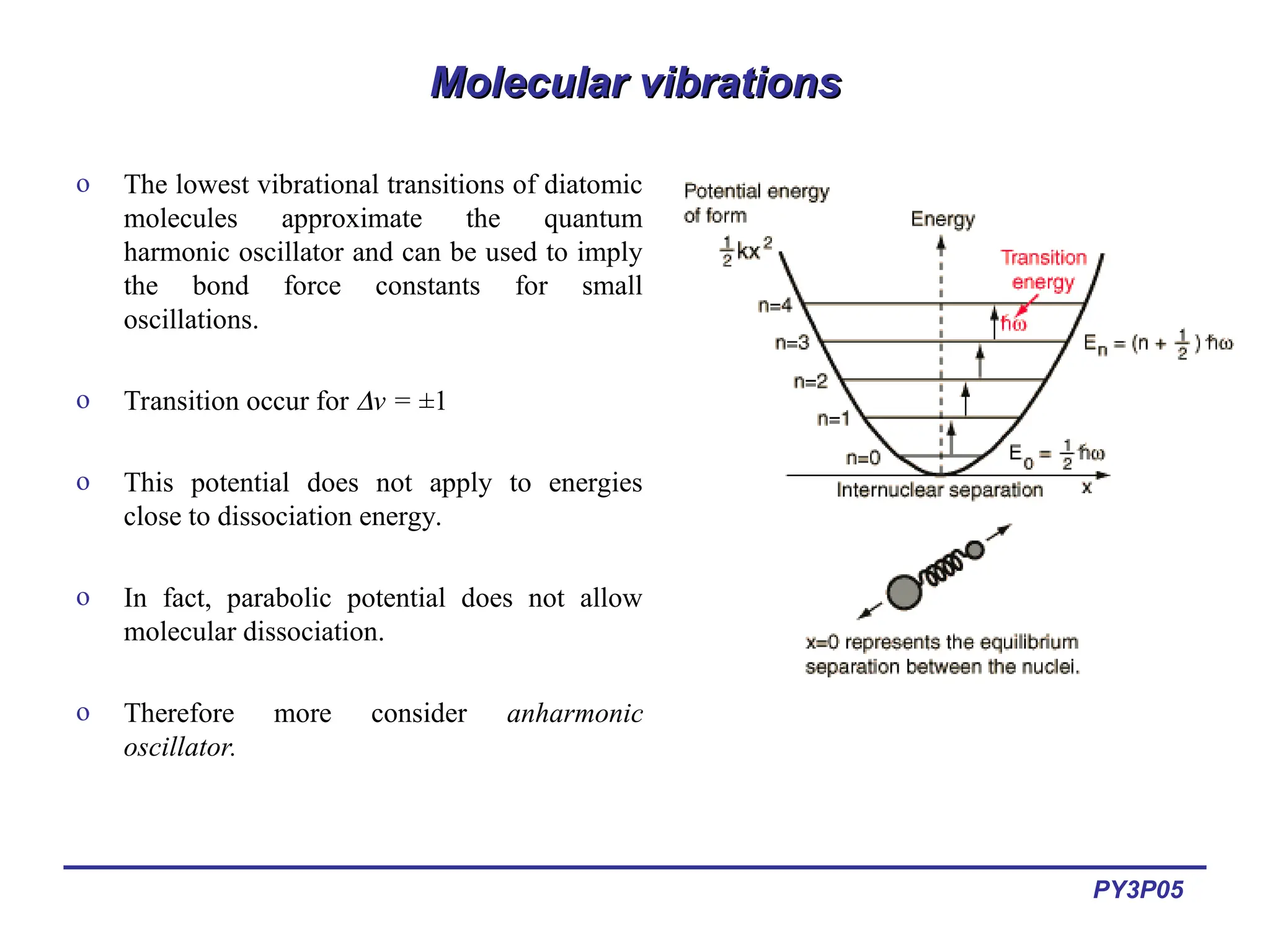
oThe lowest vibrational transitions of diatomic
molecules approximate the quantum
harmonic oscillator and can be used to imply
the bond force constants for small
oscillations.
o Transition occur for v = ±1
o This potential does not apply to energies
close to dissociation energy.
o In fact, parabolic potential does not allow
molecular dissociation.
o Therefore more consider anharmonic
oscillator.
12.
PY3P05
Anharmonic oscillator
Anharmonic oscillator
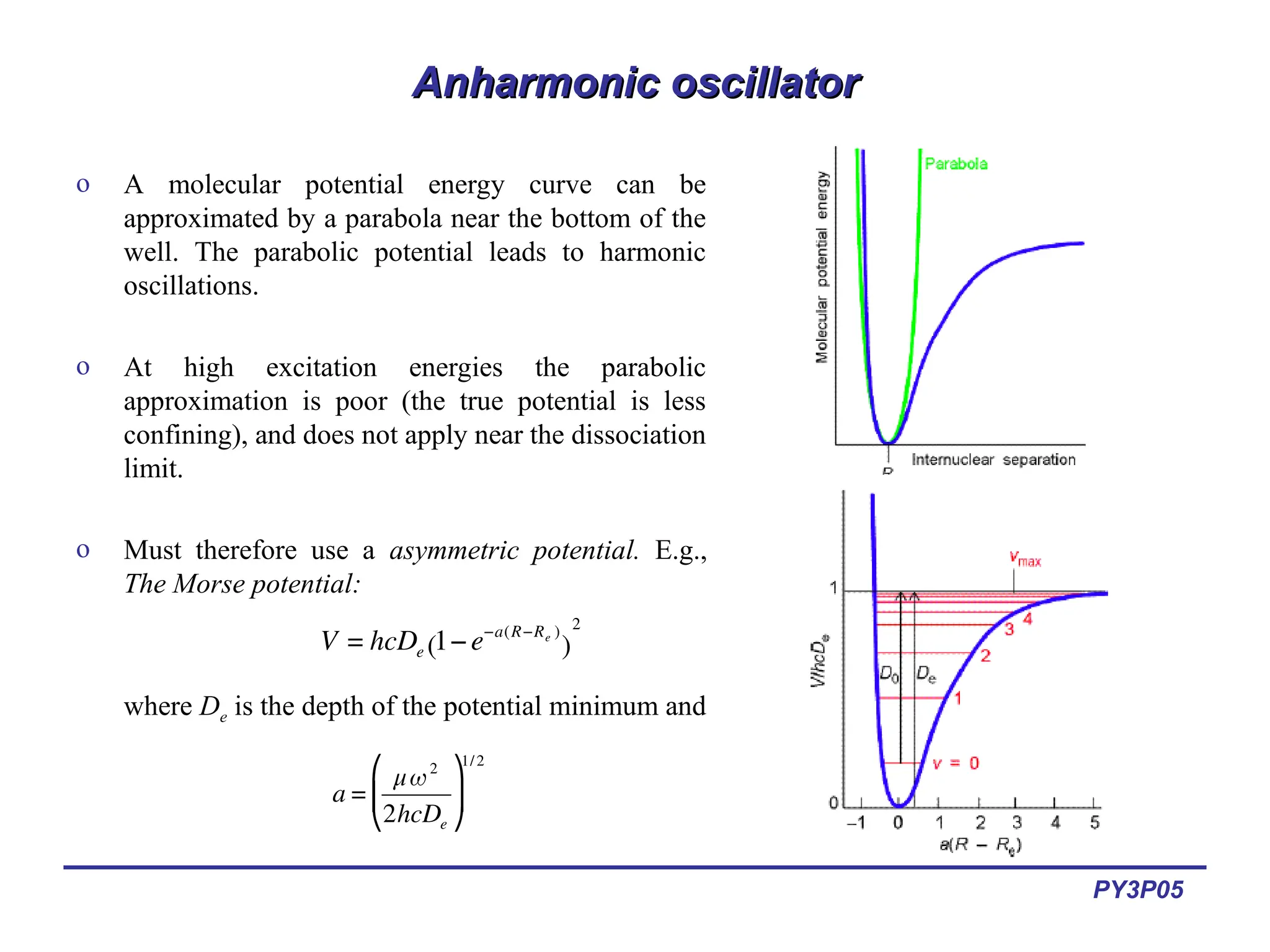
oA molecular potential energy curve can be
approximated by a parabola near the bottom of the
well. The parabolic potential leads to harmonic
oscillations.
o At high excitation energies the parabolic
approximation is poor (the true potential is less
confining), and does not apply near the dissociation
limit.
o Must therefore use a asymmetric potential. E.g.,
The Morse potential:
where De is the depth of the potential minimum and
€
V = hcDe 1−e−a(R−Re )
( )
2
€
a =
μω2
2hcDe
⎛
⎝
⎜
⎞
⎠
⎟
1/2
13.
PY3P05
Anharmonic oscillator
Anharmonic oscillator
oThe Schrödinger equation can be solved for the Morse potential, giving permitted energy
levels:
where xe is the anharmonicity constant:
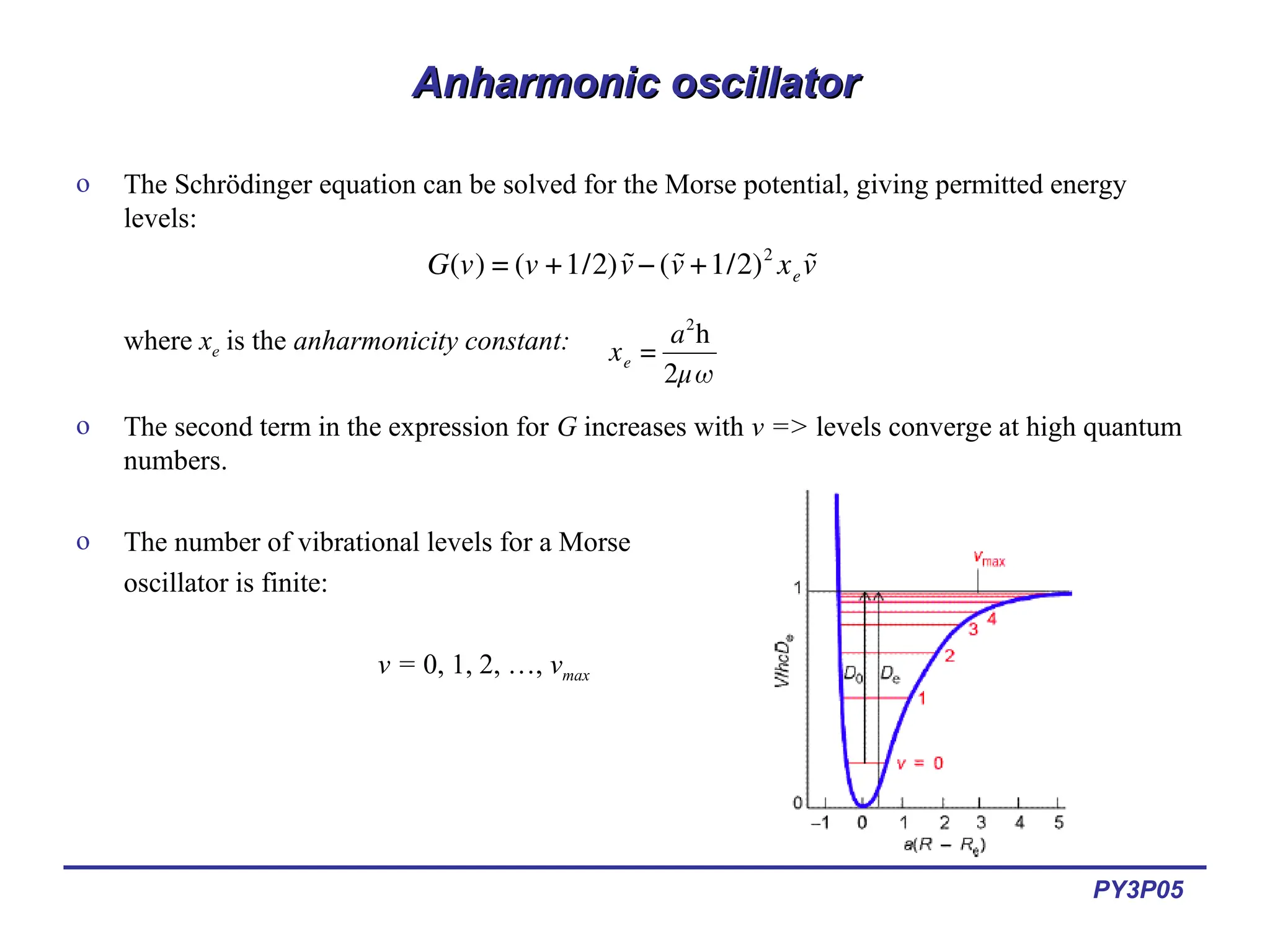
o The second term in the expression for G increases with v => levels converge at high quantum
numbers.
o The number of vibrational levels for a Morse
oscillator is finite:
v = 0, 1, 2, …, vmax
€
G(v) = (v +1/2) ˜
v−( ˜
v +1/2)2
xe
˜
v
€
xe =
a2
h
2μω
14.
PY3P05
Vibrational-rotational spectroscopy
Vibrational-rotational spectroscopy
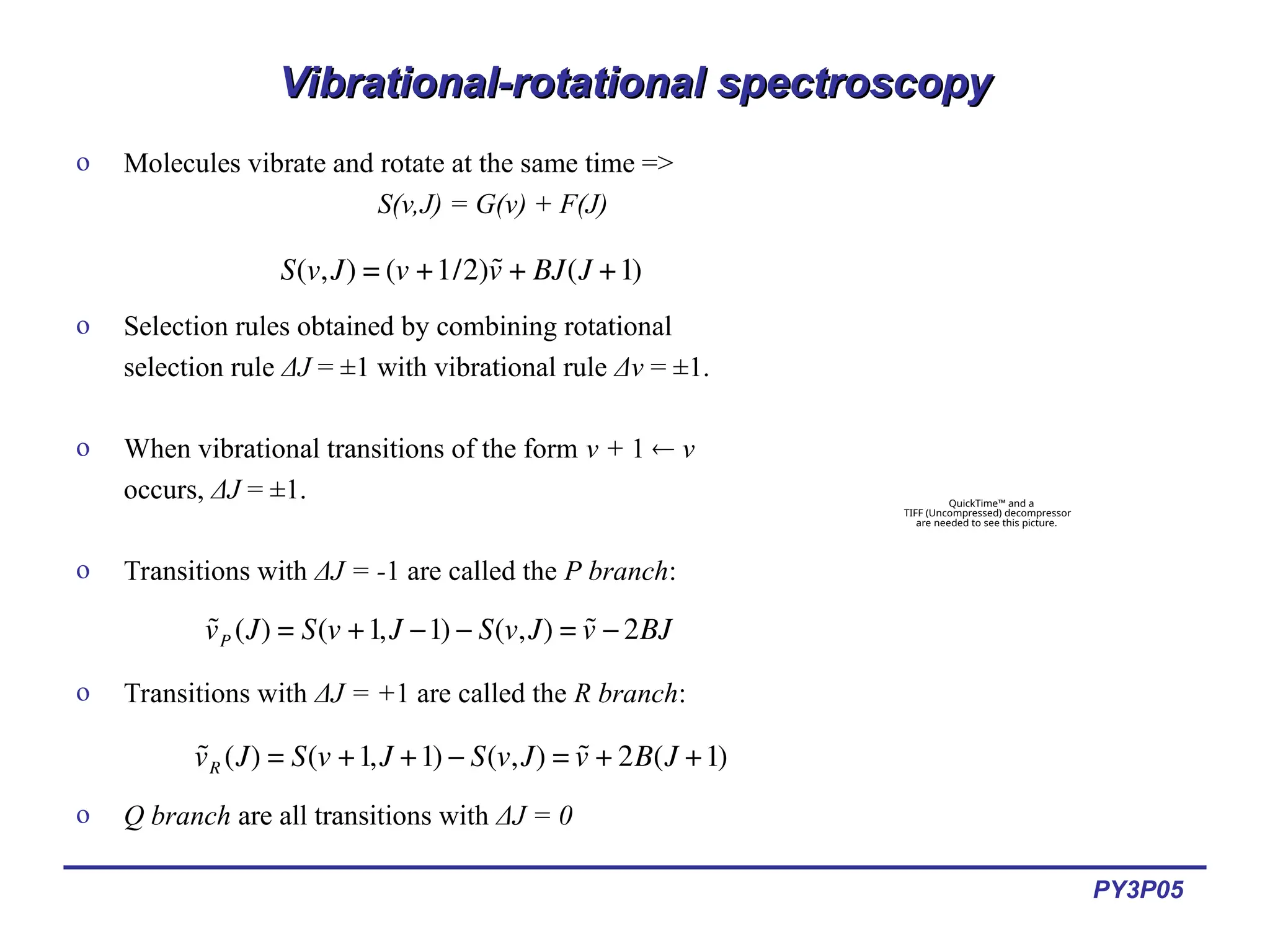
oMolecules vibrate and rotate at the same time =>
S(v,J) = G(v) + F(J)
o Selection rules obtained by combining rotational
selection rule ΔJ = ±1 with vibrational rule Δv = ±1.
o When vibrational transitions of the form v + 1 v
occurs, ΔJ = ±1.
o Transitions with ΔJ = -1 are called the P branch:
o Transitions with ΔJ = +1 are called the R branch:
o Q branch are all transitions with ΔJ = 0
€
S(v,J) = (v +1/2)˜
v + BJ(J +1)
€
˜
vP (J) = S(v +1,J −1) − S(v,J) = ˜
v −2BJ
€
˜
vR (J) = S(v +1,J +1) − S(v,J) = ˜
v + 2B(J +1)
QuickTime™ and a
TIFF (Uncompressed) decompressor
are needed to see this picture.
15.
PY3P05
Vibrational-rotational spectroscopy
Vibrational-rotational spectroscopy
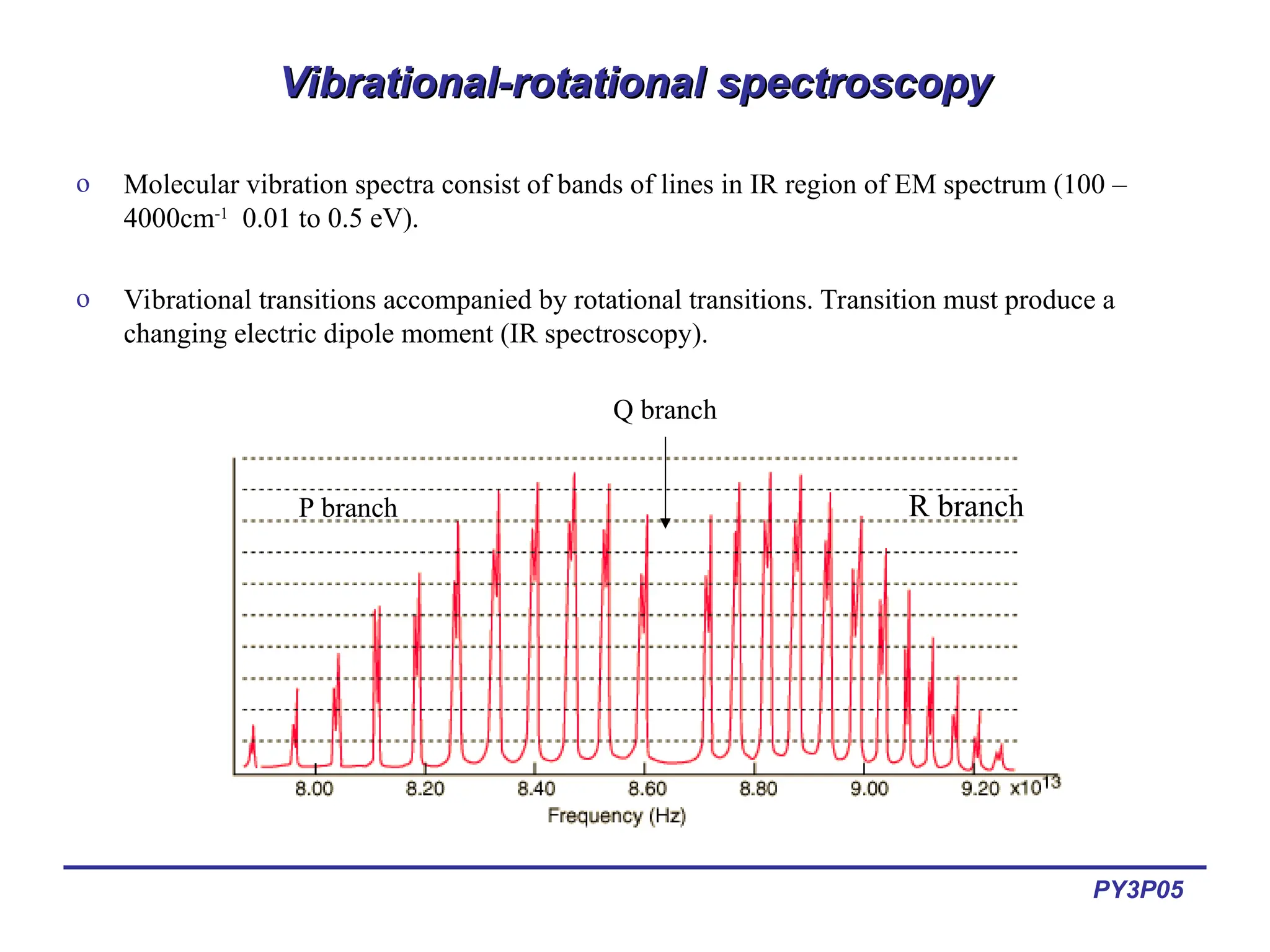
oMolecular vibration spectra consist of bands of lines in IR region of EM spectrum (100 –
4000cm-1
0.01 to 0.5 eV).
o Vibrational transitions accompanied by rotational transitions. Transition must produce a
changing electric dipole moment (IR spectroscopy).
P branch
Q branch
R branch
16.
PY3P05
Electronic transitions
Electronic transitions
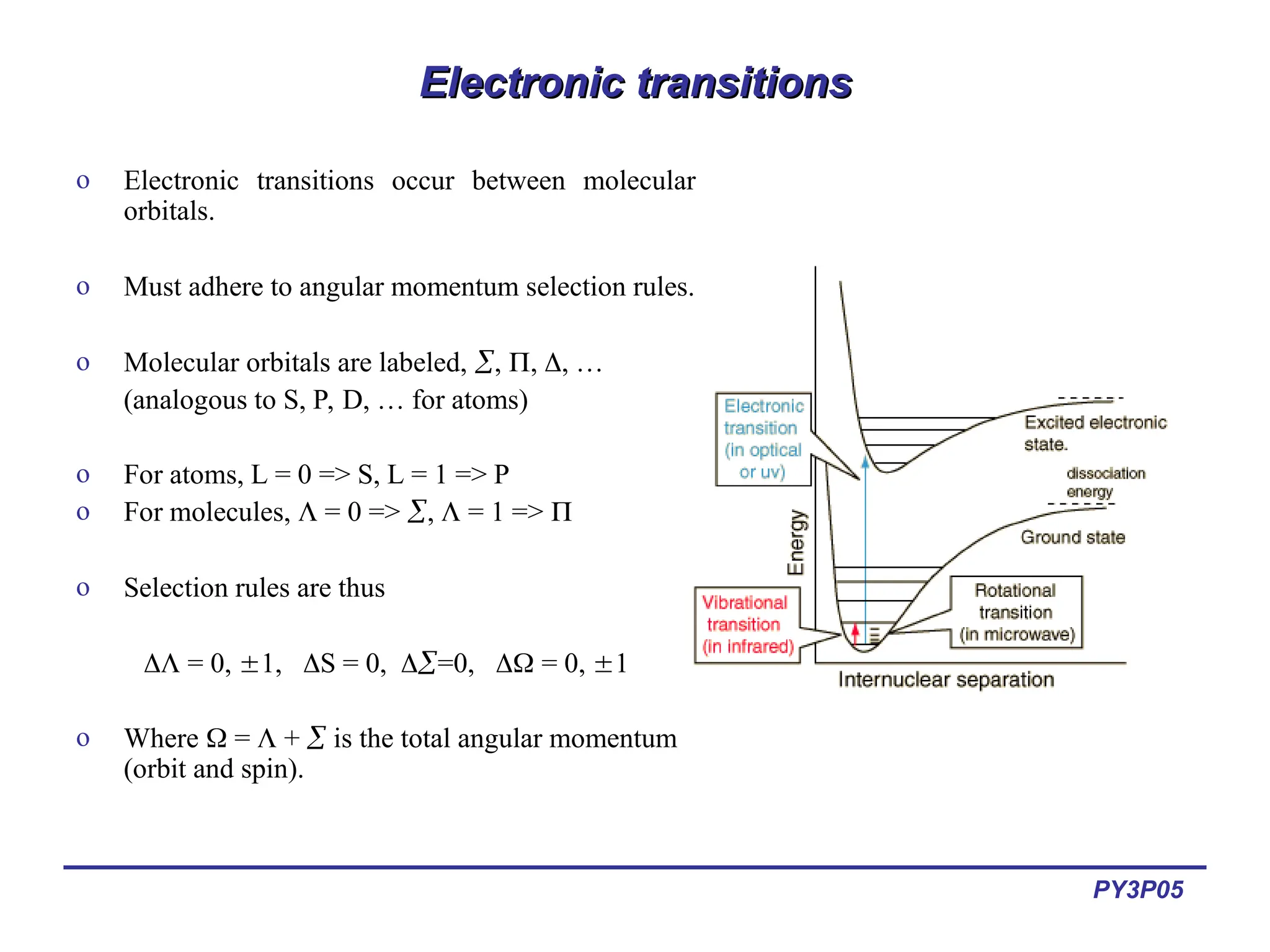
oElectronic transitions occur between molecular
orbitals.
o Must adhere to angular momentum selection rules.
o Molecular orbitals are labeled, , , , …
(analogous to S, P, D, … for atoms)
o For atoms, L = 0 => S, L = 1 => P
o For molecules, = 0 => , = 1 =>
o Selection rules are thus
= 0, 1, S = 0, =0, = 0, 1
o Where = + is the total angular momentum
(orbit and spin).
17.
PY3P05
The End!
The End!
oAll notes and tutorial set available from
http://www.physics.tcd.ie/people/peter.gallagher/lectures/py3004/
o Questions? Contact:
o peter.gallagher@tcd.ie
o Room 3.17A in SNIAM
![PY3P05
Molecular vibrations
Molecular vibrations
o Consider simple case of a vibrating diatomic molecule,
where restoring force is proportional to displacement
(F = -kx). Potential energy is therefore
V = 1/2 kx2
o Can write the corresponding Schrodinger equation as
where
o The SE results in allowed energies
QuickTime™ and a
Graphics decompressor
are needed to see this picture.
€
h2
2μ
d2
ψ
dx2
+[E −V]ψ = 0
h2
2μ
d2
ψ
dx2
+[E −1/2kx2
]ψ = 0
€
μ =
m1m2
m1 + m2
€
Ev = (v +1/2)hω ω =
k
μ
⎛
⎝
⎜
⎞
⎠
⎟
1/ 2
v = 0, 1, 2, …](https://image.slidesharecdn.com/jsatomiclecture14-250226152842-b1ab6dbc/75/Atomic-structure-and-electronic-transitions-9-2048.jpg)