Lini Cleetus C
1st M.Sc BPS
CBPST, KOCHI
What we will be discussing?
Nucleic acids
Nucleotides
Nucleoside
Nitrogenous bases
Pentose sugar
DNA and RNA
RNA
Introduction
Different types &
functions
Conclusion
Nucleic Acids
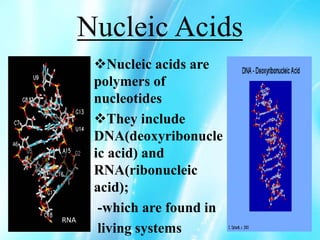
Nucleic acids are
polymers of
nucleotides
They include
DNA(deoxyribonucle
ic acid) and
RNA(ribonucleic
acid);
-which are found in
living systems
RNA
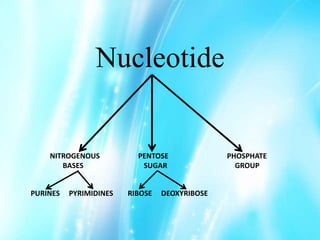
Nucleotide
PURINES PYRIMIDINES RIBOSE DEOXYRIBOSE
NITROGENOUS PENTOSE PHOSPHATE
BASES SUGAR GROUP
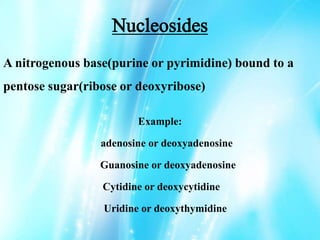
Nucleosides
A nitrogenous base(purine or pyrimidine) bound to a
pentose sugar(ribose or deoxyribose)
Example:
adenosine or deoxyadenosine
Guanosine or deoxyadenosine
Cytidine or deoxycytidine
Uridine or deoxythymidine
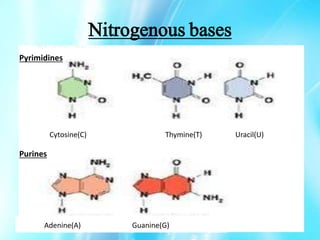
Nitrogenous bases
Cytosine(C) Thymine(T) Uracil(U)
Adenine(A) Guanine(G)
Pyrimidines
Purines
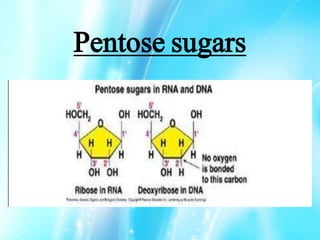
Pentose sugars
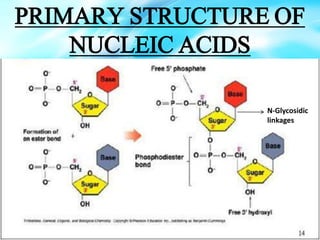
PRIMARY STRUCTURE OF
NUCLEIC ACIDS
N-Glycosidic
linkages
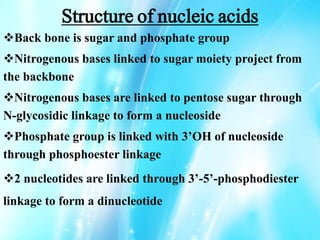
Structure of nucleic acids
Back bone is sugar and phosphate group
Nitrogenous bases linked to sugar moiety project from
the backbone
Nitrogenous bases are linked to pentose sugar through
N-glycosidic linkage to form a nucleoside
Phosphate group is linked with 3’OH of nucleoside
through phosphoester linkage
2 nucleotides are linked through 3’-5’-phosphodiester
linkage to form a dinucleotide
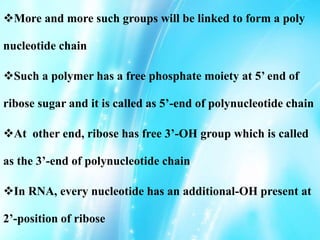
More and more such groups will be linked to form a poly
nucleotide chain
Such a polymer has a free phosphate moiety at 5’ end of
ribose sugar and it is called as 5’-end of polynucleotide chain
At other end, ribose has free 3’-OH group which is called
as the 3’-end of polynucleotide chain
In RNA, every nucleotide has an additional-OH present at
2’-position of ribose
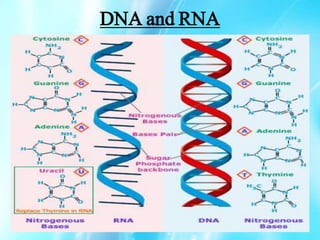
DNA and RNA
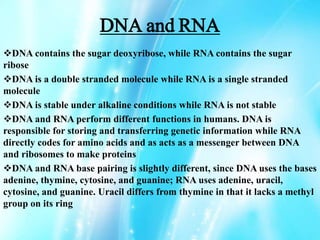
DNA and RNA
DNA contains the sugar deoxyribose, while RNA contains the sugar
ribose
DNA is a double stranded molecule while RNA is a single stranded
molecule
DNA is stable under alkaline conditions while RNA is not stable
DNA and RNA perform different functions in humans. DNA is
responsible for storing and transferring genetic information while RNA
directly codes for amino acids and as acts as a messenger between DNA
and ribosomes to make proteins
DNA and RNA base pairing is slightly different, since DNA uses the bases
adenine, thymine, cytosine, and guanine; RNA uses adenine, uracil,
cytosine, and guanine. Uracil differs from thymine in that it lacks a methyl
group on its ring
Ribonucleic acid
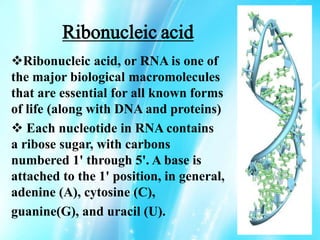
Ribonucleic acid, or RNA is one of
the major biological macromolecules
that are essential for all known forms
of life (along with DNA and proteins)
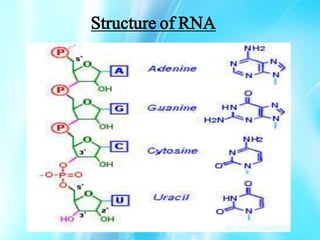
 Each nucleotide in RNA contains
a ribose sugar, with carbons
numbered 1' through 5'. A base is
attached to the 1' position, in general,
adenine (A), cytosine (C),
guanine(G), and uracil (U).
Structure of RNA
Synthesis
Synthesis of RNA is usually catalyzed by an enzyme—
RNA polymerase
By using DNA as a template
The process is known as transcription
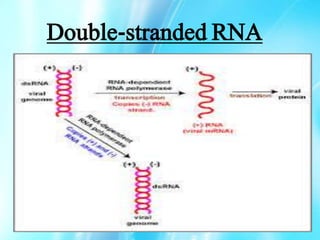
There are also a number of RNA-dependent RNA
polymerases that use RNA as their template for synthesis
of a new strand of RNA
A number of RNA viruses (such as poliovirus) use this
type of enzyme to replicate their genetic material
Types of RNA
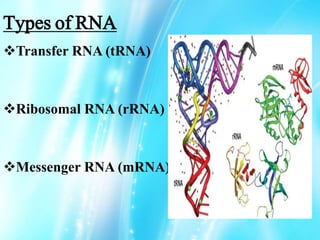
Transfer RNA (tRNA)
Ribosomal RNA (rRNA)
Messenger RNA (mRNA)
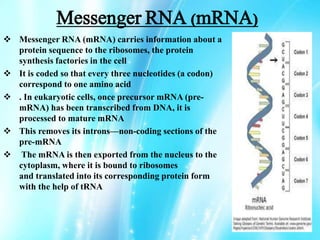
Messenger RNA (mRNA)
 Messenger RNA (mRNA) carries information about a
protein sequence to the ribosomes, the protein
synthesis factories in the cell
 It is coded so that every three nucleotides (a codon)
correspond to one amino acid
 . In eukaryotic cells, once precursor mRNA (pre-
mRNA) has been transcribed from DNA, it is
processed to mature mRNA
 This removes its introns—non-coding sections of the
pre-mRNA
 The mRNA is then exported from the nucleus to the
cytoplasm, where it is bound to ribosomes
and translated into its corresponding protein form
with the help of tRNA
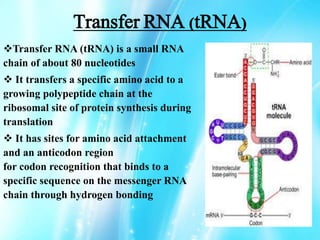
Transfer RNA (tRNA)
Transfer RNA (tRNA) is a small RNA
chain of about 80 nucleotides
 It transfers a specific amino acid to a
growing polypeptide chain at the
ribosomal site of protein synthesis during
translation
 It has sites for amino acid attachment
and an anticodon region
for codon recognition that binds to a
specific sequence on the messenger RNA
chain through hydrogen bonding
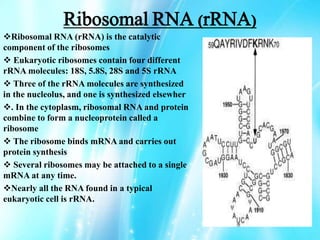
Ribosomal RNA (rRNA)
Ribosomal RNA (rRNA) is the catalytic
component of the ribosomes
 Eukaryotic ribosomes contain four different
rRNA molecules: 18S, 5.8S, 28S and 5S rRNA
 Three of the rRNA molecules are synthesized
in the nucleolus, and one is synthesized elsewher
. In the cytoplasm, ribosomal RNA and protein
combine to form a nucleoprotein called a
ribosome
 The ribosome binds mRNA and carries out
protein synthesis
 Several ribosomes may be attached to a single
mRNA at any time.
Nearly all the RNA found in a typical
eukaryotic cell is rRNA.
D Dobbs ISU - BCB 444/544X:
RNA Structure Prediction
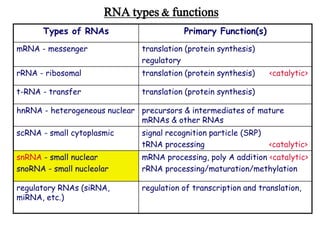
RNA types & functions
Types of RNAs Primary Function(s)
mRNA - messenger translation (protein synthesis)
regulatory
rRNA - ribosomal translation (protein synthesis) <catalytic>
t-RNA - transfer translation (protein synthesis)
hnRNA - heterogeneous nuclear precursors & intermediates of mature
mRNAs & other RNAs
scRNA - small cytoplasmic signal recognition particle (SRP)
tRNA processing <catalytic>
snRNA - small nuclear
snoRNA - small nucleolar
mRNA processing, poly A addition <catalytic>
rRNA processing/maturation/methylation
regulatory RNAs (siRNA,
miRNA, etc.)
regulation of transcription and translation,
L Samaraweera 2005
RNA genomes
Like DNA, RNA can carry genetic
information. RNA viruses have genomes composed
of RNA that encodes a number of proteins. The
viral genome is replicated by some of those
proteins, while other proteins protect the genome as
the virus particle moves to a new host cell.
Double-stranded RNA
Double-stranded RNA (dsRNA) is RNA with two
complementary strands, similar to the DNA found
in all cells. dsRNA forms the genetic material of
some viruses (double-stranded RNA viruses)
Double-stranded RNA
Conclusion
RNA is one of the major biological
macromolecule essential in all life forms
Ribose is the sugar unit present in it
Guanine ,adenine, uracil and cytisine are the
nitrogenous bases present in RNA
There are different types of RNA:- mRNA,
tRNA, Rrna
Like DNA,RNA also can behave as a genetic
material
Ribonucleic acid

Ribonucleic acid

  • 1.
    Lini Cleetus C 1stM.Sc BPS CBPST, KOCHI
  • 2.
    What we willbe discussing? Nucleic acids Nucleotides Nucleoside Nitrogenous bases Pentose sugar DNA and RNA RNA Introduction Different types & functions Conclusion
  • 3.
    Nucleic Acids Nucleic acidsare polymers of nucleotides They include DNA(deoxyribonucle ic acid) and RNA(ribonucleic acid); -which are found in living systems RNA
  • 4.
    Nucleotide PURINES PYRIMIDINES RIBOSEDEOXYRIBOSE NITROGENOUS PENTOSE PHOSPHATE BASES SUGAR GROUP
  • 5.
    Nucleosides A nitrogenous base(purineor pyrimidine) bound to a pentose sugar(ribose or deoxyribose) Example: adenosine or deoxyadenosine Guanosine or deoxyadenosine Cytidine or deoxycytidine Uridine or deoxythymidine
  • 6.
    Nitrogenous bases Cytosine(C) Thymine(T)Uracil(U) Adenine(A) Guanine(G) Pyrimidines Purines
  • 7.
  • 8.
    PRIMARY STRUCTURE OF NUCLEICACIDS N-Glycosidic linkages
  • 9.
    Structure of nucleicacids Back bone is sugar and phosphate group Nitrogenous bases linked to sugar moiety project from the backbone Nitrogenous bases are linked to pentose sugar through N-glycosidic linkage to form a nucleoside Phosphate group is linked with 3’OH of nucleoside through phosphoester linkage 2 nucleotides are linked through 3’-5’-phosphodiester linkage to form a dinucleotide
  • 10.
    More and moresuch groups will be linked to form a poly nucleotide chain Such a polymer has a free phosphate moiety at 5’ end of ribose sugar and it is called as 5’-end of polynucleotide chain At other end, ribose has free 3’-OH group which is called as the 3’-end of polynucleotide chain In RNA, every nucleotide has an additional-OH present at 2’-position of ribose
  • 11.
  • 12.
    DNA and RNA DNAcontains the sugar deoxyribose, while RNA contains the sugar ribose DNA is a double stranded molecule while RNA is a single stranded molecule DNA is stable under alkaline conditions while RNA is not stable DNA and RNA perform different functions in humans. DNA is responsible for storing and transferring genetic information while RNA directly codes for amino acids and as acts as a messenger between DNA and ribosomes to make proteins DNA and RNA base pairing is slightly different, since DNA uses the bases adenine, thymine, cytosine, and guanine; RNA uses adenine, uracil, cytosine, and guanine. Uracil differs from thymine in that it lacks a methyl group on its ring
  • 13.
    Ribonucleic acid Ribonucleic acid,or RNA is one of the major biological macromolecules that are essential for all known forms of life (along with DNA and proteins)  Each nucleotide in RNA contains a ribose sugar, with carbons numbered 1' through 5'. A base is attached to the 1' position, in general, adenine (A), cytosine (C), guanine(G), and uracil (U).
  • 14.
  • 15.
    Synthesis Synthesis of RNAis usually catalyzed by an enzyme— RNA polymerase By using DNA as a template The process is known as transcription There are also a number of RNA-dependent RNA polymerases that use RNA as their template for synthesis of a new strand of RNA A number of RNA viruses (such as poliovirus) use this type of enzyme to replicate their genetic material
  • 16.
    Types of RNA TransferRNA (tRNA) Ribosomal RNA (rRNA) Messenger RNA (mRNA)
  • 17.
    Messenger RNA (mRNA) Messenger RNA (mRNA) carries information about a protein sequence to the ribosomes, the protein synthesis factories in the cell  It is coded so that every three nucleotides (a codon) correspond to one amino acid  . In eukaryotic cells, once precursor mRNA (pre- mRNA) has been transcribed from DNA, it is processed to mature mRNA  This removes its introns—non-coding sections of the pre-mRNA  The mRNA is then exported from the nucleus to the cytoplasm, where it is bound to ribosomes and translated into its corresponding protein form with the help of tRNA
  • 18.
    Transfer RNA (tRNA) TransferRNA (tRNA) is a small RNA chain of about 80 nucleotides  It transfers a specific amino acid to a growing polypeptide chain at the ribosomal site of protein synthesis during translation  It has sites for amino acid attachment and an anticodon region for codon recognition that binds to a specific sequence on the messenger RNA chain through hydrogen bonding
  • 19.
    Ribosomal RNA (rRNA) RibosomalRNA (rRNA) is the catalytic component of the ribosomes  Eukaryotic ribosomes contain four different rRNA molecules: 18S, 5.8S, 28S and 5S rRNA  Three of the rRNA molecules are synthesized in the nucleolus, and one is synthesized elsewher . In the cytoplasm, ribosomal RNA and protein combine to form a nucleoprotein called a ribosome  The ribosome binds mRNA and carries out protein synthesis  Several ribosomes may be attached to a single mRNA at any time. Nearly all the RNA found in a typical eukaryotic cell is rRNA.
  • 20.
    D Dobbs ISU- BCB 444/544X: RNA Structure Prediction RNA types & functions Types of RNAs Primary Function(s) mRNA - messenger translation (protein synthesis) regulatory rRNA - ribosomal translation (protein synthesis) <catalytic> t-RNA - transfer translation (protein synthesis) hnRNA - heterogeneous nuclear precursors & intermediates of mature mRNAs & other RNAs scRNA - small cytoplasmic signal recognition particle (SRP) tRNA processing <catalytic> snRNA - small nuclear snoRNA - small nucleolar mRNA processing, poly A addition <catalytic> rRNA processing/maturation/methylation regulatory RNAs (siRNA, miRNA, etc.) regulation of transcription and translation, L Samaraweera 2005
  • 21.
    RNA genomes Like DNA,RNA can carry genetic information. RNA viruses have genomes composed of RNA that encodes a number of proteins. The viral genome is replicated by some of those proteins, while other proteins protect the genome as the virus particle moves to a new host cell.
  • 22.
    Double-stranded RNA Double-stranded RNA(dsRNA) is RNA with two complementary strands, similar to the DNA found in all cells. dsRNA forms the genetic material of some viruses (double-stranded RNA viruses)
  • 23.
  • 24.
    Conclusion RNA is oneof the major biological macromolecule essential in all life forms Ribose is the sugar unit present in it Guanine ,adenine, uracil and cytisine are the nitrogenous bases present in RNA There are different types of RNA:- mRNA, tRNA, Rrna Like DNA,RNA also can behave as a genetic material

Editor's Notes