Advance Characterization Techniques
1. Nuclear Magnetic Resonance (NMR)
Kanhaya Kumawat
Ict mumbai
12-01-2020 1
Nuclear Magnetic Resonance (NMR)
Part-1
•Instrumentation
Part-2 •Analysis
12-01-2020 2
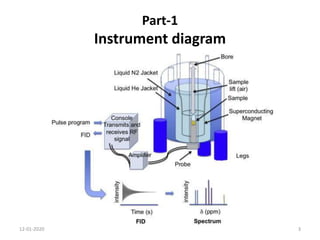
Part-1
Instrument diagram
12-01-2020 3
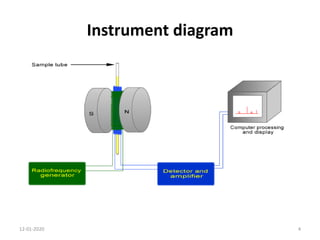
Instrument diagram
12-01-2020 4
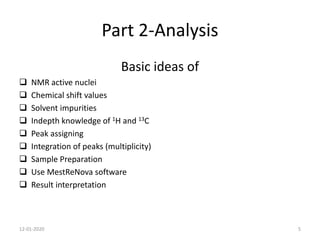
Part 2-Analysis
Basic ideas of
 NMR active nuclei
 Chemical shift values
 Solvent impurities
 Indepth knowledge of 1H and 13C
 Peak assigning
 Integration of peaks (multiplicity)
 Sample Preparation
 Use MestReNova software
 Result interpretation
12-01-2020 5
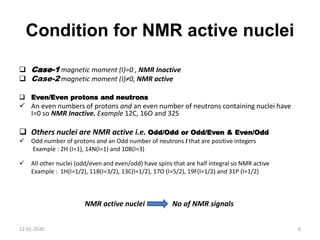
Condition for NMR active nuclei
 Case-1 magnetic moment (I)=0 , NMR Inactive
 Case-2 magnetic moment (I)≠0, NMR active
 Even/Even protons and neutrons
 An even numbers of protons and an even number of neutrons containing nuclei have
I=0 so NMR Inactive. Example 12C, 16O and 32S
 Others nuclei are NMR active i.e. Odd/Odd or Odd/Even & Even/Odd
 Odd number of protons and an Odd number of neutrons I that are positive integers
Example : 2H (I=1), 14N(I=1) and 10B(I=3)
 All other nuclei (odd/even and even/odd) have spins that are half integral so NMR active
Example : 1H(I=1/2), 11B(I=3/2), 13C(I=1/2), 17O (I=5/2), 19F(I=1/2) and 31P (I=1/2)
NMR active nuclei No of NMR signals
12-01-2020 6
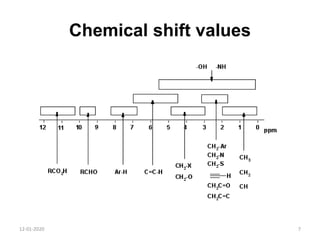
Chemical shift values
12-01-2020 7
NMR solvent impurities
Org. Process Res. Dev. 2016, 20, 661−667 DOI: 10.1021/acs.oprd.5b00417
12-01-2020 8
How to determine no of NMR signals ?
 Parameters to determine NMR Signals
 magnetically and chemically equivalence
 symmetry elements i.e. POS, COS
Enantiotropic,diastereotropic nature
12-01-2020 9
Proton and Carbon NMR
1H ( simple proton and COSY)
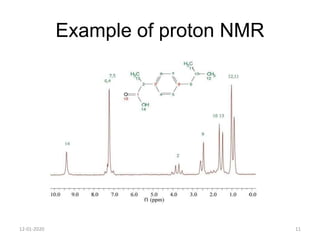
 Simple 1H only proton signals
 COSY 1H corelation among the protons
13C ( simple and DEPT-45,90,135)
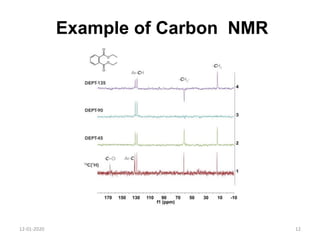
 Simple13C NMR( all Carbons with +ve)
 DEPT-45 (only H attached carbon with all +ve ),
 DEPT-90 ( only quarternary C)
 DEPT-135( CH,CH2,CH3 : even with -ve, odd with +ve)
12-01-2020 10
Example of proton NMR
12-01-2020 11
Example of Carbon NMR
12-01-2020 12
How to find multiplicity ?
(2nI+1) rule
Where, n = no of neighbouring protons and I= magnetic moment value
Case1, if I=1/2 Multiplicity rule =n+1
Case2, if I=1 Multiplicity rule =2n+1
12-01-2020 13
Find the no of NMR signals in given compounds
12-01-2020 14
Find the no of NMR signals in given compounds
12-01-2020 15
Find the no of NMR signals in given compounds
12-01-2020 16
Sample preparation for NMR
 Pre Preparation
 Ultrapure sample (purified compound by
appropriate purification techniques )
Vacuum drying of synthesized sample
Solubility of sample
Common solvents to check solubilty
CHCl3,MeOH,DMSO,DMF
Quantity of sample required
12-01-2020 17
Sample preparation for NMR
 Sample Preparation
Vacuum dried 20-25 mg sample
Duetrated solvents upto 1ml for sample
preparation
NMR tube for prepared sample with proper
labeling
12-01-2020 18
Why deuterated solvents are used in NMR spectroscopy ?
 To avoid swamping by the solvent signal.
• There is usually much more solvent than sample in an NMR tube. An ordinary proton-containing
solvent would give a huge solvent absorption that would dominate the 1H-NMR spectrum.
• Most 1H- NMR spectra are therefore recorded in a deuterated solvent, because deuterium atoms
absorb at a completely different frequency. But deuteration is never complete, so in CDCl3, for
example, there is always some residual CHCl3.
• You always get a solvent signal from CHCl3 at 7.26 ppm.
 To stabilize the magnetic field strength.
• The field strength of superconducting magnets tends to drift slowly.
• Modern NMR spectrometers measure the deuterium absorption of the solvent and adjust the field
strength to keep the resonance frequency (field strength) constant.
 To accurately define 0 ppm.
• The difference between the deuterium frequency and 0 ppm (TMS) is well known.
• Modern spectrometers can "lock" onto the deuterium signal, so the addition of an internal
reference like TMS is not usually required.
12-01-2020 19
NMR Tubes
12-01-2020 20
Sample Submission and data Collection
Data collected as FID file
Open FID file in MestReNova for
Reference solvent
Peak picking
Integration
Multiplicity
Finally Data Interpretation
12-01-2020 21
What is FID file?
NMR data is collected through pulse-observe procedure.
GED phenomenon
a. Generation of brief pulse of radio energy.
b. Excitation of NMR active nuclei
c. Decaying back to equilibrium by releasing radio energy.
Hence
The released energy is called a free induction decay or FID.
12-01-2020 22
Thanku for Your Kind Attention
12-01-2020 23

NMR Spectroscopy

  • 1.
    Advance Characterization Techniques 1.Nuclear Magnetic Resonance (NMR) Kanhaya Kumawat Ict mumbai 12-01-2020 1
  • 2.
    Nuclear Magnetic Resonance(NMR) Part-1 •Instrumentation Part-2 •Analysis 12-01-2020 2
  • 3.
  • 4.
  • 5.
    Part 2-Analysis Basic ideasof  NMR active nuclei  Chemical shift values  Solvent impurities  Indepth knowledge of 1H and 13C  Peak assigning  Integration of peaks (multiplicity)  Sample Preparation  Use MestReNova software  Result interpretation 12-01-2020 5
  • 6.
    Condition for NMRactive nuclei  Case-1 magnetic moment (I)=0 , NMR Inactive  Case-2 magnetic moment (I)≠0, NMR active  Even/Even protons and neutrons  An even numbers of protons and an even number of neutrons containing nuclei have I=0 so NMR Inactive. Example 12C, 16O and 32S  Others nuclei are NMR active i.e. Odd/Odd or Odd/Even & Even/Odd  Odd number of protons and an Odd number of neutrons I that are positive integers Example : 2H (I=1), 14N(I=1) and 10B(I=3)  All other nuclei (odd/even and even/odd) have spins that are half integral so NMR active Example : 1H(I=1/2), 11B(I=3/2), 13C(I=1/2), 17O (I=5/2), 19F(I=1/2) and 31P (I=1/2) NMR active nuclei No of NMR signals 12-01-2020 6
  • 7.
  • 8.
    NMR solvent impurities Org.Process Res. Dev. 2016, 20, 661−667 DOI: 10.1021/acs.oprd.5b00417 12-01-2020 8
  • 9.
    How to determineno of NMR signals ?  Parameters to determine NMR Signals  magnetically and chemically equivalence  symmetry elements i.e. POS, COS Enantiotropic,diastereotropic nature 12-01-2020 9
  • 10.
    Proton and CarbonNMR 1H ( simple proton and COSY)  Simple 1H only proton signals  COSY 1H corelation among the protons 13C ( simple and DEPT-45,90,135)  Simple13C NMR( all Carbons with +ve)  DEPT-45 (only H attached carbon with all +ve ),  DEPT-90 ( only quarternary C)  DEPT-135( CH,CH2,CH3 : even with -ve, odd with +ve) 12-01-2020 10
  • 11.
    Example of protonNMR 12-01-2020 11
  • 12.
    Example of CarbonNMR 12-01-2020 12
  • 13.
    How to findmultiplicity ? (2nI+1) rule Where, n = no of neighbouring protons and I= magnetic moment value Case1, if I=1/2 Multiplicity rule =n+1 Case2, if I=1 Multiplicity rule =2n+1 12-01-2020 13
  • 14.
    Find the noof NMR signals in given compounds 12-01-2020 14
  • 15.
    Find the noof NMR signals in given compounds 12-01-2020 15
  • 16.
    Find the noof NMR signals in given compounds 12-01-2020 16
  • 17.
    Sample preparation forNMR  Pre Preparation  Ultrapure sample (purified compound by appropriate purification techniques ) Vacuum drying of synthesized sample Solubility of sample Common solvents to check solubilty CHCl3,MeOH,DMSO,DMF Quantity of sample required 12-01-2020 17
  • 18.
    Sample preparation forNMR  Sample Preparation Vacuum dried 20-25 mg sample Duetrated solvents upto 1ml for sample preparation NMR tube for prepared sample with proper labeling 12-01-2020 18
  • 19.
    Why deuterated solventsare used in NMR spectroscopy ?  To avoid swamping by the solvent signal. • There is usually much more solvent than sample in an NMR tube. An ordinary proton-containing solvent would give a huge solvent absorption that would dominate the 1H-NMR spectrum. • Most 1H- NMR spectra are therefore recorded in a deuterated solvent, because deuterium atoms absorb at a completely different frequency. But deuteration is never complete, so in CDCl3, for example, there is always some residual CHCl3. • You always get a solvent signal from CHCl3 at 7.26 ppm.  To stabilize the magnetic field strength. • The field strength of superconducting magnets tends to drift slowly. • Modern NMR spectrometers measure the deuterium absorption of the solvent and adjust the field strength to keep the resonance frequency (field strength) constant.  To accurately define 0 ppm. • The difference between the deuterium frequency and 0 ppm (TMS) is well known. • Modern spectrometers can "lock" onto the deuterium signal, so the addition of an internal reference like TMS is not usually required. 12-01-2020 19
  • 20.
  • 21.
    Sample Submission anddata Collection Data collected as FID file Open FID file in MestReNova for Reference solvent Peak picking Integration Multiplicity Finally Data Interpretation 12-01-2020 21
  • 22.
    What is FIDfile? NMR data is collected through pulse-observe procedure. GED phenomenon a. Generation of brief pulse of radio energy. b. Excitation of NMR active nuclei c. Decaying back to equilibrium by releasing radio energy. Hence The released energy is called a free induction decay or FID. 12-01-2020 22
  • 23.
    Thanku for YourKind Attention 12-01-2020 23