WELCOME  TO  NSQ HSE TRAINING PROGRAMME RISK ASSESSMENT
OBJECTIVES 1. Reduce risks in various job s and  specific tasks. 2. Prevent accidents and losses to people, property and the    environment. 3. Prevent accident, which effect the reputation of NSQ as a  company. 4. Promote proactive approaches to accidents/loss prevention 5. Assist management in making critical HSE decisions. 6. Assist line management/supervisors in the day to day  management of HSE rules. 7. To assess the risk and make a decision as to whether it is safe to  proceed with the activity.
DEFINITIONS HAZARD : the potential to cause harm or damage(physically). RISK : the likelihood of hazard occurring (possibility). PRECAUTION : Steps to reduce the risk of hazard occurring to an acceptable level. INJURY : The result of hazard occurring to a person. DAMAGE : The result  of  hazard occurring to a thing.
ASSESSMENT THE IDENTIFICATION AND CONTROL THE HAZARD FOR PROMOTION OF A SAFE WORK PLACE AND SAFE SYSTEM OF THE WORK. The emphasis should be on  elimination   of unnecessary risk ,perhaps by  substitution  of substances ;then the  control  the residual risk ,perhaps through  enclosure  of the hazard;and lastly on protecting the employees by  personal protective equipment A  PRO-ACTIVE APPROACH  should be done through the safety tours,… To identify the risk before accident occur.and after accident,near miss the  REACTING  is necessary.
ASSESSMENT STEPS: LOOK FOR HAZARD  : Slipping , tripping , fire risk ,unguarded machinery , working at height ,forklift trucks , poor electrical wiring , noise , dust , poor lighting. Task should break to steps then identify the hazards associated with each other. DECIDE WHO MIGHT BE HARMED AND HOW  : No need to name of individual staff just about group of people: office staff,pipe coating,blasting personnel , GRP pipe fitters . EVALUATE THE RISK  : evaluate the risk arising from the hazards and decide if existing precaution is adequate or more should be done.
ASSESSMENT STEPS: RECORD ,MEASURE ,MONITOR : IF THE NUMBER OF STAFF IS MORE THAN 5 PEOPLE THE RISK ASSESSMENT SOULD BE WRITTEN AND RECORDED. THE FINDINGS SHOULD BE RECORDED, e.g. ‘’Electrical checks carried out in SPP2 and everything found to be satisfactory’’ It is very important to keep documents for future reference. REVIEW THE ASSESSMENT : FROM TIME TO TIME REVISE IF NECESSARY .BECAUSE YARD SITUATION MIGHT BE CHANGED: NEW MACHINERY,…
HAZARD IDENTIFICATION: Identifying the hazards to minimize the modification costs and entirely eliminate the hazard from design and planning step is the best. In  CONSTRUCTION  phase we should follow the identifying hazards about overlooked  safety basis.in  COMISSIONING  near the project completion ,there is tendency to speed up the things in order to enter production phase ,so many safety controls would be overlooked. NEW TECHNOLOGY :The edges of new technology,the occupational hazards may be unknown.
SURVEYING THE HAZARD   Think about the activity that is about to be performed and  break it   down into steps . Assess  what materials/substances  are to be used or what you may encounter (research unfamiliar substances). What tools  and equipment will be used (pneumatic/electrical). When  (day/night) and  where  will the job be done (hazardous area/confined space/excavation/over water) etc
SURVEYING THE HAZARD: THE KEY QUESTIONS WILL HELP US TO IDENTIFY THE HAZARDS: 1.What can happen? 2.How can it happen? 3.What will happen in the event that there is too much or too little Pressure/ heat /cold/ air /vacuum/ ventilation /noise/ flow /supply/ reactant /containment,… 4.who could be affected? 5.why is the risk necessary? 6.where will it take place?
Safety procedures/manuals. Accident, incident & near miss report . Talk to colleagues/discussion. Minutes of safety committee meetings. Safety Audit reports . Safety Flashes. HIP reports.   FINALLY YOU CAN USE PAST EXPERIENCES
Every activity  you do has some risk associated with it. Crossing the road Driving Skiing Sport Climbing a ladder Heavy lifts Air travel Entering a confined space
In drawing up your list you have probably listed both hazards and effects - Examples: Ladder slipping    (Hazard) Twisting/breaking   (Effect) Flying particles (Hazard) Eye damage/cut or bruise (Effect ) Falling picture frame  (Hazard) Broken/cut foot   (Effect )
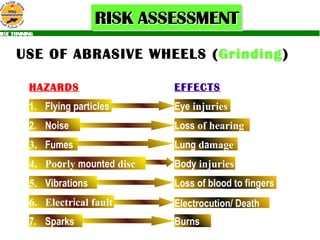
USE OF ABRASIVE WHEELS ( Grinding ) HAZARDS EFFECTS Eye  injuries Loss  of hearing Lung  d a mage Burns Loss of blood to fingers Electrocution/ Death Body  injuries 1. Flying particles 2. Noise 3. Fumes 7. Sparks 5. Vibrations 6. Electr i cal fault 4. Po o rly  mounted  disc
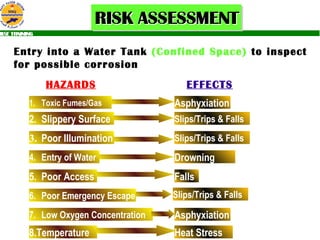
Entry into a Water Tank  (Confined Space)  to inspect for possible corrosion HAZARDS EFFECTS Asphyxiation Slips/Trips & Falls Heat Stress Drowning Slips/Trips & Falls Slips/Trips & Falls Asphyxiation Falls 1. Toxic Fumes/Gas 2. Slippery Surface 3. Poor Illumination 7. Low Oxygen Concentration 5. Poor Access 6. Poor Emergency Escape 4. Entry of Water 8.Temperature
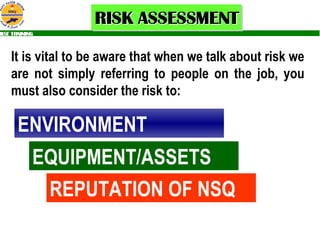
It is vital to be aware that when we talk about risk we are not simply referring to people on the job, you must also consider the risk to: ENVIRONMENT EQUIPMENT/ASSETS REPUTATION OF NSQ
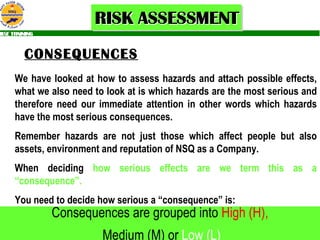
CONSEQUENCES We have looked at how to assess hazards and attach possible effects, what we also need to look at is which hazards are the most serious and therefore need our immediate attention in other words which hazards have the most serious consequences. Remember hazards are not just those which affect people but also assets, environment and reputation of NSQ as a Company. When deciding  how serious effects are we term this as a   “consequence”. You need to decide how serious a “consequence” is: Consequences are grouped into  High (H), Medium (M) or  Low (L)
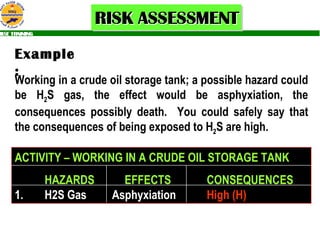
Example: Working in a crude oil storage tank; a possible hazard could be H 2 S gas, the effect would be asphyxiation, the consequences possibly death.  You could safely say that the consequences of being exposed to H 2 S are high. ACTIVITY – WORKING IN A CRUDE OIL STORAGE TANK HAZARDS EFFECTS CONSEQUENCES 1. H2S Gas  Asphyxiation High (H)
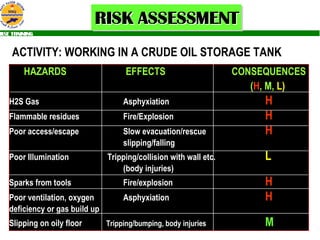
ACTIVITY: WORKING IN A CRUDE OIL STORAGE TANK HAZARDS  EFFECTS  CONSEQUENCES   ( H , M,  L) H2S Gas Asphyxiation   H Flammable residues Fire/Explosion H Poor access/escape Slow evacuation/rescue H slipping/falling Poor Illumination  Tripping/collision with wall etc. L (body injuries) Sparks from tools Fire/explosion H Poor ventilation, oxygen Asphyxiation   H deficiency or gas build up Slipping on oily floor  Tripping/bumping, body injuries M
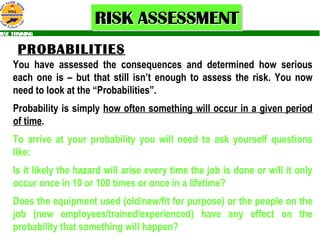
PROBABILITIES You have assessed the consequences and determined how serious each one is – but that still isn’t enough to assess the risk. You now need to look at the “Probabilities”. Probability is simply  how often something will occur in a given period   of time .  To arrive at your probability you will need to ask yourself questions like: Is it likely the hazard will arise every time the job is done or will it only occur once in 10 or 100 times or once in a lifetime? Does the equipment used (old/new/fit for purpose) or the people on the job (new employees/trained/experienced) have any effect on the probability that something will happen?
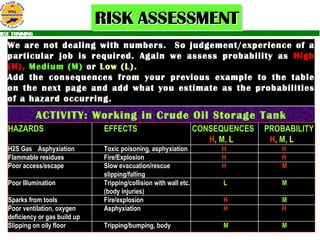
We are not dealing with numbers.  So judgement/experience of a particular job is required. Again we assess probability as  High (H),   Medium (M)  or  Low (L). Add the consequences from your previous example to the table on the next page and add what you estimate as the probabilities of a hazard occurring. ACTIVITY: Working in Crude Oil Storage Tank HAZARDS EFFECTS  CONSEQUENCES  PROBABILITY   H , M,  L  H , M,  L  H2S Gas Asphyxiation Toxic poisoning, asphyxiation   H H Flammable residues Fire/Explosion H H Poor access/escape Slow evacuation/rescue H M slipping/falling Poor Illumination Tripping/collision with wall etc.   L M (body injuries) Sparks from tools Fire/explosion   H M Poor ventilation, oxygen Asphyxiation   H H deficiency or gas build up Slipping on oily floor  Tripping/bumping, body   M M
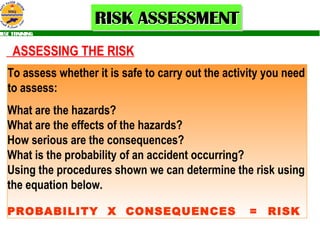
ASSESSING THE RISK To assess whether it is safe to carry out the activity you need to assess: What are the hazards? What are the effects of the hazards? How serious are the consequences? What is the probability of an accident occurring? Using the procedures shown we can determine the risk using the equation below. PROBABILITY  X  CONSEQUENCES  =  RISK
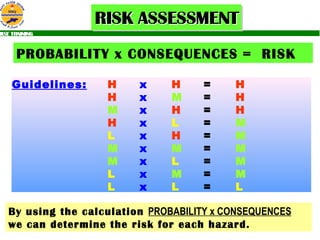
PROBABILITY x CONSEQUENCES =  RISK Guidelines: H x H = H H x M = H M x H = H H x L = M L x H = M M x M = M M x L = M L x M = M L x L = L By using the calculation  PROBABILITY x CONSEQUENCES  we can determine the risk for each hazard.
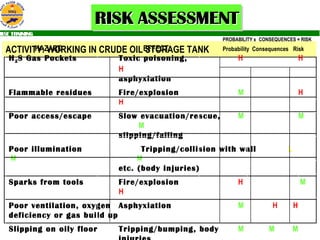
ACTIVITY: WORKING IN CRUDE OIL STORAGE TANK PROBABILITY x   CONSEQUENCES = RISK HAZARD   EFFECT Probability  Consequences Risk H 2 S Gas Pockets Toxic poisoning,   H   H  H asphyxiation Flammable residues Fire/explosion   M   H  H Poor access/escape Slow evacuation/rescue,   M   M   M slipping/falling Poor illumination  Tripping/collision with wall   L   M   M etc. (body injuries) Sparks from tools Fire/explosion   H   M  H Poor ventilation, oxygen Asphyxiation   M   H  H deficiency or gas build up Slipping on oily floor Tripping/bumping, body    M  M  M injuries
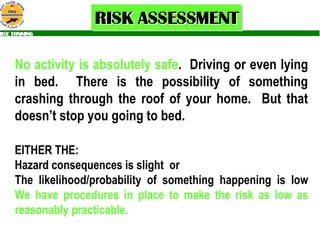
No activity is absolutely safe .  Driving or even lying in bed.  There is the possibility of something crashing through the roof of your home.  But that doesn’t stop you going to bed.   EITHER THE:  the: Hazard consequences is slight  or The likelihood/probability of something happening is low  We have procedures in place to make the risk as low as reasonably practicable.
MANAGEMENT OF RISK TO AN ACCEPTABLE LEVEL Once the risks have been identified, management has to decide what corrective action (if any) is necessary.  The corrective action should be to such a level i.e.  “ As Low As   Reasonably Practicable ” or “ ALARP ”. Low risks require little or no action;   medium and high risk require management intervention in the form of a corrective action plan.
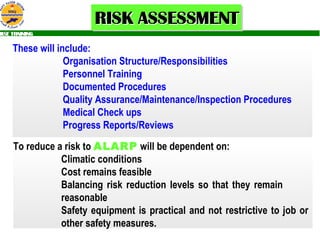
These will include:  Organisation Structure/Responsibilities Personnel Training Documented Procedures Quality Assurance/Maintenance/Inspection Procedures Medical Check ups Progress Reports/Reviews To reduce a risk to  ALARP   will be dependent on: Climatic conditions Cost remains feasible  Balancing risk reduction levels so that they remain  reasonable  Safety equipment is practical and not restrictive to job or  other safety measures.
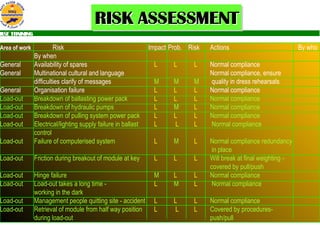
Area of work  Risk Impact Prob. Risk Actions By who By when General Availability of spares L L L Normal compliance General Multinational cultural and language   Normal compliance, ensure difficulties clarify of messages M M M  quality in dress rehearsals General Organisation failure L L L Normal compliance Load-out Breakdown of ballasting power pack L L L Normal compliance Load-out Breakdown of hydraulic pumps L M L Normal compliance Load-out Breakdown of pulling system power pack L L L Normal compliance Load-out Electrical/lighting supply failure in ballast  L  L L  Normal compliance control Load-out Failure of computerised system L M L Normal compliance redundancy   in place Load-out Friction during breakout of module at key  L L L Will break at final weighting -   covered by pull/push Load-out Hinge failure M L L Normal compliance Load-out Load-out takes a long time -  L M   L  Normal compliance working in the dark Load-out Management people quitting site - accident L L L Normal compliance Load-out Retrieval of module from half way position  L   L  L   Covered by procedures- during load-out push/pull
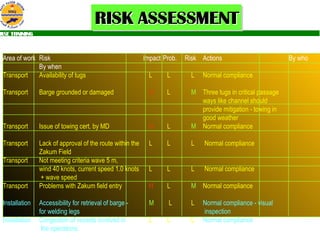
Area of work Risk Impact Prob. Risk Actions By who By when Transport Availability of tugs L L L Normal compliance Transport Barge grounded or damaged H L M Three tugs in critical passage   ways like channel should   provide mitigation - towing in  good weather Transport Issue of towing cert. by MD H L M Normal compliance Transport Lack of approval of the route within the L L L   Normal compliance Zakum Field Transport Not meeting criteria wave 5 m,   wind 40 knots, current speed 1.0 knots   L L L   Normal compliance   + wave speed Transport Problems with Zakum field entry H L M Normal compliance Installation Accessibility for retrieval of barge -   M   L L Normal compliance - visual for welding legs  inspection   Installation Congestion of vessels involved in L L L Normal compliance   the operations

NGI-Risk Assessment

  • 1.
    WELCOME TO NSQ HSE TRAINING PROGRAMME RISK ASSESSMENT
  • 2.
    OBJECTIVES 1. Reducerisks in various job s and specific tasks. 2. Prevent accidents and losses to people, property and the environment. 3. Prevent accident, which effect the reputation of NSQ as a company. 4. Promote proactive approaches to accidents/loss prevention 5. Assist management in making critical HSE decisions. 6. Assist line management/supervisors in the day to day management of HSE rules. 7. To assess the risk and make a decision as to whether it is safe to proceed with the activity.
  • 3.
    DEFINITIONS HAZARD :the potential to cause harm or damage(physically). RISK : the likelihood of hazard occurring (possibility). PRECAUTION : Steps to reduce the risk of hazard occurring to an acceptable level. INJURY : The result of hazard occurring to a person. DAMAGE : The result of hazard occurring to a thing.
  • 4.
    ASSESSMENT THE IDENTIFICATIONAND CONTROL THE HAZARD FOR PROMOTION OF A SAFE WORK PLACE AND SAFE SYSTEM OF THE WORK. The emphasis should be on elimination of unnecessary risk ,perhaps by substitution of substances ;then the control the residual risk ,perhaps through enclosure of the hazard;and lastly on protecting the employees by personal protective equipment A PRO-ACTIVE APPROACH should be done through the safety tours,… To identify the risk before accident occur.and after accident,near miss the REACTING is necessary.
  • 5.
    ASSESSMENT STEPS: LOOKFOR HAZARD : Slipping , tripping , fire risk ,unguarded machinery , working at height ,forklift trucks , poor electrical wiring , noise , dust , poor lighting. Task should break to steps then identify the hazards associated with each other. DECIDE WHO MIGHT BE HARMED AND HOW : No need to name of individual staff just about group of people: office staff,pipe coating,blasting personnel , GRP pipe fitters . EVALUATE THE RISK : evaluate the risk arising from the hazards and decide if existing precaution is adequate or more should be done.
  • 6.
    ASSESSMENT STEPS: RECORD,MEASURE ,MONITOR : IF THE NUMBER OF STAFF IS MORE THAN 5 PEOPLE THE RISK ASSESSMENT SOULD BE WRITTEN AND RECORDED. THE FINDINGS SHOULD BE RECORDED, e.g. ‘’Electrical checks carried out in SPP2 and everything found to be satisfactory’’ It is very important to keep documents for future reference. REVIEW THE ASSESSMENT : FROM TIME TO TIME REVISE IF NECESSARY .BECAUSE YARD SITUATION MIGHT BE CHANGED: NEW MACHINERY,…
  • 7.
    HAZARD IDENTIFICATION: Identifyingthe hazards to minimize the modification costs and entirely eliminate the hazard from design and planning step is the best. In CONSTRUCTION phase we should follow the identifying hazards about overlooked safety basis.in COMISSIONING near the project completion ,there is tendency to speed up the things in order to enter production phase ,so many safety controls would be overlooked. NEW TECHNOLOGY :The edges of new technology,the occupational hazards may be unknown.
  • 8.
    SURVEYING THE HAZARD Think about the activity that is about to be performed and break it down into steps . Assess what materials/substances are to be used or what you may encounter (research unfamiliar substances). What tools and equipment will be used (pneumatic/electrical). When (day/night) and where will the job be done (hazardous area/confined space/excavation/over water) etc
  • 9.
    SURVEYING THE HAZARD:THE KEY QUESTIONS WILL HELP US TO IDENTIFY THE HAZARDS: 1.What can happen? 2.How can it happen? 3.What will happen in the event that there is too much or too little Pressure/ heat /cold/ air /vacuum/ ventilation /noise/ flow /supply/ reactant /containment,… 4.who could be affected? 5.why is the risk necessary? 6.where will it take place?
  • 10.
    Safety procedures/manuals. Accident,incident & near miss report . Talk to colleagues/discussion. Minutes of safety committee meetings. Safety Audit reports . Safety Flashes. HIP reports. FINALLY YOU CAN USE PAST EXPERIENCES
  • 11.
    Every activity you do has some risk associated with it. Crossing the road Driving Skiing Sport Climbing a ladder Heavy lifts Air travel Entering a confined space
  • 12.
    In drawing upyour list you have probably listed both hazards and effects - Examples: Ladder slipping (Hazard) Twisting/breaking (Effect) Flying particles (Hazard) Eye damage/cut or bruise (Effect ) Falling picture frame (Hazard) Broken/cut foot (Effect )
  • 13.
    USE OF ABRASIVEWHEELS ( Grinding ) HAZARDS EFFECTS Eye injuries Loss of hearing Lung d a mage Burns Loss of blood to fingers Electrocution/ Death Body injuries 1. Flying particles 2. Noise 3. Fumes 7. Sparks 5. Vibrations 6. Electr i cal fault 4. Po o rly mounted disc
  • 14.
    Entry into aWater Tank (Confined Space) to inspect for possible corrosion HAZARDS EFFECTS Asphyxiation Slips/Trips & Falls Heat Stress Drowning Slips/Trips & Falls Slips/Trips & Falls Asphyxiation Falls 1. Toxic Fumes/Gas 2. Slippery Surface 3. Poor Illumination 7. Low Oxygen Concentration 5. Poor Access 6. Poor Emergency Escape 4. Entry of Water 8.Temperature
  • 15.
    It is vitalto be aware that when we talk about risk we are not simply referring to people on the job, you must also consider the risk to: ENVIRONMENT EQUIPMENT/ASSETS REPUTATION OF NSQ
  • 16.
    CONSEQUENCES We havelooked at how to assess hazards and attach possible effects, what we also need to look at is which hazards are the most serious and therefore need our immediate attention in other words which hazards have the most serious consequences. Remember hazards are not just those which affect people but also assets, environment and reputation of NSQ as a Company. When deciding how serious effects are we term this as a “consequence”. You need to decide how serious a “consequence” is: Consequences are grouped into High (H), Medium (M) or Low (L)
  • 17.
    Example: Working ina crude oil storage tank; a possible hazard could be H 2 S gas, the effect would be asphyxiation, the consequences possibly death. You could safely say that the consequences of being exposed to H 2 S are high. ACTIVITY – WORKING IN A CRUDE OIL STORAGE TANK HAZARDS EFFECTS CONSEQUENCES 1. H2S Gas Asphyxiation High (H)
  • 18.
    ACTIVITY: WORKING INA CRUDE OIL STORAGE TANK HAZARDS EFFECTS CONSEQUENCES ( H , M, L) H2S Gas Asphyxiation H Flammable residues Fire/Explosion H Poor access/escape Slow evacuation/rescue H slipping/falling Poor Illumination Tripping/collision with wall etc. L (body injuries) Sparks from tools Fire/explosion H Poor ventilation, oxygen Asphyxiation H deficiency or gas build up Slipping on oily floor Tripping/bumping, body injuries M
  • 19.
    PROBABILITIES You haveassessed the consequences and determined how serious each one is – but that still isn’t enough to assess the risk. You now need to look at the “Probabilities”. Probability is simply how often something will occur in a given period of time . To arrive at your probability you will need to ask yourself questions like: Is it likely the hazard will arise every time the job is done or will it only occur once in 10 or 100 times or once in a lifetime? Does the equipment used (old/new/fit for purpose) or the people on the job (new employees/trained/experienced) have any effect on the probability that something will happen?
  • 20.
    We are notdealing with numbers. So judgement/experience of a particular job is required. Again we assess probability as High (H), Medium (M) or Low (L). Add the consequences from your previous example to the table on the next page and add what you estimate as the probabilities of a hazard occurring. ACTIVITY: Working in Crude Oil Storage Tank HAZARDS EFFECTS CONSEQUENCES PROBABILITY H , M, L H , M, L H2S Gas Asphyxiation Toxic poisoning, asphyxiation H H Flammable residues Fire/Explosion H H Poor access/escape Slow evacuation/rescue H M slipping/falling Poor Illumination Tripping/collision with wall etc. L M (body injuries) Sparks from tools Fire/explosion H M Poor ventilation, oxygen Asphyxiation H H deficiency or gas build up Slipping on oily floor Tripping/bumping, body M M
  • 21.
    ASSESSING THE RISKTo assess whether it is safe to carry out the activity you need to assess: What are the hazards? What are the effects of the hazards? How serious are the consequences? What is the probability of an accident occurring? Using the procedures shown we can determine the risk using the equation below. PROBABILITY X CONSEQUENCES = RISK
  • 22.
    PROBABILITY x CONSEQUENCES= RISK Guidelines: H x H = H H x M = H M x H = H H x L = M L x H = M M x M = M M x L = M L x M = M L x L = L By using the calculation PROBABILITY x CONSEQUENCES we can determine the risk for each hazard.
  • 23.
    ACTIVITY: WORKING INCRUDE OIL STORAGE TANK PROBABILITY x CONSEQUENCES = RISK HAZARD EFFECT Probability Consequences Risk H 2 S Gas Pockets Toxic poisoning, H H H asphyxiation Flammable residues Fire/explosion M H H Poor access/escape Slow evacuation/rescue, M M M slipping/falling Poor illumination Tripping/collision with wall L M M etc. (body injuries) Sparks from tools Fire/explosion H M H Poor ventilation, oxygen Asphyxiation M H H deficiency or gas build up Slipping on oily floor Tripping/bumping, body M M M injuries
  • 24.
    No activity isabsolutely safe . Driving or even lying in bed. There is the possibility of something crashing through the roof of your home. But that doesn’t stop you going to bed. EITHER THE: the: Hazard consequences is slight or The likelihood/probability of something happening is low We have procedures in place to make the risk as low as reasonably practicable.
  • 25.
    MANAGEMENT OF RISKTO AN ACCEPTABLE LEVEL Once the risks have been identified, management has to decide what corrective action (if any) is necessary. The corrective action should be to such a level i.e. “ As Low As Reasonably Practicable ” or “ ALARP ”. Low risks require little or no action; medium and high risk require management intervention in the form of a corrective action plan.
  • 26.
    These will include: Organisation Structure/Responsibilities Personnel Training Documented Procedures Quality Assurance/Maintenance/Inspection Procedures Medical Check ups Progress Reports/Reviews To reduce a risk to ALARP will be dependent on: Climatic conditions Cost remains feasible Balancing risk reduction levels so that they remain reasonable Safety equipment is practical and not restrictive to job or other safety measures.
  • 27.
    Area of work Risk Impact Prob. Risk Actions By who By when General Availability of spares L L L Normal compliance General Multinational cultural and language Normal compliance, ensure difficulties clarify of messages M M M quality in dress rehearsals General Organisation failure L L L Normal compliance Load-out Breakdown of ballasting power pack L L L Normal compliance Load-out Breakdown of hydraulic pumps L M L Normal compliance Load-out Breakdown of pulling system power pack L L L Normal compliance Load-out Electrical/lighting supply failure in ballast L L L Normal compliance control Load-out Failure of computerised system L M L Normal compliance redundancy in place Load-out Friction during breakout of module at key L L L Will break at final weighting - covered by pull/push Load-out Hinge failure M L L Normal compliance Load-out Load-out takes a long time - L M L Normal compliance working in the dark Load-out Management people quitting site - accident L L L Normal compliance Load-out Retrieval of module from half way position L L L Covered by procedures- during load-out push/pull
  • 28.
    Area of workRisk Impact Prob. Risk Actions By who By when Transport Availability of tugs L L L Normal compliance Transport Barge grounded or damaged H L M Three tugs in critical passage ways like channel should provide mitigation - towing in good weather Transport Issue of towing cert. by MD H L M Normal compliance Transport Lack of approval of the route within the L L L Normal compliance Zakum Field Transport Not meeting criteria wave 5 m, wind 40 knots, current speed 1.0 knots L L L Normal compliance + wave speed Transport Problems with Zakum field entry H L M Normal compliance Installation Accessibility for retrieval of barge - M L L Normal compliance - visual for welding legs inspection Installation Congestion of vessels involved in L L L Normal compliance the operations