NGI  Training Center Welcome safety course PERMIT TO WORK
Definition Permit  : The formal written and authorising document:  approved by management,  describing the work to be carried on identifying the potential hazards or interacting activities that can take place specifying the requirement, precautions requested to work in safe condition
Purpose To ensure: All work activities,  hazards and precautions are defined prior to the execution of the work proper planning and consideration  communication between installation management, supervisors and operators and those who carry out the work. Monitoring and auditing to ensure safe system of works.
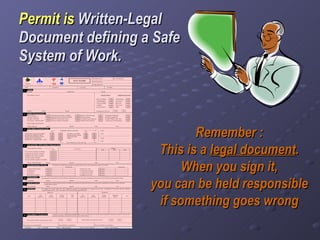
Permit is  Written-Legal Document defining a Safe System of Work. Remember : This is a  legal document . When you sign it, you can be held responsible if something goes wrong
Mis-conception that the PTW system should control  all  of the work carried out at a facility can lead to an overload of the PTW system, which prevents proper attention given to activities with a higher hazard potential. PTW is appropriate to non-routine activities which may require some form of Job Safety Analysis prior to work commencing. PTW is required for Maintenance work carried out by plant operators. Use a PTW when two or more groups of people (different trades), need to co-ordinate their activities to ensure that their work is completed safely.  What work  requires  Permit?
Routine  Maintenance and production plant operations; all carried out in accordance with site approved procedures Where this is identified on fixed lists approved by TIJD Commissioning Manager If it is carried out in an area specified on an installation layout drawing, approved by TIJD Commissioning Manager Visual inspection of areas (except in confined spaces).  Work  Not  require  a Permit
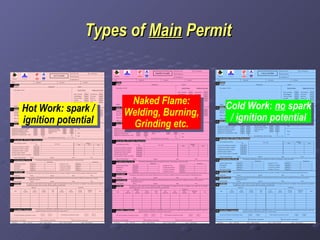
Types of  Main  Permit   Hot Work: spark / ignition potential Naked Flame: Welding, Burning, Grinding etc. Cold Work:  no  spark / ignition potential
Any work involving equipment giving rise to a  Definite  source of ignition, such as: use of equipment for oxy-acetylene burning, gas welding, electric-arc welding, propane torch heating and burning, grinding or use of a hot-air gun. What is a  Hot (Naked Flame)  Work ?
Any work involving, or giving rise to, a  Potential   source of ignition, such as: Grit-blasting  Work on non-intrinsically safe equipment Using non-certified electrical equipment not controlled by an Electrical Permit (e.g. Avometer, power tools etc)   Spray painting Use of Camera with flash  What is a  Hot  Work ?
What is a  Cold  Work ? Cold Work-  Any task, or the use of any tool or equipment that will  not  produce a source of ignition. Such as: use of tools for erection, dismantling and cleaning, which are not liable to produce sparks, Pressure testing of plant and equipment Disconnection or opening  up of any closed pipeline or vessel Spading and de-spading of hydrocarbon line Chemical cleaning Handling of  hazardous substances, e.g. radioactive source, toxic / corrosive chemicals, asbestos, etc
 Validity Hot Work, Naked Flame and Cold Work Main Permits, all have  same validity period . 7 Consequent SHIFTS or 7 Days Maximum!
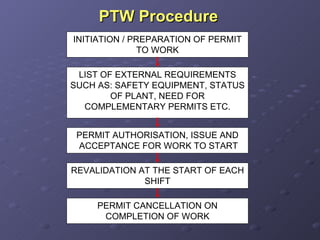
PTW Procedure INITIATION / PREPARATION OF PERMIT TO WORK LIST OF EXTERNAL REQUIREMENTS SUCH AS: SAFETY EQUIPMENT, STATUS OF PLANT, NEED FOR COMPLEMENTARY PERMITS ETC. PERMIT AUTHORISATION, ISSUE AND ACCEPTANCE FOR WORK TO START REVALIDATION AT THE START OF EACH SHIFT PERMIT CANCELLATION ON COMPLETION OF WORK
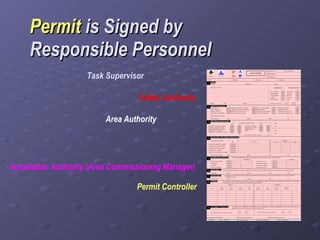
Permit  is Signed by Responsible Personnel Safety Authority Installation Authority (Area Commissioning Manager) Task Supervisor  Permit Controller Area Authority
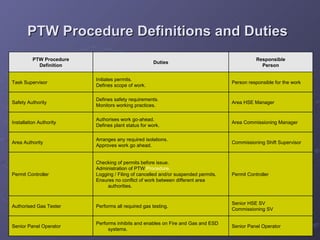
PTW Procedure Definitions and Duties   Area HSE Manager Defines safety requirements. Monitors working practices. Safety Authority Senior Panel Operator Performs inhibits and enables on Fire and Gas and ESD systems. Senior Panel Operator Senior HSE SV Commissioning SV Performs all required gas testing. Authorised Gas Tester Permit Controller Checking of permits before issue. Administration of PTW  Procedure. Logging / Filing of cancelled and/or suspended permits. Ensures no conflict of work between different area authorities. Permit Controller Commissioning Shift Supervisor Arranges any required isolations. Approves work go ahead. Area Authority Area Commissioning Manager Authorises work go-ahead. Defines plant status for work. Installation Authority Person responsible for the work Initiates permits. Defines scope of work. Task Supervisor Responsible Person Duties PTW Procedure Definition
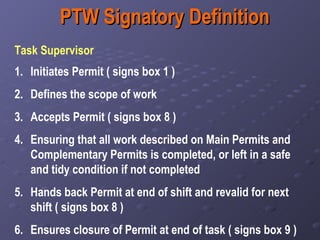
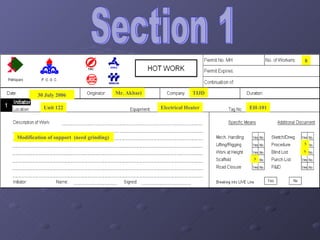
PTW Signatory Definition Task Supervisor  Initiates Permit ( signs box 1 ) Defines the scope of work Accepts Permit ( signs box 8 ) Ensuring that all work described on Main Permits and Complementary Permits is completed, or left in a safe and tidy condition if not completed   Hands back Permit at end of shift and revalid for next shift ( signs box 8 ) Ensures closure of Permit at end of task ( signs box 9 )
Section 1 TIJD Modification of support  (need grinding)  8 X Mr. Akbari 30 July 2006 Unit 122 Electrical Heater EH-101 X X
To all Task Supervisors When you send someone to the Permit Office to have a permit signed, please ensure: They  understand what the permit  is requesting. The Permit Authority may have questions about the job description or location. They understand and speak  English . Most Permit Authorities speak only English   and they may want to communicate with the person you send Please print clearly all information on job description, location and equipment requirements with  CAPITAL LETTERS , If the writing is not clear, the permit will be rejected and you have to start all over again
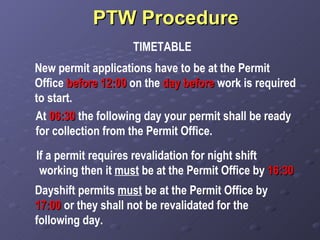
PTW Procedure  TIMETABLE New permit applications have to be at the Permit Office  before   12:00  on the  day before  work is required to start. At  06:30  the following day your permit shall be ready for collection from the Permit Office. If a permit requires revalidation for night shift working then it  must  be at the Permit Office by  16:30 Dayshift permits  must  be at the Permit Office by  17:00  or they shall not be revalidated for the following day.
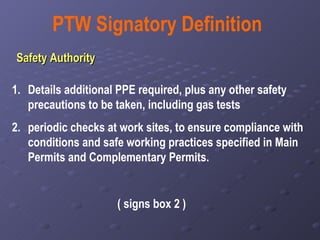
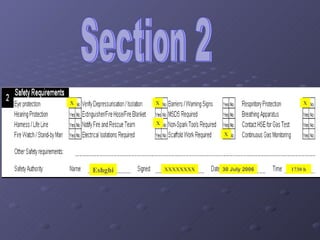
Safety Authority Details additional PPE required, plus any other safety precautions to be taken, including gas tests periodic checks at work sites, to ensure compliance with conditions and safe working practices specified in Main Permits and Complementary Permits. ( signs box 2 ) PTW Signatory Definition
Section 2 X Eshghi XXXXXXXX 30 July 2006 1730 h X X X X
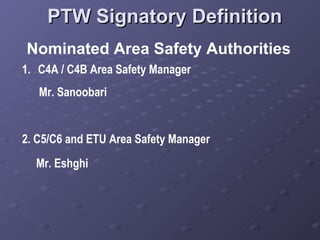
PTW Signatory Definition Nominated Area Safety Authorities C4A / C4B Area Safety Manager Mr.  Sanoobari 2.  C5/C6 and ETU Area Safety Manager Mr.  Eshghi
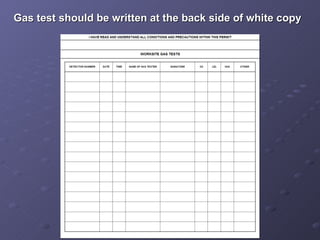
Gas test should be written at the back side of white copy
PTW Signatory Definition Installation Authorities   Evaluation of intended work Ensuring proper authorisation, issue and cancellation of all Main Permits in their areas Planning, coordinating and authorising all Hot Work (Naked Flame) Permits (not more than  ONE  Naked flame permit per designated area.
PTW Signatory Definition Nominated Installation Authorities C4A / C4B Area Commissioning Manager Mr.  2.  C5/C6 and ETU Area Commissioning Manager Mr.  ( signs box 3 )
PTW Signatory Definition Area Authorities  Arranging for any required Electrical or Process / Mechanical Isolations. Delegating the issue and cancellation Complementary Permits  Periodic checks of work sites are performed to ensure compliance with conditions specified in Main Permits and any Complementary Permits.
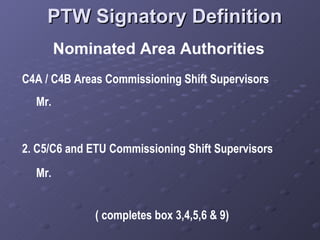
PTW Signatory Definition Nominated Area Authorities C4A / C4B Areas Commissioning Shift Supervisors Mr.  2.  C5/C6 and ETU Commissioning Shift Supervisors Mr.  ( completes box 3,4,5,6 & 9)
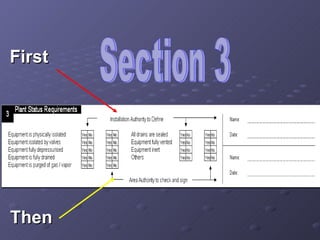
Section 3 First Then
SECTION 3 To All  Area Authorities   : When you sign in box 3, you are signing that the requirements to carry out work safely have been done.  If you have not physically checked these requirements,  DO   NOT SIGN !   If someone is hurt or killed due to improper compliance with requirements, you may be held responsible. This could mean criminal charges are filed against you. Do not sign as the  Installation Authority  unless you have  written permission / instruction to do so formalized delegation of authority).
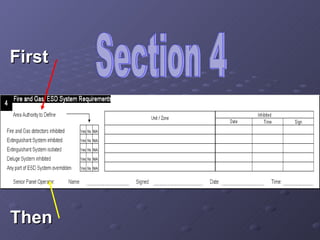
Section 4 First Then
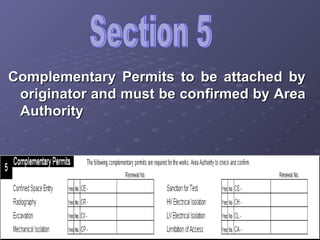
Section 5 Complementary Permits to be attached by originator and must be confirmed by Area Authority
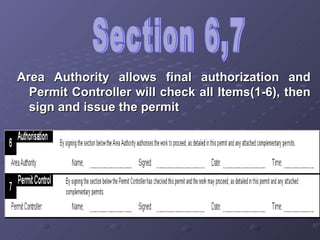
Section 6,7  Area Authority allows final authorization and Permit Controller will check all Items(1-6), then sign and issue the permit
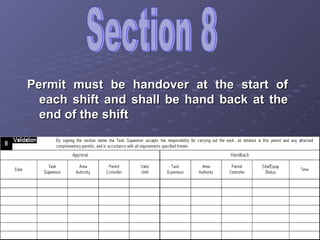
Section 8 Permit must be handover at the start of each shift and shall be hand back at the end of the shift
DISTRIBUTION Copy 1 , kept at the work site, on display, for  duration of activity Copy 2,  with Safety Authority form checking of continuous compliance Copy 3,  in Permit Office Copy 4,  with Area Authority for checking of continuous compliance
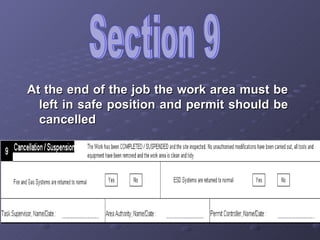
Section 9 At the end of the job the work area must be left in safe position and permit should be cancelled
Complementary Permits Issued with  Hot  /  Cold  Work Permit, depending on ongoing work
Type of Complementary PTW Entry to Confined Spaces Radiography Excavation Process / Mechanical Isolation HV Electrical Isolation  LV Electrical Isolation Sanction for Test Limitation of Access
Radiography and Confined Space Entry Complementary Permits are valid for  one shift only! New Permit required each day
Process / Mechanical Isolation   This Complementary Permit is required to withdraw equipment from service by physical isolation, usually by valve.  Isolation Certificate: Combines in one document record of all isolation required for a task to be carried out safely. The control and use of isolation certificate are described in `the permit to work procedure .
Are Valid as far as the isolation is implemented without limit of duration. ISOLATION CERTIFICATE
Certificates are Not Permits!!  They are Added to Permit to Confirm  Isolation status of an Equipment ISOLATION CERTIFICATE
High Voltage Electrical Isolation This Complementary Permit is required for all isolation work on electrical systems or equipment where the voltage exceeds the following limits: 1000 volts AC or 1500 volts DC between conductors. 600 volts AC or 900 volts DC between conductors and earth. Any situation except above condition will be covered under  Low Voltage Electrical Isolation  Permit
Sanction for Test   This Complementary Permit is required to test individual or multi-discipline items of equipment.  It allows for temporary removal of safety isolations and the provision of temporary actions to override or remove equipment to carry out such tests.
Limitation of Access This Complementary Permit is required to work in any area close to live electrical systems or equipment.  A Limitation of Access Permit is not required where the work to be performed is already covered by any of the other Main Permits. All Limitation of Access permits shall be authorised by electrical authorised persons
PTW is all about Planning the tasks Responsibilities ( Authorisation Supervision ) Understanding jobs Hazards and Control Measures Communication Briefing Implementation Verification
THANK YOU FOR YOUR  ATTENTION

NGI-Permit to Work

  • 1.
    NGI TrainingCenter Welcome safety course PERMIT TO WORK
  • 2.
    Definition Permit : The formal written and authorising document: approved by management, describing the work to be carried on identifying the potential hazards or interacting activities that can take place specifying the requirement, precautions requested to work in safe condition
  • 3.
    Purpose To ensure:All work activities, hazards and precautions are defined prior to the execution of the work proper planning and consideration communication between installation management, supervisors and operators and those who carry out the work. Monitoring and auditing to ensure safe system of works.
  • 4.
    Permit is Written-Legal Document defining a Safe System of Work. Remember : This is a legal document . When you sign it, you can be held responsible if something goes wrong
  • 5.
    Mis-conception that thePTW system should control all of the work carried out at a facility can lead to an overload of the PTW system, which prevents proper attention given to activities with a higher hazard potential. PTW is appropriate to non-routine activities which may require some form of Job Safety Analysis prior to work commencing. PTW is required for Maintenance work carried out by plant operators. Use a PTW when two or more groups of people (different trades), need to co-ordinate their activities to ensure that their work is completed safely. What work requires Permit?
  • 6.
    Routine Maintenanceand production plant operations; all carried out in accordance with site approved procedures Where this is identified on fixed lists approved by TIJD Commissioning Manager If it is carried out in an area specified on an installation layout drawing, approved by TIJD Commissioning Manager Visual inspection of areas (except in confined spaces). Work Not require a Permit
  • 7.
    Types of Main Permit Hot Work: spark / ignition potential Naked Flame: Welding, Burning, Grinding etc. Cold Work: no spark / ignition potential
  • 8.
    Any work involvingequipment giving rise to a Definite source of ignition, such as: use of equipment for oxy-acetylene burning, gas welding, electric-arc welding, propane torch heating and burning, grinding or use of a hot-air gun. What is a Hot (Naked Flame) Work ?
  • 9.
    Any work involving,or giving rise to, a Potential source of ignition, such as: Grit-blasting Work on non-intrinsically safe equipment Using non-certified electrical equipment not controlled by an Electrical Permit (e.g. Avometer, power tools etc) Spray painting Use of Camera with flash What is a Hot Work ?
  • 10.
    What is a Cold Work ? Cold Work- Any task, or the use of any tool or equipment that will not produce a source of ignition. Such as: use of tools for erection, dismantling and cleaning, which are not liable to produce sparks, Pressure testing of plant and equipment Disconnection or opening up of any closed pipeline or vessel Spading and de-spading of hydrocarbon line Chemical cleaning Handling of hazardous substances, e.g. radioactive source, toxic / corrosive chemicals, asbestos, etc
  • 11.
     Validity HotWork, Naked Flame and Cold Work Main Permits, all have same validity period . 7 Consequent SHIFTS or 7 Days Maximum!
  • 12.
    PTW Procedure INITIATION/ PREPARATION OF PERMIT TO WORK LIST OF EXTERNAL REQUIREMENTS SUCH AS: SAFETY EQUIPMENT, STATUS OF PLANT, NEED FOR COMPLEMENTARY PERMITS ETC. PERMIT AUTHORISATION, ISSUE AND ACCEPTANCE FOR WORK TO START REVALIDATION AT THE START OF EACH SHIFT PERMIT CANCELLATION ON COMPLETION OF WORK
  • 13.
    Permit isSigned by Responsible Personnel Safety Authority Installation Authority (Area Commissioning Manager) Task Supervisor Permit Controller Area Authority
  • 14.
    PTW Procedure Definitionsand Duties Area HSE Manager Defines safety requirements. Monitors working practices. Safety Authority Senior Panel Operator Performs inhibits and enables on Fire and Gas and ESD systems. Senior Panel Operator Senior HSE SV Commissioning SV Performs all required gas testing. Authorised Gas Tester Permit Controller Checking of permits before issue. Administration of PTW Procedure. Logging / Filing of cancelled and/or suspended permits. Ensures no conflict of work between different area authorities. Permit Controller Commissioning Shift Supervisor Arranges any required isolations. Approves work go ahead. Area Authority Area Commissioning Manager Authorises work go-ahead. Defines plant status for work. Installation Authority Person responsible for the work Initiates permits. Defines scope of work. Task Supervisor Responsible Person Duties PTW Procedure Definition
  • 15.
    PTW Signatory DefinitionTask Supervisor Initiates Permit ( signs box 1 ) Defines the scope of work Accepts Permit ( signs box 8 ) Ensuring that all work described on Main Permits and Complementary Permits is completed, or left in a safe and tidy condition if not completed Hands back Permit at end of shift and revalid for next shift ( signs box 8 ) Ensures closure of Permit at end of task ( signs box 9 )
  • 16.
    Section 1 TIJDModification of support (need grinding) 8 X Mr. Akbari 30 July 2006 Unit 122 Electrical Heater EH-101 X X
  • 17.
    To all TaskSupervisors When you send someone to the Permit Office to have a permit signed, please ensure: They understand what the permit is requesting. The Permit Authority may have questions about the job description or location. They understand and speak English . Most Permit Authorities speak only English and they may want to communicate with the person you send Please print clearly all information on job description, location and equipment requirements with CAPITAL LETTERS , If the writing is not clear, the permit will be rejected and you have to start all over again
  • 18.
    PTW Procedure TIMETABLE New permit applications have to be at the Permit Office before 12:00 on the day before work is required to start. At 06:30 the following day your permit shall be ready for collection from the Permit Office. If a permit requires revalidation for night shift working then it must be at the Permit Office by 16:30 Dayshift permits must be at the Permit Office by 17:00 or they shall not be revalidated for the following day.
  • 19.
    Safety Authority Detailsadditional PPE required, plus any other safety precautions to be taken, including gas tests periodic checks at work sites, to ensure compliance with conditions and safe working practices specified in Main Permits and Complementary Permits. ( signs box 2 ) PTW Signatory Definition
  • 20.
    Section 2 XEshghi XXXXXXXX 30 July 2006 1730 h X X X X
  • 21.
    PTW Signatory DefinitionNominated Area Safety Authorities C4A / C4B Area Safety Manager Mr. Sanoobari 2. C5/C6 and ETU Area Safety Manager Mr. Eshghi
  • 22.
    Gas test shouldbe written at the back side of white copy
  • 23.
    PTW Signatory DefinitionInstallation Authorities Evaluation of intended work Ensuring proper authorisation, issue and cancellation of all Main Permits in their areas Planning, coordinating and authorising all Hot Work (Naked Flame) Permits (not more than ONE Naked flame permit per designated area.
  • 24.
    PTW Signatory DefinitionNominated Installation Authorities C4A / C4B Area Commissioning Manager Mr. 2. C5/C6 and ETU Area Commissioning Manager Mr. ( signs box 3 )
  • 25.
    PTW Signatory DefinitionArea Authorities Arranging for any required Electrical or Process / Mechanical Isolations. Delegating the issue and cancellation Complementary Permits Periodic checks of work sites are performed to ensure compliance with conditions specified in Main Permits and any Complementary Permits.
  • 26.
    PTW Signatory DefinitionNominated Area Authorities C4A / C4B Areas Commissioning Shift Supervisors Mr. 2. C5/C6 and ETU Commissioning Shift Supervisors Mr. ( completes box 3,4,5,6 & 9)
  • 27.
  • 28.
    SECTION 3 ToAll Area Authorities : When you sign in box 3, you are signing that the requirements to carry out work safely have been done. If you have not physically checked these requirements, DO NOT SIGN ! If someone is hurt or killed due to improper compliance with requirements, you may be held responsible. This could mean criminal charges are filed against you. Do not sign as the Installation Authority unless you have written permission / instruction to do so formalized delegation of authority).
  • 29.
  • 30.
    Section 5 ComplementaryPermits to be attached by originator and must be confirmed by Area Authority
  • 31.
    Section 6,7 Area Authority allows final authorization and Permit Controller will check all Items(1-6), then sign and issue the permit
  • 32.
    Section 8 Permitmust be handover at the start of each shift and shall be hand back at the end of the shift
  • 33.
    DISTRIBUTION Copy 1, kept at the work site, on display, for duration of activity Copy 2, with Safety Authority form checking of continuous compliance Copy 3, in Permit Office Copy 4, with Area Authority for checking of continuous compliance
  • 34.
    Section 9 Atthe end of the job the work area must be left in safe position and permit should be cancelled
  • 35.
    Complementary Permits Issuedwith Hot / Cold Work Permit, depending on ongoing work
  • 36.
    Type of ComplementaryPTW Entry to Confined Spaces Radiography Excavation Process / Mechanical Isolation HV Electrical Isolation LV Electrical Isolation Sanction for Test Limitation of Access
  • 37.
    Radiography and ConfinedSpace Entry Complementary Permits are valid for one shift only! New Permit required each day
  • 38.
    Process / MechanicalIsolation This Complementary Permit is required to withdraw equipment from service by physical isolation, usually by valve. Isolation Certificate: Combines in one document record of all isolation required for a task to be carried out safely. The control and use of isolation certificate are described in `the permit to work procedure .
  • 39.
    Are Valid asfar as the isolation is implemented without limit of duration. ISOLATION CERTIFICATE
  • 40.
    Certificates are NotPermits!! They are Added to Permit to Confirm Isolation status of an Equipment ISOLATION CERTIFICATE
  • 41.
    High Voltage ElectricalIsolation This Complementary Permit is required for all isolation work on electrical systems or equipment where the voltage exceeds the following limits: 1000 volts AC or 1500 volts DC between conductors. 600 volts AC or 900 volts DC between conductors and earth. Any situation except above condition will be covered under Low Voltage Electrical Isolation Permit
  • 42.
    Sanction for Test This Complementary Permit is required to test individual or multi-discipline items of equipment. It allows for temporary removal of safety isolations and the provision of temporary actions to override or remove equipment to carry out such tests.
  • 43.
    Limitation of AccessThis Complementary Permit is required to work in any area close to live electrical systems or equipment. A Limitation of Access Permit is not required where the work to be performed is already covered by any of the other Main Permits. All Limitation of Access permits shall be authorised by electrical authorised persons
  • 44.
    PTW is allabout Planning the tasks Responsibilities ( Authorisation Supervision ) Understanding jobs Hazards and Control Measures Communication Briefing Implementation Verification
  • 45.
    THANK YOU FORYOUR ATTENTION