RISK ASSESSMENT
Introduction to Safety
What is an Accident?
An accident is any undesired,
unplanned event that
results in Personal
Injury or in Property
Damage.
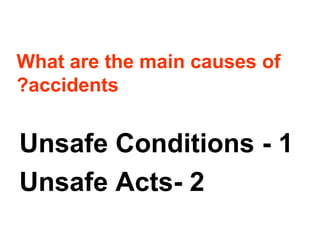
What are the main causes of
accidents?
1-Unsafe Conditions
2-Unsafe Acts
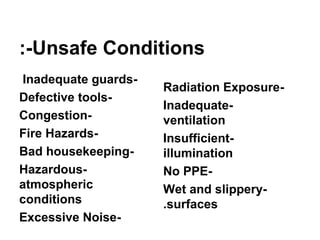
Unsafe Conditions:-
-Inadequate guards
-Defective tools
-Congestion
-Fire Hazards
-Bad housekeeping
-Hazardous
atmospheric
conditions
-Excessive Noise
-Radiation Exposure
-Inadequate
ventilation
-Insufficient
illumination
-No PPE
-Wet and slippery
surfaces.
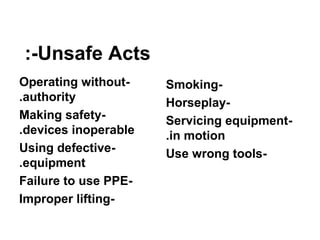
Unsafe Acts:-
-Operating without
authority.
-Making safety
devices inoperable.
-Using defective
equipment.
-Failure to use PPE
-Improper lifting
-Smoking
-Horseplay
-Servicing equipment
in motion.
-Use wrong tools
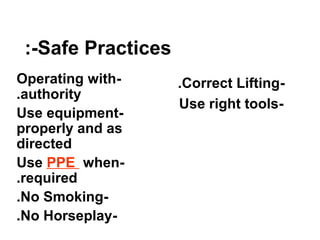
Safe Practices:-
-Operating with
authority.
-Use equipment
properly and as
directed
-Use PPE when
required.
-No Smoking.
-No Horseplay.
-Correct Lifting.
-Use right tools
Occupational Health & SafetyOccupational Health & Safety
TrainingTraining
1-Risk Assessment
2-Job Hazard Analysis (JHA(
3-Safety And Health Auditing
4-Safety Inspection & Checklists
Risk Assessment
•Risk assessment is the process of
identifying and evaluating a hazard to
determine the level of action required to
reduce a risk to an acceptable level.
•It is nothing more than a careful examination
of what in the workplace could cause harm to
people, so that we can weigh-up whether the
department has taken enough precautions or
are required to take additional precautions,
to prevent harm occurring.
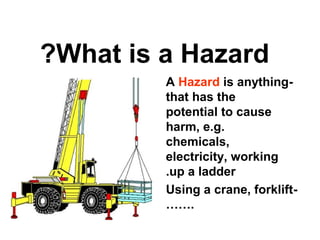
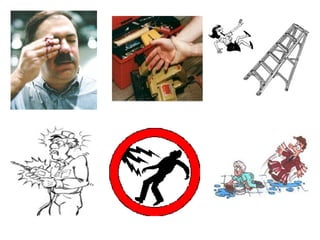
What is a Hazard?
-A Hazard is anything
that has the
potential to cause
harm, e.g.
chemicals,
electricity, working
up a ladder.
-Using a crane, forklift
…….
What is a Risk?
-The Risk is the likelihood that the hazard will
cause harm and the severity of the
consequence.
-For Example:
*If you are cleaning the oven with corrosive
cleaner without using gloves or apron there is a
great risk of being harmed.
*If you wear all protective clothing and gloves
and adhere to all safety precautions the risk is
low.
*If you change the chemical to a safer type and
adhere to all precautions the risk will be even
lower.
Risk Assessment In Practice
Five Steps to Risk Assessment:
1-Look for the hazards
2-Decide who might be harmed and
how
3-Evaluate the risks and decide whether
the existing precautions are adequate
or whether more should be done.
4-Record your findings.
5-Review your assessment and revise it
1-Hazard Identification
-Walk around the workplace and look afresh
at what could reasonably be expected to
cause harm.
-Previous Accident Reports
-Brainstorming
-Knowledge of Employees
-Material Safety Data Sheets (MSDS(
-Manufacturers Instruction Books
-Ask, “What If….?”
Continue
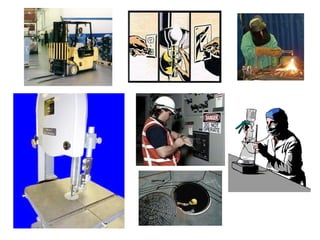
The following are examples of plant,
equipment or activities that are
usually associated with a hazard:
-Work at heights, and access to/from it
(roofwork, ladders, scaffolds(.
-Work below ground level and in confined
spaces (tanks, ducts, trenches(
-Manual handling of loads.
-Work with electricity (portable tools,
extension leads(
-Hazardous chemical substances.
Continue
-Display screen equipment.
-Ionizing, non - ionizing and laser radiation
-Pressure vessels / vacuum works
-Flammable liquid and gases
-Machinery and plant (machinery requiring
guarding(.
-Grinding/milling machines
-Woodworking machines.
-Portable power tools.
•-Noise
-Vehicles (forklift, cranes(
-Disposal of special wastes.
List of Hazards
-Slipping/tripping
hazards (poorly
maintained floors or
stairs(.
-Fume (from welding(
-Dust (from grinding(
-Manual handling
-Poor lighting
-Temperature
-Electricity (poor
wiring(
-Ejection of material
(from plastic molding(
-Chemicals (battery
acids(
-Pressure systems
(steam boilers(.
2-Who Might Be Harmed and How
-Generally it will be staff occupying the
workplace.
-Attention must be paid to:
*Visitors
*Contractors
*Cleaning staff
*Maintenance staff
*Inexperienced staff
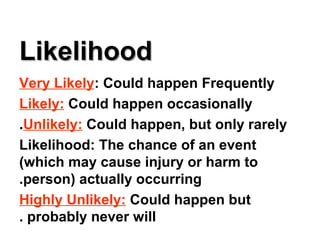
LikelihoodLikelihood
Very Likely: Could happen Frequently
Likely: Could happen occasionally
Unlikely: Could happen, but only rarely.
Likelihood: The chance of an event
(which may cause injury or harm to
person( actually occurring.
Highly Unlikely: Could happen but
probably never will.
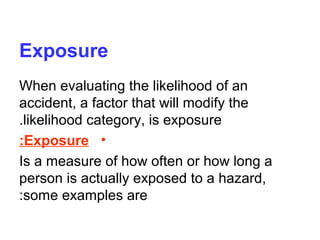
Exposure
When evaluating the likelihood of an
accident, a factor that will modify the
likelihood category, is exposure.
•Exposure:
Is a measure of how often or how long a
person is actually exposed to a hazard,
some examples are:
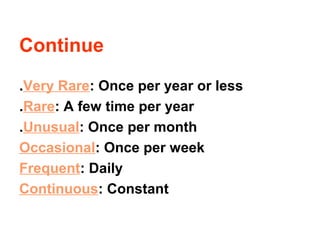
Continue
Very Rare: Once per year or less.
Rare: A few time per year.
Unusual: Once per month.
Occasional: Once per week
Frequent: Daily
Continuous: Constant
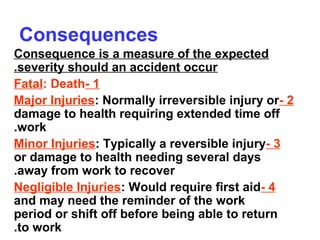
Consequences
Consequence is a measure of the expected
severity should an accident occur.
1-Fatal: Death
2-Major Injuries: Normally irreversible injury or
damage to health requiring extended time off
work.
3-Minor Injuries: Typically a reversible injury
or damage to health needing several days
away from work to recover.
4-Negligible Injuries: Would require first aid
and may need the reminder of the work
period or shift off before being able to return
to work.
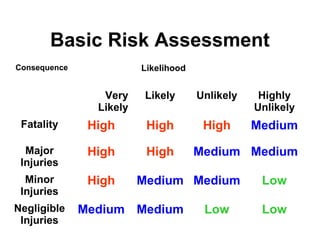
Basic Risk Assessment
Consequence Likelihood
Very
Likely
Likely Unlikely Highly
Unlikely
Fatality High High High Medium
Major
Injuries
High High Medium Medium
Minor
Injuries
High Medium Medium Low
Negligible
Injuries
Medium Medium Low Low
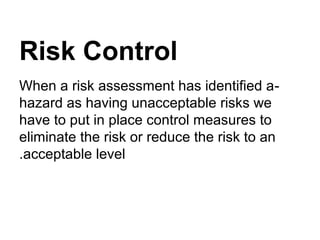
Risk Control
-When a risk assessment has identified a
hazard as having unacceptable risks we
have to put in place control measures to
eliminate the risk or reduce the risk to an
acceptable level.
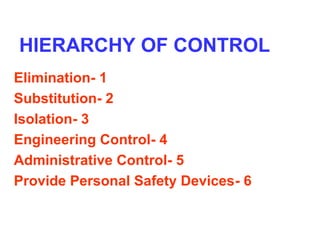
HIERARCHY OF CONTROL
1-Elimination
2-Substitution
3-Isolation
4-Engineering Control
5-Administrative Control
6-Provide Personal Safety Devices

Risk assessment 3

  • 1.
  • 2.
  • 3.
    What is anAccident? An accident is any undesired, unplanned event that results in Personal Injury or in Property Damage.
  • 4.
    What are themain causes of accidents? 1-Unsafe Conditions 2-Unsafe Acts
  • 5.
    Unsafe Conditions:- -Inadequate guards -Defectivetools -Congestion -Fire Hazards -Bad housekeeping -Hazardous atmospheric conditions -Excessive Noise -Radiation Exposure -Inadequate ventilation -Insufficient illumination -No PPE -Wet and slippery surfaces.
  • 6.
    Unsafe Acts:- -Operating without authority. -Makingsafety devices inoperable. -Using defective equipment. -Failure to use PPE -Improper lifting -Smoking -Horseplay -Servicing equipment in motion. -Use wrong tools
  • 7.
    Safe Practices:- -Operating with authority. -Useequipment properly and as directed -Use PPE when required. -No Smoking. -No Horseplay. -Correct Lifting. -Use right tools
  • 8.
    Occupational Health &SafetyOccupational Health & Safety TrainingTraining 1-Risk Assessment 2-Job Hazard Analysis (JHA( 3-Safety And Health Auditing 4-Safety Inspection & Checklists
  • 9.
    Risk Assessment •Risk assessmentis the process of identifying and evaluating a hazard to determine the level of action required to reduce a risk to an acceptable level. •It is nothing more than a careful examination of what in the workplace could cause harm to people, so that we can weigh-up whether the department has taken enough precautions or are required to take additional precautions, to prevent harm occurring.
  • 10.
    What is aHazard? -A Hazard is anything that has the potential to cause harm, e.g. chemicals, electricity, working up a ladder. -Using a crane, forklift …….
  • 12.
    What is aRisk? -The Risk is the likelihood that the hazard will cause harm and the severity of the consequence. -For Example: *If you are cleaning the oven with corrosive cleaner without using gloves or apron there is a great risk of being harmed. *If you wear all protective clothing and gloves and adhere to all safety precautions the risk is low. *If you change the chemical to a safer type and adhere to all precautions the risk will be even lower.
  • 14.
    Risk Assessment InPractice Five Steps to Risk Assessment: 1-Look for the hazards 2-Decide who might be harmed and how 3-Evaluate the risks and decide whether the existing precautions are adequate or whether more should be done. 4-Record your findings. 5-Review your assessment and revise it
  • 15.
    1-Hazard Identification -Walk aroundthe workplace and look afresh at what could reasonably be expected to cause harm. -Previous Accident Reports -Brainstorming -Knowledge of Employees -Material Safety Data Sheets (MSDS( -Manufacturers Instruction Books -Ask, “What If….?”
  • 16.
    Continue The following areexamples of plant, equipment or activities that are usually associated with a hazard: -Work at heights, and access to/from it (roofwork, ladders, scaffolds(. -Work below ground level and in confined spaces (tanks, ducts, trenches( -Manual handling of loads. -Work with electricity (portable tools, extension leads( -Hazardous chemical substances.
  • 17.
    Continue -Display screen equipment. -Ionizing,non - ionizing and laser radiation -Pressure vessels / vacuum works -Flammable liquid and gases -Machinery and plant (machinery requiring guarding(. -Grinding/milling machines -Woodworking machines. -Portable power tools. •-Noise -Vehicles (forklift, cranes( -Disposal of special wastes.
  • 18.
    List of Hazards -Slipping/tripping hazards(poorly maintained floors or stairs(. -Fume (from welding( -Dust (from grinding( -Manual handling -Poor lighting -Temperature -Electricity (poor wiring( -Ejection of material (from plastic molding( -Chemicals (battery acids( -Pressure systems (steam boilers(.
  • 19.
    2-Who Might BeHarmed and How -Generally it will be staff occupying the workplace. -Attention must be paid to: *Visitors *Contractors *Cleaning staff *Maintenance staff *Inexperienced staff
  • 20.
    LikelihoodLikelihood Very Likely: Couldhappen Frequently Likely: Could happen occasionally Unlikely: Could happen, but only rarely. Likelihood: The chance of an event (which may cause injury or harm to person( actually occurring. Highly Unlikely: Could happen but probably never will.
  • 21.
    Exposure When evaluating thelikelihood of an accident, a factor that will modify the likelihood category, is exposure. •Exposure: Is a measure of how often or how long a person is actually exposed to a hazard, some examples are:
  • 22.
    Continue Very Rare: Onceper year or less. Rare: A few time per year. Unusual: Once per month. Occasional: Once per week Frequent: Daily Continuous: Constant
  • 23.
    Consequences Consequence is ameasure of the expected severity should an accident occur. 1-Fatal: Death 2-Major Injuries: Normally irreversible injury or damage to health requiring extended time off work. 3-Minor Injuries: Typically a reversible injury or damage to health needing several days away from work to recover. 4-Negligible Injuries: Would require first aid and may need the reminder of the work period or shift off before being able to return to work.
  • 24.
    Basic Risk Assessment ConsequenceLikelihood Very Likely Likely Unlikely Highly Unlikely Fatality High High High Medium Major Injuries High High Medium Medium Minor Injuries High Medium Medium Low Negligible Injuries Medium Medium Low Low
  • 25.
    Risk Control -When arisk assessment has identified a hazard as having unacceptable risks we have to put in place control measures to eliminate the risk or reduce the risk to an acceptable level.
  • 26.
    HIERARCHY OF CONTROL 1-Elimination 2-Substitution 3-Isolation 4-EngineeringControl 5-Administrative Control 6-Provide Personal Safety Devices