Effective Safety Committee
Creating an Effective Workplace Safety Committee
1
PPT-093-02
Bureau of Workers’ Comp
PA Training for Health & Safety
(PATHS)
• Positively impacts a safety management system
• Permeates all levels of the organization
• Liaison between management and employees
PPT-093-02 2
Effective Safety Committees
3
PPT-093-02
Organizational Benefits
• Reduces incidents and lost work time
• Promotes employee involvement at all levels
• Accomplishes more safety initiatives
• Increases productivity
Successful Safety Committees
4
PPT-093-02
Employee Benefits
• Creates a safer work environment
• Improves communication
• Increases safety awareness
• Enhances employee morale
Successful Safety Committees
5
PPT-093-02
 Written Committee Bylaws
 Mission Statement
 Committee Size and Structure
 Role and Function
Effective Committees
6
PPT-093-02
 Member’s Responsibilities
 Management’s Responsibilities
 Meetings
 Agendas
Effective Committees
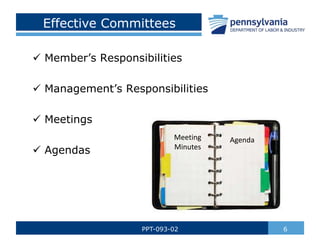
Agenda
Meeting
Minutes
7
PPT-093-02
 Committee Chairperson
 Committee Member Training
 Hazard Identification, Evaluation and Control
 Employee Involvement
Effective Committees
8
PPT-093-02
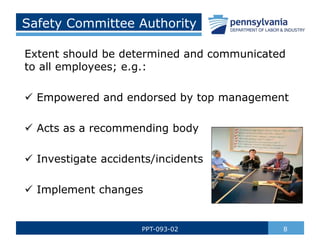
Extent should be determined and communicated
to all employees; e.g.:
 Empowered and endorsed by top management
 Acts as a recommending body
 Investigate accidents/incidents
 Implement changes
Safety Committee Authority
9
PPT-093-02
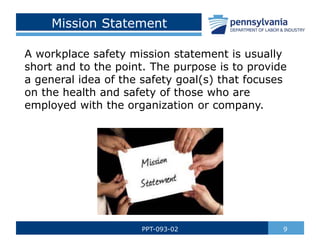
A workplace safety mission statement is usually
short and to the point. The purpose is to provide
a general idea of the safety goal(s) that focuses
on the health and safety of those who are
employed with the organization or company.
Mission Statement
10
PPT-093-02
Bylaws
What to include in your safety committee bylaws:
• Goals and objectives
• Membership duties, responsibilities and training
• Meetings
• Hazard Identification and control
- Workplace Inspections
- JSA’s
- Incident Investigations
• Evaluation of the safety and health program
11
PPT-093-02
Committee Size & Structure
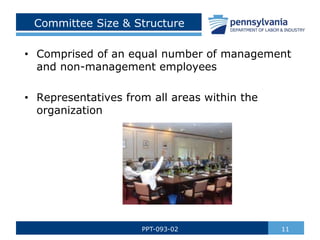
• Comprised of an equal number of management
and non-management employees
• Representatives from all areas within the
organization
12
PPT-093-02
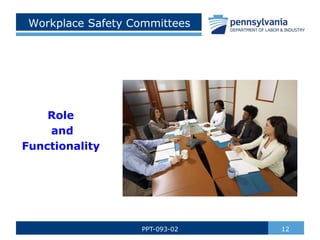
Workplace Safety Committees
Role
and
Functionality
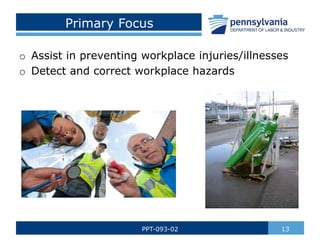
Primary Focus
13
PPT-093-02
o Assist in preventing workplace injuries/illnesses
o Detect and correct workplace hazards
Safety Committee Function
14
PPT-093-02
The specific functions of the safety committee are
to:
- Review & update safety training
- Develop safety work practices
- Recommend use of safety equipment/devices
- Review incident reports
- Review items from reports & safety
inspections
- Discuss employee safety-related issues
15
PPT-093-02
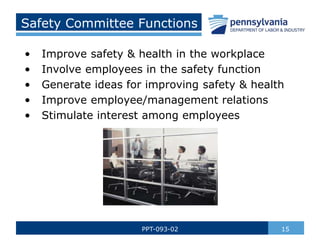
Safety Committee Functions
• Improve safety & health in the workplace
• Involve employees in the safety function
• Generate ideas for improving safety & health
• Improve employee/management relations
• Stimulate interest among employees
16
PPT-093-02
Members’ Responsibilities
• Attend meetings
• Notify all employees in your area that you
are their representative on the committee
• Be watchful for unsafe conditions and acts
and report them
• Be responsive to people’s concerns; follow up
17
PPT-093-02
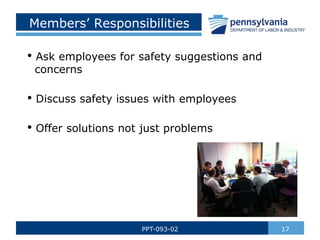
• Ask employees for safety suggestions and
concerns
• Discuss safety issues with employees
• Offer solutions not just problems
Members’ Responsibilities
18
PPT-093-02
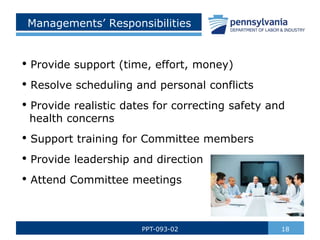
Managements’ Responsibilities
• Provide support (time, effort, money)
• Resolve scheduling and personal conflicts
• Provide realistic dates for correcting safety and
health concerns
• Support training for Committee members
• Provide leadership and direction
• Attend Committee meetings
19
PPT-093-02
Employees’ Responsibilities
• Identify safety and health hazards
• Report all unsafe conditions and practices
• Make suggestions for improving workplace
safety
• Participate in committee activities/initiatives
20
PPT-093-02
Employees’ Responsibilities
• Use proper personal protective equipment
• Follow safe practices/procedures
• Cooperate with Committee members
• Consider becoming a Committee member
21
PPT-093-02
Committee Chairperson
• Accountable to top management
• Sets the agenda
• Coordinates meetings
• Facilitates meetings
• Ensures agenda is followed
• Ensures everyone is heard
Successful Safety Committees
22
PPT-093-02
Ingredients of effective safety committees
• Trust
• Healthy Conflict
• Commit to decisions made
• Hold one another accountable
• Focus on results
23
PPT-093-02
• Competent -- dedicated
• Support goals & objectives
• Demonstrate team effort
• Develop mutual trust, respect & support
Successful Safety Committees
24
PPT-093-02
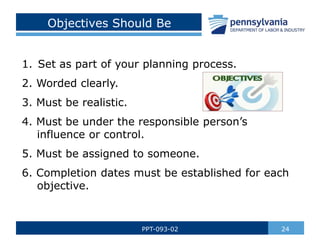
1. Set as part of your planning process.
2. Worded clearly.
3. Must be realistic.
4. Must be under the responsible person’s
influence or control.
5. Must be assigned to someone.
6. Completion dates must be established for each
objective.
Objectives Should Be
Employee Involvement
• Provides the means for everyone to develop and
express their own commitment to safety and
health
• Involves the persons most in contact with
potential safety and health hazards
• Utilizes everyone’s wide range of experience
25
PPT-093-02
Everyone is more likely to support
and use programs in which they
have input.
Employee Involvement
26
PPT-093-02
 Ownership: Give workers responsibility for such
actions as planning and conducting inspections,
analyzing their own work hazards, and developing
safety checklists.
 Leadership: Set an example by taking the same
precautions, and wearing the same PPE, as you expect
your workers to do. Be on the lookout for potential
hazards and point them out to your workers.
 Understanding: Explain the “why” of safety so that
employees will realize that hazards put their own
personal health and safety at risk.
Ideas for Stimulating Employee Involvement
Employee Involvement
27
PPT-093-02
 Commitment: Strive to get commitment
from every employee that safety is a value.
 Goals: Set clear objectives to help employees
achieve safety goals and constantly evaluate
them.
 Competence: Train employees so that they
will have the skills that enable them to work
safely and avoid incidents.
Ideas for Stimulating Employee Involvement
Employee Involvement
28
PPT-093-02
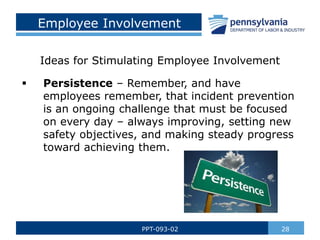
 Persistence – Remember, and have
employees remember, that incident prevention
is an ongoing challenge that must be focused
on every day – always improving, setting new
safety objectives, and making steady progress
toward achieving them.
Ideas for Stimulating Employee Involvement
Employee Involvement
29
PPT-093-02
 Feedback – Praise employees who identify and
correct hazards or report problems they can’t fix
 Teamwork – Use every opportunity to encourage
employees to play a role in workplace safety and
incident prevention.
 Responsiveness – Make sure you respond promptly
to identify hazards and take immediate steps to
correct them.
Ideas for Stimulating Employee Involvement
Employee Involvement
30
PPT-093-02
Employee Buy In
 Show results
 Protect employees’ voices
 Give employees something meaningful to do
 Provide positive consequences
 Give people the feeling that they will have an
impact
Roles & Function Training
31
PPT-093-02
Effective safety committees need members trained in
performing their roles and functions including:
 The reasons for a safe workplace and working safely
 The meeting practices that actively contribute to
identifying problems and how to work toward
solutions
 The identification of the company’s specific industry
hazards and how to conduct inspections, job safety
analysis and other hazard recognition and
correction
 The correct techniques for incident investigations
32
PPT-093-02
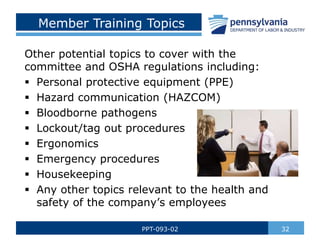
Member Training Topics
Other potential topics to cover with the
committee and OSHA regulations including:
 Personal protective equipment (PPE)
 Hazard communication (HAZCOM)
 Bloodborne pathogens
 Lockout/tag out procedures
 Ergonomics
 Emergency procedures
 Housekeeping
 Any other topics relevant to the health and
safety of the company’s employees
33
PPT-093-02
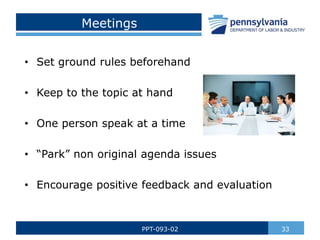
Meetings
• Set ground rules beforehand
• Keep to the topic at hand
• One person speak at a time
• “Park” non original agenda issues
• Encourage positive feedback and evaluation
Conducting Effective Meetings
34
PPT-093-02
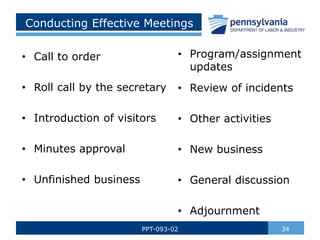
• Program/assignment
updates
• Review of incidents
• Other activities
• New business
• General discussion
• Adjournment
• Call to order
• Roll call by the secretary
• Introduction of visitors
• Minutes approval
• Unfinished business
Possible Meeting Topics
35
PPT-093-02
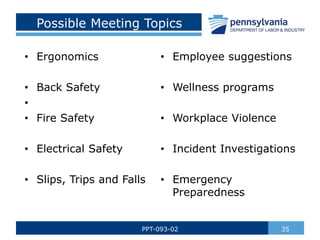
• Ergonomics
• Back Safety
•
• Fire Safety
• Electrical Safety
• Slips, Trips and Falls
• Employee suggestions
• Wellness programs
• Workplace Violence
• Incident Investigations
• Emergency
Preparedness
36
PPT-093-02
Minutes should include:
- Time & date
- Members present
- Items discussed
- Recommendations,
justification and
counter arguments
- Next meeting date
Minutes should be:
– Brief
– Finalized and
distributed to
committee members
prior to next
meeting
– Approved at
following meeting
– Posted
Written Minutes
37
PPT-093-02
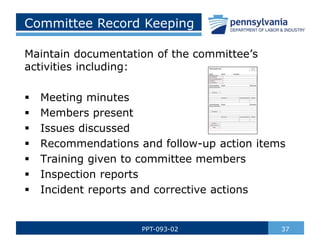
Committee Record Keeping
Maintain documentation of the committee’s
activities including:
 Meeting minutes
 Members present
 Issues discussed
 Recommendations and follow-up action items
 Training given to committee members
 Inspection reports
 Incident reports and corrective actions
38
PPT-093-02
• Evaluate the success of the committee meeting
in terms of meeting skills and accomplishments
• Evaluate the safety committee process and
make necessary corrections/improvements to
make it more efficient and effective
• Assure action items are assigned and
completed
• Plan and prepare for next meeting
Follow-up Activities
39
PPT-093-02
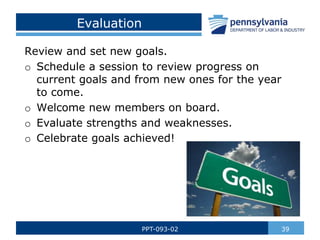
Review and set new goals.
o Schedule a session to review progress on
current goals and from new ones for the year
to come.
o Welcome new members on board.
o Evaluate strengths and weaknesses.
o Celebrate goals achieved!
Evaluation
40
PPT-093-02
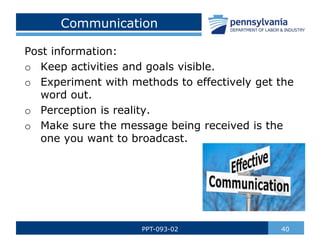
Post information:
o Keep activities and goals visible.
o Experiment with methods to effectively get the
word out.
o Perception is reality.
o Make sure the message being received is the
one you want to broadcast.
Communication
Successful Committees
41
PPT-093-02
Success Factors
 Top management commitment
 Middle management, supervisor and employee
participation
 Involve employees in goals
 Effective meetings
 Effective training
 Effective communication
 Follow-up
Resource
42
PPT-093-02
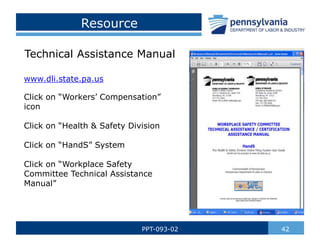
Technical Assistance Manual
www.dli.state.pa.us
Click on “Workers’ Compensation”
icon
Click on “Health & Safety Division
Click on “HandS” System
Click on “Workplace Safety
Committee Technical Assistance
Manual”
43
PPT-093-02
• OSHA
- Federal Regulations (29 CFR 1910)
- Available at www.osha.gov
• PA Department of Labor & Industry
– www.dli.state.pa.us
• PA Department of Environmental Protection
– www.depweb.state.pa.us/portal/server.pt
• Other technical standards
(NFPA, ANSI, ASTM, ASME, etc.) – get help if
necessary!
Standards to Reference
44
PPT-093-02
HandS Tech Manual
Contact Information
Health & Safety Training Specialists
1171 South Cameron Street, Room 324
Harrisburg, PA 17104-2501
(717) 772-1635
RA-LI-BWC-PATHS@pa.gov
45
PPT-093-02
Like us on Facebook! -
https://www.facebook.com/BWCPATHS
Questions
46
PPT-093-02

Creating an Effective Workplace Safety Committee.pptx

  • 1.
    Effective Safety Committee Creatingan Effective Workplace Safety Committee 1 PPT-093-02 Bureau of Workers’ Comp PA Training for Health & Safety (PATHS)
  • 2.
    • Positively impactsa safety management system • Permeates all levels of the organization • Liaison between management and employees PPT-093-02 2 Effective Safety Committees
  • 3.
    3 PPT-093-02 Organizational Benefits • Reducesincidents and lost work time • Promotes employee involvement at all levels • Accomplishes more safety initiatives • Increases productivity Successful Safety Committees
  • 4.
    4 PPT-093-02 Employee Benefits • Createsa safer work environment • Improves communication • Increases safety awareness • Enhances employee morale Successful Safety Committees
  • 5.
    5 PPT-093-02  Written CommitteeBylaws  Mission Statement  Committee Size and Structure  Role and Function Effective Committees
  • 6.
    6 PPT-093-02  Member’s Responsibilities Management’s Responsibilities  Meetings  Agendas Effective Committees Agenda Meeting Minutes
  • 7.
    7 PPT-093-02  Committee Chairperson Committee Member Training  Hazard Identification, Evaluation and Control  Employee Involvement Effective Committees
  • 8.
    8 PPT-093-02 Extent should bedetermined and communicated to all employees; e.g.:  Empowered and endorsed by top management  Acts as a recommending body  Investigate accidents/incidents  Implement changes Safety Committee Authority
  • 9.
    9 PPT-093-02 A workplace safetymission statement is usually short and to the point. The purpose is to provide a general idea of the safety goal(s) that focuses on the health and safety of those who are employed with the organization or company. Mission Statement
  • 10.
    10 PPT-093-02 Bylaws What to includein your safety committee bylaws: • Goals and objectives • Membership duties, responsibilities and training • Meetings • Hazard Identification and control - Workplace Inspections - JSA’s - Incident Investigations • Evaluation of the safety and health program
  • 11.
    11 PPT-093-02 Committee Size &Structure • Comprised of an equal number of management and non-management employees • Representatives from all areas within the organization
  • 12.
  • 13.
    Primary Focus 13 PPT-093-02 o Assistin preventing workplace injuries/illnesses o Detect and correct workplace hazards
  • 14.
    Safety Committee Function 14 PPT-093-02 Thespecific functions of the safety committee are to: - Review & update safety training - Develop safety work practices - Recommend use of safety equipment/devices - Review incident reports - Review items from reports & safety inspections - Discuss employee safety-related issues
  • 15.
    15 PPT-093-02 Safety Committee Functions •Improve safety & health in the workplace • Involve employees in the safety function • Generate ideas for improving safety & health • Improve employee/management relations • Stimulate interest among employees
  • 16.
    16 PPT-093-02 Members’ Responsibilities • Attendmeetings • Notify all employees in your area that you are their representative on the committee • Be watchful for unsafe conditions and acts and report them • Be responsive to people’s concerns; follow up
  • 17.
    17 PPT-093-02 • Ask employeesfor safety suggestions and concerns • Discuss safety issues with employees • Offer solutions not just problems Members’ Responsibilities
  • 18.
    18 PPT-093-02 Managements’ Responsibilities • Providesupport (time, effort, money) • Resolve scheduling and personal conflicts • Provide realistic dates for correcting safety and health concerns • Support training for Committee members • Provide leadership and direction • Attend Committee meetings
  • 19.
    19 PPT-093-02 Employees’ Responsibilities • Identifysafety and health hazards • Report all unsafe conditions and practices • Make suggestions for improving workplace safety • Participate in committee activities/initiatives
  • 20.
    20 PPT-093-02 Employees’ Responsibilities • Useproper personal protective equipment • Follow safe practices/procedures • Cooperate with Committee members • Consider becoming a Committee member
  • 21.
    21 PPT-093-02 Committee Chairperson • Accountableto top management • Sets the agenda • Coordinates meetings • Facilitates meetings • Ensures agenda is followed • Ensures everyone is heard
  • 22.
    Successful Safety Committees 22 PPT-093-02 Ingredientsof effective safety committees • Trust • Healthy Conflict • Commit to decisions made • Hold one another accountable • Focus on results
  • 23.
    23 PPT-093-02 • Competent --dedicated • Support goals & objectives • Demonstrate team effort • Develop mutual trust, respect & support Successful Safety Committees
  • 24.
    24 PPT-093-02 1. Set aspart of your planning process. 2. Worded clearly. 3. Must be realistic. 4. Must be under the responsible person’s influence or control. 5. Must be assigned to someone. 6. Completion dates must be established for each objective. Objectives Should Be
  • 25.
    Employee Involvement • Providesthe means for everyone to develop and express their own commitment to safety and health • Involves the persons most in contact with potential safety and health hazards • Utilizes everyone’s wide range of experience 25 PPT-093-02 Everyone is more likely to support and use programs in which they have input.
  • 26.
    Employee Involvement 26 PPT-093-02  Ownership:Give workers responsibility for such actions as planning and conducting inspections, analyzing their own work hazards, and developing safety checklists.  Leadership: Set an example by taking the same precautions, and wearing the same PPE, as you expect your workers to do. Be on the lookout for potential hazards and point them out to your workers.  Understanding: Explain the “why” of safety so that employees will realize that hazards put their own personal health and safety at risk. Ideas for Stimulating Employee Involvement
  • 27.
    Employee Involvement 27 PPT-093-02  Commitment:Strive to get commitment from every employee that safety is a value.  Goals: Set clear objectives to help employees achieve safety goals and constantly evaluate them.  Competence: Train employees so that they will have the skills that enable them to work safely and avoid incidents. Ideas for Stimulating Employee Involvement
  • 28.
    Employee Involvement 28 PPT-093-02  Persistence– Remember, and have employees remember, that incident prevention is an ongoing challenge that must be focused on every day – always improving, setting new safety objectives, and making steady progress toward achieving them. Ideas for Stimulating Employee Involvement
  • 29.
    Employee Involvement 29 PPT-093-02  Feedback– Praise employees who identify and correct hazards or report problems they can’t fix  Teamwork – Use every opportunity to encourage employees to play a role in workplace safety and incident prevention.  Responsiveness – Make sure you respond promptly to identify hazards and take immediate steps to correct them. Ideas for Stimulating Employee Involvement
  • 30.
    Employee Involvement 30 PPT-093-02 Employee BuyIn  Show results  Protect employees’ voices  Give employees something meaningful to do  Provide positive consequences  Give people the feeling that they will have an impact
  • 31.
    Roles & FunctionTraining 31 PPT-093-02 Effective safety committees need members trained in performing their roles and functions including:  The reasons for a safe workplace and working safely  The meeting practices that actively contribute to identifying problems and how to work toward solutions  The identification of the company’s specific industry hazards and how to conduct inspections, job safety analysis and other hazard recognition and correction  The correct techniques for incident investigations
  • 32.
    32 PPT-093-02 Member Training Topics Otherpotential topics to cover with the committee and OSHA regulations including:  Personal protective equipment (PPE)  Hazard communication (HAZCOM)  Bloodborne pathogens  Lockout/tag out procedures  Ergonomics  Emergency procedures  Housekeeping  Any other topics relevant to the health and safety of the company’s employees
  • 33.
    33 PPT-093-02 Meetings • Set groundrules beforehand • Keep to the topic at hand • One person speak at a time • “Park” non original agenda issues • Encourage positive feedback and evaluation
  • 34.
    Conducting Effective Meetings 34 PPT-093-02 •Program/assignment updates • Review of incidents • Other activities • New business • General discussion • Adjournment • Call to order • Roll call by the secretary • Introduction of visitors • Minutes approval • Unfinished business
  • 35.
    Possible Meeting Topics 35 PPT-093-02 •Ergonomics • Back Safety • • Fire Safety • Electrical Safety • Slips, Trips and Falls • Employee suggestions • Wellness programs • Workplace Violence • Incident Investigations • Emergency Preparedness
  • 36.
    36 PPT-093-02 Minutes should include: -Time & date - Members present - Items discussed - Recommendations, justification and counter arguments - Next meeting date Minutes should be: – Brief – Finalized and distributed to committee members prior to next meeting – Approved at following meeting – Posted Written Minutes
  • 37.
    37 PPT-093-02 Committee Record Keeping Maintaindocumentation of the committee’s activities including:  Meeting minutes  Members present  Issues discussed  Recommendations and follow-up action items  Training given to committee members  Inspection reports  Incident reports and corrective actions
  • 38.
    38 PPT-093-02 • Evaluate thesuccess of the committee meeting in terms of meeting skills and accomplishments • Evaluate the safety committee process and make necessary corrections/improvements to make it more efficient and effective • Assure action items are assigned and completed • Plan and prepare for next meeting Follow-up Activities
  • 39.
    39 PPT-093-02 Review and setnew goals. o Schedule a session to review progress on current goals and from new ones for the year to come. o Welcome new members on board. o Evaluate strengths and weaknesses. o Celebrate goals achieved! Evaluation
  • 40.
    40 PPT-093-02 Post information: o Keepactivities and goals visible. o Experiment with methods to effectively get the word out. o Perception is reality. o Make sure the message being received is the one you want to broadcast. Communication
  • 41.
    Successful Committees 41 PPT-093-02 Success Factors Top management commitment  Middle management, supervisor and employee participation  Involve employees in goals  Effective meetings  Effective training  Effective communication  Follow-up
  • 42.
    Resource 42 PPT-093-02 Technical Assistance Manual www.dli.state.pa.us Clickon “Workers’ Compensation” icon Click on “Health & Safety Division Click on “HandS” System Click on “Workplace Safety Committee Technical Assistance Manual”
  • 43.
    43 PPT-093-02 • OSHA - FederalRegulations (29 CFR 1910) - Available at www.osha.gov • PA Department of Labor & Industry – www.dli.state.pa.us • PA Department of Environmental Protection – www.depweb.state.pa.us/portal/server.pt • Other technical standards (NFPA, ANSI, ASTM, ASME, etc.) – get help if necessary! Standards to Reference
  • 44.
  • 45.
    Contact Information Health &Safety Training Specialists 1171 South Cameron Street, Room 324 Harrisburg, PA 17104-2501 (717) 772-1635 RA-LI-BWC-PATHS@pa.gov 45 PPT-093-02 Like us on Facebook! - https://www.facebook.com/BWCPATHS
  • 46.

Editor's Notes

  • #2 The creation of an effective workplace safety committee provides a focal point for conducting safety evaluations and providing remedies to conditions found.
  • #3 The effective committee has a positive impact on the safety management system providing direction and a systematic method of addressing concerns. All levels of the organization are included in the safety mission. It is the bridge between employees and management.
  • #4 Benefits incurred: Incident reduction and elimination of lost work time. This is of benefit not only to the employee but to Management due to providing continuity of operations. Employees are made a part of the system More safety initiatives are promoted and implemented A safer work place increases productivity.
  • #5 Employees benefit from: A safer work environment where they can concentrate on their work effort without worrying if each action will result in jeopardy. Communication of adverse conditions found permits the knowledge something will be done to alleviate the condition. Safety awareness is not just for the work site but also translates into safety at home. Employee morale is enhanced when staff feel like more than just a cog in a machine.
  • #6 To be effective, the system requires those things encompassed in a professional organization. Written Bylaws are a must. The Mission Statement narrows yet delineates the reason for the committee’s existence. The size and structure emphasize the duties for members and the rotation of new members onto the committee. Roles and functions create a “division of labor” to achieve the goals of the committee.
  • #7 What each member will be responsible for accomplishing can be assigned and measured Management has specific duties to ensure success Meeting schedules allow members to plan their work schedules accordingly and Agendas structure discussion topics and keep the meetings on-track.
  • #8 The committee must have a leader to provide direction and guidance. Member training not only includes initial and annual refresher on Workplace Safety Committee Certification/Recertification but training in areas specific to the industry dealing with safety. Members must involve themselves in a thorough hazard identification program. At the same time evaluating the problems found, prioritizing the problems toward resolution. This includes adopting control methods. Employee involvement means those who may not be committee members but representatives of the areas evaluated.
  • #9 The Committee must be authorized in their endeavors by management. The committee, having conducted their hazard analyses will recommend resolutions. Accidents and incidents should be investigated by the committee with assistance from other knowledgeable sources which may be required. Change implementation will then be scheduled to create as few conflicts with ongoing operations as possible.
  • #10 The mission statement will be short and to the point. The purpose is to provide a general idea of the safety goal(s) that focus on the health and safety of those who are employed with the organization or company.
  • #11 Bylaws indicate: Goals and objectives; what is hoped to be accomplished. It narrows the focus of the committee. Duties, responsibilities and requisite training of members to achieve stated goals. That meetings will be scheduled on a standard frequency so time is not lost between findings and actions to be taken. Hazard identification and control must include: Workplace inspections lending continuity to ensuring a safe environment Job Safety Analyses (JSA) for existing and new constructs within the organization Incident investigations to determine causal factors and means to eliminate future occurrences The evaluation of the safety and health program will import new state-of-the-art methods which other organizations have found successful toward rounding-out your program.
  • #12 To ensure management does not out weigh the employee representation, an equal number of each will constitute the committee. A minimum of 4 members: 2-management and 2-employee, will form the committee. In larger organizations, this membership may be larger as long as Employer Representatives do not out-number Employee Representatives. The goal is to have representation from all areas in the organization. Where only management types exist, special provisions may be made by the Bureau to allow for this (in the event that the Committee is a “Certified” Committee). An area might not have a designated representative but as long as there is someone on the committee who can represent this area, such would be permitted.
  • #13 A Workplace Safety Committee (WSC) needs to have a purpose and function in order to maximize its potential. Not giving the Committee a role and function within the organization results in members meeting just to meet – nothing of substance will be accomplished in that case.
  • #14 The Primary Focus or goal of the committee is to Assist in preventing workplace injuries and illnesses To detect and correct workplace hazards.
  • #15 Specific functions can be described as: Review and updating safety training. This training may take various directions owing to the type of organization and its interactions with other agencies. The development of safe work practices can be obtained from vendors as well as professional organizations representative of your operations. Safety equipment and devices would be engineering controls, generally the first alternative followed by Administration policies and procedures and finally the use of PPE. Incident report reviews may lead to new operating methods and precautions which will enhance safety and not interfere with the organization’s mission. Reports and safety inspection reviews will permit a knowledge of the history involved with systems; where past problems and failures were found and the remedies employed. There must also be discussions of safety-related issues either discovered during inspections or as reported by staff.
  • #16 Functions of the committee includes: Safety and health improvement. This will involve short-term and long-term planning. Involving other employees in the safety function. Encouraging their thoughts and imagination in means to promote the safety effort. Exploring what other safety committees are doing and generating ideas for consideration by the committee and staff. Improvement of employee/management relations is a main goal. Stimulating interest in staff that the improvements advanced are to their benefit not only at work but also at home or when traveling.
  • #17 For Committee members to keep informed of meeting results and plans to be implemented they must: Attend meetings Let other, non-committee members know they are represented and who that representative is. Likewise, just as the Committee hopes to achieve safety, each member must be watchful for unsafe conditions or acts and report them. Be responsive to the concerns of employees and always follow-up on requests made or questions asked.
  • #18 Always ask employees for their safety suggestions and concerns. They work within a small area in the overall scheme of things and are usually focused on their areas of interest. Employees have good ideas concerning safety in their areas so Committee members should be willing to discuss safety issues with them regularly. Committee members should be encouraged to not only report problems but to offer solutions.
  • #19 Management aids the Committee by: Providing support in time, effort and money; permit workers to attend the meeting without being docked pay. Providing realistic dates for the correction of safety and health concerns. Allowing and encouraging training for Committee members as well as employees that will support the Committee’s effort. Leadership and direction is vital from management and they should attend meetings to keep updated on safety issue status.
  • #20 Each employee is responsible to: Identify safety and health hazards Report all unsafe conditions and practices which may be more difficult because it may draw unfavorable attention to other workers. Make suggestions for improving workplace safety Participate in committee activities/initiatives
  • #21 To conform to the in-house safety program, employees should: Use proper PPE and encourage others to do the same. Follow the safe practices and procedures designed by the Committee or Safety Manager. If one does not exist, recommend to the Committee that procedures be designed. Cooperate with committee members and consider become a member yourself. Permit the committee/company to benefit from your knowledge, training and experience.
  • #22 The Committee Chairperson reports to top management and should: Set the meeting agenda Coordinate and facilitate meetings Ensure the agenda is followed and that everyone gets to be heard.
  • #23 Successful Safety Committees are ones that have the following: Trust – Members are willing to admit mistakes, needing help on a project from another without criticism. Peers will encourage and support improvement. Healthy Conflict – Opinions/ideas are encouraged and openly debated on their merits, and not based on personalities or personal agendas. Commit to decisions made – Everyone feels their opinion has been adequately heard and the final decision has been made with the best interests of the organization. Hold one another accountable – Peer–to-peer accountability is most effective, rather than accountability handed out by the leader. Focus on results – Focus on how the committee does rather than how well one individual performs over another. 5 Behaviors of a cohesive team--- Patrick Lencioni
  • #24 It has been found that the successful safety committees are staffed by competent and dedicated people. They support goals and objectives realizing an unsafe workplace is unproductive. Lack of productivity may lead to a loss of customers. No customers=no business. A team effort is created whereby mutual trust, respect and support are advanced by all members to each other.
  • #25 Objectives designed by the committee for policies should be SMART: Specific Measurable Attainable Relevant Time-limited Bad example: None of our members will be injured or get sick this year. Better example: We will work to reduce back injuries in the workplace by 30% through training, information and observation for this year.
  • #26 Employee involvement Provides the means for everyone to develop and express their own commitment to safety and health Involves the persons most in contact with potential safety and health hazards Utilizes everyone’s wide range of experience Everyone is more likely to support and use programs in which they have input.
  • #27 Ideas for stimulating employee involvement are as extensive as the staff you possess. Ownership: Give workers responsibility for such actions as planning and conducting inspections, analyzing their own work hazards, and developing safety checklists. Leadership: Set an example by taking the same precautions, and wearing the same PPE, as you expect your workers to do. Be on the lookout for potential hazards and point them out to your workers. Understanding: Explain the “why” of safety so that employees will realize that hazards put their own personal health and safety at risk.
  • #28 Additional ideas for stimulating employee involvement include: Commitment: Strive to get commitment from every employee that safety is a value. Goals: Set clear objectives to help employees achieve safety goals and constantly evaluate them. Competence: Train employees so that they will have the skills that enable them to work safely and avoid incidents.
  • #29 Persistence – Remember, and have employees remember, that incident prevention is an ongoing challenge that must be focused on every day – always improving, setting new safety objectives, and making steady progress toward achieving them.
  • #30 The following should also be considered as a way of stimulating employee involvement: Feedback – Praise employees who identify and correct hazards or report problems they can’t fix Teamwork – Use every opportunity to encourage employees to play a role in workplace safety and incident prevention. Responsiveness – Make sure you respond promptly to identify hazards and take immediate steps to correct them.
  • #31 To have employees “buy in” to a program, it must: Show results. Mere lip service never draws people to a program. Assignments must be meaningful not just busy work. The result must do something to advance the program in a positive fashion. People need to feel their suggestions have a value to the program.
  • #32 Training should concentrate on Committee member roles and functions. It gives them purposeful direction. Reasons for the training should be enumerated. Practices need to show how it will help identify problems and how to correspond solutions to problems found. Specific industry hazards are sought. How do we conduct an inspection? A Job Safety Analysis? And other hazard recognition and correction? What are the correct techniques for incident investigations? What materials will be needed? What interview methods are acceptable?
  • #33 There are numerous and various training topics as listed in the slide in which members should be trained. This training evokes the minimum acceptable standards of OSHA. Even if your facility is not governed by OSHA, the adoption of these can constitute “Best Practices” and lead to a safer workplace. Other topics would be area-specific depending upon the expectations of staff: Spill and Leak Control Compressed Gas Safety Flammable and Combustible Safety to mention a few.
  • #34 Committee meetings must be structured otherwise people lose interest feeling the meetings are nothing but “gab sessions.” Establish the meeting rules. Keep to the topic at hand – “sidebar” conversations should be discouraged. Only one person speaks at a time (courtesy should be provided to all of those speaking – i.e. no other conversations, cell phone calls, texting, etc.). Non-original agenda issues can be “parked” for later discussion. Positive feedback and evaluation of discussed topics should be encouraged; to show how they are relevant to the safety program.
  • #35 Effective Safety Committee meetings are structured and organized. This slide shows the categories and sequence for conducting a meeting.
  • #36 Possible meeting topics are shown. You can select others as may be required to advance safety for your organization.
  • #37 Written Meeting Minutes serve as a record of your activities. They will also be viewed during an audit of your organization. Meeting Minutes verify you are attempting to conduct your workplace safety program in a professional manner.
  • #38 Committee records track the past, present and future of findings. They provide a means to determine actions taken and if they were taken in a timely fashion.
  • #39 After each meeting, an evaluation of committee success is possible. Are you meeting skills and accomplishments as hoped? If not, what stands in the way? What corrections/improvements are needed to make it more efficient and effective? Assure action items are assigned and completed. If not completed, what hindered closure of the problem? Plan and prepare for next meeting. What action items need to be carried forward? Which ones can be reported successfully completed?
  • #40 During the evaluation process, review and set new goals. Schedule a session to review progress on current goals and form new ones for the year to come. Welcome new members on board. Evaluate strengths and weaknesses of your program. Celebrate goals achieved!
  • #41 Post information related to meeting minutes and the status of items reported for correction in an area where it can be easily viewed by employees: Keep activities and goals visible to all employees. Experiment with methods to effectively get the word out. Perception is reality. Make sure the message being received is the one you want to broadcast.
  • #42 Success Factors related to successful committees include: Top management commitment is shown Middle management, supervisor and employee participation is evident Employees are involved in goal setting Effective meetings stay on schedule, are thorough and efficient in problem resolution Effective training results in transmittal of pertinent information and safety methods can be seen in the overall organization Effective communication is a two-way street and employees know it. Follow-up on reported issues and methods by which they were corrected.
  • #43 You can find additional help in constructing or checking your in-house operational methods concerning workplace safety committees at this location on the web.
  • #44 Several standards can be referenced which you may “buy in to.”
  • #45 A Technical Manual has been developed which can assist in the establishment, operation and function of a Workplace Safety Committee. The Manual is located on the Labor & Industry website (www.dli.state.pa.us). The pages in the Technical Manual that are listed can aid an organization in structuring or restructuring their Committee’s operation. There is a myriad of good, useful information contained in the Tech Manual, and even Committees that have been in existence for a long period of time have found it useful.
  • #46 For more information on webinars and free training please contact a Health & Safety Training Specialist.