
PREMIUM POWERPOINT SLIDES
Behavior-Based Safety
Behavior-based safety
POWERPOINT TEMPLATE
1. quote
2. Heinrich‘s law
3. Definition
4. principles
5. reasons
6. Preventive measures
7. applications
8. Checklists
9. Icons
AGENDA
Don’t do something detrimental to yourself. In
hurting yourself, you obviously do damage to
you, but you are part of the team, so when you
damage yourself via a poor choice, you are
hurting the team as well.
Matt Forck (Safety Speaker)
W
OR
K
SA
FE
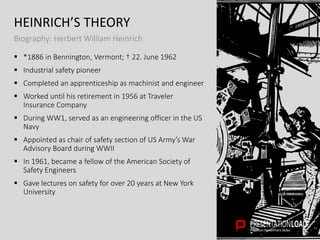
HEINRICH’S THEORY
Biography: Herbert William Heinrich
 *1886 in Bennington, Vermont; † 22. June 1962
 Industrial safety pioneer
 Completed an apprenticeship as machinist and engineer
 Worked until his retirement in 1956 at Traveler
Insurance Company
 During WW1, served as an engineering officer in the US
Navy
 Appointed as chair of safety section of US Army’s War
Advisory Board during WWII
 In 1961, became a fellow of the American Society of
Safety Engineers
 Gave lectures on safety for over 20 years at New York
University
Out of this patient group, one accident with
major injury will occur “Titanic Event“.
29 accidents of moderate injury will occur.
These must be met with countermeasures.
In a group of 3,846 patients, negligence
causes 300 accidents with no or little injury.
His studyshows the relationship between
small instances of negligence and
catastrophic events in the workplace:
HEINRICH`S LAW
Description
Every prevention strategy should focus on
eliminating small errors so that larger errors
cannot occur.
3.846 Patients
300
Small incidences of negligence, calculated risk
29
Barely avoided or minor injury
to patient
1
Titanic Event
Injury Occurrence
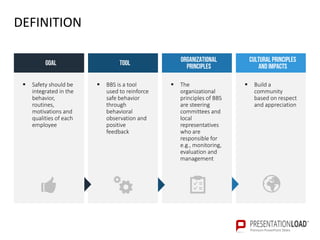
DEFINITION
Behavior-Based Safety
Behavior Based Safety (BBS)
Heinrich’s theory serves as the basis
for the behavior-based safety theory.
This implies that 85 – 90 % of
workplace accidents are caused by
unsafe behavior.
Heinrich reviewed numerous accident
reports. These reports concluded that
workers were generally responsible for
these accidents but did not investigate
the causes.
DEFINITION
goal
 Safety should be
integrated in the
behavior,
routines,
motivations and
qualities of each
employee
tool
 BBS is a tool
used to reinforce
safe behavior
through
behavioral
observation and
positive
feedback
Organizational
principles
 The
organizational
principles of BBS
are steering
committees and
local
representatives
who are
responsible for
e.g., monitoring,
evaluation and
management
Cultural principles
and impacts
 Build a
community
based on respect
and appreciation
PRINCIPLES
Fatal Work-Related Accidents in Germany
1.712
1.596
1.523
1.403
1287 1293
1153 1107 1071 1029
949
863
941
812 765
622 674 664 677
606
1995 2000 2005 2010
FATAL WORK-RELATED ACCIDENTS
Source: Suga 2013
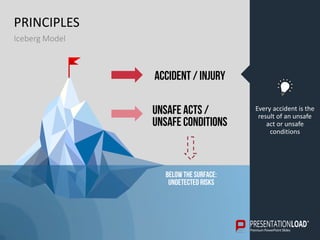
PRINCIPLES
Iceberg Model
accident / injury
Unsafe acts /
unsafe conditions
Every accident is the
result of an unsafe
act or unsafe
conditions
Below the surface:
undetected risks
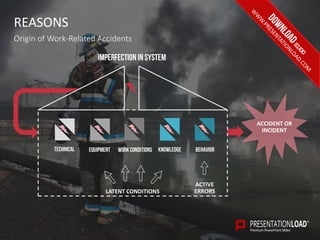
REASONS
Origin of Work-Related Accidents
ACCIDENT OR
INCIDENT
imperfection inSystem
Technical equipment Workconditions Knowledge Behavior
LATENT CONDITIONS
ACTIVE
ERRORS
REASONS
How is Behavior Learned?
BEHAVIOR
Carries certain advantages and has
positive consequences
Carries certain disadvantages and has
negative consequences
The behavior is often demonstrated
The behavior is less likely to be
demonstrated
The behavior develops into a habit The behavior is abandoned
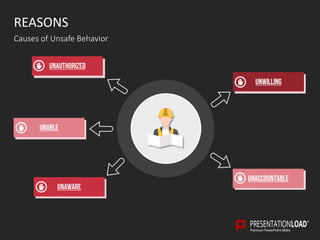
REASONS
Causes of Unsafe Behavior
Unauthorized
Unable
Unwilling
Unaccountable
Unaware
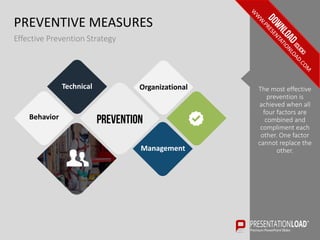
PREVENTIVE MEASURES
Effective Prevention Strategy
The most effective
prevention is
achieved when all
four factors are
combined and
compliment each
other. One factor
cannot replace the
other.
Organizational
Management
Behavior
Technical
Prevention
PREVENTIVE MEASURES
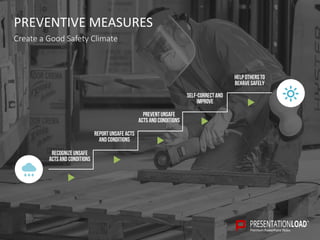
Create a Good Safety Climate
Reportunsafe acts
and conditions
Recognizeunsafe
actsandconditions
Preventunsafe
actsandconditions
Self-correctand
improve
Helpothersto
behavesafely
APPLICATIONS
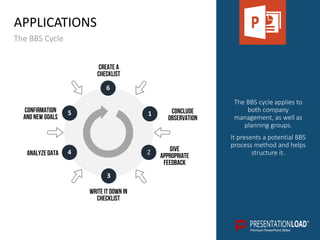
The BBS Cycle
The BBS cycle applies to
both company
management, as well as
planning groups.
It presents a potential BBS
process method and helps
structure it.
6
3
5
4
1
2
Create a
checklist
Confirmation
and new goals
Analyze data
Write it down in
checklist
Give
appropriate
feedback
Conclude
observation
CHECKLISTS
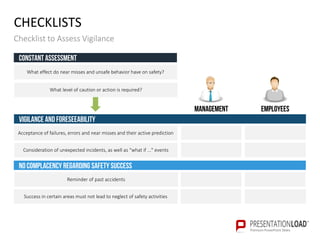
Checklist to Assess Vigilance
Constant Assessment
What effect do near misses and unsafe behavior have on safety?
Management Employees
What level of caution or action is required?
Vigilance and Foreseeability
Acceptance of failures, errors and near misses and their active prediction
Consideration of unexpected incidents, as well as “what if ..." events
NoComplacency Regarding Safety Success
Reminder of past accidents
Success in certain areas must not lead to neglect of safety activities
ICONS
Click here to visit www.PresentationLoad.com
DOWNLOAD POWERPOINT SLIDES

Behavior-Based Safety PPT Slide Template

  • 1.
  • 2.
  • 3.
    1. quote 2. Heinrich‘slaw 3. Definition 4. principles 5. reasons 6. Preventive measures 7. applications 8. Checklists 9. Icons AGENDA
  • 4.
    Don’t do somethingdetrimental to yourself. In hurting yourself, you obviously do damage to you, but you are part of the team, so when you damage yourself via a poor choice, you are hurting the team as well. Matt Forck (Safety Speaker) W OR K SA FE
  • 5.
    HEINRICH’S THEORY Biography: HerbertWilliam Heinrich  *1886 in Bennington, Vermont; † 22. June 1962  Industrial safety pioneer  Completed an apprenticeship as machinist and engineer  Worked until his retirement in 1956 at Traveler Insurance Company  During WW1, served as an engineering officer in the US Navy  Appointed as chair of safety section of US Army’s War Advisory Board during WWII  In 1961, became a fellow of the American Society of Safety Engineers  Gave lectures on safety for over 20 years at New York University
  • 6.
    Out of thispatient group, one accident with major injury will occur “Titanic Event“. 29 accidents of moderate injury will occur. These must be met with countermeasures. In a group of 3,846 patients, negligence causes 300 accidents with no or little injury. His studyshows the relationship between small instances of negligence and catastrophic events in the workplace: HEINRICH`S LAW Description Every prevention strategy should focus on eliminating small errors so that larger errors cannot occur. 3.846 Patients 300 Small incidences of negligence, calculated risk 29 Barely avoided or minor injury to patient 1 Titanic Event Injury Occurrence
  • 7.
    DEFINITION Behavior-Based Safety Behavior BasedSafety (BBS) Heinrich’s theory serves as the basis for the behavior-based safety theory. This implies that 85 – 90 % of workplace accidents are caused by unsafe behavior. Heinrich reviewed numerous accident reports. These reports concluded that workers were generally responsible for these accidents but did not investigate the causes.
  • 8.
    DEFINITION goal  Safety shouldbe integrated in the behavior, routines, motivations and qualities of each employee tool  BBS is a tool used to reinforce safe behavior through behavioral observation and positive feedback Organizational principles  The organizational principles of BBS are steering committees and local representatives who are responsible for e.g., monitoring, evaluation and management Cultural principles and impacts  Build a community based on respect and appreciation
  • 9.
    PRINCIPLES Fatal Work-Related Accidentsin Germany 1.712 1.596 1.523 1.403 1287 1293 1153 1107 1071 1029 949 863 941 812 765 622 674 664 677 606 1995 2000 2005 2010 FATAL WORK-RELATED ACCIDENTS Source: Suga 2013
  • 10.
    PRINCIPLES Iceberg Model accident /injury Unsafe acts / unsafe conditions Every accident is the result of an unsafe act or unsafe conditions Below the surface: undetected risks
  • 11.
    REASONS Origin of Work-RelatedAccidents ACCIDENT OR INCIDENT imperfection inSystem Technical equipment Workconditions Knowledge Behavior LATENT CONDITIONS ACTIVE ERRORS
  • 12.
    REASONS How is BehaviorLearned? BEHAVIOR Carries certain advantages and has positive consequences Carries certain disadvantages and has negative consequences The behavior is often demonstrated The behavior is less likely to be demonstrated The behavior develops into a habit The behavior is abandoned
  • 13.
    REASONS Causes of UnsafeBehavior Unauthorized Unable Unwilling Unaccountable Unaware
  • 14.
    PREVENTIVE MEASURES Effective PreventionStrategy The most effective prevention is achieved when all four factors are combined and compliment each other. One factor cannot replace the other. Organizational Management Behavior Technical Prevention
  • 15.
    PREVENTIVE MEASURES Create aGood Safety Climate Reportunsafe acts and conditions Recognizeunsafe actsandconditions Preventunsafe actsandconditions Self-correctand improve Helpothersto behavesafely
  • 16.
    APPLICATIONS The BBS Cycle TheBBS cycle applies to both company management, as well as planning groups. It presents a potential BBS process method and helps structure it. 6 3 5 4 1 2 Create a checklist Confirmation and new goals Analyze data Write it down in checklist Give appropriate feedback Conclude observation
  • 17.
    CHECKLISTS Checklist to AssessVigilance Constant Assessment What effect do near misses and unsafe behavior have on safety? Management Employees What level of caution or action is required? Vigilance and Foreseeability Acceptance of failures, errors and near misses and their active prediction Consideration of unexpected incidents, as well as “what if ..." events NoComplacency Regarding Safety Success Reminder of past accidents Success in certain areas must not lead to neglect of safety activities
  • 18.
  • 19.
    Click here tovisit www.PresentationLoad.com DOWNLOAD POWERPOINT SLIDES