Understanding and
Teaching Spoken English
金 利 民
北京外国语大学英语学院
Outline
Features of the spoken language
Teaching spoken English: Principles and
practice
How to use A Speaking Course
Part One: Preview
Features of the spoken language
Prosodic features
Shortened forms
Features resulting from limited
processing time
Organizational features
Accent and dialect
Functions of the spoken language
1. Features of the spoken language
1.1 Prosodic features:
stress
pitch
intonation

rhythm
tempo

e.g. She sells seashells on the seashore,
the shells she sells are seashells I’m
sure.

(1)
1. Features of the spoken language
1.2 Shortened forms
Contraction
Elision
Ellipsis

(2)
Contraction:
a reduced form often marked by an
apostrophe in writing
e.g.

can’t = cannot
I’ll = I will
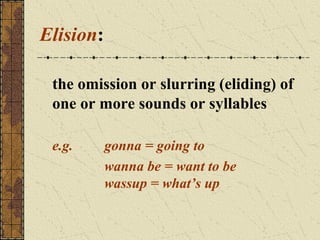
Elision:
the omission or slurring (eliding) of
one or more sounds or syllables
e.g.

gonna = going to
wanna be = want to be
wassup = what’s up
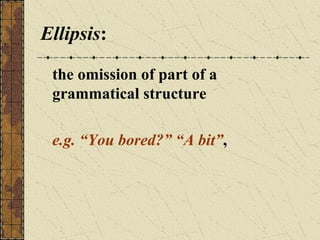
Ellipsis:
the omission of part of a
grammatical structure
e.g. “You bored?” “A bit”,
1. Features of the spoken language
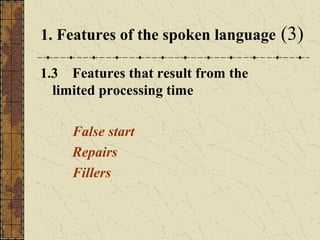
1.3 Features that result from the
limited processing time
False start
Repairs
Fillers

(3)
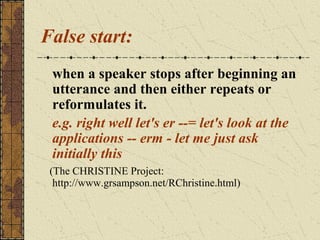
False start:
when a speaker stops after beginning an
utterance and then either repeats or
reformulates it.
e.g. right well let's er --= let's look at the
applications -- erm - let me just ask
initially this
(The CHRISTINE Project:
http://www.grsampson.net/RChristine.html)
Repairs:
an alteration suggested or made by
the speaker, the addressee or the
audience to correct or clarify a
previous conversational
contribution.
Fillers:
- no particular meanings
- provides time to think,
to create a pause or
to hold a turn
e.g. “er”, “uhm”, “ah”, “well”.
Compare with the Chinese filler “neige”.
1. Features of the spoken language
1.4 Organizational features
Back-channeling
Turn-taking

(4)
Back-channeling:
Feedback for a speaker, meaning “I
understand you” or “I’m listening”.
e.g. “I see”, “really”, “uh huh” or “oh”
Turn-taking:
a typical, orderly arrangement in
which participants speak with
minimal overlap and gap between
them.
Short-turns: one or two sentences;
long turns: can be an hour’s lecture.
1. Features of the spoken language

(5)

Accent: the ways in which words are
pronounced. Factors: age, region or
social class, e.g. RP
Dialect: The distinctive grammar and
vocabulary associated with the
regional or social use of a language,
e.g. Bernard Shaw’s Pygmalion.
1. Features of the spoken language

(6)

Different functions
Interactional talk: Conversational language
for interpersonal reasons and/or
socializing. E.g. chitchat. Primarily
listener-oriented.
Transactional talk: Language to get things
done or to transmit content or
information. Primarily speaker-oriented.
Part Two: Preview
What should be taught and what can be
taught?
The roles of a spoken English teacher
Basic principles in teaching spoken English
Some suggestions for the design of
activities
2.1 What should be taught and what
can be taught? (1)
What are the possible aims of a spoken
English course?
Notions; Situations; Topics; etc.
Which spoken model should we present to
our students?
RP or a standard American accent?
2.1 What should be taught and what
can be taught? (2)
What should be corrected and what should
not be corrected?
What are the possible sideline productions?
Training of communication skills, public
speaking skills, and skills to organize
thoughts within a short time…
2.2 The roles of a spoken English
teacher
Three stages and respective teachers’ roles:
Presentation: an informant (+ a
model provider?)
Practice: a conductor or a classroom
manager
Production: a guide or a facilitator
Does teaching have to be in this order?
2.3 Basic principles in teaching spoken
English (1)
The importance of stress and rhythm
Difference between English and Chinese
English: stress-timed
Chinese: syllable-timed

e.g. I saw a big tree on the top of the
mountain.
The use of songs in the teaching of
pronunciation: Do Re Mi (Unit 1)
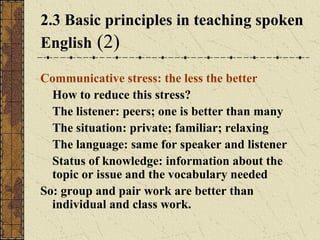
2.3 Basic principles in teaching spoken
English (2)
Communicative stress: the less the better
How to reduce this stress?
The listener: peers; one is better than many
The situation: private; familiar; relaxing
The language: same for speaker and listener
Status of knowledge: information about the
topic or issue and the vocabulary needed
So: group and pair work are better than
individual and class work.
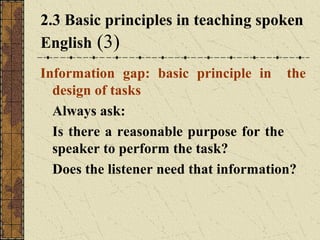
2.3 Basic principles in teaching spoken
English (3)
Information gap: basic principle in the
design of tasks
Always ask:
Is there a reasonable purpose for the
speaker to perform the task?
Does the listener need that information?
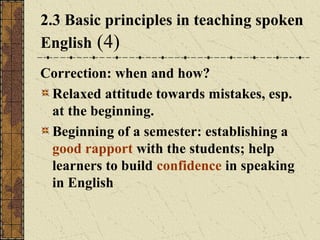
2.3 Basic principles in teaching spoken
English (4)
Correction: when and how?
Relaxed attitude towards mistakes, esp.
at the beginning.
Beginning of a semester: establishing a
good rapport with the students; help
learners to build confidence in speaking
in English
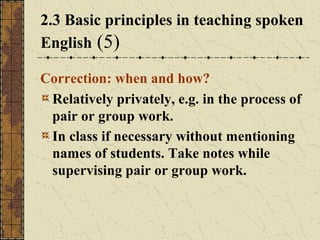
2.3 Basic principles in teaching spoken
English (5)
Correction: when and how?
Relatively privately, e.g. in the process of
pair or group work.
In class if necessary without mentioning
names of students. Take notes while
supervising pair or group work.
2.3 Basic principles in teaching spoken
English (6)
The importance of encouragement: Pygmalion
Effect - Rosenthal and Jacobson (1968),
children aged six to twelve years, all drawn
from the same school, given an IQ test.
Children were then assigned to an experimental
or control group. When teachers were told that
the children in the experimental group were
"high achievers", these children showed
significant IQ gains over the course of one year,
despite allocation to group having been in fact
random.
2.4 Some suggestions for the design of
activities
The use of pictures
The use of jigsaw
The use of games
The use of drama
The use of role play and simulation
Part Three: Preview
Brief introduction to A Speaking
Course
Teaching spoken English to big
classes
Teaching spoken English to mixed
ability classes
Motivating the students
3.1 A Speaking Course
An integrated syllabus:
Book 1: Pronunciation; Functions (I);
Functions (II); Situations
Book 2: What will you say?
What will you do?
How to complete the project?
What is your opinion?
3.1 A Speaking Course
Principles in organization and design of
content
1) Objectives, warming-up, activities,
review, tips
2) Presentation, practice, production
Models are usually provided.
3) Situations and topics are close to the
life and future needs of the students.
3.2 Teaching big classes
Big classes: 50-60 students in one class
Difficult, but not mission impossible.
1) Carefully design tasks with clear
learning goals
2) Use pair work and group work
3) Maintain discipline: Be firm and fair
4) Feedback: One or two groups or pair
3.3 Teaching mixed ability classes
Let the more competent students do some
of the teaching.
Pair work and group work benefit the
more capable students more.
Leave different types of assignments for
the students to choose from.
3.4 Motivating the students
Involve the students in the design of tasks
Interesting tasks
Varied design of activities
Encouragement and some training of
learning skills
Make learners aware of the
sideline products of the training of
spoken English.
Tell me and I'll forget;
Teach me and I'll remember;
Involve me and I'll learn.
Benjamin
Franklin?
Thank You

English

  • 1.
    Understanding and Teaching SpokenEnglish 金 利 民 北京外国语大学英语学院
  • 2.
    Outline Features of thespoken language Teaching spoken English: Principles and practice How to use A Speaking Course
  • 3.
    Part One: Preview Featuresof the spoken language Prosodic features Shortened forms Features resulting from limited processing time Organizational features Accent and dialect Functions of the spoken language
  • 4.
    1. Features ofthe spoken language 1.1 Prosodic features: stress pitch intonation rhythm tempo e.g. She sells seashells on the seashore, the shells she sells are seashells I’m sure. (1)
  • 5.
    1. Features ofthe spoken language 1.2 Shortened forms Contraction Elision Ellipsis (2)
  • 6.
    Contraction: a reduced formoften marked by an apostrophe in writing e.g. can’t = cannot I’ll = I will
  • 7.
    Elision: the omission orslurring (eliding) of one or more sounds or syllables e.g. gonna = going to wanna be = want to be wassup = what’s up
  • 8.
    Ellipsis: the omission ofpart of a grammatical structure e.g. “You bored?” “A bit”,
  • 9.
    1. Features ofthe spoken language 1.3 Features that result from the limited processing time False start Repairs Fillers (3)
  • 10.
    False start: when aspeaker stops after beginning an utterance and then either repeats or reformulates it. e.g. right well let's er --= let's look at the applications -- erm - let me just ask initially this (The CHRISTINE Project: http://www.grsampson.net/RChristine.html)
  • 11.
    Repairs: an alteration suggestedor made by the speaker, the addressee or the audience to correct or clarify a previous conversational contribution.
  • 12.
    Fillers: - no particularmeanings - provides time to think, to create a pause or to hold a turn e.g. “er”, “uhm”, “ah”, “well”. Compare with the Chinese filler “neige”.
  • 13.
    1. Features ofthe spoken language 1.4 Organizational features Back-channeling Turn-taking (4)
  • 14.
    Back-channeling: Feedback for aspeaker, meaning “I understand you” or “I’m listening”. e.g. “I see”, “really”, “uh huh” or “oh”
  • 15.
    Turn-taking: a typical, orderlyarrangement in which participants speak with minimal overlap and gap between them. Short-turns: one or two sentences; long turns: can be an hour’s lecture.
  • 16.
    1. Features ofthe spoken language (5) Accent: the ways in which words are pronounced. Factors: age, region or social class, e.g. RP Dialect: The distinctive grammar and vocabulary associated with the regional or social use of a language, e.g. Bernard Shaw’s Pygmalion.
  • 17.
    1. Features ofthe spoken language (6) Different functions Interactional talk: Conversational language for interpersonal reasons and/or socializing. E.g. chitchat. Primarily listener-oriented. Transactional talk: Language to get things done or to transmit content or information. Primarily speaker-oriented.
  • 18.
    Part Two: Preview Whatshould be taught and what can be taught? The roles of a spoken English teacher Basic principles in teaching spoken English Some suggestions for the design of activities
  • 19.
    2.1 What shouldbe taught and what can be taught? (1) What are the possible aims of a spoken English course? Notions; Situations; Topics; etc. Which spoken model should we present to our students? RP or a standard American accent?
  • 20.
    2.1 What shouldbe taught and what can be taught? (2) What should be corrected and what should not be corrected? What are the possible sideline productions? Training of communication skills, public speaking skills, and skills to organize thoughts within a short time…
  • 21.
    2.2 The rolesof a spoken English teacher Three stages and respective teachers’ roles: Presentation: an informant (+ a model provider?) Practice: a conductor or a classroom manager Production: a guide or a facilitator Does teaching have to be in this order?
  • 22.
    2.3 Basic principlesin teaching spoken English (1) The importance of stress and rhythm Difference between English and Chinese English: stress-timed Chinese: syllable-timed e.g. I saw a big tree on the top of the mountain. The use of songs in the teaching of pronunciation: Do Re Mi (Unit 1)
  • 23.
    2.3 Basic principlesin teaching spoken English (2) Communicative stress: the less the better How to reduce this stress? The listener: peers; one is better than many The situation: private; familiar; relaxing The language: same for speaker and listener Status of knowledge: information about the topic or issue and the vocabulary needed So: group and pair work are better than individual and class work.
  • 24.
    2.3 Basic principlesin teaching spoken English (3) Information gap: basic principle in the design of tasks Always ask: Is there a reasonable purpose for the speaker to perform the task? Does the listener need that information?
  • 25.
    2.3 Basic principlesin teaching spoken English (4) Correction: when and how? Relaxed attitude towards mistakes, esp. at the beginning. Beginning of a semester: establishing a good rapport with the students; help learners to build confidence in speaking in English
  • 26.
    2.3 Basic principlesin teaching spoken English (5) Correction: when and how? Relatively privately, e.g. in the process of pair or group work. In class if necessary without mentioning names of students. Take notes while supervising pair or group work.
  • 27.
    2.3 Basic principlesin teaching spoken English (6) The importance of encouragement: Pygmalion Effect - Rosenthal and Jacobson (1968), children aged six to twelve years, all drawn from the same school, given an IQ test. Children were then assigned to an experimental or control group. When teachers were told that the children in the experimental group were "high achievers", these children showed significant IQ gains over the course of one year, despite allocation to group having been in fact random.
  • 28.
    2.4 Some suggestionsfor the design of activities The use of pictures The use of jigsaw The use of games The use of drama The use of role play and simulation
  • 29.
    Part Three: Preview Briefintroduction to A Speaking Course Teaching spoken English to big classes Teaching spoken English to mixed ability classes Motivating the students
  • 30.
    3.1 A SpeakingCourse An integrated syllabus: Book 1: Pronunciation; Functions (I); Functions (II); Situations Book 2: What will you say? What will you do? How to complete the project? What is your opinion?
  • 31.
    3.1 A SpeakingCourse Principles in organization and design of content 1) Objectives, warming-up, activities, review, tips 2) Presentation, practice, production Models are usually provided. 3) Situations and topics are close to the life and future needs of the students.
  • 32.
    3.2 Teaching bigclasses Big classes: 50-60 students in one class Difficult, but not mission impossible. 1) Carefully design tasks with clear learning goals 2) Use pair work and group work 3) Maintain discipline: Be firm and fair 4) Feedback: One or two groups or pair
  • 33.
    3.3 Teaching mixedability classes Let the more competent students do some of the teaching. Pair work and group work benefit the more capable students more. Leave different types of assignments for the students to choose from.
  • 34.
    3.4 Motivating thestudents Involve the students in the design of tasks Interesting tasks Varied design of activities Encouragement and some training of learning skills Make learners aware of the sideline products of the training of spoken English.
  • 35.
    Tell me andI'll forget; Teach me and I'll remember; Involve me and I'll learn. Benjamin Franklin?
  • 36.