PREPARED BY: ANTHONY ALLSOP
DEFINITIONS OF HAZARDS
 Anything or condition with the potential to cause
harm
 The potential of a substance, person, activity or
process to cause harm (injury or illness)
 Anything (material/substance, machine, methods
or matters) in the workplace that has the
potential to cause harm
TYPES OF HAZARD
 Safety – anything or condition that can cause physical
injury
 Health – any infective agent, substance situation or
condition that directly attacks the body tissues causing
occupational illness
 Environment – any pollution, waste including noise
in any form or quantity that impairs the quality of the
working environment, such as
dust, smoke, gases, radioactivity and odors
TWO MAIN CATEGORIES
 Natural – (geological) a threat of a naturally occurring
event that will have a negative effect on people or the
environment. (flood, lightening, wildfires, earthquake, soil
erosion, high winds, hurricanes, volcanic eruption, sink
holes, tsunami, drought, famine, heat waves, climate
change
 Manmade - (sociological) threats having an element of
human intent, negligence, or error; or involving a failure of
a human-made system. It results in huge loss of life and
property. It further affects a person's mental, physical and
social well-being. (fire, flood, crime, arson, civil
disorder, terrorism, war)
OTHER CATEGORIES OF HAZARD
Technology –
A hazard originating from technological or industrial
conditions, including accidents, dangerous
procedures, infrastructure failures or specific human activities, that
may cause loss of life, injury, illness or other health
impacts, property damage, loss of livelihoods and services, social
and economic disruption, or environmental damage.
Structural collapse - Communication fallouts - Transportation
Electrical fallouts (explosions and outages) - Nuclear fallouts
CBRN warfare (chemical, biological, radiation and
nuclear), are threat of terror against a nation (mass
destruction) -
Industrial Pollution - Fires
OTHER CATEGORIES OF HAZARD
 Behavioral –This is a reaction by a person subjected
to specific conditions of work and materials which
result in physical harm (health and injury). How
people behave at work can create hazardous
conditions.
 Irresponsible behaviour (horseplay, pranks, etc,)
 Leaving objects in pathways that causes obstruction and
tripping
 Running and rushing to different points about the
workplace
 Using hazardous substances dangerously and carelessly
Specifics of hazards
 Physical –
doors, stairs, platforms, ladders, fire, falling
objects, manual
handling, noise, vibration, temperature, radiation,
lighting, air quality.
 Mechanical –
electricity, machinery, equipment, pressure
vessels, dangerous goods, forklifts, cranes
 Chemical – chemical substances, liquids, cleaning
agents, dust and fumes from
Specifics of hazards
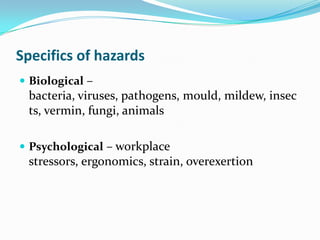
 Biological –
bacteria, viruses, pathogens, mould, mildew, insec
ts, vermin, fungi, animals
 Psychological – workplace
stressors, ergonomics, strain, overexertion
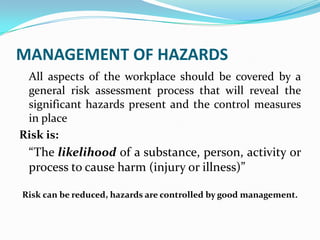
MANAGEMENT OF HAZARDS
All aspects of the workplace should be covered by a
general risk assessment process that will reveal the
significant hazards present and the control measures
in place
Risk is:
“The likelihood of a substance, person, activity or
process to cause harm (injury or illness)”
Risk can be reduced, hazards are controlled by good management.
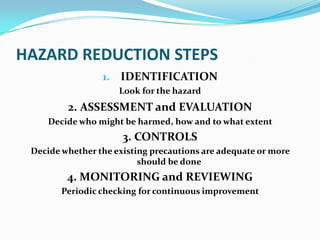
HAZARD REDUCTION STEPS
1. IDENTIFICATION
Look for the hazard
2. ASSESSMENT and EVALUATION
Decide who might be harmed, how and to what extent
3. CONTROLS
Decide whether the existing precautions are adequate or more
should be done
4. MONITORING and REVIEWING
Periodic checking for continuous improvement
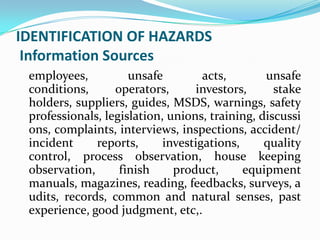
IDENTIFICATION OF HAZARDS
Information Sources
employees, unsafe acts, unsafe
conditions, operators, investors, stake
holders, suppliers, guides, MSDS, warnings, safety
professionals, legislation, unions, training, discussi
ons, complaints, interviews, inspections, accident/
incident reports, investigations, quality
control, process observation, house keeping
observation, finish product, equipment
manuals, magazines, reading, feedbacks, surveys, a
udits, records, common and natural senses, past
experience, good judgment, etc,.
ASSESS AND EVALUATE THE HAZARDS
“consider its severity(consequences) probability and exposure”
Once identified, determine how harmful the hazard
can be:
 The likelihood to cause harm
 Under what conditions it can occur?
 What type of harm can occur?
 Who or how many workers can be harmed?
 What may be the extent of the harm or injury?
 Is there a history of problem, accidents or dangerous
occurrence from the hazard?
 What monitoring is needed to evaluate the risk?
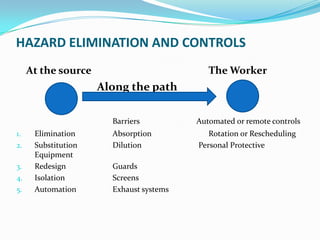
HAZARD ELIMINATION AND CONTROLS
At the source The Worker
Along the path
Barriers Automated or remote controls
1. Elimination Absorption Rotation or Rescheduling
2. Substitution Dilution Personal Protective
Equipment
3. Redesign Guards
4. Isolation Screens
5. Automation Exhaust systems
ENGINEERING CONTROLS
“Removing the hazard from the worker”
Designing the workplace and process, also ensure
professional installation of machine and equipment.
(isolation, lockouts, design, monitoring and
warning equipment, process and procedural
changes)
 Knowledge
 Maintenance
 Plant and equipment
ADMINISTRATIVE CONTROLS
“Removing the worker from the hazard”
 Accident/Incident reporting procedures
 Effective safety policy
 Develop rules, standards and safe systems of work
 Performance measurement
 Training and education
 Good communication
 Use of job safety analysis
 Housekeeping and maintenance
 Monitor performance and follow-up short comings
 Quality assurance and safety
 Purchasing
Personal Protective Equipment
“Protecting the worker from the hazard”
 Insulate the worker.
 Use only when all options are exhausted, and the hazard cannot be
corrected through substitution or design.
Selection:
1. Where there is no immediate way to control the hazard by more
effective means.
2. When employed as a temporary measure, while more effective
solutions are being installed.
Its short comings:
It cannot eliminate or reduce the hazard
If it fails the worker is exposed to the full destructive effects of the
hazard
It may be too cumbersome and can interfere with the worker’s ability
to perform the task, thus compound the problem
PRINCIPLES OF PREVENTION
“HIERACHY OF CONTROLS”
1. AVOIDANCE
2. EVALUATING THE RESIDUAL HAZARDS
3. COMBATING AT THE SOURCE
4. ADAPTING THE WORK TO THE INDIVIDUAL
5. ADAPTING TO TECHNNICAL PROGRESS
6. SUBTITUTION
7. DEVELOP A COHERENT INVOLVING ALL ASPECTS
AT WORK
8. COLLECTIVE PROTECTION OVERIDES INDIVIDUAL
PROTECTION
9. APPROPRIATE INSTRUCTIONS TO ALL EMPLOYEES
MONITORING AND REVIEWING
Controls must be reviewed periodically
 Monitor and review when condition changes;
New machinery
Change in process
New hazards
New information
Change in legislation
Change in workforce
New employees
Post accident risk assessment
EFFECTIVENESSS OF CONTROLS
 Where hazards cannot be eliminated, control measures must be
implemented to reduce it to an acceptable level.
 Hazards should be controlled by applying
contemporary, comprehensive and proactive management
systems than reactive responses.
Effectiveness must meet these standards;
1. It must be sufficient to prevent the hazard from causing harm
2. It must protect everyone who can be harmed from the hazard
3. It must not create new hazards, or production and quality
control problems
4. It must not create a hazard to the environment or the
community of the workplace situation
ROUTES OF ENTRY
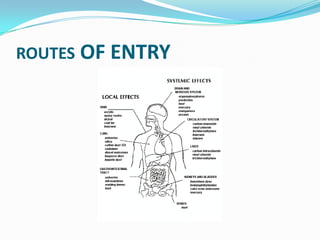
Chemical and biological hazards can be transported into
the human body by various agents, pathogens and other
forms, through the four main routes of entry;
1. Inhalation – taken into the body through the
lungs
2. Absorption - taken into the body through the skin
3. Ingestion - taken into the body orally
4. Injection (direct entry) - taken into the body
through broken skin
ROUTES OF ENTRY
ROUTES OF ENTRY
The most common route of entry is inhalation since
all organisms must breathe in oxygen to live.
Hazards that cause immediate harm such as an injury
from an accident are termed “acute”, while “chronic”
hazards where the harm is not experienced
immediately due to prolong exposure to health
hazards.
Responsibility and Support
Prevention is the first and safest and also the most
effective measure of control for safety, health and
environment hazards.
Safety professionals must become familiar with health
and safety issues in the workplace because its their
responsibility to manage the safety and health
matters, or solicit the services of specialist of
specific safety situations for successful safety
management.
Questions
 What is the difference between acute hazards and chronic
hazards?
 What are the steps to controlling hazards?
 Explain in order of priority hazard reduction
 Explain risk and hazard
THANK YOU
NEXT DISCUSSION
RISK ASSESSMENT

Workplace hazards

  • 1.
  • 2.
    DEFINITIONS OF HAZARDS Anything or condition with the potential to cause harm  The potential of a substance, person, activity or process to cause harm (injury or illness)  Anything (material/substance, machine, methods or matters) in the workplace that has the potential to cause harm
  • 3.
    TYPES OF HAZARD Safety – anything or condition that can cause physical injury  Health – any infective agent, substance situation or condition that directly attacks the body tissues causing occupational illness  Environment – any pollution, waste including noise in any form or quantity that impairs the quality of the working environment, such as dust, smoke, gases, radioactivity and odors
  • 4.
    TWO MAIN CATEGORIES Natural – (geological) a threat of a naturally occurring event that will have a negative effect on people or the environment. (flood, lightening, wildfires, earthquake, soil erosion, high winds, hurricanes, volcanic eruption, sink holes, tsunami, drought, famine, heat waves, climate change  Manmade - (sociological) threats having an element of human intent, negligence, or error; or involving a failure of a human-made system. It results in huge loss of life and property. It further affects a person's mental, physical and social well-being. (fire, flood, crime, arson, civil disorder, terrorism, war)
  • 5.
    OTHER CATEGORIES OFHAZARD Technology – A hazard originating from technological or industrial conditions, including accidents, dangerous procedures, infrastructure failures or specific human activities, that may cause loss of life, injury, illness or other health impacts, property damage, loss of livelihoods and services, social and economic disruption, or environmental damage. Structural collapse - Communication fallouts - Transportation Electrical fallouts (explosions and outages) - Nuclear fallouts CBRN warfare (chemical, biological, radiation and nuclear), are threat of terror against a nation (mass destruction) - Industrial Pollution - Fires
  • 6.
    OTHER CATEGORIES OFHAZARD  Behavioral –This is a reaction by a person subjected to specific conditions of work and materials which result in physical harm (health and injury). How people behave at work can create hazardous conditions.  Irresponsible behaviour (horseplay, pranks, etc,)  Leaving objects in pathways that causes obstruction and tripping  Running and rushing to different points about the workplace  Using hazardous substances dangerously and carelessly
  • 7.
    Specifics of hazards Physical – doors, stairs, platforms, ladders, fire, falling objects, manual handling, noise, vibration, temperature, radiation, lighting, air quality.  Mechanical – electricity, machinery, equipment, pressure vessels, dangerous goods, forklifts, cranes  Chemical – chemical substances, liquids, cleaning agents, dust and fumes from
  • 8.
    Specifics of hazards Biological – bacteria, viruses, pathogens, mould, mildew, insec ts, vermin, fungi, animals  Psychological – workplace stressors, ergonomics, strain, overexertion
  • 9.
    MANAGEMENT OF HAZARDS Allaspects of the workplace should be covered by a general risk assessment process that will reveal the significant hazards present and the control measures in place Risk is: “The likelihood of a substance, person, activity or process to cause harm (injury or illness)” Risk can be reduced, hazards are controlled by good management.
  • 10.
    HAZARD REDUCTION STEPS 1.IDENTIFICATION Look for the hazard 2. ASSESSMENT and EVALUATION Decide who might be harmed, how and to what extent 3. CONTROLS Decide whether the existing precautions are adequate or more should be done 4. MONITORING and REVIEWING Periodic checking for continuous improvement
  • 11.
    IDENTIFICATION OF HAZARDS InformationSources employees, unsafe acts, unsafe conditions, operators, investors, stake holders, suppliers, guides, MSDS, warnings, safety professionals, legislation, unions, training, discussi ons, complaints, interviews, inspections, accident/ incident reports, investigations, quality control, process observation, house keeping observation, finish product, equipment manuals, magazines, reading, feedbacks, surveys, a udits, records, common and natural senses, past experience, good judgment, etc,.
  • 12.
    ASSESS AND EVALUATETHE HAZARDS “consider its severity(consequences) probability and exposure” Once identified, determine how harmful the hazard can be:  The likelihood to cause harm  Under what conditions it can occur?  What type of harm can occur?  Who or how many workers can be harmed?  What may be the extent of the harm or injury?  Is there a history of problem, accidents or dangerous occurrence from the hazard?  What monitoring is needed to evaluate the risk?
  • 13.
    HAZARD ELIMINATION ANDCONTROLS At the source The Worker Along the path Barriers Automated or remote controls 1. Elimination Absorption Rotation or Rescheduling 2. Substitution Dilution Personal Protective Equipment 3. Redesign Guards 4. Isolation Screens 5. Automation Exhaust systems
  • 14.
    ENGINEERING CONTROLS “Removing thehazard from the worker” Designing the workplace and process, also ensure professional installation of machine and equipment. (isolation, lockouts, design, monitoring and warning equipment, process and procedural changes)  Knowledge  Maintenance  Plant and equipment
  • 15.
    ADMINISTRATIVE CONTROLS “Removing theworker from the hazard”  Accident/Incident reporting procedures  Effective safety policy  Develop rules, standards and safe systems of work  Performance measurement  Training and education  Good communication  Use of job safety analysis  Housekeeping and maintenance  Monitor performance and follow-up short comings  Quality assurance and safety  Purchasing
  • 16.
    Personal Protective Equipment “Protectingthe worker from the hazard”  Insulate the worker.  Use only when all options are exhausted, and the hazard cannot be corrected through substitution or design. Selection: 1. Where there is no immediate way to control the hazard by more effective means. 2. When employed as a temporary measure, while more effective solutions are being installed. Its short comings: It cannot eliminate or reduce the hazard If it fails the worker is exposed to the full destructive effects of the hazard It may be too cumbersome and can interfere with the worker’s ability to perform the task, thus compound the problem
  • 17.
    PRINCIPLES OF PREVENTION “HIERACHYOF CONTROLS” 1. AVOIDANCE 2. EVALUATING THE RESIDUAL HAZARDS 3. COMBATING AT THE SOURCE 4. ADAPTING THE WORK TO THE INDIVIDUAL 5. ADAPTING TO TECHNNICAL PROGRESS 6. SUBTITUTION 7. DEVELOP A COHERENT INVOLVING ALL ASPECTS AT WORK 8. COLLECTIVE PROTECTION OVERIDES INDIVIDUAL PROTECTION 9. APPROPRIATE INSTRUCTIONS TO ALL EMPLOYEES
  • 18.
    MONITORING AND REVIEWING Controlsmust be reviewed periodically  Monitor and review when condition changes; New machinery Change in process New hazards New information Change in legislation Change in workforce New employees Post accident risk assessment
  • 19.
    EFFECTIVENESSS OF CONTROLS Where hazards cannot be eliminated, control measures must be implemented to reduce it to an acceptable level.  Hazards should be controlled by applying contemporary, comprehensive and proactive management systems than reactive responses. Effectiveness must meet these standards; 1. It must be sufficient to prevent the hazard from causing harm 2. It must protect everyone who can be harmed from the hazard 3. It must not create new hazards, or production and quality control problems 4. It must not create a hazard to the environment or the community of the workplace situation
  • 20.
    ROUTES OF ENTRY Chemicaland biological hazards can be transported into the human body by various agents, pathogens and other forms, through the four main routes of entry; 1. Inhalation – taken into the body through the lungs 2. Absorption - taken into the body through the skin 3. Ingestion - taken into the body orally 4. Injection (direct entry) - taken into the body through broken skin
  • 21.
  • 22.
    ROUTES OF ENTRY Themost common route of entry is inhalation since all organisms must breathe in oxygen to live. Hazards that cause immediate harm such as an injury from an accident are termed “acute”, while “chronic” hazards where the harm is not experienced immediately due to prolong exposure to health hazards.
  • 23.
    Responsibility and Support Preventionis the first and safest and also the most effective measure of control for safety, health and environment hazards. Safety professionals must become familiar with health and safety issues in the workplace because its their responsibility to manage the safety and health matters, or solicit the services of specialist of specific safety situations for successful safety management.
  • 24.
    Questions  What isthe difference between acute hazards and chronic hazards?  What are the steps to controlling hazards?  Explain in order of priority hazard reduction  Explain risk and hazard
  • 25.