Hazard Recognition Training

   The “What if…” of Accident
          Prevention
            Allen Jingst, CIE
    Safety / Ergonomics Consulting
What is “Hazard Recognition”
 A method to identify workplace hazards.
 An observation tool for understanding how
  both unsafe conditions and actions occur.
 Hazard Recognition goes “beneath” the
  obvious hazards to their underlying causes.
Why Hazard Recognition?
 Facility Inspections -      Hazard Recognition -
   – Focus is mostly on        – Universally applicable.
     unsafe conditions.        – Uses a questioning
   – However, Unsafe             format, rather than a
     Actions account for         checklist or audit.
     most workplace            – Can be used to
     hazards.                    augment or better
   – Requires an in-depth        address other facility
     knowledge.                  inspection methods.
   – Limited by “checklist     – Provides a “Pro-active”
     approach”.                  approach.
Hazard Recognition Concept
 Key Concept / Question:
  – What hazard Causes exist here?
 Look for Causes in a given work situation:
  – General duties of a Job .
  – Specific Tasks within the job.
  – Workstation or site.
  – Work method or process.
 Ask “What if…?”
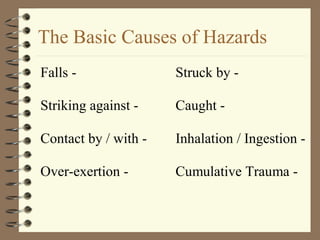
The Basic Causes of Hazards
Falls -               Struck by -

Striking against -    Caught -

Contact by / with -   Inhalation / Ingestion -

Over-exertion -       Cumulative Trauma -
Falls -
 On the Same Level
  – Slip due to…
  – Trip due to…
  – Haste, slope, etc.
 To a Lower Level
   – Balance / posture
   – Slip or Trip due to…
   – 3 points of contact?
   – While performing
     another task.
Struck by -
 The object provides the force or action, such as the
  following:
   – A Moving Object strikes the worker...
      • Misdirected Hand Tool; Workpiece that is
        dislodged; Point of Operation area in a machine.
   – A Flying Object is projected toward a worker...
      • Foreign body in the Eye is typical.
   – A Falling Object drops from above...
      • Can you give an Example?
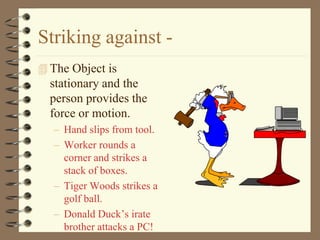
Striking against -
 The Object is
  stationary and the
  person provides the
  force or motion.
   – Hand slips from tool.
   – Worker rounds a
     corner and strikes a
     stack of boxes.
   – Tiger Woods strikes a
     golf ball.
   – Donald Duck’s irate
     brother attacks a PC!
Caught -
 In, On or Between - Stationary and / or Moving
  Objects
   – Caught In: Worker trapped in confined space.
   – Caught On: Pant leg snagged by a loose steel cable
     end, leading to fall.
      • Note: The Fall might be accident type, but the “underlying
        cause” is the Caught On hazard.
   – Caught Between: Hand crushed between pinch rollers
     on a conveyor.
 Many machine and equipment accidents involve
  Caught - type hazards.
Contact by / with -
 The substance or
  object’s composition
  or nature is inherently
  Hazardous.
 The substance or
  object may be
  Hazardous only in
  certain situations or
  when specific
  conditions are met.
Contact by / with -
                  Electricity
                    – Voltage, amperage, etc.
                  Cold or Heat
                   – Skin contact / body.
                  Chemicals
                   – Skin contact hazard.
                  Noise / Vibration /
                      Shock
                      – Intensity + Duration
Inhalation / Ingestion -
 Similar to Contact as the substance has an
  inherent hazard.
  – However, the substance must be internalized to
    be hazardous or toxic.
 Some substances are both contact and
  inhalation / ingestion hazards.
  – Remember, you can be “unexpectedly” exposed
    to these hazards (e.g. airborne toxins settle on open
    beverages or food).
Over-exertion -
 Situations or conditions that create or cause
  the need for more force, strength or
  endurance than the person is capable of
  performing.
 Manual Materials Handling - whole body:
  – Lifting, Lowering, Pushing, Pulling, Carrying.
  – Underlying Causes of Manual Handling -
     • Weight or force, Posture & position, Frequency and
       duration of task, Location of object handled.
Over-exertion -
 Other forms of Over-exertion include:
  – Hands - type of grasp and grip force.
  – Overhead or above - shoulder work.
  – Physically demanding work -
     • Shoveling, carrying long distances.
  – Extensive tool use.
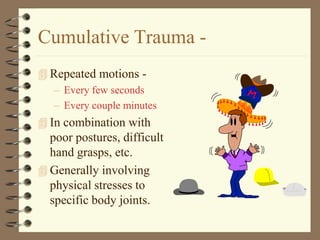
Cumulative Trauma -
 Repeated motions -
  – Every few seconds
  – Every couple minutes
 In combination with
  poor postures, difficult
  hand grasps, etc.
 Generally involving
  physical stresses to
  specific body joints.
Using Hazard Recognition -
 When Conducting Facility Inspections -
  – People
      • Observe the worker’s motions, postures, sequence of job or
        task steps.
   – Equipment
      • How do tools, machines and equipment create or act as a
        source for hazards?
   – Environment
      • Floors, work surfaces, lighting, noise, other jobs.
   – Management
      • Does management act to correct, warn or train to minimize
        hazards?
Hazard Recognition -
 How else is it Valuable?
  – When Investigating Accidents.
  – To determine the causes of a “Near Miss”
    incident.
  – For Job Safety Analysis .
  – As a part of New Employee Training.
 Make it a part of Employee Hazard
  Awareness!

Hazard Recognition Training Generic

  • 1.
    Hazard Recognition Training The “What if…” of Accident Prevention Allen Jingst, CIE Safety / Ergonomics Consulting
  • 2.
    What is “HazardRecognition”  A method to identify workplace hazards.  An observation tool for understanding how both unsafe conditions and actions occur.  Hazard Recognition goes “beneath” the obvious hazards to their underlying causes.
  • 3.
    Why Hazard Recognition? Facility Inspections -  Hazard Recognition - – Focus is mostly on – Universally applicable. unsafe conditions. – Uses a questioning – However, Unsafe format, rather than a Actions account for checklist or audit. most workplace – Can be used to hazards. augment or better – Requires an in-depth address other facility knowledge. inspection methods. – Limited by “checklist – Provides a “Pro-active” approach”. approach.
  • 4.
    Hazard Recognition Concept Key Concept / Question: – What hazard Causes exist here?  Look for Causes in a given work situation: – General duties of a Job . – Specific Tasks within the job. – Workstation or site. – Work method or process.  Ask “What if…?”
  • 5.
    The Basic Causesof Hazards Falls - Struck by - Striking against - Caught - Contact by / with - Inhalation / Ingestion - Over-exertion - Cumulative Trauma -
  • 6.
    Falls -  Onthe Same Level – Slip due to… – Trip due to… – Haste, slope, etc.  To a Lower Level – Balance / posture – Slip or Trip due to… – 3 points of contact? – While performing another task.
  • 7.
    Struck by - The object provides the force or action, such as the following: – A Moving Object strikes the worker... • Misdirected Hand Tool; Workpiece that is dislodged; Point of Operation area in a machine. – A Flying Object is projected toward a worker... • Foreign body in the Eye is typical. – A Falling Object drops from above... • Can you give an Example?
  • 8.
    Striking against - The Object is stationary and the person provides the force or motion. – Hand slips from tool. – Worker rounds a corner and strikes a stack of boxes. – Tiger Woods strikes a golf ball. – Donald Duck’s irate brother attacks a PC!
  • 9.
    Caught -  In,On or Between - Stationary and / or Moving Objects – Caught In: Worker trapped in confined space. – Caught On: Pant leg snagged by a loose steel cable end, leading to fall. • Note: The Fall might be accident type, but the “underlying cause” is the Caught On hazard. – Caught Between: Hand crushed between pinch rollers on a conveyor.  Many machine and equipment accidents involve Caught - type hazards.
  • 10.
    Contact by /with -  The substance or object’s composition or nature is inherently Hazardous.  The substance or object may be Hazardous only in certain situations or when specific conditions are met.
  • 11.
    Contact by /with -  Electricity – Voltage, amperage, etc.  Cold or Heat – Skin contact / body.  Chemicals – Skin contact hazard.  Noise / Vibration / Shock – Intensity + Duration
  • 12.
    Inhalation / Ingestion-  Similar to Contact as the substance has an inherent hazard. – However, the substance must be internalized to be hazardous or toxic.  Some substances are both contact and inhalation / ingestion hazards. – Remember, you can be “unexpectedly” exposed to these hazards (e.g. airborne toxins settle on open beverages or food).
  • 13.
    Over-exertion -  Situationsor conditions that create or cause the need for more force, strength or endurance than the person is capable of performing.  Manual Materials Handling - whole body: – Lifting, Lowering, Pushing, Pulling, Carrying. – Underlying Causes of Manual Handling - • Weight or force, Posture & position, Frequency and duration of task, Location of object handled.
  • 14.
    Over-exertion -  Otherforms of Over-exertion include: – Hands - type of grasp and grip force. – Overhead or above - shoulder work. – Physically demanding work - • Shoveling, carrying long distances. – Extensive tool use.
  • 15.
    Cumulative Trauma - Repeated motions - – Every few seconds – Every couple minutes  In combination with poor postures, difficult hand grasps, etc.  Generally involving physical stresses to specific body joints.
  • 16.
    Using Hazard Recognition-  When Conducting Facility Inspections - – People • Observe the worker’s motions, postures, sequence of job or task steps. – Equipment • How do tools, machines and equipment create or act as a source for hazards? – Environment • Floors, work surfaces, lighting, noise, other jobs. – Management • Does management act to correct, warn or train to minimize hazards?
  • 17.
    Hazard Recognition - How else is it Valuable? – When Investigating Accidents. – To determine the causes of a “Near Miss” incident. – For Job Safety Analysis . – As a part of New Employee Training.  Make it a part of Employee Hazard Awareness!