SEMINAR ON
Presented to:-
Nitesh Rawat
Presented by:-
Mr. Vivek Uniyal
Introduction
01.
History & Development
02.
Working Principle
03.
Brain Computer Interface(BCI)
04.
05.
Advantages
06.
Disadvantages
07.
Future Scope
08.
CONTENT
Working
TURNING THOUGHT IN TO ACTION
INTRODUCTION
M A C H I N E L E A R N I N G
It is a mind-to-movement system that allows a Quadriplegic
man to control a computer using his Thoughts.
The system is to help those who have lost
control of their limbs or other bodily functions
such as patients with spinal cord injury to
operate various gadgets such as Tv, computer,
lights, fan etc.
It monitors brain activity in the patient and
converts the intention of the user into
computer commands
This can be used to control a robot arm or a
cursor on a screen
HISTORY & DEVELOPMENT
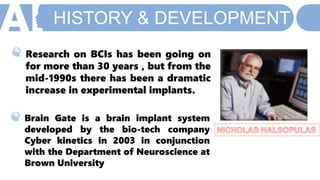
Brain Gate is a brain implant system
developed by the bio-tech company
Cyber kinetics in 2003 in conjunction
with the Department of Neuroscience at
Brown University
Research on BCIs has been going on
for more than 30 years , but from the
mid-1990s there has been a dramatic
increase in experimental implants.
WORKING PRINCIPLE
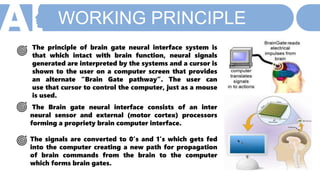
The principle of brain gate neural interface system is
that which intact with brain function, neural signals
generated are interpreted by the systems and a cursor is
shown to the user on a computer screen that provides
an alternate “Brain Gate pathway”. The user can
use that cursor to control the computer, just as a mouse
is used.
The Brain gate neural interface consists of an inter
neural sensor and external (motor cortex) processors
forming a propriety brain computer interface.
The signals are converted to 0’s and 1’s which gets fed
into the computer creating a new path for propagation
of brain commands from the brain to the computer
which forms brain gates.
COMPONENTS
BRAIN COMPUTER INTERFACE(BCI)
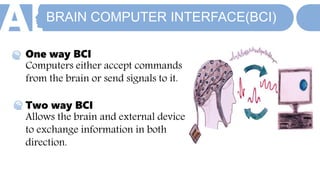
One way BCI
Computers either accept commands
from the brain or send signals to it.
Two way BCI
Allows the brain and external device
to exchange information in both
direction.
WORKING
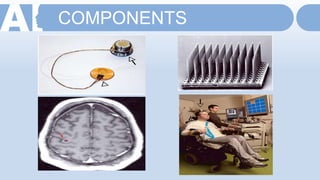
The Brain Gate neural interface device is a propriety brain-
computer interface that consist of an
Inter neural signal sensor and External Processors.
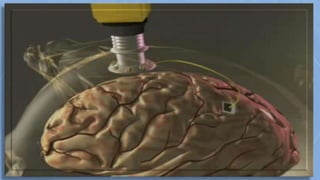
The sensor consists of a tiny clip containing 100 microscopic
electrodes that detect brain cell electrical activity.
The chip is implanted on the surface of brain in the motor cortex
area that controls movement.
WORKING CONT……
External Processors convert neural signals into an output
signal under the users own control.
In the pilot version of the device, a cable connects the
sensor to an external processor in a cart that contains
computers.
The computers translate brain activity and create the
communication output using custom decoding software.
…………………DEMONSTRATION…………………..
ADVANTAGES
Controlling remote devices
Making and receiving telephone calls
Accessing the internet in pc.
Turn on or off the lights
Control robotic arm
Watch and control television
Locking or unlocking doors
Motorized Wheelchair
DISADVANTAGES
Expensive
Risky surgery
not Wireless yet
Difficulty in adaptation and learning.
limitation in information transform rate.
The latest technology is 20 bits/min.
FUTURE SCOPE
Current new advances include a second-
generation interface software M*Power
controller that will enable users to perform a
wide variety of daily activities without
assistances of technician.
smaller ,wireless device .
The user will have an improved control of
respiratory system' limb with muscle
stimulation or robotics.
REFERENCE
www.braingates.org
https://en.wikipedia.org/wiki/BrainGate
https://www.researchgate.net/publication/287994259_BRAINGAT
E_SYSTEM_Application_of_human_computer_interaction
THANK YOU

BrainNit

  • 1.
    SEMINAR ON Presented to:- NiteshRawat Presented by:- Mr. Vivek Uniyal
  • 2.
    Introduction 01. History & Development 02. WorkingPrinciple 03. Brain Computer Interface(BCI) 04. 05. Advantages 06. Disadvantages 07. Future Scope 08. CONTENT Working
  • 3.
  • 4.
    INTRODUCTION M A CH I N E L E A R N I N G It is a mind-to-movement system that allows a Quadriplegic man to control a computer using his Thoughts. The system is to help those who have lost control of their limbs or other bodily functions such as patients with spinal cord injury to operate various gadgets such as Tv, computer, lights, fan etc. It monitors brain activity in the patient and converts the intention of the user into computer commands This can be used to control a robot arm or a cursor on a screen
  • 5.
    HISTORY & DEVELOPMENT BrainGate is a brain implant system developed by the bio-tech company Cyber kinetics in 2003 in conjunction with the Department of Neuroscience at Brown University Research on BCIs has been going on for more than 30 years , but from the mid-1990s there has been a dramatic increase in experimental implants.
  • 6.
    WORKING PRINCIPLE The principleof brain gate neural interface system is that which intact with brain function, neural signals generated are interpreted by the systems and a cursor is shown to the user on a computer screen that provides an alternate “Brain Gate pathway”. The user can use that cursor to control the computer, just as a mouse is used. The Brain gate neural interface consists of an inter neural sensor and external (motor cortex) processors forming a propriety brain computer interface. The signals are converted to 0’s and 1’s which gets fed into the computer creating a new path for propagation of brain commands from the brain to the computer which forms brain gates.
  • 7.
  • 8.
    BRAIN COMPUTER INTERFACE(BCI) Oneway BCI Computers either accept commands from the brain or send signals to it. Two way BCI Allows the brain and external device to exchange information in both direction.
  • 9.
    WORKING The Brain Gateneural interface device is a propriety brain- computer interface that consist of an Inter neural signal sensor and External Processors. The sensor consists of a tiny clip containing 100 microscopic electrodes that detect brain cell electrical activity. The chip is implanted on the surface of brain in the motor cortex area that controls movement.
  • 10.
    WORKING CONT…… External Processorsconvert neural signals into an output signal under the users own control. In the pilot version of the device, a cable connects the sensor to an external processor in a cart that contains computers. The computers translate brain activity and create the communication output using custom decoding software. …………………DEMONSTRATION…………………..
  • 12.
    ADVANTAGES Controlling remote devices Makingand receiving telephone calls Accessing the internet in pc. Turn on or off the lights Control robotic arm Watch and control television Locking or unlocking doors Motorized Wheelchair
  • 13.
    DISADVANTAGES Expensive Risky surgery not Wirelessyet Difficulty in adaptation and learning. limitation in information transform rate. The latest technology is 20 bits/min.
  • 14.
    FUTURE SCOPE Current newadvances include a second- generation interface software M*Power controller that will enable users to perform a wide variety of daily activities without assistances of technician. smaller ,wireless device . The user will have an improved control of respiratory system' limb with muscle stimulation or robotics.
  • 15.
  • 16.