Nervous System
Nervous System
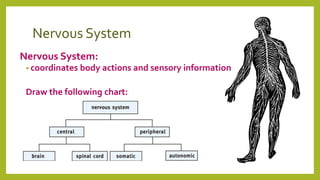
Nervous System:
• coordinates body actions and sensory information
Draw the following chart:
Nervous System
Nervous System
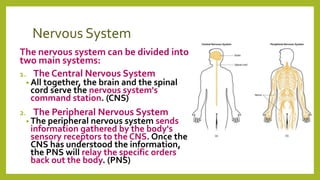
The nervous system can be divided into
two main systems:
1. The Central Nervous System
• All together, the brain and the spinal
cord serve the nervous system's
command station. (CNS)
2. The Peripheral Nervous System
• The peripheral nervous system sends
information gathered by the body's
sensory receptors to the CNS. Once the
CNS has understood the information,
the PNS will relay the specific orders
back out the body. (PNS)
Nervous System
Our peripheral nervous system is divided into two main
subsystems:
1. The Autonomic Nervous System (ANS)
• controls involuntary movement of the body.
• A few examples of things this system controls: the heart,
digestion, respiration, salivation (saliva production),
perspiration (sweating)
• For autonomic think automatic!
Nervous System
2. Somatic System
• controls voluntary movement of the body.This system allows
the mind to make conscious decisions about movement. It
connects the CNS to skeletal muscles.
• It is also responsible for controlling the involuntary movement
of reflexes.
• Somatic means relating to the body and mind.
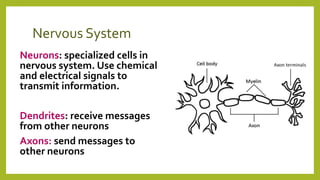
Nervous System
Neurons: specialized cells in
nervous system. Use chemical
and electrical signals to
transmit information.
Dendrites: receive messages
from other neurons
Axons: send messages to
other neurons
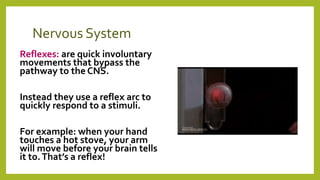
Nervous System
Reflexes: are quick involuntary
movements that bypass the
pathway to the CNS.
Instead they use a reflex arc to
quickly respond to a stimuli.
For example: when your hand
touches a hot stove, your arm
will move before your brain tells
it to.That’s a reflex!
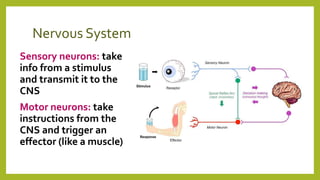
Nervous System
Sensory neurons: take
info from a stimulus
and transmit it to the
CNS
Motor neurons: take
instructions from the
CNS and trigger an
effector (like a muscle)

Nervous system

  • 1.
  • 2.
    Nervous System Nervous System: •coordinates body actions and sensory information Draw the following chart:
  • 3.
  • 4.
    Nervous System The nervoussystem can be divided into two main systems: 1. The Central Nervous System • All together, the brain and the spinal cord serve the nervous system's command station. (CNS) 2. The Peripheral Nervous System • The peripheral nervous system sends information gathered by the body's sensory receptors to the CNS. Once the CNS has understood the information, the PNS will relay the specific orders back out the body. (PNS)
  • 5.
    Nervous System Our peripheralnervous system is divided into two main subsystems: 1. The Autonomic Nervous System (ANS) • controls involuntary movement of the body. • A few examples of things this system controls: the heart, digestion, respiration, salivation (saliva production), perspiration (sweating) • For autonomic think automatic!
  • 6.
    Nervous System 2. SomaticSystem • controls voluntary movement of the body.This system allows the mind to make conscious decisions about movement. It connects the CNS to skeletal muscles. • It is also responsible for controlling the involuntary movement of reflexes. • Somatic means relating to the body and mind.
  • 7.
    Nervous System Neurons: specializedcells in nervous system. Use chemical and electrical signals to transmit information. Dendrites: receive messages from other neurons Axons: send messages to other neurons
  • 8.
    Nervous System Reflexes: arequick involuntary movements that bypass the pathway to the CNS. Instead they use a reflex arc to quickly respond to a stimuli. For example: when your hand touches a hot stove, your arm will move before your brain tells it to.That’s a reflex!
  • 9.
    Nervous System Sensory neurons:take info from a stimulus and transmit it to the CNS Motor neurons: take instructions from the CNS and trigger an effector (like a muscle)