Nervous
System
McDo
Cornetto
Bear Brand
Nido
Nestea
Nervous
System
Objectives
At the end of the 60-minute discussion, the
students should be able to:
- understand the structure and function of
nervous system;
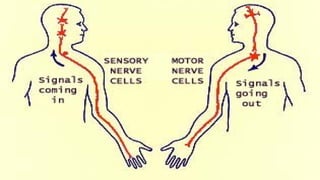
- explain the actions of sensory and motor
neurons in the body and;
- appreciate the value of clarity of
expression.
The nervous system
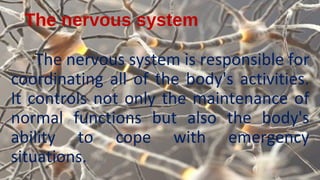
The nervous system is responsible for
coordinating all of the body's activities.
It controls not only the maintenance of
normal functions but also the body's
ability to cope with emergency
situations.
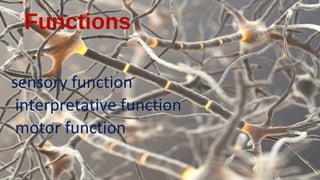
Functions

sensory function

interpretative function

motor function
…the Nervous system can
transmit impulses
as fast as
100 meters per second.
Did you know that…
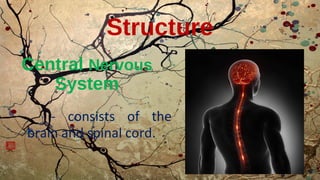
Central Nervous
System
- consists of the
brain and spinal cord.
Structure
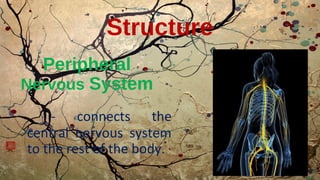
Peripheral
Nervous System
- connects the
central nervous system
to the rest of the body.
Structure
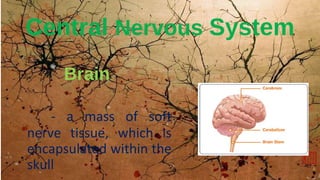
Brain
- a mass of soft
nerve tissue, which is
encapsulated within the
skull
Central Nervous System
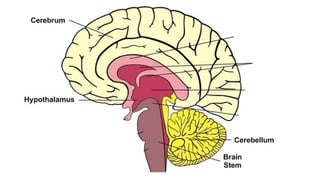
Brain
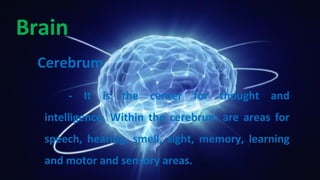
Cerebrum
- It is the center for thought and
intelligence. Within the cerebrum are areas for
speech, hearing, smell, sight, memory, learning
and motor and sensory areas.
Brain
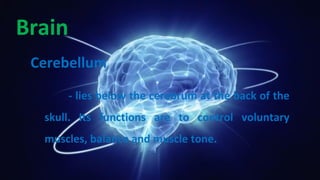
Cerebellum
- lies below the cerebrum at the back of the
skull. Its functions are to control voluntary
muscles, balance and muscle tone.
Brain
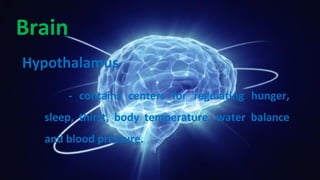
Hypothalamus
- contains centers for regulating hunger,
sleep, thirst, body temperature, water balance
and blood pressure.
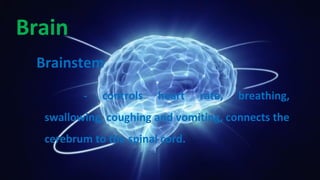
Brain
Brainstem
- controls heart rate, breathing,
swallowing, coughing and vomiting, connects the
cerebrum to the spinal cord.
…as we get older, the brain
loses almost one gram
per year.
Did you know that…
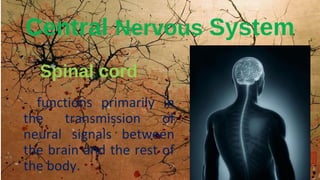
Spinal cord
- functions primarily in
the transmission of
neural signals between
the brain and the rest of
the body.
Central Nervous System
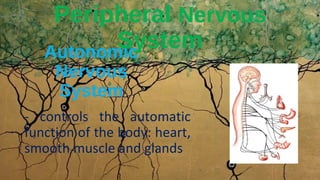
Autonomic
Nervous
System
Peripheral Nervous
System
- controls the automatic
function of the body: heart,
smooth muscle and glands
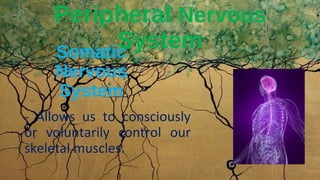
Somatic
Nervous
System
Peripheral Nervous
System
- Allows us to consciously
or voluntarily control our
skeletal muscles.
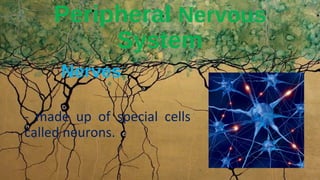
Nerves
Peripheral Nervous
System
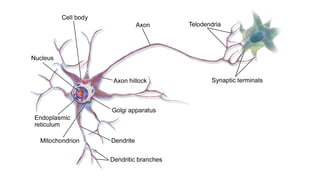
- made up of special cells
called neurons.
How many billion neurons
do we have in our brain?
The class will be divided into two groups. An
illustration of the human body will be distributed among
the groups. Using two different colored markers, the
students will then trace the path of the sensory and
motor neurons. A representative from the group should
be able to explain their work.
Tracing the Neurons
On a one whole sheet of paper, write an essay, of
not more than 200 words, about how could we survive
without our nervous system. Your work will be graded
using this rubric :
Content – 60%
Grammar – 40%
Assignment

Nervous System