
Nervous System
Nervous System
Nervous
System
The Nervous System controls the activities of all the other organ systems of our body.
This system consists of the brain, spinal cord and nerves.
Brain
Nervous
System
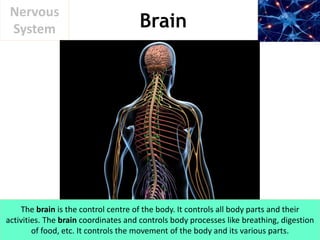
The brain is the control centre of the body. It controls all body parts and their
activities. The brain coordinates and controls body processes like breathing, digestion
of food, etc. It controls the movement of the body and its various parts.
Brain
Nervous
System
The brain interprets sensations and allows the body to react accordingly.
It enables us to think, learn, memorise and apply logic.
Brain
Nervous
System
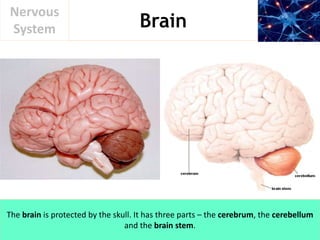
The brain is protected by the skull. It has three parts – the cerebrum, the cerebellum
and the brain stem.
Cerebrum
Nervous
System
The cerebrum is the largest part of the brain. It is responsible for thinking and
reasoning. It controls our thoughts, memory, intelligence, learning and
our sense organs.
Cerebellum
Nervous
System
The cerebellum is situated at the back of the brain, below the cerebrum. It controls
balance, movement and muscle coordination. It is because of cerebellum only that we
can stand upright, move around and maintain our balance.
Brain Stem
Nervous
System
The brain stem, also known as the medulla, lies beneath the cerebellum. It connects the
rest of the brain to the spinal cord. It controls the vital activities like breathing, digestion
and blood circulation. All information to and from our body passes through the medulla on
the way to and from the brain.
Spinal Cord
Nervous
System
The spinal cord is a long, thick bundle of nerves that extends from the medulla. It is
surrounded and protected by the bony vertebral column. However, the length of the spinal
cord is much shorter than the length of the vertebral column. It transfers information
between the brain and the rest of our body through nerves.
Nerves
Nervous
System
Nerves form a network of pathways for conducting information throughout the body.
They transfer messages to and from the brain so that it can function efficiently. There
are three kinds of nerves – sensory, motor and mixed.
Sensory & Motor
Nerves
Nervous
System
Sensory nerves bring messages from the sense organs to the brain. Motor nerves
carry messages from the brain to other parts of the body.
Mixed Nerves
Nervous
System
Mixed nerves carry messages to and from the brain.
Actions of the body
Nervous
System
In daily life, our body performs many different actions. These can be categorised as –
voluntary actions and involuntary actions.
Voluntary Action
Nervous
System
A voluntary action is any action that we do out of our will or we do it consciously. For
example, we drink water when we feel thirsty.
Involuntary Action
Nervous
System
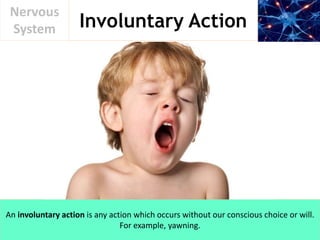
An involuntary action is any action which occurs without our conscious choice or will.
For example, yawning.
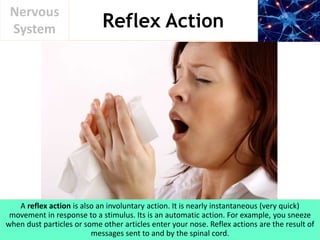
Reflex Action
Nervous
System
A reflex action is also an involuntary action. It is nearly instantaneous (very quick)
movement in response to a stimulus. Its is an automatic action. For example, you sneeze
when dust particles or some other articles enter your nose. Reflex actions are the result of
messages sent to and by the spinal cord.
This presentation is a result of my experiences while I was
helping out my son with his school assignments and project
work. I am happy to share this with other students and their
parents. Hope you find this informative and useful. Thank you.
- Prashant Mahajan -
All pictures belong to their original authors, photographers.

Nervous System

  • 1.
  • 2.
    Nervous System Nervous System The NervousSystem controls the activities of all the other organ systems of our body. This system consists of the brain, spinal cord and nerves.
  • 3.
    Brain Nervous System The brain isthe control centre of the body. It controls all body parts and their activities. The brain coordinates and controls body processes like breathing, digestion of food, etc. It controls the movement of the body and its various parts.
  • 4.
    Brain Nervous System The brain interpretssensations and allows the body to react accordingly. It enables us to think, learn, memorise and apply logic.
  • 5.
    Brain Nervous System The brain isprotected by the skull. It has three parts – the cerebrum, the cerebellum and the brain stem.
  • 6.
    Cerebrum Nervous System The cerebrum isthe largest part of the brain. It is responsible for thinking and reasoning. It controls our thoughts, memory, intelligence, learning and our sense organs.
  • 7.
    Cerebellum Nervous System The cerebellum issituated at the back of the brain, below the cerebrum. It controls balance, movement and muscle coordination. It is because of cerebellum only that we can stand upright, move around and maintain our balance.
  • 8.
    Brain Stem Nervous System The brainstem, also known as the medulla, lies beneath the cerebellum. It connects the rest of the brain to the spinal cord. It controls the vital activities like breathing, digestion and blood circulation. All information to and from our body passes through the medulla on the way to and from the brain.
  • 9.
    Spinal Cord Nervous System The spinalcord is a long, thick bundle of nerves that extends from the medulla. It is surrounded and protected by the bony vertebral column. However, the length of the spinal cord is much shorter than the length of the vertebral column. It transfers information between the brain and the rest of our body through nerves.
  • 10.
    Nerves Nervous System Nerves form anetwork of pathways for conducting information throughout the body. They transfer messages to and from the brain so that it can function efficiently. There are three kinds of nerves – sensory, motor and mixed.
  • 11.
    Sensory & Motor Nerves Nervous System Sensorynerves bring messages from the sense organs to the brain. Motor nerves carry messages from the brain to other parts of the body.
  • 12.
    Mixed Nerves Nervous System Mixed nervescarry messages to and from the brain.
  • 13.
    Actions of thebody Nervous System In daily life, our body performs many different actions. These can be categorised as – voluntary actions and involuntary actions.
  • 14.
    Voluntary Action Nervous System A voluntaryaction is any action that we do out of our will or we do it consciously. For example, we drink water when we feel thirsty.
  • 15.
    Involuntary Action Nervous System An involuntaryaction is any action which occurs without our conscious choice or will. For example, yawning.
  • 16.
    Reflex Action Nervous System A reflexaction is also an involuntary action. It is nearly instantaneous (very quick) movement in response to a stimulus. Its is an automatic action. For example, you sneeze when dust particles or some other articles enter your nose. Reflex actions are the result of messages sent to and by the spinal cord.
  • 17.
    This presentation isa result of my experiences while I was helping out my son with his school assignments and project work. I am happy to share this with other students and their parents. Hope you find this informative and useful. Thank you. - Prashant Mahajan - All pictures belong to their original authors, photographers.