29.4 Central and Peripheral Nervous Systems
Sponge 5
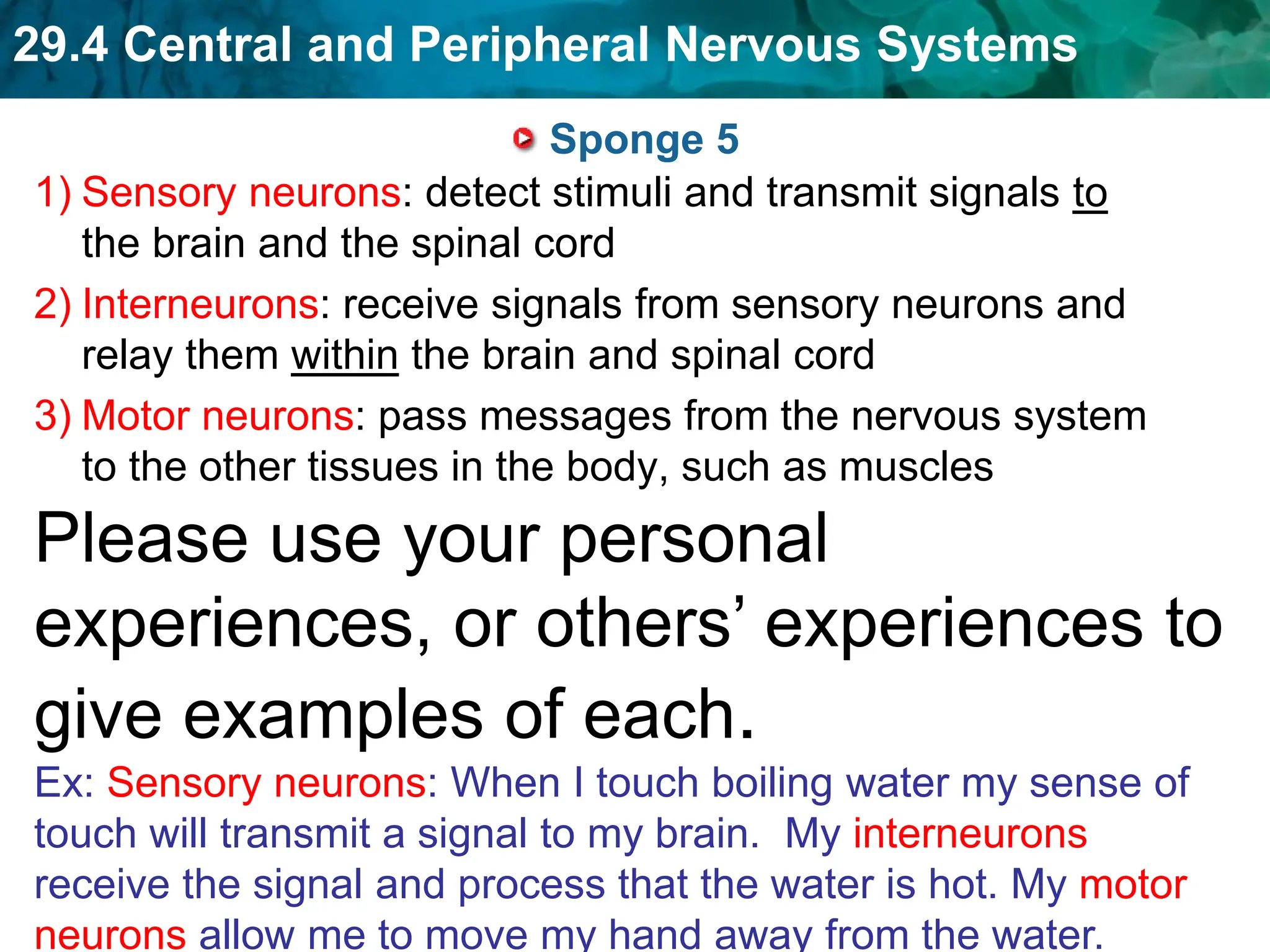
1) Sensory neurons: detect stimuli and transmit signals to
the brain and the spinal cord
2) Interneurons: receive signals from sensory neurons and
relay them within the brain and spinal cord
3) Motor neurons: pass messages from the nervous system
to the other tissues in the body, such as muscles
Please use your personal
experiences, or others’ experiences to
give examples of each.
Ex: Sensory neurons: When I touch boiling water my sense of
touch will transmit a signal to my brain. My interneurons
receive the signal and process that the water is hot. My motor
neurons allow me to move my hand away from the water.
29.4 Central and Peripheral Nervous Systems
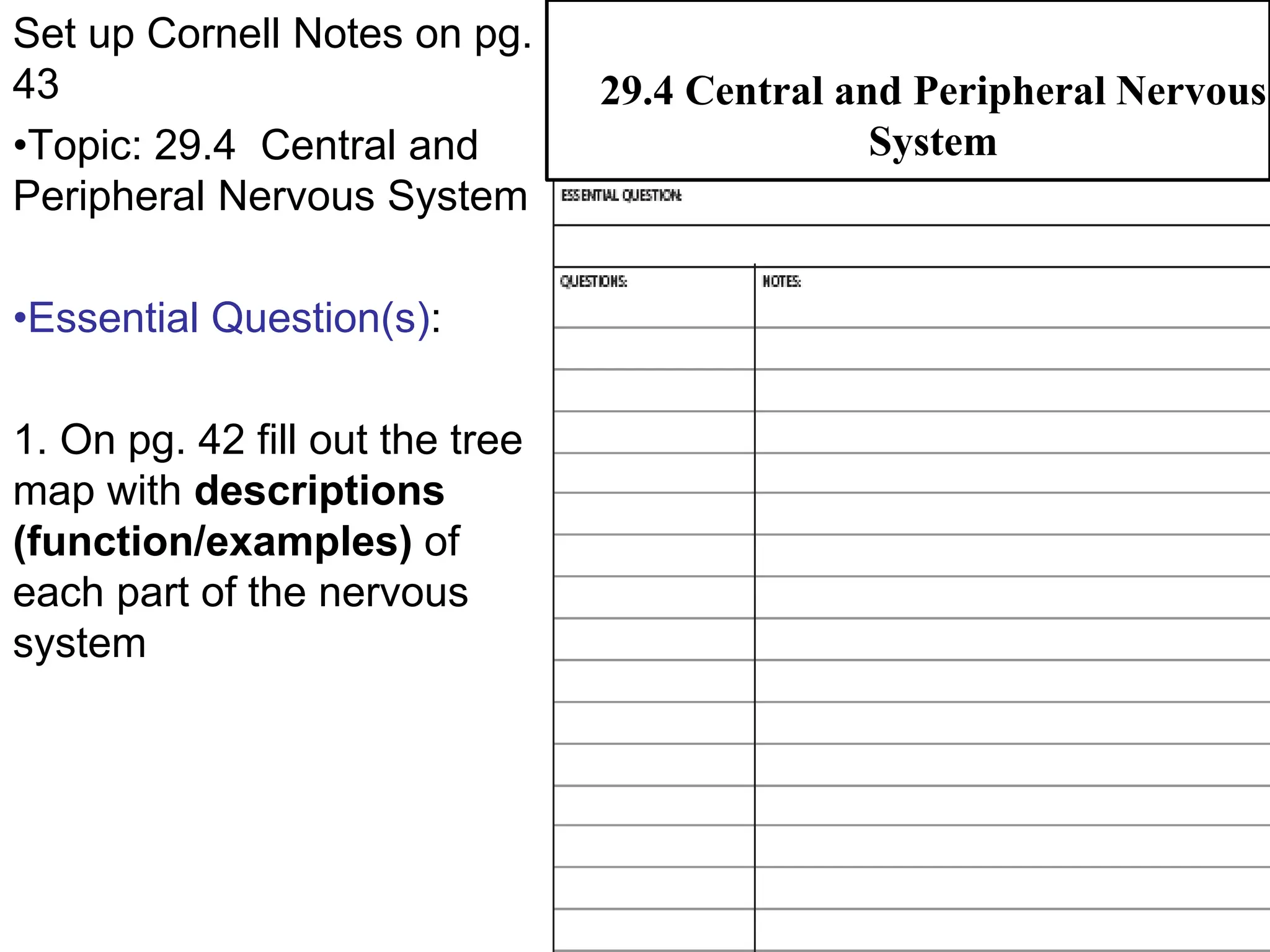
Set up Cornell Notes on pg.
43
•Topic: 29.4 Central and
Peripheral Nervous System
•Essential Question(s):
1. On pg. 42 fill out the tree
map with descriptions
(function/examples) of
each part of the nervous
system
2.1 Atoms, Ions,
and Molecules
29.4 Central and Peripheral Nervous
System
29.4 Central and Peripheral Nervous Systems
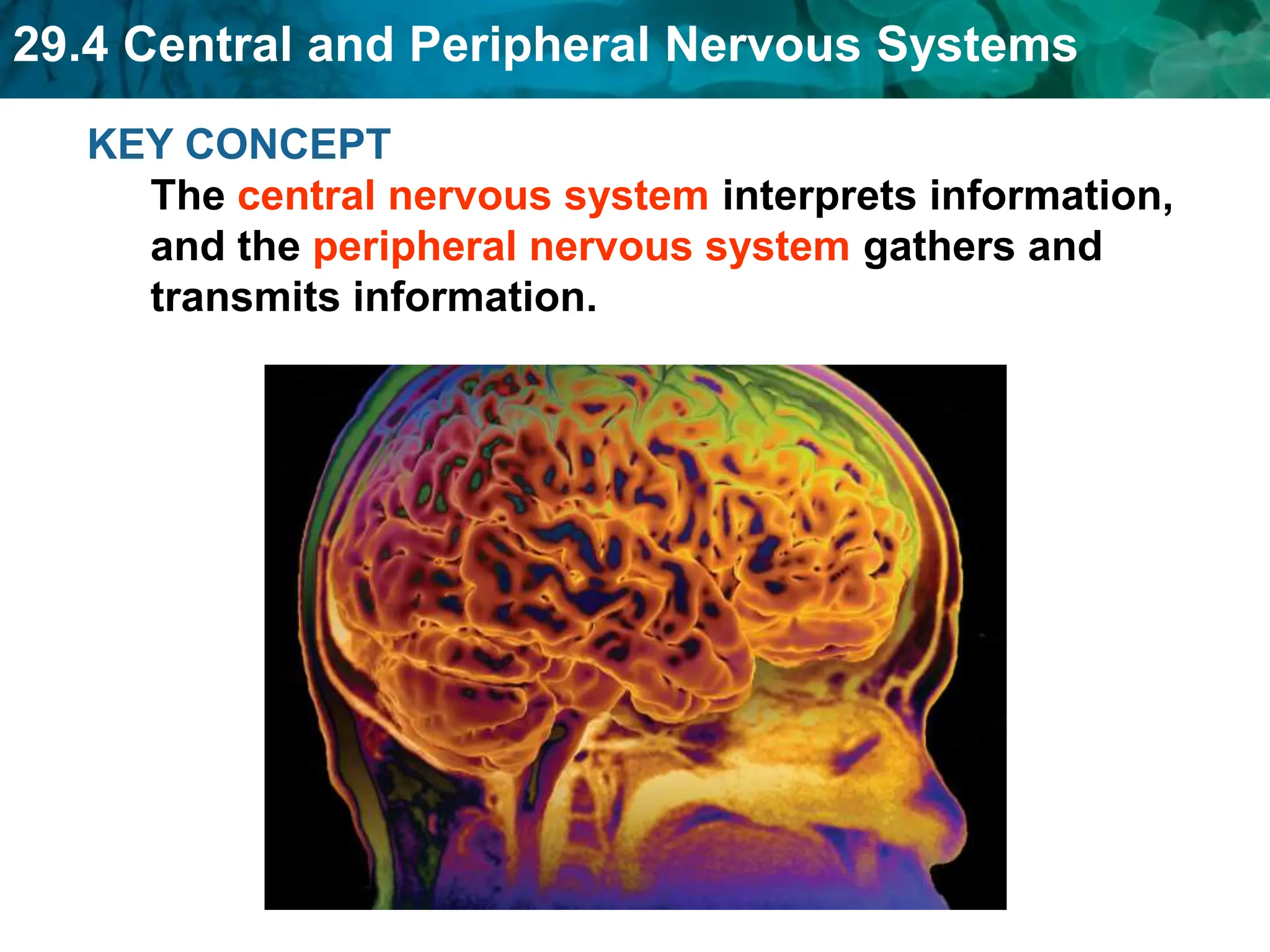
KEY CONCEPT
The central nervous system interprets information,
and the peripheral nervous system gathers and
transmits information.
29.4 Central and Peripheral Nervous Systems
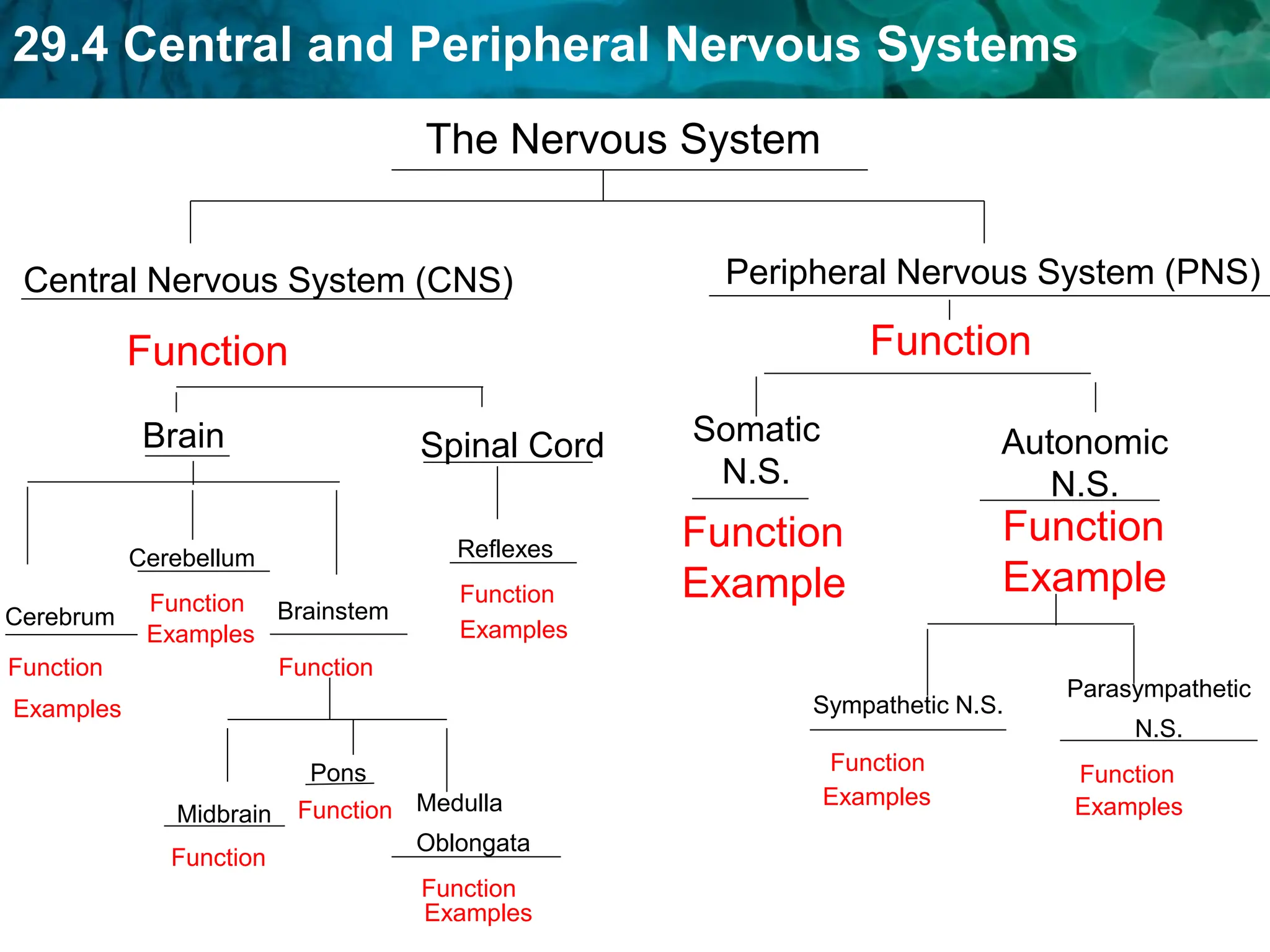
The Nervous System
Central Nervous System (CNS) Peripheral Nervous System (PNS)
Brain Spinal Cord Somatic
N.S.
Autonomic
N.S.
Cerebrum
Cerebellum
Brainstem
Sympathetic N.S.
Parasympathetic
N.S.
Reflexes
Function
Function
Function
Function
Function Function
Function
Example
Function
Example
Function
Function
Midbrain
Pons
Medulla
Oblongata
Function
Function
Function
Examples
Examples
Examples
Examples
Examples Examples
29.4 Central and Peripheral Nervous Systems
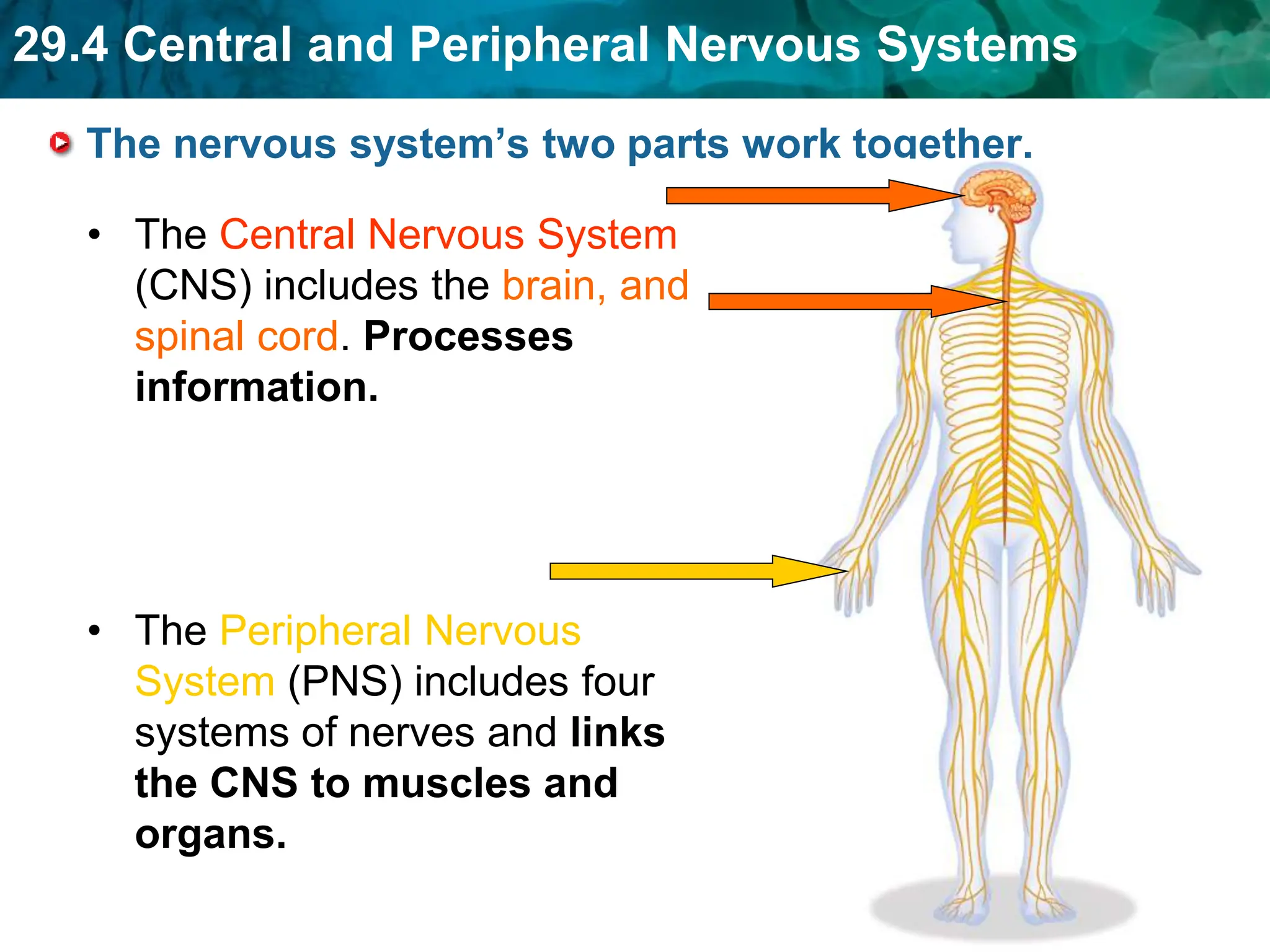
The nervous system’s two parts work together.
• The Central Nervous System
(CNS) includes the brain, and
spinal cord. Processes
information.
• The Peripheral Nervous
System (PNS) includes four
systems of nerves and links
the CNS to muscles and
organs.
29.4 Central and Peripheral Nervous Systems
If you have a question, you will raise
your hand to ask it. How do your CNS
and PNS work together to allow you to
raise your hand?
Your CNS passes a signal to a motor neuron in your PNS
causing you to raise your hand.
29.4 Central and Peripheral Nervous Systems
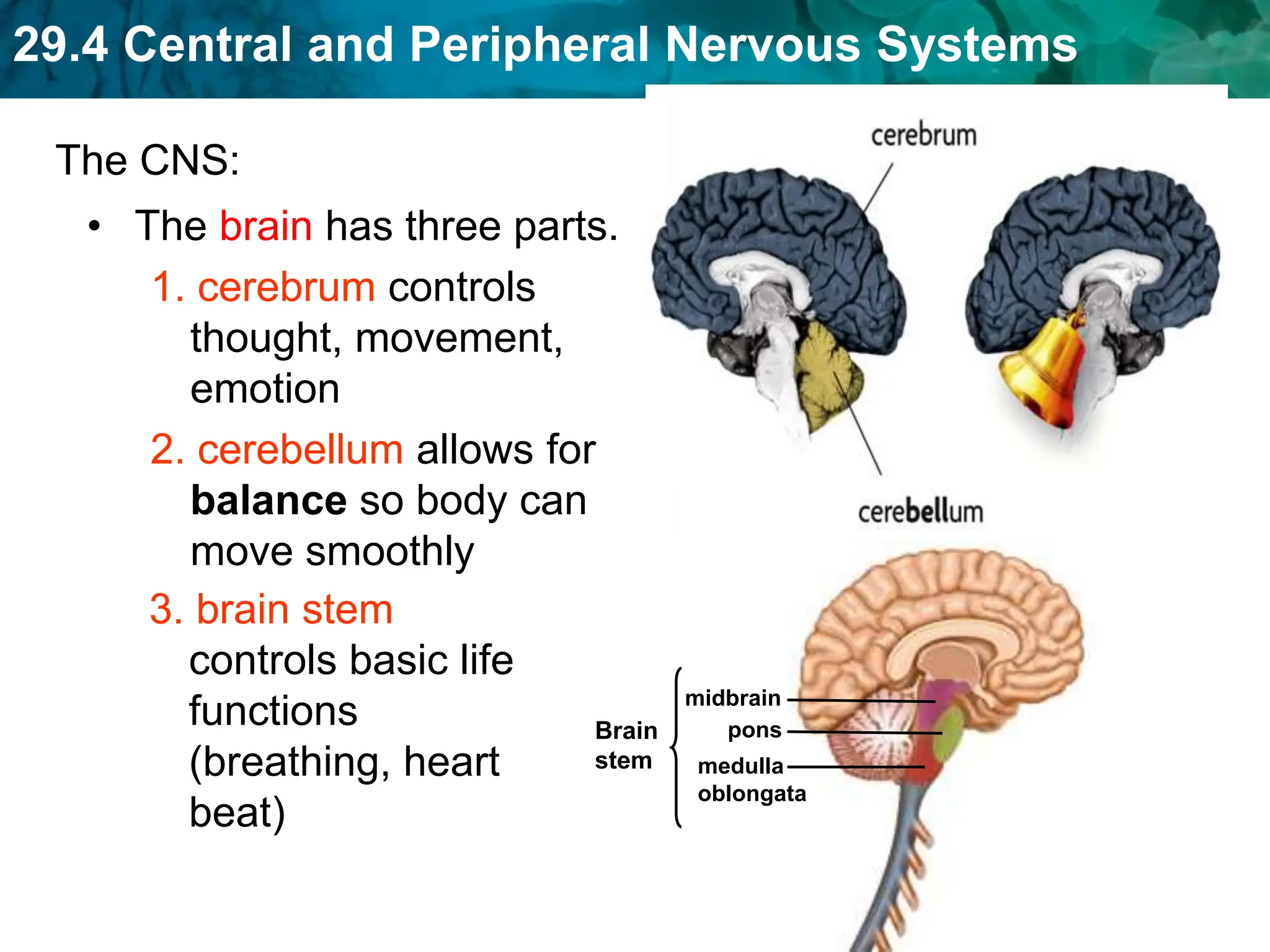
• The brain has three parts.
1. cerebrum controls
thought, movement,
emotion
2. cerebellum allows for
balance so body can
move smoothly
midbrain
pons
medulla
oblongata
3. brain stem
controls basic life
functions
(breathing, heart
beat)
Brain
stem
The CNS:
29.4 Central and Peripheral Nervous Systems
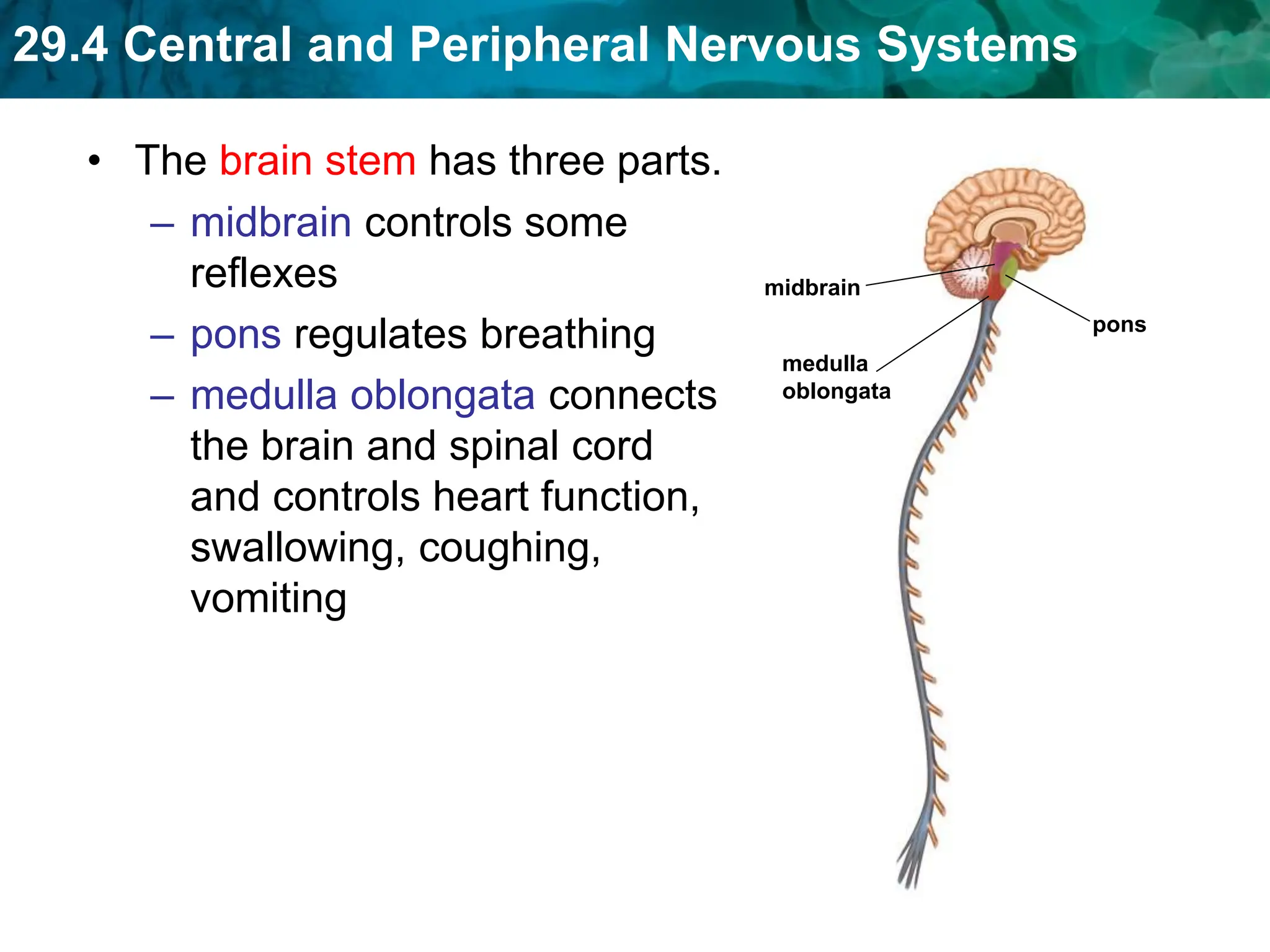
• The brain stem has three parts.
– midbrain controls some
reflexes
– pons regulates breathing
– medulla oblongata connects
the brain and spinal cord
and controls heart function,
swallowing, coughing,
vomiting
midbrain
medulla
oblongata
pons
29.4 Central and Peripheral Nervous Systems
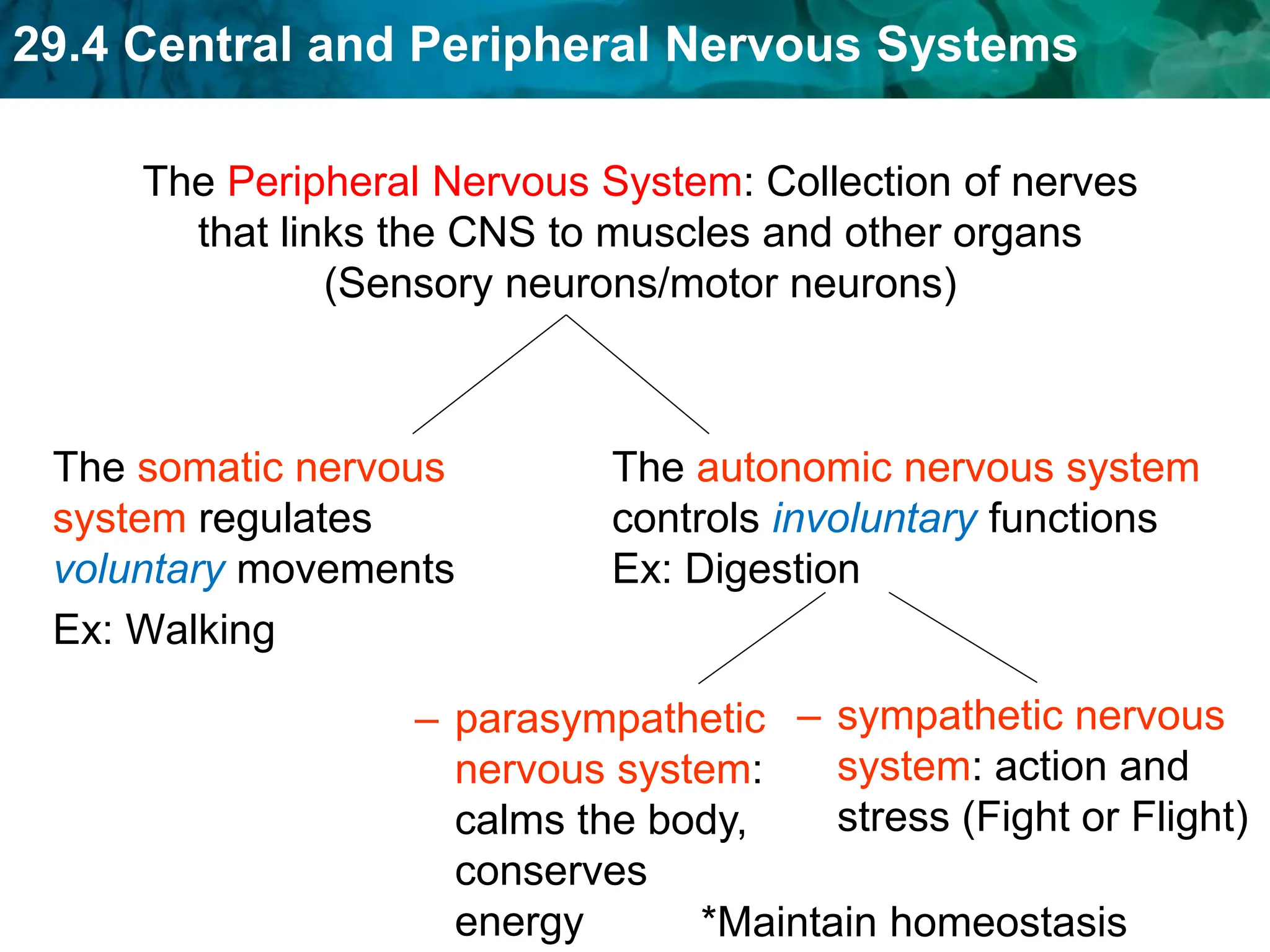
The somatic nervous
system regulates
voluntary movements
Ex: Walking
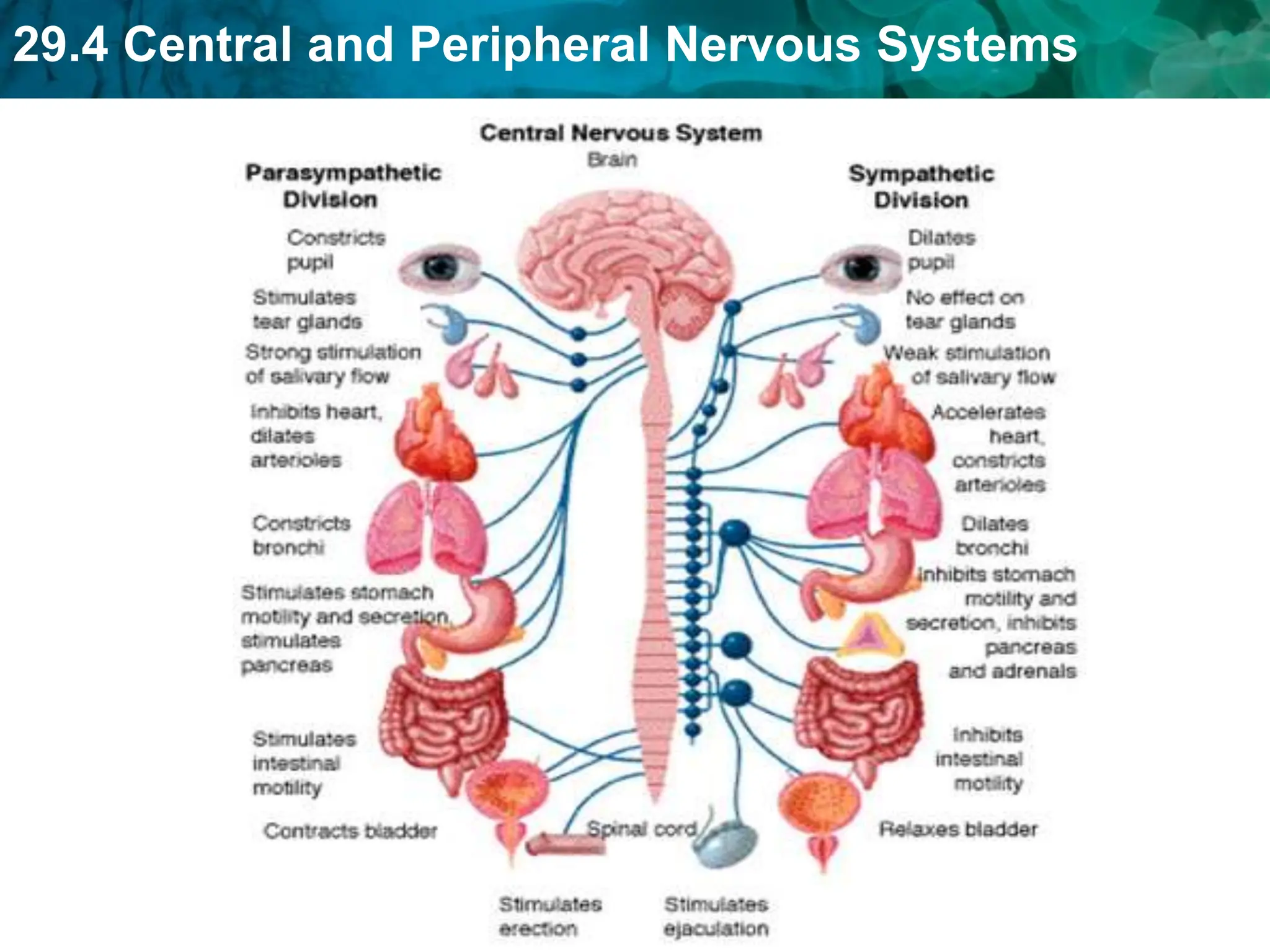
– sympathetic nervous
system: action and
stress (Fight or Flight)
– parasympathetic
nervous system:
calms the body,
conserves
energy
The autonomic nervous system
controls involuntary functions
Ex: Digestion
The Peripheral Nervous System: Collection of nerves
that links the CNS to muscles and other organs
(Sensory neurons/motor neurons)
*Maintain homeostasis
29.4 Central and Peripheral Nervous Systems
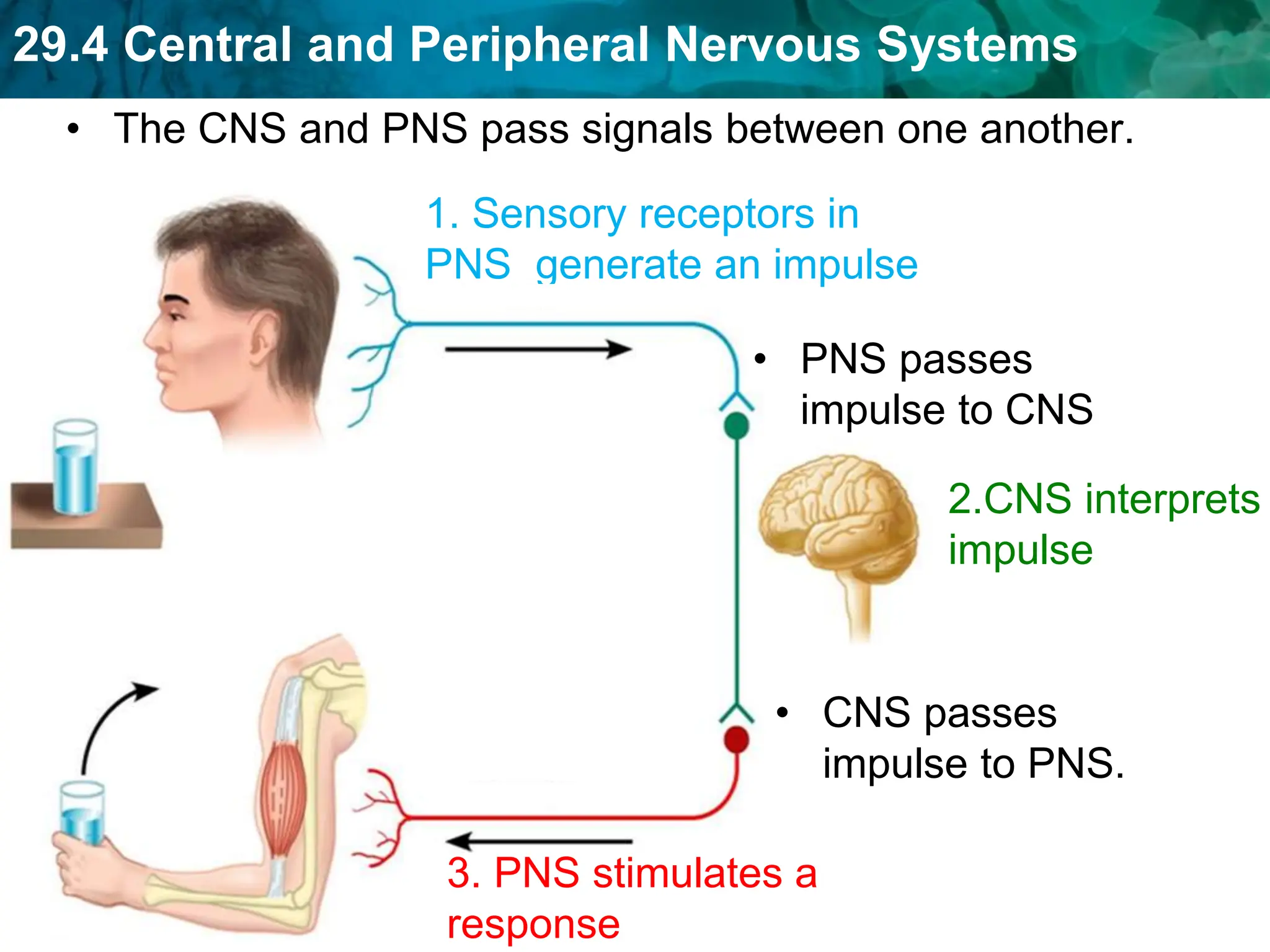
• The CNS and PNS pass signals between one another.
1. Sensory receptors in
PNS generate an impulse
• PNS passes
impulse to CNS
3. PNS stimulates a
response
2.CNS interprets
impulse
• CNS passes
impulse to PNS.
29.4 Central and Peripheral Nervous Systems
12
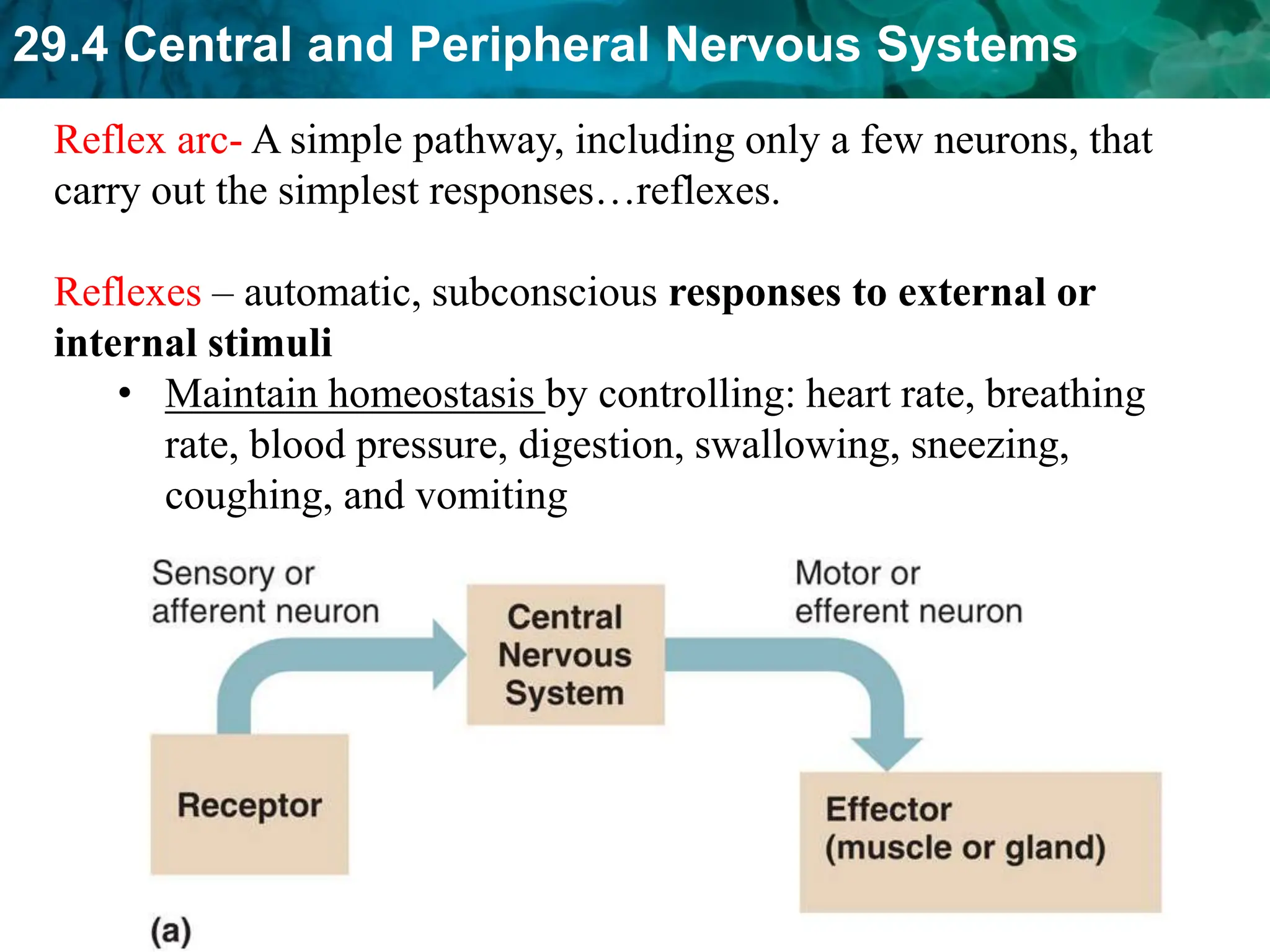
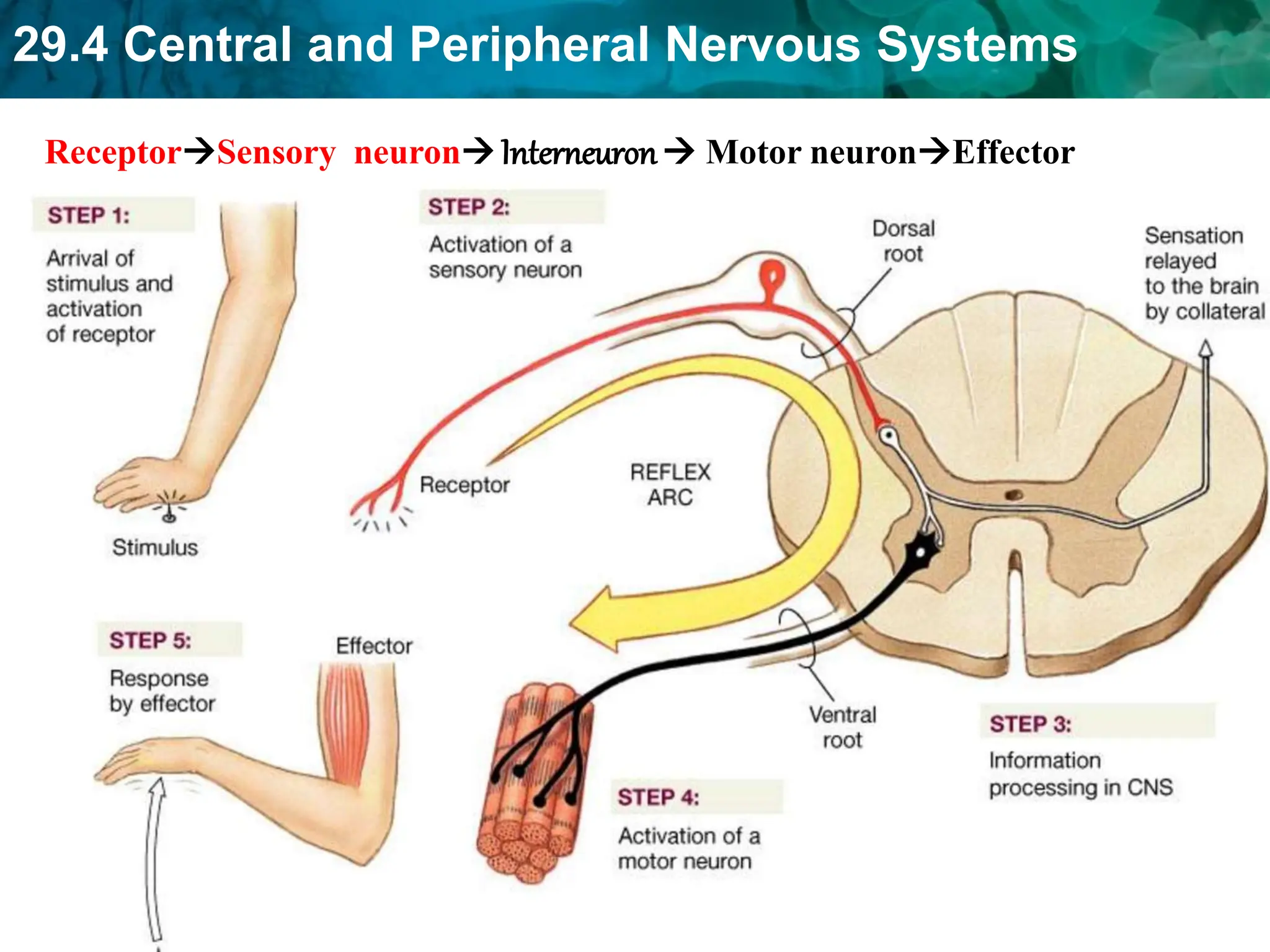
Reflex arc- A simple pathway, including only a few neurons, that
carry out the simplest responses…reflexes.
Reflexes – automatic, subconscious responses to external or
internal stimuli
• Maintain homeostasis by controlling: heart rate, breathing
rate, blood pressure, digestion, swallowing, sneezing,
coughing, and vomiting
29.4 Central and Peripheral Nervous Systems
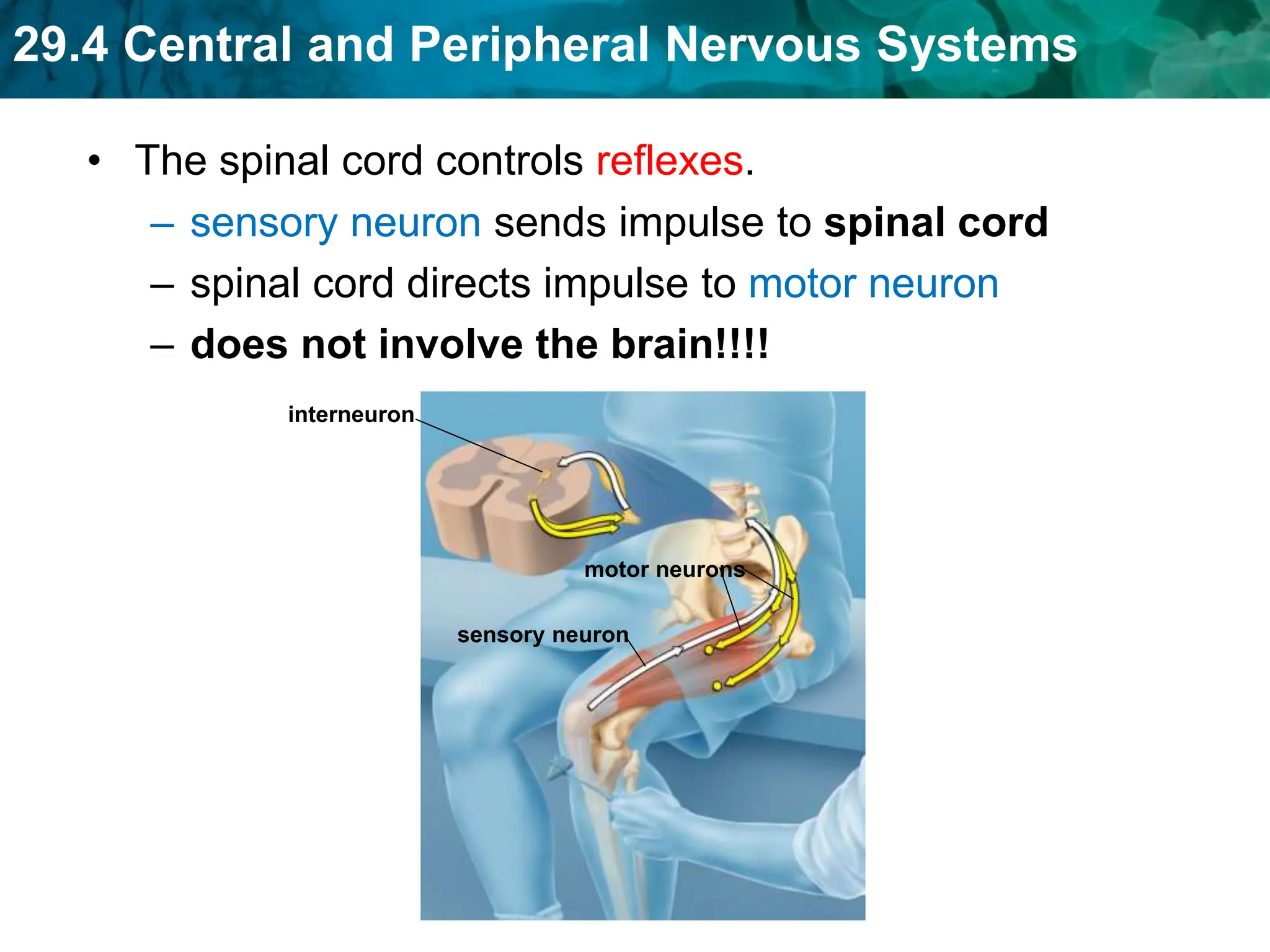
• The spinal cord controls reflexes.
– sensory neuron sends impulse to spinal cord
– spinal cord directs impulse to motor neuron
– does not involve the brain!!!!
interneuron
motor neurons
sensory neuron
29.4 Central and Peripheral Nervous Systems
14
1
2
3
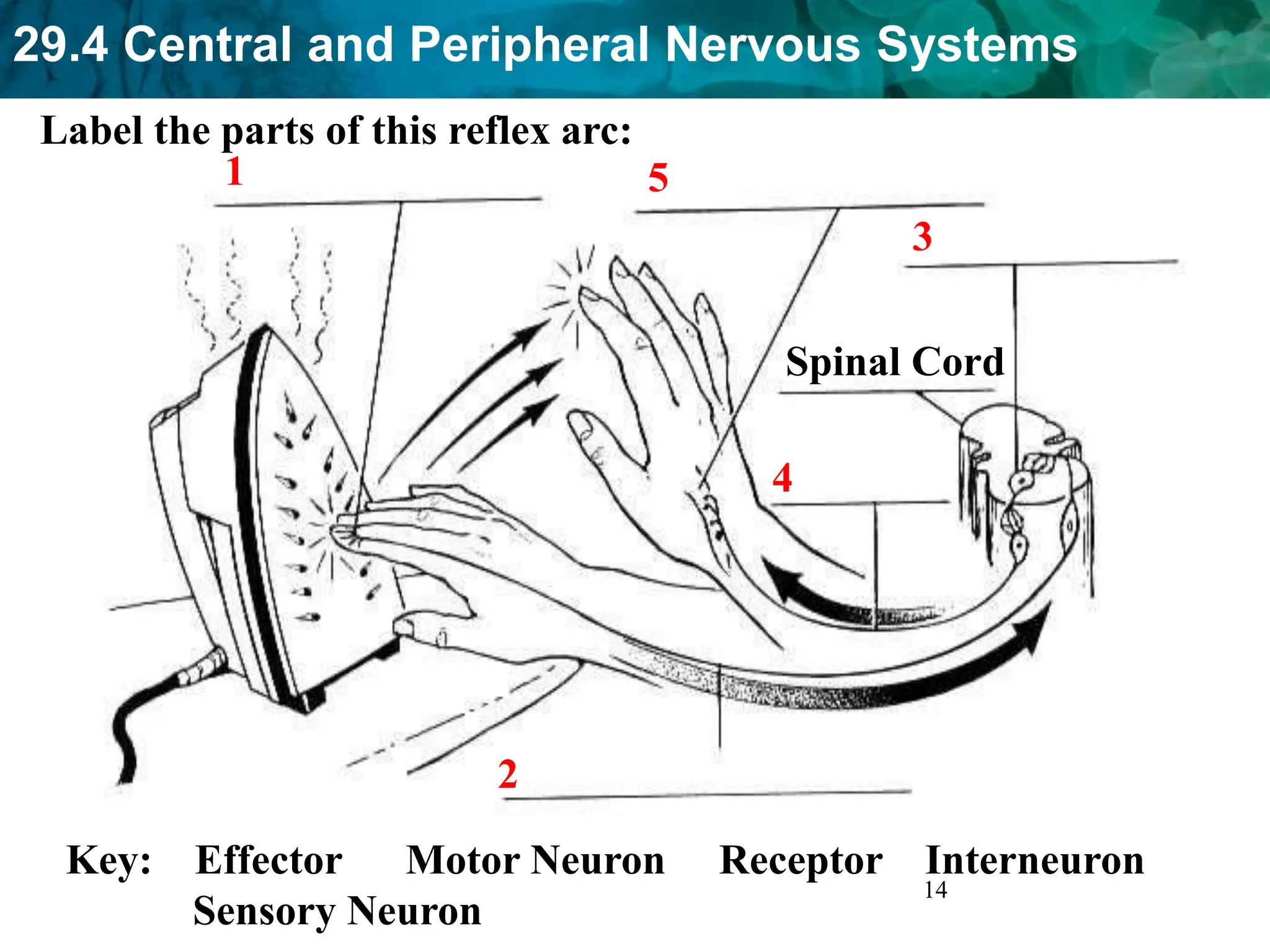
Spinal Cord
4
5
Label the parts of this reflex arc:
Key: Effector Motor Neuron Receptor Interneuron
Sensory Neuron
29.4 Central and Peripheral Nervous Systems
15
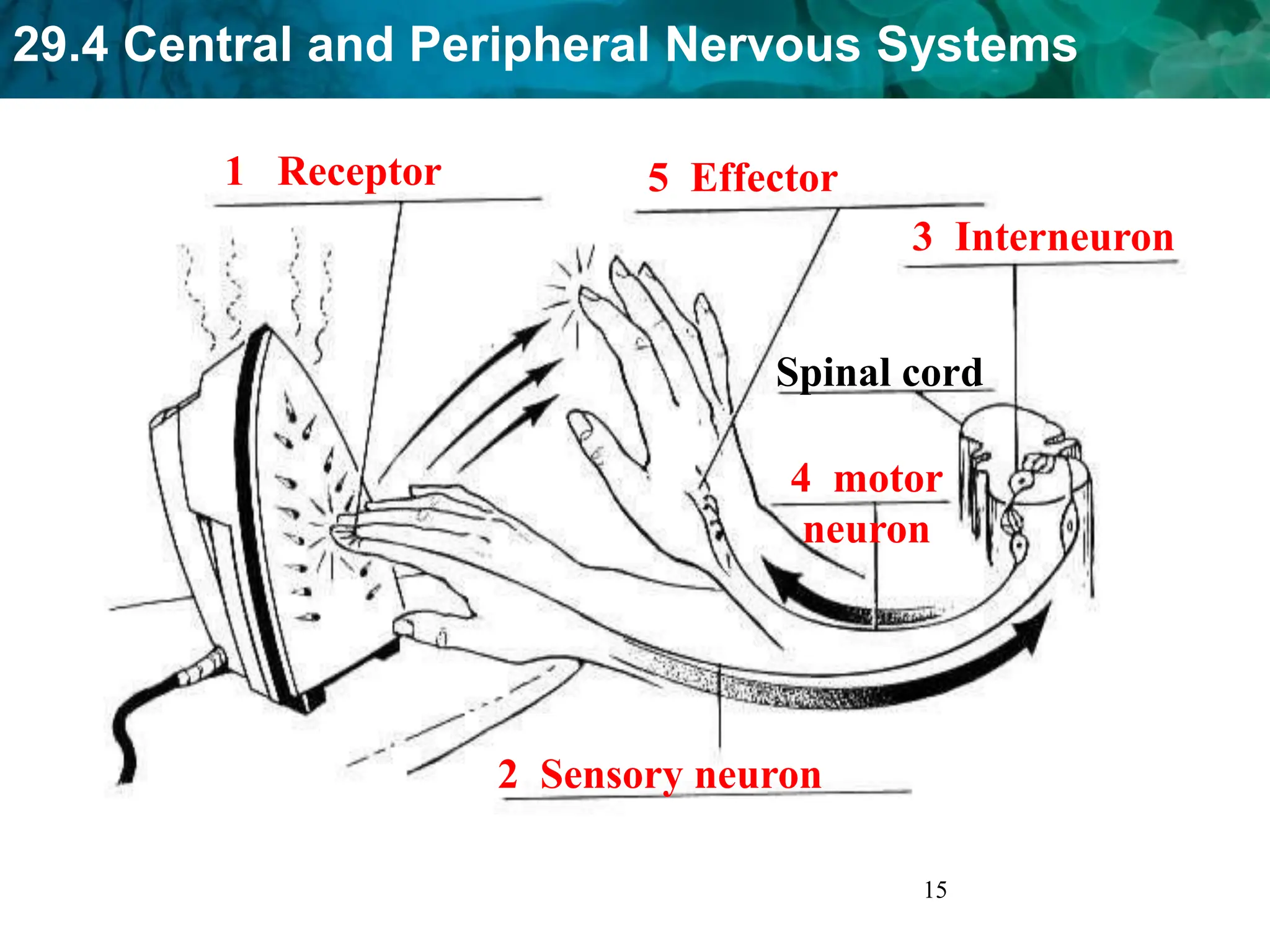
1 Receptor
2 Sensory neuron
3 Interneuron
4 motor
neuron
5 Effector
Spinal cord
29.4 Central and Peripheral Nervous Systems
16
ReceptorSensory neuron Interneuron Motor neuronEffector

NERVOUS SYSTEM - The central nervous system and the peripheral nervous system

  • 1.
    29.4 Central andPeripheral Nervous Systems Sponge 5 1) Sensory neurons: detect stimuli and transmit signals to the brain and the spinal cord 2) Interneurons: receive signals from sensory neurons and relay them within the brain and spinal cord 3) Motor neurons: pass messages from the nervous system to the other tissues in the body, such as muscles Please use your personal experiences, or others’ experiences to give examples of each. Ex: Sensory neurons: When I touch boiling water my sense of touch will transmit a signal to my brain. My interneurons receive the signal and process that the water is hot. My motor neurons allow me to move my hand away from the water.
  • 2.
    29.4 Central andPeripheral Nervous Systems Set up Cornell Notes on pg. 43 •Topic: 29.4 Central and Peripheral Nervous System •Essential Question(s): 1. On pg. 42 fill out the tree map with descriptions (function/examples) of each part of the nervous system 2.1 Atoms, Ions, and Molecules 29.4 Central and Peripheral Nervous System
  • 3.
    29.4 Central andPeripheral Nervous Systems KEY CONCEPT The central nervous system interprets information, and the peripheral nervous system gathers and transmits information.
  • 4.
    29.4 Central andPeripheral Nervous Systems The Nervous System Central Nervous System (CNS) Peripheral Nervous System (PNS) Brain Spinal Cord Somatic N.S. Autonomic N.S. Cerebrum Cerebellum Brainstem Sympathetic N.S. Parasympathetic N.S. Reflexes Function Function Function Function Function Function Function Example Function Example Function Function Midbrain Pons Medulla Oblongata Function Function Function Examples Examples Examples Examples Examples Examples
  • 5.
    29.4 Central andPeripheral Nervous Systems The nervous system’s two parts work together. • The Central Nervous System (CNS) includes the brain, and spinal cord. Processes information. • The Peripheral Nervous System (PNS) includes four systems of nerves and links the CNS to muscles and organs.
  • 6.
    29.4 Central andPeripheral Nervous Systems If you have a question, you will raise your hand to ask it. How do your CNS and PNS work together to allow you to raise your hand? Your CNS passes a signal to a motor neuron in your PNS causing you to raise your hand.
  • 7.
    29.4 Central andPeripheral Nervous Systems • The brain has three parts. 1. cerebrum controls thought, movement, emotion 2. cerebellum allows for balance so body can move smoothly midbrain pons medulla oblongata 3. brain stem controls basic life functions (breathing, heart beat) Brain stem The CNS:
  • 8.
    29.4 Central andPeripheral Nervous Systems • The brain stem has three parts. – midbrain controls some reflexes – pons regulates breathing – medulla oblongata connects the brain and spinal cord and controls heart function, swallowing, coughing, vomiting midbrain medulla oblongata pons
  • 9.
    29.4 Central andPeripheral Nervous Systems The somatic nervous system regulates voluntary movements Ex: Walking – sympathetic nervous system: action and stress (Fight or Flight) – parasympathetic nervous system: calms the body, conserves energy The autonomic nervous system controls involuntary functions Ex: Digestion The Peripheral Nervous System: Collection of nerves that links the CNS to muscles and other organs (Sensory neurons/motor neurons) *Maintain homeostasis
  • 10.
    29.4 Central andPeripheral Nervous Systems
  • 11.
    29.4 Central andPeripheral Nervous Systems • The CNS and PNS pass signals between one another. 1. Sensory receptors in PNS generate an impulse • PNS passes impulse to CNS 3. PNS stimulates a response 2.CNS interprets impulse • CNS passes impulse to PNS.
  • 12.
    29.4 Central andPeripheral Nervous Systems 12 Reflex arc- A simple pathway, including only a few neurons, that carry out the simplest responses…reflexes. Reflexes – automatic, subconscious responses to external or internal stimuli • Maintain homeostasis by controlling: heart rate, breathing rate, blood pressure, digestion, swallowing, sneezing, coughing, and vomiting
  • 13.
    29.4 Central andPeripheral Nervous Systems • The spinal cord controls reflexes. – sensory neuron sends impulse to spinal cord – spinal cord directs impulse to motor neuron – does not involve the brain!!!! interneuron motor neurons sensory neuron
  • 14.
    29.4 Central andPeripheral Nervous Systems 14 1 2 3 Spinal Cord 4 5 Label the parts of this reflex arc: Key: Effector Motor Neuron Receptor Interneuron Sensory Neuron
  • 15.
    29.4 Central andPeripheral Nervous Systems 15 1 Receptor 2 Sensory neuron 3 Interneuron 4 motor neuron 5 Effector Spinal cord
  • 16.
    29.4 Central andPeripheral Nervous Systems 16 ReceptorSensory neuron Interneuron Motor neuronEffector