Transporting
Chemicals
Transporting Chemicals
1. Transport in Air
◦ 3 stages: release, dispersion,
deposition. Release of the chemical at
the source, dispersion or scattering of
the chemical in the atmosphere,
deposition of chemical in soil or water.
◦ direction and distance determined by
pollutants' properties, wind speed,
direction of the prevailing
winds, precipitation.
Transporting Chemicals
2. Transport in Groundwater
◦ Ground water: zone where all spaces are filled with water
◦ groundwater can move sideways and up/down.
◦ moves 1 m/year - 1 m/day.
◦ Moves slow so does not spread out and may become concentrated
over time.
◦ number and connection of pores in the soil affects how fast water moves
◦ permeable soil: is one with interconnected pores or spaces.
◦ Pollutants will be transported farther by groundwater that flows through
permeable soil.
Transporting Chemicals
3. Transport in Surface Water
◦ chemicals enter water from air, groundwater, runoff from agricultural
fields and industrial sites and outflow from storm sewers and sewage
treatment plants.
◦ substance that dissolve easily in water may be carried a long way and
dispersed.
◦ substance that does not easily dissolve, attaches to solids and do not
travel as far. - they sink and become concentrated closer to source - builds
up at the bottom of the lake/river.
Transporting Chemicals
4. Transport in the Soil
◦ leachate - liquid that dissolves and carries substances as it passes through
soil.
◦ composition of soil can affect the rate at which a liquid moves through it.
◦ packed clay - impermeable - fluids cannot move through it because soil
grains are packed too closely.
◦ organic material can slow the movement of chemicals. Hazardous
materials can be changed by chemical reactions that occur in the soil.
◦ Hydrocarbon - spread over wide area, does not dissolve, coats soil grains
and fills pores.
Transporting Chemicals
Dispersion: scatterings of a substance
away from its sources.
ie: scattering fertilizer.
Dilution: reducing concentration of a
pollutant by mixing the polluting
substance with large quantities of air
or water.
ie: drop of bleach into a tub of water.
Transporting Chemicals
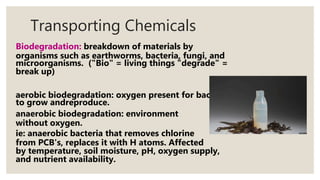
Biodegradation: breakdown of materials by
organisms such as earthworms, bacteria, fungi, and
microorganisms. ("Bio" = living things "degrade" =
break up)
aerobic biodegradation: oxygen present for bacteria
to grow andreproduce.
anaerobic biodegradation: environment
without oxygen.
ie: anaerobic bacteria that removes chlorine
from PCB's, replaces it with H atoms. Affected
by temperature, soil moisture, pH, oxygen supply,
and nutrient availability.
Transporting Chemicals
Phytoremediation: technique that can be
used to reduce the concentration of
harmful chemicals in soil
or groundwater, using plants. ("phyto" =
plant "remediation" = clean up)
plants have been used to clean up
metals, hydrocarbons, solvents,
pesticides, radioactive materials,
explosives, and landfill leachates.
Transporting Chemicals
Photolysis: breakdown (lysis) of
compounds by the sunlight (photo).
ie: formation of ozone. Nitrogen dioxide in
the presence of light breaks down to form
nitrogen monoxide and oxygen atoms.
Oxygen atoms then combine with
oxygen to form ozone.

Transporting chemicals

  • 1.
  • 2.
    Transporting Chemicals 1. Transportin Air ◦ 3 stages: release, dispersion, deposition. Release of the chemical at the source, dispersion or scattering of the chemical in the atmosphere, deposition of chemical in soil or water. ◦ direction and distance determined by pollutants' properties, wind speed, direction of the prevailing winds, precipitation.
  • 3.
    Transporting Chemicals 2. Transportin Groundwater ◦ Ground water: zone where all spaces are filled with water ◦ groundwater can move sideways and up/down. ◦ moves 1 m/year - 1 m/day. ◦ Moves slow so does not spread out and may become concentrated over time. ◦ number and connection of pores in the soil affects how fast water moves ◦ permeable soil: is one with interconnected pores or spaces. ◦ Pollutants will be transported farther by groundwater that flows through permeable soil.
  • 4.
  • 5.
  • 6.
    Transporting Chemicals 3. Transportin Surface Water ◦ chemicals enter water from air, groundwater, runoff from agricultural fields and industrial sites and outflow from storm sewers and sewage treatment plants. ◦ substance that dissolve easily in water may be carried a long way and dispersed. ◦ substance that does not easily dissolve, attaches to solids and do not travel as far. - they sink and become concentrated closer to source - builds up at the bottom of the lake/river.
  • 7.
    Transporting Chemicals 4. Transportin the Soil ◦ leachate - liquid that dissolves and carries substances as it passes through soil. ◦ composition of soil can affect the rate at which a liquid moves through it. ◦ packed clay - impermeable - fluids cannot move through it because soil grains are packed too closely. ◦ organic material can slow the movement of chemicals. Hazardous materials can be changed by chemical reactions that occur in the soil. ◦ Hydrocarbon - spread over wide area, does not dissolve, coats soil grains and fills pores.
  • 8.
    Transporting Chemicals Dispersion: scatteringsof a substance away from its sources. ie: scattering fertilizer. Dilution: reducing concentration of a pollutant by mixing the polluting substance with large quantities of air or water. ie: drop of bleach into a tub of water.
  • 9.
    Transporting Chemicals Biodegradation: breakdownof materials by organisms such as earthworms, bacteria, fungi, and microorganisms. ("Bio" = living things "degrade" = break up) aerobic biodegradation: oxygen present for bacteria to grow andreproduce. anaerobic biodegradation: environment without oxygen. ie: anaerobic bacteria that removes chlorine from PCB's, replaces it with H atoms. Affected by temperature, soil moisture, pH, oxygen supply, and nutrient availability.
  • 10.
    Transporting Chemicals Phytoremediation: techniquethat can be used to reduce the concentration of harmful chemicals in soil or groundwater, using plants. ("phyto" = plant "remediation" = clean up) plants have been used to clean up metals, hydrocarbons, solvents, pesticides, radioactive materials, explosives, and landfill leachates.
  • 11.
    Transporting Chemicals Photolysis: breakdown(lysis) of compounds by the sunlight (photo). ie: formation of ozone. Nitrogen dioxide in the presence of light breaks down to form nitrogen monoxide and oxygen atoms. Oxygen atoms then combine with oxygen to form ozone.