Nervous System
The nervous system is defined as:
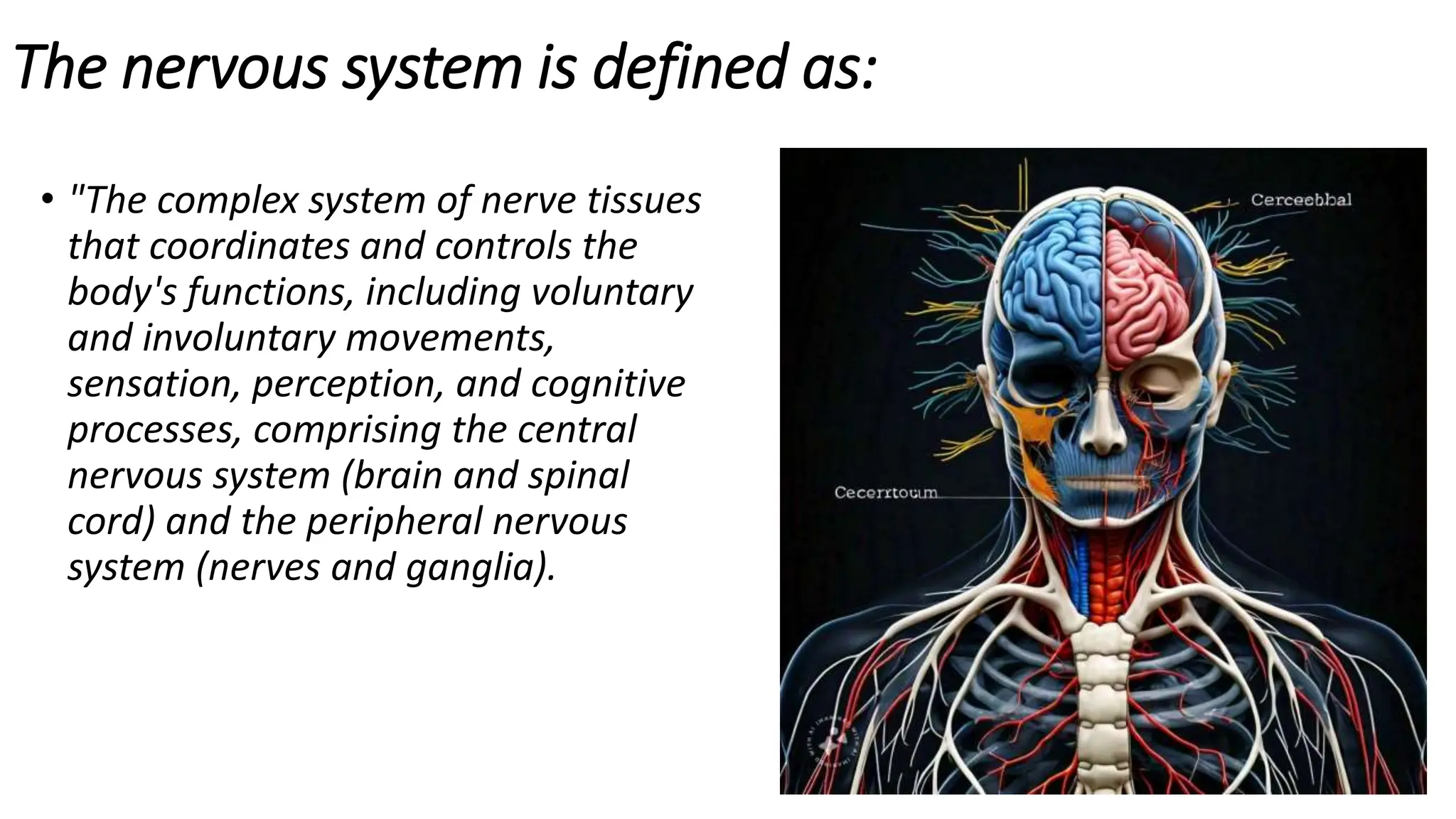
• "The complex system of nerve tissues
that coordinates and controls the
body's functions, including voluntary
and involuntary movements,
sensation, perception, and cognitive
processes, comprising the central
nervous system (brain and spinal
cord) and the peripheral nervous
system (nerves and ganglia).
Types of nervous system
1. Central Nervous System (CNS)
2. Peripheral Nervous System(PNS)
• Somatic Nervous System (SNS)
• Autonomic Nervous System
(ANS)
• Sympathetic Nervous System
(SNS)
• Parasympathetic Nervous
System
Central Nervous System
• The Central Nervous System
(CNS) is the part of the nervous
system that consists of the brain
and spinal cord. It is responsible
for:- Integrating and processing
information- Controlling
voluntary movements-
Regulating body functions (e.g.,
heart rate, blood pressure)-
Facilitating thought, perception,
and behaviour Enabling
consciousness and awareness
• The CNS is protected by the blood-brain
barrier, a specialized barrier that
separates it from the peripheral nervous
system and the rest of the body.
• The brain and spinal cord are the two
main components of the CNS:- Brain
• controls higher-level functions (e.g.,
thought, emotion, sensation)- Spinal
cord
• relays messages between the brain and
the rest of the body
• The CNS plays a crucial role in
controlling the body's functions and
enabling us to interact with the world
around us.
Peripheral Nervous System
• The Peripheral Nervous System (PNS) is a
network of nerves that connects the Central
Nervous System (CNS) to the rest of the
body. It transmits information between the
CNS and Sensory receptors (e.g., skin, eyes,
ears)- Muscles and glands
• Organs and tissuesThe PNS has two
divisions:-
• Somatic Nervous System (SNS): controls
voluntary movements and sensations
• Autonomic Nervous System (ANS): controls
involuntary movements and body functions
(e.g., heart rate, digestion
Neuron
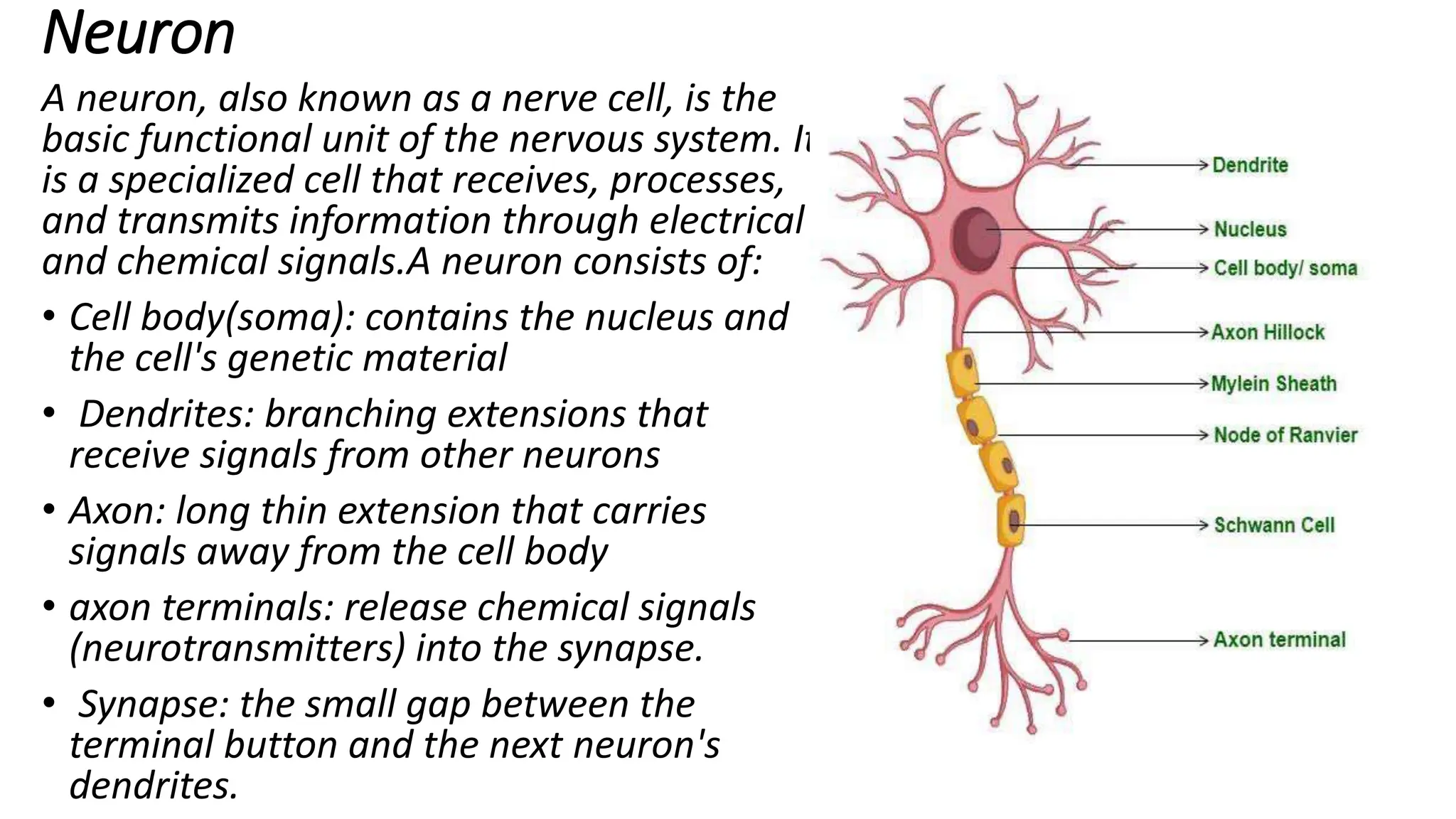
A neuron, also known as a nerve cell, is the
basic functional unit of the nervous system. It
is a specialized cell that receives, processes,
and transmits information through electrical
and chemical signals.A neuron consists of:
• Cell body(soma): contains the nucleus and
the cell's genetic material
• Dendrites: branching extensions that
receive signals from other neurons
• Axon: long thin extension that carries
signals away from the cell body
• axon terminals: release chemical signals
(neurotransmitters) into the synapse.
• Synapse: the small gap between the
terminal button and the next neuron's
dendrites.

Neuron A neuron, also known as a nerve cell, is the basic functional unit of the nervous system. It is a specialized cell ...

  • 1.
  • 2.
    The nervous systemis defined as: • "The complex system of nerve tissues that coordinates and controls the body's functions, including voluntary and involuntary movements, sensation, perception, and cognitive processes, comprising the central nervous system (brain and spinal cord) and the peripheral nervous system (nerves and ganglia).
  • 3.
    Types of nervoussystem 1. Central Nervous System (CNS) 2. Peripheral Nervous System(PNS) • Somatic Nervous System (SNS) • Autonomic Nervous System (ANS) • Sympathetic Nervous System (SNS) • Parasympathetic Nervous System
  • 4.
    Central Nervous System •The Central Nervous System (CNS) is the part of the nervous system that consists of the brain and spinal cord. It is responsible for:- Integrating and processing information- Controlling voluntary movements- Regulating body functions (e.g., heart rate, blood pressure)- Facilitating thought, perception, and behaviour Enabling consciousness and awareness
  • 5.
    • The CNSis protected by the blood-brain barrier, a specialized barrier that separates it from the peripheral nervous system and the rest of the body. • The brain and spinal cord are the two main components of the CNS:- Brain • controls higher-level functions (e.g., thought, emotion, sensation)- Spinal cord • relays messages between the brain and the rest of the body • The CNS plays a crucial role in controlling the body's functions and enabling us to interact with the world around us.
  • 6.
    Peripheral Nervous System •The Peripheral Nervous System (PNS) is a network of nerves that connects the Central Nervous System (CNS) to the rest of the body. It transmits information between the CNS and Sensory receptors (e.g., skin, eyes, ears)- Muscles and glands • Organs and tissuesThe PNS has two divisions:- • Somatic Nervous System (SNS): controls voluntary movements and sensations • Autonomic Nervous System (ANS): controls involuntary movements and body functions (e.g., heart rate, digestion
  • 7.
    Neuron A neuron, alsoknown as a nerve cell, is the basic functional unit of the nervous system. It is a specialized cell that receives, processes, and transmits information through electrical and chemical signals.A neuron consists of: • Cell body(soma): contains the nucleus and the cell's genetic material • Dendrites: branching extensions that receive signals from other neurons • Axon: long thin extension that carries signals away from the cell body • axon terminals: release chemical signals (neurotransmitters) into the synapse. • Synapse: the small gap between the terminal button and the next neuron's dendrites.