The system of all cells, tissues, and organs
that regulates the body’s responses to
internal and external stimuli. In vertebrates
in consist of the brain, spinal cord, nerves,
ganglia.
(Physiology) The sensory and control
apparatus of all multi cellular animals above
the level of sponges, consisting of a network
of nerve cells.
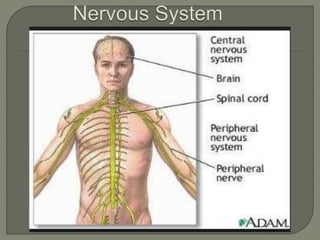
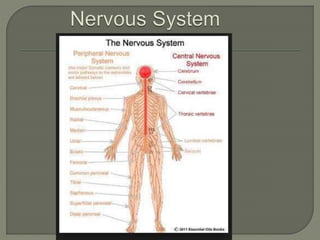
 (CNS) Central Nervous System
• The portion of the vertebrate nervous
system consist of the brain and spinal cord.
• Peripheral Nervous System
The part of the vertebrate nervous system
constituting the nerves outside the central
nervous system and including the cranial
nerves, spinal nerves.
 CNS- Composed of :
-Brain
-Cranial Nerves
-Spinal Cord
 PNS- Composed of :
-Nerves that exit from
the spinal cord.
-Automatic nervous
system.
Human brain serves many important functions:
-Imagination
- Memory
-Speech
-Limb movement of secretion hormones and
control of various organs within the body.
Brain Cells – The brain is made up of two types
of cells neurons (yellow cells.) and glial cells
(pink and purple cells.) Neurons are
responsible for all the functions that are
sends to the brain while the glial cells are non
neuronal cells that provide support for
neurons.
Neurons Communicate with one another
through connections called Synapses.
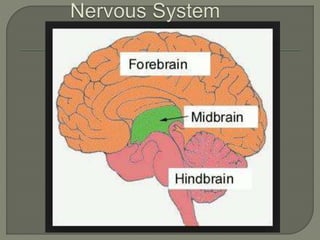
3 major region
1. Hindbrain-located at the rear of the skull
and lowest portion of the brain
*Medulla-spinal cord enters the skull.
Responsible for controlling breathing
regulating reflexes and body posture.
*Cerebellum-responsible for motor activity
(movement of the body)
*Pons-serves as bridge towards midbrain
and responsible for monitoring sleep.
2. Midbrain- relay information between the
hindbrain and forebrain, particularly
information coming from eyes and ears.
3. Forebrain- consider as the highest region
of the brain processing complex
information.
Nervous System
Nervous System
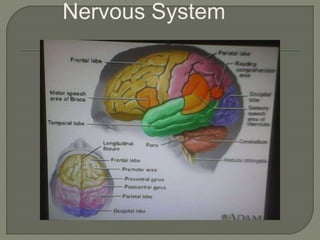
4 Lobes
1. Temporal lobe-located just above the ears
(hearing, language processing, memory)
2. Parietal lobe- located at the top of the head.
(taste, attention, motor control, pain, touch,
temperature)
3. Frontal Lobe- voluntary muscles,
intelligence and personality.
4. Occipital Lobe- located at the back of the
head.
(visual information, color, shape, and motion.)
Nervous System
Meninges of the Spinal cord- three
meninges layers surround the spinal cord,
form superficial to deep they are the dura
mater, arachnoid mater and pia mater .
Blood Supply to the brain-the brain
requires a tremendous amount of blood to
maintain its normal function.
Glia-connective tissue of nervous system,
consisting of several different types of cell.
Nervous System
Neurotransmitters- a chemical substance that is released
at the end of the nerve fiber by the arrival of nerve impulse
and by diffusing across the synapse.
*Acetylcholine- a compound the occurs through out the
nervous system , in which it functions as a
neurotransmitters .
*GABA- (gamma- amino butyric acid) Is an amino acid which
acts as a neurotransmitter in the CNS. It inhibits the
nerves transmission in the brain, calming nervous activity.
*Serotonin- a compound present in blood platelets and
serum that constricts the blood vessels and acts as a
neurotransmitter.
*Dopamine- a compound present in the body as a
neurotransmitter and a precursor of other substances
including epinephine.
Nervous System

Nervous system

  • 1.
    The system ofall cells, tissues, and organs that regulates the body’s responses to internal and external stimuli. In vertebrates in consist of the brain, spinal cord, nerves, ganglia. (Physiology) The sensory and control apparatus of all multi cellular animals above the level of sponges, consisting of a network of nerve cells.
  • 3.
     (CNS) CentralNervous System • The portion of the vertebrate nervous system consist of the brain and spinal cord. • Peripheral Nervous System The part of the vertebrate nervous system constituting the nerves outside the central nervous system and including the cranial nerves, spinal nerves.
  • 5.
     CNS- Composedof : -Brain -Cranial Nerves -Spinal Cord  PNS- Composed of : -Nerves that exit from the spinal cord. -Automatic nervous system.
  • 6.
    Human brain servesmany important functions: -Imagination - Memory -Speech -Limb movement of secretion hormones and control of various organs within the body.
  • 7.
    Brain Cells –The brain is made up of two types of cells neurons (yellow cells.) and glial cells (pink and purple cells.) Neurons are responsible for all the functions that are sends to the brain while the glial cells are non neuronal cells that provide support for neurons. Neurons Communicate with one another through connections called Synapses.
  • 9.
    3 major region 1.Hindbrain-located at the rear of the skull and lowest portion of the brain *Medulla-spinal cord enters the skull. Responsible for controlling breathing regulating reflexes and body posture. *Cerebellum-responsible for motor activity (movement of the body) *Pons-serves as bridge towards midbrain and responsible for monitoring sleep.
  • 10.
    2. Midbrain- relayinformation between the hindbrain and forebrain, particularly information coming from eyes and ears. 3. Forebrain- consider as the highest region of the brain processing complex information. Nervous System
  • 11.
  • 12.
    4 Lobes 1. Temporallobe-located just above the ears (hearing, language processing, memory) 2. Parietal lobe- located at the top of the head. (taste, attention, motor control, pain, touch, temperature) 3. Frontal Lobe- voluntary muscles, intelligence and personality. 4. Occipital Lobe- located at the back of the head. (visual information, color, shape, and motion.) Nervous System
  • 13.
    Meninges of theSpinal cord- three meninges layers surround the spinal cord, form superficial to deep they are the dura mater, arachnoid mater and pia mater . Blood Supply to the brain-the brain requires a tremendous amount of blood to maintain its normal function. Glia-connective tissue of nervous system, consisting of several different types of cell. Nervous System
  • 14.
    Neurotransmitters- a chemicalsubstance that is released at the end of the nerve fiber by the arrival of nerve impulse and by diffusing across the synapse. *Acetylcholine- a compound the occurs through out the nervous system , in which it functions as a neurotransmitters . *GABA- (gamma- amino butyric acid) Is an amino acid which acts as a neurotransmitter in the CNS. It inhibits the nerves transmission in the brain, calming nervous activity. *Serotonin- a compound present in blood platelets and serum that constricts the blood vessels and acts as a neurotransmitter. *Dopamine- a compound present in the body as a neurotransmitter and a precursor of other substances including epinephine. Nervous System