The Nervous System:
Overview and Central Nervous
System
EHS Unit 4
Learning Targets
• Establish the functions of the nervous system.
• Discuss general anatomy and physiology of the
system
• Describe the central nervous system structure
and functions.
An Overview
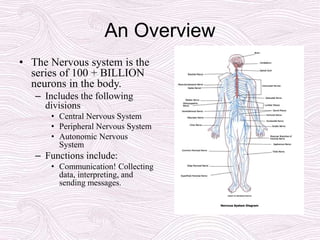
• The Nervous system is the
series of 100 + BILLION
neurons in the body.
– Includes the following
divisions
• Central Nervous System
• Peripheral Nervous System
• Autonomic Nervous
System
– Functions include:
• Communication! Collecting
data, interpreting, and
sending messages.
Tissue in the Nervous System
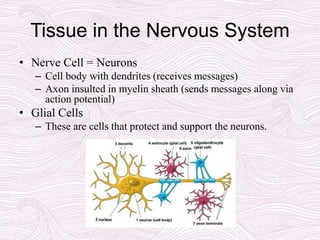
• Nerve Cell = Neurons
– Cell body with dendrites (receives messages)
– Axon insulted in myelin sheath (sends messages along via
action potential)
• Glial Cells
– These are cells that protect and support the neurons.
Neurotransmitters
• These are chemical messengers that pass from
neuron to neuron to continue the message.
– They are released into the synapse (space between
neurons) and picked up by the next neuron.
– There are 200-300 chemicals in the body that serve
as neurotransmitters.
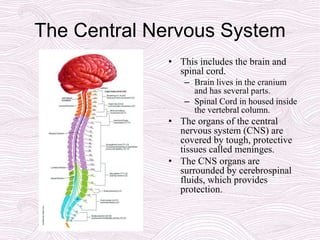
The Central Nervous System
• This includes the brain and
spinal cord.
– Brain lives in the cranium
and has several parts.
– Spinal Cord in housed inside
the vertebral column.
• The organs of the central
nervous system (CNS) are
covered by tough, protective
tissues called meninges.
• The CNS organs are
surrounded by cerebrospinal
fluids, which provides
protection.
The Brain
• Central Control of the body.
– Divided into four parts
• Cerebrum
• Diencephalon
• Cerebellum
• Brain Stem
– The brain has 4 ventricles (fluid filled spaces)
• These are highly vascular and lined with cells that
produce cerebrospinal fluid. Maintains the blood-brain-
barrier.
The Cerebrum
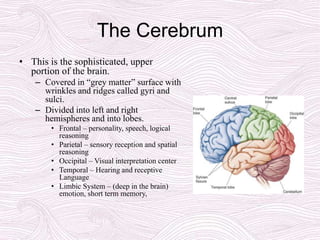
• This is the sophisticated, upper
portion of the brain.
– Covered in “grey matter” surface with
wrinkles and ridges called gyri and
sulci.
– Divided into left and right
hemispheres and into lobes.
• Frontal – personality, speech, logical
reasoning
• Parietal – sensory reception and spatial
reasoning
• Occipital – Visual interpretation center
• Temporal – Hearing and receptive
Language
• Limbic System – (deep in the brain)
emotion, short term memory,
Diencephalon
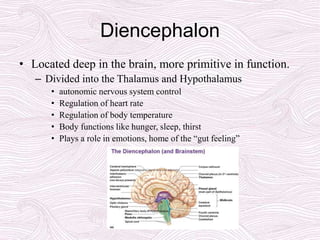
• Located deep in the brain, more primitive in function.
– Divided into the Thalamus and Hypothalamus
• autonomic nervous system control
• Regulation of heart rate
• Regulation of body temperature
• Body functions like hunger, sleep, thirst
• Plays a role in emotions, home of the “gut feeling”
Cerebellum
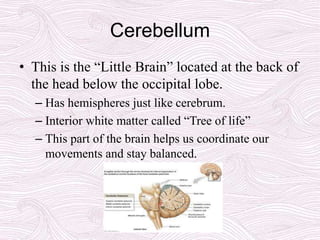
• This is the “Little Brain” located at the back of
the head below the occipital lobe.
– Has hemispheres just like cerebrum.
– Interior white matter called “Tree of life”
– This part of the brain helps us coordinate our
movements and stay balanced.
Brain Stem
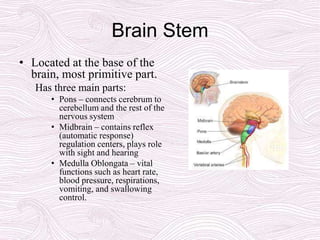
• Located at the base of the
brain, most primitive part.
Has three main parts:
• Pons – connects cerebrum to
cerebellum and the rest of the
nervous system
• Midbrain – contains reflex
(automatic response)
regulation centers, plays role
with sight and hearing
• Medulla Oblongata – vital
functions such as heart rate,
blood pressure, respirations,
vomiting, and swallowing
control.
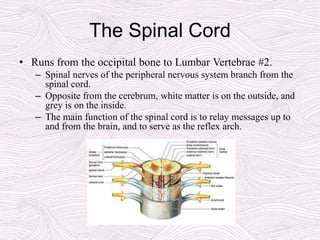
The Spinal Cord
• Runs from the occipital bone to Lumbar Vertebrae #2.
– Spinal nerves of the peripheral nervous system branch from the
spinal cord.
– Opposite from the cerebrum, white matter is on the outside, and
grey is on the inside.
– The main function of the spinal cord is to relay messages up to
and from the brain, and to serve as the reflex arch.
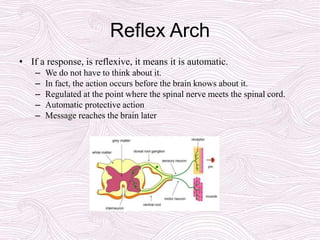
Reflex Arch
• If a response, is reflexive, it means it is automatic.
– We do not have to think about it.
– In fact, the action occurs before the brain knows about it.
– Regulated at the point where the spinal nerve meets the spinal cord.
– Automatic protective action
– Message reaches the brain later

Nervous System Introduction and Central Nervous System

  • 1.
    The Nervous System: Overviewand Central Nervous System EHS Unit 4
  • 2.
    Learning Targets • Establishthe functions of the nervous system. • Discuss general anatomy and physiology of the system • Describe the central nervous system structure and functions.
  • 3.
    An Overview • TheNervous system is the series of 100 + BILLION neurons in the body. – Includes the following divisions • Central Nervous System • Peripheral Nervous System • Autonomic Nervous System – Functions include: • Communication! Collecting data, interpreting, and sending messages.
  • 4.
    Tissue in theNervous System • Nerve Cell = Neurons – Cell body with dendrites (receives messages) – Axon insulted in myelin sheath (sends messages along via action potential) • Glial Cells – These are cells that protect and support the neurons.
  • 5.
    Neurotransmitters • These arechemical messengers that pass from neuron to neuron to continue the message. – They are released into the synapse (space between neurons) and picked up by the next neuron. – There are 200-300 chemicals in the body that serve as neurotransmitters.
  • 6.
    The Central NervousSystem • This includes the brain and spinal cord. – Brain lives in the cranium and has several parts. – Spinal Cord in housed inside the vertebral column. • The organs of the central nervous system (CNS) are covered by tough, protective tissues called meninges. • The CNS organs are surrounded by cerebrospinal fluids, which provides protection.
  • 7.
    The Brain • CentralControl of the body. – Divided into four parts • Cerebrum • Diencephalon • Cerebellum • Brain Stem – The brain has 4 ventricles (fluid filled spaces) • These are highly vascular and lined with cells that produce cerebrospinal fluid. Maintains the blood-brain- barrier.
  • 8.
    The Cerebrum • Thisis the sophisticated, upper portion of the brain. – Covered in “grey matter” surface with wrinkles and ridges called gyri and sulci. – Divided into left and right hemispheres and into lobes. • Frontal – personality, speech, logical reasoning • Parietal – sensory reception and spatial reasoning • Occipital – Visual interpretation center • Temporal – Hearing and receptive Language • Limbic System – (deep in the brain) emotion, short term memory,
  • 9.
    Diencephalon • Located deepin the brain, more primitive in function. – Divided into the Thalamus and Hypothalamus • autonomic nervous system control • Regulation of heart rate • Regulation of body temperature • Body functions like hunger, sleep, thirst • Plays a role in emotions, home of the “gut feeling”
  • 10.
    Cerebellum • This isthe “Little Brain” located at the back of the head below the occipital lobe. – Has hemispheres just like cerebrum. – Interior white matter called “Tree of life” – This part of the brain helps us coordinate our movements and stay balanced.
  • 11.
    Brain Stem • Locatedat the base of the brain, most primitive part. Has three main parts: • Pons – connects cerebrum to cerebellum and the rest of the nervous system • Midbrain – contains reflex (automatic response) regulation centers, plays role with sight and hearing • Medulla Oblongata – vital functions such as heart rate, blood pressure, respirations, vomiting, and swallowing control.
  • 12.
    The Spinal Cord •Runs from the occipital bone to Lumbar Vertebrae #2. – Spinal nerves of the peripheral nervous system branch from the spinal cord. – Opposite from the cerebrum, white matter is on the outside, and grey is on the inside. – The main function of the spinal cord is to relay messages up to and from the brain, and to serve as the reflex arch.
  • 13.
    Reflex Arch • Ifa response, is reflexive, it means it is automatic. – We do not have to think about it. – In fact, the action occurs before the brain knows about it. – Regulated at the point where the spinal nerve meets the spinal cord. – Automatic protective action – Message reaches the brain later