Nerve ImpulsesThe Over all StoryKatie Burke
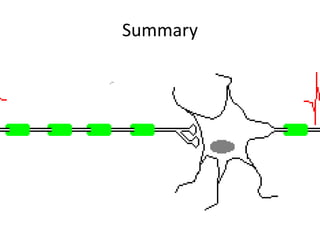
Summary
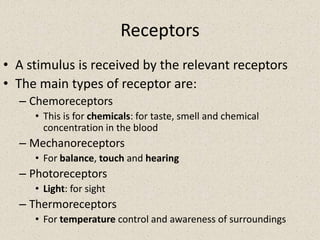
ReceptorsA stimulus is received by the relevant receptorsThe main types of receptor are:ChemoreceptorsThis is for chemicals: for taste, smell and chemical concentration in the bloodMechanoreceptorsFor balance, touch and hearingPhotoreceptorsLight: for sightThermoreceptorsFor temperature control and awareness of surroundings
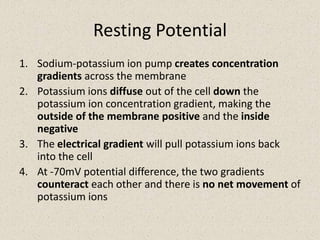
Sodium-potassium ion pump creates concentration gradients across the membranePotassium ions diffuse out of the cell down the potassium ion concentration gradient, making the outside of the membrane positive and the inside negativeThe electrical gradient will pull potassium ions back into the cellAt -70mV potential difference, the two gradients counteract each other and there is no net movement of potassium ionsResting Potential
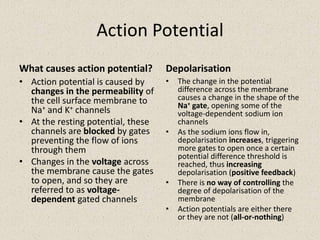
Action PotentialWhat causes action potential?The change in the potential difference across the membrane causes a change in the shape of the Na+ gate, opening some of the voltage-dependent sodium ion channelsAs the sodium ions flow in, depolarisation increases, triggering more gates to open once a certain potential difference threshold is reached, thus increasing depolarisation (positive feedback)There is no way of controlling the degree of depolarisation of the membraneAction potentials are either there or they are not (all-or-nothing)Action potential is caused by changes in the permeability of the cell surface membrane to Na+ and K+ channelsAt the resting potential, these channels are blocked by gates preventing the flow of ions through themChanges in the voltage across the membrane cause the gates to open, and so they are referred to as voltage-dependent gated channelsDepolarisation
Action PotentialRepolarisationThe voltage-dependent Na+ channels spontaneously close and Na+permeability of the membrane returns to its usual very low level
Voltage-dependent K+ channels open due to the depolarisation of the membrane
Potassium ions move out of the axon, down the electrochemical gradient, and the inside of the cell once again becomes more negative than the outside
This is the falling phase of the oscilloscope traceRestoring the resting potentialThe membrane is now highly permeable to potassium ions, and more ions move out than occurs at resting potential, making the potential difference more negative than the normal resting potential (hyperpolarisation)The resting potential is re-established by closing of the voltage-dependent K+ channels and potassium ion diffusion into the axon.

Nerve impulses - the over all story

  • 1.
    Nerve ImpulsesThe Overall StoryKatie Burke
  • 2.
  • 3.
    ReceptorsA stimulus isreceived by the relevant receptorsThe main types of receptor are:ChemoreceptorsThis is for chemicals: for taste, smell and chemical concentration in the bloodMechanoreceptorsFor balance, touch and hearingPhotoreceptorsLight: for sightThermoreceptorsFor temperature control and awareness of surroundings
  • 4.
    Sodium-potassium ion pumpcreates concentration gradients across the membranePotassium ions diffuse out of the cell down the potassium ion concentration gradient, making the outside of the membrane positive and the inside negativeThe electrical gradient will pull potassium ions back into the cellAt -70mV potential difference, the two gradients counteract each other and there is no net movement of potassium ionsResting Potential
  • 5.
    Action PotentialWhat causesaction potential?The change in the potential difference across the membrane causes a change in the shape of the Na+ gate, opening some of the voltage-dependent sodium ion channelsAs the sodium ions flow in, depolarisation increases, triggering more gates to open once a certain potential difference threshold is reached, thus increasing depolarisation (positive feedback)There is no way of controlling the degree of depolarisation of the membraneAction potentials are either there or they are not (all-or-nothing)Action potential is caused by changes in the permeability of the cell surface membrane to Na+ and K+ channelsAt the resting potential, these channels are blocked by gates preventing the flow of ions through themChanges in the voltage across the membrane cause the gates to open, and so they are referred to as voltage-dependent gated channelsDepolarisation
  • 6.
    Action PotentialRepolarisationThe voltage-dependentNa+ channels spontaneously close and Na+permeability of the membrane returns to its usual very low level
  • 7.
    Voltage-dependent K+ channelsopen due to the depolarisation of the membrane
  • 8.
    Potassium ions moveout of the axon, down the electrochemical gradient, and the inside of the cell once again becomes more negative than the outside
  • 9.
    This is thefalling phase of the oscilloscope traceRestoring the resting potentialThe membrane is now highly permeable to potassium ions, and more ions move out than occurs at resting potential, making the potential difference more negative than the normal resting potential (hyperpolarisation)The resting potential is re-established by closing of the voltage-dependent K+ channels and potassium ion diffusion into the axon.

Editor's Notes

  • #2 SummaryReceptorsResting potentialAction potentialAt the synapseNeurotransmitter
  • #3 Action potentialResting potentialNeurotransmitter released
  • #4 Others in the green book
  • #5 The distribution of ions found in the solutions inside and outside a squid giant axon is unequal.
  • #6 There is a higher concentration of sodium ions outside of the axon, so sodium ions flow rapidly inwards through the open voltage-dependent Na+ channels, causing a build-up of positive charges inside. This reverses the polarity of the membrane. This is where the potential difference reaches +40mV.
  • #7 If hundreds of action potentials occur in the neurone, the sodium ion concentration inside the cell rises significantly. The sodium-potassium pumps start to function, restoring the original ion concentrations across the cell membrane. If a cell is not transmitting many action potentials, these pumps will not have to be used very frequently. At rest there is some slow leakage of sodium ions into the axon. These sodium ions are pumped back out of the cell.
  • #8 The gap is about 20-50 nm and a nerve impulse cannot jump across it.
  • #10 The neurotransmitter takes about 0.5 ms to diffuse across the synaptic cleft and reach the postsynaptic membrane. A single impulse will not usually be enough and several impulses are usually required to generate enough neurotransmitter to depolarise the postsynaptic membrane.The number of functioning receptors in the postsynaptic membrane will also influence the degree of depolarisation.