
How Complement Works
The Lectin Pathway
Stage 1
• Microbes enter the
body through wounds,
respiratory means,
digestion, etc.
Microbes
Person
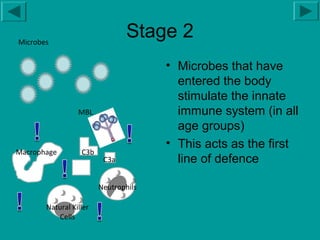
Stage 2
• Microbes that have
entered the body
stimulate the innate
immune system (in all
age groups)
• This acts as the first
line of defence
Microbes
C3
Macrophage
Natural Killer
Cells
Neutrophils
MBL
C3b
C3a
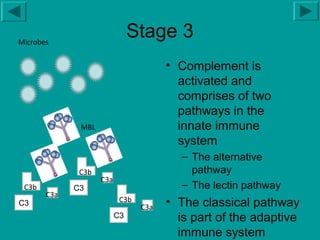
Stage 3
• Complement is
activated and
comprises of two
pathways in the
innate immune
system
– The alternative
pathway
– The lectin pathway
• The classical pathway
is part of the adaptive
immune system
Microbes
C3
MBL
C3b
C3a
C3
C3b
C3a
C3
C3b
C3a
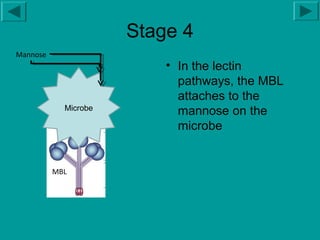
• In the lectin
pathways, the MBL
attaches to the
mannose on the
microbe
MBL
Stage 4
Microbe
Mannose
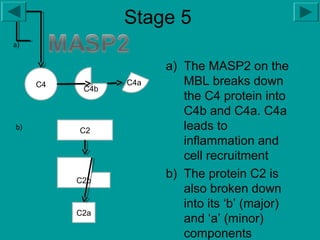
Stage 5
a) The MASP2 on the
MBL breaks down
the C4 protein into
C4b and C4a. C4a
leads to
inflammation and
cell recruitment
b) The protein C2 is
also broken down
into its ‘b’ (major)
and ‘a’ (minor)
components
C4
C4b
C4a
a)
b) C2
C2a
C2b
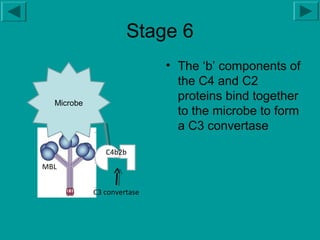
Stage 6
• The ‘b’ components of
the C4 and C2
proteins bind together
to the microbe to form
a C3 convertase
MBL
Microbe
C4b2b
C3 convertase
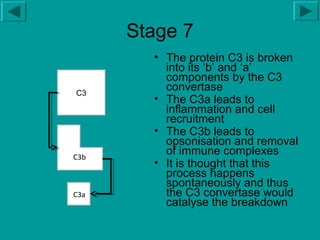
Stage 7
• The protein C3 is broken
into its ‘b’ and ‘a’
components by the C3
convertase
• The C3a leads to
inflammation and cell
recruitment
• The C3b leads to
opsonisation and removal
of immune complexes
• It is thought that this
process happens
spontaneously and thus
the C3 convertase would
catalyse the breakdown
C3
C3b
C3a
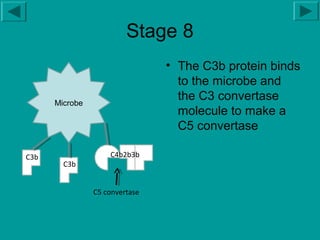
Stage 8
• The C3b protein binds
to the microbe and
the C3 convertase
molecule to make a
C5 convertase
Microbe
C3b
C3b C4b2b3b
C5 convertase
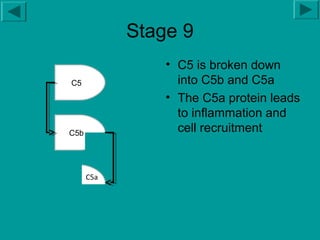
Stage 9
• C5 is broken down
into C5b and C5a
• The C5a protein leads
to inflammation and
cell recruitment
C5
C5b
C5a
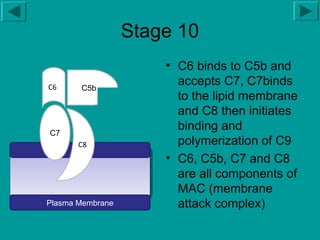
Stage 10
• C6 binds to C5b and
accepts C7, C7binds
to the lipid membrane
and C8 then initiates
binding and
polymerization of C9
• C6, C5b, C7 and C8
are all components of
MAC (membrane
attack complex)
C5b
C7
C6
C8
Plasma Membrane
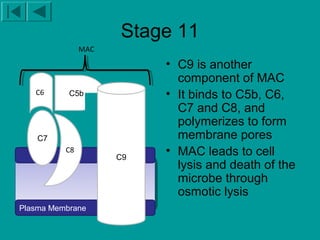
Stage 11
• C9 is another
component of MAC
• It binds to C5b, C6,
C7 and C8, and
polymerizes to form
membrane pores
• MAC leads to cell
lysis and death of the
microbe through
osmotic lysis
C5b
C7
C6
C8
Plasma Membrane
C9
MAC

How Complement System Works (Lectin Pathway)

  • 1.
  • 2.
    Stage 1 • Microbesenter the body through wounds, respiratory means, digestion, etc. Microbes Person
  • 3.
    Stage 2 • Microbesthat have entered the body stimulate the innate immune system (in all age groups) • This acts as the first line of defence Microbes C3 Macrophage Natural Killer Cells Neutrophils MBL C3b C3a
  • 4.
    Stage 3 • Complementis activated and comprises of two pathways in the innate immune system – The alternative pathway – The lectin pathway • The classical pathway is part of the adaptive immune system Microbes C3 MBL C3b C3a C3 C3b C3a C3 C3b C3a
  • 5.
    • In thelectin pathways, the MBL attaches to the mannose on the microbe MBL Stage 4 Microbe Mannose
  • 6.
    Stage 5 a) TheMASP2 on the MBL breaks down the C4 protein into C4b and C4a. C4a leads to inflammation and cell recruitment b) The protein C2 is also broken down into its ‘b’ (major) and ‘a’ (minor) components C4 C4b C4a a) b) C2 C2a C2b
  • 7.
    Stage 6 • The‘b’ components of the C4 and C2 proteins bind together to the microbe to form a C3 convertase MBL Microbe C4b2b C3 convertase
  • 8.
    Stage 7 • Theprotein C3 is broken into its ‘b’ and ‘a’ components by the C3 convertase • The C3a leads to inflammation and cell recruitment • The C3b leads to opsonisation and removal of immune complexes • It is thought that this process happens spontaneously and thus the C3 convertase would catalyse the breakdown C3 C3b C3a
  • 9.
    Stage 8 • TheC3b protein binds to the microbe and the C3 convertase molecule to make a C5 convertase Microbe C3b C3b C4b2b3b C5 convertase
  • 10.
    Stage 9 • C5is broken down into C5b and C5a • The C5a protein leads to inflammation and cell recruitment C5 C5b C5a
  • 11.
    Stage 10 • C6binds to C5b and accepts C7, C7binds to the lipid membrane and C8 then initiates binding and polymerization of C9 • C6, C5b, C7 and C8 are all components of MAC (membrane attack complex) C5b C7 C6 C8 Plasma Membrane
  • 12.
    Stage 11 • C9is another component of MAC • It binds to C5b, C6, C7 and C8, and polymerizes to form membrane pores • MAC leads to cell lysis and death of the microbe through osmotic lysis C5b C7 C6 C8 Plasma Membrane C9 MAC