SEROTONIN
Presentation by: Dr. B Ooha Susmita
Moderator: Dr. Satya Krishna Kumar
METABOLISM
Synthesis
[Rate limiting step]
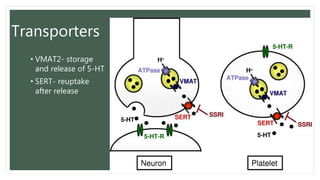
Transporters
• VMAT2- storage
and release of 5-HT
• SERT- reuptake
after release
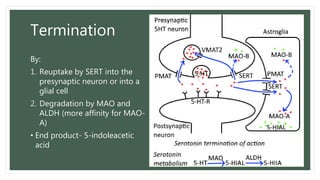
Termination
By:
1. Reuptake by SERT into the
presynaptic neuron or into a
glial cell
2. Degradation by MAO and
ALDH (more affinity for MAO-
A)
• End product- 5-indoleacetic
acid
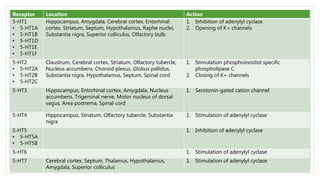
Receptor Location Action
5-HT1
• 5-HT1A
• 5-HT1B
• 5-HT1D
• 5-HT1E
• 5-HT1F
Hippocampus, Amygdala, Cerebral cortex, Entorhinal
cortex, Striatum, Septum, Hypothalamus, Raphe nuclei,
Substantia nigra, Superior colliculus, Olfactory bulb
1. Inhibition of adenylyl cyclase
2. Opening of K+ channels
5-HT2
• 5-HT2A
• 5-HT2B
• 5-HT2C
Claustrum, Cerebral cortex, Striatum, Olfactory tubercle,
Nucleus accumbens, Choroid plexus, Globus pallidus,
Substantia nigra, Hypothalamus, Septum, Spinal cord
1. Stimulation phosphoinositol specific
phospholipase C
2. Closing of K+ channels
5-HT3 Hippocampus, Entorhinal cortex, Amygdala, Nucleus
accumbens, Trigeminal nerve, Motor nucleus of dorsal
vagus, Area postrema, Spinal cord
1. Serotonin-gated cation channel
5-HT4 Hippocampus, Striatum, Olfactory tubercle, Substantia
nigra
1. Stimulation of adenylyl cyclase
5-HT5
• 5-HT5A
• 5-HT5B
1. Inhibition of adenylyl cyclase
5-HT6 1. Stimulation of adenylyl cyclase
5-HT7 Cerebral cortex, Septum, Thalamus, Hypothalamus,
Amygdala, Superior colliculus
1. Stimulation of adenylyl cyclase
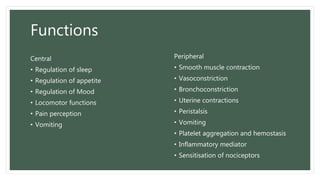
Functions
Central
• Regulation of sleep
• Regulation of appetite
• Regulation of Mood
• Locomotor functions
• Pain perception
• Vomiting
Peripheral
• Smooth muscle contraction
• Vasoconstriction
• Bronchoconstriction
• Uterine contractions
• Peristalsis
• Vomiting
• Platelet aggregation and hemostasis
• Inflammatory mediator
• Sensitisation of nociceptors
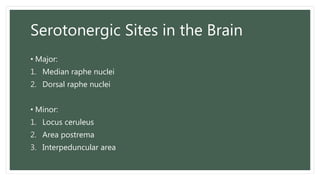
Serotonergic Sites in the Brain
• Major:
1. Median raphe nuclei
2. Dorsal raphe nuclei
• Minor:
1. Locus ceruleus
2. Area postrema
3. Interpeduncular area
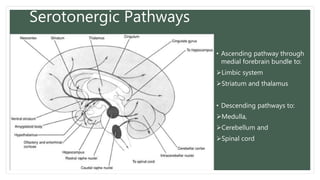
Serotonergic Pathways
• Ascending pathway through
medial forebrain bundle to:
Limbic system
Striatum and thalamus
• Descending pathways to:
Medulla,
Cerebellum and
Spinal cord
Ascending pathway
• From median raphe nuclei to limbic system
• From dorsal raphe nuclei to thalamus and striatum
• Involved in regulation of mood, anxiety, sleep-wake cycle and feeding behaviour
• Also involved in execution of rhythmic motor movements
Descending pathway
• From raphe nuclei to spinal cord
• Implicated in the suppression of nociceptive pathways, which might account for
analgesic effects of some antidepressants
SEROTONIN IN
PSYCHIATRY
Depression
• Biogenic amine hypothesis of mood disorders- depression is associated with too little
serotonin and mania is associated with too much serotonin
• The hypothesis might not be entirely accurate, however, it has been supported by
data from clinical trials of SSRIs which have been very effective in the treatment of
depressive disorder
• Permissive hypothesis postulates that low levels of serotonin permit abnormal levels
of norepinephrine to cause depression or mania
Suicidal Behaviour
• Decreased levels of central serotonin is associated with
increased risk of suicidal behaviour
• Studies have found low levels of serotonin metabolites
in the CSF and lower concentration of reuptake sites
on the platelets of patients with suicidal impulses
• Post-mortem neurochemical studies have decreased
levels of serotonin or 5-HIAA in either the brainstem or
frontal cortex of suicide victims
• Post-mortem receptor studies have also found
significant changes in the presynaptic and
postsynaptic binding sites of victims.
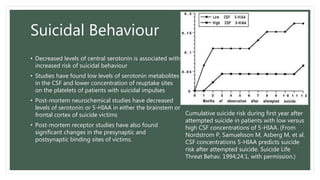
Cumulative suicide risk during first year after
attempted suicide in patients with low versus
high CSF concentrations of 5-HIAA. (From
Nordstrom P, Samuelsson M, Asberg M, et al.
CSF concentrations 5-HIAA predicts suicide
risk after attempted suicide. Suicide Life
Threat Behav. 1994;24:1, with permission.)
Anxiety Disorders
• Different types of acute stress result in increased 5-HT turnover in the prefrontal
cortex, nucleus accumbens, amygdala and lateral hypothalamus
• Drugs with serotonergic action such as Fenfluramine and Meta-
Chlorophenylpiperazine increase anxiety levels in patients
• Serotonergic hallucinogens and stimulants- LSD and MDMA- have been associated
with the development of acute and chronic anxiety disorders in users
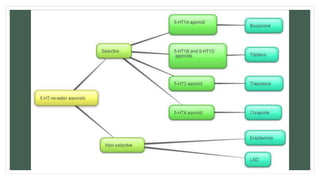
• Buspirone, a 5-HT1A agonist, has yielded results when used as an anxiolytic which also
suggests a relationship between serotonin and anxiety
Obsessive-Compulsive Disorder
• Serotonergic drugs more effective than others
• Data from many clinical drug trials supports the hypothesis that dysfunction in the
serotonergic system is involved in the psychopathology of OCD
• One study shows decreased levels of 5-HIAA in CSF after treatment with
Clomipramine
Schizophrenia
• Current hypotheses posit serotonin excess as a cause of both positive and negative
symptoms in schizophrenia.
• The robust serotonin antagonist activity of clozapine and other second-generation
antipsychotics, coupled with the effectiveness of clozapine to decrease positive
symptoms in chronic patients has contributed to the validity of this proposition.
Personality Disorders
• Serotonin produces a sense of general well-being in a person
• In relation to personality traits, serotonergic and dopaminergic systems have been
found to stimulate arousal mechanisms in people.
• Also, treatment with serotonergic drugs such as SSRIs has been found to induce
changes in character traits of a patient
Sleep Regulation
• Many studies support the role of serotonin in sleep regulation
• Prevention of serotonin production or destruction of raphe nuclei reduces sleep for a
considerable time
• In deficiency of L-Tryptophan (the precursor of serotonin), REM sleep is decreased
along with increased sleep latency and nocturnal awakenings which is correctable by
increasing dietary L-tryptophan
Body Dysmorphic Disorder
• The pathophysiology may involve serotonin because of:
1. High comorbidity with depressive disorders,
2. Higher-than-expected family history of mood disorders and obsessive-compulsive
disorder (OCD), and
3. Reported responsiveness of the condition to serotonin-specific drugs
Eating Disorders
• The implication is hypothesised due to serotonin’s involvement in regulation of
feeding behaviour and satiety in the hypothalamus
• SSRIs are an effective modality of treatment in cases of Bulimia Nervosa
Aggression
• Some studies have found decreased CSF levels of 5-HIAA in alcoholic with history of
violence.
Sexual Disorders
• Serotonin has an inverse relationship with dopamine
• Stimulation of 5-HT2 and 5-HT3 receptors decreases synaptic dopamine release and
this has been implicated in the etiology of sexual dysfunction.
• This is further supported by the side effect profile of SSRIs which includes erectile
dysfunction and decreased libido
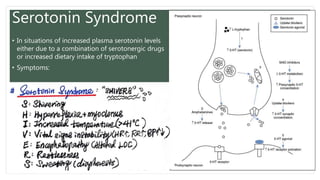
Serotonin Syndrome
• In situations of increased plasma serotonin levels
either due to a combination of serotonergic drugs
or increased dietary intake of tryptophan
• Symptoms:
SEROTONIN IN
PHARMACOLOGY
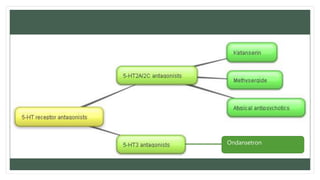
Ondansetron
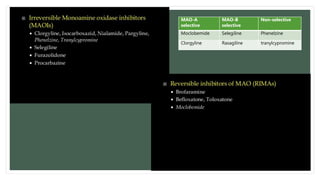
MAO-A
selective
MAO-B
selective
Non-selective
Moclobemide Selegiline Phenelzine
Clorgyline Rasagiline tranylcypromine
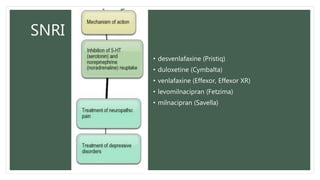
SNRI
• desvenlafaxine (Pristiq)
• duloxetine (Cymbalta)
• venlafaxine (Effexor, Effexor XR)
• levomilnacipran (Fetzima)
• milnacipran (Savella)
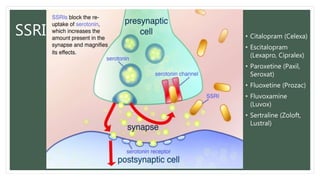
SSRI • Citalopram (Celexa)
• Escitalopram
(Lexapro, Cipralex)
• Paroxetine (Paxil,
Seroxat)
• Fluoxetine (Prozac)
• Fluvoxamine
(Luvox)
• Sertraline (Zoloft,
Lustral)
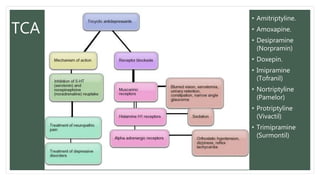
TCA
• Amitriptyline.
• Amoxapine.
• Desipramine
(Norpramin)
• Doxepin.
• Imipramine
(Tofranil)
• Nortriptyline
(Pamelor)
• Protriptyline
(Vivactil)
• Trimipramine
(Surmontil)
References
• Stephen Stahl Essential Psychopharmacology, 4th ed.
• Kaplan and Sadock’s Synopsis of Psychiatry, 11th ed.
• Thank you

Serotonin

  • 1.
    SEROTONIN Presentation by: Dr.B Ooha Susmita Moderator: Dr. Satya Krishna Kumar
  • 2.
  • 3.
  • 4.
    Transporters • VMAT2- storage andrelease of 5-HT • SERT- reuptake after release
  • 5.
    Termination By: 1. Reuptake bySERT into the presynaptic neuron or into a glial cell 2. Degradation by MAO and ALDH (more affinity for MAO- A) • End product- 5-indoleacetic acid
  • 6.
    Receptor Location Action 5-HT1 •5-HT1A • 5-HT1B • 5-HT1D • 5-HT1E • 5-HT1F Hippocampus, Amygdala, Cerebral cortex, Entorhinal cortex, Striatum, Septum, Hypothalamus, Raphe nuclei, Substantia nigra, Superior colliculus, Olfactory bulb 1. Inhibition of adenylyl cyclase 2. Opening of K+ channels 5-HT2 • 5-HT2A • 5-HT2B • 5-HT2C Claustrum, Cerebral cortex, Striatum, Olfactory tubercle, Nucleus accumbens, Choroid plexus, Globus pallidus, Substantia nigra, Hypothalamus, Septum, Spinal cord 1. Stimulation phosphoinositol specific phospholipase C 2. Closing of K+ channels 5-HT3 Hippocampus, Entorhinal cortex, Amygdala, Nucleus accumbens, Trigeminal nerve, Motor nucleus of dorsal vagus, Area postrema, Spinal cord 1. Serotonin-gated cation channel 5-HT4 Hippocampus, Striatum, Olfactory tubercle, Substantia nigra 1. Stimulation of adenylyl cyclase 5-HT5 • 5-HT5A • 5-HT5B 1. Inhibition of adenylyl cyclase 5-HT6 1. Stimulation of adenylyl cyclase 5-HT7 Cerebral cortex, Septum, Thalamus, Hypothalamus, Amygdala, Superior colliculus 1. Stimulation of adenylyl cyclase
  • 7.
    Functions Central • Regulation ofsleep • Regulation of appetite • Regulation of Mood • Locomotor functions • Pain perception • Vomiting Peripheral • Smooth muscle contraction • Vasoconstriction • Bronchoconstriction • Uterine contractions • Peristalsis • Vomiting • Platelet aggregation and hemostasis • Inflammatory mediator • Sensitisation of nociceptors
  • 8.
    Serotonergic Sites inthe Brain • Major: 1. Median raphe nuclei 2. Dorsal raphe nuclei • Minor: 1. Locus ceruleus 2. Area postrema 3. Interpeduncular area
  • 9.
    Serotonergic Pathways • Ascendingpathway through medial forebrain bundle to: Limbic system Striatum and thalamus • Descending pathways to: Medulla, Cerebellum and Spinal cord
  • 10.
    Ascending pathway • Frommedian raphe nuclei to limbic system • From dorsal raphe nuclei to thalamus and striatum • Involved in regulation of mood, anxiety, sleep-wake cycle and feeding behaviour • Also involved in execution of rhythmic motor movements Descending pathway • From raphe nuclei to spinal cord • Implicated in the suppression of nociceptive pathways, which might account for analgesic effects of some antidepressants
  • 11.
  • 12.
    Depression • Biogenic aminehypothesis of mood disorders- depression is associated with too little serotonin and mania is associated with too much serotonin • The hypothesis might not be entirely accurate, however, it has been supported by data from clinical trials of SSRIs which have been very effective in the treatment of depressive disorder • Permissive hypothesis postulates that low levels of serotonin permit abnormal levels of norepinephrine to cause depression or mania
  • 13.
    Suicidal Behaviour • Decreasedlevels of central serotonin is associated with increased risk of suicidal behaviour • Studies have found low levels of serotonin metabolites in the CSF and lower concentration of reuptake sites on the platelets of patients with suicidal impulses • Post-mortem neurochemical studies have decreased levels of serotonin or 5-HIAA in either the brainstem or frontal cortex of suicide victims • Post-mortem receptor studies have also found significant changes in the presynaptic and postsynaptic binding sites of victims. Cumulative suicide risk during first year after attempted suicide in patients with low versus high CSF concentrations of 5-HIAA. (From Nordstrom P, Samuelsson M, Asberg M, et al. CSF concentrations 5-HIAA predicts suicide risk after attempted suicide. Suicide Life Threat Behav. 1994;24:1, with permission.)
  • 14.
    Anxiety Disorders • Differenttypes of acute stress result in increased 5-HT turnover in the prefrontal cortex, nucleus accumbens, amygdala and lateral hypothalamus • Drugs with serotonergic action such as Fenfluramine and Meta- Chlorophenylpiperazine increase anxiety levels in patients • Serotonergic hallucinogens and stimulants- LSD and MDMA- have been associated with the development of acute and chronic anxiety disorders in users • Buspirone, a 5-HT1A agonist, has yielded results when used as an anxiolytic which also suggests a relationship between serotonin and anxiety
  • 15.
    Obsessive-Compulsive Disorder • Serotonergicdrugs more effective than others • Data from many clinical drug trials supports the hypothesis that dysfunction in the serotonergic system is involved in the psychopathology of OCD • One study shows decreased levels of 5-HIAA in CSF after treatment with Clomipramine
  • 16.
    Schizophrenia • Current hypothesesposit serotonin excess as a cause of both positive and negative symptoms in schizophrenia. • The robust serotonin antagonist activity of clozapine and other second-generation antipsychotics, coupled with the effectiveness of clozapine to decrease positive symptoms in chronic patients has contributed to the validity of this proposition.
  • 17.
    Personality Disorders • Serotoninproduces a sense of general well-being in a person • In relation to personality traits, serotonergic and dopaminergic systems have been found to stimulate arousal mechanisms in people. • Also, treatment with serotonergic drugs such as SSRIs has been found to induce changes in character traits of a patient
  • 18.
    Sleep Regulation • Manystudies support the role of serotonin in sleep regulation • Prevention of serotonin production or destruction of raphe nuclei reduces sleep for a considerable time • In deficiency of L-Tryptophan (the precursor of serotonin), REM sleep is decreased along with increased sleep latency and nocturnal awakenings which is correctable by increasing dietary L-tryptophan
  • 19.
    Body Dysmorphic Disorder •The pathophysiology may involve serotonin because of: 1. High comorbidity with depressive disorders, 2. Higher-than-expected family history of mood disorders and obsessive-compulsive disorder (OCD), and 3. Reported responsiveness of the condition to serotonin-specific drugs
  • 20.
    Eating Disorders • Theimplication is hypothesised due to serotonin’s involvement in regulation of feeding behaviour and satiety in the hypothalamus • SSRIs are an effective modality of treatment in cases of Bulimia Nervosa Aggression • Some studies have found decreased CSF levels of 5-HIAA in alcoholic with history of violence.
  • 21.
    Sexual Disorders • Serotoninhas an inverse relationship with dopamine • Stimulation of 5-HT2 and 5-HT3 receptors decreases synaptic dopamine release and this has been implicated in the etiology of sexual dysfunction. • This is further supported by the side effect profile of SSRIs which includes erectile dysfunction and decreased libido
  • 22.
    Serotonin Syndrome • Insituations of increased plasma serotonin levels either due to a combination of serotonergic drugs or increased dietary intake of tryptophan • Symptoms:
  • 23.
  • 26.
  • 27.
  • 28.
    SNRI • desvenlafaxine (Pristiq) •duloxetine (Cymbalta) • venlafaxine (Effexor, Effexor XR) • levomilnacipran (Fetzima) • milnacipran (Savella)
  • 29.
    SSRI • Citalopram(Celexa) • Escitalopram (Lexapro, Cipralex) • Paroxetine (Paxil, Seroxat) • Fluoxetine (Prozac) • Fluvoxamine (Luvox) • Sertraline (Zoloft, Lustral)
  • 30.
    TCA • Amitriptyline. • Amoxapine. •Desipramine (Norpramin) • Doxepin. • Imipramine (Tofranil) • Nortriptyline (Pamelor) • Protriptyline (Vivactil) • Trimipramine (Surmontil)
  • 31.
    References • Stephen StahlEssential Psychopharmacology, 4th ed. • Kaplan and Sadock’s Synopsis of Psychiatry, 11th ed. • Thank you

Editor's Notes

  • #23 Treatment: withdrawal of drug and supportive management with fluid replacement, cooling blankets, cyproheptadine, nitroglycerine, dantrolene bzds, anticonvulsants, mechanical ventilation and paralysing agents