

Contents
• The Legacy of the Great War •
– Treaty of Versailles (1919) •
– Impact
•
• Hitler’s Foreign Policy
•
– Rhineland
•
– ‘Lebensraum’
•
– Britain-Italy-Germany
Triangle

•
•
– Anschluss
– Sudetenland and the Munich•
Agreement
•
• Appeasement
•
• Path to War

USSR’s Role
Invasion of Poland
Propaganda
Evacuation
Home Front
Churchill Takes Over
– Dunkirk

The Blitz
Turning Points in WW2
British Women in the war
1943-1944
The Legacy of War in Britain
Back to Contents

The Legacy of the Great War
• WW1 ended November 1918
• Treaty of Versailles (28 June 1918)
– Decision made by Allies
– Germans not invited

• Versailles was first of a series of agreements
• 1919 – separate treaties with Austria-Hungary
and Bulgaria
• 1920 – treaty with Turkey
Back to Contents

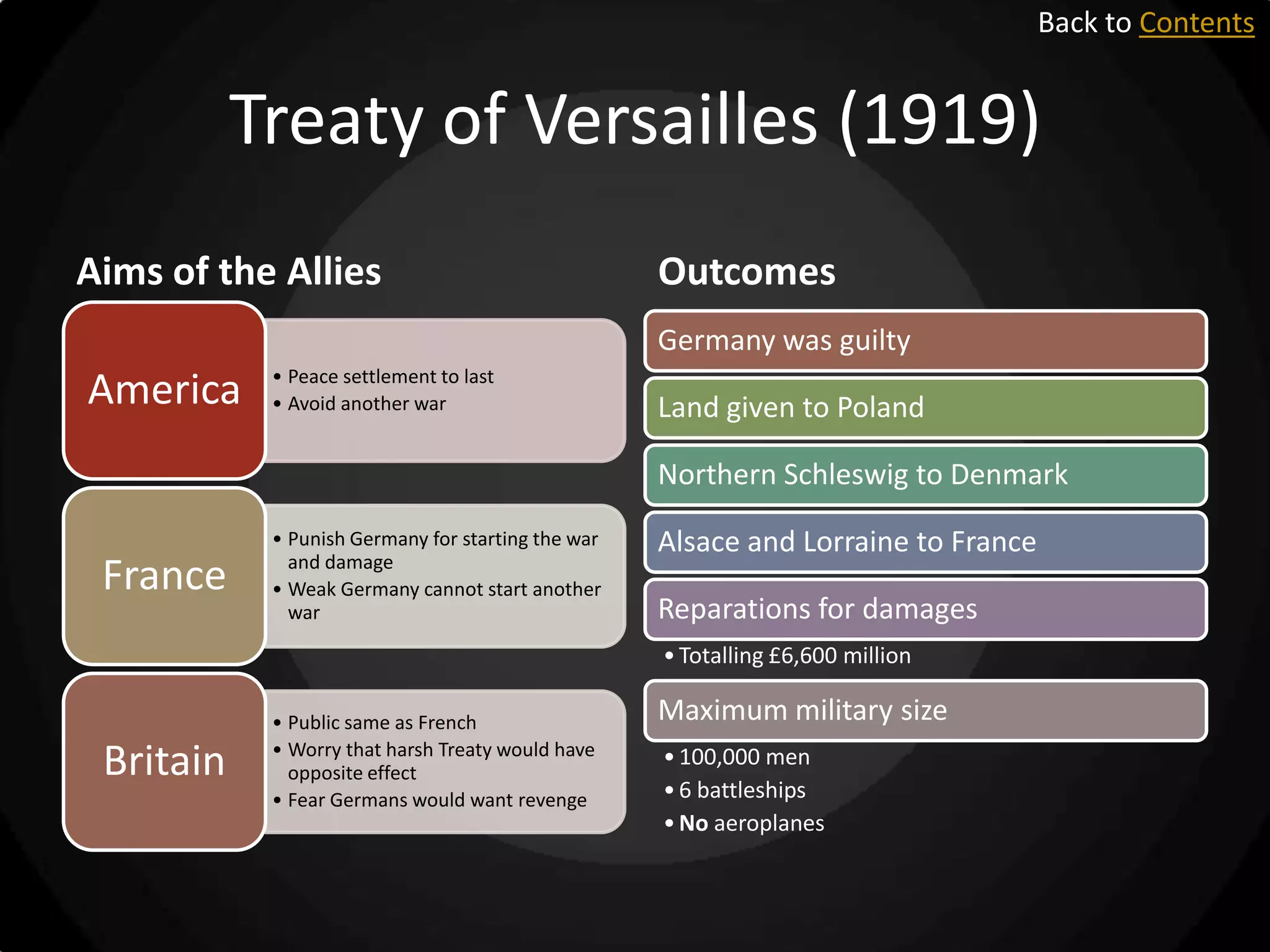
Treaty of Versailles (1919)
Aims of the Allies

Outcomes
Germany was guilty

America

• Peace settlement to last
• Avoid another war

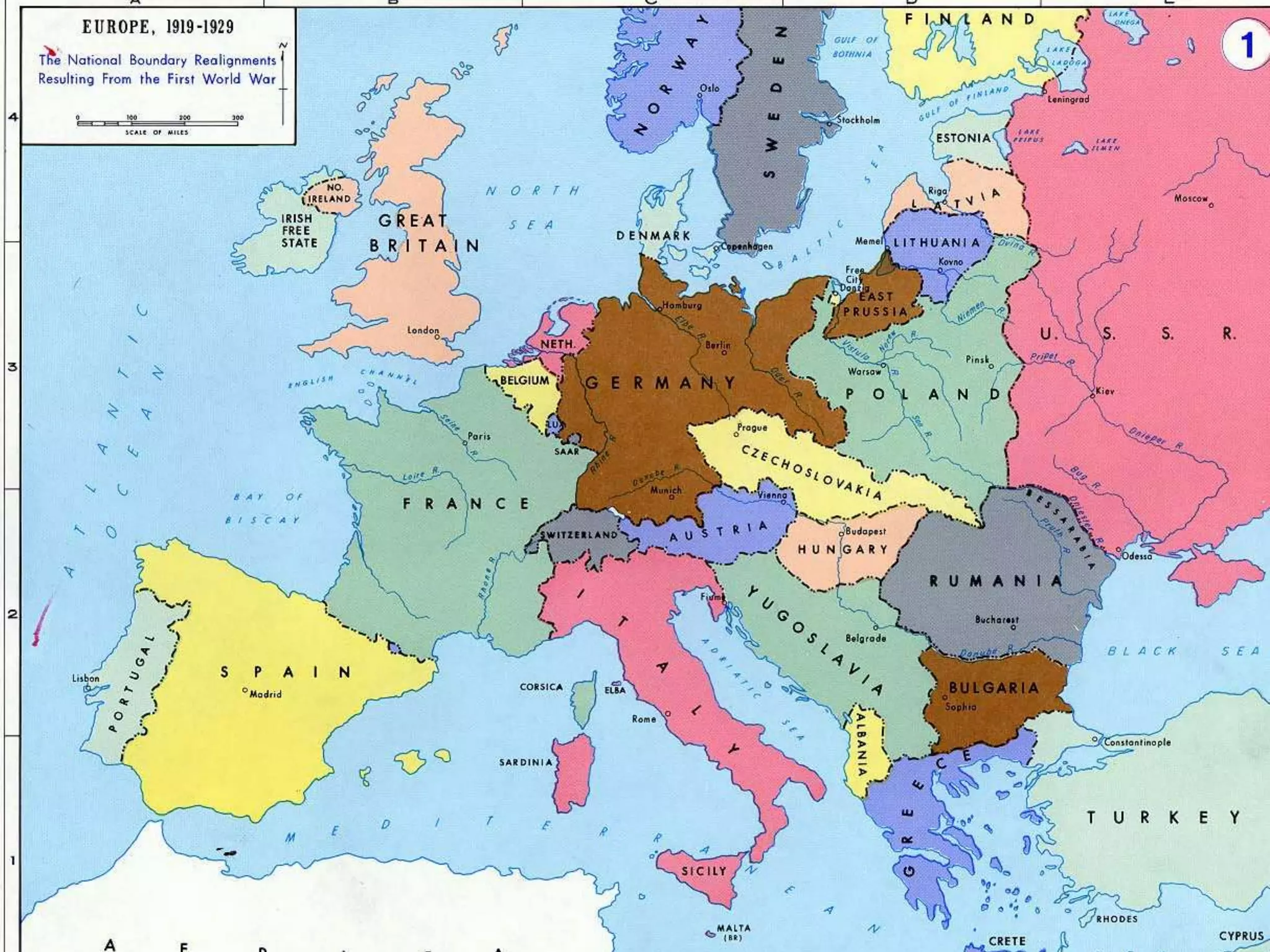
Land given to Poland
Northern Schleswig to Denmark

France

• Punish Germany for starting the war
and damage
• Weak Germany cannot start another
war

Alsace and Lorraine to France
Reparations for damages
• Totalling £6,600 million

Britain

• Public same as French
• Worry that harsh Treaty would have
opposite effect
• Fear Germans would want revenge

Maximum military size
• 100,000 men
• 6 battleships
• No aeroplanes
Back to Contents

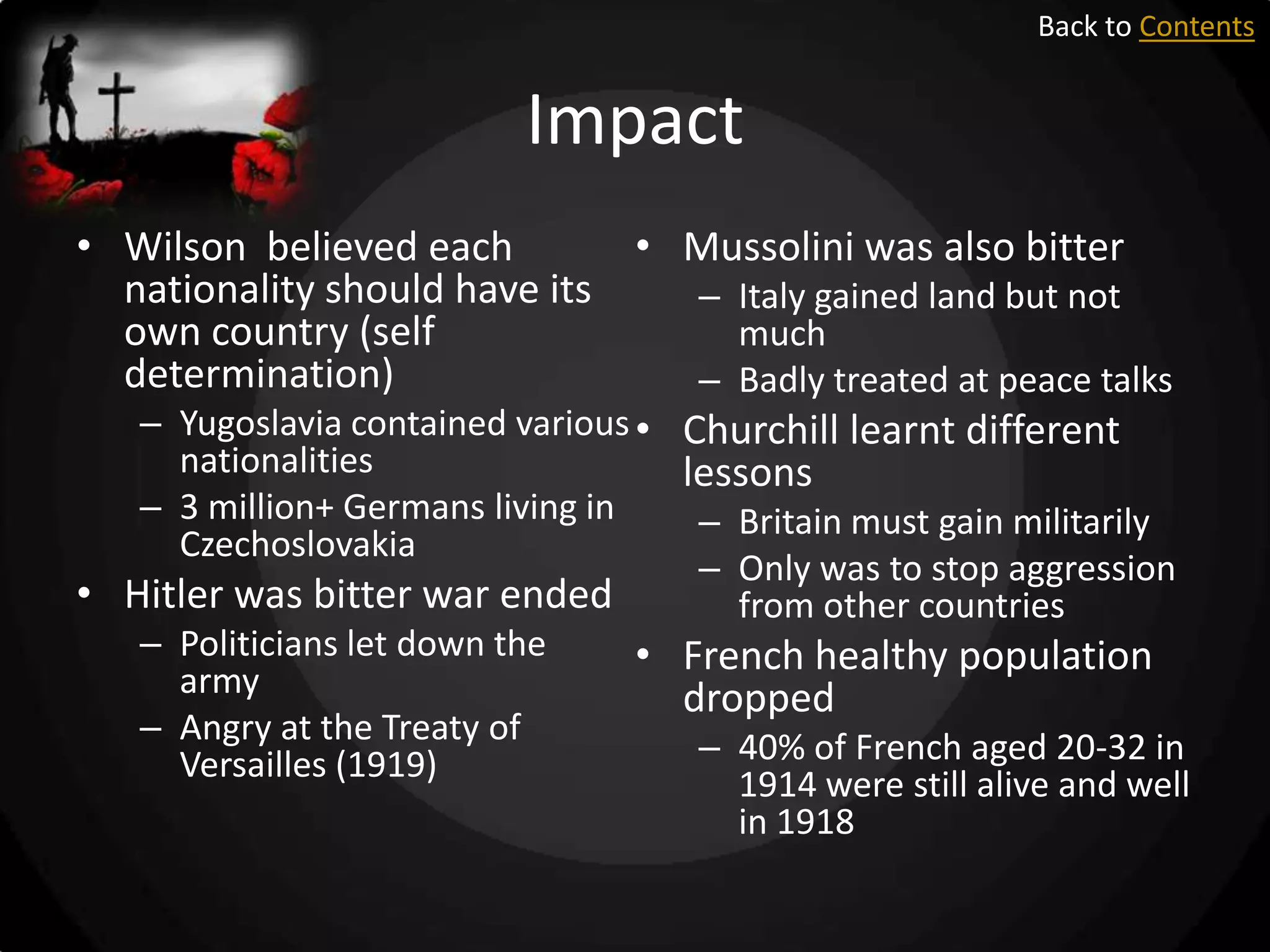
Impact
• Wilson believed each
• Mussolini was also bitter
nationality should have its
– Italy gained land but not
own country (self
much
determination)
– Badly treated at peace talks
– Yugoslavia contained various • Churchill learnt different
nationalities
lessons
– 3 million+ Germans living in
Czechoslovakia

• Hitler was bitter war ended
– Politicians let down the
army
– Angry at the Treaty of
Versailles (1919)

– Britain must gain militarily
– Only was to stop aggression
from other countries

• French healthy population
dropped
– 40% of French aged 20-32 in
1914 were still alive and well
in 1918
Back to Contents

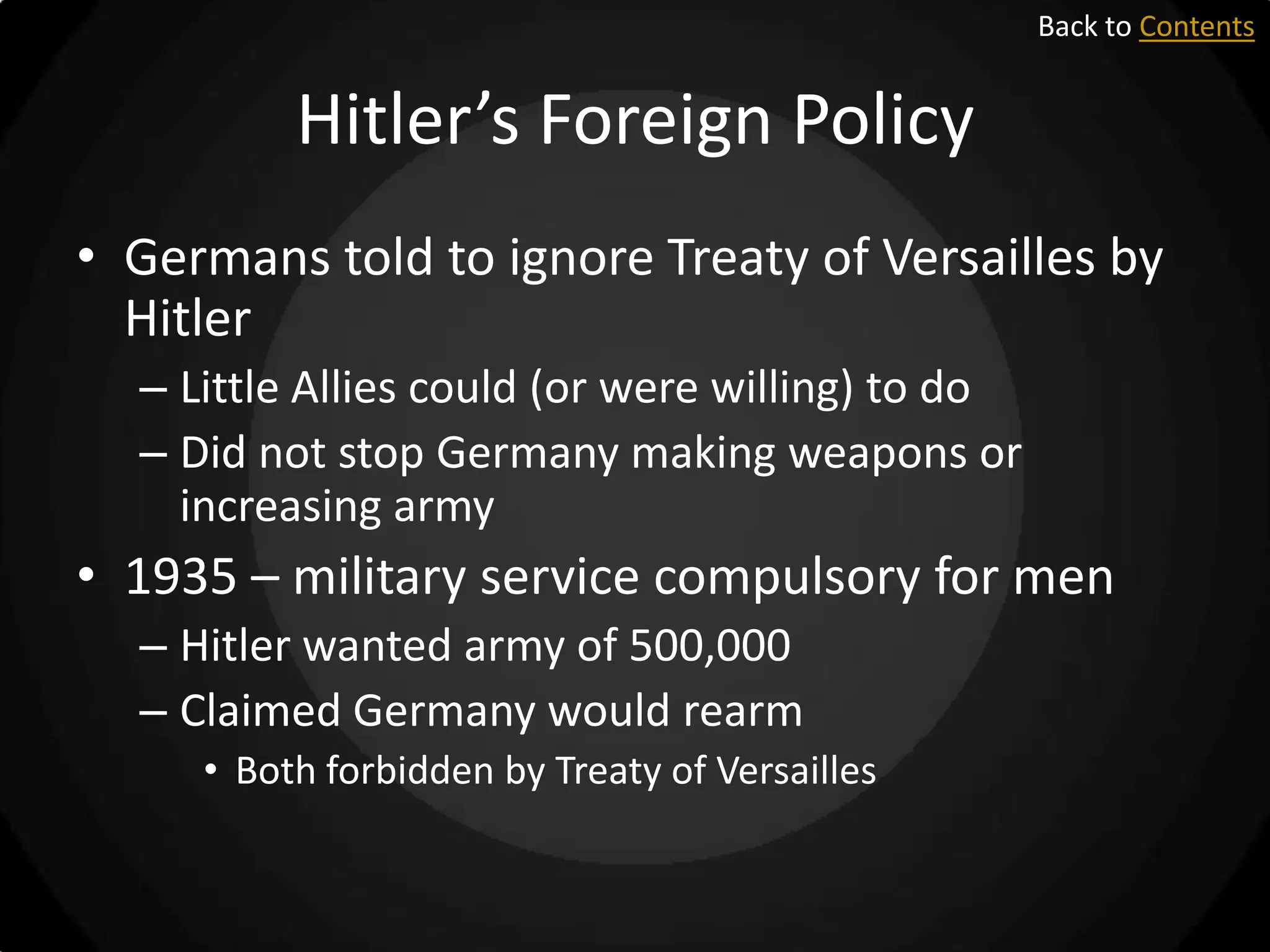
Hitler’s Foreign Policy
• Germans told to ignore Treaty of Versailles by
Hitler
– Little Allies could (or were willing) to do
– Did not stop Germany making weapons or
increasing army

• 1935 – military service compulsory for men
– Hitler wanted army of 500,000
– Claimed Germany would rearm
• Both forbidden by Treaty of Versailles
Back to Contents

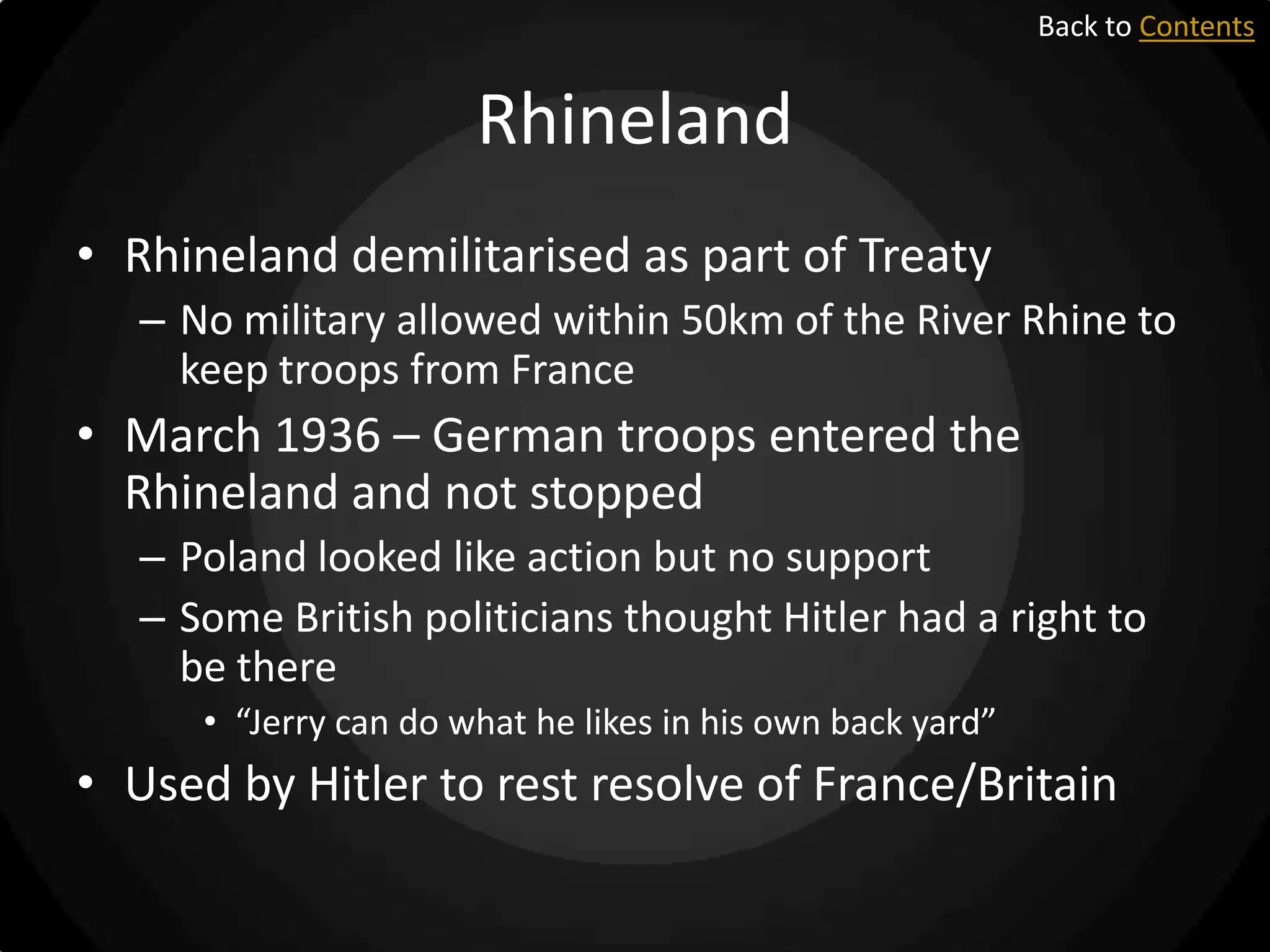
Rhineland
• Rhineland demilitarised as part of Treaty
– No military allowed within 50km of the River Rhine to
keep troops from France

• March 1936 – German troops entered the
Rhineland and not stopped
– Poland looked like action but no support
– Some British politicians thought Hitler had a right to
be there
• “Jerry can do what he likes in his own back yard”

• Used by Hitler to rest resolve of France/Britain
Back to Contents

‘Lebensraum’
• Hitler wanted all Germans on German soil 
master race
• Needed living space (lebensraum) to feed all
these people
– Looked towards Poland and Russia

• Attacking Poland was risky but a surprise attack
from France impossible with troops in the
Rhineland
– Feared fighting 2 fronts like Great War
– Wanted Britain and Italy as allies
Back to Contents

Britain – Italy – Germany Triangle
• Britain foresaw a need to have another ally
(besides France) against Germany
– Italy seemed obvious choice given location etc.

• 1935 – Mussolini attacked Abyssinia which
Britain opposed
– This spoilt any chance of Britain gaining Italy as an
ally
– Hitler also had to choose between Britain and Italy

• 1936 – Rome-Berlin Axis
Back to Contents

Path to War
• 1937
– Japan invades China
– Germany signs a military
agreement with Japan
– The Rape of Nanjing (Nanking) by
Japanese soldiers

• 1938
– Germany announces ‘Anschluss’
with Austria
– German military mobilises
– USSR beat Japan in border conflict
(Battle of Lake Khasan)
– Munich Agreement
– Germany occupies the
Sudetenland
– Kristallnacht

• 1939
–
–
–
–
–
–
–
–
–
–
–

Nazis take over Czechoslovakia
End of Spanish Civil War
‘Pact of Steel’ signed with Italy
Nazis and Soviets sign Pact
Britain and Poland sign a Mutual
Assistance Treaty
Nazis invade Poland
War is declared on Germany
Battle of the Atlantic begins
Soviets invade Poland which is
divided between Germany and
USSR
USSR attacks Finland
USSR expelled from the League of
Nations
Back to Contents

Anschluss
• Hitler was keen to join Germany and Austria
as he was Austrian himself
– But it was banned under the Treaty of Versailles

• Austrian Chancellor wanted to avoid this 
1938 he arranged a plebiscite
– March (day before plebiscite) German soldiers
marched to Austria with no resistance
– Hitler got his Anschluss
Back to Contents

The Sudetenland and the Munich
Agreement
• A fortnight after the
Anschluss, Hitler wanted
the Sudetenland
– 3 million Germans there
– Heavy industry and main
Czech defences

• September 1938 –
Chamberlain flew to
Germany to discuss issue
– In Britain gas masks were
issued and trenches dug in
preparation for air raids
• Nobody wanted war – most
wanted Czechs to give in

• 3 trips were made
– Czechs present but not
taking part in talks
– Britain and France already
decided to give in to Hitler

• Agreement signed 1
October 1938
– “Peace in our time”

• Bookmakers offered odds
of 32:1 against war in
France
– But PM Daladier thought
war was now inevitable
Back to Contents

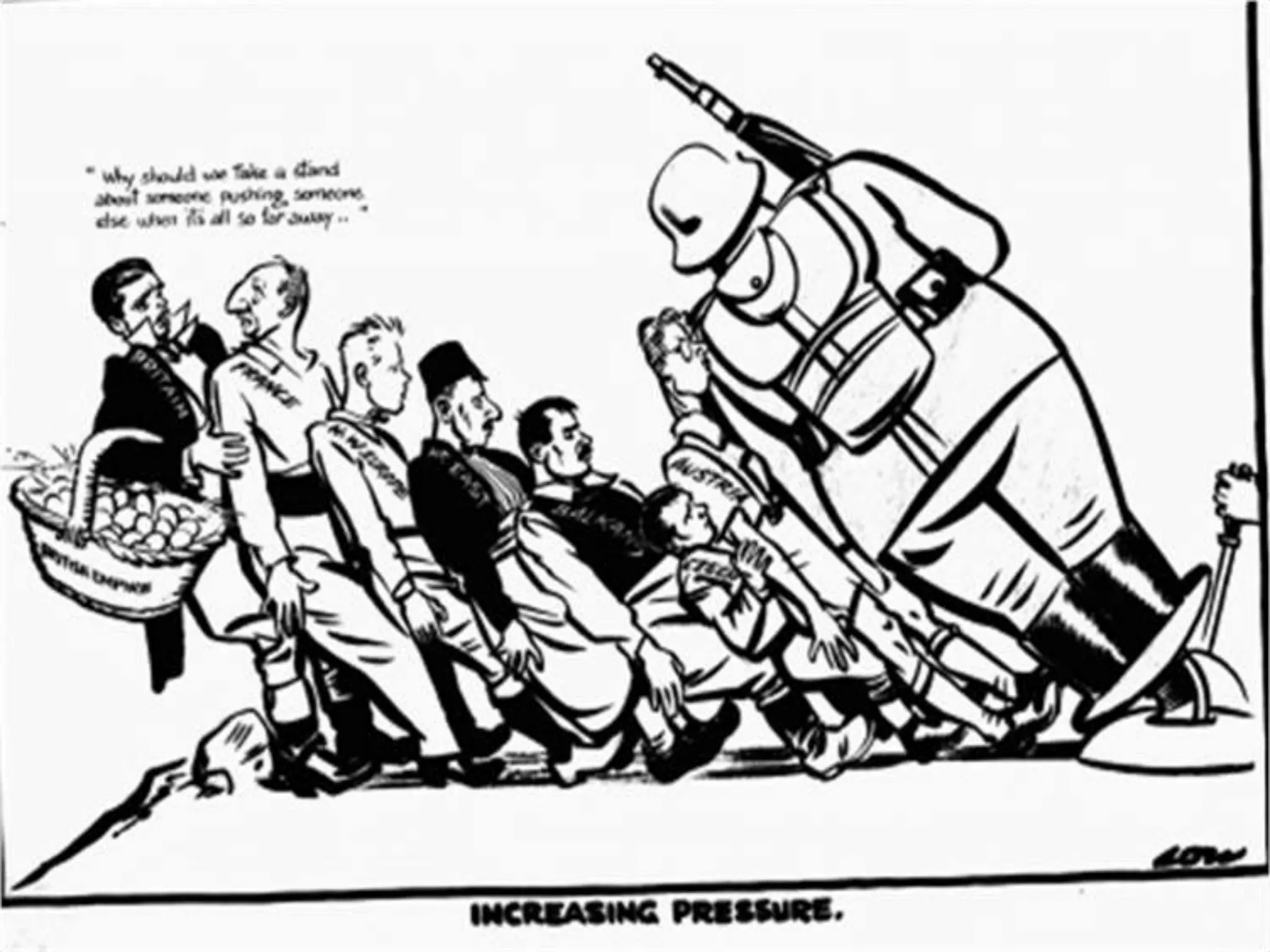
Appeasement
• Popular policy aimed to satisfy
Hitler and prevent war
• Most thought it was fair for
Germany to get what it lost in
Versailles
• Few outside Germany read
Mein Kampf
– Few realised there was no limit
to lebensraum

• Half British Cabinet against
appeasement
– Chamberlain didn’t trust Hitler
– Britain started to rearm from
1937

• Reasons for appeasement’s
popularity:
– Germany had been treated
harshly at Versailles
– Britain too weak for war
– Hitler would stop the
Communists
– Couldn’t help Czechoslovakia
due to its location
– Sacrifice would be worth
making for peace
– USSR too weak and unreliable
as an ally (plus they are
Communist!)
Back to Contents

USSR’s Role
• No invitation to Munich
Agreement
• Communists not trusted by
Western world
• Communists wanted another
war
– Spread communism
– But scared and unready

• USSR in a dangerous position
from the threat of war
– 1934 – joined the League of
Nations
– Couldn’t get support to stand
up to Hitler
– Caused mutual distrust with
West

• Hitler’s invasion of the rest of
Czechoslovakia where Britain
and France did nothing left
USSR vulnerable
– Needed an ally
• Germany or Britain

• Distrust on all sides
– Had talks with Britain but
Britain didn’t think USSR could
stand up to German military
– USSR wondered if Britain and
France would ever stand up to
Germany
– Fear of alliance with Germany
to attack USSR

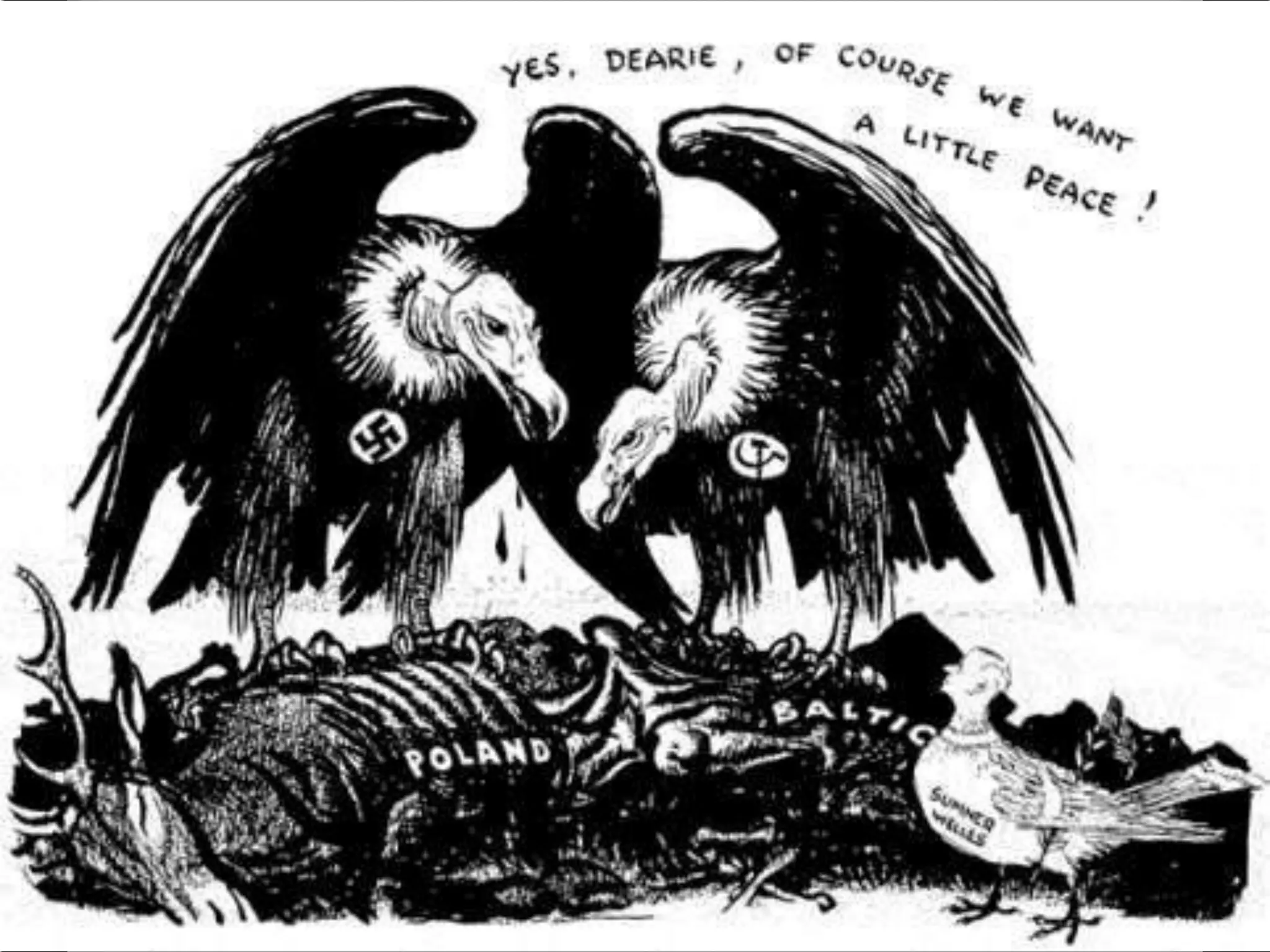
• Stalin allied with Hitler
– Nazi-Soviet Pact (23 August
1939)
Back to Contents

Invasion of Poland
• March 1939 – invasion of Czechoslovakia
– Czechs showed ager by throwing snowballs

• Hitler wanted Polish corridor
• Appeasement had failed
• March – Britain and France promised to support Poland
if attacked
• Early April – Hitler gave secret orders for army to attack
Poland on 1 September 1939
• May – Germany and Italy made the ‘Pact of Steel’
– Mussolini thought war with Poland would lead to a wider
war
– Hitler disagreed: ‘neither England or France will embark
upon a general war’
Back to Contents

Invasion of Poland continued
• Britain was getting ready for
war
– May – all men 20-21 were
conscripted
– June – first young men signed
on
– Newspapers supported this
saying it would make them
fitter

• August – reports of clashes
between German and Polish
troops
– 23rd – USSR signed pact with
Germany, including a secret
pact to carve up Poland
– 24th – Polish mobilised troops

• SS officers disguised as Polish
soldiers took over a German
radio station on the Polish
border with an anti-Hitler
message
• Meant to mean German attack
justified
– Orders to attack signed 8 hours
before

• 1 September – invasion
• 3rd September – war declared
on Germany by Britain and
France
Back to Contents

Propaganda
• British propaganda very effective in WW1
– Goebbels studied this very closely
– 1933 Goebbels became propaganda chief
• sole control over all media (including radio, film, etc.)

• After the war began Britain set up:
– Ministry of Information – propaganda for British
– Another organisation for propaganda aimed at enemy

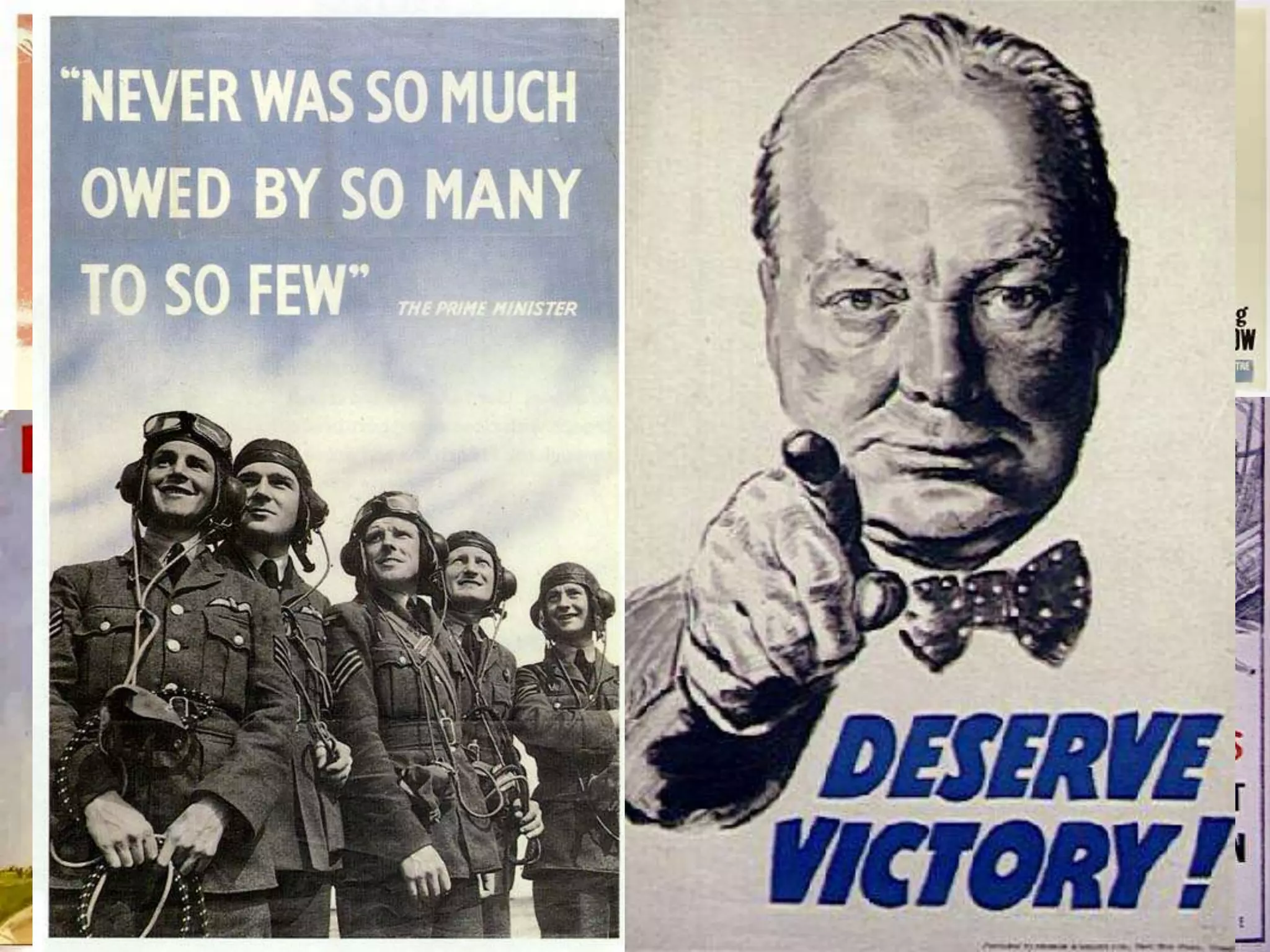
• Posters were always propaganda
• Photographs that showed real events could be
used for propaganda
Back to Contents

Evacuation
• 1 June – 3 September 1939 – 3.5 million moved
house
– Many were newly-weds
– Many were children – 1.5million moved 3 days before
war started
• Accompanied by teachers and mothers if under 5

– Anywhere with room to spare had to have at least 1
child
– Government paid 52 1/2 p/week
– Locals chose evacuees
• Many were middle class while the children were often very
poor
Back to Contents

Evacuation continued
• Stepney – 10% of homes had a bath
• Glasgow – 50% of homes had a bath
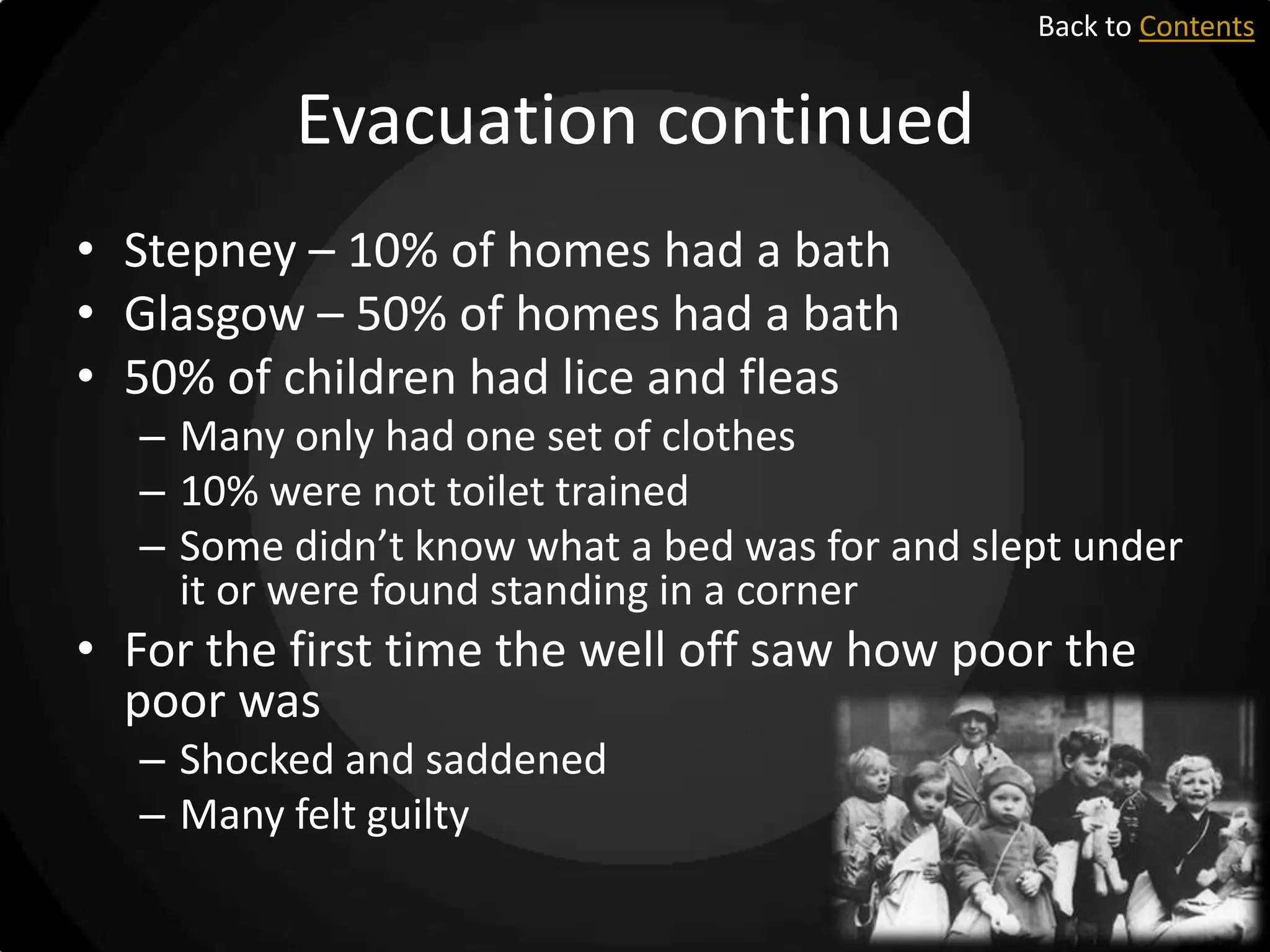
• 50% of children had lice and fleas
– Many only had one set of clothes
– 10% were not toilet trained
– Some didn’t know what a bed was for and slept under
it or were found standing in a corner

• For the first time the well off saw how poor the
poor was
– Shocked and saddened
– Many felt guilty
Back to Contents

Home Front
• Most feared air raids
– Animals also evacuated

• Many feared gas attacks
– Tops of pillow boxes were
pained in gas-sensitive paint
– Gas masks were issued

• From 1 September blackouts
were enforced
• From 3 September there was
conscription for all men 18-41
– Anyone whose jobs were not
vital
– Conscientious objectors not
forced to join

• No rationing until January
1940 – bacon, sugar and
butter
– Meat and tea later in 1940
– Jam in 1941
– Sweets in 1942

• Restaurants rationed from
1942
– Only allowed to serve 1 main
meal
– Meals could cost no more than
25p

• Phoney War
– Blackouts relaxed (dimmed
lights)
– ½ evacuees returned home
Back to Contents

Churchill Takes Over
• Blitzkrieg tactics used effective by Germany
– Poland was invaded and nothing could be done

• April 1940 – Chamberlain: ‘Hitler had missed the
bus’
– Within days. Denmark and Norway were invaded

• 10 May – Chamberlain resigned, replaced by
Churchill
– Germany entered Holland, Belgium, and later,
Luxemburg
– Germany would soon turn onto France
Back to Contents

Dunkirk
• Britain sent an Expeditionary Force to France but
the Germans continued to advance
• French and British troops retreated to the coast
and were surrounded at Dunkirk
• 300,000 were rescued by sea – pleasure boats,
yachts and dinghies
– Called a ‘miracle’ by the newspapers
– But France was soon defeated by Germany (and Italy)
• 22 June – France surrendered to Germany, an agreement
was signed in the same railway carriage as the Treaty of
Versailles
Back to Contents

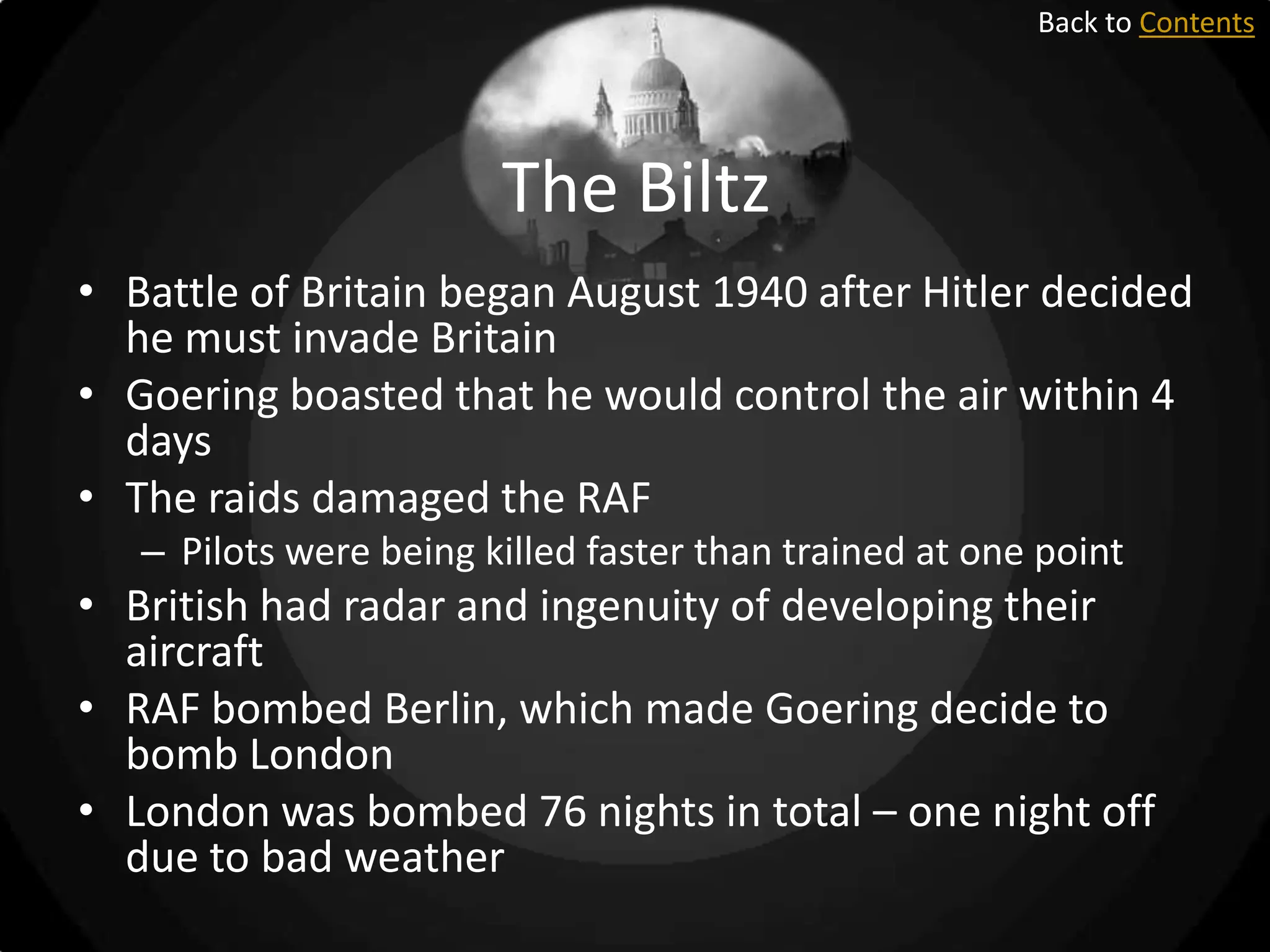
The Biltz
• Battle of Britain began August 1940 after Hitler decided
he must invade Britain
• Goering boasted that he would control the air within 4
days
• The raids damaged the RAF
– Pilots were being killed faster than trained at one point

• British had radar and ingenuity of developing their
aircraft
• RAF bombed Berlin, which made Goering decide to
bomb London
• London was bombed 76 nights in total – one night off
due to bad weather
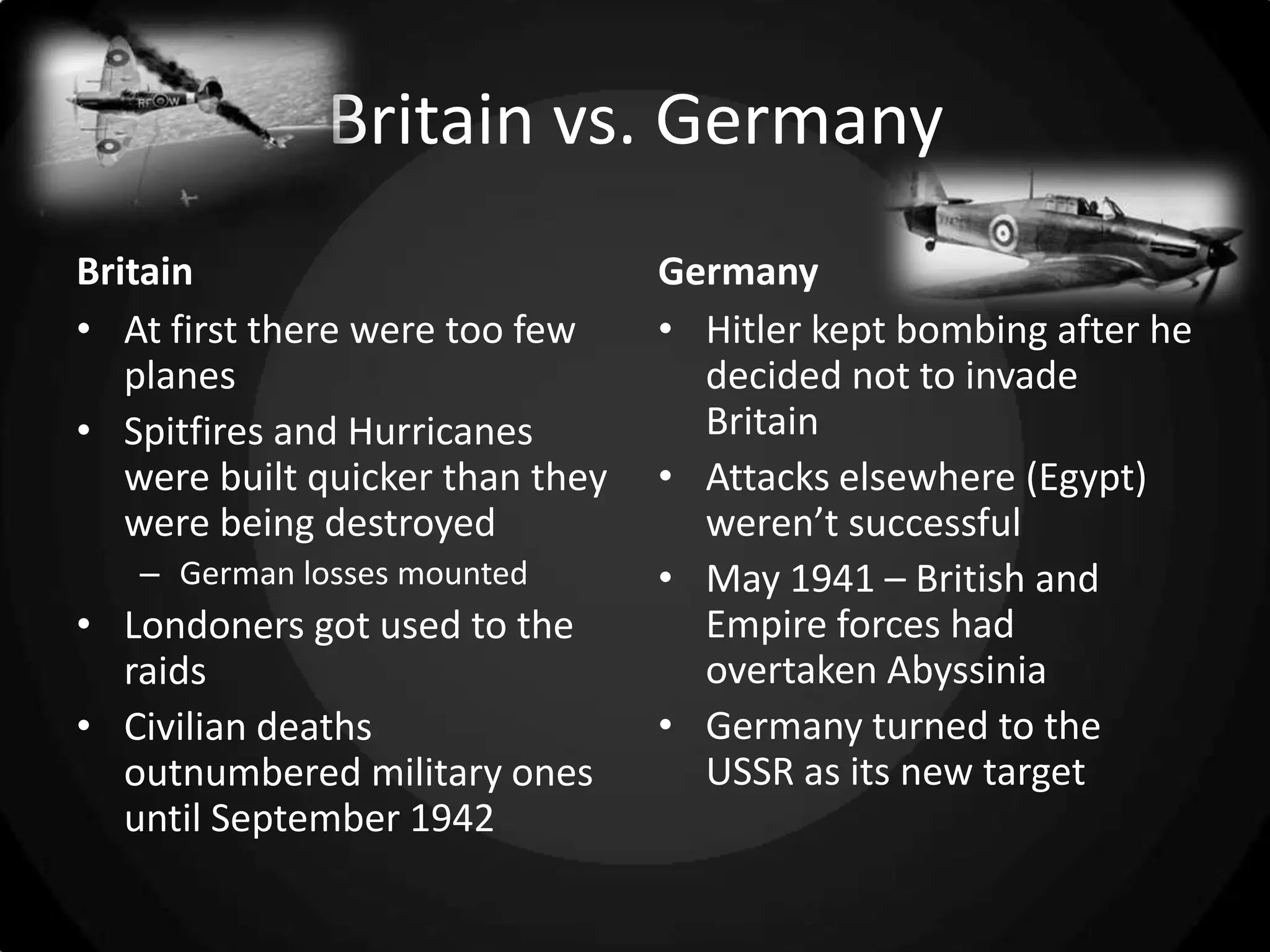
Britain vs. Germany
Britain
• At first there were too few
planes
• Spitfires and Hurricanes
were built quicker than they
were being destroyed
– German losses mounted

• Londoners got used to the
raids
• Civilian deaths
outnumbered military ones
until September 1942

Germany
• Hitler kept bombing after he
decided not to invade
Britain
• Attacks elsewhere (Egypt)
weren’t successful
• May 1941 – British and
Empire forces had
overtaken Abyssinia
• Germany turned to the
USSR as its new target
Back to Contents

Turning Points
• Battle of the Atlantic
– U-boats used to attack merchant ships in 1941
– RAF and the convoy system were used to protect British (and
American) ships

• America Enters the War
– Sinking of American ships helped them join the war
– However, bombing of Pearl Harbour in 1942 was the catalyst
– By May, Japan suffered their first defeat to the US

• Russian Invasion
– Germany’s invasion slowed in 1942 due to Russian resistance and then
winter cold
– Stalingrad battle started in September 1942 and only ended when
German troops disobeyed Hitler in February 1943 and surrendered

• British Success
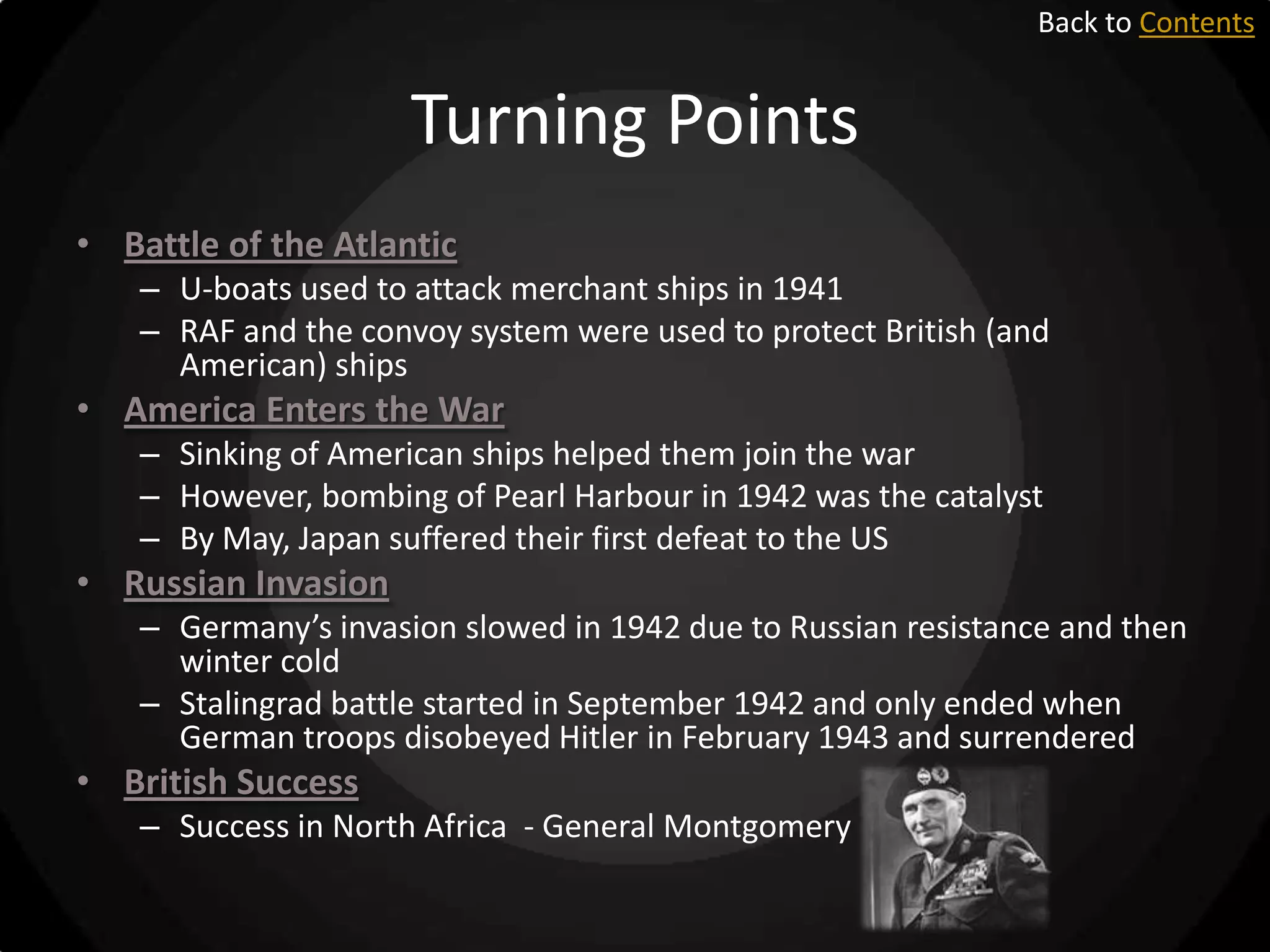
– Success in North Africa - General Montgomery
Back to Contents

British Women
• 1941 saw all unmarried women, 20-30 years old, called up
– WAAF
– Land Army
– Industry

• Better paid and hours in new jobs compared to old
– Men still earned more than women (est. 2/3)

• Better conditions for all – women’s campaigns
• 1942 allowed women to go to Church without hats or stockings –
clothes were rationed
• Relationships were also more relaxed
– Many unmarried women had sexual relationships with soldiers

• Still had some traditional values
– BBC banned a song “I heard you cry last night” because a man crying
was ‘bad’ for morale
– Men resented women’s new freedoms (thought they should be at
home)
Back to Contents

1943-44
• January 1943 – Allies asked
Germany to surrender
unconditionally
– Hitler refused and so fighting
continued

• Soviets pushed Germany out
of the USSR throughout 1943
– Two villages wiped out
completely
– Millions living in holes in the
ground
– Million people had died at
Leningrad alone

• Anglo-American troops
crossed from Africa to the
Mediterranean  towards
Italy

• Mussolini was rescued by
Germans in September 1943
– Italy was split into two halves;
both at war with each other

• D-Day (6 June 1944) was to
attack Germany from the west
• 150,000 troops landed that
day – to increase to millions
within a month
– Hitler received reports but
dismissed them

• August 1944 – Paris was
liberated
• By December, the Allies had
pushed on to the German
borders
Back to Contents

The Legacy of War in Britain
• Britain had lost as much as Germany
– In fact Germany could completely rebuilt whereas Britain just
‘patched up’

• Britain had bigger debts than any other country by 1945
– £1100million from America

• Rationing continued until 1954
• Emergence of a welfare system
– Beveridge Report
– 1948 – NHS was set up

• France and Italy was exporting twice the rate of Britain
– Out of date machinery and technology
– Industry was also out of date (e.g. shipbuilding)

• Erosion of world status – Empire erosion and World Power
status

The era of the second world war

  • 2.
    Contents • The Legacyof the Great War • – Treaty of Versailles (1919) • – Impact • • Hitler’s Foreign Policy • – Rhineland • – ‘Lebensraum’ • – Britain-Italy-Germany Triangle • • – Anschluss – Sudetenland and the Munich• Agreement • • Appeasement • • Path to War USSR’s Role Invasion of Poland Propaganda Evacuation Home Front Churchill Takes Over – Dunkirk The Blitz Turning Points in WW2 British Women in the war 1943-1944 The Legacy of War in Britain
  • 3.
    Back to Contents TheLegacy of the Great War • WW1 ended November 1918 • Treaty of Versailles (28 June 1918) – Decision made by Allies – Germans not invited • Versailles was first of a series of agreements • 1919 – separate treaties with Austria-Hungary and Bulgaria • 1920 – treaty with Turkey
  • 5.
    Back to Contents Treatyof Versailles (1919) Aims of the Allies Outcomes Germany was guilty America • Peace settlement to last • Avoid another war Land given to Poland Northern Schleswig to Denmark France • Punish Germany for starting the war and damage • Weak Germany cannot start another war Alsace and Lorraine to France Reparations for damages • Totalling £6,600 million Britain • Public same as French • Worry that harsh Treaty would have opposite effect • Fear Germans would want revenge Maximum military size • 100,000 men • 6 battleships • No aeroplanes
  • 6.
    Back to Contents Impact •Wilson believed each • Mussolini was also bitter nationality should have its – Italy gained land but not own country (self much determination) – Badly treated at peace talks – Yugoslavia contained various • Churchill learnt different nationalities lessons – 3 million+ Germans living in Czechoslovakia • Hitler was bitter war ended – Politicians let down the army – Angry at the Treaty of Versailles (1919) – Britain must gain militarily – Only was to stop aggression from other countries • French healthy population dropped – 40% of French aged 20-32 in 1914 were still alive and well in 1918
  • 7.
    Back to Contents Hitler’sForeign Policy • Germans told to ignore Treaty of Versailles by Hitler – Little Allies could (or were willing) to do – Did not stop Germany making weapons or increasing army • 1935 – military service compulsory for men – Hitler wanted army of 500,000 – Claimed Germany would rearm • Both forbidden by Treaty of Versailles
  • 8.
    Back to Contents Rhineland •Rhineland demilitarised as part of Treaty – No military allowed within 50km of the River Rhine to keep troops from France • March 1936 – German troops entered the Rhineland and not stopped – Poland looked like action but no support – Some British politicians thought Hitler had a right to be there • “Jerry can do what he likes in his own back yard” • Used by Hitler to rest resolve of France/Britain
  • 9.
    Back to Contents ‘Lebensraum’ •Hitler wanted all Germans on German soil  master race • Needed living space (lebensraum) to feed all these people – Looked towards Poland and Russia • Attacking Poland was risky but a surprise attack from France impossible with troops in the Rhineland – Feared fighting 2 fronts like Great War – Wanted Britain and Italy as allies
  • 10.
    Back to Contents Britain– Italy – Germany Triangle • Britain foresaw a need to have another ally (besides France) against Germany – Italy seemed obvious choice given location etc. • 1935 – Mussolini attacked Abyssinia which Britain opposed – This spoilt any chance of Britain gaining Italy as an ally – Hitler also had to choose between Britain and Italy • 1936 – Rome-Berlin Axis
  • 11.
    Back to Contents Pathto War • 1937 – Japan invades China – Germany signs a military agreement with Japan – The Rape of Nanjing (Nanking) by Japanese soldiers • 1938 – Germany announces ‘Anschluss’ with Austria – German military mobilises – USSR beat Japan in border conflict (Battle of Lake Khasan) – Munich Agreement – Germany occupies the Sudetenland – Kristallnacht • 1939 – – – – – – – – – – – Nazis take over Czechoslovakia End of Spanish Civil War ‘Pact of Steel’ signed with Italy Nazis and Soviets sign Pact Britain and Poland sign a Mutual Assistance Treaty Nazis invade Poland War is declared on Germany Battle of the Atlantic begins Soviets invade Poland which is divided between Germany and USSR USSR attacks Finland USSR expelled from the League of Nations
  • 13.
    Back to Contents Anschluss •Hitler was keen to join Germany and Austria as he was Austrian himself – But it was banned under the Treaty of Versailles • Austrian Chancellor wanted to avoid this  1938 he arranged a plebiscite – March (day before plebiscite) German soldiers marched to Austria with no resistance – Hitler got his Anschluss
  • 14.
    Back to Contents TheSudetenland and the Munich Agreement • A fortnight after the Anschluss, Hitler wanted the Sudetenland – 3 million Germans there – Heavy industry and main Czech defences • September 1938 – Chamberlain flew to Germany to discuss issue – In Britain gas masks were issued and trenches dug in preparation for air raids • Nobody wanted war – most wanted Czechs to give in • 3 trips were made – Czechs present but not taking part in talks – Britain and France already decided to give in to Hitler • Agreement signed 1 October 1938 – “Peace in our time” • Bookmakers offered odds of 32:1 against war in France – But PM Daladier thought war was now inevitable
  • 16.
    Back to Contents Appeasement •Popular policy aimed to satisfy Hitler and prevent war • Most thought it was fair for Germany to get what it lost in Versailles • Few outside Germany read Mein Kampf – Few realised there was no limit to lebensraum • Half British Cabinet against appeasement – Chamberlain didn’t trust Hitler – Britain started to rearm from 1937 • Reasons for appeasement’s popularity: – Germany had been treated harshly at Versailles – Britain too weak for war – Hitler would stop the Communists – Couldn’t help Czechoslovakia due to its location – Sacrifice would be worth making for peace – USSR too weak and unreliable as an ally (plus they are Communist!)
  • 17.
    Back to Contents USSR’sRole • No invitation to Munich Agreement • Communists not trusted by Western world • Communists wanted another war – Spread communism – But scared and unready • USSR in a dangerous position from the threat of war – 1934 – joined the League of Nations – Couldn’t get support to stand up to Hitler – Caused mutual distrust with West • Hitler’s invasion of the rest of Czechoslovakia where Britain and France did nothing left USSR vulnerable – Needed an ally • Germany or Britain • Distrust on all sides – Had talks with Britain but Britain didn’t think USSR could stand up to German military – USSR wondered if Britain and France would ever stand up to Germany – Fear of alliance with Germany to attack USSR • Stalin allied with Hitler – Nazi-Soviet Pact (23 August 1939)
  • 19.
    Back to Contents Invasionof Poland • March 1939 – invasion of Czechoslovakia – Czechs showed ager by throwing snowballs • Hitler wanted Polish corridor • Appeasement had failed • March – Britain and France promised to support Poland if attacked • Early April – Hitler gave secret orders for army to attack Poland on 1 September 1939 • May – Germany and Italy made the ‘Pact of Steel’ – Mussolini thought war with Poland would lead to a wider war – Hitler disagreed: ‘neither England or France will embark upon a general war’
  • 20.
    Back to Contents Invasionof Poland continued • Britain was getting ready for war – May – all men 20-21 were conscripted – June – first young men signed on – Newspapers supported this saying it would make them fitter • August – reports of clashes between German and Polish troops – 23rd – USSR signed pact with Germany, including a secret pact to carve up Poland – 24th – Polish mobilised troops • SS officers disguised as Polish soldiers took over a German radio station on the Polish border with an anti-Hitler message • Meant to mean German attack justified – Orders to attack signed 8 hours before • 1 September – invasion • 3rd September – war declared on Germany by Britain and France
  • 22.
    Back to Contents Propaganda •British propaganda very effective in WW1 – Goebbels studied this very closely – 1933 Goebbels became propaganda chief • sole control over all media (including radio, film, etc.) • After the war began Britain set up: – Ministry of Information – propaganda for British – Another organisation for propaganda aimed at enemy • Posters were always propaganda • Photographs that showed real events could be used for propaganda
  • 24.
    Back to Contents Evacuation •1 June – 3 September 1939 – 3.5 million moved house – Many were newly-weds – Many were children – 1.5million moved 3 days before war started • Accompanied by teachers and mothers if under 5 – Anywhere with room to spare had to have at least 1 child – Government paid 52 1/2 p/week – Locals chose evacuees • Many were middle class while the children were often very poor
  • 25.
    Back to Contents Evacuationcontinued • Stepney – 10% of homes had a bath • Glasgow – 50% of homes had a bath • 50% of children had lice and fleas – Many only had one set of clothes – 10% were not toilet trained – Some didn’t know what a bed was for and slept under it or were found standing in a corner • For the first time the well off saw how poor the poor was – Shocked and saddened – Many felt guilty
  • 26.
    Back to Contents HomeFront • Most feared air raids – Animals also evacuated • Many feared gas attacks – Tops of pillow boxes were pained in gas-sensitive paint – Gas masks were issued • From 1 September blackouts were enforced • From 3 September there was conscription for all men 18-41 – Anyone whose jobs were not vital – Conscientious objectors not forced to join • No rationing until January 1940 – bacon, sugar and butter – Meat and tea later in 1940 – Jam in 1941 – Sweets in 1942 • Restaurants rationed from 1942 – Only allowed to serve 1 main meal – Meals could cost no more than 25p • Phoney War – Blackouts relaxed (dimmed lights) – ½ evacuees returned home
  • 27.
    Back to Contents ChurchillTakes Over • Blitzkrieg tactics used effective by Germany – Poland was invaded and nothing could be done • April 1940 – Chamberlain: ‘Hitler had missed the bus’ – Within days. Denmark and Norway were invaded • 10 May – Chamberlain resigned, replaced by Churchill – Germany entered Holland, Belgium, and later, Luxemburg – Germany would soon turn onto France
  • 28.
    Back to Contents Dunkirk •Britain sent an Expeditionary Force to France but the Germans continued to advance • French and British troops retreated to the coast and were surrounded at Dunkirk • 300,000 were rescued by sea – pleasure boats, yachts and dinghies – Called a ‘miracle’ by the newspapers – But France was soon defeated by Germany (and Italy) • 22 June – France surrendered to Germany, an agreement was signed in the same railway carriage as the Treaty of Versailles
  • 29.
    Back to Contents TheBiltz • Battle of Britain began August 1940 after Hitler decided he must invade Britain • Goering boasted that he would control the air within 4 days • The raids damaged the RAF – Pilots were being killed faster than trained at one point • British had radar and ingenuity of developing their aircraft • RAF bombed Berlin, which made Goering decide to bomb London • London was bombed 76 nights in total – one night off due to bad weather
  • 30.
    Britain vs. Germany Britain •At first there were too few planes • Spitfires and Hurricanes were built quicker than they were being destroyed – German losses mounted • Londoners got used to the raids • Civilian deaths outnumbered military ones until September 1942 Germany • Hitler kept bombing after he decided not to invade Britain • Attacks elsewhere (Egypt) weren’t successful • May 1941 – British and Empire forces had overtaken Abyssinia • Germany turned to the USSR as its new target
  • 32.
    Back to Contents TurningPoints • Battle of the Atlantic – U-boats used to attack merchant ships in 1941 – RAF and the convoy system were used to protect British (and American) ships • America Enters the War – Sinking of American ships helped them join the war – However, bombing of Pearl Harbour in 1942 was the catalyst – By May, Japan suffered their first defeat to the US • Russian Invasion – Germany’s invasion slowed in 1942 due to Russian resistance and then winter cold – Stalingrad battle started in September 1942 and only ended when German troops disobeyed Hitler in February 1943 and surrendered • British Success – Success in North Africa - General Montgomery
  • 33.
    Back to Contents BritishWomen • 1941 saw all unmarried women, 20-30 years old, called up – WAAF – Land Army – Industry • Better paid and hours in new jobs compared to old – Men still earned more than women (est. 2/3) • Better conditions for all – women’s campaigns • 1942 allowed women to go to Church without hats or stockings – clothes were rationed • Relationships were also more relaxed – Many unmarried women had sexual relationships with soldiers • Still had some traditional values – BBC banned a song “I heard you cry last night” because a man crying was ‘bad’ for morale – Men resented women’s new freedoms (thought they should be at home)
  • 34.
    Back to Contents 1943-44 •January 1943 – Allies asked Germany to surrender unconditionally – Hitler refused and so fighting continued • Soviets pushed Germany out of the USSR throughout 1943 – Two villages wiped out completely – Millions living in holes in the ground – Million people had died at Leningrad alone • Anglo-American troops crossed from Africa to the Mediterranean  towards Italy • Mussolini was rescued by Germans in September 1943 – Italy was split into two halves; both at war with each other • D-Day (6 June 1944) was to attack Germany from the west • 150,000 troops landed that day – to increase to millions within a month – Hitler received reports but dismissed them • August 1944 – Paris was liberated • By December, the Allies had pushed on to the German borders
  • 35.
    Back to Contents TheLegacy of War in Britain • Britain had lost as much as Germany – In fact Germany could completely rebuilt whereas Britain just ‘patched up’ • Britain had bigger debts than any other country by 1945 – £1100million from America • Rationing continued until 1954 • Emergence of a welfare system – Beveridge Report – 1948 – NHS was set up • France and Italy was exporting twice the rate of Britain – Out of date machinery and technology – Industry was also out of date (e.g. shipbuilding) • Erosion of world status – Empire erosion and World Power status

Editor's Notes

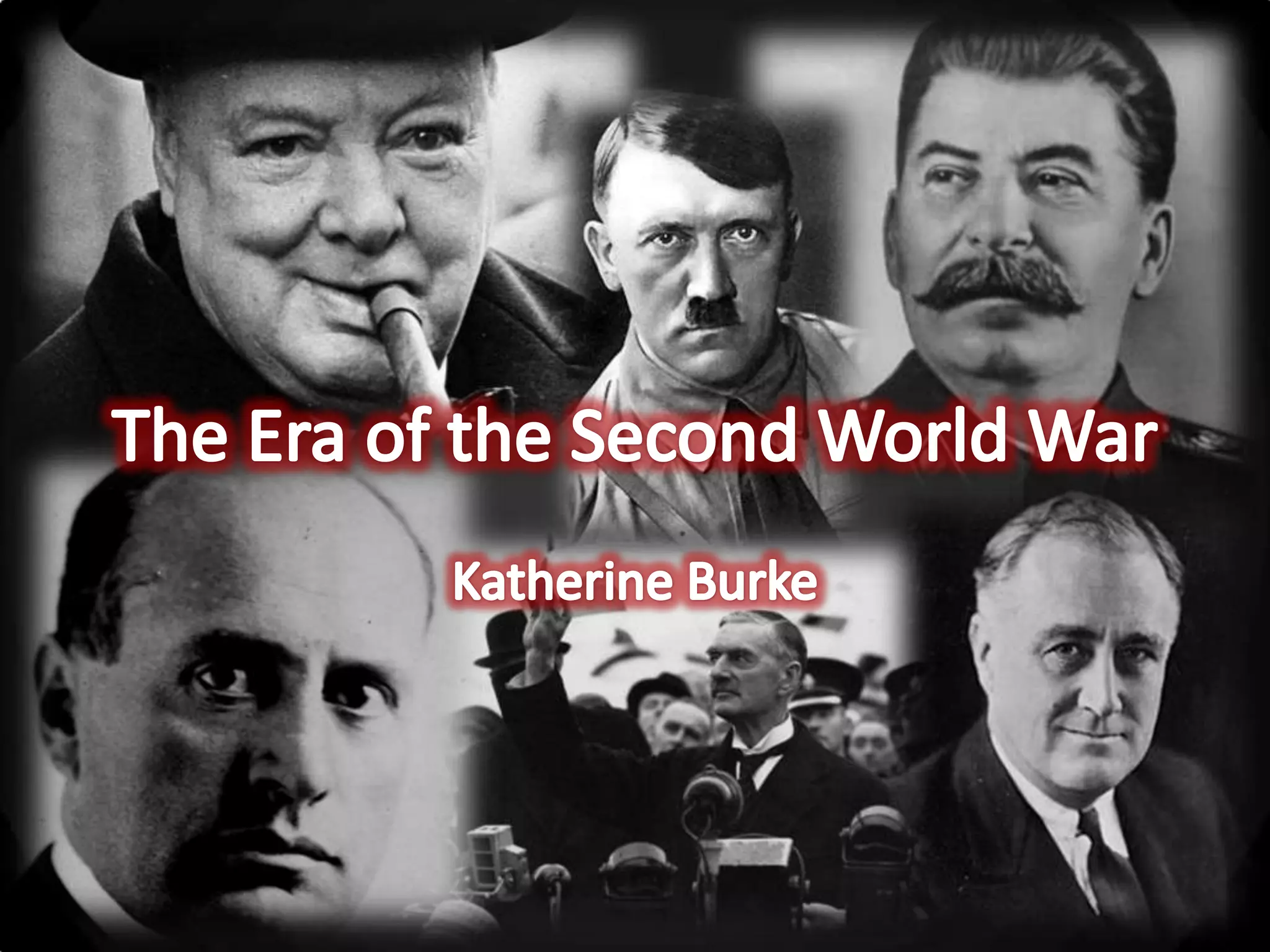
  • #2 Churchill, Hitler, StalinMussolini, Chamberlain, Roosevelt