
GLUTAMATE
GABA
Presentation: Dr. B Ooha Susmita
Chairperson: Dr. Sarath
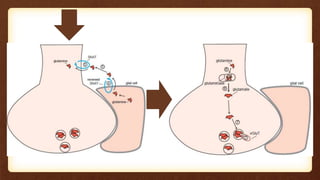
• Glutamate or Glutamic acid is an amino acid neurotransmitter
• Main role in the body- as a building block for other amino acids
• As a neurotransmitter- excitatory function in up to 80% of brain
synapses
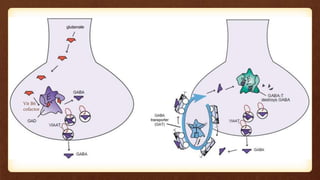
• Gamma-aminobutyric acid is a neurotransmitter found exclusively in
the CNS
• Principal inhibitory neurotransmitter in the brain
GABA
Glutamate
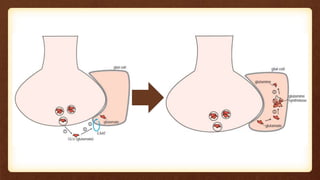
Synthesis & Metabolism
Vit B6
cofactor
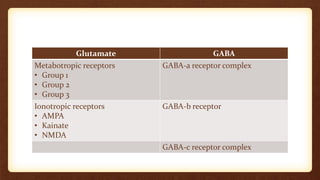
Receptors
Glutamate GABA
Metabotropic receptors
• Group 1
• Group 2
• Group 3
GABA-a receptor complex
Ionotropic receptors
• AMPA
• Kainate
• NMDA
GABA-b receptor
GABA-c receptor complex
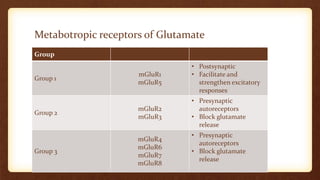
Metabotropic receptors of Glutamate
Group
Group 1
mGluR1
mGluR5
• Postsynaptic
• Facilitate and
strengthen excitatory
responses
Group 2
mGluR2
mGluR3
• Presynaptic
autoreceptors
• Block glutamate
release
Group 3
mGluR4
mGluR6
mGluR7
mGluR8
• Presynaptic
autoreceptors
• Block glutamate
release
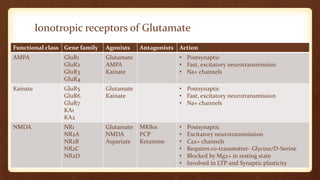
Ionotropic receptors of Glutamate
Functional class Gene family Agonists Antagonists Action
AMPA GluR1
GluR2
GluR3
GluR4
Glutamate
AMPA
Kainate
• Postsynaptic
• Fast, excitatory neurotransmission
• Na+ channels
Kainate GluR5
GluR6
GluR7
KA1
KA2
Glutamate
Kainate
• Postsynaptic
• Fast, excitatory neurotransmission
• Na+ channels
NMDA NR1
NR2A
NR2B
NR2C
NR2D
Glutamate
NMDA
Aspartate
MK801
PCP
Ketamine
• Postsynaptic
• Excitatory neurotransmission
• Ca2+ channels
• Requires co-transmitter- Glycine/D-Serine
• Blocked by Mg2+ in resting state
• Involved in LTP and Synaptic plasticity
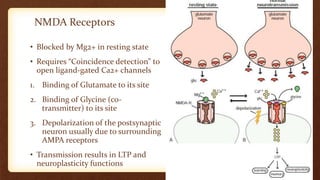
NMDA Receptors
• Blocked by Mg2+ in resting state
• Requires “Coincidence detection” to
open ligand-gated Ca2+ channels
1. Binding of Glutamate to its site
2. Binding of Glycine (co-
transmitter) to its site
3. Depolarization of the postsynaptic
neuron usually due to surrounding
AMPA receptors
• Transmission results in LTP and
neuroplasticity functions
Excitotoxicity
• Excitotoxicity relates to the hypothesis that excessive stimulation of
glutamate receptors leads to prolonged and excessive intraneuronal
concentrations of calcium and NO.
• Such conditions activate many enzymes (especially proteases) that are
destructive to neuronal integrity.
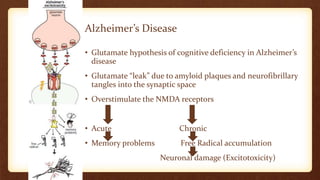
Alzheimer’s Disease
• Glutamate hypothesis of cognitive deficiency in Alzheimer’s
disease
• Glutamate “leak” due to amyloid plaques and neurofibrillary
tangles into the synaptic space
• Overstimulate the NMDA receptors
• Acute Chronic
• Memory problems Free Radical accumulation
Neuronal damage (Excitotoxicity)
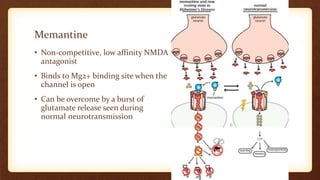
Memantine
• Non-competitive, low affinity NMDA
antagonist
• Binds to Mg2+ binding site when the
channel is open
• Can be overcome by a burst of
glutamate release seen during
normal neurotransmission
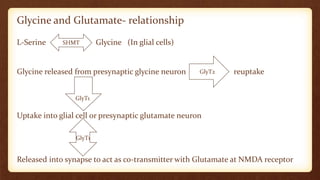
Glycine and Glutamate- relationship
L-Serine Glycine (In glial cells)
Glycine released from presynaptic glycine neuron reuptake
Uptake into glial cell or presynaptic glutamate neuron
Released into synapse to act as co-transmitter with Glutamate at NMDA receptor
SHMT
GlyT2
GlyT1
GlyT1
Phobic disorder
• The extinction of conditioned fear has been shown to be an active
process mediated by the activation of NMDA receptors in the
amygdala.
• In a study, D-Cycloserine (partial agonist at Glycine binding site of
NMDA receptor) plus CBT resulted in a highly significant reduction in
acrophobic symptoms that persisted for at least 3 months as compared
to placebo plus CBT.
• Other placebo-controlled clinical trials support the notion that n-
cycloserine is a robust enhancer of CBT, suggesting that
pharmacologically augmenting neural plasticity may be used to bolster
psychological interventions.
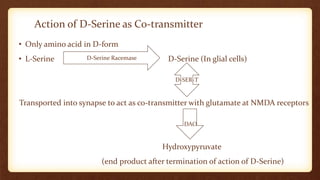
Action of D-Serine as Co-transmitter
• Only amino acid in D-form
• L-Serine D-Serine (In glial cells)
Transported into synapse to act as co-transmitter with glutamate at NMDA receptors
Hydroxypyruvate
(end product after termination of action of D-Serine)
D-Serine Racemase
D-SER-T
DAO
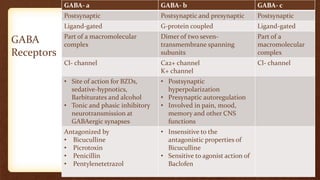
GABA
Receptors
GABA- a GABA- b GABA- c
Postsynaptic Postsynaptic and presynaptic Postsynaptic
Ligand-gated G-protein coupled Ligand-gated
Part of a macromolecular
complex
Dimer of two seven-
transmembrane spanning
subunits
Part of a
macromolecular
complex
Cl- channel Ca2+ channel
K+ channel
Cl- channel
• Site of action for BZDs,
sedative-hypnotics,
Barbiturates and alcohol
• Tonic and phasic inhibitory
neurotransmission at
GABAergic synapses
• Postsynaptic
hyperpolarization
• Presynaptic autoregulation
• Involved in pain, mood,
memory and other CNS
functions
Antagonized by
• Bicuculline
• Picrotoxin
• Penicillin
• Pentylenetetrazol
• Insensitive to the
antagonistic properties of
Bicuculline
• Sensitive to agonist action of
Baclofen
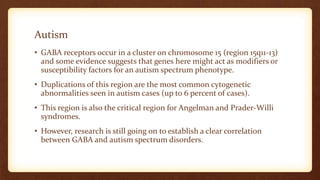
Autism
• GABA receptors occur in a cluster on chromosome 15 (region 15q11-13)
and some evidence suggests that genes here might act as modifiers or
susceptibility factors for an autism spectrum phenotype.
• Duplications of this region are the most common cytogenetic
abnormalities seen in autism cases (up to 6 percent of cases).
• This region is also the critical region for Angelman and Prader-Willi
syndromes.
• However, research is still going on to establish a clear correlation
between GABA and autism spectrum disorders.
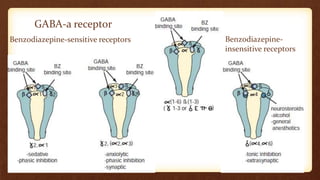
GABA-a receptor
Benzodiazepine-sensitive receptors Benzodiazepine-
insensitive receptors
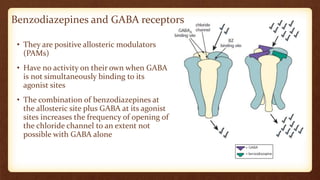
Benzodiazepines and GABA receptors
• They are positive allosteric modulators
(PAMs)
• Have no activity on their own when GABA
is not simultaneously binding to its
agonist sites
• The combination of benzodiazepines at
the allosteric site plus GABA at its agonist
sites increases the frequency of opening of
the chloride channel to an extent not
possible with GABA alone
Anxiety
• GABA is strongly implicated due to the efficacy of BZDs in the
treatment of anxiety disorders
• While low potency BZDs can be used to treat GAD, high potency BZDs
like clonazepam may be required in panic disorder
• Inverse agonists at BZD site of GABA-a receptors like BCCE and
antagonists like Flumazenil have been known to induce anxiety and
panic attacks in patients
Sleep
• GABA systems involved in maintaining sleep-wake cycle
• First line treatment for insomnia include BZD and non-BZD agents
that bind to the BZD-binding site of GABA-a receptors and enhance
GABAergic inhibitory activity
Barbiturates
• Barbiturates allosterically increase the affinities of the binding sites for
GABA and benzodiazepines
• Barbiturates also affect channel dynamics by markedly increasing the
long open state and reducing the short open state, thereby increasing
Cl- inhibition
Other GABAergic drugs
• Progabide- GABA receptor agonist with good brain penetration
• Tiagabine- inhibits the GABA transporter (GAT)
• Vigabatrin- inhibits GABA-T
• Topiramate- potentiates GABA activity by acting on the Cl- channels
(and also acts as a glutamate receptor antagonist); has shown efficacy
as an anti-craving agent in cocaine and METH dependence
• Gabapentin- a GABA derivative with good brain penetration; yet,
curiously, it has no activity at GABA receptors or the GABA transporter.
• All of them are favoured for their anticonvulsant property
Alcohol Addiction
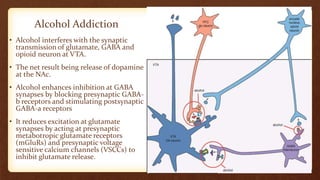
• Alcohol interferes with the synaptic
transmission of glutamate, GABA and
opioid neuron at VTA.
• The net result being release of dopamine
at the NAc.
• Alcohol enhances inhibition at GABA
synapses by blocking presynaptic GABA-
b receptors and stimulating postsynaptic
GABA-a receptors
• It reduces excitation at glutamate
synapses by acting at presynaptic
metabotropic glutamate receptors
(mGluRs) and presynaptic voltage
sensitive calcium channels (VSCCs) to
inhibit glutamate release.
Alcohol Withdrawal
• Acute administration of alcohol antagonizes NMDA receptors whereas
chronic administration increases these receptor sites
• This finding reflects the fact that alcohol withdrawal symptoms and
other neurotoxic effects of alcohol are mediated by glutamate.
• Furthermore, alcohol withdrawal appears to be associated with
increased glutamate concentrations and decreased dopamine levels in
the NAc.
• Findings concerning the efficacy of Acamprosate (which exerts effects
on the NMDA receptor) in the treatment of alcohol dependence
suggest that this neurotransmitter system may have a major role in the
disorder.
Acamprosate
• Thus, withdrawal from chronic alcohol use is a state of glutamate
overexcitement and even excitotoxicity as well as GABA deficiency.
• Acamprosate is a derivative of the amino acid taurine and interacts
with both the glutamate system,to inhibit it, and with the GABA
system, to enhance it, a bit like a form of “artificial alcohol”.
• Acamprosate appears to have direct blocking actions on certain
glutamate receptors, particularly mGlu receptors (specifically mGluR5
and perhaps mGluR2).
• Actions at NMDA receptors and at GABA systems may be secondary
downstream effects from Acamprosate’s actions on mGlu receptors.
Mood Disorders - GABA
• Reductions of GABA have been observed in plasma, CSF, and brain
GABA levels in depression.
• Low activity in frontal cortex and hippocampus in an animal model of
depression (which is reversed by antidepressant treatment) has been
noted.
• Animal studies have also found that chronic stress can reduce and
eventually deplete GABA levels.
• By contrast, GABA receptors are upregulated by antidepressants, and
some GABAergic medications have weak antidepressant effects.
• Animal models have demonstrated that blockade of glutamate activity
also blocks the learned helplessness response,
• Elevated levels of cortical glutamate were demonstrated using MRI
spectroscopy of depressed individuals and direct chemical assay from
the brains of suicide victims.
• There is also evidence for the antidepressant effects of antiglutamate
agents such as Ketamine, Riluzole and Lamotrigine (which has some
antiglutamate action).
Mood Disorders - Glutamate
Treatment Resistant Depression
• Antiglutamate drugs as augmenting agents for TRD with the rationale
that treatment resistance in depressive disorders may arise from excess
inhibitory function.
• Mainly- Ketamine
• A single intravenous infusion of ketamine results in remission of
depression in up to 75% of TRD patients, although its effects wane
rapidly, usually over the course of days.
• Repeated ketamine infusions have been shown to maintain benefit for
up to 2 weeks, and a few case reports have suggested even longer
remissions with continuing repeated administrations.
• Research is ongoing.
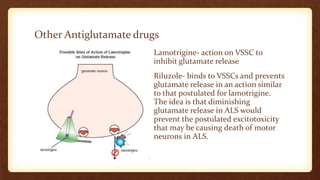
Other Antiglutamate drugs
• Lamotrigine- action on VSSC to
inhibit glutamate release
• Riluzole- binds to VSSCs and prevents
glutamate release in an action similar
to that postulated for lamotrigine.
The idea is that diminishing
glutamate release in ALS would
prevent the postulated excitotoxicity
that may be causing death of motor
neurons in ALS.
Pathways
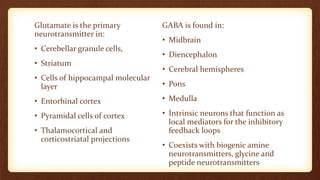
Glutamate is the primary
neurotransmitter in:
• Cerebellar granule cells,
• Striatum
• Cells of hippocampal molecular
layer
• Entorhinal cortex
• Pyramidal cells of cortex
• Thalamocortical and
corticostriatal projections
GABA is found in:
• Midbrain
• Diencephalon
• Cerebral hemispheres
• Pons
• Medulla
• Intrinsic neurons that function as
local mediators for the inhibitory
feedback loops
• Coexists with biogenic amine
neurotransmitters, glycine and
peptide neurotransmitters
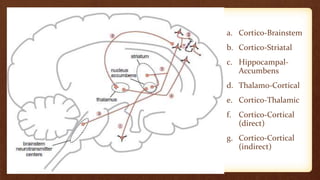
a. Cortico-Brainstem
b. Cortico-Striatal
c. Hippocampal-
Accumbens
d. Thalamo-Cortical
e. Cortico-Thalamic
f. Cortico-Cortical
(direct)
g. Cortico-Cortical
(indirect)
Cortico-Brainstem pathway
• Pyramidal neurons of cortex  Neurotransmitter centres of brainstem
• Raphe nucleus- Serotonin
• VTA- Dopamine
• Locus coeruleus- Norepinephrine
• Regulates neurotransmitter release
• Direct innervation- stimulates release
• Indirect innervation via GABAnergic neurons- inhibits release
Schizophrenia
• NMDA hypofunction hypothesis of schizophrenia
• Postulated due to psychotomimetic effects observed with NMDA
antagonists like PCP and Ketamine
• Can explain positive symptoms and negative symptoms and the
dopamine hypothesis as a result of downstream regulation
• Involved pathway – cortico-brainstem glutamate pathway
• Cause: Neurodevelopmental abnormalities of GABA interneurons
which synapse with Glutamate in the prefrontal cortex
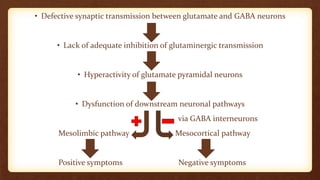
• Defective synaptic transmission between glutamate and GABA neurons
• Lack of adequate inhibition of glutaminergic transmission
• Hyperactivity of glutamate pyramidal neurons
• Dysfunction of downstream neuronal pathways
via GABA interneurons
Mesolimbic pathway Mesocortical pathway
Positive symptoms Negative symptoms
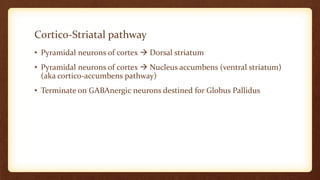
Cortico-Striatal pathway
• Pyramidal neurons of cortex  Dorsal striatum
• Pyramidal neurons of cortex  Nucleus accumbens (ventral striatum)
(aka cortico-accumbens pathway)
• Terminate on GABAnergic neurons destined for Globus Pallidus
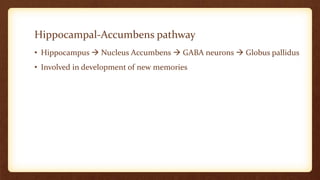
Hippocampal-Accumbens pathway
• Hippocampus  Nucleus Accumbens  GABA neurons  Globus pallidus
• Involved in development of new memories
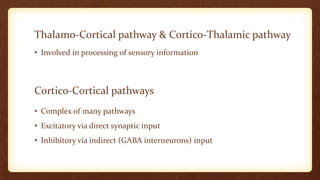
Thalamo-Cortical pathway & Cortico-Thalamic pathway
• Involved in processing of sensory information
• Complex of many pathways
• Excitatory via direct synaptic input
• Inhibitory via indirect (GABA interneurons) input
Cortico-Cortical pathways
References
• Stahl’s essential psychopharmacology : neuroscientific basis and
practical application / Stephen M. Stahl ; with illustrations by Nancy
Muntner. – 4th ed.
• Kaplan & Sadock's synopsis of psychiatry : behavioral sciences/clinical
psychiatry.-Eleventh edition I Benjamin James Sadock, Virginia Alcott
Sadock, Pedro Ruiz.
• Psychiatry / edited by Allan Tasman, Jerald Kay, Jeffrey A. Lieberman,
Michael B. First, Michelle B. Riba.–Fourth edition.
• Thank You

Glutamate and GABA

  • 1.
    GLUTAMATE GABA Presentation: Dr. BOoha Susmita Chairperson: Dr. Sarath
  • 2.
    • Glutamate orGlutamic acid is an amino acid neurotransmitter • Main role in the body- as a building block for other amino acids • As a neurotransmitter- excitatory function in up to 80% of brain synapses • Gamma-aminobutyric acid is a neurotransmitter found exclusively in the CNS • Principal inhibitory neurotransmitter in the brain GABA Glutamate
  • 3.
  • 6.
  • 7.
  • 8.
    Glutamate GABA Metabotropic receptors •Group 1 • Group 2 • Group 3 GABA-a receptor complex Ionotropic receptors • AMPA • Kainate • NMDA GABA-b receptor GABA-c receptor complex
  • 9.
    Metabotropic receptors ofGlutamate Group Group 1 mGluR1 mGluR5 • Postsynaptic • Facilitate and strengthen excitatory responses Group 2 mGluR2 mGluR3 • Presynaptic autoreceptors • Block glutamate release Group 3 mGluR4 mGluR6 mGluR7 mGluR8 • Presynaptic autoreceptors • Block glutamate release
  • 10.
    Ionotropic receptors ofGlutamate Functional class Gene family Agonists Antagonists Action AMPA GluR1 GluR2 GluR3 GluR4 Glutamate AMPA Kainate • Postsynaptic • Fast, excitatory neurotransmission • Na+ channels Kainate GluR5 GluR6 GluR7 KA1 KA2 Glutamate Kainate • Postsynaptic • Fast, excitatory neurotransmission • Na+ channels NMDA NR1 NR2A NR2B NR2C NR2D Glutamate NMDA Aspartate MK801 PCP Ketamine • Postsynaptic • Excitatory neurotransmission • Ca2+ channels • Requires co-transmitter- Glycine/D-Serine • Blocked by Mg2+ in resting state • Involved in LTP and Synaptic plasticity
  • 11.
    NMDA Receptors • Blockedby Mg2+ in resting state • Requires “Coincidence detection” to open ligand-gated Ca2+ channels 1. Binding of Glutamate to its site 2. Binding of Glycine (co- transmitter) to its site 3. Depolarization of the postsynaptic neuron usually due to surrounding AMPA receptors • Transmission results in LTP and neuroplasticity functions
  • 12.
    Excitotoxicity • Excitotoxicity relatesto the hypothesis that excessive stimulation of glutamate receptors leads to prolonged and excessive intraneuronal concentrations of calcium and NO. • Such conditions activate many enzymes (especially proteases) that are destructive to neuronal integrity.
  • 13.
    Alzheimer’s Disease • Glutamatehypothesis of cognitive deficiency in Alzheimer’s disease • Glutamate “leak” due to amyloid plaques and neurofibrillary tangles into the synaptic space • Overstimulate the NMDA receptors • Acute Chronic • Memory problems Free Radical accumulation Neuronal damage (Excitotoxicity)
  • 14.
    Memantine • Non-competitive, lowaffinity NMDA antagonist • Binds to Mg2+ binding site when the channel is open • Can be overcome by a burst of glutamate release seen during normal neurotransmission
  • 15.
    Glycine and Glutamate-relationship L-Serine Glycine (In glial cells) Glycine released from presynaptic glycine neuron reuptake Uptake into glial cell or presynaptic glutamate neuron Released into synapse to act as co-transmitter with Glutamate at NMDA receptor SHMT GlyT2 GlyT1 GlyT1
  • 16.
    Phobic disorder • Theextinction of conditioned fear has been shown to be an active process mediated by the activation of NMDA receptors in the amygdala. • In a study, D-Cycloserine (partial agonist at Glycine binding site of NMDA receptor) plus CBT resulted in a highly significant reduction in acrophobic symptoms that persisted for at least 3 months as compared to placebo plus CBT. • Other placebo-controlled clinical trials support the notion that n- cycloserine is a robust enhancer of CBT, suggesting that pharmacologically augmenting neural plasticity may be used to bolster psychological interventions.
  • 17.
    Action of D-Serineas Co-transmitter • Only amino acid in D-form • L-Serine D-Serine (In glial cells) Transported into synapse to act as co-transmitter with glutamate at NMDA receptors Hydroxypyruvate (end product after termination of action of D-Serine) D-Serine Racemase D-SER-T DAO
  • 18.
    GABA Receptors GABA- a GABA-b GABA- c Postsynaptic Postsynaptic and presynaptic Postsynaptic Ligand-gated G-protein coupled Ligand-gated Part of a macromolecular complex Dimer of two seven- transmembrane spanning subunits Part of a macromolecular complex Cl- channel Ca2+ channel K+ channel Cl- channel • Site of action for BZDs, sedative-hypnotics, Barbiturates and alcohol • Tonic and phasic inhibitory neurotransmission at GABAergic synapses • Postsynaptic hyperpolarization • Presynaptic autoregulation • Involved in pain, mood, memory and other CNS functions Antagonized by • Bicuculline • Picrotoxin • Penicillin • Pentylenetetrazol • Insensitive to the antagonistic properties of Bicuculline • Sensitive to agonist action of Baclofen
  • 19.
    Autism • GABA receptorsoccur in a cluster on chromosome 15 (region 15q11-13) and some evidence suggests that genes here might act as modifiers or susceptibility factors for an autism spectrum phenotype. • Duplications of this region are the most common cytogenetic abnormalities seen in autism cases (up to 6 percent of cases). • This region is also the critical region for Angelman and Prader-Willi syndromes. • However, research is still going on to establish a clear correlation between GABA and autism spectrum disorders.
  • 20.
    GABA-a receptor Benzodiazepine-sensitive receptorsBenzodiazepine- insensitive receptors
  • 21.
    Benzodiazepines and GABAreceptors • They are positive allosteric modulators (PAMs) • Have no activity on their own when GABA is not simultaneously binding to its agonist sites • The combination of benzodiazepines at the allosteric site plus GABA at its agonist sites increases the frequency of opening of the chloride channel to an extent not possible with GABA alone
  • 22.
    Anxiety • GABA isstrongly implicated due to the efficacy of BZDs in the treatment of anxiety disorders • While low potency BZDs can be used to treat GAD, high potency BZDs like clonazepam may be required in panic disorder • Inverse agonists at BZD site of GABA-a receptors like BCCE and antagonists like Flumazenil have been known to induce anxiety and panic attacks in patients
  • 23.
    Sleep • GABA systemsinvolved in maintaining sleep-wake cycle • First line treatment for insomnia include BZD and non-BZD agents that bind to the BZD-binding site of GABA-a receptors and enhance GABAergic inhibitory activity
  • 24.
    Barbiturates • Barbiturates allostericallyincrease the affinities of the binding sites for GABA and benzodiazepines • Barbiturates also affect channel dynamics by markedly increasing the long open state and reducing the short open state, thereby increasing Cl- inhibition
  • 25.
    Other GABAergic drugs •Progabide- GABA receptor agonist with good brain penetration • Tiagabine- inhibits the GABA transporter (GAT) • Vigabatrin- inhibits GABA-T • Topiramate- potentiates GABA activity by acting on the Cl- channels (and also acts as a glutamate receptor antagonist); has shown efficacy as an anti-craving agent in cocaine and METH dependence • Gabapentin- a GABA derivative with good brain penetration; yet, curiously, it has no activity at GABA receptors or the GABA transporter. • All of them are favoured for their anticonvulsant property
  • 26.
    Alcohol Addiction • Alcoholinterferes with the synaptic transmission of glutamate, GABA and opioid neuron at VTA. • The net result being release of dopamine at the NAc. • Alcohol enhances inhibition at GABA synapses by blocking presynaptic GABA- b receptors and stimulating postsynaptic GABA-a receptors • It reduces excitation at glutamate synapses by acting at presynaptic metabotropic glutamate receptors (mGluRs) and presynaptic voltage sensitive calcium channels (VSCCs) to inhibit glutamate release.
  • 27.
    Alcohol Withdrawal • Acuteadministration of alcohol antagonizes NMDA receptors whereas chronic administration increases these receptor sites • This finding reflects the fact that alcohol withdrawal symptoms and other neurotoxic effects of alcohol are mediated by glutamate. • Furthermore, alcohol withdrawal appears to be associated with increased glutamate concentrations and decreased dopamine levels in the NAc. • Findings concerning the efficacy of Acamprosate (which exerts effects on the NMDA receptor) in the treatment of alcohol dependence suggest that this neurotransmitter system may have a major role in the disorder.
  • 28.
    Acamprosate • Thus, withdrawalfrom chronic alcohol use is a state of glutamate overexcitement and even excitotoxicity as well as GABA deficiency. • Acamprosate is a derivative of the amino acid taurine and interacts with both the glutamate system,to inhibit it, and with the GABA system, to enhance it, a bit like a form of “artificial alcohol”. • Acamprosate appears to have direct blocking actions on certain glutamate receptors, particularly mGlu receptors (specifically mGluR5 and perhaps mGluR2). • Actions at NMDA receptors and at GABA systems may be secondary downstream effects from Acamprosate’s actions on mGlu receptors.
  • 29.
    Mood Disorders -GABA • Reductions of GABA have been observed in plasma, CSF, and brain GABA levels in depression. • Low activity in frontal cortex and hippocampus in an animal model of depression (which is reversed by antidepressant treatment) has been noted. • Animal studies have also found that chronic stress can reduce and eventually deplete GABA levels. • By contrast, GABA receptors are upregulated by antidepressants, and some GABAergic medications have weak antidepressant effects.
  • 30.
    • Animal modelshave demonstrated that blockade of glutamate activity also blocks the learned helplessness response, • Elevated levels of cortical glutamate were demonstrated using MRI spectroscopy of depressed individuals and direct chemical assay from the brains of suicide victims. • There is also evidence for the antidepressant effects of antiglutamate agents such as Ketamine, Riluzole and Lamotrigine (which has some antiglutamate action). Mood Disorders - Glutamate
  • 31.
    Treatment Resistant Depression •Antiglutamate drugs as augmenting agents for TRD with the rationale that treatment resistance in depressive disorders may arise from excess inhibitory function. • Mainly- Ketamine • A single intravenous infusion of ketamine results in remission of depression in up to 75% of TRD patients, although its effects wane rapidly, usually over the course of days. • Repeated ketamine infusions have been shown to maintain benefit for up to 2 weeks, and a few case reports have suggested even longer remissions with continuing repeated administrations. • Research is ongoing.
  • 32.
    Other Antiglutamate drugs •Lamotrigine- action on VSSC to inhibit glutamate release • Riluzole- binds to VSSCs and prevents glutamate release in an action similar to that postulated for lamotrigine. The idea is that diminishing glutamate release in ALS would prevent the postulated excitotoxicity that may be causing death of motor neurons in ALS.
  • 33.
  • 34.
    Glutamate is theprimary neurotransmitter in: • Cerebellar granule cells, • Striatum • Cells of hippocampal molecular layer • Entorhinal cortex • Pyramidal cells of cortex • Thalamocortical and corticostriatal projections GABA is found in: • Midbrain • Diencephalon • Cerebral hemispheres • Pons • Medulla • Intrinsic neurons that function as local mediators for the inhibitory feedback loops • Coexists with biogenic amine neurotransmitters, glycine and peptide neurotransmitters
  • 35.
    a. Cortico-Brainstem b. Cortico-Striatal c.Hippocampal- Accumbens d. Thalamo-Cortical e. Cortico-Thalamic f. Cortico-Cortical (direct) g. Cortico-Cortical (indirect)
  • 36.
    Cortico-Brainstem pathway • Pyramidalneurons of cortex  Neurotransmitter centres of brainstem • Raphe nucleus- Serotonin • VTA- Dopamine • Locus coeruleus- Norepinephrine • Regulates neurotransmitter release • Direct innervation- stimulates release • Indirect innervation via GABAnergic neurons- inhibits release
  • 37.
    Schizophrenia • NMDA hypofunctionhypothesis of schizophrenia • Postulated due to psychotomimetic effects observed with NMDA antagonists like PCP and Ketamine • Can explain positive symptoms and negative symptoms and the dopamine hypothesis as a result of downstream regulation • Involved pathway – cortico-brainstem glutamate pathway • Cause: Neurodevelopmental abnormalities of GABA interneurons which synapse with Glutamate in the prefrontal cortex
  • 38.
    • Defective synaptictransmission between glutamate and GABA neurons • Lack of adequate inhibition of glutaminergic transmission • Hyperactivity of glutamate pyramidal neurons • Dysfunction of downstream neuronal pathways via GABA interneurons Mesolimbic pathway Mesocortical pathway Positive symptoms Negative symptoms
  • 39.
    Cortico-Striatal pathway • Pyramidalneurons of cortex  Dorsal striatum • Pyramidal neurons of cortex  Nucleus accumbens (ventral striatum) (aka cortico-accumbens pathway) • Terminate on GABAnergic neurons destined for Globus Pallidus
  • 40.
    Hippocampal-Accumbens pathway • Hippocampus Nucleus Accumbens  GABA neurons  Globus pallidus • Involved in development of new memories
  • 41.
    Thalamo-Cortical pathway &Cortico-Thalamic pathway • Involved in processing of sensory information • Complex of many pathways • Excitatory via direct synaptic input • Inhibitory via indirect (GABA interneurons) input Cortico-Cortical pathways
  • 42.
    References • Stahl’s essentialpsychopharmacology : neuroscientific basis and practical application / Stephen M. Stahl ; with illustrations by Nancy Muntner. – 4th ed. • Kaplan & Sadock's synopsis of psychiatry : behavioral sciences/clinical psychiatry.-Eleventh edition I Benjamin James Sadock, Virginia Alcott Sadock, Pedro Ruiz. • Psychiatry / edited by Allan Tasman, Jerald Kay, Jeffrey A. Lieberman, Michael B. First, Michelle B. Riba.–Fourth edition. • Thank You

Editor's Notes

  • #5 Excitatory amino acid transporter
  • #7 Vesicular inhibitory amino acid transporter Glutamic acid decarboxylase GABA transaminase
  • #16 Serine hydroxymethyl transferase
  • #18 D-amino acid oxidase
  • #35 Voltage sensitive sodium channels
  • #40 Found to contain a Ca2+ binding protein called PARVALBUMIN