
Neoclassical Art
Europe and America, 1700 to 1800


 Gardner’s Art Through the Ages
             13th ed., Chapter 29


                                1
Goals
• Discuss the change in European and American tastes in
  art in the mid-18th century
• Explain the causes and characteristics of Neoclassical art
  and architecture in Europe and America.


                                                               2
Revival of Classicism

• Understand how the discovery of Herculaneum and Pompeii
  create an interest in classical art.
• Understand the formal elements of classical art and their
  revival in 19th century art and architecture.
• Examine Neoclassical art and architecture in France,
  England, and in the United States.
• Examine the adaptation of classical and mythological subject
  matter in Neoclassical art.


                                                                 3
Neoclassical Art in France

• Understand the formal elements of classical art and their
  revival in 19th century.
• Examine the adaptation of classical and mythological subject
  matter.


                                                                 4
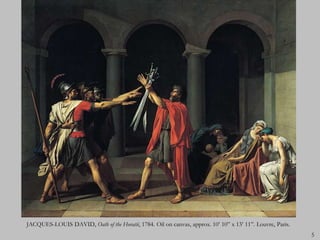
JACQUES-LOUIS DAVID, Oath of the Horatii, 1784. Oil on canvas, approx. 10’ 10” x 13’ 11”. Louvre, Paris.
                                                                                                           5
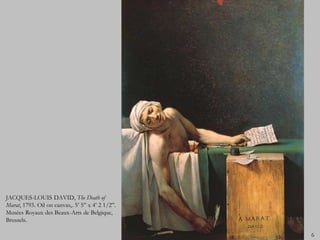
JACQUES-LOUIS DAVID, The Death of
Marat, 1793. Oil on canvas,. 5’ 5” x 4’ 2 1/2”.
Musées Royaux des Beaux-Arts de Belgique,
Brussels.

                                                  6
Neoclassical Architecture and Sculpture

• Examine classical revival in architecture and how it was used
  in Western Europe and the United States (Federal style).
• Observe the influence of Palladio on Neoclassical
  architecture.
• Recall the significance of the discovery of Pompeii and
  Herculaneum on Neoclassical art
• Analyze Neoclassical sculpture for its classical references and
  stylistic qualities


                                                                    7
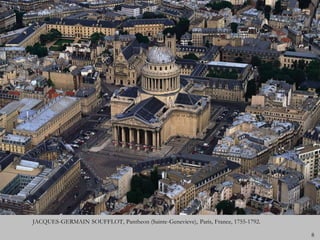
JACQUES-GERMAIN SOUFFLOT, Pantheon (Sainte-Genevieve), Paris, France, 1755-1792.

                                                                                   8
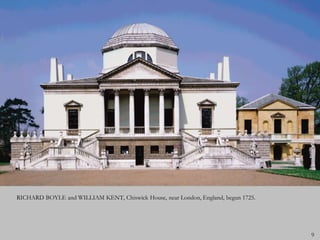
RICHARD BOYLE and WILLIAM KENT, Chiswick House, near London, England, begun 1725.


                                                                                    9
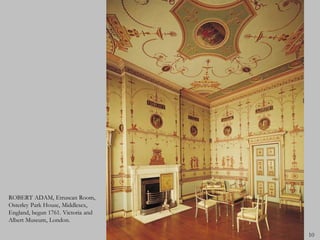
ROBERT ADAM, Etruscan Room,
Osterley Park House, Middlesex,
England, begun 1761. Victoria and
Albert Museum, London.

                                    10
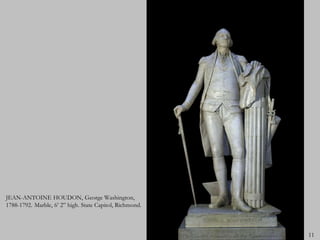
JEAN-ANTOINE HOUDON, George Washington,
1788-1792. Marble, 6’ 2” high. State Capitol, Richmond.


                                                          11
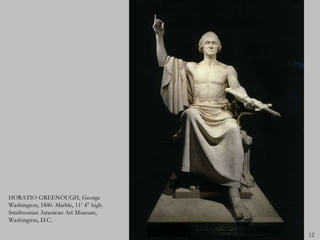
HORATIO GREENOUGH, George
Washington, 1840. Marble, 11’ 4” high.
Smithsonian American Art Museum,
Washington, D.C.

                                         12
The Neoclassical in the United States
        a.k.a. Federal Style

• Examine Neoclassical or Federal Style as the national style of
  architecture in the United States in the early 19th century.


                                                                   13
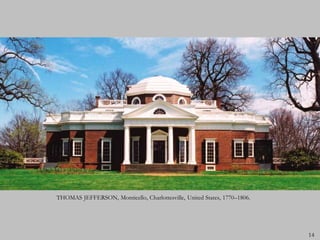
THOMAS JEFFERSON, Monticello, Charlottesville, United States, 1770–1806.


                                                                           14
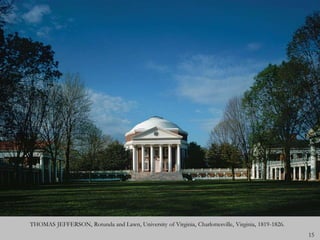
THOMAS JEFFERSON, Rotunda and Lawn, University of Virginia, Charlottesville, Virginia, 1819-1826.
                                                                                                    15
Discussion Questions

 Why did European tastes in art change in the mid-18th
  century? How did this make for a smoother transition
  toward Neoclassicism?
 Why did Neoclassicism appeal to political leaders in the
  19th century?
 Was the Federal style an appropriate choice for architecture
  in the fledgling United States?


                                                                 16

Neoclassical Art

  • 1.
    Neoclassical Art Europe andAmerica, 1700 to 1800 Gardner’s Art Through the Ages 13th ed., Chapter 29 1
  • 2.
    Goals • Discuss thechange in European and American tastes in art in the mid-18th century • Explain the causes and characteristics of Neoclassical art and architecture in Europe and America. 2
  • 3.
    Revival of Classicism •Understand how the discovery of Herculaneum and Pompeii create an interest in classical art. • Understand the formal elements of classical art and their revival in 19th century art and architecture. • Examine Neoclassical art and architecture in France, England, and in the United States. • Examine the adaptation of classical and mythological subject matter in Neoclassical art. 3
  • 4.
    Neoclassical Art inFrance • Understand the formal elements of classical art and their revival in 19th century. • Examine the adaptation of classical and mythological subject matter. 4
  • 5.
    JACQUES-LOUIS DAVID, Oathof the Horatii, 1784. Oil on canvas, approx. 10’ 10” x 13’ 11”. Louvre, Paris. 5
  • 6.
    JACQUES-LOUIS DAVID, TheDeath of Marat, 1793. Oil on canvas,. 5’ 5” x 4’ 2 1/2”. Musées Royaux des Beaux-Arts de Belgique, Brussels. 6
  • 7.
    Neoclassical Architecture andSculpture • Examine classical revival in architecture and how it was used in Western Europe and the United States (Federal style). • Observe the influence of Palladio on Neoclassical architecture. • Recall the significance of the discovery of Pompeii and Herculaneum on Neoclassical art • Analyze Neoclassical sculpture for its classical references and stylistic qualities 7
  • 8.
    JACQUES-GERMAIN SOUFFLOT, Pantheon(Sainte-Genevieve), Paris, France, 1755-1792. 8
  • 9.
    RICHARD BOYLE andWILLIAM KENT, Chiswick House, near London, England, begun 1725. 9
  • 10.
    ROBERT ADAM, EtruscanRoom, Osterley Park House, Middlesex, England, begun 1761. Victoria and Albert Museum, London. 10
  • 11.
    JEAN-ANTOINE HOUDON, GeorgeWashington, 1788-1792. Marble, 6’ 2” high. State Capitol, Richmond. 11
  • 12.
    HORATIO GREENOUGH, George Washington,1840. Marble, 11’ 4” high. Smithsonian American Art Museum, Washington, D.C. 12
  • 13.
    The Neoclassical inthe United States a.k.a. Federal Style • Examine Neoclassical or Federal Style as the national style of architecture in the United States in the early 19th century. 13
  • 14.
    THOMAS JEFFERSON, Monticello,Charlottesville, United States, 1770–1806. 14
  • 15.
    THOMAS JEFFERSON, Rotundaand Lawn, University of Virginia, Charlottesville, Virginia, 1819-1826. 15
  • 16.
    Discussion Questions  Whydid European tastes in art change in the mid-18th century? How did this make for a smoother transition toward Neoclassicism?  Why did Neoclassicism appeal to political leaders in the 19th century?  Was the Federal style an appropriate choice for architecture in the fledgling United States? 16