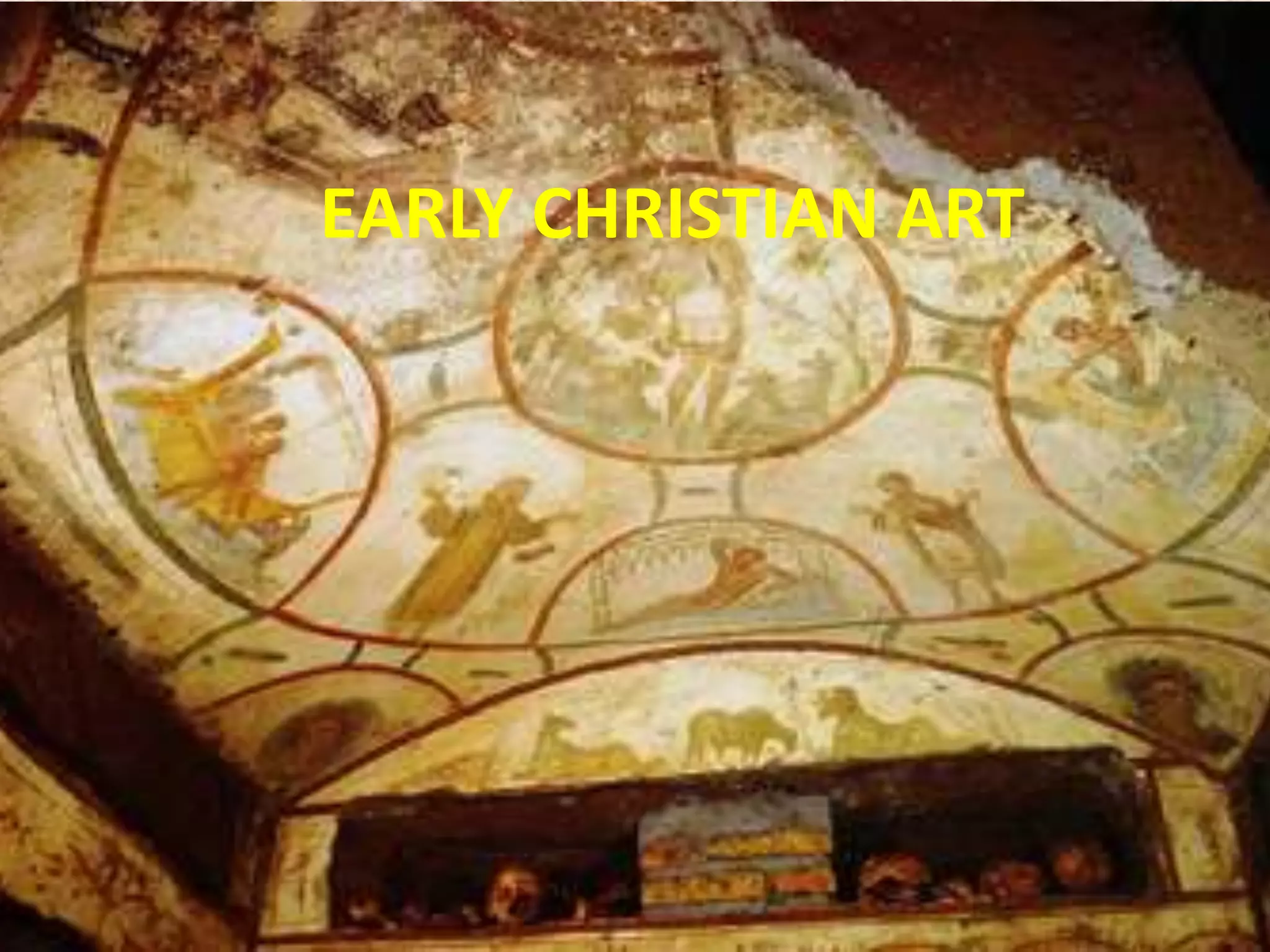
EARLY CHRISTIAN ART
Early Christian Art:
earliest period-350/525 AD
250 AD. Time of Decian Persecution
Middle stage: AD250 - AD406
AD406: Christianity at the time of Gothic
and Germanic invasions
Key Events
Two important moments
played a critical role in the
development of early
Christianity:
1. The decision of the Apostle
Paul to spread Christianity
beyond the Jewish
communities of Palestine
into the Greco-Roman
world.
St. Paul Preaching in Athens
By Raphael, 1515
Key Events
• 2. When the Emperor
Constantine accepted
Christianity and became
its patron at the
beginning of the fourth
century
Baptism of Emperor the Great
In 337 AD
Timeline
29 AD, Crucifixion of Christ
249-251, Persecution,
Trajan Decius
303-305, Persecution,
Diocletian
313, Edict of Milan
380, Christianity proclaimed
State religion of Roman
Empire
Edict of Milan
• Refers to the February 313 agreement to treat Christians
benevolently within the Roman Empire.
• Western Roman Emperor Constantine I, and Licinius, who
controlled the Balkans, met in Milan, and agreed to
change policies towards Christians.
• Early Christian art: Pre-Constantinian
• Period of the First 7 Ecumenical
Churches
• First Council of Nicea (325 AD): ecumenical assembly of
Christian bishops
Key Points
• Under Constantine, Christianity became an imperially
sponsored religion.
• Constantinian shift
Colossal marble head of Emperor
Constantine the Great, Roman, 4th AD
• Supported the church financially.
• Had a large number of basilicas built.
• Granted privileges (tax exemptions) to clergy.
San Giovanni
Laterano, Italy
Old St. Peter’s Basilica, 319-333 AD
• Promoted Christians to high-ranking offices.
• Returned properties confiscated during the Great
Persecution of Diocletian.
• Endowed the Church with land and other wealth.
Hagia Eirene, the first
church commissioned
by Constantine in
Constantinople.
Other Legacies:
• Abolished Crucifixion for reasons of Christian piety
• Declared Sunday as the official rest day.
• Publicly displayed gladiatorial games were ordered to
be eliminated in 325 AD.
Key Points
• Christian themes became a staple of many of the
greatest works of Western art.
Leonardo da Vinci
The Last Supper
1495-1498
tempera on gesso
Caravaggio
The Conversion on the Way
to Damascus
Oil on canvas
1601
Fra Angelico
Annunciation 6
1450
Felix Resurreccion Hidalgo
Christian Virgins Exposed to the Public
oil on canvas
1884
Key Points
• Early Christian basilican churches stood as the
template for future shrines up to the present.
Basilica de Santa Sabina
Rome, Italy
422-432
Interior of Santa Sabina
Santa Constanza, Rome, 337-351
EARLY CHRISTIAN ART FORMS
Early Christian Art Forms/Motifs
• Frescoes
• Mosaics
• Sculptures
• Illuminated manuscripts
Adaptation of Roman pagan motifs
• Peacock
• Grapevine
• Good Shepherd
• Fish (ikhtus)
Mosaics
• Simple beginnings
• Invented to provide simple
and inexpensive flooring
• Pebble mosaics of
geometric shapes
Gordium floor mosaics,
The oldest extant tile mosaic
Western Turkey
8th century BC
Mosaics
• 3rd BC
• Invention of a new kind of
mosaic
• Used “tesserae” (Latin for
cubes or dice)
• Used to decorate walls and
vaults
The parting of Lot and Abraham
Mosaic in nave of Santa Maria
Magiorre
Rome, Italy
Mosaics
Christ as the Good Shepherd, mosaic
Mausoleum of Galla Placidia, Ravenna, Italy, 423 AD
Mosaics
• Tesserae were made of glass
so as to reflect light and
make the surface sparkle
Miracle of the loaves and fishes
Sant’ Apollinare Nuovo
Ravenna, Italy, ca 504
Illuminated Manuscripts
• Manuscript in which the text is
supplemented by the addition
of decorations
• Time consuming and costly to
produce
• Borders
• Marginalia
• Miniature illustrations
• From Latin, “illuminare” –to
light upSinope Gospels
Illuminated Greek Gospel
book
Illuminated Manuscripts
• Gold or silver
• Illuminators were humble
craftsmen
• Painter’s guild or book trade
guild
• Earliest preserved
illuminated book that
contains illustrations of the
New TestamentChrist before Pilate
Rossano Gospels, folio 8
6th century
Illuminated Manuscripts
• Oldest, well-preserved ,
surviving, illustrated biblical
codex
• Probable origin, Syria
• First half of the 6th century
• Written on purple dyed
vellum
Vienna Genesis, folio 7
6th century
Ivory Carvings
• Ivory carving – luxury art
much admired in the Early
Christian period
• Book covers, boxes,
chests
Suicide of Judas and
Crucifixion of Christ
Plaque from a box
Unknown Roman sculptor
420 AD
Ivory Carvings
• Ice Age European
mammoths
• India
• Africa
• Carved ivories
• Mesopotamian
• Egyptian sites Carved ivory plaque from Nimrud showing a
winged sphinx with apron and crown in the
Egyptian style. 8th – 7th century BC.
Phoenician style
Ivory Carvings
Statuette of a camel
and rider Mesopotamia
or the Levant,
8th or 9th century;
ivory, carved, with some
traces of black pigment,
25 x 23.5 x 12 cm
Ivory Carvings
• Nimrud ivories
• Carved ivory plaques and
figures
• 9-7th centuries BC
• Nimrud, Assyria (now,
Ninawa, Iraq)
• 2011, British Museum, UK
• Iraqi institutions
Ivory plaque with traces of paint and
original gold leaf
9th-7th century BC, Neo-Assyrian
Nimrud
Ivory Carvings
• Origins: Levant or Egypt
• Motifs typical of the region
• Sir Austen Henry Layard
• 1845
• Decoration for high status
items like furniture
One of the Nimrud ivories,
made in Egypt, depicting
two Egyptians facing each
other
Ivory Carvings
The Nicomachi and Symmachi diptych
Ivory relief
Rome, 388-401
depict female figures engaged in
religious ritual before sacrificial altars
Nicomachi –Paris
Symmachi – London
References two important senatorial
families
Was commissioned by the family of
Q. Aurelius Symmachus
Ivory Carvings
Diptychs fashioned out of
ivory:
• Ceremonial and official
purposes
• Announce election of consul
• Marriage between 2
wealthy families
• Commemorate death of an
important citizen
The London panel
Key Terms
• Constantinian shift
• Apse
• Nave
• Aisle
• Narthex
• Transept
• Mosaic
• Tessarae
• Nimrud ivories
• Illuminated manuscripts
• Diptych

Early Christian Art

  • 1.
  • 2.
  • 3.
    250 AD. Timeof Decian Persecution
  • 4.
  • 5.
    AD406: Christianity atthe time of Gothic and Germanic invasions
  • 6.
    Key Events Two importantmoments played a critical role in the development of early Christianity: 1. The decision of the Apostle Paul to spread Christianity beyond the Jewish communities of Palestine into the Greco-Roman world. St. Paul Preaching in Athens By Raphael, 1515
  • 7.
    Key Events • 2.When the Emperor Constantine accepted Christianity and became its patron at the beginning of the fourth century Baptism of Emperor the Great In 337 AD
  • 8.
    Timeline 29 AD, Crucifixionof Christ 249-251, Persecution, Trajan Decius 303-305, Persecution, Diocletian 313, Edict of Milan 380, Christianity proclaimed State religion of Roman Empire
  • 9.
    Edict of Milan •Refers to the February 313 agreement to treat Christians benevolently within the Roman Empire. • Western Roman Emperor Constantine I, and Licinius, who controlled the Balkans, met in Milan, and agreed to change policies towards Christians. • Early Christian art: Pre-Constantinian • Period of the First 7 Ecumenical Churches • First Council of Nicea (325 AD): ecumenical assembly of Christian bishops
  • 10.
    Key Points • UnderConstantine, Christianity became an imperially sponsored religion. • Constantinian shift Colossal marble head of Emperor Constantine the Great, Roman, 4th AD
  • 11.
    • Supported thechurch financially. • Had a large number of basilicas built. • Granted privileges (tax exemptions) to clergy. San Giovanni Laterano, Italy
  • 12.
    Old St. Peter’sBasilica, 319-333 AD
  • 13.
    • Promoted Christiansto high-ranking offices. • Returned properties confiscated during the Great Persecution of Diocletian. • Endowed the Church with land and other wealth. Hagia Eirene, the first church commissioned by Constantine in Constantinople.
  • 14.
    Other Legacies: • AbolishedCrucifixion for reasons of Christian piety • Declared Sunday as the official rest day. • Publicly displayed gladiatorial games were ordered to be eliminated in 325 AD.
  • 15.
    Key Points • Christianthemes became a staple of many of the greatest works of Western art. Leonardo da Vinci The Last Supper 1495-1498 tempera on gesso
  • 16.
    Caravaggio The Conversion onthe Way to Damascus Oil on canvas 1601
  • 17.
  • 18.
    Felix Resurreccion Hidalgo ChristianVirgins Exposed to the Public oil on canvas 1884
  • 19.
    Key Points • EarlyChristian basilican churches stood as the template for future shrines up to the present.
  • 21.
    Basilica de SantaSabina Rome, Italy 422-432 Interior of Santa Sabina
  • 22.
  • 23.
  • 24.
    Early Christian ArtForms/Motifs • Frescoes • Mosaics • Sculptures • Illuminated manuscripts Adaptation of Roman pagan motifs • Peacock • Grapevine • Good Shepherd • Fish (ikhtus)
  • 25.
    Mosaics • Simple beginnings •Invented to provide simple and inexpensive flooring • Pebble mosaics of geometric shapes Gordium floor mosaics, The oldest extant tile mosaic Western Turkey 8th century BC
  • 26.
    Mosaics • 3rd BC •Invention of a new kind of mosaic • Used “tesserae” (Latin for cubes or dice) • Used to decorate walls and vaults The parting of Lot and Abraham Mosaic in nave of Santa Maria Magiorre Rome, Italy
  • 27.
    Mosaics Christ as theGood Shepherd, mosaic Mausoleum of Galla Placidia, Ravenna, Italy, 423 AD
  • 28.
    Mosaics • Tesserae weremade of glass so as to reflect light and make the surface sparkle Miracle of the loaves and fishes Sant’ Apollinare Nuovo Ravenna, Italy, ca 504
  • 29.
    Illuminated Manuscripts • Manuscriptin which the text is supplemented by the addition of decorations • Time consuming and costly to produce • Borders • Marginalia • Miniature illustrations • From Latin, “illuminare” –to light upSinope Gospels Illuminated Greek Gospel book
  • 30.
    Illuminated Manuscripts • Goldor silver • Illuminators were humble craftsmen • Painter’s guild or book trade guild • Earliest preserved illuminated book that contains illustrations of the New TestamentChrist before Pilate Rossano Gospels, folio 8 6th century
  • 31.
    Illuminated Manuscripts • Oldest,well-preserved , surviving, illustrated biblical codex • Probable origin, Syria • First half of the 6th century • Written on purple dyed vellum Vienna Genesis, folio 7 6th century
  • 32.
    Ivory Carvings • Ivorycarving – luxury art much admired in the Early Christian period • Book covers, boxes, chests Suicide of Judas and Crucifixion of Christ Plaque from a box Unknown Roman sculptor 420 AD
  • 33.
    Ivory Carvings • IceAge European mammoths • India • Africa • Carved ivories • Mesopotamian • Egyptian sites Carved ivory plaque from Nimrud showing a winged sphinx with apron and crown in the Egyptian style. 8th – 7th century BC. Phoenician style
  • 34.
    Ivory Carvings Statuette ofa camel and rider Mesopotamia or the Levant, 8th or 9th century; ivory, carved, with some traces of black pigment, 25 x 23.5 x 12 cm
  • 35.
    Ivory Carvings • Nimrudivories • Carved ivory plaques and figures • 9-7th centuries BC • Nimrud, Assyria (now, Ninawa, Iraq) • 2011, British Museum, UK • Iraqi institutions Ivory plaque with traces of paint and original gold leaf 9th-7th century BC, Neo-Assyrian Nimrud
  • 36.
    Ivory Carvings • Origins:Levant or Egypt • Motifs typical of the region • Sir Austen Henry Layard • 1845 • Decoration for high status items like furniture One of the Nimrud ivories, made in Egypt, depicting two Egyptians facing each other
  • 37.
    Ivory Carvings The Nicomachiand Symmachi diptych Ivory relief Rome, 388-401 depict female figures engaged in religious ritual before sacrificial altars Nicomachi –Paris Symmachi – London References two important senatorial families Was commissioned by the family of Q. Aurelius Symmachus
  • 38.
    Ivory Carvings Diptychs fashionedout of ivory: • Ceremonial and official purposes • Announce election of consul • Marriage between 2 wealthy families • Commemorate death of an important citizen The London panel
  • 39.
    Key Terms • Constantinianshift • Apse • Nave • Aisle • Narthex • Transept • Mosaic • Tessarae • Nimrud ivories • Illuminated manuscripts • Diptych