$  Art produced in Europe and North America
   from the mid-18c to the early 19c.
$  More than just an antique revival  a reaction
   against the surviving Baroque & Rococo styles.
$  Linked to contemporary political events:
   S  Revolutions established republics in France
      and in America. [Neo-Classicism was adapted
      as the official art style].
   S  Association with the democracy of Greece
      and the republicanism of Rome.
   S  Napoleon  used the style for propaganda.
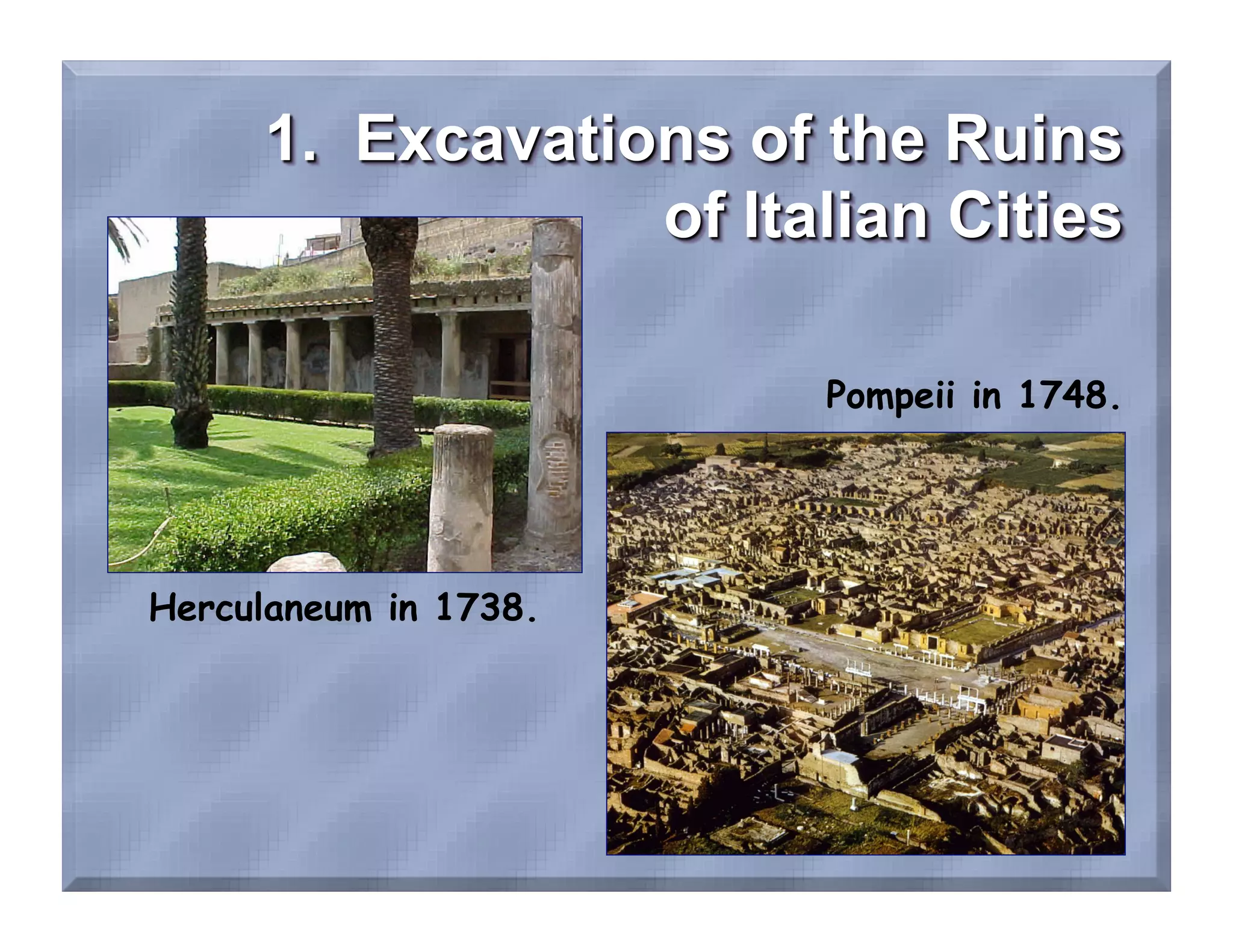
Pompeii in 1748.


Herculaneum in 1738.
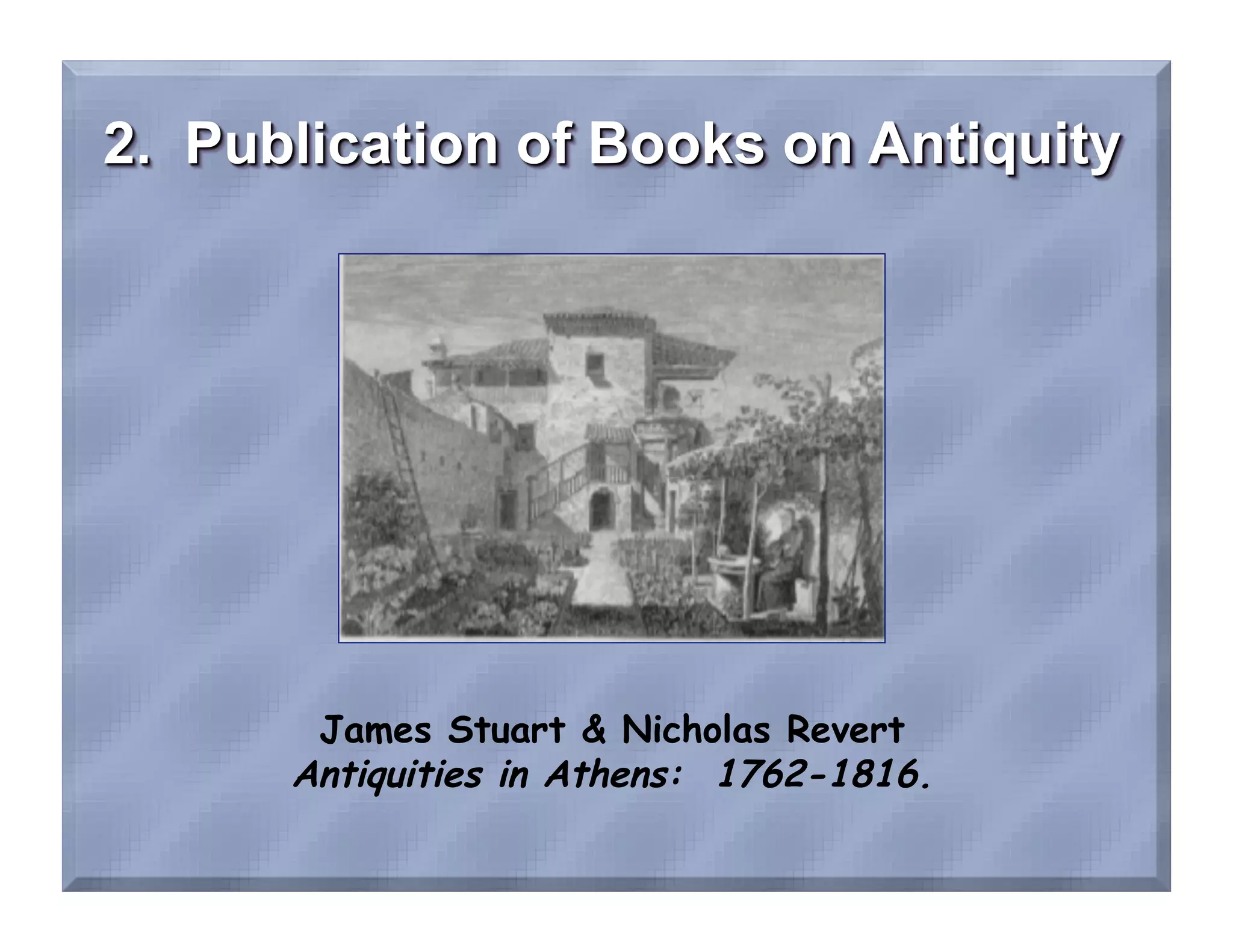
James Stuart & Nicholas Revert
Antiquities in Athens: 1762-1816.
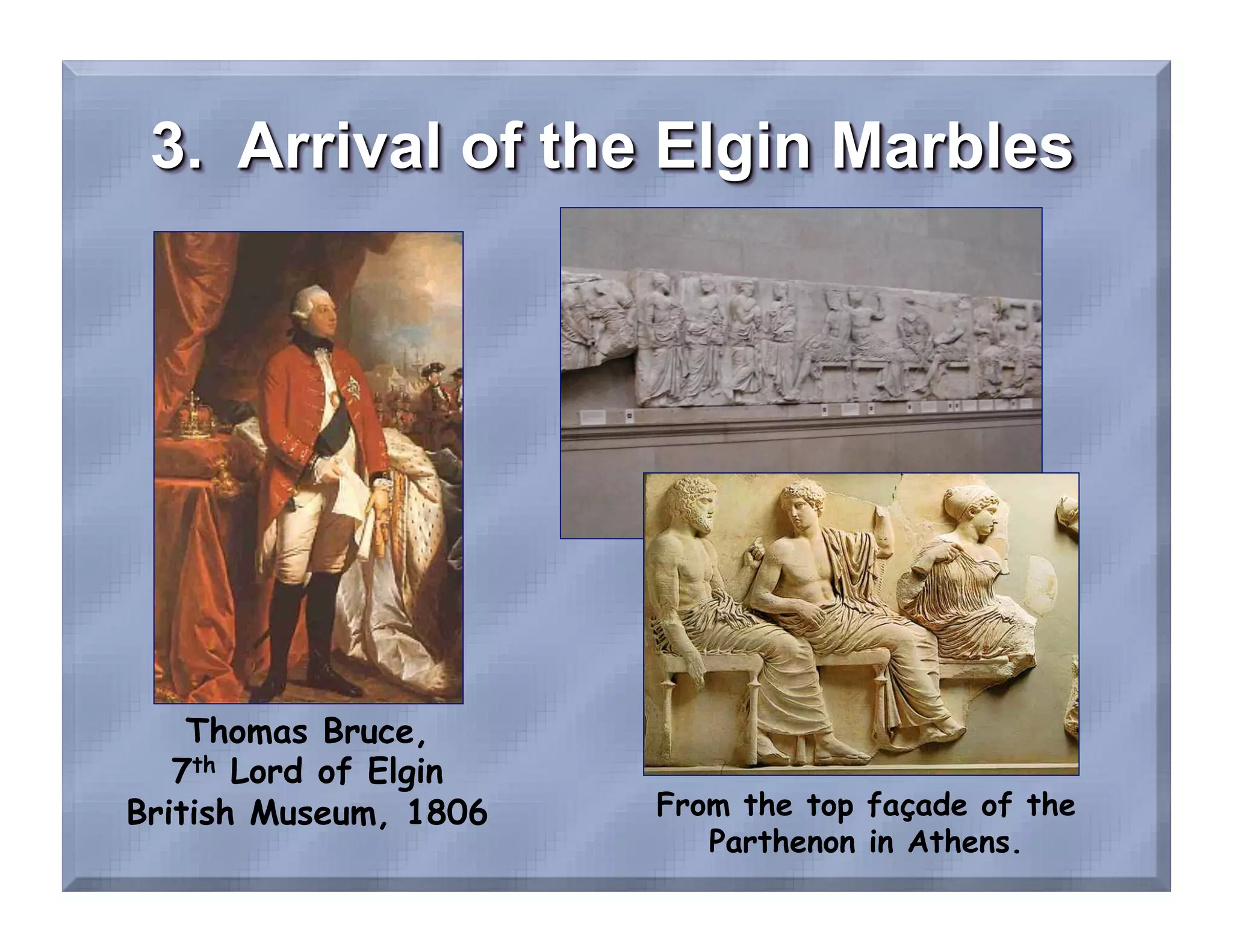
Thomas Bruce,
   7th Lord of Elgin
British Museum, 1806   From the top façade of the
                          Parthenon in Athens.
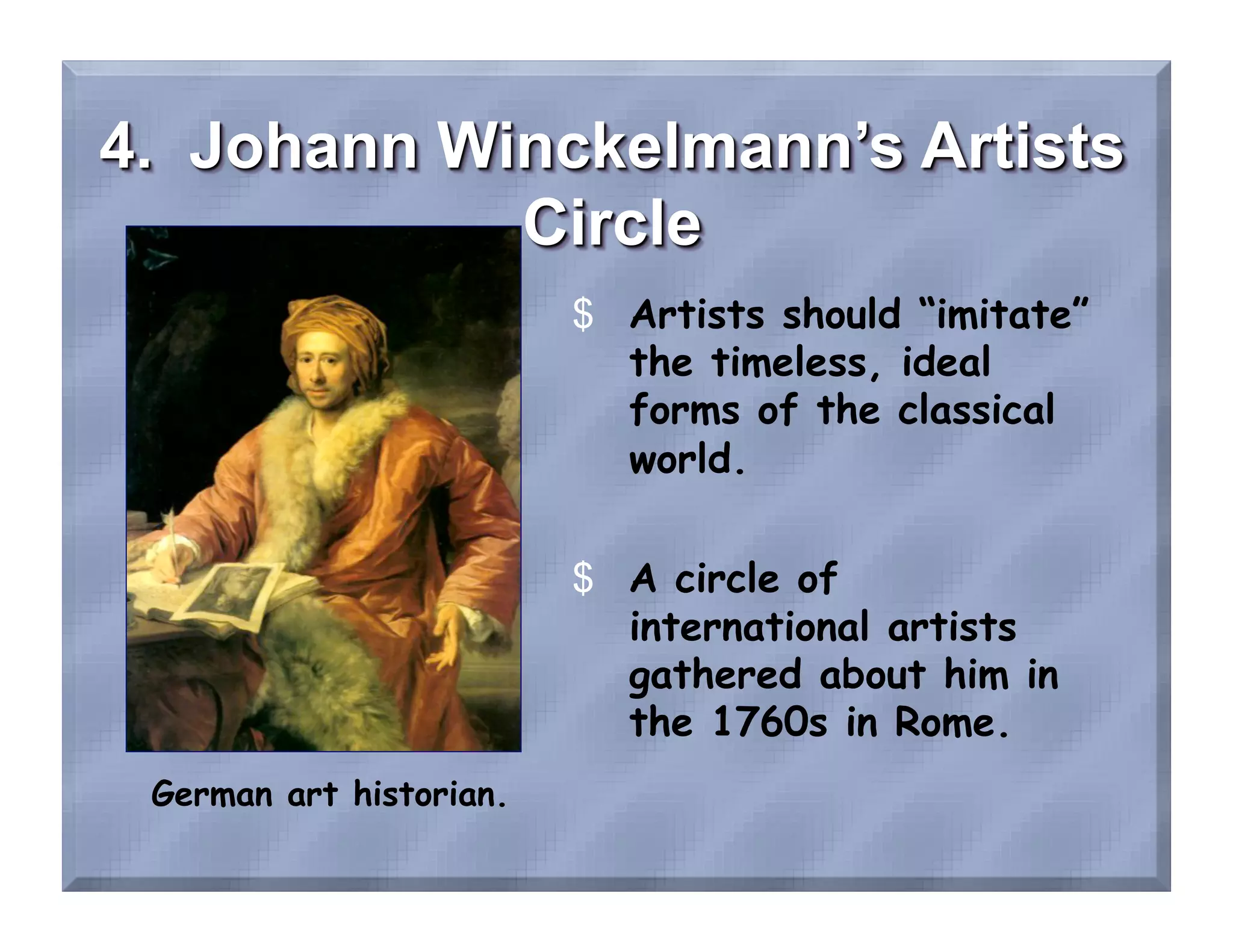
$  Artists should “imitate”
                           the timeless, ideal
                           forms of the classical
                           world.

                        $  A circle of
                           international artists
                           gathered about him in
                           the 1760s in Rome.
German art historian.
$  Return to the perceived “purity” of the arts of
   Rome.
$  Model the “ideal” of the ancient Greek arts
   and, to a lesser, extent, 16c Renaissance
   classicism.
$  A conviction that there is a permanent,
   universal way things are (and should be), which
   obviously entails fundamental political and
   ethical commitments.
$  Sometimes considered anti-modern or even
   reactionary.
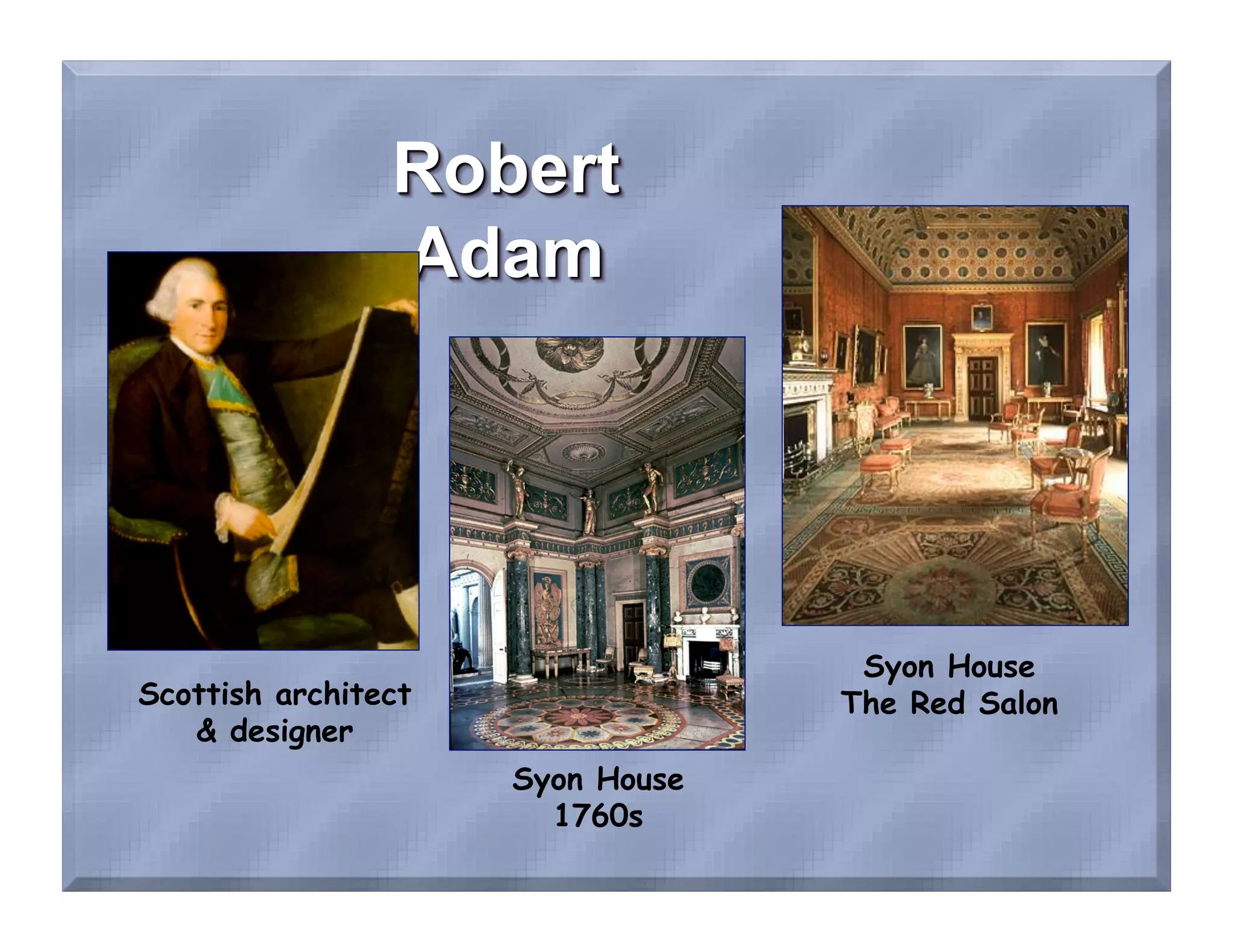
Syon House
Scottish architect                The Red Salon
   & designer
                     Syon House
                       1760s
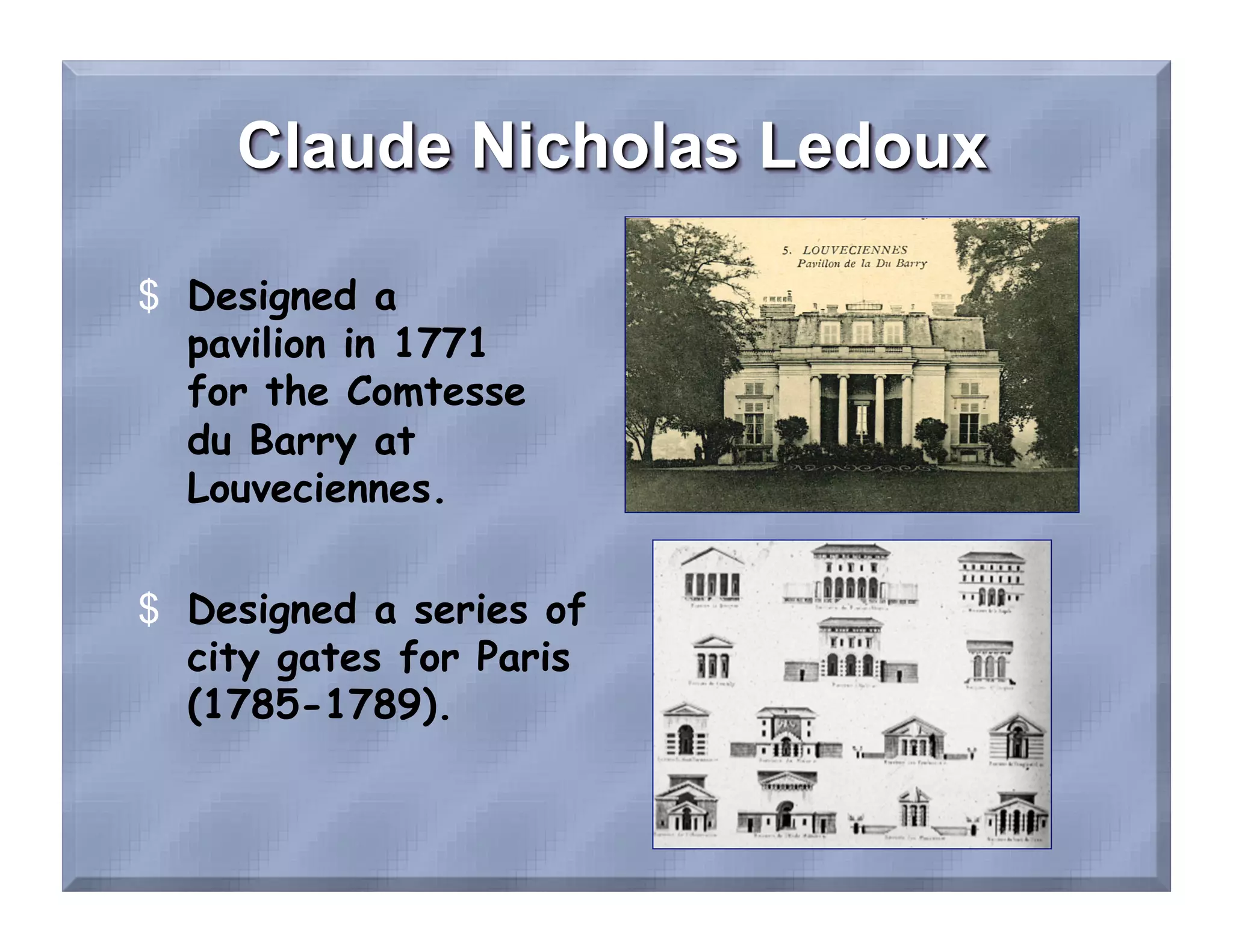
$  Designed a
   pavilion in 1771
   for the Comtesse
   du Barry at
   Louveciennes.


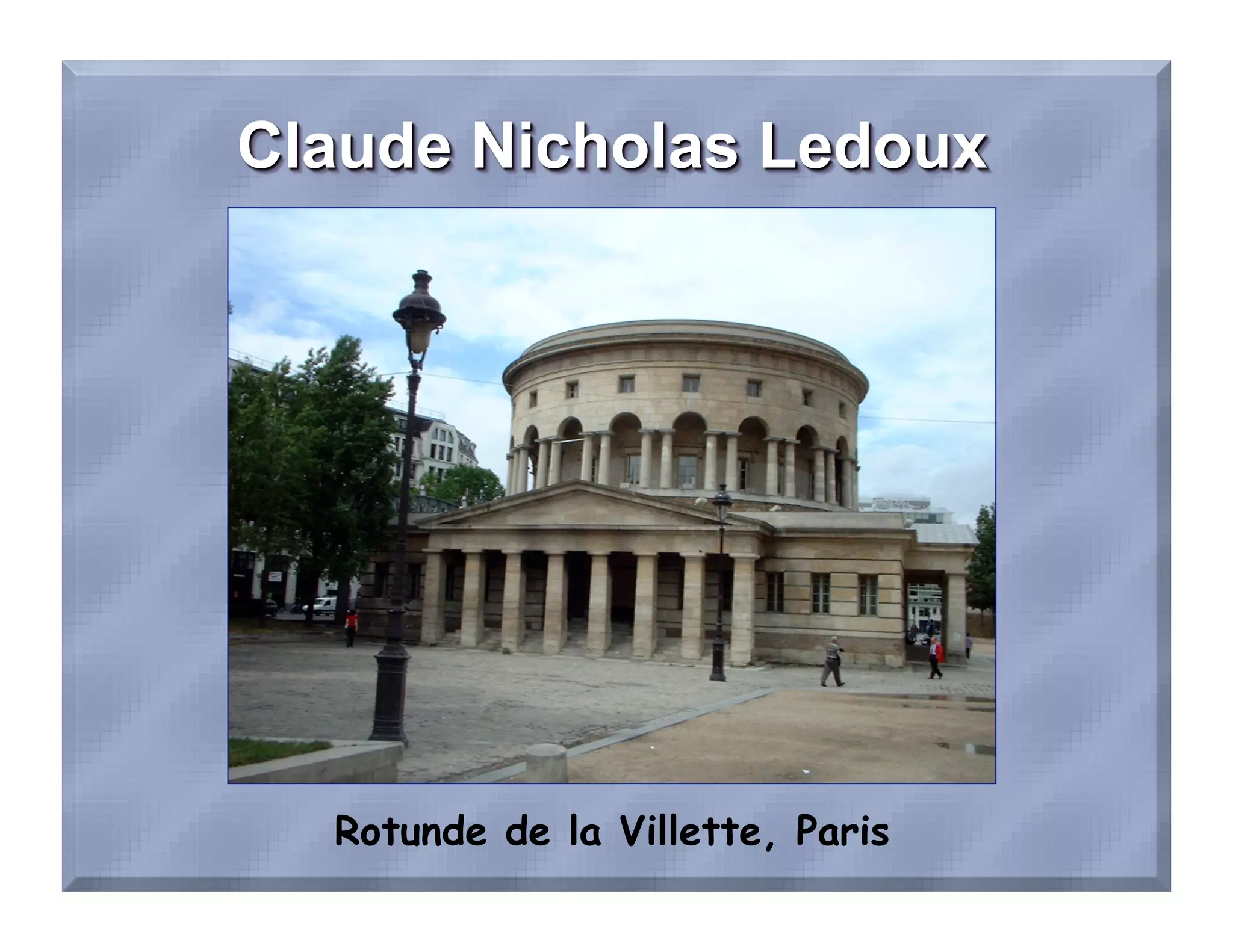
$  Designed a series of
   city gates for Paris
   (1785-1789).
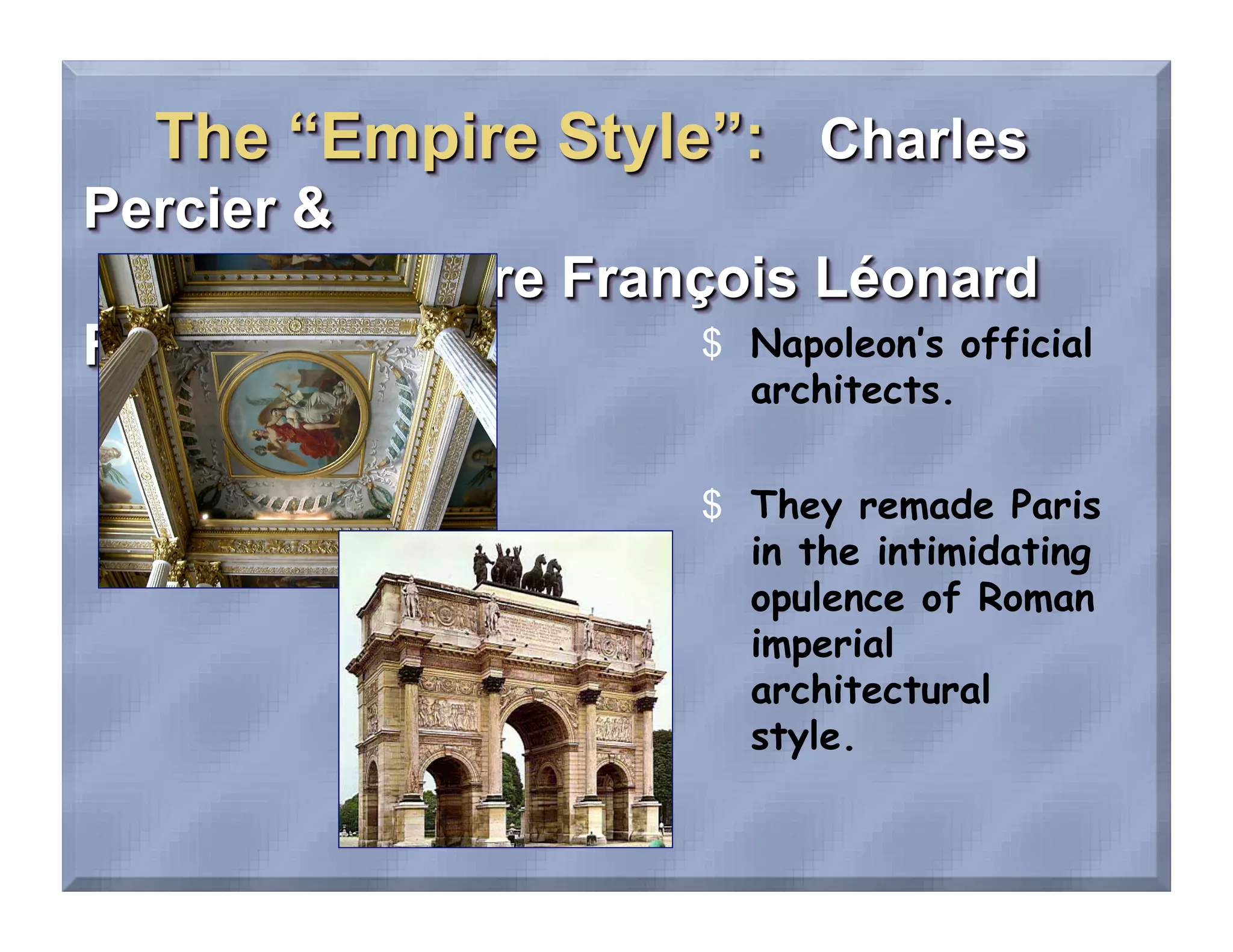
Rotunde de la Villette, Paris
“The Royal Crescent [Circus]” at Bath, England (1754).
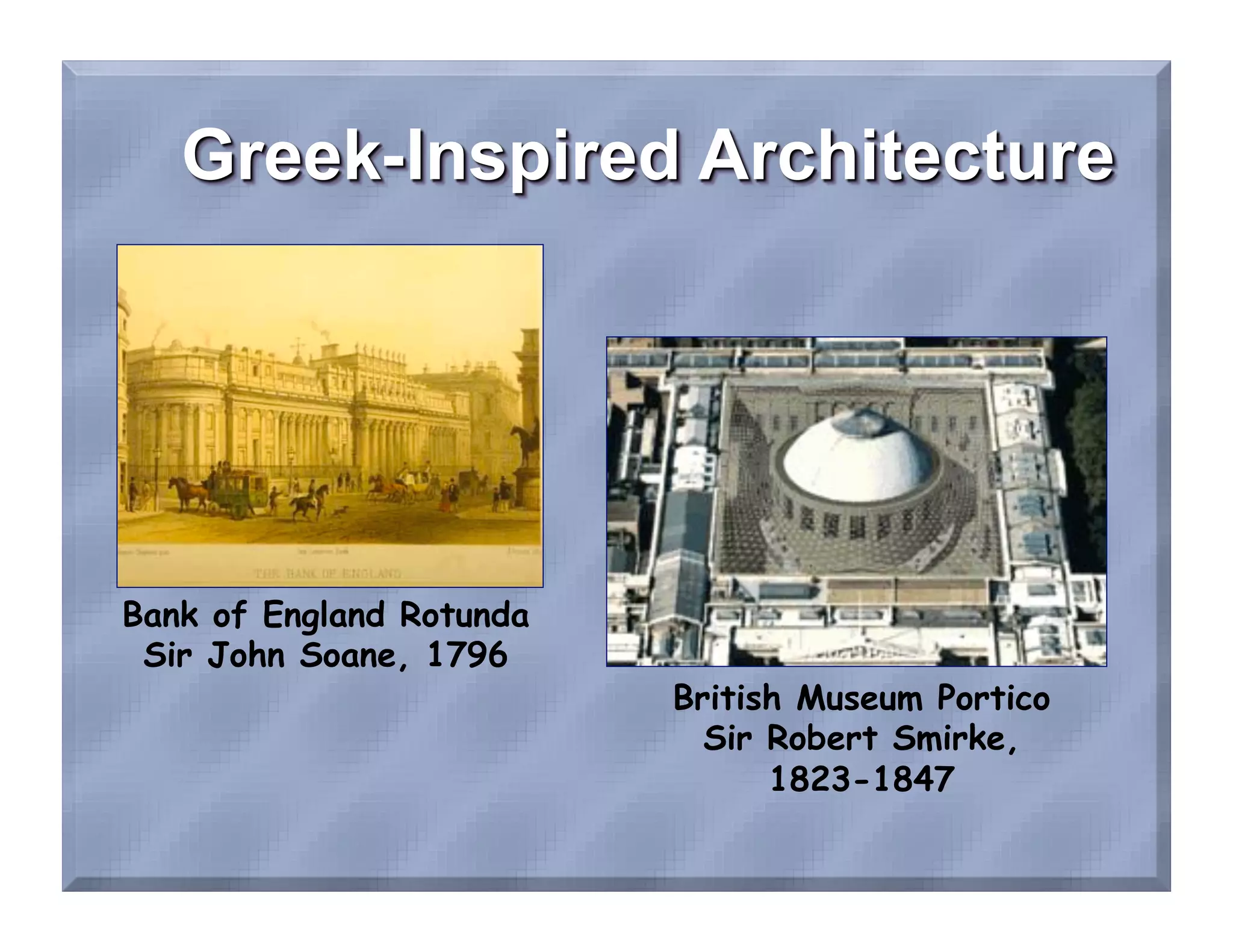
$  Napoleon’s official
   architects.

$  They remade Paris
   in the intimidating
   opulence of Roman
   imperial
   architectural
   style.
Bank of England Rotunda
 Sir John Soane, 1796
                          British Museum Portico
                            Sir Robert Smirke,
                                1823-1847
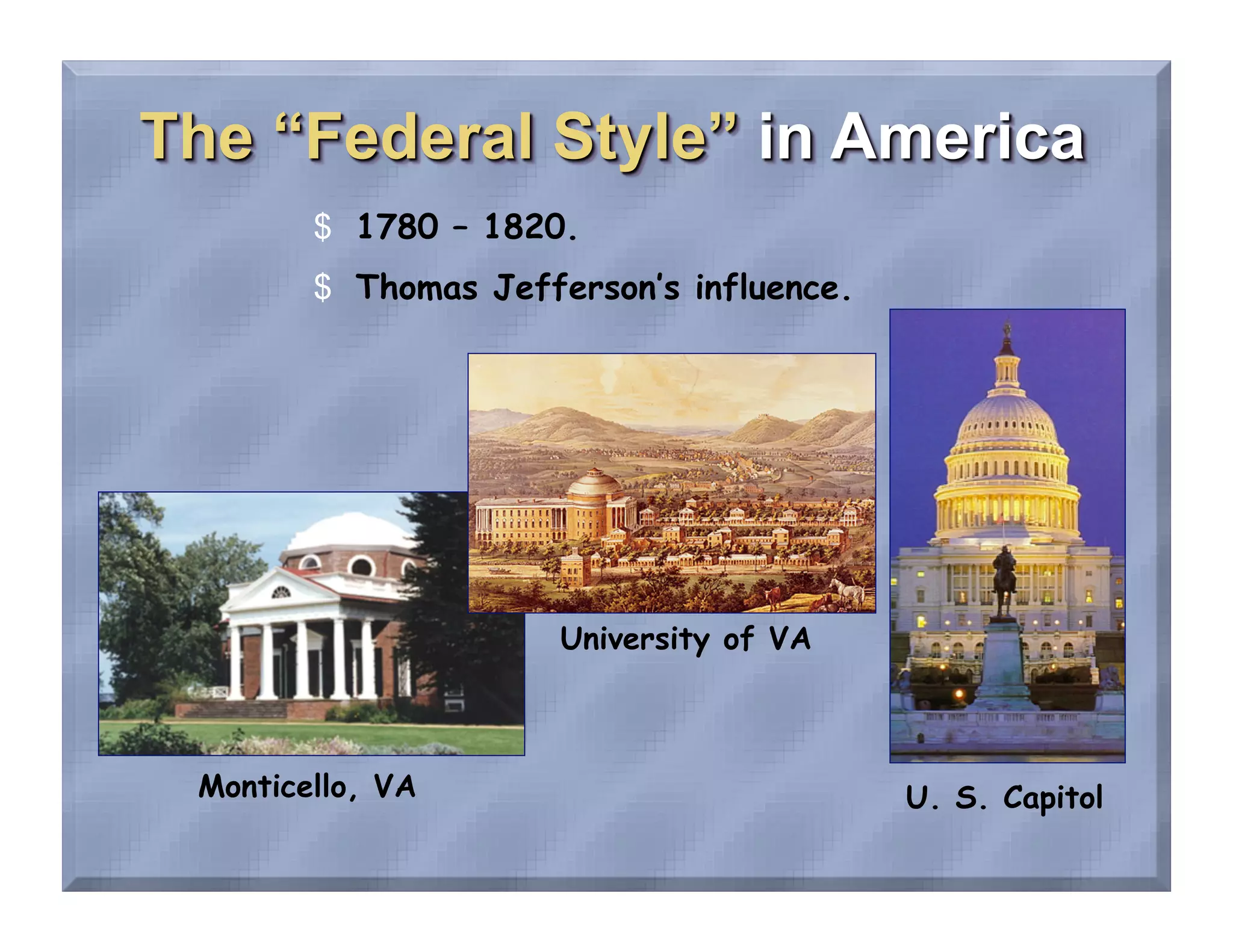
$  1780 – 1820.
       $  Thomas Jefferson’s influence.


                     University of VA


Monticello, VA                            U. S. Capitol
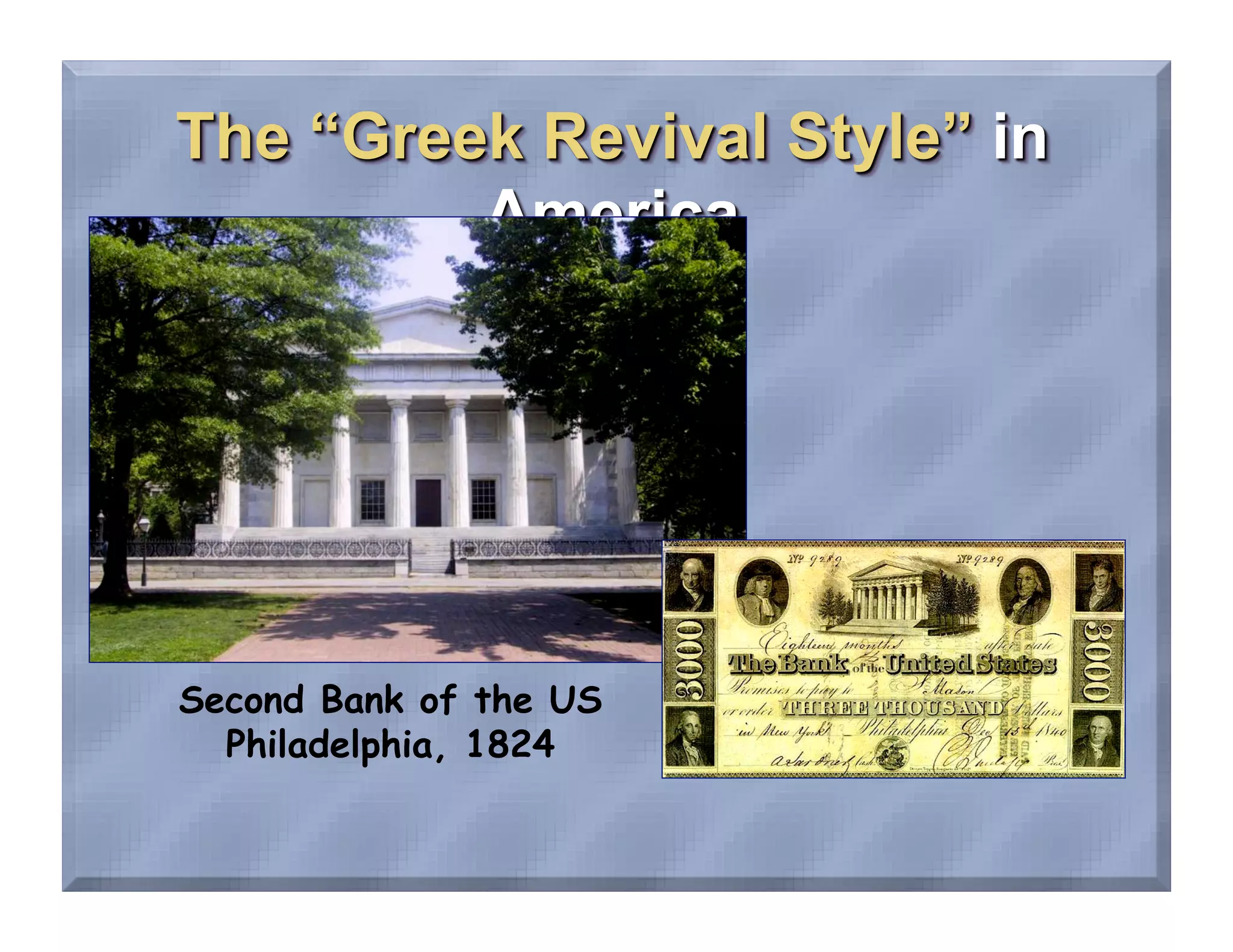
Second Bank of the US
  Philadelphia, 1824
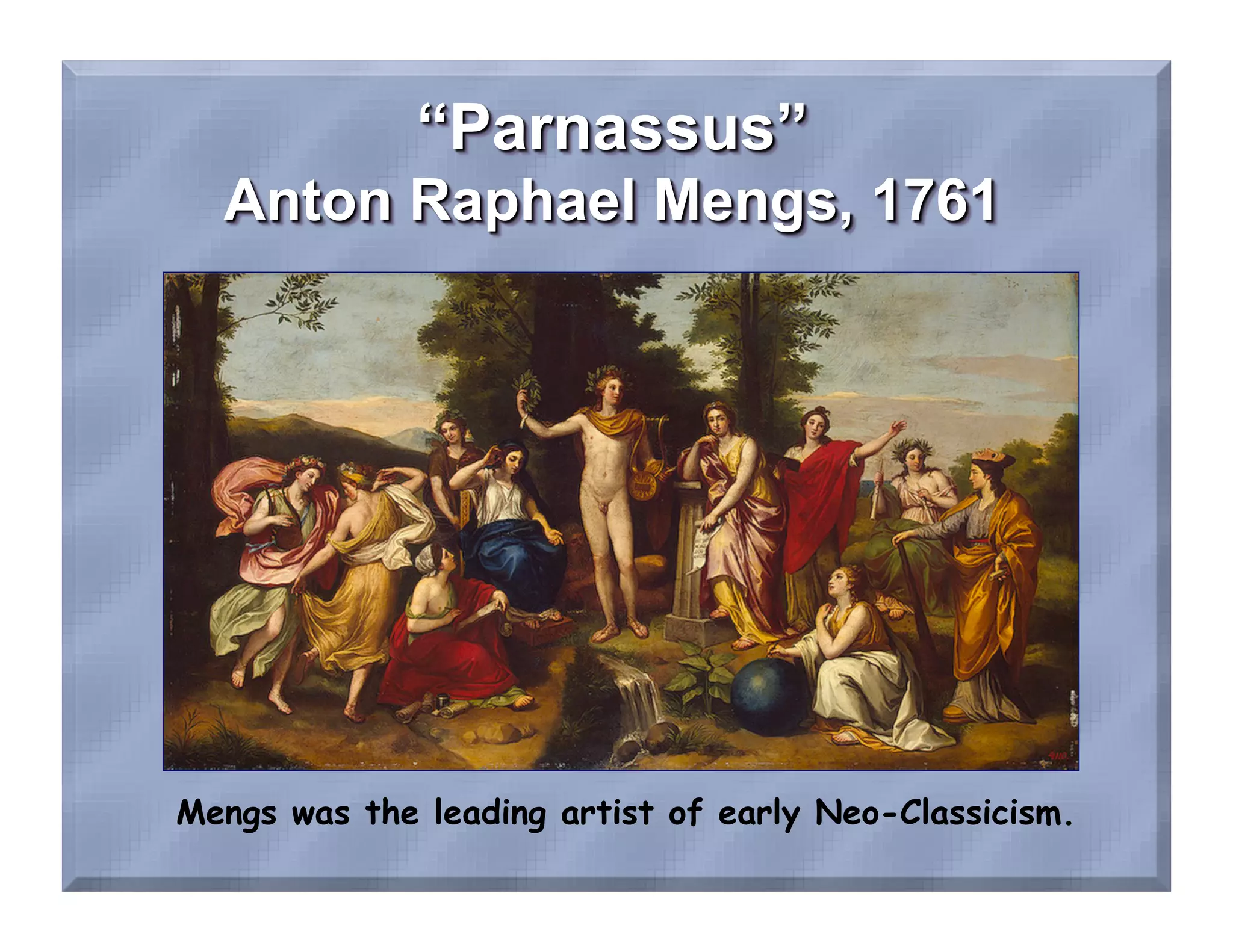
Mengs was the leading artist of early Neo-Classicism.
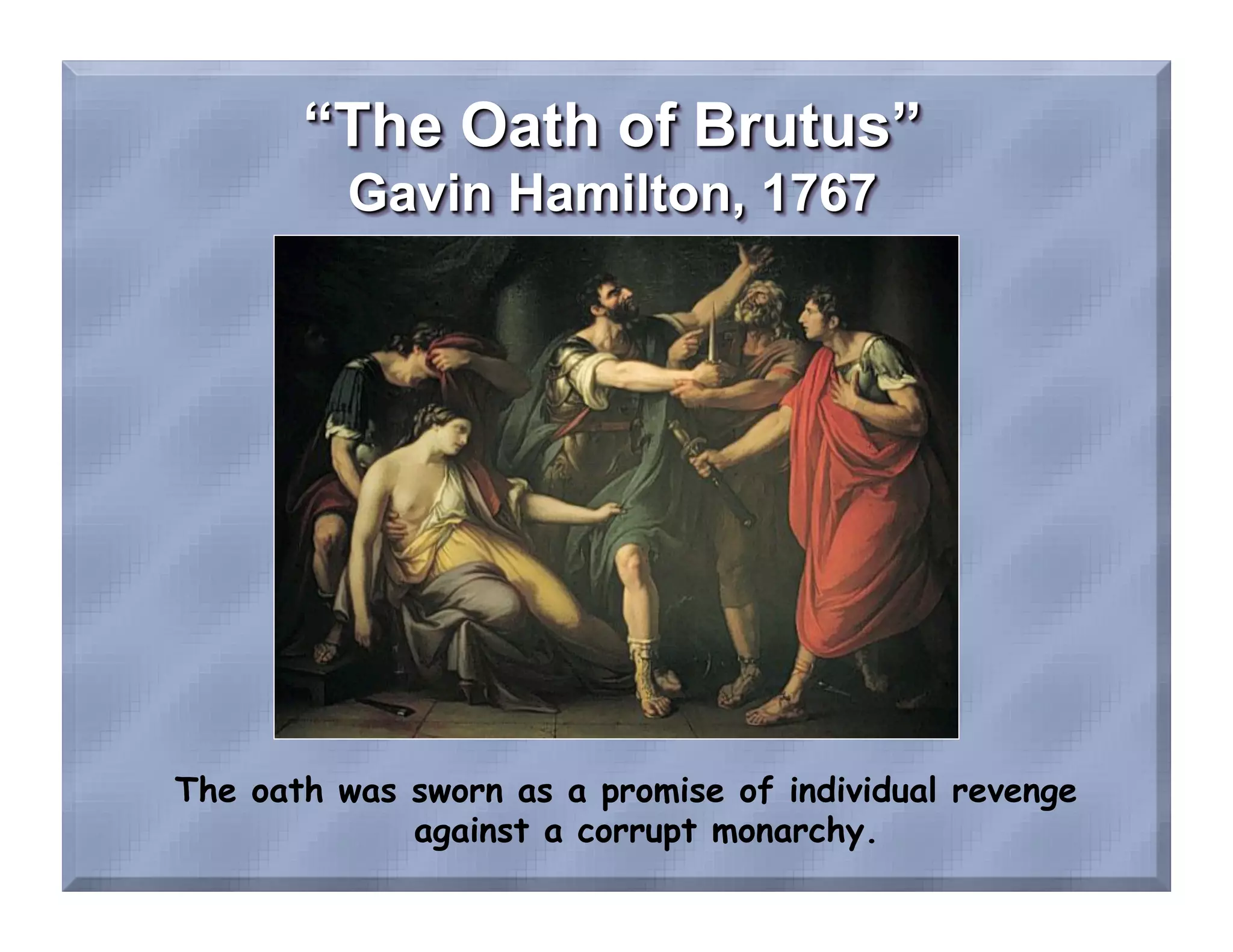
The oath was sworn as a promise of individual revenge
             against a corrupt monarchy.
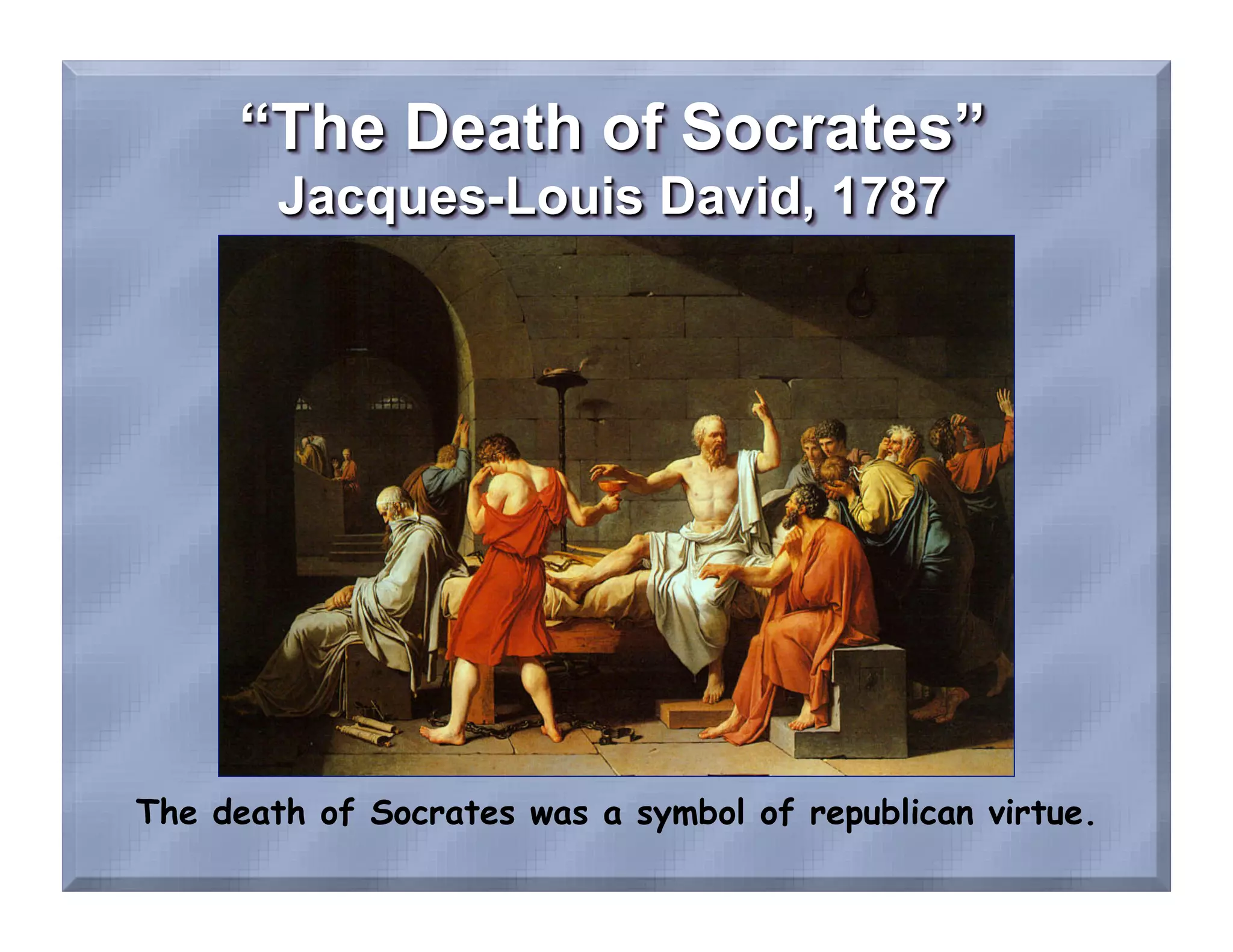
The death of Socrates was a symbol of republican virtue.
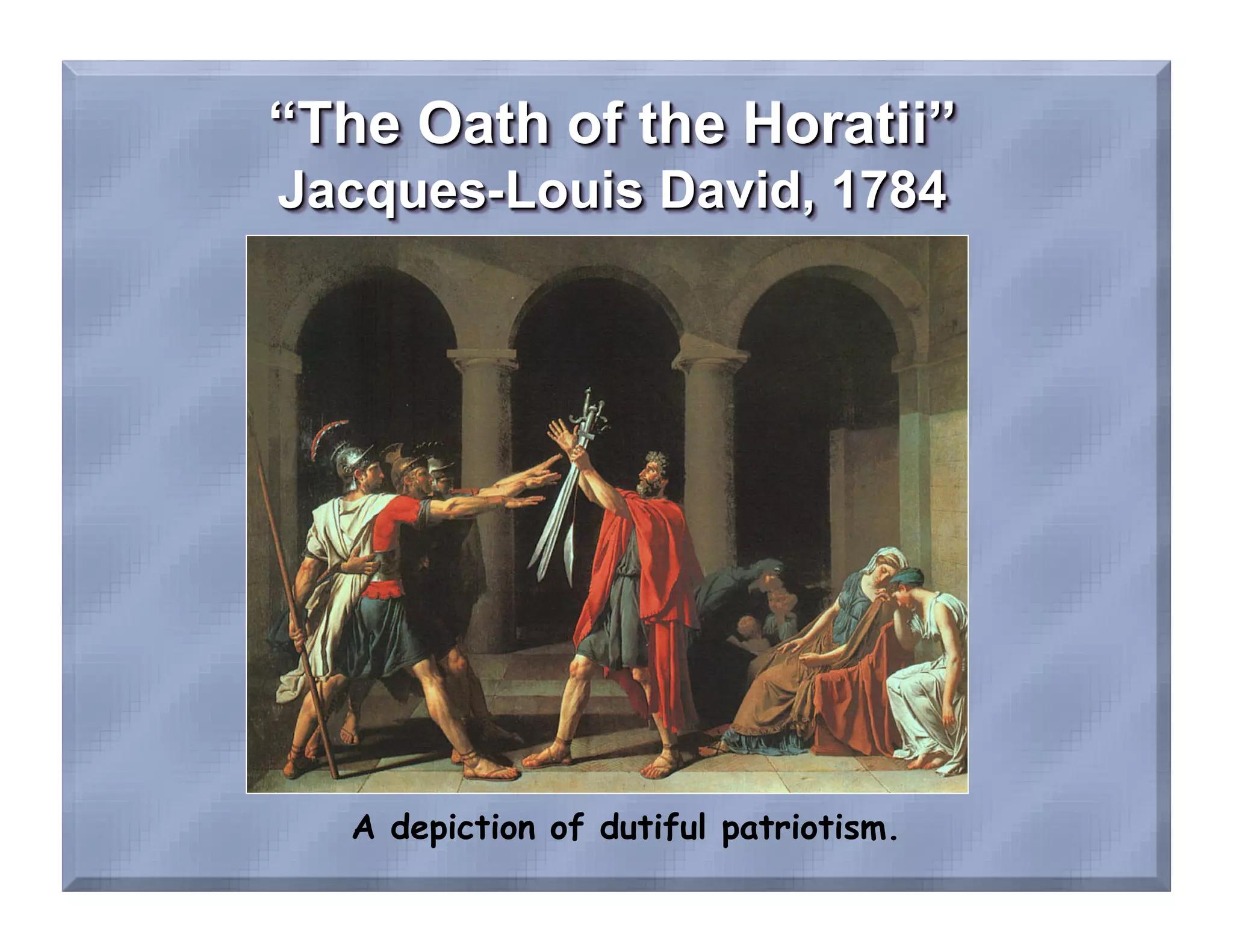
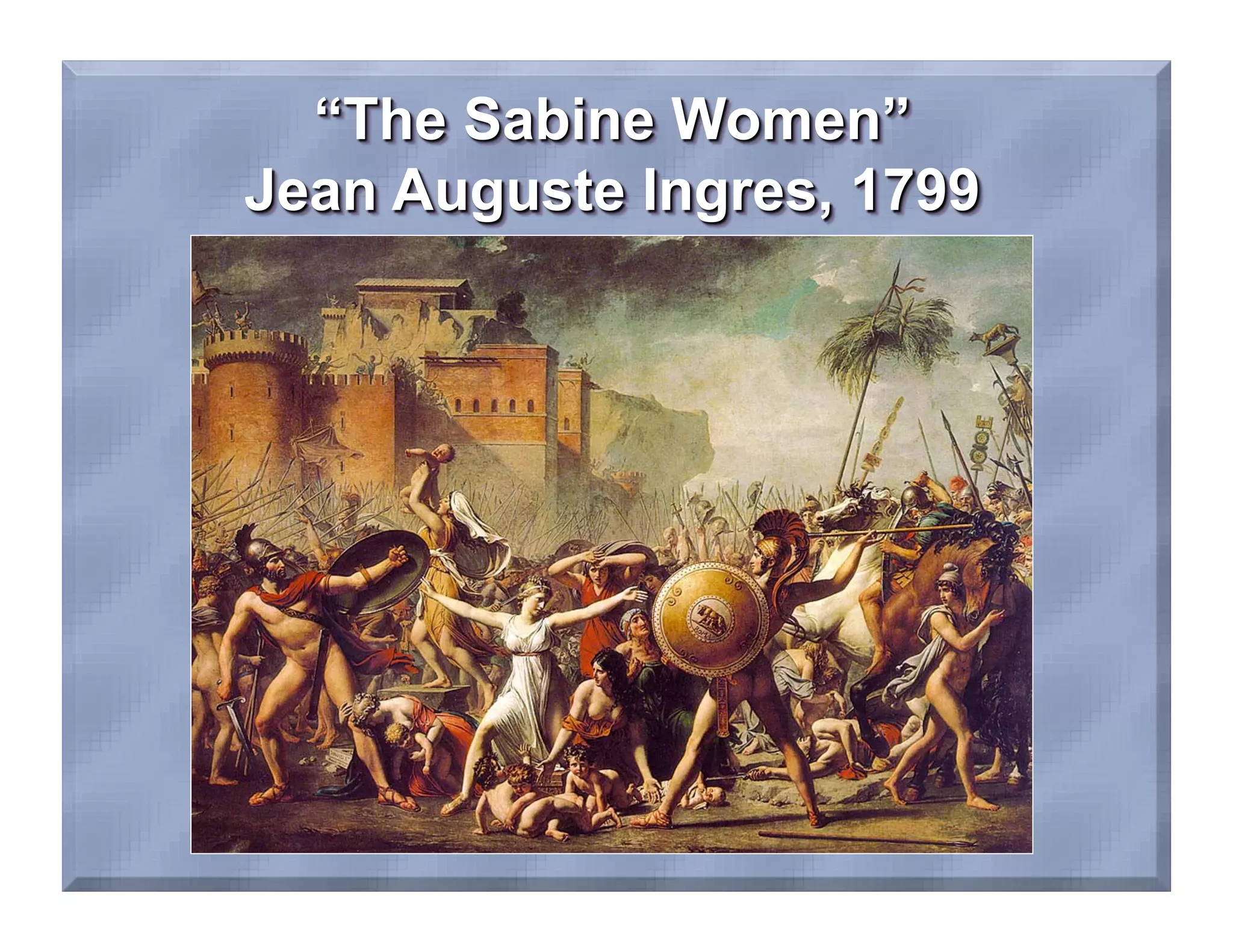
A depiction of dutiful patriotism.
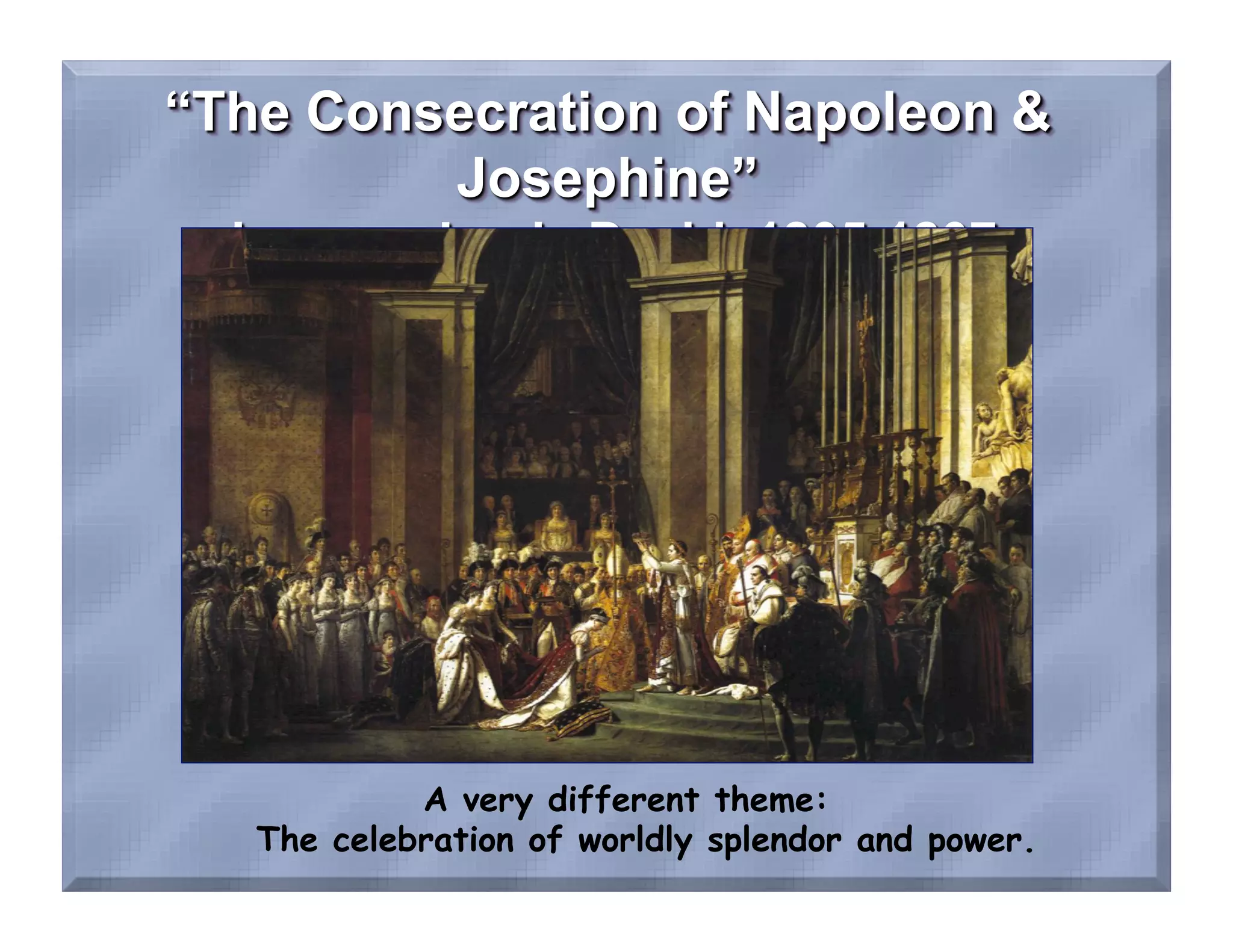
A very different theme:
The celebration of worldly splendor and power.
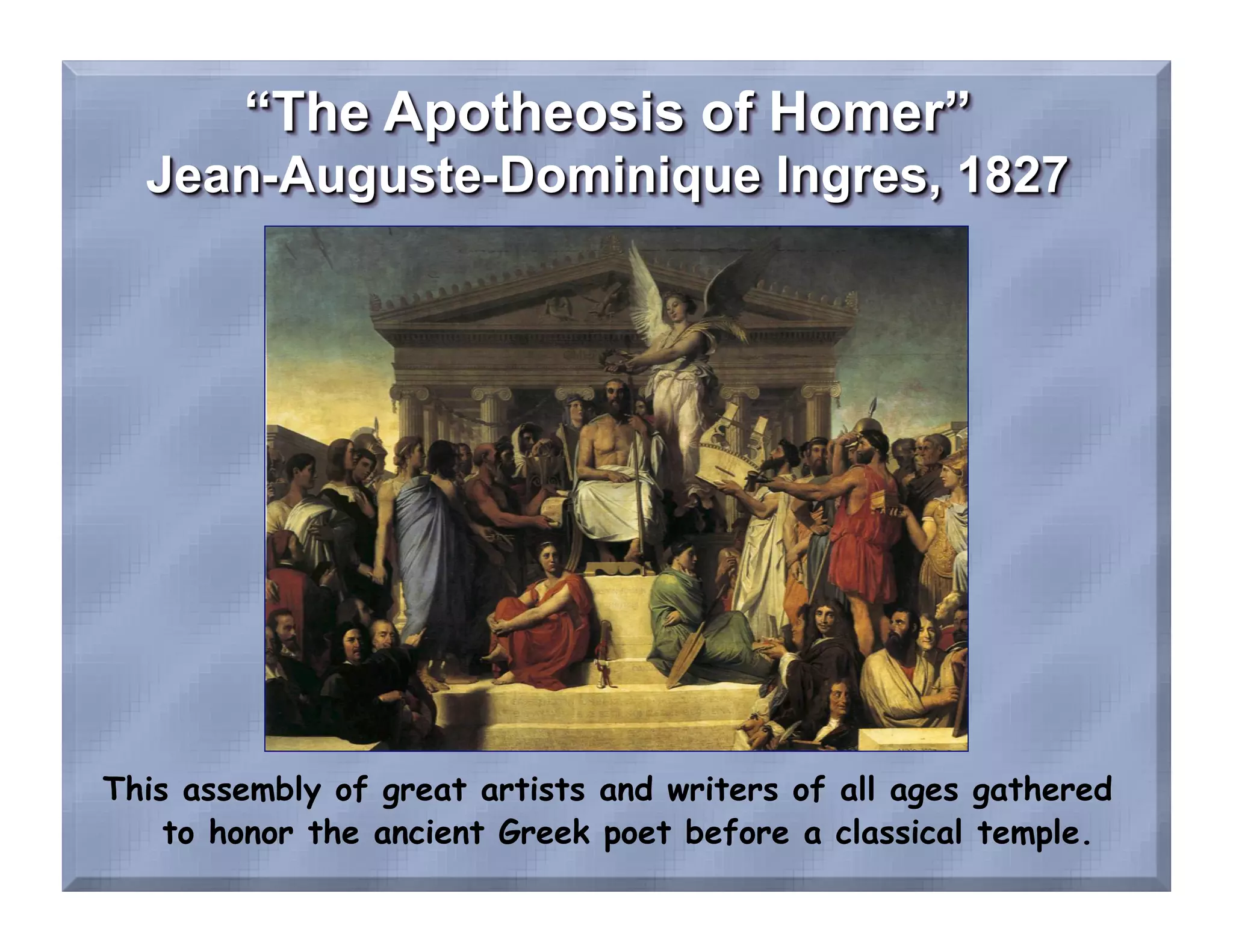
This assembly of great artists and writers of all ages gathered
    to honor the ancient Greek poet before a classical temple.
$  Profoundly influenced by ancient art since the
   Renaissance.
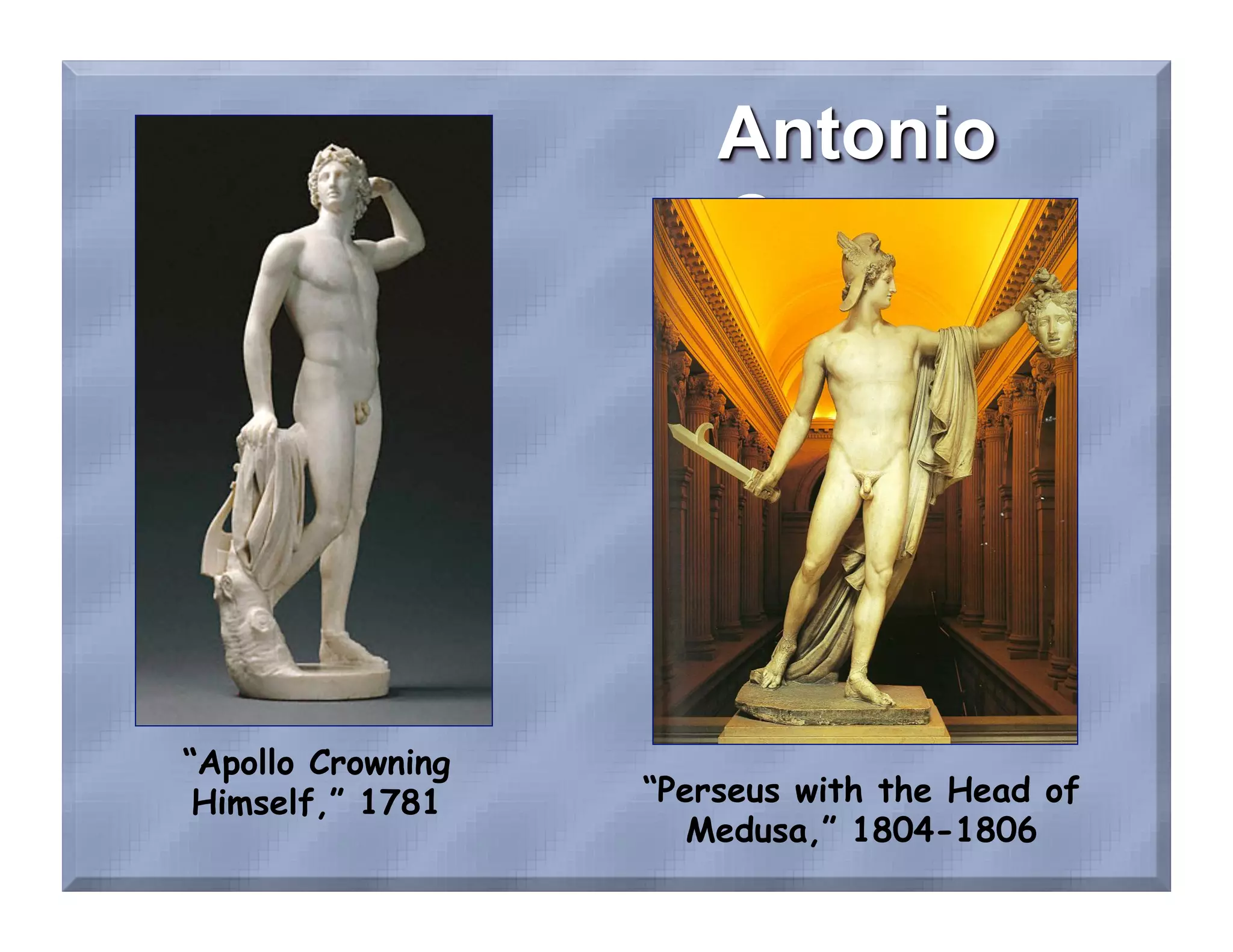
$  Neo-Classical sculptors avoided the dramatic
   twisting poses and colored marble surfaces
   characteristic of late Baroque and Rococo
   sculpture.
$  They preferred:
    S  Crisp contours.
    S  A noble stillness.

    S  Idealized white marble forms.
“Apollo Crowning
 Himself,” 1781    “Perseus with the Head of
                      Medusa,” 1804-1806
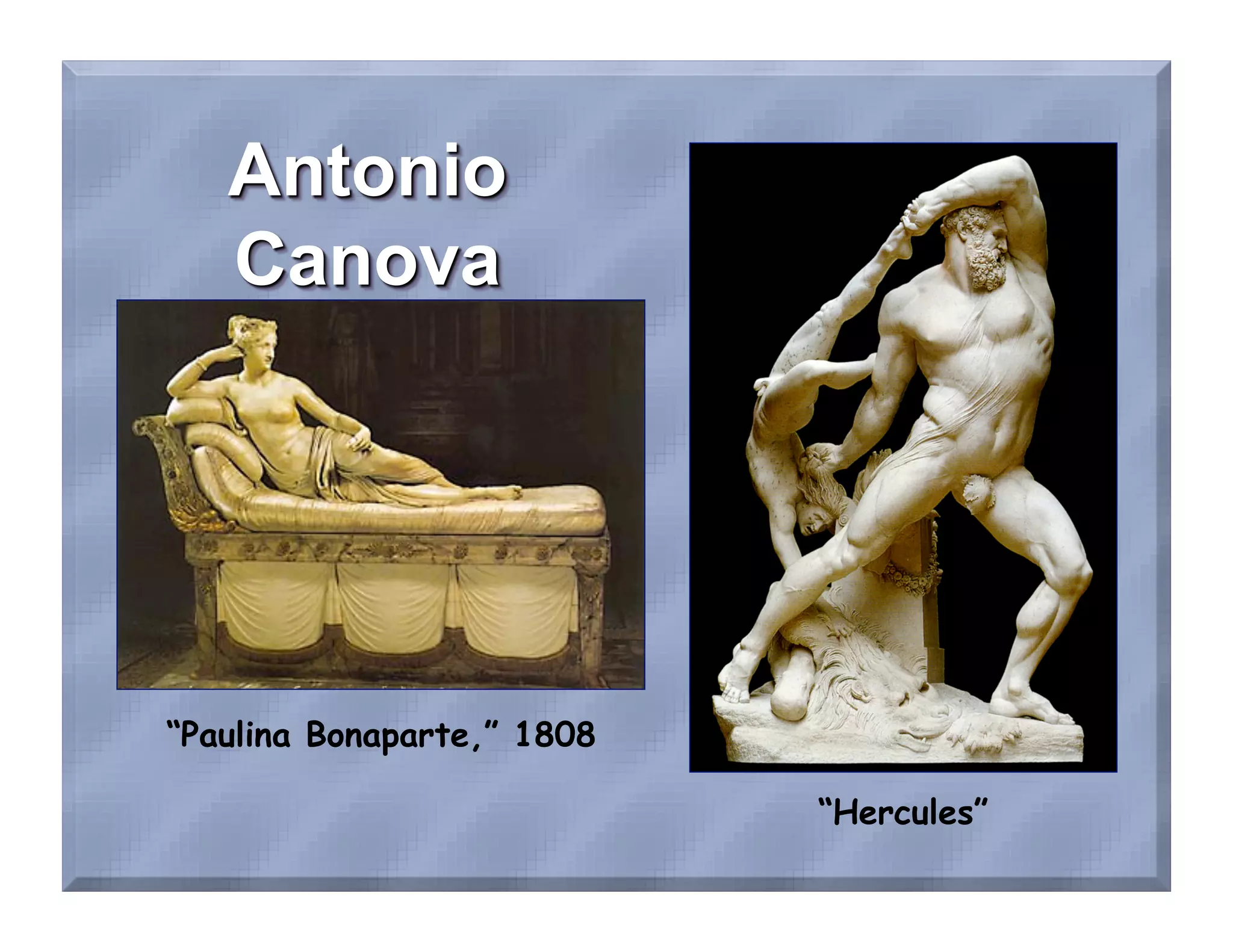
“Paulina Bonaparte,” 1808

                            “Hercules”
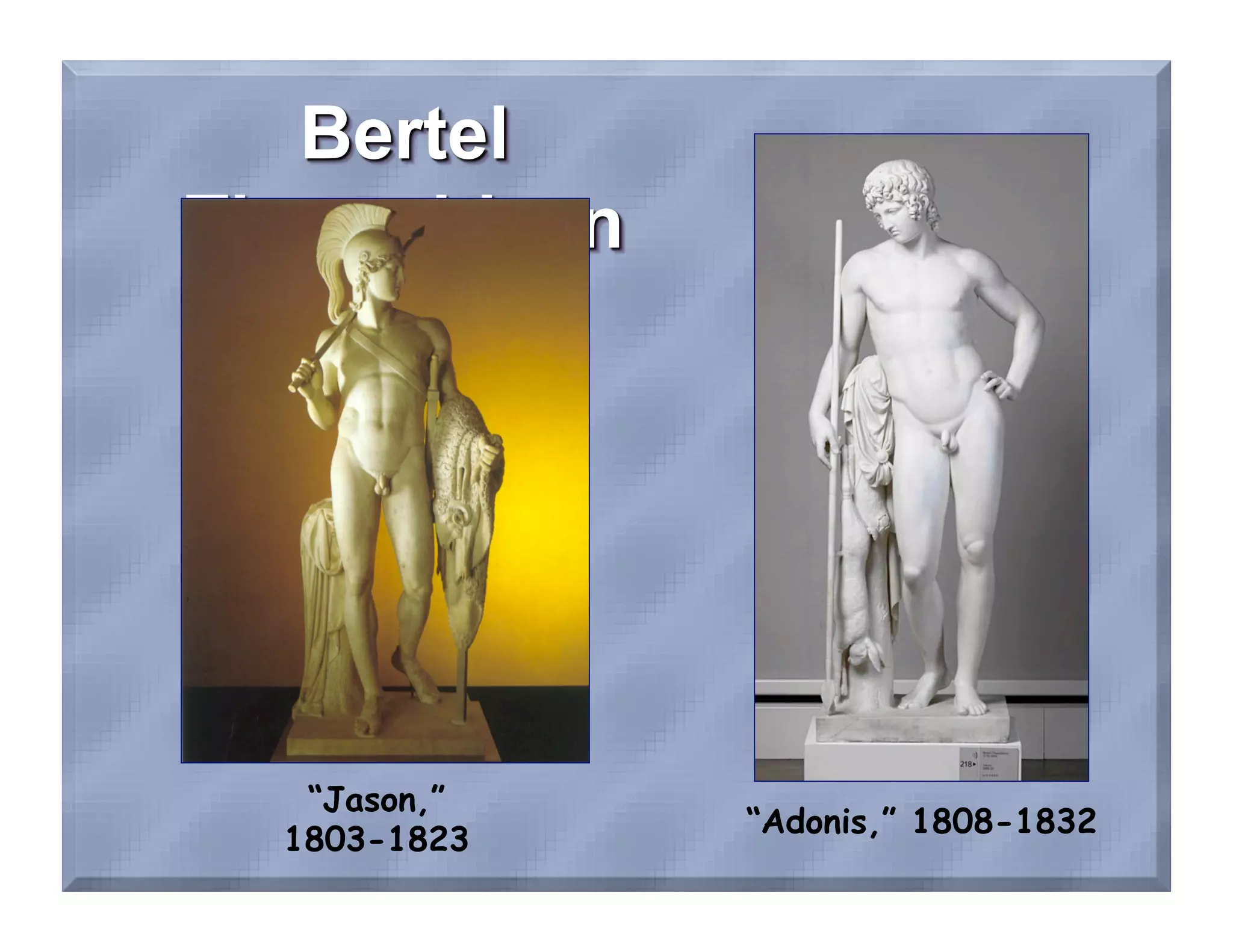
“Jason,”
            “Adonis,” 1808-1832
1803-1823
$  The furniture designs used Greco-Roman
   motifs.
$  Became known as style étrusque [“Etruscan
   style”] in France.
$  Were favored by the court of Louis XV and
   later by Napoleon I.
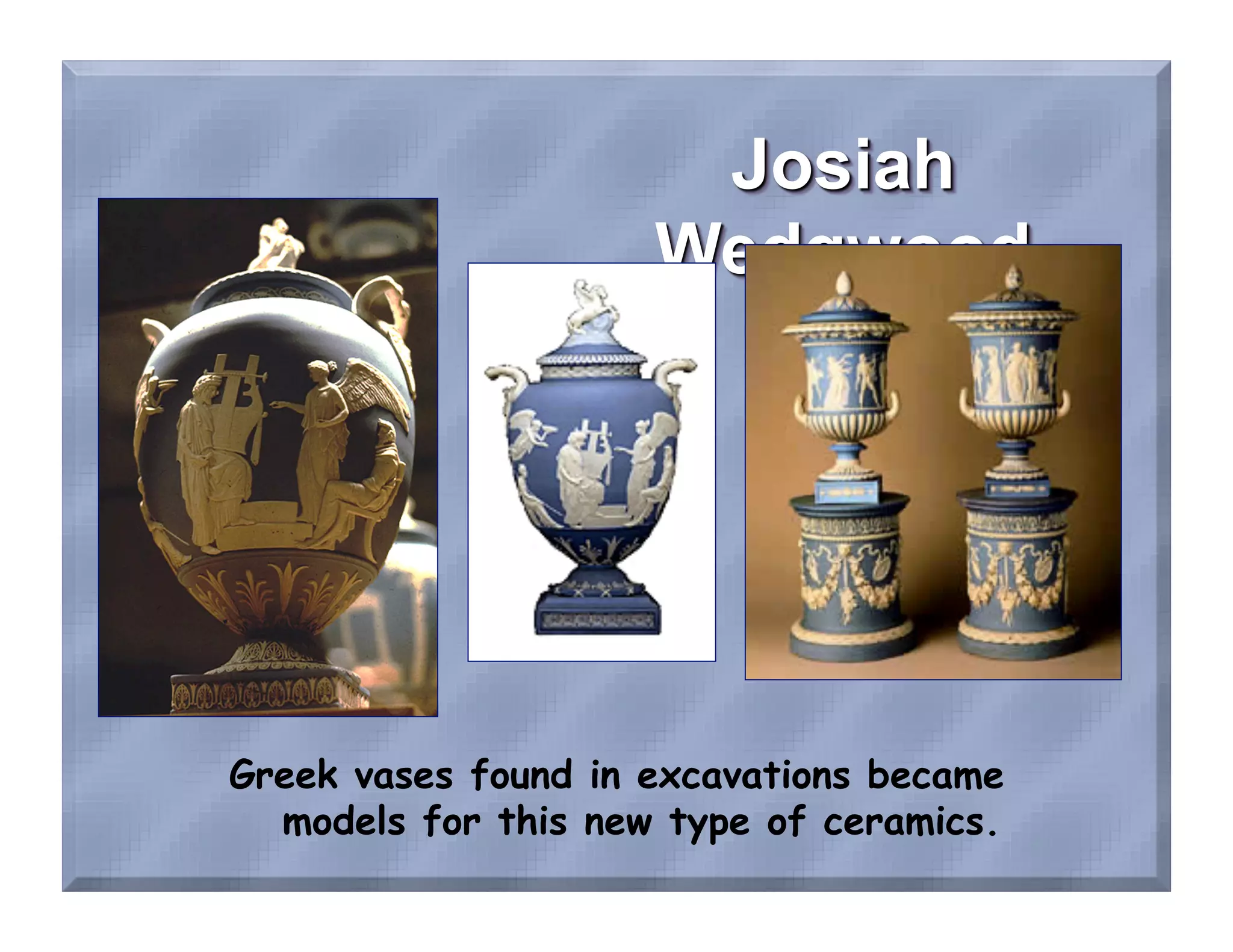
Greek vases found in excavations became
  models for this new type of ceramics.
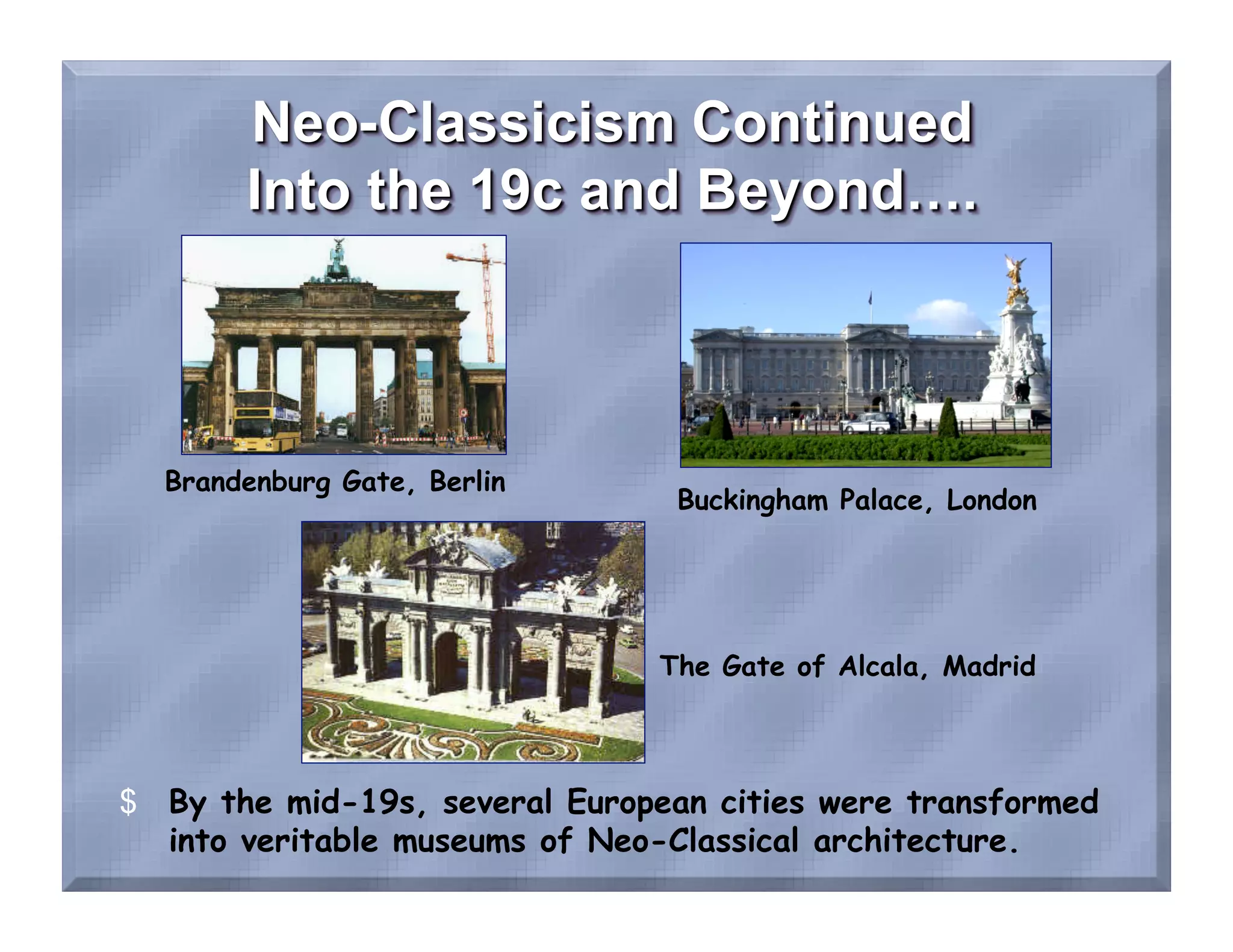
Brandenburg Gate, Berlin
                                 Buckingham Palace, London


                                The Gate of Alcala, Madrid


$  By the mid-19s, several European cities were transformed
   into veritable museums of Neo-Classical architecture.
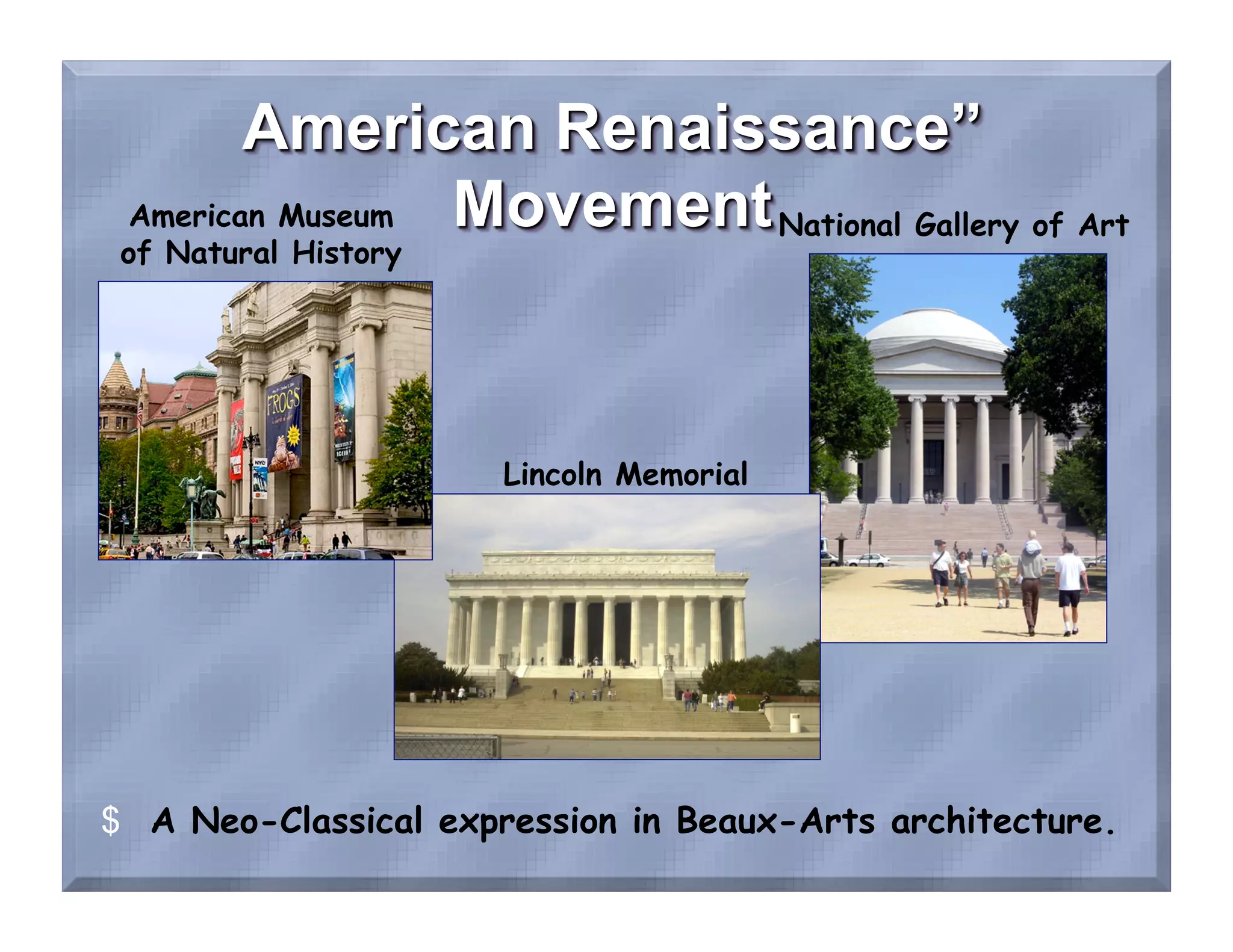
American Museum                        National Gallery of Art
 of Natural History


                      Lincoln Memorial


$  A Neo-Classical expression in Beaux-Arts architecture.
$  Sir Edwin Lutyan  a monumental city plan for
   New Delhi during the British Raj.


      Rashtrapati Bhavan      India Gate Monument
      [President’s House]

Neo-Classicism

  • 2.
    $  Art producedin Europe and North America from the mid-18c to the early 19c. $  More than just an antique revival  a reaction against the surviving Baroque & Rococo styles. $  Linked to contemporary political events: S  Revolutions established republics in France and in America. [Neo-Classicism was adapted as the official art style]. S  Association with the democracy of Greece and the republicanism of Rome. S  Napoleon  used the style for propaganda.
  • 4.
  • 5.
    James Stuart &Nicholas Revert Antiquities in Athens: 1762-1816.
  • 6.
    Thomas Bruce, 7th Lord of Elgin British Museum, 1806 From the top façade of the Parthenon in Athens.
  • 7.
    $  Artists should“imitate” the timeless, ideal forms of the classical world. $  A circle of international artists gathered about him in the 1760s in Rome. German art historian.
  • 8.
    $  Return tothe perceived “purity” of the arts of Rome. $  Model the “ideal” of the ancient Greek arts and, to a lesser, extent, 16c Renaissance classicism. $  A conviction that there is a permanent, universal way things are (and should be), which obviously entails fundamental political and ethical commitments. $  Sometimes considered anti-modern or even reactionary.
  • 10.
    Syon House Scottish architect The Red Salon & designer Syon House 1760s
  • 11.
    $  Designed a pavilion in 1771 for the Comtesse du Barry at Louveciennes. $  Designed a series of city gates for Paris (1785-1789).
  • 12.
    Rotunde de laVillette, Paris
  • 13.
    “The Royal Crescent[Circus]” at Bath, England (1754).
  • 14.
    $  Napoleon’s official architects. $  They remade Paris in the intimidating opulence of Roman imperial architectural style.
  • 15.
    Bank of EnglandRotunda Sir John Soane, 1796 British Museum Portico Sir Robert Smirke, 1823-1847
  • 16.
    $  1780 –1820. $  Thomas Jefferson’s influence. University of VA Monticello, VA U. S. Capitol
  • 17.
    Second Bank ofthe US Philadelphia, 1824
  • 19.
    Mengs was theleading artist of early Neo-Classicism.
  • 20.
    The oath wassworn as a promise of individual revenge against a corrupt monarchy.
  • 21.
    The death ofSocrates was a symbol of republican virtue.
  • 22.
    A depiction ofdutiful patriotism.
  • 23.
    A very differenttheme: The celebration of worldly splendor and power.
  • 24.
    This assembly ofgreat artists and writers of all ages gathered to honor the ancient Greek poet before a classical temple.
  • 27.
    $  Profoundly influencedby ancient art since the Renaissance. $  Neo-Classical sculptors avoided the dramatic twisting poses and colored marble surfaces characteristic of late Baroque and Rococo sculpture. $  They preferred: S  Crisp contours. S  A noble stillness. S  Idealized white marble forms.
  • 28.
    “Apollo Crowning Himself,”1781 “Perseus with the Head of Medusa,” 1804-1806
  • 29.
  • 30.
    “Jason,” “Adonis,” 1808-1832 1803-1823
  • 32.
    $  The furnituredesigns used Greco-Roman motifs. $  Became known as style étrusque [“Etruscan style”] in France. $  Were favored by the court of Louis XV and later by Napoleon I.
  • 33.
    Greek vases foundin excavations became models for this new type of ceramics.
  • 34.
    Brandenburg Gate, Berlin Buckingham Palace, London The Gate of Alcala, Madrid $  By the mid-19s, several European cities were transformed into veritable museums of Neo-Classical architecture.
  • 35.
    American Museum National Gallery of Art of Natural History Lincoln Memorial $  A Neo-Classical expression in Beaux-Arts architecture.
  • 36.
    $  Sir EdwinLutyan  a monumental city plan for New Delhi during the British Raj. Rashtrapati Bhavan India Gate Monument [President’s House]