1
1
2
3
NEOCLASSICISM, 1780 - 1840
Neoclassic – Greek word neos meaning new and the
Latin word classicus which is similar in meaning to the
English phrase first class.
> The Western movement in decorative and visual arts
was called Neoclassicism.
> coincided with the 18th
century Age of Reason also
known as the Age of Enlightenment.
4
Enlightment :
•Science and intellectual interchange
vs
•Superstition, intolerance and abuses by church and state
•Art must have a social and moral purpose.
•Against the excess of Baroque (art for the church and
royalty)
5
Neoclassical art pieces such as paintings, sculpture, and
architecture generally portrayed Roman history which
elevated the Roman heroes.
Characteristics:
 portrayal of Roman history
 formal composition
 the use of diagonals to show the peak of an emotion or
moment
 local color
Overall lighting
Classic geo structure
6
NEOCLASSICAL PAINTING
Neoclassical artists embraced the ideas of order and
moderation in which artistic interpretations of classic
Greek and Roman history were restored to realistic
portrayals.
Neoclassical painters gave great importance to the
costumes, settings and details of classical subject matter
without adding distracting details but with as much
historical accuracy as possible.
7
Neo-classical artists
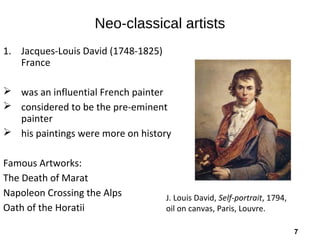
1. Jacques-Louis David (1748-1825)
France
 was an influential French painter
 considered to be the pre-eminent
painter
 his paintings were more on history
Famous Artworks:
The Death of Marat
Napoleon Crossing the Alps
Oath of the Horatii
J. Louis David, Self-portrait, 1794,
oil on canvas, Paris, Louvre.
8
The Death of Marat
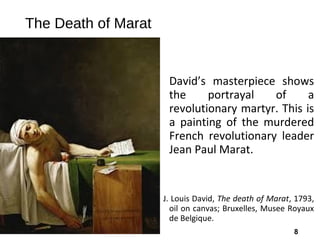
David’s masterpiece shows
the portrayal of a
revolutionary martyr. This is
a painting of the murdered
French revolutionary leader
Jean Paul Marat.
J. Louis David, The death of Marat, 1793,
oil on canvas; Bruxelles, Musee Royaux
de Belgique.
9
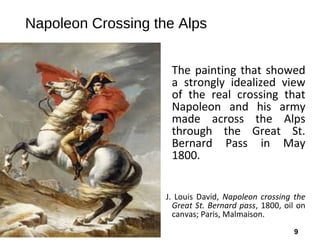
Napoleon Crossing the Alps
The painting that showed
a strongly idealized view
of the real crossing that
Napoleon and his army
made across the Alps
through the Great St.
Bernard Pass in May
1800.
J. Louis David, Napoleon crossing the
Great St. Bernard pass, 1800, oil on
canvas; Paris, Malmaison.
10
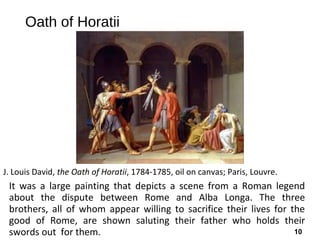
Oath of Horatii
J. Louis David, the Oath of Horatii, 1784-1785, oil on canvas; Paris, Louvre.
It was a large painting that depicts a scene from a Roman legend
about the dispute between Rome and Alba Longa. The three
brothers, all of whom appear willing to sacrifice their lives for the
good of Rome, are shown saluting their father who holds their
swords out for them.
11
NEOCLASSICAL SCULPTURES
The Neoclassical period was one of the great ages of
public sculpture. Artists looked to Roman styles during
the time of Alexander the Great for inspiration as well
as to mimic their style.
12
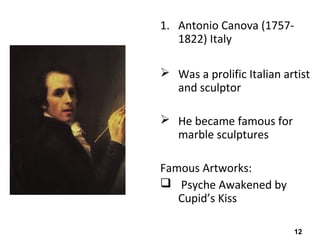
1. Antonio Canova (1757-
1822) Italy
 Was a prolific Italian artist
and sculptor
 He became famous for
marble sculptures
Famous Artworks:
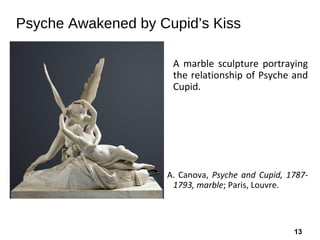
 Psyche Awakened by
Cupid’s Kiss
13
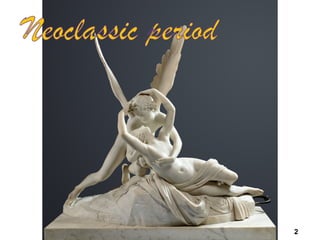
Psyche Awakened by Cupid’s Kiss
A marble sculpture portraying
the relationship of Psyche and
Cupid.
A. Canova, Psyche and Cupid, 1787-
1793, marble; Paris, Louvre.
14
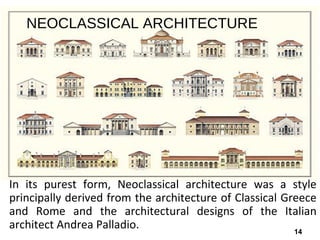
NEOCLASSICAL ARCHITECTURE
In its purest form, Neoclassical architecture was a style
principally derived from the architecture of Classical Greece
and Rome and the architectural designs of the Italian
architect Andrea Palladio.
15
TYPES OF NEOCLASSICAL
ARCHITECTURE:
Temple Style > was based on an ancient temple.
 Palladian Style > were based on style of villa construction.
Robert Adam (1728 – 1792) Britain
- He was known as the Palladian architect of the Neoclassical who
designed two well-known American civic buildings – The White House
and the United States Capitol
 Classical Block Style >features a rectangular or square plan, with a
flat roof and an exterior rich in classical detail.
Henri Labrouste – His masterpiece is the Library of Sainte-Genevieve
Charles Garnier – He designed the most famous classical block of all
which is the Palais Garnier
Matt H. Evans,
matt@exinfm.com
16
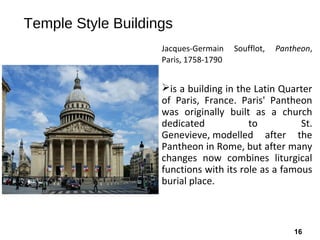
Temple Style Buildings
Jacques-Germain Soufflot, Pantheon,
Paris, 1758-1790
is a building in the Latin Quarter
of Paris, France. Paris' Pantheon
was originally built as a church
dedicated to St.
Genevieve, modelled after the
Pantheon in Rome, but after many
changes now combines liturgical
functions with its role as a famous
burial place.
17
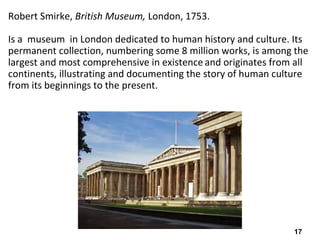
Robert Smirke, British Museum, London, 1753.
Is a museum in London dedicated to human history and culture. Its
permanent collection, numbering some 8 million works, is among the
largest and most comprehensive in existence and originates from all
continents, illustrating and documenting the story of human culture
from its beginnings to the present.
18
Palladian Style Building
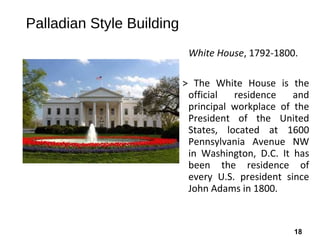
White House, 1792-1800.
> The White House is the
official residence and
principal workplace of the
President of the United
States, located at 1600
Pennsylvania Avenue NW
in Washington, D.C. It has
been the residence of
every U.S. president since
John Adams in 1800.
19
Classical Block Style Building
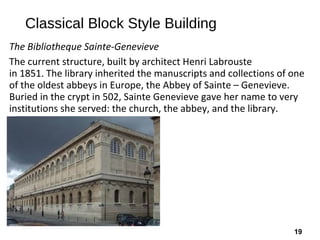
The Bibliotheque Sainte-Genevieve
The current structure, built by architect Henri Labrouste
in 1851. The library inherited the manuscripts and collections of one
of the oldest abbeys in Europe, the Abbey of Sainte – Genevieve.
Buried in the crypt in 502, Sainte Genevieve gave her name to very
institutions she served: the church, the abbey, and the library.

Creative Industries 1: 9 neoclassic period updated

  • 1.
  • 2.
  • 3.
    3 NEOCLASSICISM, 1780 -1840 Neoclassic – Greek word neos meaning new and the Latin word classicus which is similar in meaning to the English phrase first class. > The Western movement in decorative and visual arts was called Neoclassicism. > coincided with the 18th century Age of Reason also known as the Age of Enlightenment.
  • 4.
    4 Enlightment : •Science andintellectual interchange vs •Superstition, intolerance and abuses by church and state •Art must have a social and moral purpose. •Against the excess of Baroque (art for the church and royalty)
  • 5.
    5 Neoclassical art piecessuch as paintings, sculpture, and architecture generally portrayed Roman history which elevated the Roman heroes. Characteristics:  portrayal of Roman history  formal composition  the use of diagonals to show the peak of an emotion or moment  local color Overall lighting Classic geo structure
  • 6.
    6 NEOCLASSICAL PAINTING Neoclassical artistsembraced the ideas of order and moderation in which artistic interpretations of classic Greek and Roman history were restored to realistic portrayals. Neoclassical painters gave great importance to the costumes, settings and details of classical subject matter without adding distracting details but with as much historical accuracy as possible.
  • 7.
    7 Neo-classical artists 1. Jacques-LouisDavid (1748-1825) France  was an influential French painter  considered to be the pre-eminent painter  his paintings were more on history Famous Artworks: The Death of Marat Napoleon Crossing the Alps Oath of the Horatii J. Louis David, Self-portrait, 1794, oil on canvas, Paris, Louvre.
  • 8.
    8 The Death ofMarat David’s masterpiece shows the portrayal of a revolutionary martyr. This is a painting of the murdered French revolutionary leader Jean Paul Marat. J. Louis David, The death of Marat, 1793, oil on canvas; Bruxelles, Musee Royaux de Belgique.
  • 9.
    9 Napoleon Crossing theAlps The painting that showed a strongly idealized view of the real crossing that Napoleon and his army made across the Alps through the Great St. Bernard Pass in May 1800. J. Louis David, Napoleon crossing the Great St. Bernard pass, 1800, oil on canvas; Paris, Malmaison.
  • 10.
    10 Oath of Horatii J.Louis David, the Oath of Horatii, 1784-1785, oil on canvas; Paris, Louvre. It was a large painting that depicts a scene from a Roman legend about the dispute between Rome and Alba Longa. The three brothers, all of whom appear willing to sacrifice their lives for the good of Rome, are shown saluting their father who holds their swords out for them.
  • 11.
    11 NEOCLASSICAL SCULPTURES The Neoclassicalperiod was one of the great ages of public sculpture. Artists looked to Roman styles during the time of Alexander the Great for inspiration as well as to mimic their style.
  • 12.
    12 1. Antonio Canova(1757- 1822) Italy  Was a prolific Italian artist and sculptor  He became famous for marble sculptures Famous Artworks:  Psyche Awakened by Cupid’s Kiss
  • 13.
    13 Psyche Awakened byCupid’s Kiss A marble sculpture portraying the relationship of Psyche and Cupid. A. Canova, Psyche and Cupid, 1787- 1793, marble; Paris, Louvre.
  • 14.
    14 NEOCLASSICAL ARCHITECTURE In itspurest form, Neoclassical architecture was a style principally derived from the architecture of Classical Greece and Rome and the architectural designs of the Italian architect Andrea Palladio.
  • 15.
    15 TYPES OF NEOCLASSICAL ARCHITECTURE: TempleStyle > was based on an ancient temple.  Palladian Style > were based on style of villa construction. Robert Adam (1728 – 1792) Britain - He was known as the Palladian architect of the Neoclassical who designed two well-known American civic buildings – The White House and the United States Capitol  Classical Block Style >features a rectangular or square plan, with a flat roof and an exterior rich in classical detail. Henri Labrouste – His masterpiece is the Library of Sainte-Genevieve Charles Garnier – He designed the most famous classical block of all which is the Palais Garnier Matt H. Evans, matt@exinfm.com
  • 16.
    16 Temple Style Buildings Jacques-GermainSoufflot, Pantheon, Paris, 1758-1790 is a building in the Latin Quarter of Paris, France. Paris' Pantheon was originally built as a church dedicated to St. Genevieve, modelled after the Pantheon in Rome, but after many changes now combines liturgical functions with its role as a famous burial place.
  • 17.
    17 Robert Smirke, BritishMuseum, London, 1753. Is a museum in London dedicated to human history and culture. Its permanent collection, numbering some 8 million works, is among the largest and most comprehensive in existence and originates from all continents, illustrating and documenting the story of human culture from its beginnings to the present.
  • 18.
    18 Palladian Style Building WhiteHouse, 1792-1800. > The White House is the official residence and principal workplace of the President of the United States, located at 1600 Pennsylvania Avenue NW in Washington, D.C. It has been the residence of every U.S. president since John Adams in 1800.
  • 19.
    19 Classical Block StyleBuilding The Bibliotheque Sainte-Genevieve The current structure, built by architect Henri Labrouste in 1851. The library inherited the manuscripts and collections of one of the oldest abbeys in Europe, the Abbey of Sainte – Genevieve. Buried in the crypt in 502, Sainte Genevieve gave her name to very institutions she served: the church, the abbey, and the library.