The
Classical
Period
Of Western Musical History
Circa 1750 to 1820
47 minutes of Musical Examples
The Classical Period of Music
The Classical Period of Western music followed the
Baroque period. Lasting a relatively short period of
time, (70 years) the dates of the Classical period
are approximately 1750 to 1820.
In contrast to the music of the Baroque period,
much of the music of the Classical period is
characterized by generally simpler melodies and
musical textures (i.e. the number of distinct
musical lines occurring simultaneously).
Baroque vs. Classical Period Music
Despite the fact that the music of these two periods
of musical history are characterized by distinct
differences in musical style, there are still many
similarities between music of the Baroque period
and music of the Classical period. There is also
considerable overlap between the two periods.
That said, some of the general differences between
Baroque and Classical period music are detailed
on the following slides.
Baroque vs. Classical
Period Music
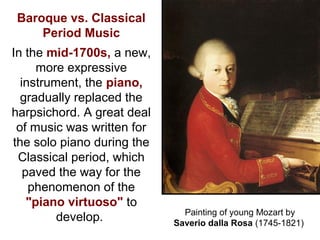
In the mid-1700s, a new,
more expressive
instrument, the piano,
gradually replaced the
harpsichord. A great deal
of music was written for
the solo piano during the
Classical period, which
paved the way for the
phenomenon of the
"piano virtuoso" to
develop. Painting of young Mozart by
Saverio dalla Rosa (1745-1821)
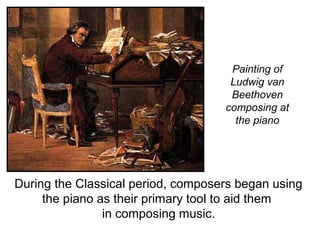
During the Classical period, composers began using
the piano as their primary tool to aid them
in composing music.
Painting of
Ludwig van
Beethoven
composing at
the piano
The Orchestra Is Standardized in the
Classical Period
The idea of an orchestra as a musical ensemble was
first established during the Baroque Period,
but not yet standardized.
During the Classical Period, the size of the orchestra
increased and by the end of the Classical period, the
instruments of the orchestra became standardized as:
2 flutes, 2 oboes, 2 clarinets, 2 bassoons,
2 French horns, 2 trumpets, timpani & strings.
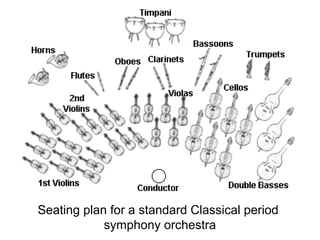
Seating plan for a standard Classical period
symphony orchestra
Music in the Classical period was written
to appeal to the emerging middle class
audience, whereas Baroque music was
typically intended for the aristocracy
or the church.
Opera was still popular in the
Classical period, but the subjects of
the operas began to change.
In the Classical period, fewer operas were written
about mythological characters, as they were in the
Baroque period, and more operas were written
about the lives of ordinary people
(such as in Mozart's The Marriage of Figaro.)
However, some Classical period operas
were still written about kings.
The style of music changed in the Classical period
to become generally simpler in a number of ways.
The complex style of polyphonic music (music with
many melodies simultaneously) that was prevalent
in the late Baroque period was replaced in the
Classical period by music that emphasizes single
melodies with an underlying accompaniment. The
concepts of proportion and balance as applied to
the phrasing and musical structure became very
important during the Classical period.
The length or duration of some musical works
gradually increased in the Classical period. This
became evident with the development of the
"Sonata-Allegro form." This form became one of
the most important developments in Classical
period music, because it was adopted as the
standard structure (musical architecture)
for the first movements of Sonatas, Symphonies
and String Quartets.
Classical Period Trends In Other Arts
Other arts forms, such as painting, sculpture,
architecture and literature experienced a period in the
late 18th
and early 19th
centuries similar to the Classical
Period in music. But with these other arts forms, these
trends are usually called “Neoclassical*” to distinguish
them from the Classical periods of art, architecture and
literature that took place during the cultures
of ancient Greece and Rome. (“Neo” means “new.”)
Since the music of ancient Greece and Rome has
largely been lost, the word “Neoclassical” is not used to
refer to the “Classical” trend that took place
from 1750 to 1820.
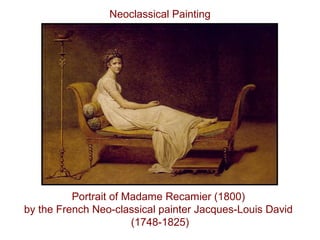
Portrait of Madame Recamier (1800)
by the French Neo-classical painter Jacques-Louis David
(1748-1825)
Neoclassical Painting
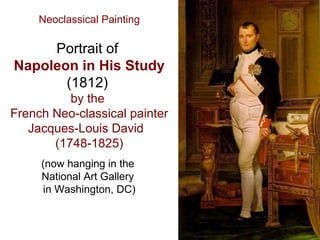
Portrait of
Napoleon in His Study
(1812)
by the
French Neo-classical painter
Jacques-Louis David
(1748-1825)
(now hanging in the
National Art Gallery
in Washington, DC)
Neoclassical Painting
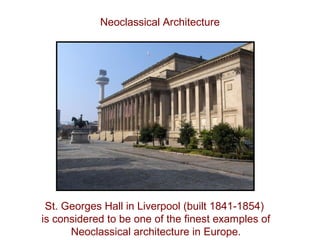
St. Georges Hall in Liverpool (built 1841-1854)
is considered to be one of the finest examples of
Neoclassical architecture in Europe.
Neoclassical Architecture
Examples of Classical Period Music
Piano Sonata
Mozart: Sonata in C Major for Piano, K. 545
1st
Movement (4’57”)
http://www.youtube.com/watch?v=JiCld3wZGPA
Symphony
Mozart: Symphony No. 41 in C Major (The “Jupiter” Symphony)
http://www.youtube.com/watch?v=Fcly8-RGhgw (9’31”)
Concerto (11’29”)
Mozart: Concerto in G Major for Piano, K. 453 (TEOM CD 2, #29)
String Quartet
Haydn: String Quartet, Opus 77, No. 1 – First Movement
http://www.youtube.com/watch?v=gXXJ7g1JH88 (5’58”)
Examples of Classical Period Music
Opera
Mozart: The Marriage of Figaro
Bass Aria: “Non piu andrai” (4’48”)
http://www.youtube.com/watch?v=J3UCxd_KSVo
Theme and Variations
Haydn: Symphony No. 94 in G Major
(“The Surprise Symphony”)
TEOM CD1 #79 (6’11”)
Examples of Classical Period Music
Minuet and Trio
The Minuet and Trio is a common musical form in the
Classical period, especially in Symphonies.
Some Symphonies have 3 movements
and some have 4 movements.
If a Symphony has 4 movements, then the Minuet & Trio form
is used for the 3rd
movement.
Examples of Classical Period Music
Minuet and Trio Structure
A-A B-B
Trio: C-C D-D
Da capo*: A-B
Example:
Haydn: Symphony No. 6 in D Major – 3rd
Movement (4’08”)
http://www.youtube.com/watch?v=1RLFfK7vcRk
*Da capo is an Italian musical term that means
“from the beginning.” “Capo” in Italian means “head.”
Examples of Classical Period Music
Rondo
The Rondo form consists of the repeated use of a theme,
alternating with musical episodes, each consisting of a new
theme, intervening among the repetitions, like this:
A – B – A – C - A - D – A – Coda)
(A “coda” in music is an ending. “Coda means “tail” in Italian.
Example:
Haydn: Piano Trio in G Major - Rondo all'Ongarese (Presto)
http://www.youtube.com/watch?v=EJfBIg4tWjo
3’26”

Classical period

  • 1.
    The Classical Period Of Western MusicalHistory Circa 1750 to 1820 47 minutes of Musical Examples
  • 2.
    The Classical Periodof Music The Classical Period of Western music followed the Baroque period. Lasting a relatively short period of time, (70 years) the dates of the Classical period are approximately 1750 to 1820. In contrast to the music of the Baroque period, much of the music of the Classical period is characterized by generally simpler melodies and musical textures (i.e. the number of distinct musical lines occurring simultaneously).
  • 3.
    Baroque vs. ClassicalPeriod Music Despite the fact that the music of these two periods of musical history are characterized by distinct differences in musical style, there are still many similarities between music of the Baroque period and music of the Classical period. There is also considerable overlap between the two periods. That said, some of the general differences between Baroque and Classical period music are detailed on the following slides.
  • 4.
    Baroque vs. Classical PeriodMusic In the mid-1700s, a new, more expressive instrument, the piano, gradually replaced the harpsichord. A great deal of music was written for the solo piano during the Classical period, which paved the way for the phenomenon of the "piano virtuoso" to develop. Painting of young Mozart by Saverio dalla Rosa (1745-1821)
  • 5.
    During the Classicalperiod, composers began using the piano as their primary tool to aid them in composing music. Painting of Ludwig van Beethoven composing at the piano
  • 6.
    The Orchestra IsStandardized in the Classical Period The idea of an orchestra as a musical ensemble was first established during the Baroque Period, but not yet standardized. During the Classical Period, the size of the orchestra increased and by the end of the Classical period, the instruments of the orchestra became standardized as: 2 flutes, 2 oboes, 2 clarinets, 2 bassoons, 2 French horns, 2 trumpets, timpani & strings.
  • 7.
    Seating plan fora standard Classical period symphony orchestra
  • 8.
    Music in theClassical period was written to appeal to the emerging middle class audience, whereas Baroque music was typically intended for the aristocracy or the church.
  • 9.
    Opera was stillpopular in the Classical period, but the subjects of the operas began to change. In the Classical period, fewer operas were written about mythological characters, as they were in the Baroque period, and more operas were written about the lives of ordinary people (such as in Mozart's The Marriage of Figaro.) However, some Classical period operas were still written about kings.
  • 10.
    The style ofmusic changed in the Classical period to become generally simpler in a number of ways. The complex style of polyphonic music (music with many melodies simultaneously) that was prevalent in the late Baroque period was replaced in the Classical period by music that emphasizes single melodies with an underlying accompaniment. The concepts of proportion and balance as applied to the phrasing and musical structure became very important during the Classical period.
  • 11.
    The length orduration of some musical works gradually increased in the Classical period. This became evident with the development of the "Sonata-Allegro form." This form became one of the most important developments in Classical period music, because it was adopted as the standard structure (musical architecture) for the first movements of Sonatas, Symphonies and String Quartets.
  • 12.
    Classical Period TrendsIn Other Arts Other arts forms, such as painting, sculpture, architecture and literature experienced a period in the late 18th and early 19th centuries similar to the Classical Period in music. But with these other arts forms, these trends are usually called “Neoclassical*” to distinguish them from the Classical periods of art, architecture and literature that took place during the cultures of ancient Greece and Rome. (“Neo” means “new.”) Since the music of ancient Greece and Rome has largely been lost, the word “Neoclassical” is not used to refer to the “Classical” trend that took place from 1750 to 1820.
  • 13.
    Portrait of MadameRecamier (1800) by the French Neo-classical painter Jacques-Louis David (1748-1825) Neoclassical Painting
  • 14.
    Portrait of Napoleon inHis Study (1812) by the French Neo-classical painter Jacques-Louis David (1748-1825) (now hanging in the National Art Gallery in Washington, DC) Neoclassical Painting
  • 15.
    St. Georges Hallin Liverpool (built 1841-1854) is considered to be one of the finest examples of Neoclassical architecture in Europe. Neoclassical Architecture
  • 16.
    Examples of ClassicalPeriod Music Piano Sonata Mozart: Sonata in C Major for Piano, K. 545 1st Movement (4’57”) http://www.youtube.com/watch?v=JiCld3wZGPA Symphony Mozart: Symphony No. 41 in C Major (The “Jupiter” Symphony) http://www.youtube.com/watch?v=Fcly8-RGhgw (9’31”) Concerto (11’29”) Mozart: Concerto in G Major for Piano, K. 453 (TEOM CD 2, #29) String Quartet Haydn: String Quartet, Opus 77, No. 1 – First Movement http://www.youtube.com/watch?v=gXXJ7g1JH88 (5’58”)
  • 17.
    Examples of ClassicalPeriod Music Opera Mozart: The Marriage of Figaro Bass Aria: “Non piu andrai” (4’48”) http://www.youtube.com/watch?v=J3UCxd_KSVo Theme and Variations Haydn: Symphony No. 94 in G Major (“The Surprise Symphony”) TEOM CD1 #79 (6’11”)
  • 18.
    Examples of ClassicalPeriod Music Minuet and Trio The Minuet and Trio is a common musical form in the Classical period, especially in Symphonies. Some Symphonies have 3 movements and some have 4 movements. If a Symphony has 4 movements, then the Minuet & Trio form is used for the 3rd movement.
  • 19.
    Examples of ClassicalPeriod Music Minuet and Trio Structure A-A B-B Trio: C-C D-D Da capo*: A-B Example: Haydn: Symphony No. 6 in D Major – 3rd Movement (4’08”) http://www.youtube.com/watch?v=1RLFfK7vcRk *Da capo is an Italian musical term that means “from the beginning.” “Capo” in Italian means “head.”
  • 20.
    Examples of ClassicalPeriod Music Rondo The Rondo form consists of the repeated use of a theme, alternating with musical episodes, each consisting of a new theme, intervening among the repetitions, like this: A – B – A – C - A - D – A – Coda) (A “coda” in music is an ending. “Coda means “tail” in Italian. Example: Haydn: Piano Trio in G Major - Rondo all'Ongarese (Presto) http://www.youtube.com/watch?v=EJfBIg4tWjo 3’26”