Near Point
of
Convergen
ce
Definition:
Convergence


Is the only disjunctive movement that
is under conscious control. It is a
fusional movement that may be
stimulated by volition, disparate
stimulation, and accommodation.
The near point of convergence
(NPC)
 Is

the point of intersection of the lines
of sight of the eyes when maximum
convergence is utilized.
The near point of convergence
distance
 Is

the distance from the near point of
convergence to the midpoint of the
line connecting the center of rotation
of the eyes.
Clinical use:


The near point of convergence
distance is a measurement of the
maximum convergence ability of a
patient. Patients who have reduced
near point of convergence distances
may have visual and ocular
discomfort when performing near
point vision tasks.
Instruments:
 Penlight

 Transilluminator
 Millimeter

ruler
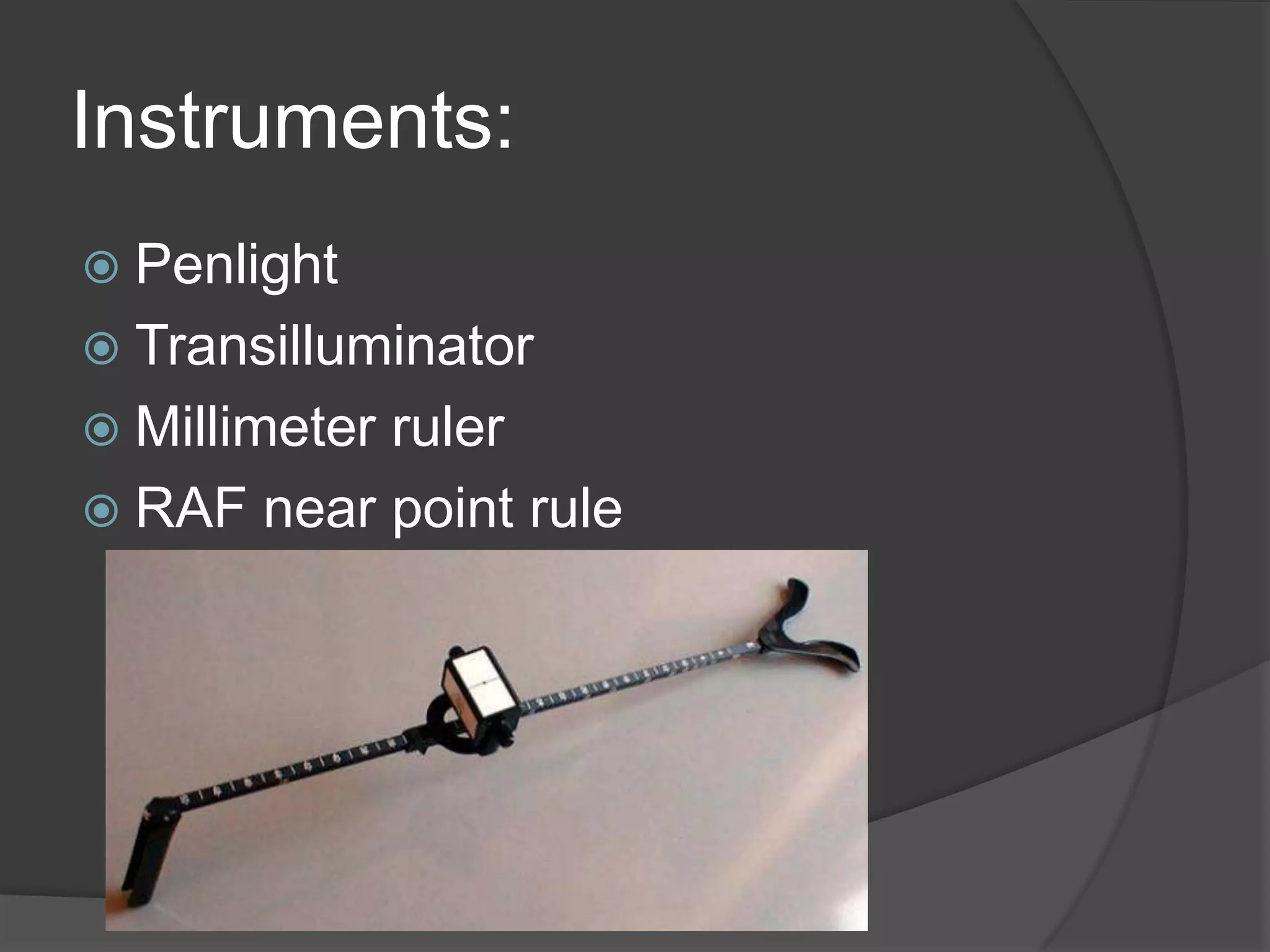
 RAF near point rule
Clinical procedure


The measurement of the near point of
convergence distance should be
performed in free space, the clinical
procedure is as follows:

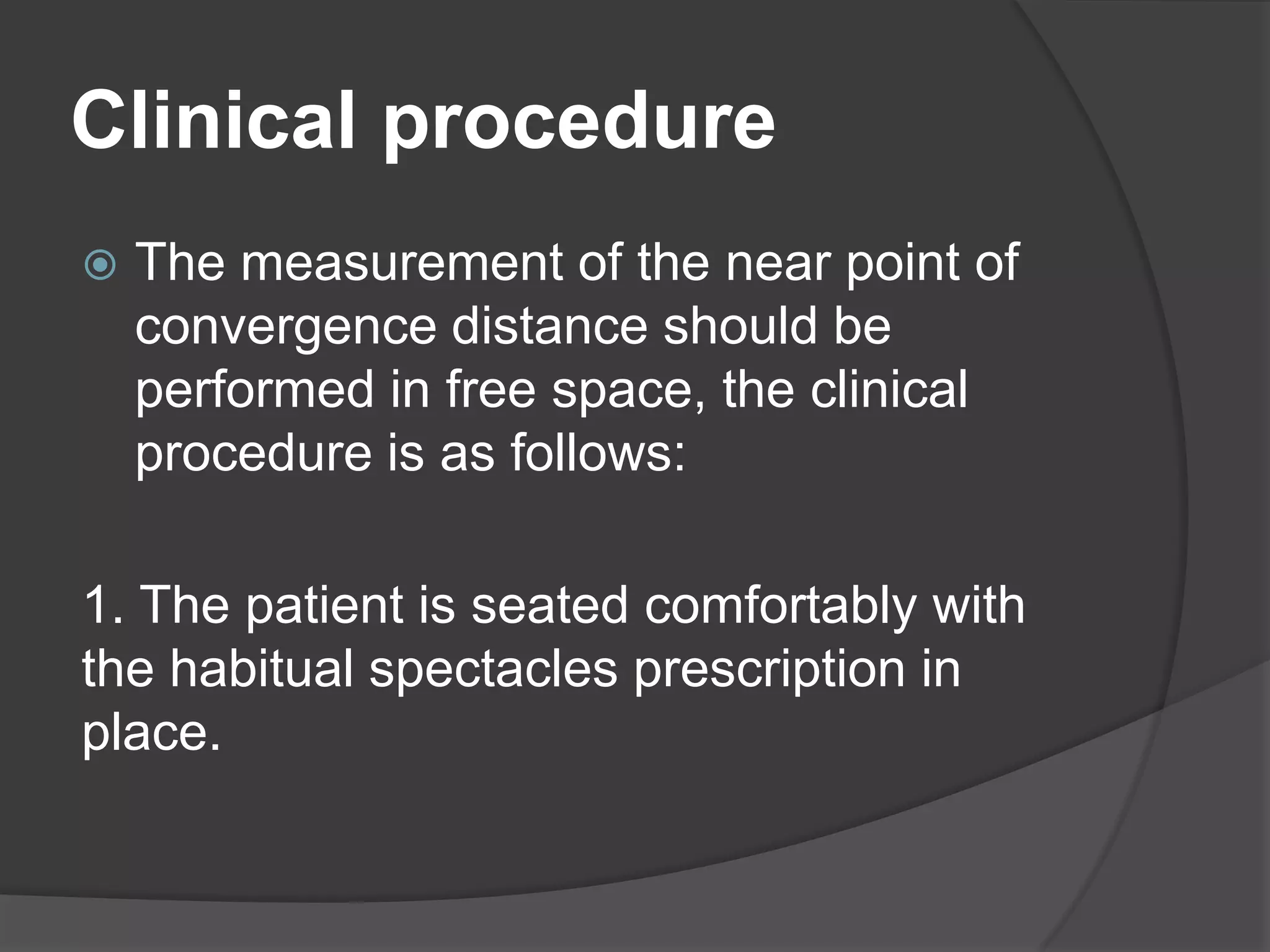
1. The patient is seated comfortably with
the habitual spectacles prescription in
place.
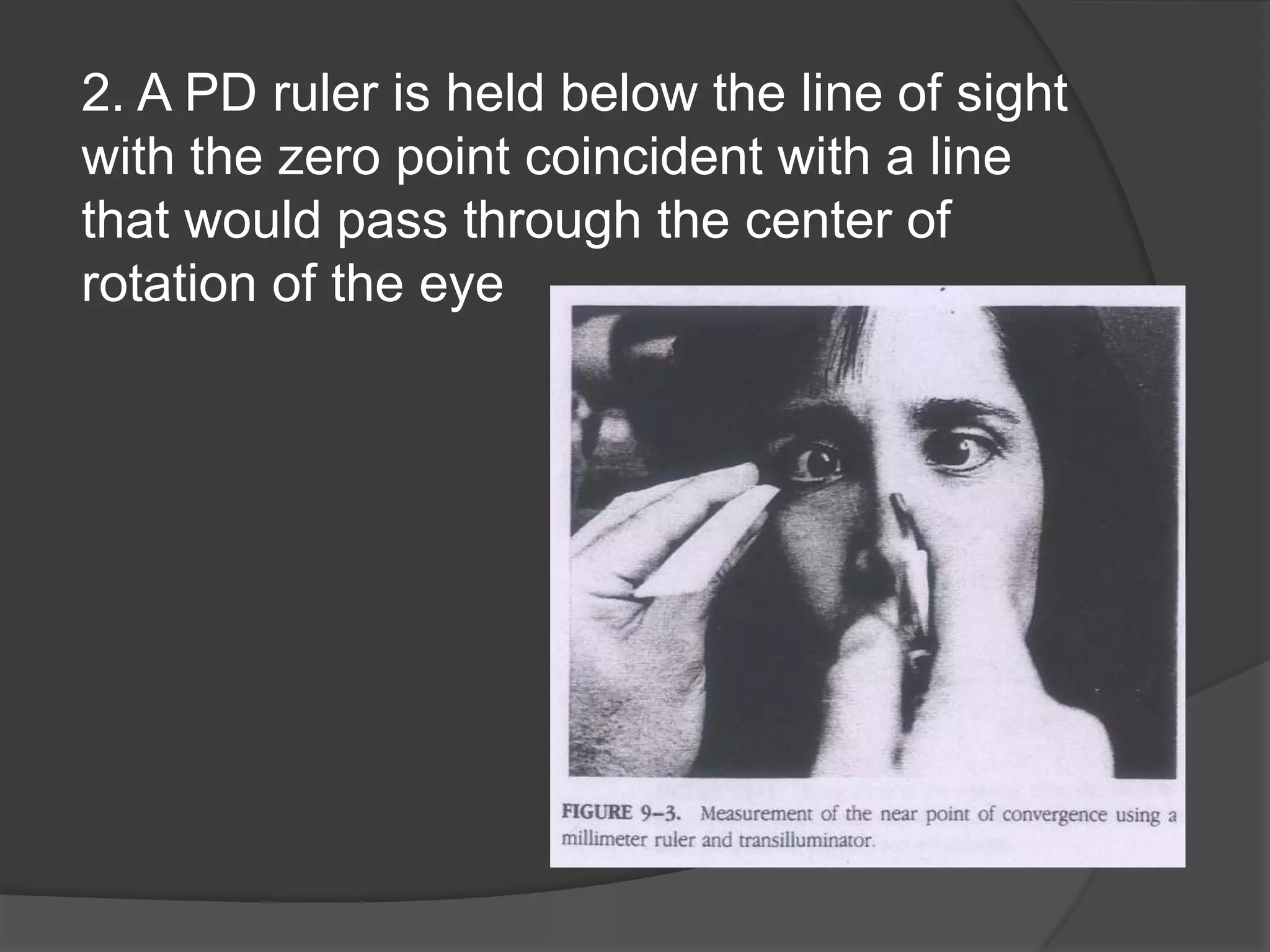
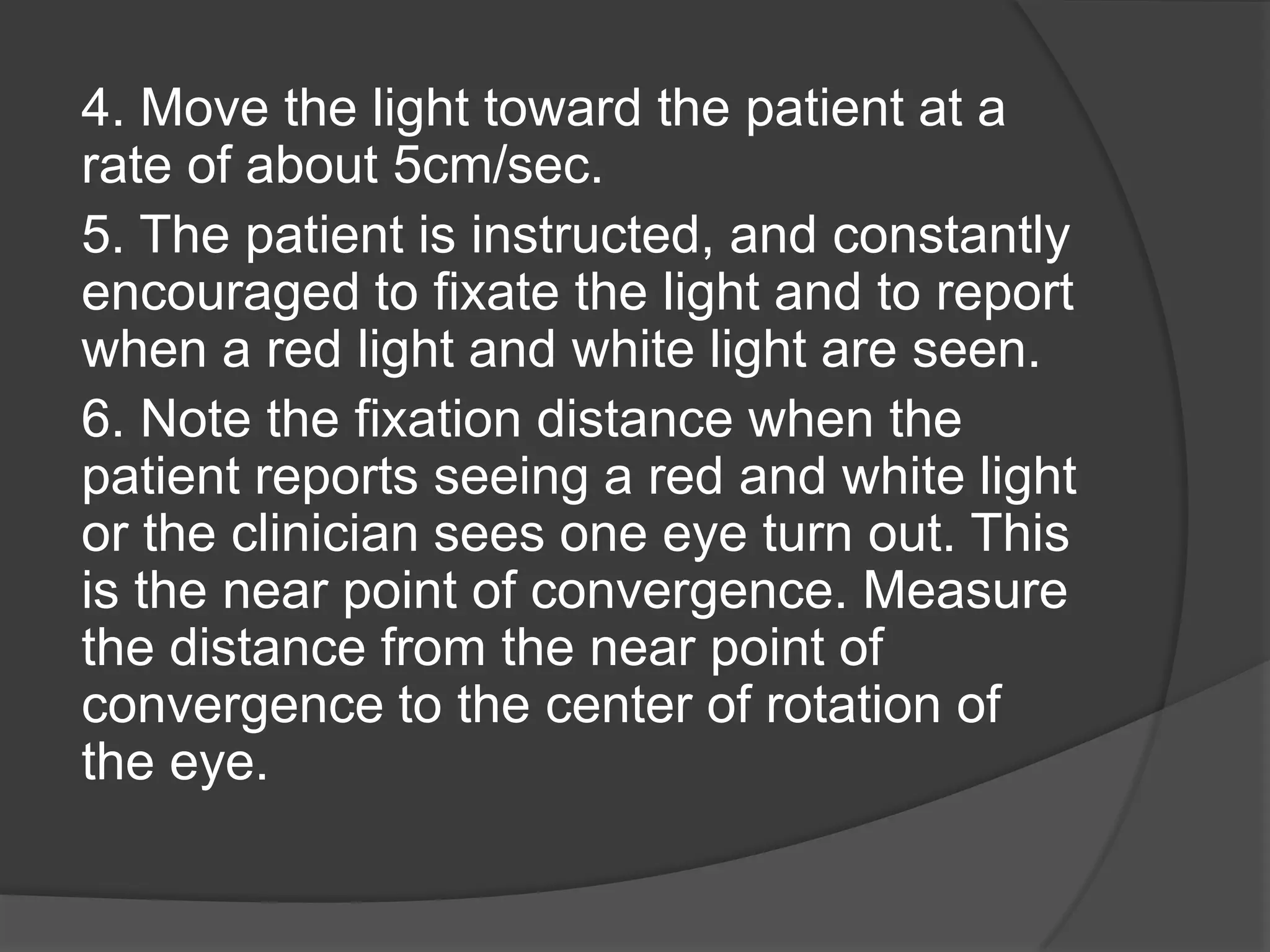
2. A PD ruler is held below the line of sight
with the zero point coincident with a line
that would pass through the center of
rotation of the eye
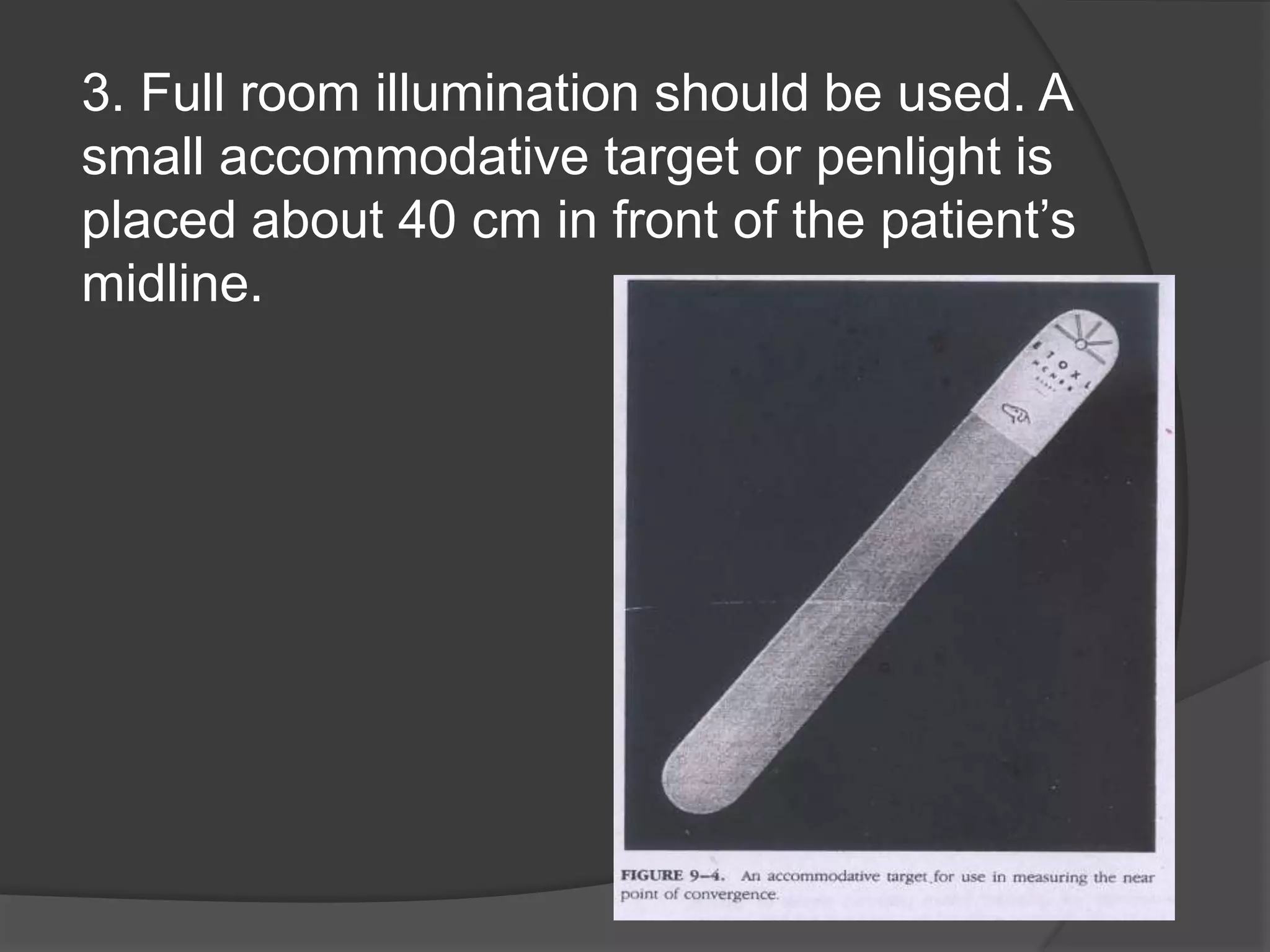
3. Full room illumination should be used. A
small accommodative target or penlight is
placed about 40 cm in front of the patient’s
midline.
4. The patient is encouraged to maintain
fixation on the target and report when it
doubles.
5. Slowly move the target (about 5cm/sec)
along the midline toward the patient.
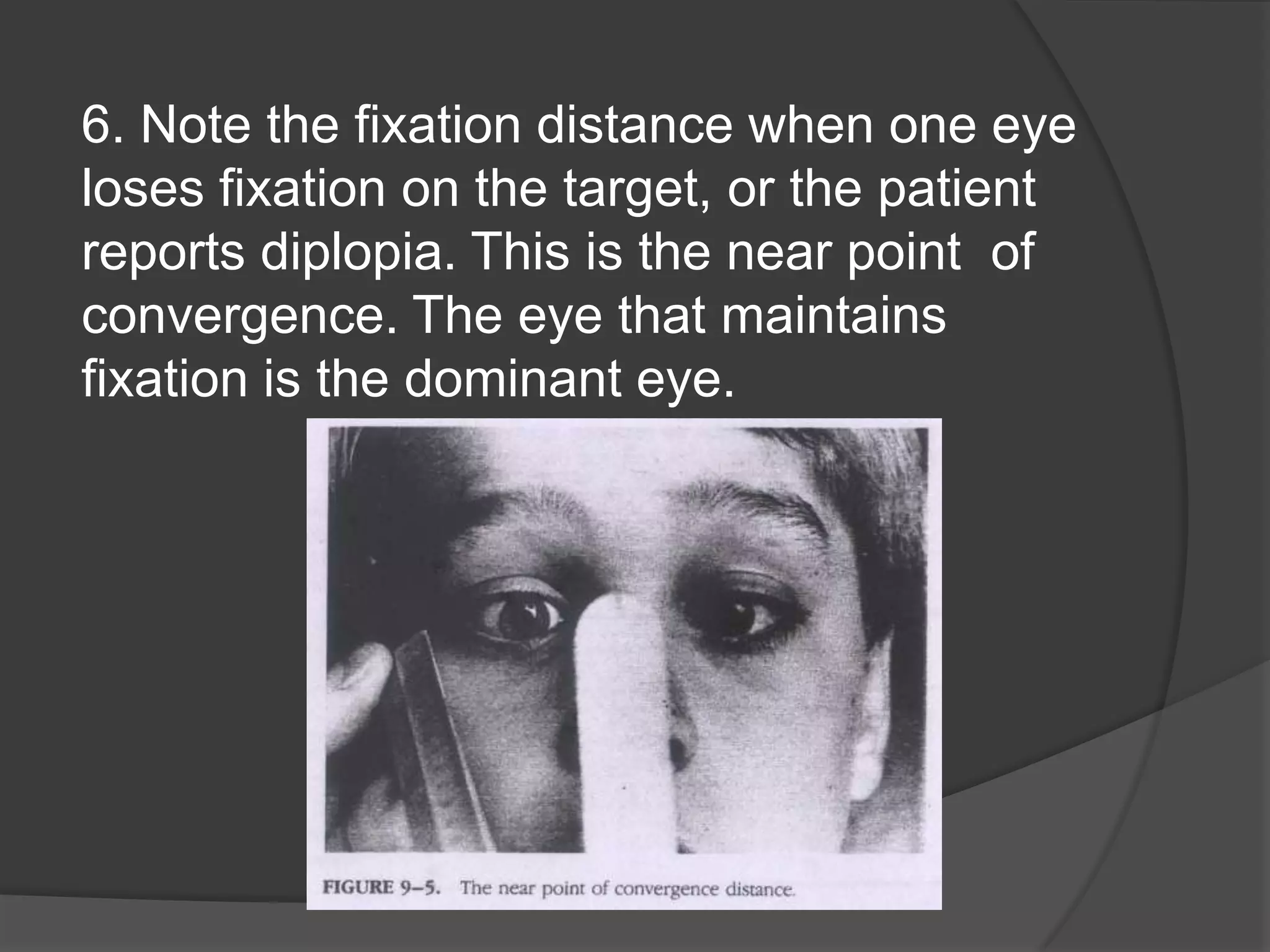
6. Note the fixation distance when one eye
loses fixation on the target, or the patient
reports diplopia. This is the near point of
convergence. The eye that maintains
fixation is the dominant eye.
7. Measure the distance from the near
point of convergence to the center of
rotation of the eye for both the subjective
and objective near points of convergence.
8.Slowly move the target away from the
patient along the midline and ask the
patient to report when fusion occurs. This
is the recovery distance.
9. This is recorded as break/recovery
(e.g., 10cm/15cm).
10. This procedure may be repeated
several times to determine the effect of
fatigue. When the near point of
convergence is repeated five or more
times, symptomatic patients often show
significant decreased convergence ability
with repeated testing, whereas
asymptomatic patients demonstrate little
change.
The near point convergence can also be
determined using a red lens technique.
The clinical procedure for this follows:
1. The patient is seated with the habitual
Rx in place.
2. A PD ruler is held below the line of sight
with the zero point coincident with a line
that would pass through the center of
rotation of the eye

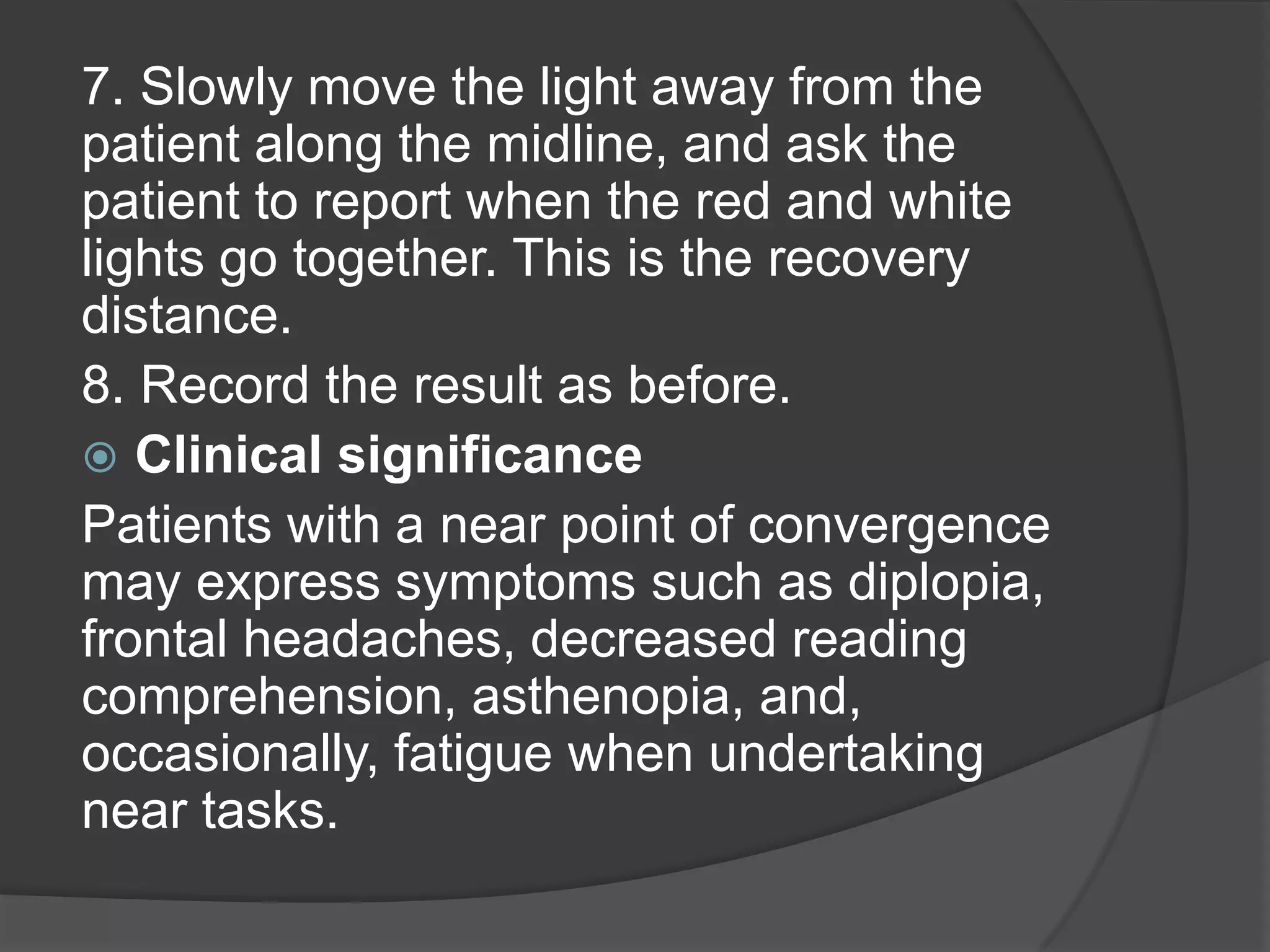
3. A penlight or transilluminator is held at
40cm from the patient, aimed at the bridge
of the nose. A transilluminator is more
desirable than a penlight, since the
brightness of the light source may be
modified for patient comfort. Place a red
lens in front of one of the patient’s eyes.
4. Move the light toward the patient at a
rate of about 5cm/sec.
5. The patient is instructed, and constantly
encouraged to fixate the light and to report
when a red light and white light are seen.
6. Note the fixation distance when the
patient reports seeing a red and white light
or the clinician sees one eye turn out. This
is the near point of convergence. Measure
the distance from the near point of
convergence to the center of rotation of
the eye.
7. Slowly move the light away from the
patient along the midline, and ask the
patient to report when the red and white
lights go together. This is the recovery
distance.
8. Record the result as before.
 Clinical significance
Patients with a near point of convergence
may express symptoms such as diplopia,
frontal headaches, decreased reading
comprehension, asthenopia, and,
occasionally, fatigue when undertaking
near tasks.
Clinical interpretation
 The near point of convergence is
expected to be 6 to 10cm.
 Closer than 5cm is considered to be
convergence excess.
 A remote near point of convergence is
suspected to have convergence
insufficiency.


Near point of convergence

  • 1.
  • 2.
    Definition: Convergence  Is the onlydisjunctive movement that is under conscious control. It is a fusional movement that may be stimulated by volition, disparate stimulation, and accommodation.
  • 3.
    The near pointof convergence (NPC)  Is the point of intersection of the lines of sight of the eyes when maximum convergence is utilized.
  • 4.
    The near pointof convergence distance  Is the distance from the near point of convergence to the midpoint of the line connecting the center of rotation of the eyes.
  • 5.
    Clinical use:  The nearpoint of convergence distance is a measurement of the maximum convergence ability of a patient. Patients who have reduced near point of convergence distances may have visual and ocular discomfort when performing near point vision tasks.
  • 6.
    Instruments:  Penlight  Transilluminator Millimeter ruler  RAF near point rule
  • 7.
    Clinical procedure  The measurementof the near point of convergence distance should be performed in free space, the clinical procedure is as follows: 1. The patient is seated comfortably with the habitual spectacles prescription in place.
  • 8.
    2. A PDruler is held below the line of sight with the zero point coincident with a line that would pass through the center of rotation of the eye
  • 9.
    3. Full roomillumination should be used. A small accommodative target or penlight is placed about 40 cm in front of the patient’s midline.
  • 10.
    4. The patientis encouraged to maintain fixation on the target and report when it doubles. 5. Slowly move the target (about 5cm/sec) along the midline toward the patient.
  • 11.
    6. Note thefixation distance when one eye loses fixation on the target, or the patient reports diplopia. This is the near point of convergence. The eye that maintains fixation is the dominant eye.
  • 12.
    7. Measure thedistance from the near point of convergence to the center of rotation of the eye for both the subjective and objective near points of convergence. 8.Slowly move the target away from the patient along the midline and ask the patient to report when fusion occurs. This is the recovery distance. 9. This is recorded as break/recovery (e.g., 10cm/15cm).
  • 13.
    10. This proceduremay be repeated several times to determine the effect of fatigue. When the near point of convergence is repeated five or more times, symptomatic patients often show significant decreased convergence ability with repeated testing, whereas asymptomatic patients demonstrate little change.
  • 14.
    The near pointconvergence can also be determined using a red lens technique. The clinical procedure for this follows: 1. The patient is seated with the habitual Rx in place. 2. A PD ruler is held below the line of sight with the zero point coincident with a line that would pass through the center of rotation of the eye 
  • 15.
    3. A penlightor transilluminator is held at 40cm from the patient, aimed at the bridge of the nose. A transilluminator is more desirable than a penlight, since the brightness of the light source may be modified for patient comfort. Place a red lens in front of one of the patient’s eyes.
  • 16.
    4. Move thelight toward the patient at a rate of about 5cm/sec. 5. The patient is instructed, and constantly encouraged to fixate the light and to report when a red light and white light are seen. 6. Note the fixation distance when the patient reports seeing a red and white light or the clinician sees one eye turn out. This is the near point of convergence. Measure the distance from the near point of convergence to the center of rotation of the eye.
  • 17.
    7. Slowly movethe light away from the patient along the midline, and ask the patient to report when the red and white lights go together. This is the recovery distance. 8. Record the result as before.  Clinical significance Patients with a near point of convergence may express symptoms such as diplopia, frontal headaches, decreased reading comprehension, asthenopia, and, occasionally, fatigue when undertaking near tasks.
  • 18.
    Clinical interpretation  Thenear point of convergence is expected to be 6 to 10cm.  Closer than 5cm is considered to be convergence excess.  A remote near point of convergence is suspected to have convergence insufficiency. 