RAF RULAR
PRESENTED BY :-
MIFTAHUL ISLAM
OPTOMETRY
Work at MGM Eye Institute Raipur. C.G
INTRODUCTION
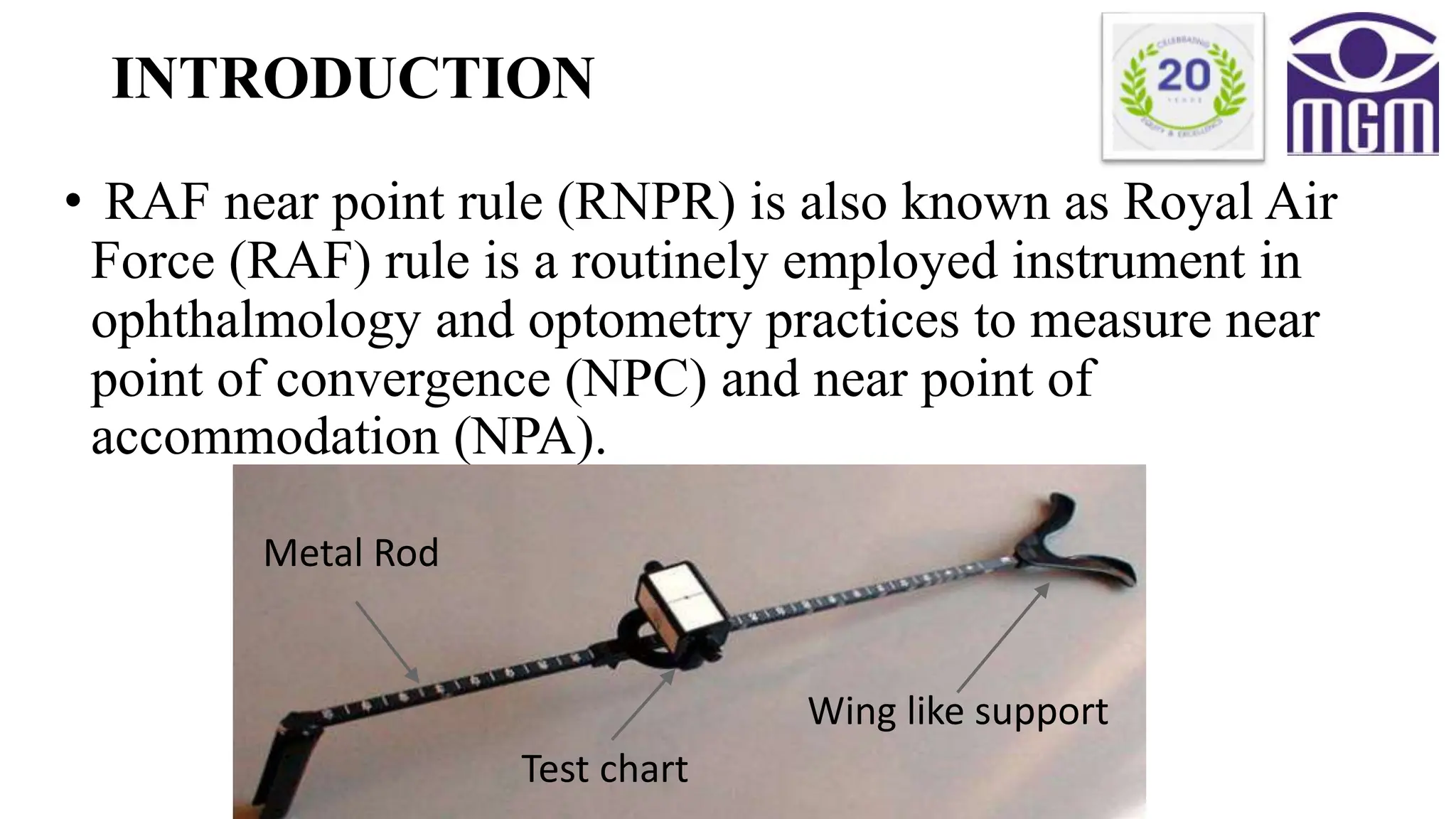
• RAF near point rule (RNPR) is also known as Royal Air
Force (RAF) rule is a routinely employed instrument in
ophthalmology and optometry practices to measure near
point of convergence (NPC) and near point of
accommodation (NPA).
Metal Rod
Test chart
Wing like support
A brief history
• The RNPR was first mentioned in the literature by J. C.
Neely in 1956.
• It stated that the RAF was originally developed in the
United Kingdom (UK) in the mid-1950s
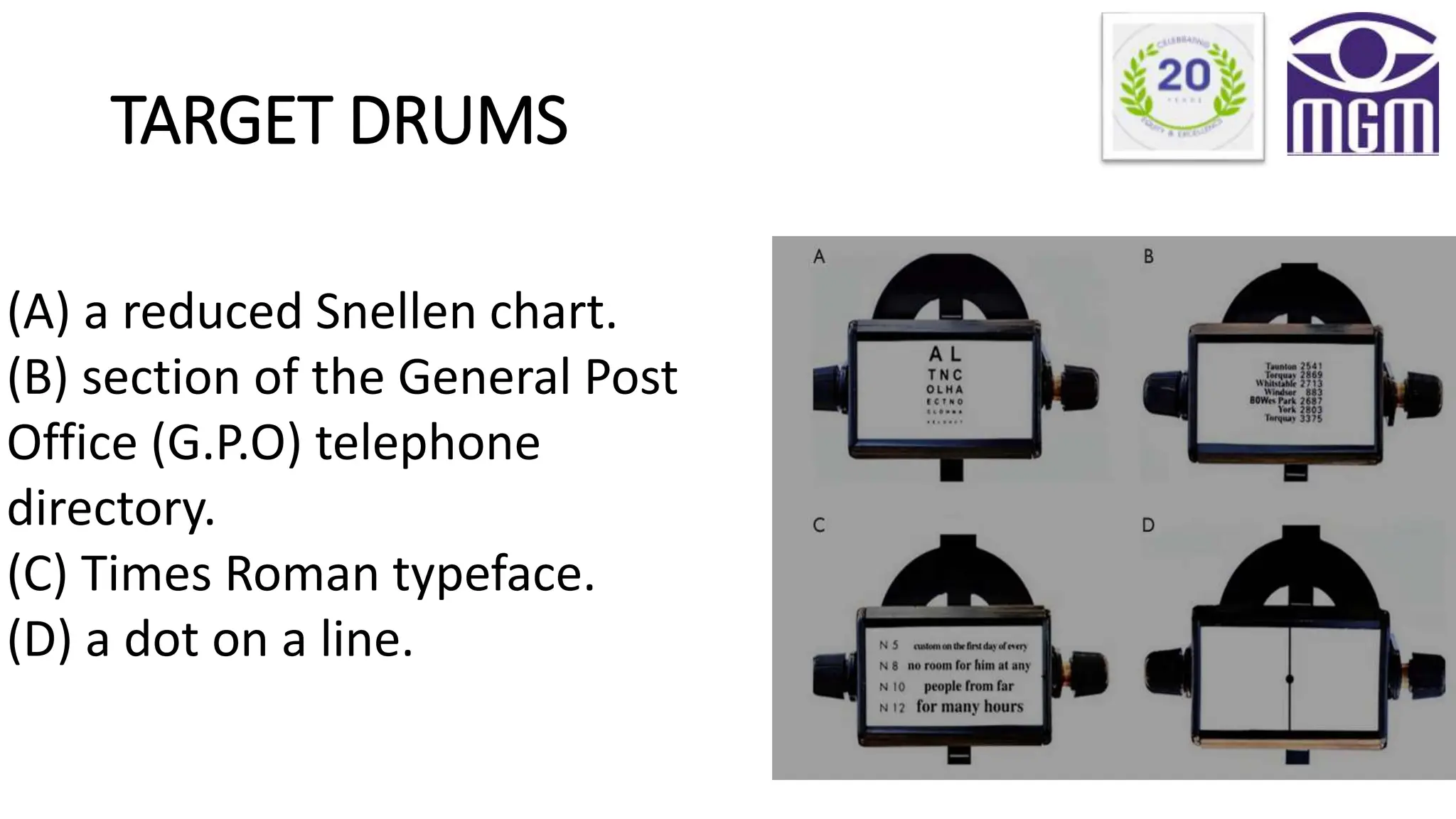
TARGET DRUMS
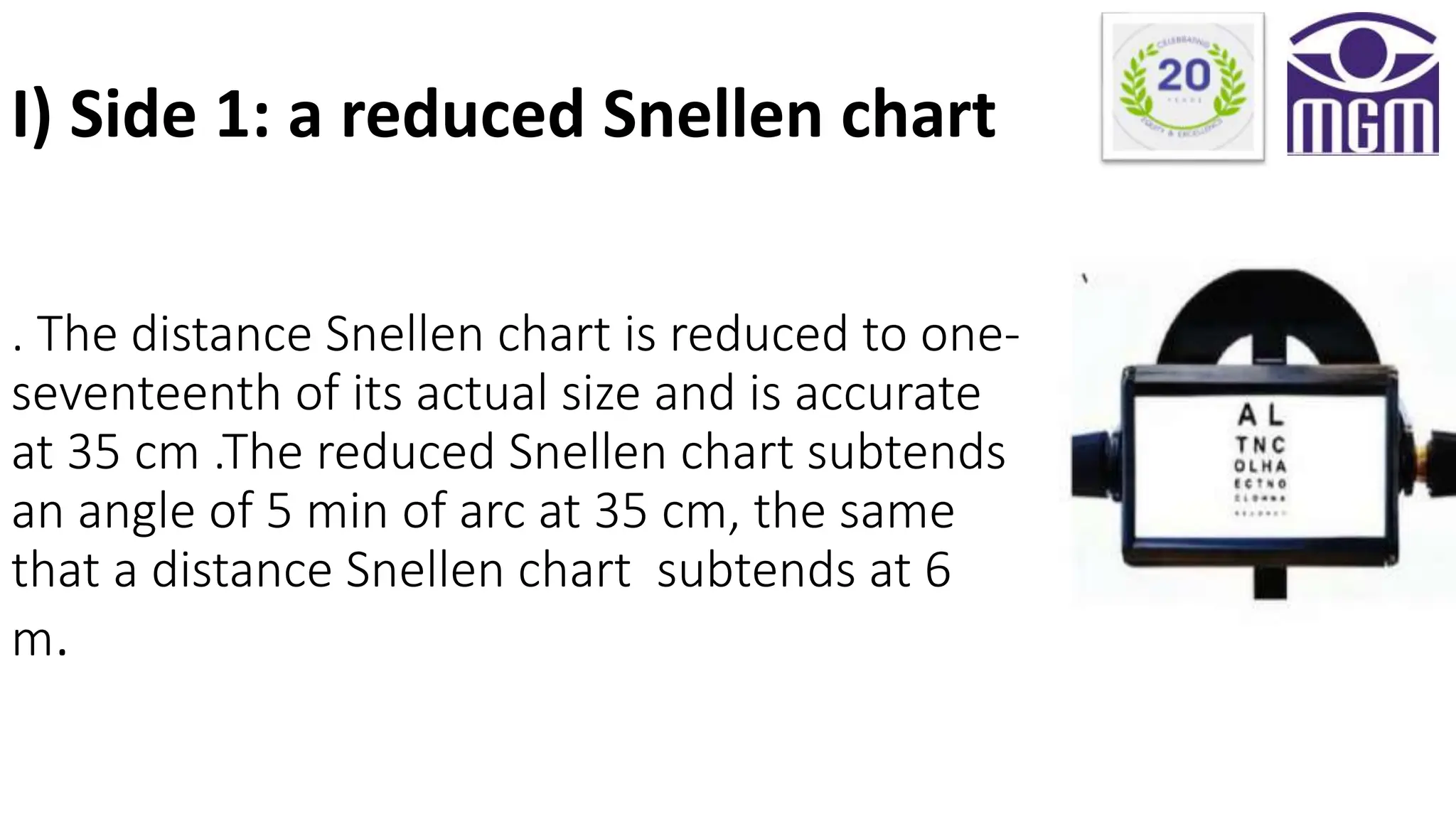
(A) a reduced Snellen chart.
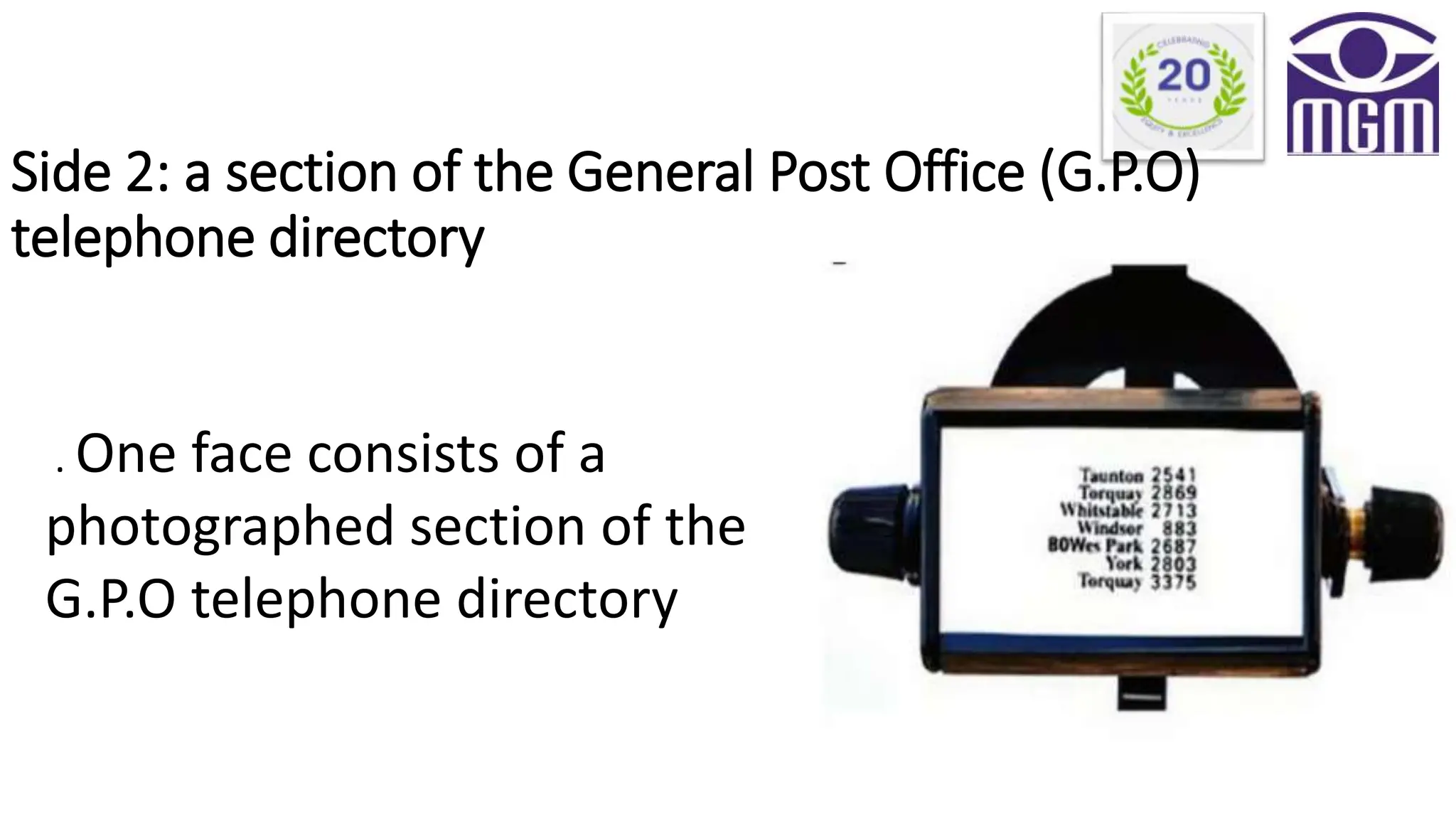
(B) section of the General Post
Office (G.P.O) telephone
directory.
(C) Times Roman typeface.
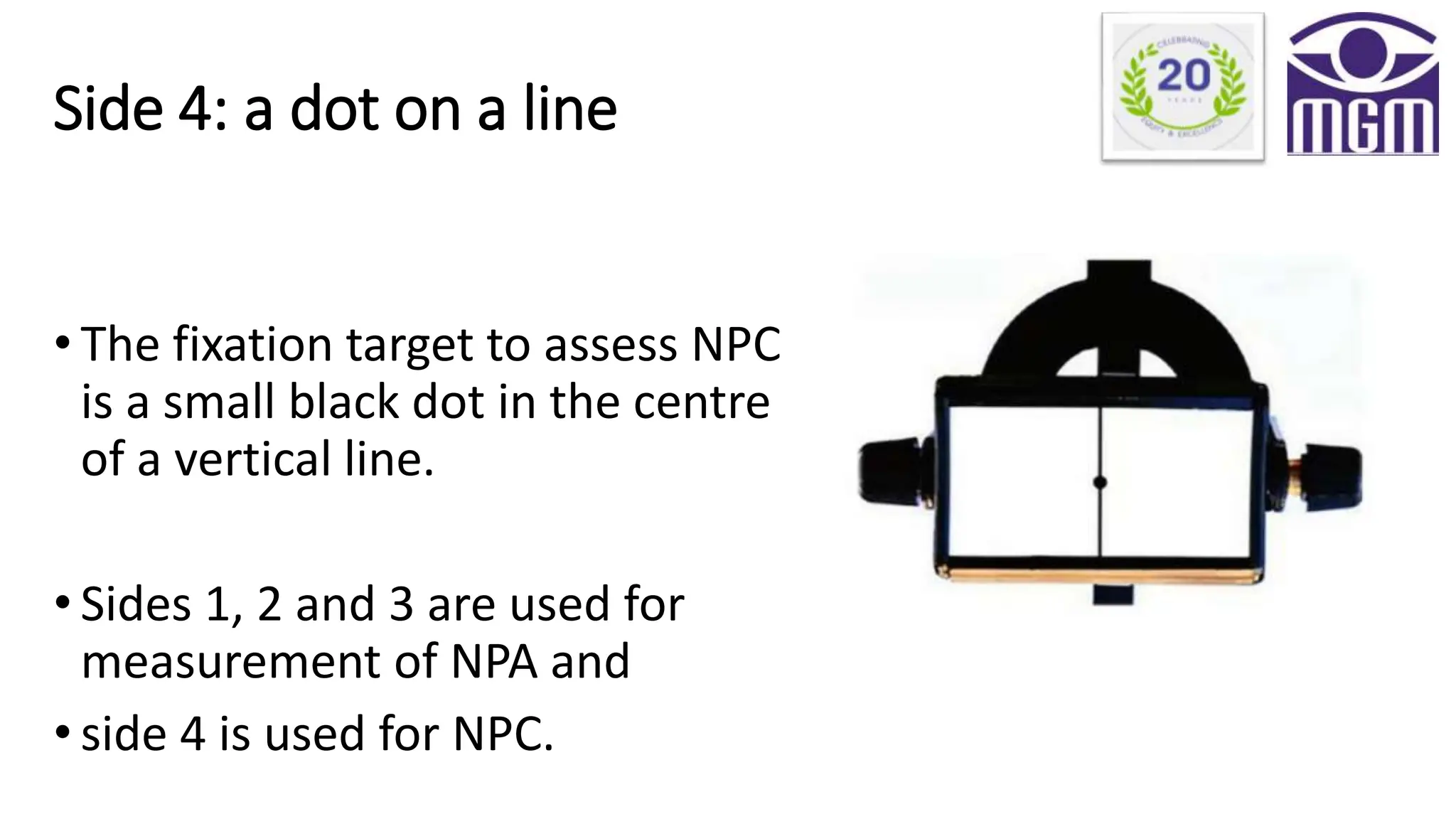
(D) a dot on a line.
. The distance Snellen chart is reduced to one-
seventeenth of its actual size and is accurate
at 35 cm .The reduced Snellen chart subtends
an angle of 5 min of arc at 35 cm, the same
that a distance Snellen chart subtends at 6
m.
I) Side 1: a reduced Snellen chart
Side 2: a section of the General Post Office (G.P.O)
telephone directory
. One face consists of a
photographed section of the
G.P.O telephone directory
Side 3: Times Roman typeface
•The Faculty of Ophthalmologists [1951]
suggested that.
• Based on these recommendations one
face consists of four lines: N5, N8, N10
and N12;
Side 4: a dot on a line
• The fixation target to assess NPC
is a small black dot in the centre
of a vertical line.
• Sides 1, 2 and 3 are used for
measurement of NPA and
• side 4 is used for NPC.
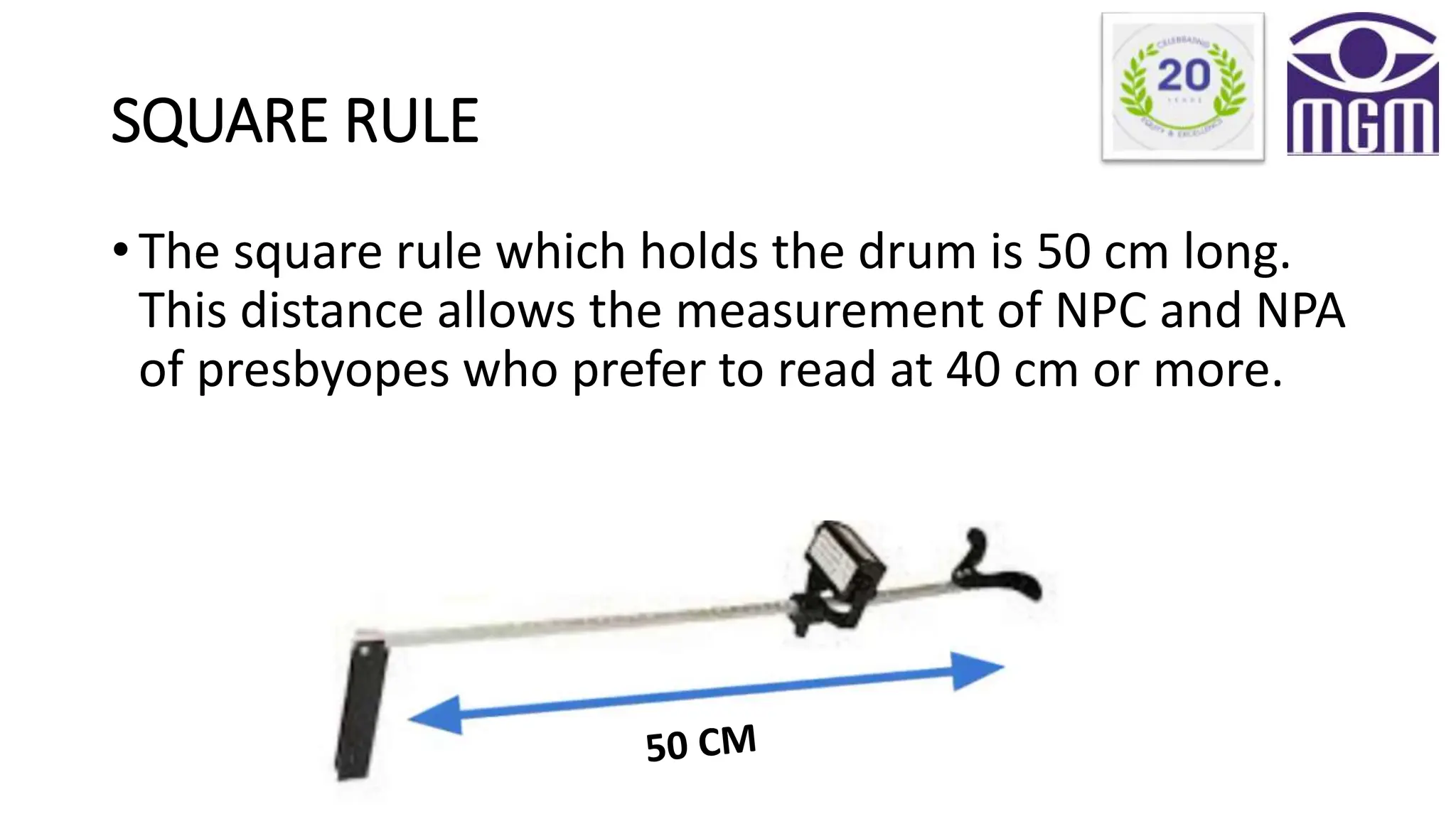
SQUARE RULE
• The square rule which holds the drum is 50 cm long.
This distance allows the measurement of NPC and NPA
of presbyopes who prefer to read at 40 cm or more.
The four sides of the square rule are marked
differently as
1. a centimeter scale in 1 cm increament.
2. dioptric scale
3. Age scale
4. The positions of normal and abnormal convergence.
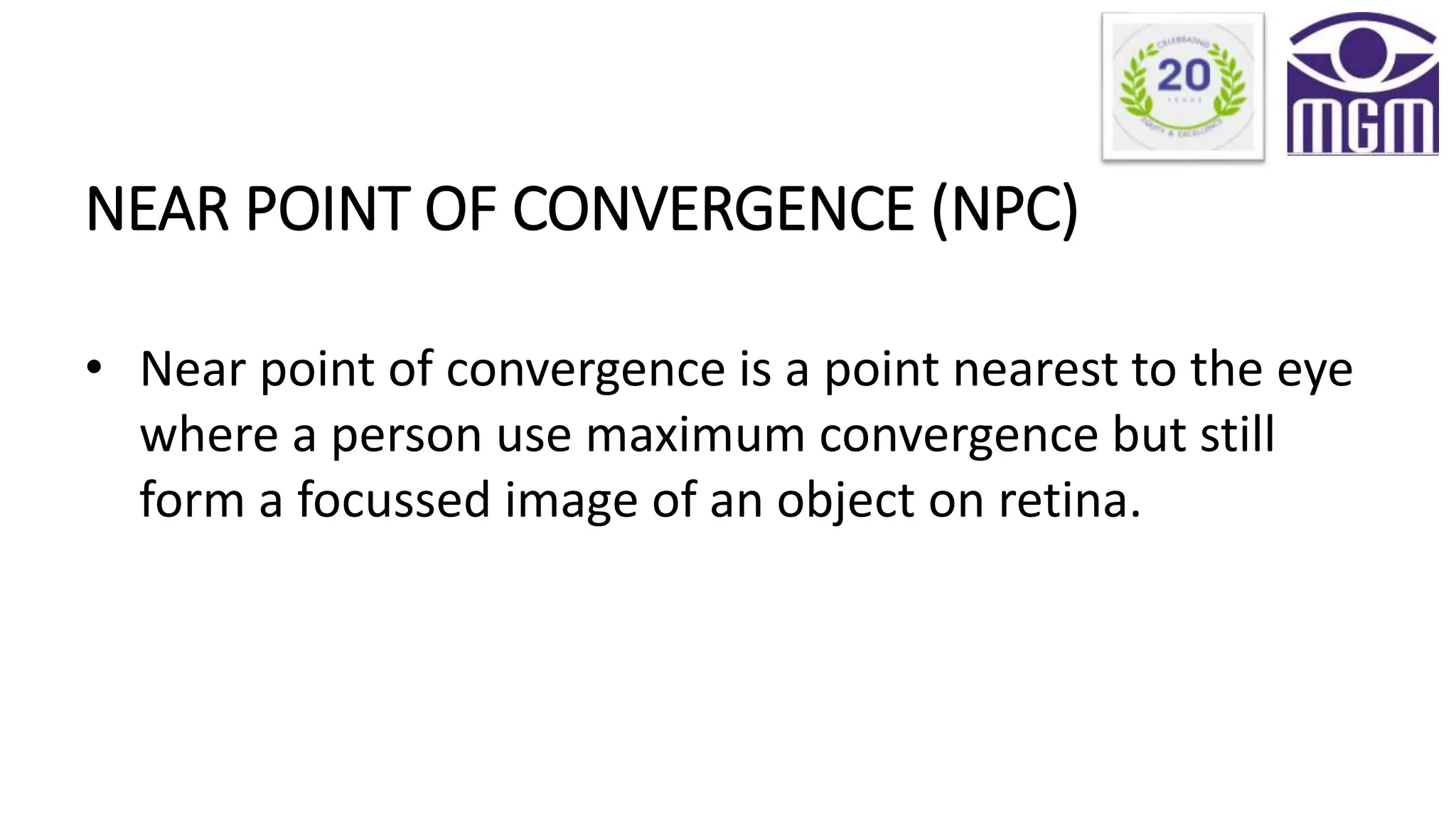
CHEEK REST
• The cheek rest of the RNPR (6 cm in length) is
attached to one end of the rule. It is made of plastic
and has a V-shaped notch in the center to fit the
nose.
NEAR POINT OF CONVERGENCE (NPC)
• Near point of convergence is a point nearest to the eye
where a person use maximum convergence but still
form a focussed image of an object on retina.
NPC & NPA
• Eyestrain and frontal Headaches
• Blurred or double vision
• Difficulty reading
• Loses place while reading
• Needs to reread the same line of words when reading
• Reads slowly and has trouble remembering what was
read.
PROCEDURE OF NPC
•Made The examiner holds the ruler and gently places
the cheek rest on the inferior orbital margin.
•NPC is most accurately measured by the RAF rule in
the depressed position of 45 degrees.
•Asks the patient to focus on the black dot and slowly
moves the target towards the patient's eye at a
constant and linear rate of about 1±2 cm/sec.
OBJECTIVE METHODS:
• The examiner should look at patient's eye movement.
• The patient is asked to fix steadily on the central dot
on the line and the slider is moved slowly towards the
patient's eye.
• The NPC is the distance where one eye is seen to
diverge.
• The test is repeated 2 to 3 times.
SUBJECTIVE METHODS:
• Test should be performed with best correction.
• Instruct the patient to inform you when the target
becomes blur or the vertical line becomes double or
when he/she sees the line move to one or the other
side.
• This happens when the Image is suppressed, the line
moves to the side of the dominant eye.
• Ask the patient to blink several times when the target
becomes blur or double.
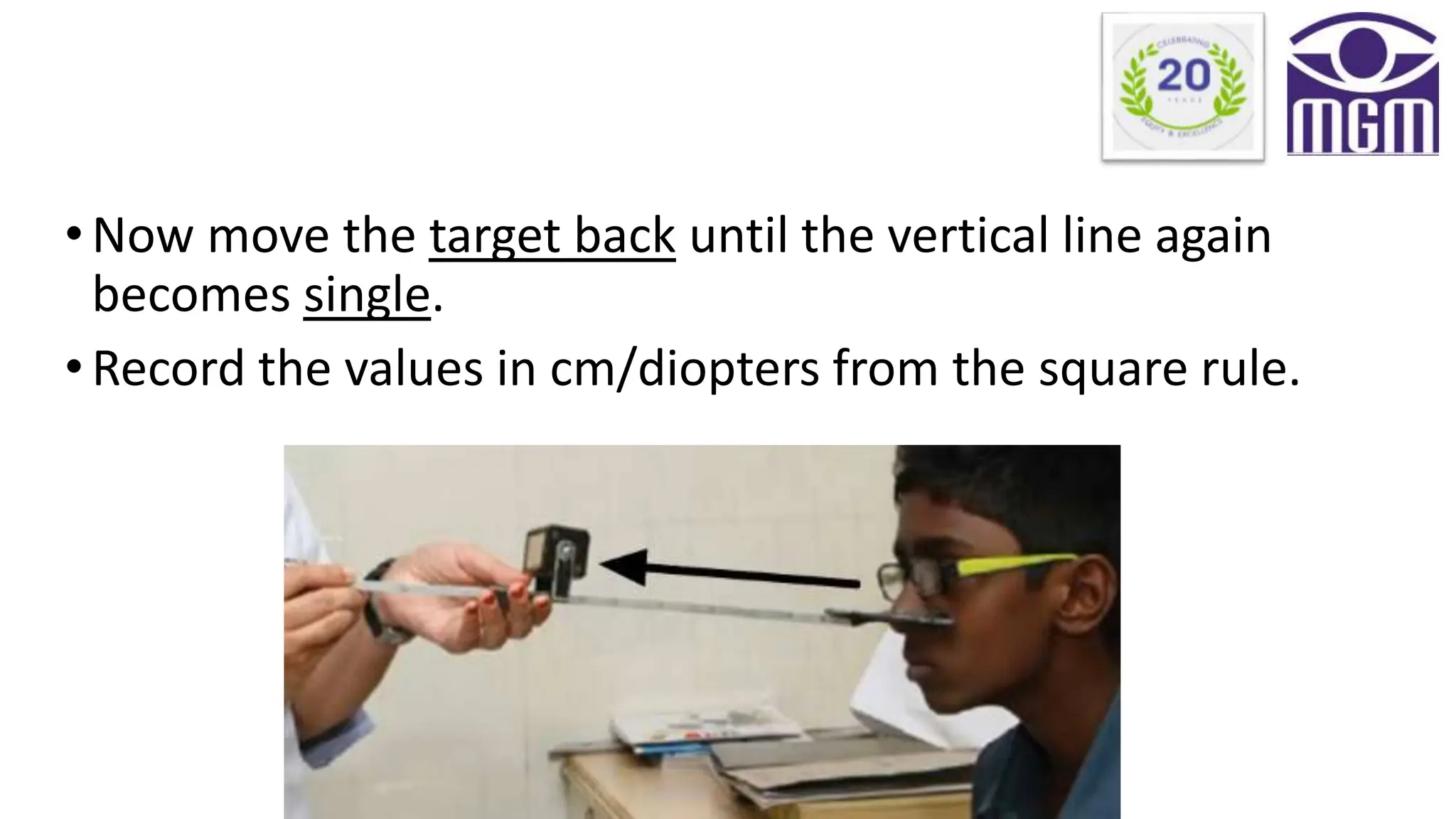
•Now move the target back until the vertical line again
becomes single.
•Record the values in cm/diopters from the square rule.
Normal Range
• Normal near point of convergence is about 6-10 cms.
• NPC less than 5 cm indicates convergence excess.
• If the near point of convergence (NPC) is more than 10
centimetre there is sign of poor convergence.
BREAK POINT & RECOVERY POINT
1. The subjective break point is indicated when the
patient either reports diplopia or until the slider is
stopped by the cheek rest.
2. The recovery is noted when the patient reports
single target when the slider is slowly moved back.
NEAR POINT OF ACCOMMODATION(NPA)
• Near point of accommodation is a point nearest to the
eye where a person use maximum accommodation but
still form a focussed image of an object on retina.
• The normal near point depends on the age of the person
tested.
PROCEDURE OF NPA
• The Standard Target for the measurement of NPA is
Times Roman Typeface (NV chart)
• The top smallest line which is N5
• We have to do the NPA measurement both
monocularly and binocularly.
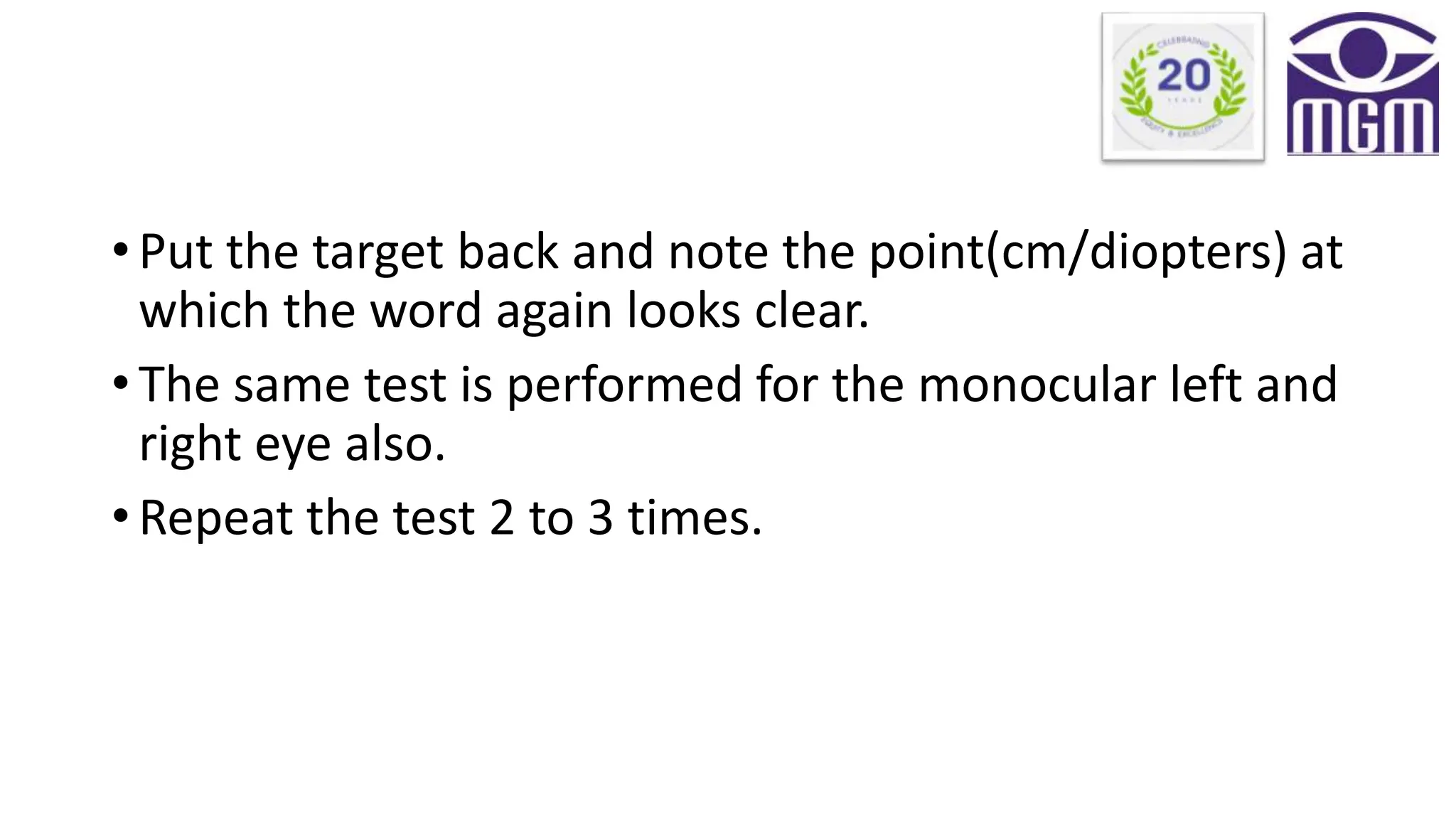
• To carry out the Binocular test we have to put the
cheek rest on the inferior orbital margin of the patient.
• Position of RAF rule should be sligjtly depressed at an
angle of 45 degrees.Now ask the patient if he/she can
see the word.
• Now move the target slowly towards the patient at a
constant rate of 1 to 2 cm/sec.
• Instruct the patient to inform you when the word gets
blurred.
• Put the target back and note the point(cm/diopters) at
which the word again looks clear.
• The same test is performed for the monocular left and
right eye also.
• Repeat the test 2 to 3 times.
RAF RULAR PPT PRESENTATION. Near point of Accommodation & Near point of Convergence.

RAF RULAR PPT PRESENTATION. Near point of Accommodation & Near point of Convergence.

  • 1.
    RAF RULAR PRESENTED BY:- MIFTAHUL ISLAM OPTOMETRY Work at MGM Eye Institute Raipur. C.G
  • 2.
    INTRODUCTION • RAF nearpoint rule (RNPR) is also known as Royal Air Force (RAF) rule is a routinely employed instrument in ophthalmology and optometry practices to measure near point of convergence (NPC) and near point of accommodation (NPA). Metal Rod Test chart Wing like support
  • 3.
    A brief history •The RNPR was first mentioned in the literature by J. C. Neely in 1956. • It stated that the RAF was originally developed in the United Kingdom (UK) in the mid-1950s
  • 4.
    TARGET DRUMS (A) areduced Snellen chart. (B) section of the General Post Office (G.P.O) telephone directory. (C) Times Roman typeface. (D) a dot on a line.
  • 5.
    . The distanceSnellen chart is reduced to one- seventeenth of its actual size and is accurate at 35 cm .The reduced Snellen chart subtends an angle of 5 min of arc at 35 cm, the same that a distance Snellen chart subtends at 6 m. I) Side 1: a reduced Snellen chart
  • 6.
    Side 2: asection of the General Post Office (G.P.O) telephone directory . One face consists of a photographed section of the G.P.O telephone directory
  • 7.
    Side 3: TimesRoman typeface •The Faculty of Ophthalmologists [1951] suggested that. • Based on these recommendations one face consists of four lines: N5, N8, N10 and N12;
  • 8.
    Side 4: adot on a line • The fixation target to assess NPC is a small black dot in the centre of a vertical line. • Sides 1, 2 and 3 are used for measurement of NPA and • side 4 is used for NPC.
  • 9.
    SQUARE RULE • Thesquare rule which holds the drum is 50 cm long. This distance allows the measurement of NPC and NPA of presbyopes who prefer to read at 40 cm or more.
  • 10.
    The four sidesof the square rule are marked differently as 1. a centimeter scale in 1 cm increament. 2. dioptric scale 3. Age scale 4. The positions of normal and abnormal convergence.
  • 11.
    CHEEK REST • Thecheek rest of the RNPR (6 cm in length) is attached to one end of the rule. It is made of plastic and has a V-shaped notch in the center to fit the nose.
  • 12.
    NEAR POINT OFCONVERGENCE (NPC) • Near point of convergence is a point nearest to the eye where a person use maximum convergence but still form a focussed image of an object on retina.
  • 13.
    NPC & NPA •Eyestrain and frontal Headaches • Blurred or double vision • Difficulty reading • Loses place while reading • Needs to reread the same line of words when reading • Reads slowly and has trouble remembering what was read.
  • 14.
    PROCEDURE OF NPC •MadeThe examiner holds the ruler and gently places the cheek rest on the inferior orbital margin. •NPC is most accurately measured by the RAF rule in the depressed position of 45 degrees. •Asks the patient to focus on the black dot and slowly moves the target towards the patient's eye at a constant and linear rate of about 1±2 cm/sec.
  • 15.
    OBJECTIVE METHODS: • Theexaminer should look at patient's eye movement. • The patient is asked to fix steadily on the central dot on the line and the slider is moved slowly towards the patient's eye. • The NPC is the distance where one eye is seen to diverge. • The test is repeated 2 to 3 times.
  • 16.
    SUBJECTIVE METHODS: • Testshould be performed with best correction. • Instruct the patient to inform you when the target becomes blur or the vertical line becomes double or when he/she sees the line move to one or the other side. • This happens when the Image is suppressed, the line moves to the side of the dominant eye. • Ask the patient to blink several times when the target becomes blur or double.
  • 17.
    •Now move thetarget back until the vertical line again becomes single. •Record the values in cm/diopters from the square rule.
  • 18.
    Normal Range • Normalnear point of convergence is about 6-10 cms. • NPC less than 5 cm indicates convergence excess. • If the near point of convergence (NPC) is more than 10 centimetre there is sign of poor convergence.
  • 19.
    BREAK POINT &RECOVERY POINT 1. The subjective break point is indicated when the patient either reports diplopia or until the slider is stopped by the cheek rest. 2. The recovery is noted when the patient reports single target when the slider is slowly moved back.
  • 20.
    NEAR POINT OFACCOMMODATION(NPA) • Near point of accommodation is a point nearest to the eye where a person use maximum accommodation but still form a focussed image of an object on retina. • The normal near point depends on the age of the person tested.
  • 21.
    PROCEDURE OF NPA •The Standard Target for the measurement of NPA is Times Roman Typeface (NV chart) • The top smallest line which is N5 • We have to do the NPA measurement both monocularly and binocularly.
  • 22.
    • To carryout the Binocular test we have to put the cheek rest on the inferior orbital margin of the patient. • Position of RAF rule should be sligjtly depressed at an angle of 45 degrees.Now ask the patient if he/she can see the word. • Now move the target slowly towards the patient at a constant rate of 1 to 2 cm/sec.
  • 23.
    • Instruct thepatient to inform you when the word gets blurred.
  • 24.
    • Put thetarget back and note the point(cm/diopters) at which the word again looks clear. • The same test is performed for the monocular left and right eye also. • Repeat the test 2 to 3 times.