Causes and
Management
of
Aniseikonia
Maclester OP 1-1
Causes of Aniseikonia
 1. Differences in size of dioptric images formed by the retina.
 2. Difference in the distribution of retinal elements.

Fig. 1: Schematic presentation of static aniseikonia (left) and
dynamic aniseikonia / anisophoria (right).
 Static aniseikonia or aniseikonia in short means that in a
static situation where the eyes are gazing in a certain
direction, the perceived (peripheral) images are different in
size.
 Dynamic aniseikonia or (optically induced) anisophoria
means that the eyes have to rotate a different amount to
gaze

Signs of Aniseikonia
 Aphakia
 Anisometropia
 Astigmatism
 Low Stereopsis
 Strabismus
 Amblyopia
Symptoms Associated with Aniseikonia
 Headache
 Asthenopia
 Reading difficulty
 Photophobia
 Nausea
 Vertigo and dizziness
 General fatigue
Measurement of Aniseikonia
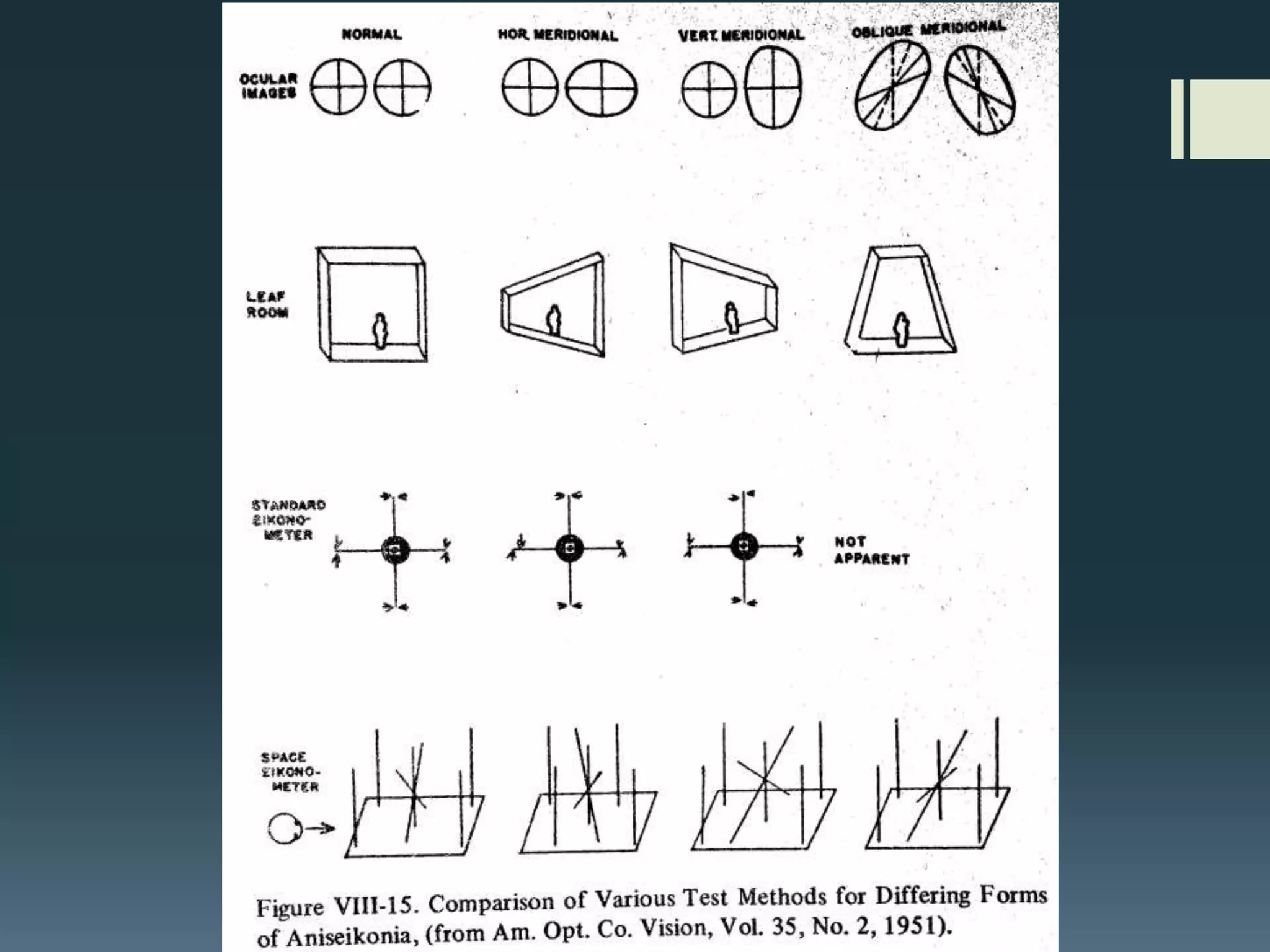
Eikonometer – an instrument used to measure
the aniseikonic condition.
 Standard
 The standard eikonometer is a special apparatus
designed to measure aniseikonia. It contains the following
elements: a device for securing the fixation of the eyes in
the desired planes by fixing the head and presenting the
targets along the primary plane and the normal
depressed plane for near; devices which alter the size of
the target without affecting the refraction and measure
discrepancies in percent; a projector which presents a
target which has certain elements polarized so that each
eye sees some part of the target alone and some parts
simultaneously; and polaroid filters before each eye to
select the target elements for each eye.
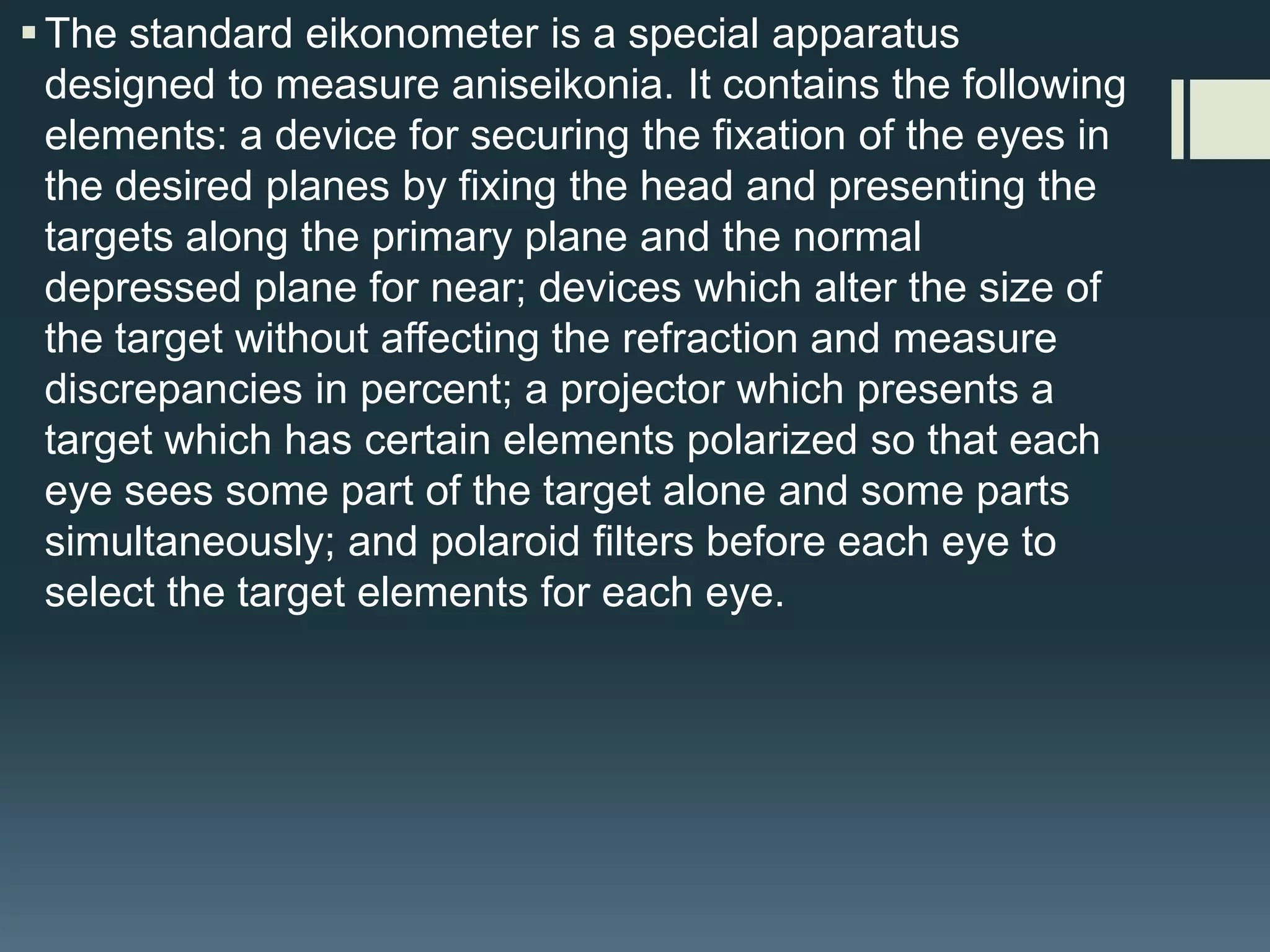
 Space eikonometer is a special device which performs its
function not by actual measurement of the ocular images
but by measuring the rotations of the observed field as
affected by binocular clues alone.
Predicting Aniseikonia: Ocular Component Analysis
 Spectacle Prescription
-Remember, the symptoms aniseikonia is nearly always
caused by the sign anisometropia
-Look for a minimum of 1.50 to 2.00 D to produce
symptoms in patients
-The higher the anisometropia, the more likely aniseikonia,
though it is never a guarantee
 Keratometry
-Use your keratometry readings to measure the optical
power of the eye, as usual
-To confirm the source of aniseikonia, compare the K’sOU
 A-Scan ultrasound
-A-scan ultrasound is routinely used in cataract surgery to
calculate IOL power, and IOL’scan cause aniseikonia too
 IOL Status
-More common these days is post-surgical
anisometropiawhen the post-surgical eye is plano, and the
other is at least +/-2 D
Simple Testing for Aniseikonia
 Size Lenses
 Maddox Rod
 Penlights
 Prism Bar
Special Testing for Aniseikonia

The Leaf Room Effects

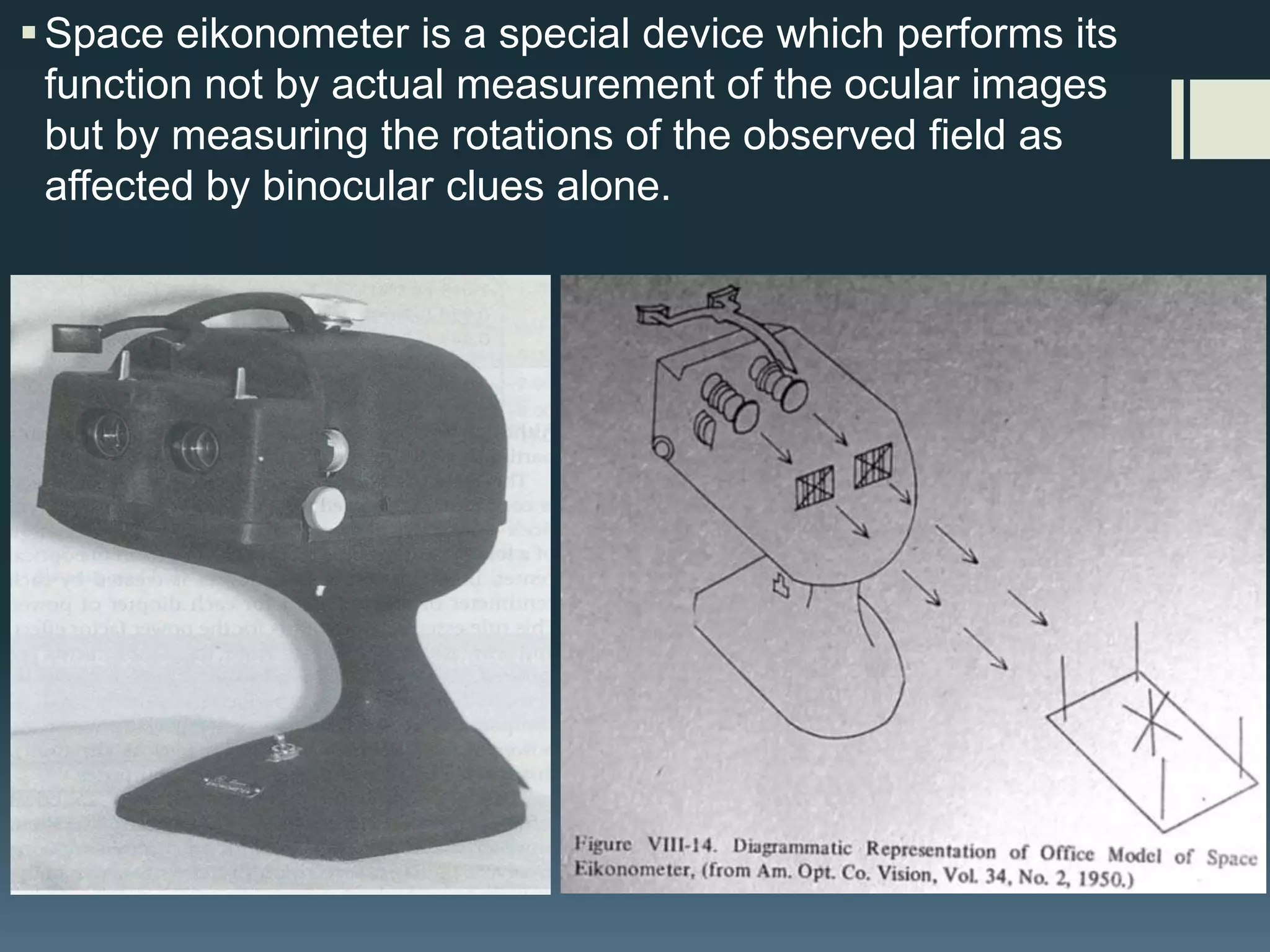
 The leaf room is a cube with no size cues, perhaps
covered with patterned wallpaper, a leaf pattern, say
 This cubical “Leaf Room” doesn’t look square if you have
aniseikonia!
 You can use the Leaf Room to simulate aniseikonia
caused by high monocular astigmatism, even in normals.
How?
 With planocylindrical magnifiers (size lenses) in front of
one eye only, as follows
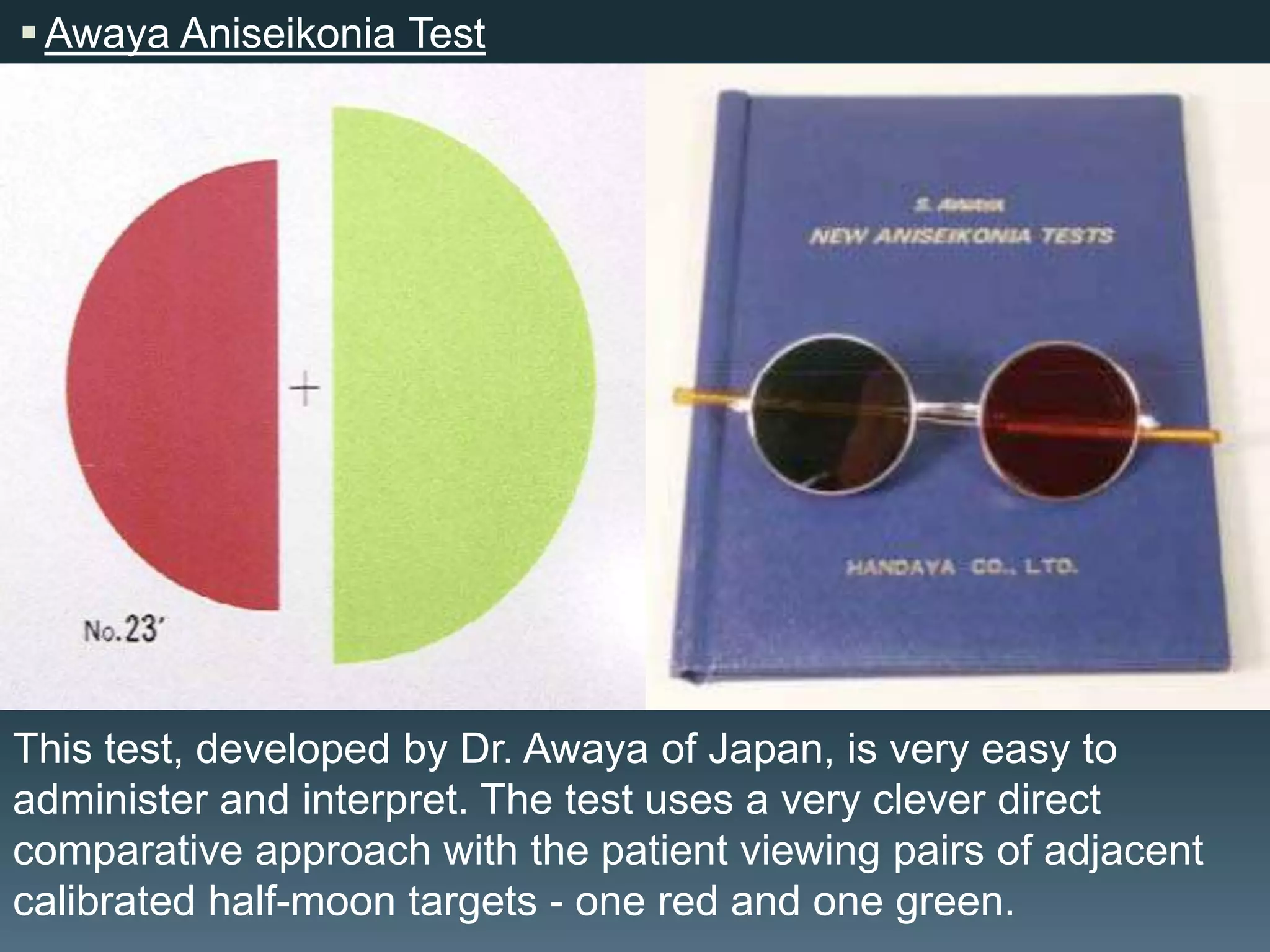
 Awaya Aniseikonia Test

This test, developed by Dr. Awaya of Japan, is very easy to
administer and interpret. The test uses a very clever direct
comparative approach with the patient viewing pairs of adjacent
calibrated half-moon targets - one red and one green.
Management of Aniseikonia
1. Iseikonic lenses- a correcting lens or device that
generally acts by altering magnification due to
thickness of the lens and base curve w/o altering its
power
2. Toric lenses- front or back surfaces are made toric or
both
3. Doublet lenses- combination of two lenses, one is
telescopic and the other on microscopic lens.
4. Fused bifocal lenses.

Causes and management of aniseikonia

  • 1.
  • 2.
    Causes of Aniseikonia 1. Differences in size of dioptric images formed by the retina.  2. Difference in the distribution of retinal elements. Fig. 1: Schematic presentation of static aniseikonia (left) and dynamic aniseikonia / anisophoria (right).
  • 3.
     Static aniseikoniaor aniseikonia in short means that in a static situation where the eyes are gazing in a certain direction, the perceived (peripheral) images are different in size.  Dynamic aniseikonia or (optically induced) anisophoria means that the eyes have to rotate a different amount to gaze Signs of Aniseikonia  Aphakia  Anisometropia  Astigmatism  Low Stereopsis  Strabismus  Amblyopia
  • 4.
    Symptoms Associated withAniseikonia  Headache  Asthenopia  Reading difficulty  Photophobia  Nausea  Vertigo and dizziness  General fatigue
  • 5.
    Measurement of Aniseikonia Eikonometer– an instrument used to measure the aniseikonic condition.  Standard
  • 6.
     The standardeikonometer is a special apparatus designed to measure aniseikonia. It contains the following elements: a device for securing the fixation of the eyes in the desired planes by fixing the head and presenting the targets along the primary plane and the normal depressed plane for near; devices which alter the size of the target without affecting the refraction and measure discrepancies in percent; a projector which presents a target which has certain elements polarized so that each eye sees some part of the target alone and some parts simultaneously; and polaroid filters before each eye to select the target elements for each eye.
  • 8.
     Space eikonometeris a special device which performs its function not by actual measurement of the ocular images but by measuring the rotations of the observed field as affected by binocular clues alone.
  • 9.
    Predicting Aniseikonia: OcularComponent Analysis  Spectacle Prescription -Remember, the symptoms aniseikonia is nearly always caused by the sign anisometropia -Look for a minimum of 1.50 to 2.00 D to produce symptoms in patients -The higher the anisometropia, the more likely aniseikonia, though it is never a guarantee  Keratometry -Use your keratometry readings to measure the optical power of the eye, as usual -To confirm the source of aniseikonia, compare the K’sOU
  • 10.
     A-Scan ultrasound -A-scanultrasound is routinely used in cataract surgery to calculate IOL power, and IOL’scan cause aniseikonia too  IOL Status -More common these days is post-surgical anisometropiawhen the post-surgical eye is plano, and the other is at least +/-2 D Simple Testing for Aniseikonia  Size Lenses  Maddox Rod  Penlights  Prism Bar
  • 11.
    Special Testing forAniseikonia The Leaf Room Effects  The leaf room is a cube with no size cues, perhaps covered with patterned wallpaper, a leaf pattern, say  This cubical “Leaf Room” doesn’t look square if you have aniseikonia!  You can use the Leaf Room to simulate aniseikonia caused by high monocular astigmatism, even in normals. How?  With planocylindrical magnifiers (size lenses) in front of one eye only, as follows
  • 12.
     Awaya AniseikoniaTest This test, developed by Dr. Awaya of Japan, is very easy to administer and interpret. The test uses a very clever direct comparative approach with the patient viewing pairs of adjacent calibrated half-moon targets - one red and one green.
  • 14.
    Management of Aniseikonia 1.Iseikonic lenses- a correcting lens or device that generally acts by altering magnification due to thickness of the lens and base curve w/o altering its power 2. Toric lenses- front or back surfaces are made toric or both 3. Doublet lenses- combination of two lenses, one is telescopic and the other on microscopic lens. 4. Fused bifocal lenses.