Presenter-Priyansh Sharma (3rd y)
Moderator-Rahul Khanna
NEAR VISION
COMPLEX
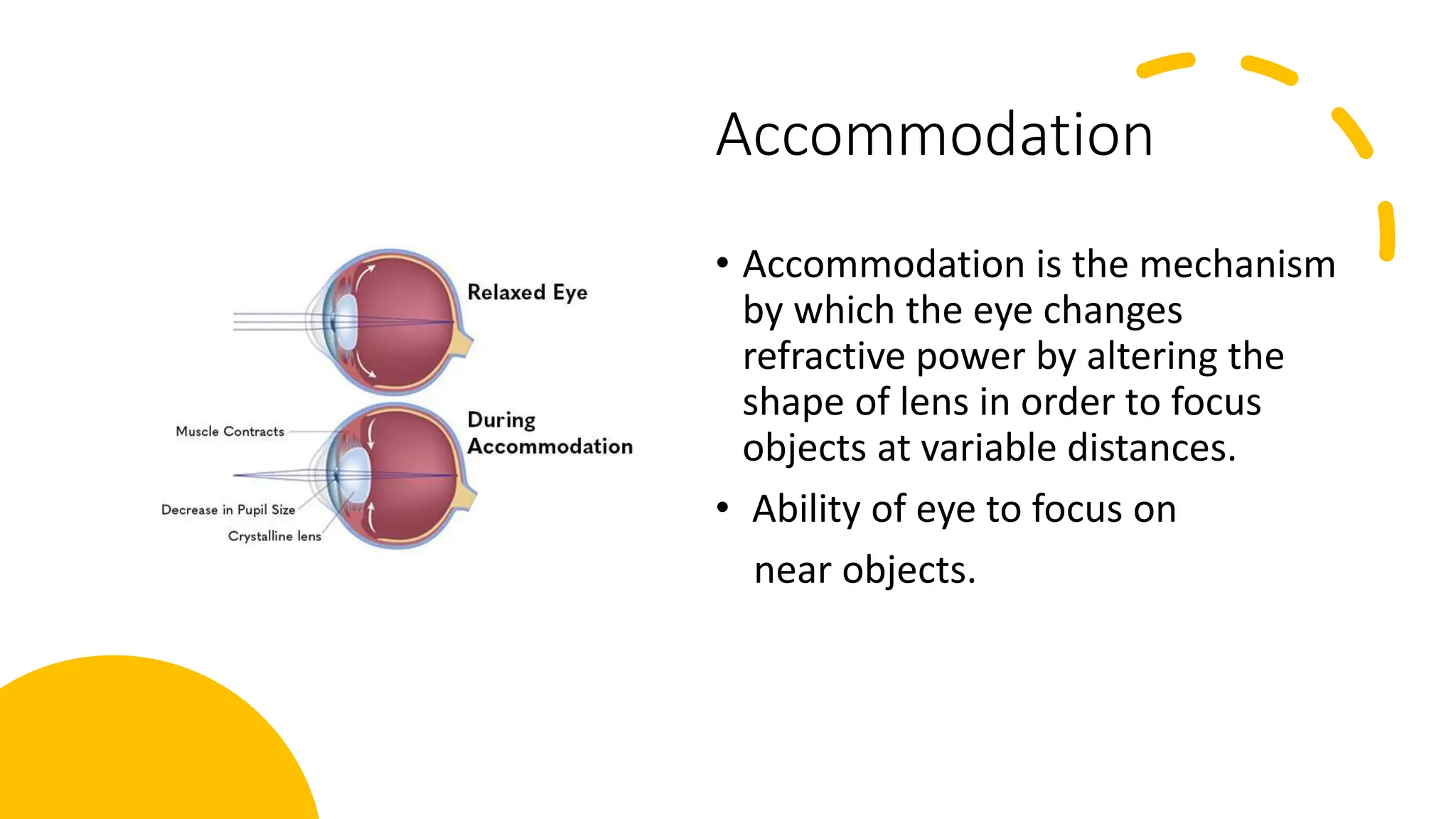
Accommodation
• Accommodation is the mechanism
by which the eye changes
refractive power by altering the
shape of lens in order to focus
objects at variable distances.
• Ability of eye to focus on
near objects.
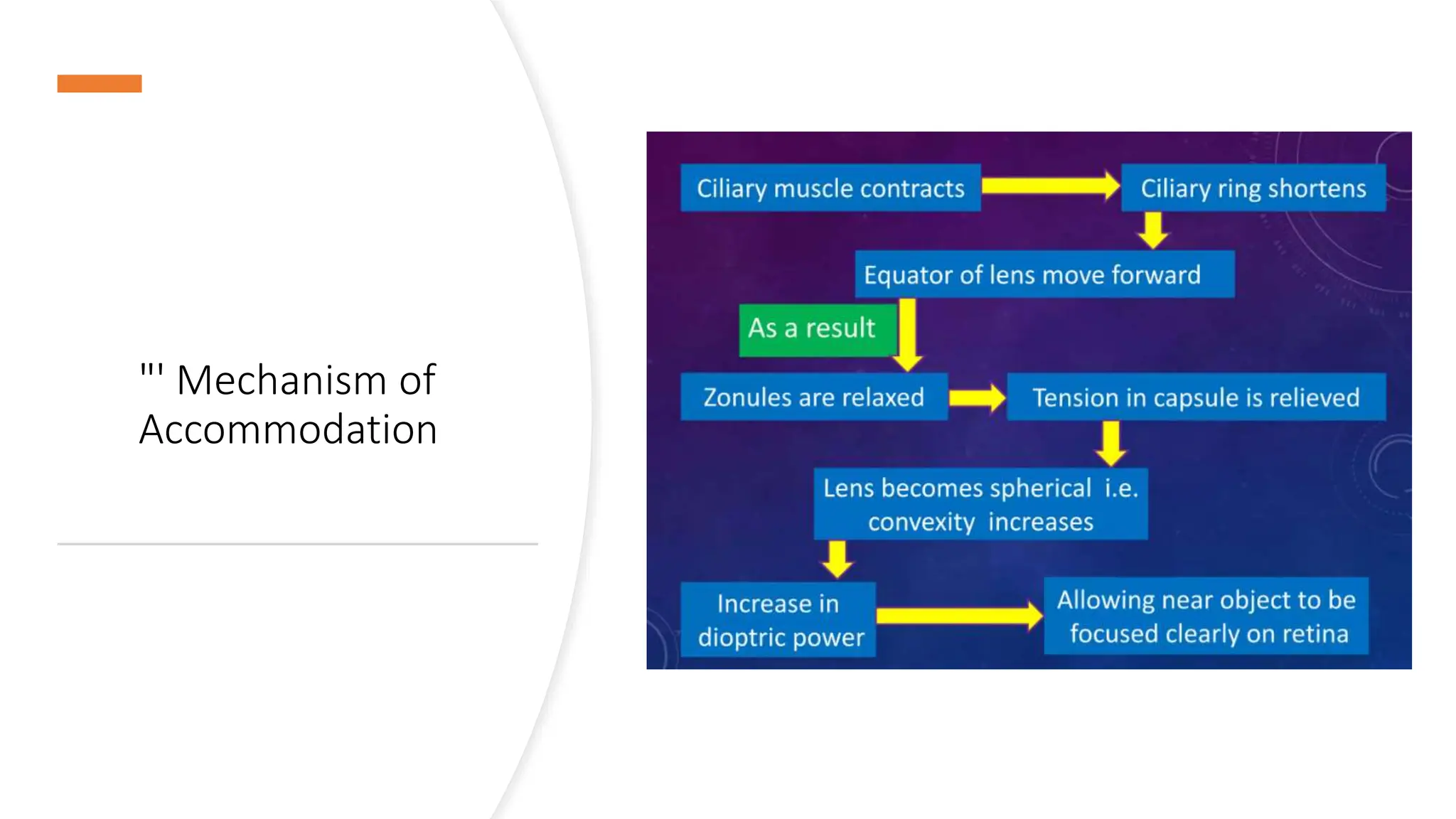
"' Mechanism of
Accommodation
MECHANISM
Pathway For
Accommodation
Reflex
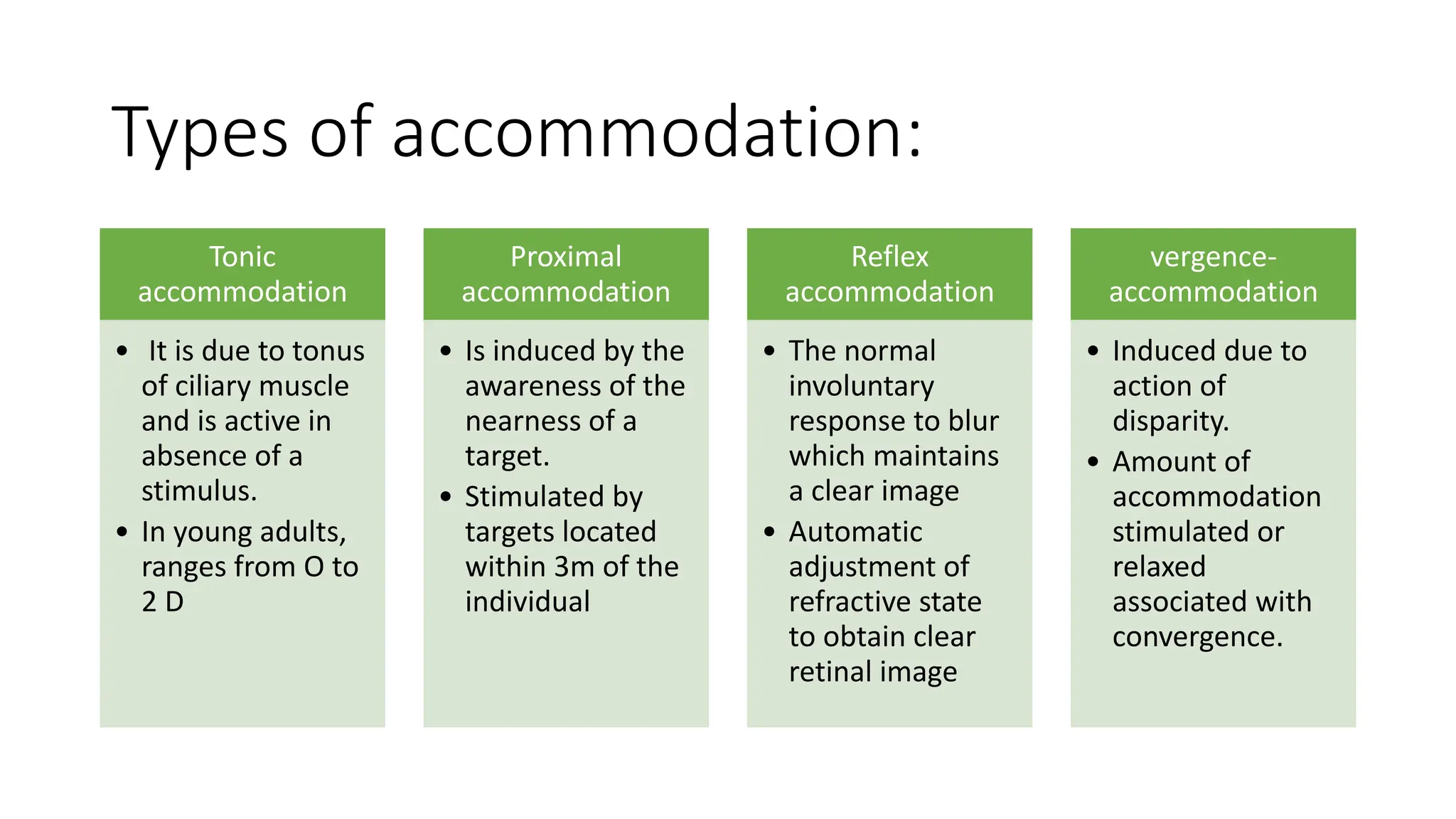
Types of accommodation:
Tonic
accommodation
• It is due to tonus
of ciliary muscle
and is active in
absence of a
stimulus.
• In young adults,
ranges from O to
2 D
Proximal
accommodation
• Is induced by the
awareness of the
nearness of a
target.
• Stimulated by
targets located
within 3m of the
individual
Reflex
accommodation
• The normal
involuntary
response to blur
which maintains
a clear image
• Automatic
adjustment of
refractive state
to obtain clear
retinal image
vergence-
accommodation
• Induced due to
action of
disparity.
• Amount of
accommodation
stimulated or
relaxed
associated with
convergence.
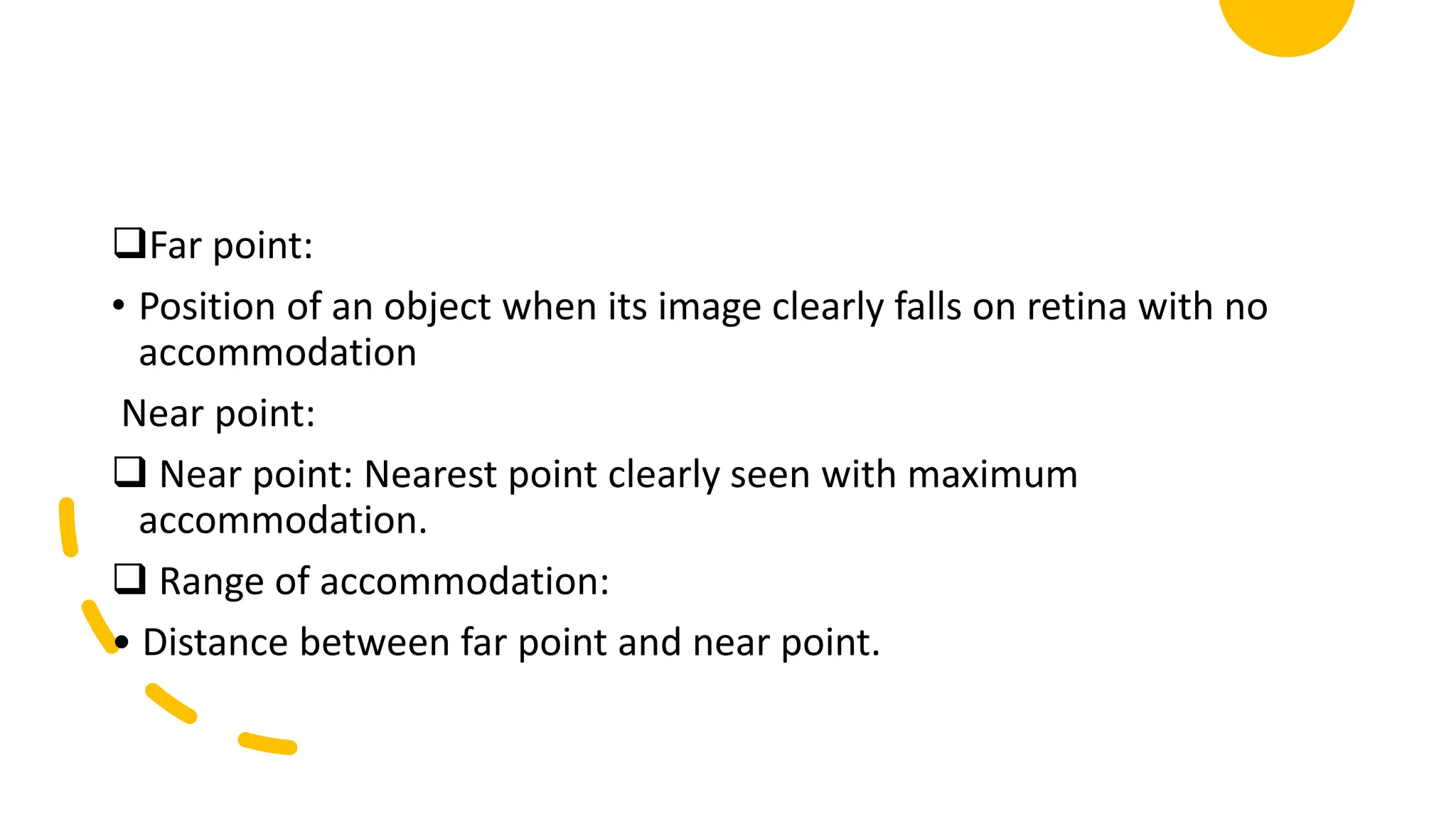
Far point:
• Position of an object when its image clearly falls on retina with no
accommodation
Near point:
 Near point: Nearest point clearly seen with maximum
accommodation.
 Range of accommodation:
• Distance between far point and near point.
Amplitude of accommodation:
• Dioptric power difference between rest and fully accommodated eye.
• A: amplitude of accommodation:
A =P-R Where
• P:dioptric value of near point; and
• R: dioptric value of far point
NEAR POINT OF ACCOMMODATION(NPA):
Near point of accommodation is a point nearest to the eye where a person use
maximum accommodation but still form a focused image of an object on retina.
• The normal near point depends on the age of the person tested.
Measurement of
accommodation
1.Measurement of
amplitude of
accommodation
2.Assessment of
Accommodative
Response
3.Assessment of
Dynamic
Accommodation
1.Measurement of amplitude of
accommodation
a) RAF Ruler or Prince’s rule:
RAF near point rule (RNPR) is also
known as Royal Air
Force (RAF) rule is a routinely
employed instrument in
ophthalmology and optometry
practices to measure near
point of convergence (NPC) and near
point of
accommodation
PROCEDURE OF NPA
• The Standard Target for the measurement of NPA is
• Times Roman Typeface (NV chart)
• The top smallest line which is N5
• We have to do the NPA measurement both
monocularly and binocularly.
• To carry out the Binocular test we have to put the
cheek rest on the inferior orbital margin of the
patient.
• Position of RAF rule should be slightly depressed
at an angle of 45 degrees. Now ask the patient if
he/she can see the word.
• Now move the target slowly towards the patient at
a constant rate of 1 to 2 cm/sec.
• Instruct the patient to inform
you when the word gets
blurred.
• Put the target back and note
the point(cm/diopters) at
which the word again looks
clear.
• The same test is performed for
the monocular left and right
eye also.
• Repeat the test 2 to 3 times.
b). Measurement of Amplitude of
Accommodation using Minus lenses:
• This test is performed for each eye separately and during examination
the patient has to wear his or her full refractive correction.
• The patient is asked to fixate the best corrected near vision target at
40 cm distance and minus lenses of progressively increasing power
are added before the eye till the patient reports the first sustained
blur.
• The power of this minus lens plus+2.5 D (for 40 cm distance of
testing) is equivalent to the amplitude of accommodation in diopters.
2.Assessment
of
Accommodative
Response
• The accommodative response of an
individual can be assessed with
dynamic retinoscopy.
• Monocular estimation method (MEM)
retinoscopy:
• Patient is asked to fixate the near
target at a distance of 40 cm and the
retinoscopy is per-formed using
streak retinoscope . The lens power
required to attain neutrality is noted.
3.Assessment of
Dynamic
Accommodation:
An accommodative flipper of +2.00 DS
with +2.00 D is used to test
accommodative facility by rapidly
flipping the lenses.
• Difficulty with plus lenses is seen in
patients with accommodative excess.
• Difficulty with minus lenses is seen in
presbyopes and with accommodative
insufficiency.
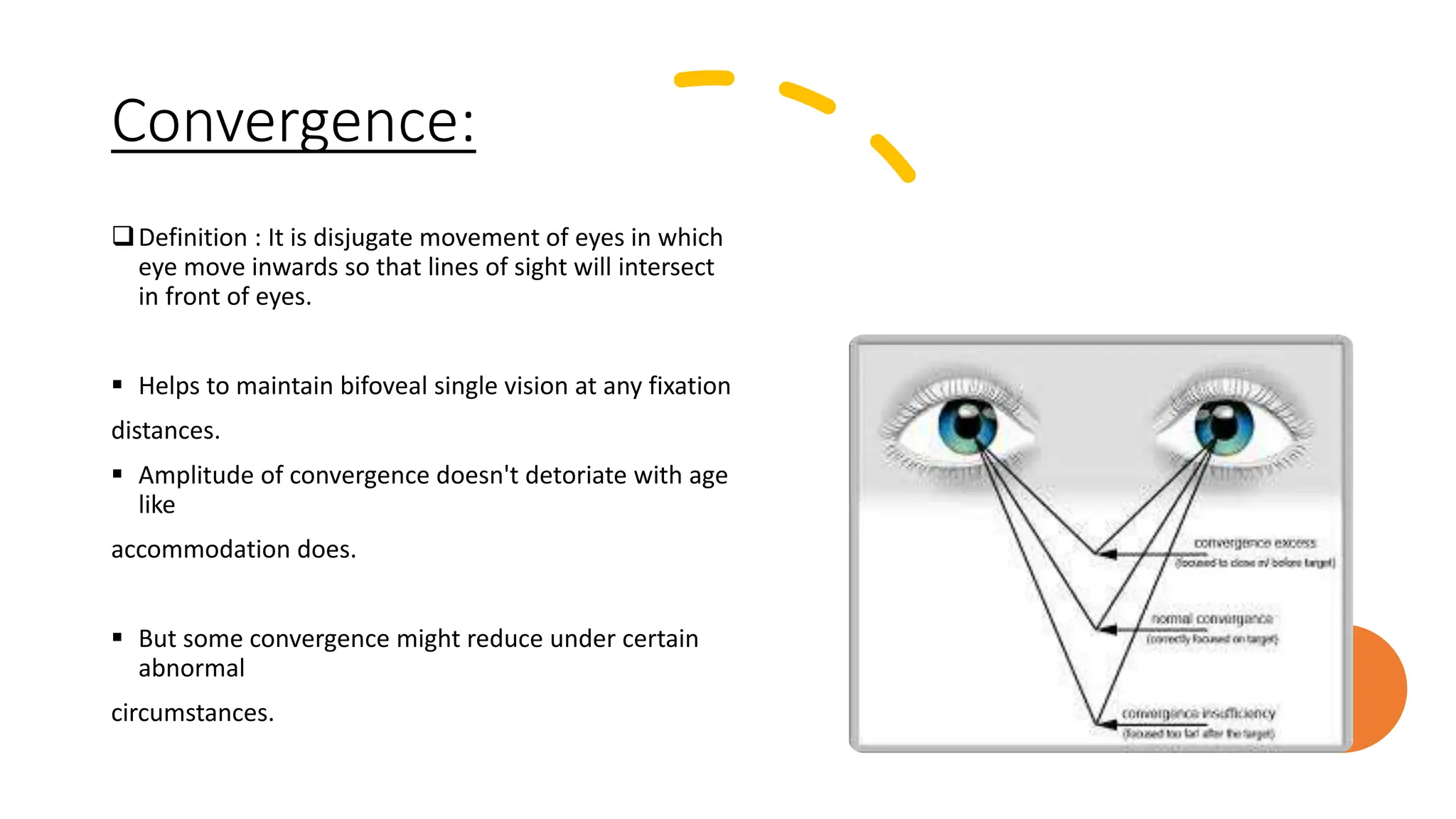
Convergence:
Definition : It is disjugate movement of eyes in which
eye move inwards so that lines of sight will intersect
in front of eyes.
 Helps to maintain bifoveal single vision at any fixation
distances.
 Amplitude of convergence doesn't detoriate with age
like
accommodation does.
 But some convergence might reduce under certain
abnormal
circumstances.
Types of
convergence
voluntary reflex
Voluntary
convergence
Convergence of visual axis at our own
will.
Not a part of normal convergence
movement.
some consider voluntary convergence is
attained by accommodating eye more
with out accommodating stimulus.
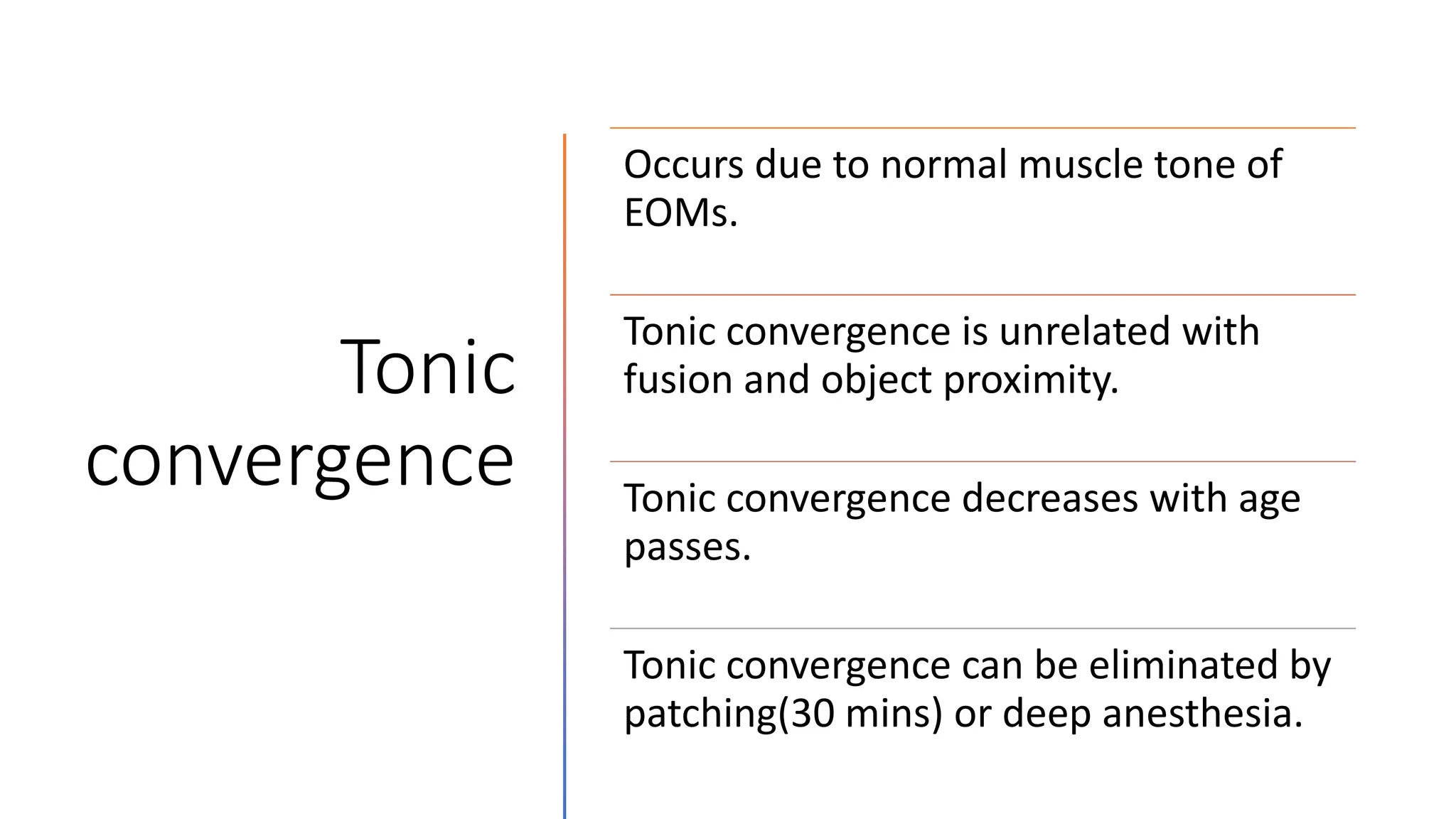
Tonic
convergence
Occurs due to normal muscle tone of
EOMs.
Tonic convergence is unrelated with
fusion and object proximity.
Tonic convergence decreases with age
passes.
Tonic convergence can be eliminated by
patching(30 mins) or deep anesthesia.
Fusional
convergence
Part of reflex convergence
Ensures similar images are imaged on corresponding
retinal point.
It is mainly induced by bitemporal image disparity.
No refractive changes seen in eye during fusional
convergence.
Involuntary mechanism to obtain bifoveal fixation
Magnitude of it is 35 pd at near and 18 pd at
distance.
Fusional convergence can be improved by orthoptic
exercises.
Accommodative
convergence
Convergence induced when a person
accommodates
Induced or stimulated by blurred retinal
image.
Independent of binocular vision ie can even
occur in one eye blind
or occluding one eye.
It has linear relationship with change in
fixation distance
AC/A will better define accommodative
convergence.
Proximal
convergence:
Induced by proximity of object of regard.
Also seems to be initiated by psychological
factor.
It is also induced when person feels he is
looking at near object although he is not doing
so.
Example of proximal convergence is eso-
deviation measure by synaptophore is greater
than as measured by prism for same subject.
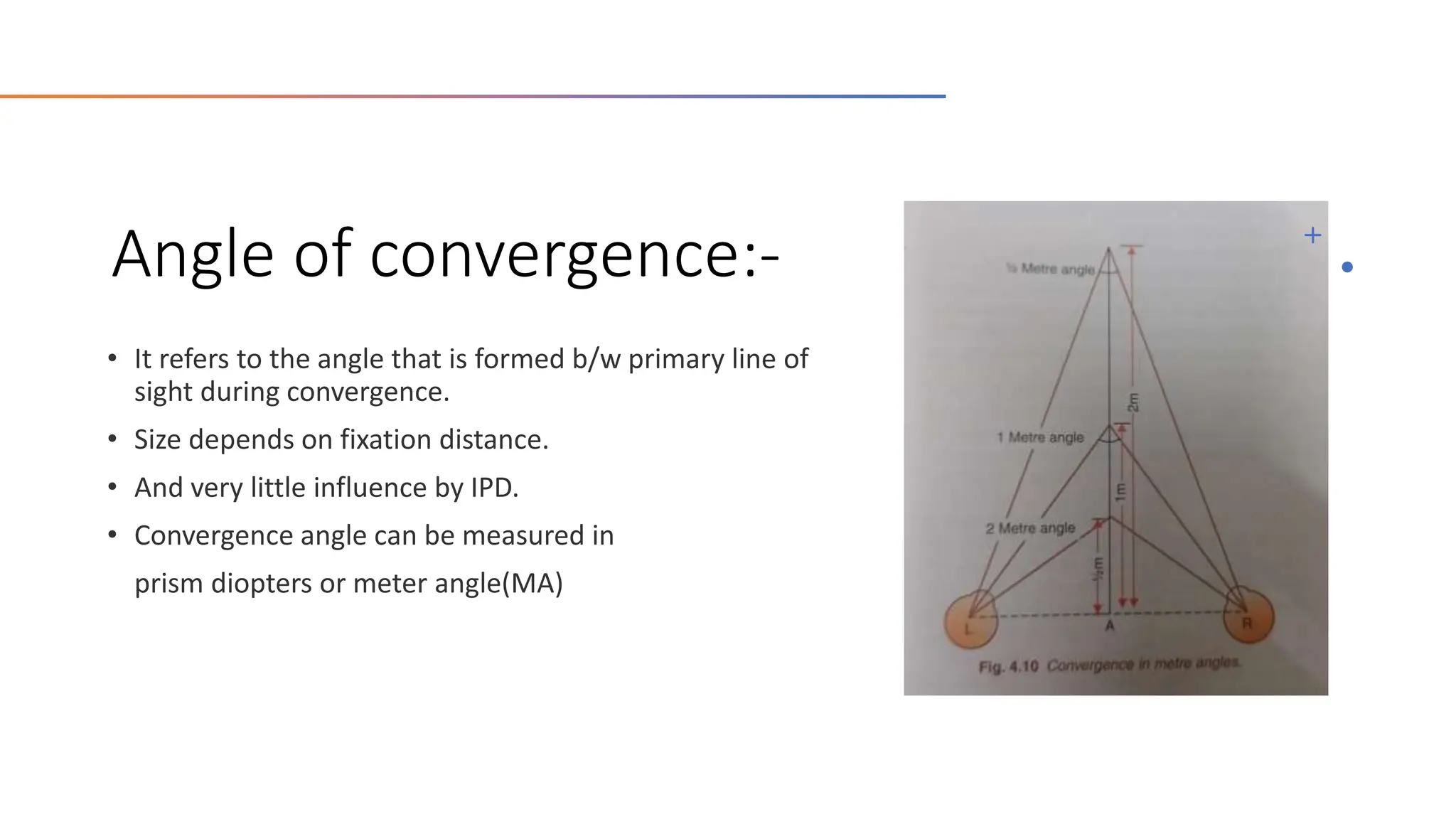
Angle of convergence:-
Measurement units of convergence.
Meter angle(MA)
• ONE MA :- It is the amount of convergence angle required to
converge an object located at one meter distance in medial plane.
• In an emmetropic eye no. of diopter of accommodation required to
see an object is numerically equal to no. of meter angle.
• The convergence exerted in (ma) by each eye is inversely proportional
to the distance in meters the object is in front of the eyes;
 Convergence
in Prism
dioptres
• Unit to measure power of prism
• Also used to measure amount of convergence
clinically.
• 1 prism diopters: Power of prism which displaces
an object by 1cm distance placed at a distance of
1m.
• 1 prism diopter convergence :- Amount of
convergence required to see an object single locate
1meter away from eye when a prism of 1 p.d is
placed in front of eye.
Near point of
convergence
( NPC )
• Closest point at which an object can be seen singly
during bifoveal vision.
• In other words, point where two foveal lines of
sight intersect when maximum convergence.
• It doesn't change with age.
• It is much close to eyes compared to near point of
accommodation.
• In clinical practice NPC of 10 cm is considered
adequate.
• Its normal adults , its range between 5 to 10 cm.
Range of convergence & Amplitude of convergence.
Range of convergence:- It is
distance b/w far point of
convergence and near
point of convergence.
Amplitude of
convergence:- Difference in
power exerted to maintain
the eye in position of rest
and in position of
maximum convergence.
Measurement of Amplitude of Convergence:
1).Prism Bar
Method:
2).
Synoptophore
Method:
Measurement of
NPC:
1). Tip of sharp pencil (
grossly)
2). RAF rule
3).Livingstone binocular
gauge
PROCEDURE OF NPC:
• Made The examiner holds the ruler and gently places the cheek rest on the inferior
orbital margin.
• NPC is most accurately measured by the RAF rule in the depressed position of 45
degrees.
• Asks the patient to focus on the black dot and slowly moves the target towards the
patient's eye at a constant and linear rate of about 1±2 cm/sec.
• OBJECTIVE METHODS:
• The examiner should look at patient's eye movement.
• The patient is asked to fix steadily on the central dot on the line and
the slider is moved slowly towards the patient's eye.
• The NPC is the distance where one eye is seen to diverge.
• The test is repeated 2 to 3 times.
SUBJECTIVE METHODS:
•Test should be performed with best correction.
• Instruct the patient to inform you when the target
becomes blur or the vertical line becomes double or
when he/she sees the line move to one or the other
side.
• This happens when the Image is suppressed, the line
moves to the side of the dominant eye.
• Ask the patient to blink several times when the target
becomes blur or double.
• Now move the target back until the vertical line again becomes
single.
• Record the values in cm/diopters from the square rule.
BREAK POINT & RECOVERY POINT
1. The subjective break point is indicated when the patient
either reports diplopia or until the slider is stopped by the
cheek rest.
2.The recovery is noted when the patient reports single target
when the slider is slowly moved back.
AC/A RATIO:
The AC/ A ratio is the relationship between accommodative convergence (AC),
expressed in pd, and accommodation ,expressed in (D).
This relationship is linear one and is thought to be relatively stable throughout life.
Normal AC/A ratio is about 3-5pd for 1 D of accommodation.
The concept of AC/A ratio was first clearly defined by Fry and Haines.
The ratio AC/A can be transiently altered by optical or pharmacological or
modified by surgical means.
SIGNIFICANCE OF AC/A RATIO:
Has effect on near phoria.
Abnormalities of the AC/A ratio are very important causes of
strabismus.
A high AC/A ratio may cause excessive convergence & produce a
convergent squint , during accommodation on a near object.
A Iow AC/A ratio may cause a divergent squint when the patient
look at a near object.
USES OF AC/A RATIO
Diagnosis of convergence excess type of esodeviation
Divergence excess esodeviation
Divergence insufficiency
Convergence insufficiency
METHODS OF MEASUREMENT OF AC/A RATIO
Heterophoria method
Gradient method
Fixation disparity method
Graphical method
Heterophoria
method:
CALCULATED AC/A RATIO
AC/A= IPD +[N – D’]/ D
Where,
IPD = interpupillary distance in
centimetres
N= near fixation distance in meters
D’= near phoria (eso is plus and exo is
minus)
D=far phoria (eso is plus and exo is
minus)
GRADIENT
METHOD
• This method is based on the fact that for a
given fixation distance, minus lenses placed
before the eyes increase the requirement for
accommodation and plus lenses relax
accommodation.
• -1 D lenses produce an equivalent of 1D of
accommodation,
• +1 D lenses relax accommodation by 1D
• AC/A =∆ L-∆O/D
• where:
• ∆L is deviation with additional lenses.
• ∆O is original deviation without additional
lenses.
• D is dioptric power of the additional lenses.
FIXATION
DISPARITY
METHOD:
• This method has been used
extensively by Ogle and coworkers.
• In this method, AC/A ratio is
indirectly derived from the fixation
disparity induced either by forced
convergence by use of prism or by
altering the accommodative
stimulus by use of optical lenses.
• Because of its complexity, this test
is not performed in routine clinical
practice.
Haploscopic
Method:
• visual fields of the two eyes are
differentiated and a separate
target is presented to each eye.
• original instrument was
designed primarily for studying
theAC/Aratio. In practice, this
method is no more used.
Accommodation and Convergence measurement and types

Accommodation and Convergence measurement and types

  • 1.
    Presenter-Priyansh Sharma (3rdy) Moderator-Rahul Khanna
  • 2.
  • 3.
    Accommodation • Accommodation isthe mechanism by which the eye changes refractive power by altering the shape of lens in order to focus objects at variable distances. • Ability of eye to focus on near objects.
  • 5.
  • 6.
  • 7.
  • 8.
    Types of accommodation: Tonic accommodation •It is due to tonus of ciliary muscle and is active in absence of a stimulus. • In young adults, ranges from O to 2 D Proximal accommodation • Is induced by the awareness of the nearness of a target. • Stimulated by targets located within 3m of the individual Reflex accommodation • The normal involuntary response to blur which maintains a clear image • Automatic adjustment of refractive state to obtain clear retinal image vergence- accommodation • Induced due to action of disparity. • Amount of accommodation stimulated or relaxed associated with convergence.
  • 9.
    Far point: • Positionof an object when its image clearly falls on retina with no accommodation Near point:  Near point: Nearest point clearly seen with maximum accommodation.  Range of accommodation: • Distance between far point and near point.
  • 10.
    Amplitude of accommodation: •Dioptric power difference between rest and fully accommodated eye. • A: amplitude of accommodation: A =P-R Where • P:dioptric value of near point; and • R: dioptric value of far point
  • 11.
    NEAR POINT OFACCOMMODATION(NPA): Near point of accommodation is a point nearest to the eye where a person use maximum accommodation but still form a focused image of an object on retina. • The normal near point depends on the age of the person tested.
  • 12.
    Measurement of accommodation 1.Measurement of amplitudeof accommodation 2.Assessment of Accommodative Response 3.Assessment of Dynamic Accommodation
  • 13.
    1.Measurement of amplitudeof accommodation a) RAF Ruler or Prince’s rule: RAF near point rule (RNPR) is also known as Royal Air Force (RAF) rule is a routinely employed instrument in ophthalmology and optometry practices to measure near point of convergence (NPC) and near point of accommodation
  • 14.
    PROCEDURE OF NPA •The Standard Target for the measurement of NPA is • Times Roman Typeface (NV chart) • The top smallest line which is N5 • We have to do the NPA measurement both monocularly and binocularly.
  • 15.
    • To carryout the Binocular test we have to put the cheek rest on the inferior orbital margin of the patient. • Position of RAF rule should be slightly depressed at an angle of 45 degrees. Now ask the patient if he/she can see the word. • Now move the target slowly towards the patient at a constant rate of 1 to 2 cm/sec.
  • 16.
    • Instruct thepatient to inform you when the word gets blurred. • Put the target back and note the point(cm/diopters) at which the word again looks clear. • The same test is performed for the monocular left and right eye also. • Repeat the test 2 to 3 times.
  • 17.
    b). Measurement ofAmplitude of Accommodation using Minus lenses: • This test is performed for each eye separately and during examination the patient has to wear his or her full refractive correction. • The patient is asked to fixate the best corrected near vision target at 40 cm distance and minus lenses of progressively increasing power are added before the eye till the patient reports the first sustained blur. • The power of this minus lens plus+2.5 D (for 40 cm distance of testing) is equivalent to the amplitude of accommodation in diopters.
  • 18.
    2.Assessment of Accommodative Response • The accommodativeresponse of an individual can be assessed with dynamic retinoscopy. • Monocular estimation method (MEM) retinoscopy: • Patient is asked to fixate the near target at a distance of 40 cm and the retinoscopy is per-formed using streak retinoscope . The lens power required to attain neutrality is noted.
  • 19.
    3.Assessment of Dynamic Accommodation: An accommodativeflipper of +2.00 DS with +2.00 D is used to test accommodative facility by rapidly flipping the lenses. • Difficulty with plus lenses is seen in patients with accommodative excess. • Difficulty with minus lenses is seen in presbyopes and with accommodative insufficiency.
  • 20.
    Convergence: Definition : Itis disjugate movement of eyes in which eye move inwards so that lines of sight will intersect in front of eyes.  Helps to maintain bifoveal single vision at any fixation distances.  Amplitude of convergence doesn't detoriate with age like accommodation does.  But some convergence might reduce under certain abnormal circumstances.
  • 21.
  • 22.
    Voluntary convergence Convergence of visualaxis at our own will. Not a part of normal convergence movement. some consider voluntary convergence is attained by accommodating eye more with out accommodating stimulus.
  • 23.
    Tonic convergence Occurs due tonormal muscle tone of EOMs. Tonic convergence is unrelated with fusion and object proximity. Tonic convergence decreases with age passes. Tonic convergence can be eliminated by patching(30 mins) or deep anesthesia.
  • 24.
    Fusional convergence Part of reflexconvergence Ensures similar images are imaged on corresponding retinal point. It is mainly induced by bitemporal image disparity. No refractive changes seen in eye during fusional convergence. Involuntary mechanism to obtain bifoveal fixation Magnitude of it is 35 pd at near and 18 pd at distance. Fusional convergence can be improved by orthoptic exercises.
  • 25.
    Accommodative convergence Convergence induced whena person accommodates Induced or stimulated by blurred retinal image. Independent of binocular vision ie can even occur in one eye blind or occluding one eye. It has linear relationship with change in fixation distance AC/A will better define accommodative convergence.
  • 26.
    Proximal convergence: Induced by proximityof object of regard. Also seems to be initiated by psychological factor. It is also induced when person feels he is looking at near object although he is not doing so. Example of proximal convergence is eso- deviation measure by synaptophore is greater than as measured by prism for same subject.
  • 27.
  • 28.
    Measurement units ofconvergence. Meter angle(MA) • ONE MA :- It is the amount of convergence angle required to converge an object located at one meter distance in medial plane. • In an emmetropic eye no. of diopter of accommodation required to see an object is numerically equal to no. of meter angle. • The convergence exerted in (ma) by each eye is inversely proportional to the distance in meters the object is in front of the eyes;
  • 29.
     Convergence in Prism dioptres •Unit to measure power of prism • Also used to measure amount of convergence clinically. • 1 prism diopters: Power of prism which displaces an object by 1cm distance placed at a distance of 1m. • 1 prism diopter convergence :- Amount of convergence required to see an object single locate 1meter away from eye when a prism of 1 p.d is placed in front of eye.
  • 30.
    Near point of convergence (NPC ) • Closest point at which an object can be seen singly during bifoveal vision. • In other words, point where two foveal lines of sight intersect when maximum convergence. • It doesn't change with age. • It is much close to eyes compared to near point of accommodation. • In clinical practice NPC of 10 cm is considered adequate. • Its normal adults , its range between 5 to 10 cm.
  • 31.
    Range of convergence& Amplitude of convergence. Range of convergence:- It is distance b/w far point of convergence and near point of convergence. Amplitude of convergence:- Difference in power exerted to maintain the eye in position of rest and in position of maximum convergence.
  • 32.
    Measurement of Amplitudeof Convergence: 1).Prism Bar Method: 2). Synoptophore Method:
  • 33.
    Measurement of NPC: 1). Tipof sharp pencil ( grossly) 2). RAF rule 3).Livingstone binocular gauge
  • 34.
    PROCEDURE OF NPC: •Made The examiner holds the ruler and gently places the cheek rest on the inferior orbital margin. • NPC is most accurately measured by the RAF rule in the depressed position of 45 degrees. • Asks the patient to focus on the black dot and slowly moves the target towards the patient's eye at a constant and linear rate of about 1±2 cm/sec.
  • 35.
    • OBJECTIVE METHODS: •The examiner should look at patient's eye movement. • The patient is asked to fix steadily on the central dot on the line and the slider is moved slowly towards the patient's eye. • The NPC is the distance where one eye is seen to diverge. • The test is repeated 2 to 3 times.
  • 36.
    SUBJECTIVE METHODS: •Test shouldbe performed with best correction. • Instruct the patient to inform you when the target becomes blur or the vertical line becomes double or when he/she sees the line move to one or the other side. • This happens when the Image is suppressed, the line moves to the side of the dominant eye. • Ask the patient to blink several times when the target becomes blur or double.
  • 37.
    • Now movethe target back until the vertical line again becomes single. • Record the values in cm/diopters from the square rule.
  • 38.
    BREAK POINT &RECOVERY POINT 1. The subjective break point is indicated when the patient either reports diplopia or until the slider is stopped by the cheek rest. 2.The recovery is noted when the patient reports single target when the slider is slowly moved back.
  • 39.
    AC/A RATIO: The AC/A ratio is the relationship between accommodative convergence (AC), expressed in pd, and accommodation ,expressed in (D). This relationship is linear one and is thought to be relatively stable throughout life. Normal AC/A ratio is about 3-5pd for 1 D of accommodation. The concept of AC/A ratio was first clearly defined by Fry and Haines. The ratio AC/A can be transiently altered by optical or pharmacological or modified by surgical means.
  • 40.
    SIGNIFICANCE OF AC/ARATIO: Has effect on near phoria. Abnormalities of the AC/A ratio are very important causes of strabismus. A high AC/A ratio may cause excessive convergence & produce a convergent squint , during accommodation on a near object. A Iow AC/A ratio may cause a divergent squint when the patient look at a near object.
  • 41.
    USES OF AC/ARATIO Diagnosis of convergence excess type of esodeviation Divergence excess esodeviation Divergence insufficiency Convergence insufficiency
  • 42.
    METHODS OF MEASUREMENTOF AC/A RATIO Heterophoria method Gradient method Fixation disparity method Graphical method
  • 43.
    Heterophoria method: CALCULATED AC/A RATIO AC/A=IPD +[N – D’]/ D Where, IPD = interpupillary distance in centimetres N= near fixation distance in meters D’= near phoria (eso is plus and exo is minus) D=far phoria (eso is plus and exo is minus)
  • 44.
    GRADIENT METHOD • This methodis based on the fact that for a given fixation distance, minus lenses placed before the eyes increase the requirement for accommodation and plus lenses relax accommodation. • -1 D lenses produce an equivalent of 1D of accommodation, • +1 D lenses relax accommodation by 1D • AC/A =∆ L-∆O/D • where: • ∆L is deviation with additional lenses. • ∆O is original deviation without additional lenses. • D is dioptric power of the additional lenses.
  • 45.
    FIXATION DISPARITY METHOD: • This methodhas been used extensively by Ogle and coworkers. • In this method, AC/A ratio is indirectly derived from the fixation disparity induced either by forced convergence by use of prism or by altering the accommodative stimulus by use of optical lenses. • Because of its complexity, this test is not performed in routine clinical practice.
  • 46.
    Haploscopic Method: • visual fieldsof the two eyes are differentiated and a separate target is presented to each eye. • original instrument was designed primarily for studying theAC/Aratio. In practice, this method is no more used.

Editor's Notes

  • #18 For example, at 40 cm distance of testing, if the patient reports blur with -3 d Spherical lens, the amplitude of accommodation would be 3 + 2.5 = 5.5 D.
  • #30 1 ma = 3 pd convergence
  • #31 But as compared to young age convergence is reduced in older age probably due to reduction in Accommodative convergence.