Maddox rod
Maddox wing
Bagolini striated glasses
RAF ruler
Prism bar
1/22/2021 Uri 1
Bhageesh Bhaskar
B.Optom.
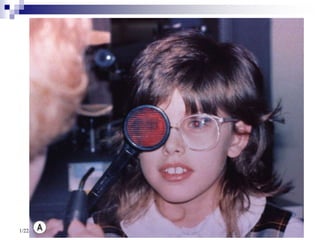
Maddox rod test
 It is based on the principle of dissociation
 Maddox Rod consists of a series of plano
cylinder lenses about 3 mm in diameter,
mounted in a trial frame lens.
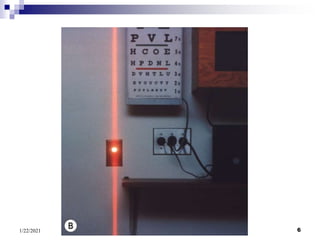
 A spot of light viewed through the Maddox
Rod appears as an elongated streak.
 The Maddox Rod is often colored usually red.
2
1/22/2021
uses
 Used to find out presence of heterophoria or
heterotropia
 Easy for patient to understand
 Easy to administer
 Very useful for vertical deviations.
3
1/22/2021
procedure
 Reduce room illumination.
 Maddox Rod is placed in front of one eye
 Measuring horizontal deviations maddox Rod
axes are placed horizontal which produces
vertical streak
 Measuring vertical deviations maddox Rod axes
are placed vertical which produces horizontal
streak
 Patient initially views with both eyes open 4
1/22/2021
5
1/22/2021
6
1/22/2021
For horizontal deviation
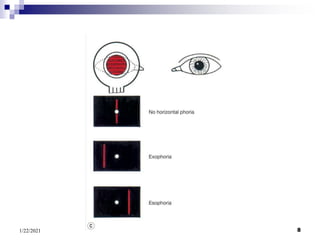
 Maddox Rod is placed horizontally (vertical
streak) in front of right eye
 With strabismics, the Maddox Rod is best
placed over the fixating eye
 Ensure that patient can see white light and
streak simultaneously
 Ask if the streak is to the right or to the left of
the light
7
1/22/2021
8
1/22/2021
Vertical deviation
9
1/22/2021
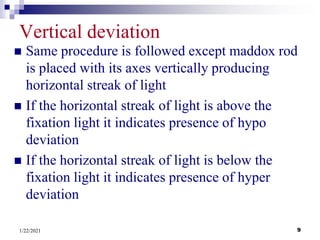
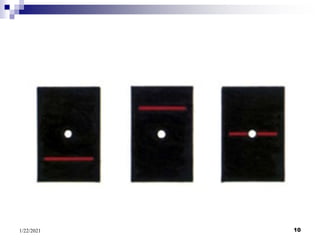
 Same procedure is followed except maddox rod
is placed with its axes vertically producing
horizontal streak of light
 If the horizontal streak of light is above the
fixation light it indicates presence of hypo
deviation
 If the horizontal streak of light is below the
fixation light it indicates presence of hyper
deviation
10
1/22/2021
Maddox tangent
 It is based on the principle of dissociation
 Instead of maddox rod a red glass is used
 Tangent scale is used
11
1/22/2021
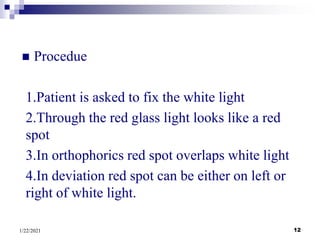
 Procedue
1.Patient is asked to fix the white light
2.Through the red glass light looks like a red
spot
3.In orthophorics red spot overlaps white light
4.In deviation red spot can be either on left or
right of white light.
12
1/22/2021
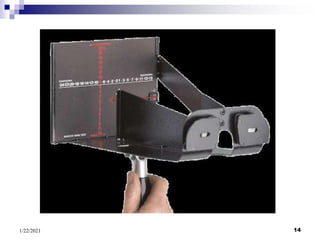
Maddox wing
 For amount of heterophoria in near fixation
 A vertical arrow is presented to one eye and a
horizontal tangent scale to the other to give
the measurement of the horizontal phoria .
 A horizontal arrow and vertical scale are used
to measure the vertical imbalance.
 Scales are mounted at the fixed viewing
distance of 1/3m.
13
1/22/2021
14
1/22/2021
Bagolini striated glasses
 It is a sub.clinical test to detect the presence or
extent of binocular function
 Bagolini glasses are glasses of no diopteric
power that have many narrow striations running
parallel in one meridian
Procedure:-
 Glasses mounted o trialframe
 Done at 33cm or 6m
15
1/22/2021
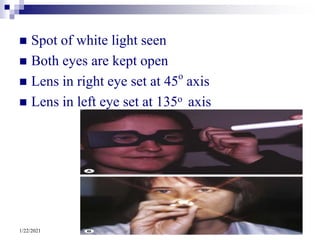
 Spot of white light seen
 Both eyes are kept open
 Lens in right eye set at 45o
axis
 Lens in left eye set at 135o axis
16
1/22/2021
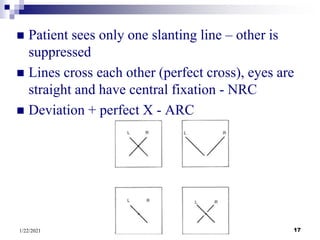
 Patient sees only one slanting line – other is
suppressed
 Lines cross each other (perfect cross), eyes are
straight and have central fixation - NRC
 Deviation + perfect X - ARC
17
1/22/2021
RAF ruler
 It consist of a square metal rod 33cm,long with a rest
attached at one end. The top surface of the rod is marked
out in cm to measure the distance from the patient’s eyes.
 The amount of Accommodation in dioptres(D) and an
indication of the accomodation normally available at
different ages are shown on the other sides
 Targets for testing convergence and Accomodation.
18
1/22/2021
 The targets used are
• Vertical black line with central
dot for convergence
• Reduced snellen letters
for accomodation
19
1/22/2021
Purpose
 RAF ruler is used for measuring the ability
of accommodation and convergence. It also
provides the dioptric value of accommodation
and convergence of the patient.
20
1/22/2021
Method
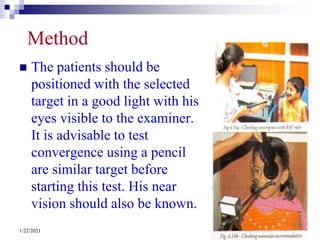
 The patients should be
positioned with the selected
target in a good light with his
eyes visible to the examiner.
It is advisable to test
convergence using a pencil
are similar target before
starting this test. His near
vision should also be known.
21
1/22/2021
To measure convergence
Objectively
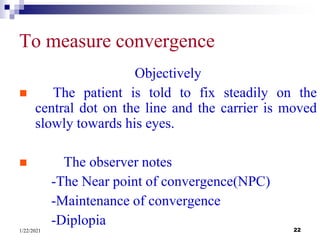
 The patient is told to fix steadily on the
central dot on the line and the carrier is moved
slowly towards his eyes.
 The observer notes
-The Near point of convergence(NPC)
-Maintenance of convergence
-Diplopia
22
1/22/2021
 Subjectively
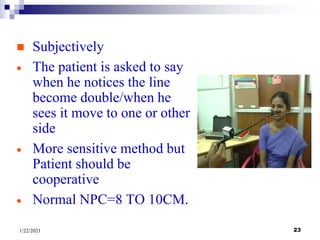
 The patient is asked to say
when he notices the line
become double/when he
sees it move to one or other
side
 More sensitive method but
Patient should be
cooperative
 Normal NPC=8 TO 10CM.
23
1/22/2021
To measure accomodation
 The NPA is the closest distance at which
clear vision is possible.
 Uniocular-
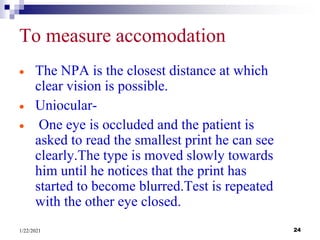
 One eye is occluded and the patient is
asked to read the smallest print he can see
clearly.The type is moved slowly towards
him until he notices that the print has
started to become blurred.Test is repeated
with the other eye closed.
24
1/22/2021
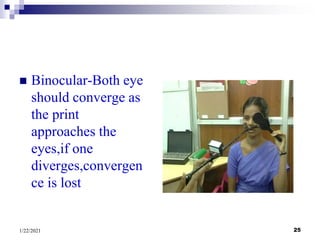
 Binocular-Both eye
should converge as
the print
approaches the
eyes,if one
diverges,convergen
ce is lost
25
1/22/2021
 Precautions
• The centimeter scale is read from the back
limit of the carrier and not from the actual
target distance
• Carrier can be placed very close to the eye
where he is unable to see and moved away
from him
• If Accommodation appears very poor,
clarity should be improved with convex
lenses.
26
1/22/2021
Maintenance of RAF ruler
 The RAF ruler should
be cleaned by the
solution and kept in the
particular box (RAF
ruler).
 Wrong handling can
cause scratches and the
numbers may become
invisible.
27
1/22/2021
Prism bar
 Purpose:
To measure Convergence, divergence and
vertical vergence
 There are two prism bars in a box. One is
for measuring horizontal deviation, the other
for vertical deviation. These bars are used for
finding the fusion range.
28
1/22/2021
 Method :
The patients should be positioned with the selected
target in a good light with his eyes visible to the
examiner. It is advisable to test convergence using a
pencil are similar target before starting this test. The
patients head keeps straight.
29
1/22/2021
Measurement of fusional amplitudes
 After refractive correction
 Horizontal and vertical amplitudes can be
measured.
 Divergence amplitudes are measured first with
base in prisms.
 Followed by Convergence amplitudes are
measured with base out prisms.
 Bar is kept as close to the eye as possible and
tilted slightly inward for near measurements.
30
1/22/2021
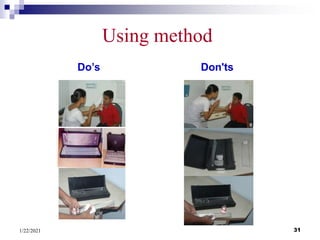
Using method
31
1/22/2021
Do’s Don'ts
Thank you...
1/22/2021 32