



Convergence
insufficiency
Prepared by:
Anis Suzanna Binti Mohamad
Optometrist
Hospital Langkawi
Content
Introduction
Journal
Comments
Suggestions
Conclusions
References
Introduction
 What is convergence insufficiency?
A sensory and neuromuscular anomaly of
binocular vision system, characterized by an
inability to converge the eyes or sustain
convergence.
CI=Abnormally poor convergence amplitude
Convergence insufficiency is a binocular
vision problem…but it is NOT strabismus
Symptoms
 Symptoms associated with close work:
Asthenopia= Symptoms related to the effort to
maintain BSV
Headaches,
Intermittent blur vision
Inability to sustain and concentrate
Discomfort of the eyes (burning,tearing) and
etc.
Convergence insufficiency is
routinely missed in vision screening
 Why???
 CI patients routinely have 6/6
 Children with CI may not complain about their eyes to
their parents or tell the family physician
 Most CI patients have “quality of life” symptoms which
are over looked in routine screenings
Facts about CI
 A disease that affects over 21 million in the
United States
 Massive research effort over 10 years by the
CITT Group
 Latest study (2008) NEI funded $6.1 M.
multicenter including: The Mayo Clinic, Bascom
Palmer and 6 Colleges of Optometry around the
US.
 Can cause behaviors that appear to be
ADD/ADHD, reading and learning problems
 There is a cure!
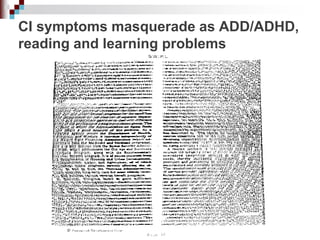
CI symptoms masquerade as ADD/ADHD,
reading and learning problems
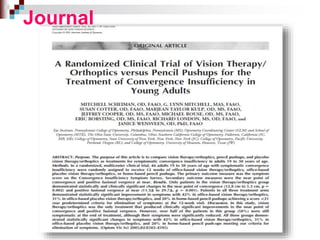
Journal
Objective:
 To compare vision therapy /orthoptics,
pencil push-ups, and placebo vision
therapy/ orthoptics as treatments for
symptomatic convergence insufficiency in
children 9 to 18 years of age.
Methods:
 In a randomized, multicenter clinical trial,
47 children 9 to 18 years of age with
symptomatic CI were randomly assign to
received 12 weeks of:-
Office-based vision therapy/orthoptics
Office-based placebo vision
therapy/orthoptics
Home-based pencil push-ups therapy.
Main outcome measures:
1. The primary outcome
a. Measure was the symptom score on the
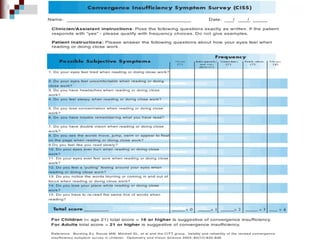
Convergence Insufficiency Symptom Survey
(CISS)
2. The secondary outcome
a. Measures were the near point of
convergence (NPC) and positive fusional
vergence (PFV) at near.
What to test?
Near Point of Convergence (NPC)
 The (NPC) is measured by bringing the
test target to the nose and observing when
the patient sees double, or one eye
deviates out.
 NPC ( receded 5cm or recovery greater
than 7cm)
How to test NPC?
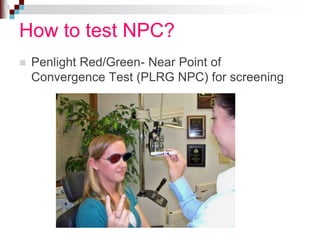
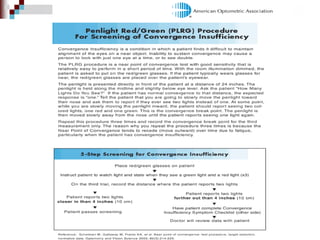
 Penlight Red/Green- Near Point of
Convergence Test (PLRG NPC) for screening
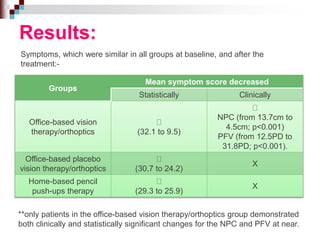
Results:
Groups
Mean symptom score decreased
Statistically Clinically
Office-based vision
therapy/orthoptics (32.1 to 9.5)
NPC (from 13.7cm to
4.5cm; p<0.001)
PFV (from 12.5PD to
31.8PD; p<0.001).
Office-based placebo
vision therapy/orthoptics (30.7 to 24.2)
X
Home-based pencil
push-ups therapy (29.3 to 25.9)
X
Symptoms, which were similar in all groups at baseline, and after the
treatment:-
**only patients in the office-based vision therapy/orthoptics group demonstrated
both clinically and statistically significant changes for the NPC and PFV at near.
Discussion
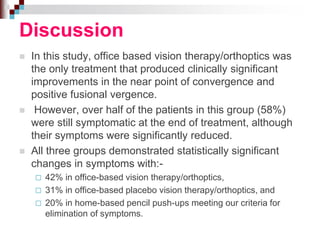
 In this study, office based vision therapy/orthoptics was
the only treatment that produced clinically significant
improvements in the near point of convergence and
positive fusional vergence.
 However, over half of the patients in this group (58%)
were still symptomatic at the end of treatment, although
their symptoms were significantly reduced.
 All three groups demonstrated statistically significant
changes in symptoms with:-
 42% in office-based vision therapy/orthoptics,
 31% in office-based placebo vision therapy/orthoptics, and
 20% in home-based pencil push-ups meeting our criteria for
elimination of symptoms.
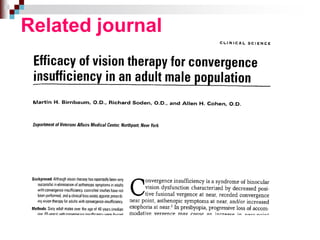
Related journal
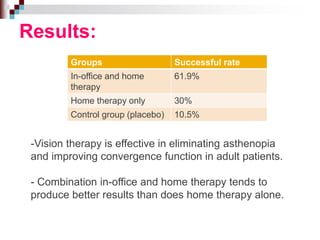
Results:
Groups Successful rate
In-office and home
therapy
61.9%
Home therapy only 30%
Control group (placebo) 10.5%
-Vision therapy is effective in eliminating asthenopia
and improving convergence function in adult patients.
- Combination in-office and home therapy tends to
produce better results than does home therapy alone.
Conclusions
o Office-based vergence accommodative therapy is an
effective treatment for children and adults with
symptomatic convergence insufficiency.
o Although among children they might experienced
symptomatic CI at the end of the treatment, but the
recurrence rate is about a year (89%, no significant
differences between group with p=0.26).
o The combination treatment in-office vision therapy and
home based therapy are the best solution among adults
with CI.
Suggestions
 What we can do in our clinic?
 Screen
Recognize
 Inform
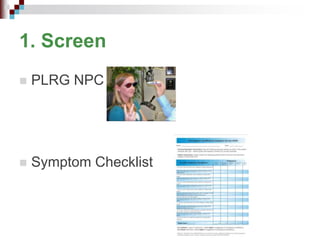
1. Screen
 PLRG NPC
 Symptom Checklist
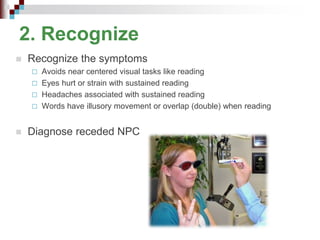
2. Recognize
 Recognize the symptoms
 Avoids near centered visual tasks like reading
 Eyes hurt or strain with sustained reading
 Headaches associated with sustained reading
 Words have illusory movement or overlap (double) when reading
 Diagnose receded NPC
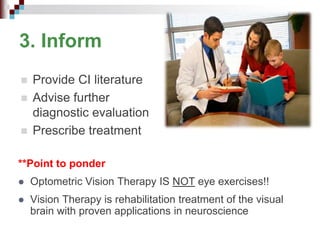
3. Inform
 Provide CI literature
 Advise further
diagnostic evaluation
 Prescribe treatment
**Point to ponder
 Optometric Vision Therapy IS NOT eye exercises!!
 Vision Therapy is rehabilitation treatment of the visual
brain with proven applications in neuroscience
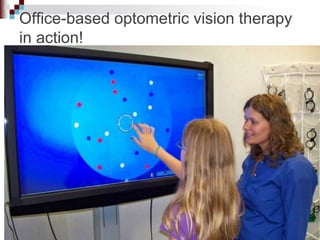
Office-based optometric vision therapy
in action!
Conclusion
 Convergence insufficiency is a sensory and
neuromuscular anomaly of binocular vision
system, characterized by an inability to
converge the eyes or sustain convergence.
 Office-based vision therapy utilizes principles
of neuroscience research:-
1. Visual awareness
2. Feedback
3. Loading -Action, movement and relevance
NEI YouTube Videos:
Convergence Insufficiency
References
Convergence Insufficiency Treatment Trial Study Group. Randomized clinical trial
of treatments for symptomatic convergence insufficiency in children. Arch
Ophthalmol. 2008 Oct;126(10):1336-49.
Barnhardt C, Cotter SA, Mitchell GL, Scheiman M, Kulp MT; CITT Study Group.
Symptoms in children with convergence insufficiency: before and after
treatment. Optom Vis Sci. 2012 Oct;89(10):1512-20.
Scheiman M, Kulp MT, Cotter S, Mitchell GL, Gallaway M, Boas M, Coulter R,
Hopkins K, Tamkins S; Convergence Insufficiency Treatment Trial Study
Group. Vision therapy/orthoptics for symptomatic convergence insufficiency in
children: treatment kinetics. Optom Vis Sci. 2010 Aug;87(8):593-603.
Rouse M, Borsting E, Mitchell GL, Kulp MT, Scheiman M, Amster D, Coulter R,
Fecho G, Gallaway M; CITT Study Group. Academic behaviors in children with
convergence insufficiency with and without parent-reported ADHD. Optom Vis
Sci. 2009 Oct;86(10):1169-77.
Convergence Insufficiency Treatment Trial Study Group. Long-term effectiveness
of treatments for symptomatic convergence insufficiency in children. Optom Vis
Sci. 2009 Sep;86(9):1096-103.
Kulp M, Mitchell GL, Borsting E, Scheiman M, Cotter S, Rouse M, Tamkins S,
Mohney BG, Toole A, Reuter K; Convergence Insufficiency Treatment Trial
Study Group. Effectiveness of placebo therapy for maintaining masking in a
Journal presentation about convergence insufficiency

Journal presentation about convergence insufficiency

  • 1.
    Convergence insufficiency Prepared by: Anis SuzannaBinti Mohamad Optometrist Hospital Langkawi
  • 2.
  • 3.
    Introduction  What isconvergence insufficiency? A sensory and neuromuscular anomaly of binocular vision system, characterized by an inability to converge the eyes or sustain convergence. CI=Abnormally poor convergence amplitude Convergence insufficiency is a binocular vision problem…but it is NOT strabismus
  • 4.
    Symptoms  Symptoms associatedwith close work: Asthenopia= Symptoms related to the effort to maintain BSV Headaches, Intermittent blur vision Inability to sustain and concentrate Discomfort of the eyes (burning,tearing) and etc.
  • 6.
    Convergence insufficiency is routinelymissed in vision screening  Why???  CI patients routinely have 6/6  Children with CI may not complain about their eyes to their parents or tell the family physician  Most CI patients have “quality of life” symptoms which are over looked in routine screenings
  • 7.
    Facts about CI A disease that affects over 21 million in the United States  Massive research effort over 10 years by the CITT Group  Latest study (2008) NEI funded $6.1 M. multicenter including: The Mayo Clinic, Bascom Palmer and 6 Colleges of Optometry around the US.  Can cause behaviors that appear to be ADD/ADHD, reading and learning problems  There is a cure!
  • 8.
    CI symptoms masqueradeas ADD/ADHD, reading and learning problems
  • 9.
  • 10.
    Objective:  To comparevision therapy /orthoptics, pencil push-ups, and placebo vision therapy/ orthoptics as treatments for symptomatic convergence insufficiency in children 9 to 18 years of age.
  • 11.
    Methods:  In arandomized, multicenter clinical trial, 47 children 9 to 18 years of age with symptomatic CI were randomly assign to received 12 weeks of:- Office-based vision therapy/orthoptics Office-based placebo vision therapy/orthoptics Home-based pencil push-ups therapy.
  • 12.
    Main outcome measures: 1.The primary outcome a. Measure was the symptom score on the Convergence Insufficiency Symptom Survey (CISS) 2. The secondary outcome a. Measures were the near point of convergence (NPC) and positive fusional vergence (PFV) at near.
  • 14.
    What to test? NearPoint of Convergence (NPC)  The (NPC) is measured by bringing the test target to the nose and observing when the patient sees double, or one eye deviates out.  NPC ( receded 5cm or recovery greater than 7cm)
  • 15.
    How to testNPC?  Penlight Red/Green- Near Point of Convergence Test (PLRG NPC) for screening
  • 17.
    Results: Groups Mean symptom scoredecreased Statistically Clinically Office-based vision therapy/orthoptics (32.1 to 9.5) NPC (from 13.7cm to 4.5cm; p<0.001) PFV (from 12.5PD to 31.8PD; p<0.001). Office-based placebo vision therapy/orthoptics (30.7 to 24.2) X Home-based pencil push-ups therapy (29.3 to 25.9) X Symptoms, which were similar in all groups at baseline, and after the treatment:- **only patients in the office-based vision therapy/orthoptics group demonstrated both clinically and statistically significant changes for the NPC and PFV at near.
  • 18.
    Discussion  In thisstudy, office based vision therapy/orthoptics was the only treatment that produced clinically significant improvements in the near point of convergence and positive fusional vergence.  However, over half of the patients in this group (58%) were still symptomatic at the end of treatment, although their symptoms were significantly reduced.  All three groups demonstrated statistically significant changes in symptoms with:-  42% in office-based vision therapy/orthoptics,  31% in office-based placebo vision therapy/orthoptics, and  20% in home-based pencil push-ups meeting our criteria for elimination of symptoms.
  • 19.
  • 20.
    Results: Groups Successful rate In-officeand home therapy 61.9% Home therapy only 30% Control group (placebo) 10.5% -Vision therapy is effective in eliminating asthenopia and improving convergence function in adult patients. - Combination in-office and home therapy tends to produce better results than does home therapy alone.
  • 21.
    Conclusions o Office-based vergenceaccommodative therapy is an effective treatment for children and adults with symptomatic convergence insufficiency. o Although among children they might experienced symptomatic CI at the end of the treatment, but the recurrence rate is about a year (89%, no significant differences between group with p=0.26). o The combination treatment in-office vision therapy and home based therapy are the best solution among adults with CI.
  • 22.
    Suggestions  What wecan do in our clinic?  Screen Recognize  Inform
  • 23.
    1. Screen  PLRGNPC  Symptom Checklist
  • 24.
    2. Recognize  Recognizethe symptoms  Avoids near centered visual tasks like reading  Eyes hurt or strain with sustained reading  Headaches associated with sustained reading  Words have illusory movement or overlap (double) when reading  Diagnose receded NPC
  • 25.
    3. Inform  ProvideCI literature  Advise further diagnostic evaluation  Prescribe treatment **Point to ponder  Optometric Vision Therapy IS NOT eye exercises!!  Vision Therapy is rehabilitation treatment of the visual brain with proven applications in neuroscience
  • 26.
  • 27.
    Conclusion  Convergence insufficiencyis a sensory and neuromuscular anomaly of binocular vision system, characterized by an inability to converge the eyes or sustain convergence.  Office-based vision therapy utilizes principles of neuroscience research:- 1. Visual awareness 2. Feedback 3. Loading -Action, movement and relevance
  • 28.
  • 29.
    References Convergence Insufficiency TreatmentTrial Study Group. Randomized clinical trial of treatments for symptomatic convergence insufficiency in children. Arch Ophthalmol. 2008 Oct;126(10):1336-49. Barnhardt C, Cotter SA, Mitchell GL, Scheiman M, Kulp MT; CITT Study Group. Symptoms in children with convergence insufficiency: before and after treatment. Optom Vis Sci. 2012 Oct;89(10):1512-20. Scheiman M, Kulp MT, Cotter S, Mitchell GL, Gallaway M, Boas M, Coulter R, Hopkins K, Tamkins S; Convergence Insufficiency Treatment Trial Study Group. Vision therapy/orthoptics for symptomatic convergence insufficiency in children: treatment kinetics. Optom Vis Sci. 2010 Aug;87(8):593-603. Rouse M, Borsting E, Mitchell GL, Kulp MT, Scheiman M, Amster D, Coulter R, Fecho G, Gallaway M; CITT Study Group. Academic behaviors in children with convergence insufficiency with and without parent-reported ADHD. Optom Vis Sci. 2009 Oct;86(10):1169-77. Convergence Insufficiency Treatment Trial Study Group. Long-term effectiveness of treatments for symptomatic convergence insufficiency in children. Optom Vis Sci. 2009 Sep;86(9):1096-103. Kulp M, Mitchell GL, Borsting E, Scheiman M, Cotter S, Rouse M, Tamkins S, Mohney BG, Toole A, Reuter K; Convergence Insufficiency Treatment Trial Study Group. Effectiveness of placebo therapy for maintaining masking in a