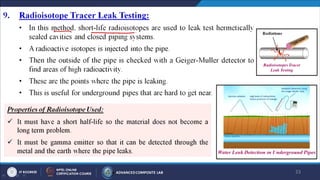
Leak testing
Thermographic ndt
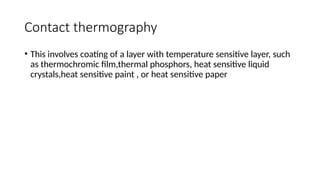
Contact thermography
• This involves coating of a layer with temperature sensitive layer, such
as thermochromic film,thermal phosphors, heat sensitive liquid
crystals,heat sensitive paint , or heat sensitive paper
Heat sensitive paints
• The temperature of a body can be measured by using
temperature-sensitive paints, and these may be, in order of
increasing performance:
• phase-change paints whose basic component is a wax: an isotherm is
identified by the line of separation between the solid and liquid
phases. With these paints, it is only possible to identify areas of the
body that are at temperatures below or above the melting
temperature of the wax; the coating can be used only once.
• multi-component paints: each component undergoes a color change
at a specific temperature and hence each isotherm is identified by a
line of separation between two different colors. In the areas between
two isotherms, it can be argued that the temperature is between the
two values. The color change is irreversible, so the coating can be
used only once.
• a reversible color change can be produced with a coating of
liquid crystals. Temperature changes alter the molecular
structure of these crystals causing a change in the
wavelength, and then in the color, of the scattered light
• temperature-sensitive paints (TSP) are fluorescent elements
(phosphorus), analogous to the pressure-sensitive paints, which,
stimulated with an appropriate radiation, emit light whose intensity
decreases with temperature the emitted light is of a wavelength
different from that of the exciting light, for example, a paint excited
with ultraviolet light (280 Ă· 390 nm) emits red light (580 Ă· 630 nm).
This feature makes it possible to filter the incident light and measures
only the emitted light. Paints have been developed to measure
temperatures ranging from ambient up to 1000 °C.
Heat Sensitive Paper
• Heat sensitive papers are also used for temperature detection.
• These papers are bonded onto the surface of the test material.
• They consist of a wax embedded in a paper substrate.
• The wax melts when a particular temperature has been reached.
• They are useful for indicating when a particular temperature has been
reached, but are not useful for imaging of temperature variations.
• Heat Sensitive Paper changes color through a special thermochromic ink.
The ink contains a pigment that responds to temperature change
• Thermochromic ink (also called thermochromatic ink) is a type of dye that
changes color when temperatures increase or decrease
Thermally quenched phosphors liquid crystals
• Thermally quenched phosphors are materials that emit light in the
visible range when exposed to ultraviolet light.
• These materials are useful over the temperature range 20 to 400 °C.
HEAT TRANSFER
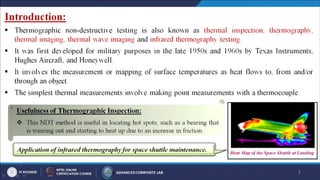
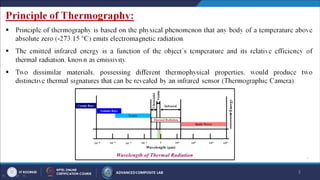
• Thermal inspection consists of all methods which use heat-sensing devices in order to measure
resulting temperatures and thermal gradients.
• This includes measurements of both transient thermal effects and steady state thermal conditions,
either
• of which may be used to detect the presence of flaws, or thermal methods aimed at detecting
unwanted distribution of heat flux from components.
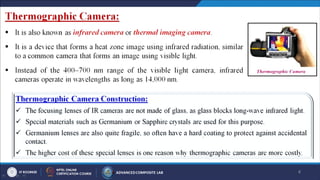
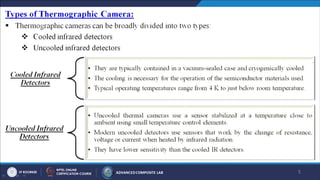
• Thermography is the principal thermal testing technique in use at present.
• This provides a map of temperature variations across the surface of a test material, and can be used
for monitoring temperature in steady state conditions to look for heat leaks, or for monitoring
transients in temperature, which can be indicative of defects such as delaminations in the test
specimen.
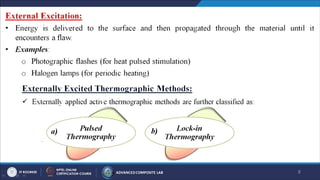
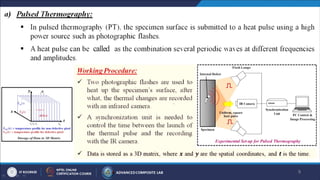
• In the case of thermal transients, the material is heated by subjecting it to a thermal pulse. Any
flaws or inhomogeneities in the material lead to thermal gradients, which are different from those in
the undamaged material.
THERMAL INSPECTION PROCEDURES
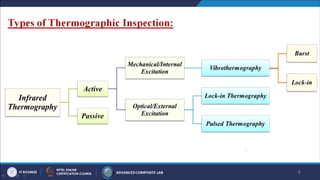
• There are two main classes of thermal inspection techniques:
• thermography, which maps temperature variations over a surface,
and thermometry, which is aimed at actual measurement of
temperature.
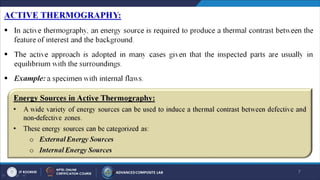
• The normal procedure is to heat the test material, but in some cases
cooling is used.
• The heating process can utilize transients or steady state conditions.
These normally involve (1) thermal pulses and (2) continuous thermal
waves, respectively.
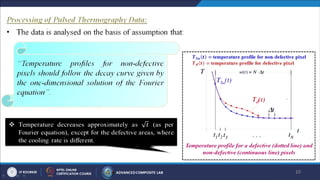
• In the first case, the material is subjected to a short-duration pulse of
heat, and the decay of the transients is used to evaluate defects.
• The transient thermal inspection methods rely on the time dependence
of temperature or temperature gradients.
• The temperatures or temperature gradients are often determined by
correlation with established calibration standards.
• The results are then interpreted to indicate the presence of flaws or
other problem areas in the material.
• Laser pulse heating has been used for thermography of transients in
temperature across a surface for crack detection
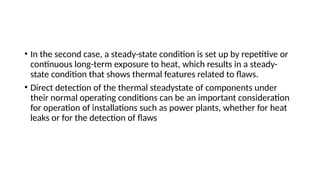
• In the second case, a steady-state condition is set up by repetitive or
continuous long-term exposure to heat, which results in a steady-
state condition that shows thermal features related to flaws.
• Direct detection of the thermal steadystate of components under
their normal operating conditions can be an important consideration
for operation of installations such as power plants, whether for heat
leaks or for the detection of flaws

leak testing,thermal imaging methods-non destructive testing methods

  • 1.
  • 24.
  • 46.
    Contact thermography • Thisinvolves coating of a layer with temperature sensitive layer, such as thermochromic film,thermal phosphors, heat sensitive liquid crystals,heat sensitive paint , or heat sensitive paper
  • 47.
    Heat sensitive paints •The temperature of a body can be measured by using temperature-sensitive paints, and these may be, in order of increasing performance: • phase-change paints whose basic component is a wax: an isotherm is identified by the line of separation between the solid and liquid phases. With these paints, it is only possible to identify areas of the body that are at temperatures below or above the melting temperature of the wax; the coating can be used only once.
  • 48.
    • multi-component paints:each component undergoes a color change at a specific temperature and hence each isotherm is identified by a line of separation between two different colors. In the areas between two isotherms, it can be argued that the temperature is between the two values. The color change is irreversible, so the coating can be used only once. • a reversible color change can be produced with a coating of liquid crystals. Temperature changes alter the molecular structure of these crystals causing a change in the wavelength, and then in the color, of the scattered light
  • 49.
    • temperature-sensitive paints(TSP) are fluorescent elements (phosphorus), analogous to the pressure-sensitive paints, which, stimulated with an appropriate radiation, emit light whose intensity decreases with temperature the emitted light is of a wavelength different from that of the exciting light, for example, a paint excited with ultraviolet light (280 ÷ 390 nm) emits red light (580 ÷ 630 nm). This feature makes it possible to filter the incident light and measures only the emitted light. Paints have been developed to measure temperatures ranging from ambient up to 1000 °C.
  • 50.
    Heat Sensitive Paper •Heat sensitive papers are also used for temperature detection. • These papers are bonded onto the surface of the test material. • They consist of a wax embedded in a paper substrate. • The wax melts when a particular temperature has been reached. • They are useful for indicating when a particular temperature has been reached, but are not useful for imaging of temperature variations. • Heat Sensitive Paper changes color through a special thermochromic ink. The ink contains a pigment that responds to temperature change • Thermochromic ink (also called thermochromatic ink) is a type of dye that changes color when temperatures increase or decrease
  • 51.
    Thermally quenched phosphorsliquid crystals • Thermally quenched phosphors are materials that emit light in the visible range when exposed to ultraviolet light. • These materials are useful over the temperature range 20 to 400 °C.
  • 52.
    HEAT TRANSFER • Thermalinspection consists of all methods which use heat-sensing devices in order to measure resulting temperatures and thermal gradients. • This includes measurements of both transient thermal effects and steady state thermal conditions, either • of which may be used to detect the presence of flaws, or thermal methods aimed at detecting unwanted distribution of heat flux from components. • Thermography is the principal thermal testing technique in use at present. • This provides a map of temperature variations across the surface of a test material, and can be used for monitoring temperature in steady state conditions to look for heat leaks, or for monitoring transients in temperature, which can be indicative of defects such as delaminations in the test specimen. • In the case of thermal transients, the material is heated by subjecting it to a thermal pulse. Any flaws or inhomogeneities in the material lead to thermal gradients, which are different from those in the undamaged material.
  • 53.
    THERMAL INSPECTION PROCEDURES •There are two main classes of thermal inspection techniques: • thermography, which maps temperature variations over a surface, and thermometry, which is aimed at actual measurement of temperature. • The normal procedure is to heat the test material, but in some cases cooling is used. • The heating process can utilize transients or steady state conditions. These normally involve (1) thermal pulses and (2) continuous thermal waves, respectively.
  • 54.
    • In thefirst case, the material is subjected to a short-duration pulse of heat, and the decay of the transients is used to evaluate defects. • The transient thermal inspection methods rely on the time dependence of temperature or temperature gradients. • The temperatures or temperature gradients are often determined by correlation with established calibration standards. • The results are then interpreted to indicate the presence of flaws or other problem areas in the material. • Laser pulse heating has been used for thermography of transients in temperature across a surface for crack detection
  • 55.
    • In thesecond case, a steady-state condition is set up by repetitive or continuous long-term exposure to heat, which results in a steady- state condition that shows thermal features related to flaws. • Direct detection of the thermal steadystate of components under their normal operating conditions can be an important consideration for operation of installations such as power plants, whether for heat leaks or for the detection of flaws