THERMAL IMAGING TECHNOLOGY
P.YUSHMITHA
12D21A1010
EIE – IV YEAR
CONTENTS
 INTRODUCTION
 THERMAL IMAGING
 THERMAL IMAGING CAMERA (TIC)
 WORKING OF THERMAL IMAGING CAMERA
 COMPONENTS OF THERMAL IMAGING CAMERA
 TYPES OF THERMAL IMAGING CAMERA
 THERMAL IMAGING APPLICATIONS
 THERMAL IMAGING IN INDUSTRIAL APPLICATIONS
 THERMAL IMAGING IN MEDICINE
 THERMAL IMAGING IN BORDER SECURITY
 THERMAL IMAGING IN SECURITY AND LAW ENFORCEMENT
 THERMAL IMAGING IN NIGHT VISION
 THERMAL IMAGING IN BUILDING DIAGNOSTICS
 OTHER APPLICATIONS
 ADVANTAGES
 LIMITATIONS
 CONCLUSION
INTRODUCTION
 Thermal imaging is the technique of using the heat given off by an
object to produce an image of it or to locate it
 First developed for military purposes in the late 1950s and 1960s by
Texas Instruments, Hughes Aircraft and Honeywell
 In recent times it is being used in firefighting, law enforcement,
industrial applications, security, transportation, medical and many
other industries
THERMAL IMAGING
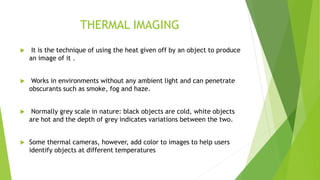
 It is the technique of using the heat given off by an object to produce
an image of it .
 Works in environments without any ambient light and can penetrate
obscurants such as smoke, fog and haze.
 Normally grey scale in nature: black objects are cold, white objects
are hot and the depth of grey indicates variations between the two.
 Some thermal cameras, however, add color to images to help users
identify objects at different temperatures
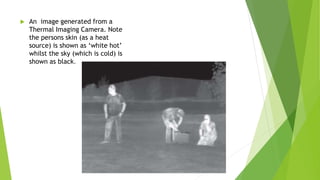
 An image generated from a
Thermal Imaging Camera. Note
the persons skin (as a heat
source) is shown as ‘white hot’
whilst the sky (which is cold) is
shown as black.
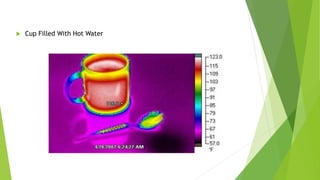
 Cup Filled With Hot Water
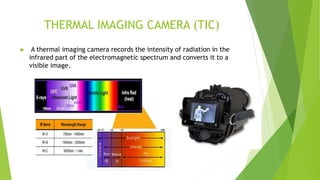
THERMAL IMAGING CAMERA (TIC)
 A thermal imaging camera records the intensity of radiation in the
infrared part of the electromagnetic spectrum and converts it to a
visible image.
WORKING OF THERMAL IMAGING CAMERA
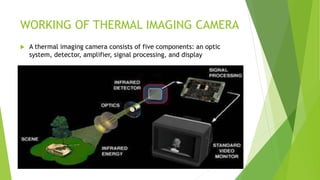
 A thermal imaging camera consists of five components: an optic
system, detector, amplifier, signal processing, and display
IMAGE PROCESSING
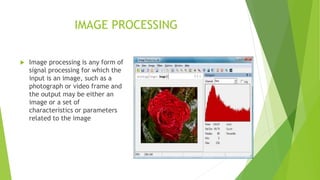
 Image processing is any form of
signal processing for which the
input is an image, such as a
photograph or video frame and
the output may be either an
image or a set of
characteristics or parameters
related to the image
COMPONENTS OF THERMAL IMAGING
CAMERA
 An optic system
 Lens
 Detector
 Cooled Detector
 Uncooled Detector
 Amplifier
 Signal processing
 Display
 Standard Video Monitor
TYPES OF THERMAL IMAGING CAMERAS
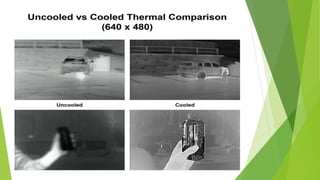
COOLED THERMAL IMAGER
 Cooled detectors are typically
contained in a vacuum-sealed case
and cryogenically cooled
 Cooling is necessary for the
operation of the semiconductor
materials used else they would be
blinded by their own radiation
 Cooled infrared cameras provide
superior image quality
 Bulky and expensive to produce
and run
 Cooling is power-hungry and time-
consuming hence the camera needs
time to cool down before it can
begin working again
UNCOOLED THERMAL IMAGER
 Un-cooled detectors use a sensor
operating at ambient temperature,
or a sensor stabilized at room
temperature using control
elements
 Resolution and image quality tend
to be lower than cooled detectors
 Smaller and less costly to produce
and run
 Fast operation and consumes less
power
THERMAL IMAGING APPLICATIONS
 INDUSTRIAL APPLICATIONS
 MEDICINE APPLICATIONS
 SECURITY APPLICATIONS
 BUILDING CONSTRUCTIONS
 NIGHT VISION
THERMAL IMAGING IN INDUSTRIAL
APPLICATIONS
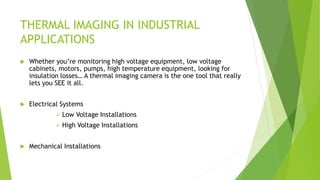
 Whether you’re monitoring high voltage equipment, low voltage
cabinets, motors, pumps, high temperature equipment, looking for
insulation losses… A thermal imaging camera is the one tool that really
lets you SEE it all.
 Electrical Systems
 Low Voltage Installations
 High Voltage Installations
 Mechanical Installations
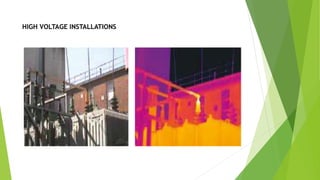
HIGH VOLTAGE INSTALLATIONS
LOW VOLTAGE INSTALLATIONS
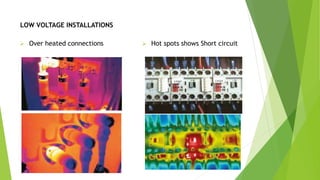
 Over heated connections  Hot spots shows Short circuit
MECHANICAL INSTALLATIONS
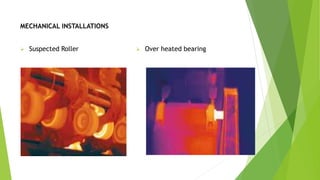
 Suspected Roller  Over heated bearing
THERMAL IMAGING IN MEDICINE
 The technique essentially uses naturally emitted infrared radiation
from the skin surface.
 The credibility and acceptance of thermal imaging in medicine is
subject to critical use of the technology and proper understanding of
thermal physiology.
 Finally, we review established and evolving medical applications for
thermal imaging, including inflammatory diseases
 Currently, there is interest in the use of thermal imaging for fever
screening
INFLAMMATORY ARTHRITIS
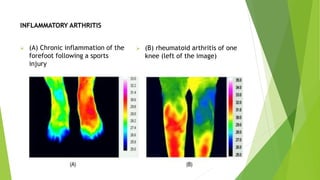
 (A) Chronic inflammation of the
forefoot following a sports
injury
 (B) rheumatoid arthritis of one
knee (left of the image)
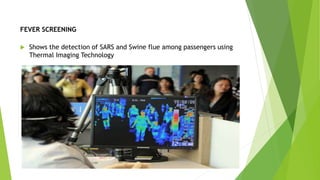
FEVER SCREENING
 Shows the detection of SARS and Swine flue among passengers using
Thermal Imaging Technology
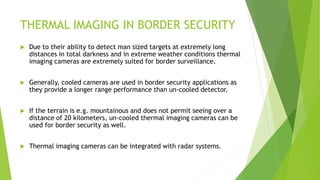
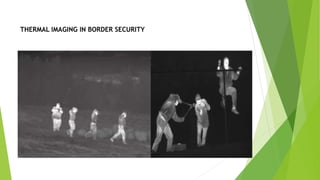
THERMAL IMAGING IN BORDER SECURITY
 Due to their ability to detect man sized targets at extremely long
distances in total darkness and in extreme weather conditions thermal
imaging cameras are extremely suited for border surveillance.
 Generally, cooled cameras are used in border security applications as
they provide a longer range performance than un-cooled detector.
 If the terrain is e.g. mountainous and does not permit seeing over a
distance of 20 kilometers, un-cooled thermal imaging cameras can be
used for border security as well.
 Thermal imaging cameras can be integrated with radar systems.
THERMAL IMAGING IN BORDER SECURITY
THERMAL IMAGING IN SECURITY AND LAW
ENFORCEMENT
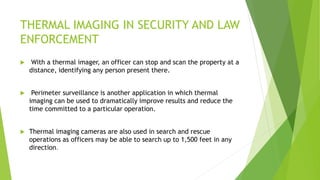
 With a thermal imager, an officer can stop and scan the property at a
distance, identifying any person present there.
 Perimeter surveillance is another application in which thermal
imaging can be used to dramatically improve results and reduce the
time committed to a particular operation.
 Thermal imaging cameras are also used in search and rescue
operations as officers may be able to search up to 1,500 feet in any
direction.
THERMAL IMAGING IN SECURITY AND LAW ENFORCEMENT
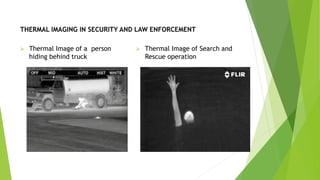
 Thermal Image of a person
hiding behind truck
 Thermal Image of Search and
Rescue operation
THERMAL IMAGING IN NIGHT VISION
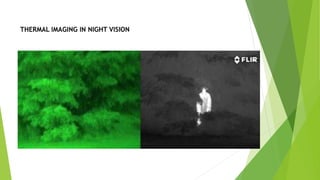
 Thermal imaging cameras are excellent tools for night vision.
 They detect thermal radiation and do not need a source of
illumination.
 They produce an image in the darkest of nights and can see through
light fog, rain and smoke.
 Thermal imaging cameras are widely used to complement new or
existing security networks, and for night vision on aircraft, where they
are commonly referred to as "FLIR" (for "forward-looking infrared".)
THERMAL IMAGING IN NIGHT VISION
THERMAL IMAGING IN BUILDING
DIAGNOSTICS
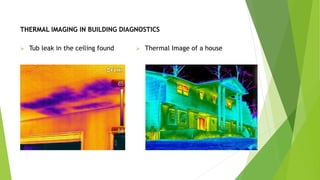
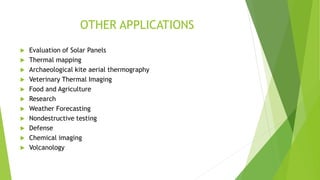
 Thermal cameras show exactly where the problems are quickly and help
detecting energy waste, moisture and electrical issues in buildings.
 Thermal imaging is used for maintenance of electrical, mechanical, and
structural systems, to detect problems, prevent downtime, guide corrective
action, and increase work safety.
 Using thermal imagers it's easy to scan an entire building to detect building
envelope, and plumbing issues, presence of moisture in building envelopes,
either from leakage or condensation and water damage.
THERMAL IMAGING IN BUILDING DIAGNOSTICS
 Tub leak in the ceiling found  Thermal Image of a house
OTHER APPLICATIONS
 Evaluation of Solar Panels
 Thermal mapping
 Archaeological kite aerial thermography
 Veterinary Thermal Imaging
 Food and Agriculture
 Research
 Weather Forecasting
 Nondestructive testing
 Defense
 Chemical imaging
 Volcanology
ADVANTAGES
 Non-invasive and non-destructive hence can be used to survey whilst the
plant and equipment is running, in production and on load
 Produces fast, accurate and immediate temperature measurement and
helps in fault detection
 Cameras are easy to install and surveys can be performed at a convenient
time.
 Is capable of catching moving targets in real time and in low light
conditions
 Can be used to measure or observe subjects in areas inaccessible or
hazardous for other methods
 Can help in identifying air leakages, documenting irregular heat
dispersion and identifying possible irregularities in insulation
 Cameras can passively see all objects, regardless of ambient light.
LIMITATIONS
 Quality cameras are expensive (often US$ 3,000 or more), cheaper are
only 40x40 up to 120x120 pixels.
 Images can be difficult to interpret accurately when based upon
certain objects, specifically objects with erratic temperatures.
 Accurate temperature measurements are hindered by differing
emissivities and reflections from other surfaces.
 Most cameras have ±2% accuracy or worse in measurement of
temperature and are not as accurate as contact methods.
 Only able to directly detect surface temperatures.
 Thermal imaging cameras cannot be used to see objects under water
 Because thermal energy can be reflected off shiny surfaces, thermal
imaging cameras cannot see through glass.
 Also thermal imaging cameras cannot see through walls.
CONCLUSION
 It deals with helping individuals see what the naked eye cannot.
However, helping you see even when there is no light is only a fraction
of what thermal imaging is used for. With the use of special cameras
and lenses, this technology offers benefits ranging from industrial
advantages, down to law enforcement.
REFERENCES
 Thermal Imaging Systems - J.M. Lloyd
 Rogalski A. and Chrzanowski K. 2002, “Infrared Devices and
Techniques”, Contributed Paper: Opto-electronics Review
 Darling, Charles R.; "Pyrometry. A Practical Treatise on the
Measurement of High Temperatures." Published by E.&F.N. Spon Ltd.
London. 1911
 Kruse, Paul W., and David Dale Skatrud. Uncooled Infrared Imaging
Arrays and Systems. San Diego: Academic, 1997. Print
 www.flir.com
 Ieeexplorer.ieee.org
 environment.nationalgeographic.com
THANK YOU
QUERIES

Thermal Imaging Technology

  • 1.
  • 2.
    CONTENTS  INTRODUCTION  THERMALIMAGING  THERMAL IMAGING CAMERA (TIC)  WORKING OF THERMAL IMAGING CAMERA  COMPONENTS OF THERMAL IMAGING CAMERA  TYPES OF THERMAL IMAGING CAMERA  THERMAL IMAGING APPLICATIONS  THERMAL IMAGING IN INDUSTRIAL APPLICATIONS  THERMAL IMAGING IN MEDICINE  THERMAL IMAGING IN BORDER SECURITY  THERMAL IMAGING IN SECURITY AND LAW ENFORCEMENT  THERMAL IMAGING IN NIGHT VISION  THERMAL IMAGING IN BUILDING DIAGNOSTICS  OTHER APPLICATIONS  ADVANTAGES  LIMITATIONS  CONCLUSION
  • 3.
    INTRODUCTION  Thermal imagingis the technique of using the heat given off by an object to produce an image of it or to locate it  First developed for military purposes in the late 1950s and 1960s by Texas Instruments, Hughes Aircraft and Honeywell  In recent times it is being used in firefighting, law enforcement, industrial applications, security, transportation, medical and many other industries
  • 4.
    THERMAL IMAGING  Itis the technique of using the heat given off by an object to produce an image of it .  Works in environments without any ambient light and can penetrate obscurants such as smoke, fog and haze.  Normally grey scale in nature: black objects are cold, white objects are hot and the depth of grey indicates variations between the two.  Some thermal cameras, however, add color to images to help users identify objects at different temperatures
  • 5.
     An imagegenerated from a Thermal Imaging Camera. Note the persons skin (as a heat source) is shown as ‘white hot’ whilst the sky (which is cold) is shown as black.
  • 6.
     Cup FilledWith Hot Water
  • 7.
    THERMAL IMAGING CAMERA(TIC)  A thermal imaging camera records the intensity of radiation in the infrared part of the electromagnetic spectrum and converts it to a visible image.
  • 8.
    WORKING OF THERMALIMAGING CAMERA  A thermal imaging camera consists of five components: an optic system, detector, amplifier, signal processing, and display
  • 9.
    IMAGE PROCESSING  Imageprocessing is any form of signal processing for which the input is an image, such as a photograph or video frame and the output may be either an image or a set of characteristics or parameters related to the image
  • 10.
    COMPONENTS OF THERMALIMAGING CAMERA  An optic system  Lens  Detector  Cooled Detector  Uncooled Detector  Amplifier  Signal processing  Display  Standard Video Monitor
  • 11.
    TYPES OF THERMALIMAGING CAMERAS COOLED THERMAL IMAGER  Cooled detectors are typically contained in a vacuum-sealed case and cryogenically cooled  Cooling is necessary for the operation of the semiconductor materials used else they would be blinded by their own radiation  Cooled infrared cameras provide superior image quality  Bulky and expensive to produce and run  Cooling is power-hungry and time- consuming hence the camera needs time to cool down before it can begin working again UNCOOLED THERMAL IMAGER  Un-cooled detectors use a sensor operating at ambient temperature, or a sensor stabilized at room temperature using control elements  Resolution and image quality tend to be lower than cooled detectors  Smaller and less costly to produce and run  Fast operation and consumes less power
  • 13.
    THERMAL IMAGING APPLICATIONS INDUSTRIAL APPLICATIONS  MEDICINE APPLICATIONS  SECURITY APPLICATIONS  BUILDING CONSTRUCTIONS  NIGHT VISION
  • 14.
    THERMAL IMAGING ININDUSTRIAL APPLICATIONS  Whether you’re monitoring high voltage equipment, low voltage cabinets, motors, pumps, high temperature equipment, looking for insulation losses… A thermal imaging camera is the one tool that really lets you SEE it all.  Electrical Systems  Low Voltage Installations  High Voltage Installations  Mechanical Installations
  • 15.
  • 16.
    LOW VOLTAGE INSTALLATIONS Over heated connections  Hot spots shows Short circuit
  • 17.
    MECHANICAL INSTALLATIONS  SuspectedRoller  Over heated bearing
  • 18.
    THERMAL IMAGING INMEDICINE  The technique essentially uses naturally emitted infrared radiation from the skin surface.  The credibility and acceptance of thermal imaging in medicine is subject to critical use of the technology and proper understanding of thermal physiology.  Finally, we review established and evolving medical applications for thermal imaging, including inflammatory diseases  Currently, there is interest in the use of thermal imaging for fever screening
  • 19.
    INFLAMMATORY ARTHRITIS  (A)Chronic inflammation of the forefoot following a sports injury  (B) rheumatoid arthritis of one knee (left of the image)
  • 20.
    FEVER SCREENING  Showsthe detection of SARS and Swine flue among passengers using Thermal Imaging Technology
  • 21.
    THERMAL IMAGING INBORDER SECURITY  Due to their ability to detect man sized targets at extremely long distances in total darkness and in extreme weather conditions thermal imaging cameras are extremely suited for border surveillance.  Generally, cooled cameras are used in border security applications as they provide a longer range performance than un-cooled detector.  If the terrain is e.g. mountainous and does not permit seeing over a distance of 20 kilometers, un-cooled thermal imaging cameras can be used for border security as well.  Thermal imaging cameras can be integrated with radar systems.
  • 22.
    THERMAL IMAGING INBORDER SECURITY
  • 23.
    THERMAL IMAGING INSECURITY AND LAW ENFORCEMENT  With a thermal imager, an officer can stop and scan the property at a distance, identifying any person present there.  Perimeter surveillance is another application in which thermal imaging can be used to dramatically improve results and reduce the time committed to a particular operation.  Thermal imaging cameras are also used in search and rescue operations as officers may be able to search up to 1,500 feet in any direction.
  • 24.
    THERMAL IMAGING INSECURITY AND LAW ENFORCEMENT  Thermal Image of a person hiding behind truck  Thermal Image of Search and Rescue operation
  • 25.
    THERMAL IMAGING INNIGHT VISION  Thermal imaging cameras are excellent tools for night vision.  They detect thermal radiation and do not need a source of illumination.  They produce an image in the darkest of nights and can see through light fog, rain and smoke.  Thermal imaging cameras are widely used to complement new or existing security networks, and for night vision on aircraft, where they are commonly referred to as "FLIR" (for "forward-looking infrared".)
  • 26.
    THERMAL IMAGING INNIGHT VISION
  • 27.
    THERMAL IMAGING INBUILDING DIAGNOSTICS  Thermal cameras show exactly where the problems are quickly and help detecting energy waste, moisture and electrical issues in buildings.  Thermal imaging is used for maintenance of electrical, mechanical, and structural systems, to detect problems, prevent downtime, guide corrective action, and increase work safety.  Using thermal imagers it's easy to scan an entire building to detect building envelope, and plumbing issues, presence of moisture in building envelopes, either from leakage or condensation and water damage.
  • 28.
    THERMAL IMAGING INBUILDING DIAGNOSTICS  Tub leak in the ceiling found  Thermal Image of a house
  • 29.
    OTHER APPLICATIONS  Evaluationof Solar Panels  Thermal mapping  Archaeological kite aerial thermography  Veterinary Thermal Imaging  Food and Agriculture  Research  Weather Forecasting  Nondestructive testing  Defense  Chemical imaging  Volcanology
  • 30.
    ADVANTAGES  Non-invasive andnon-destructive hence can be used to survey whilst the plant and equipment is running, in production and on load  Produces fast, accurate and immediate temperature measurement and helps in fault detection  Cameras are easy to install and surveys can be performed at a convenient time.  Is capable of catching moving targets in real time and in low light conditions  Can be used to measure or observe subjects in areas inaccessible or hazardous for other methods  Can help in identifying air leakages, documenting irregular heat dispersion and identifying possible irregularities in insulation  Cameras can passively see all objects, regardless of ambient light.
  • 31.
    LIMITATIONS  Quality camerasare expensive (often US$ 3,000 or more), cheaper are only 40x40 up to 120x120 pixels.  Images can be difficult to interpret accurately when based upon certain objects, specifically objects with erratic temperatures.  Accurate temperature measurements are hindered by differing emissivities and reflections from other surfaces.  Most cameras have ±2% accuracy or worse in measurement of temperature and are not as accurate as contact methods.  Only able to directly detect surface temperatures.  Thermal imaging cameras cannot be used to see objects under water  Because thermal energy can be reflected off shiny surfaces, thermal imaging cameras cannot see through glass.  Also thermal imaging cameras cannot see through walls.
  • 32.
    CONCLUSION  It dealswith helping individuals see what the naked eye cannot. However, helping you see even when there is no light is only a fraction of what thermal imaging is used for. With the use of special cameras and lenses, this technology offers benefits ranging from industrial advantages, down to law enforcement.
  • 33.
    REFERENCES  Thermal ImagingSystems - J.M. Lloyd  Rogalski A. and Chrzanowski K. 2002, “Infrared Devices and Techniques”, Contributed Paper: Opto-electronics Review  Darling, Charles R.; "Pyrometry. A Practical Treatise on the Measurement of High Temperatures." Published by E.&F.N. Spon Ltd. London. 1911  Kruse, Paul W., and David Dale Skatrud. Uncooled Infrared Imaging Arrays and Systems. San Diego: Academic, 1997. Print  www.flir.com  Ieeexplorer.ieee.org  environment.nationalgeographic.com
  • 34.