
BALANCING
 Balancing is the technique of correcting or eliminating unwanted
inertia forces and moments in rotating or reciprocating masses.
Balancing:
 If the moving part of a machine are not balanced completely
then the inertia forces are set up which may cause excessive
noise, vibration, wear and tear of the system. So balancing of
machine is necessary.
 If dynamic forces are not balanced, they will cause worse effects
such as wear and tear on bearings and excessive vibrations on
machines. It is very common in cam shafts, steam turbine rotors,
engine crank shafts and centrifugal pumps etc.
 Different types of balancing:
 A) Balancing of rotating masses
 B) Balancing of reciprocating masses.
 The process of providing the second mass in order to
counteract the effect of the centrifugal force of the
first mass is called balancing of rotating masses.

 Various cases of balancing of rotating masses:
 * Balancing of a single rotating mass by single mass
rotating in the same plane.
 * Balancing of a single rotating mass by two masses
rotating in the different plane.
 * Balancing of a several masses rotating in single
plane.
 * Balancing of a several masses rotating in different
planes.
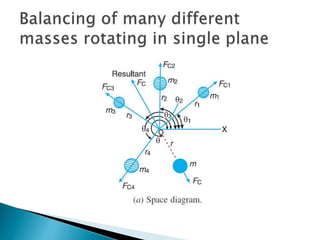
 Consider any number of masses (say four) of magnitude m1, m2,
m3, m4 at distances of r1,r2,r3 and r4 from the axis of the
rotating shaft. Let θ1, θ2, θ3 and θ4, be the angles of these
masses with the horizontal line OX.
 Let these masses rotate about an axis through O and
perpendicular to the plane of paper, with a constant angular
velocity of ω rad/s.

 The magnitude and position of the balancing mass may be found
out analytically or graphically
 1. draw the space diagram
 2. Find out the centrifugal force exerted by each mass on the
rotating shaft.
 3.Draw force polygon
 4. The balancing force is, then, equal to the resultant force, but
in opposite direction
 The multi-cylinder engines with the cylinder centre lines in
the same plane and on the same side of the centre line of
the crankshaft, are known as In-line engines.
 The following two conditions must be satisfied in order to
give the primary balance of the reciprocating parts of a
multi-cylinder
 engine :
 1. The algebraic sum of the primary forces must be equal
to zero. In other words, the primary force polygon must
close

 2. The algebraic sum of the couples about any point in the
plane of the primary forces must be equal to zero. In other
words, the primary couple polygon must close.
 When the connecting rod is not too long then the secondary
disturbing force due to the reciprocating mass arises

 The following two conditions must be satisfied in order to give a
complete secondary balance of an engine :
 1. The algebraic sum of the secondary forces must be equal to
zero. In other words, the secondary force polygon must close,
and

 2. The algebraic sum of the couples about any point in the plane
of the secondary forces must be equal to zero. In other words,
the secondary couple polygon must close.

 The closing side of the secondary force polygon gives the
maximum unbalanced secondary force and the closing side of
the secondary couple polygon gives the maximum unbalanced
secondary couple
 The firing order is the sequence of power
delivery of each cylinder in a multi-cylinder
reciprocating engine.

 *This is achieved by sparking of the spark plugs
in a gasoline engine in the correct order, or by
the sequence of fuel injection in a Diesel engine.

 * When designing an engine, choosing an
appropriate firing order is critical to minimizing
vibration, to improve engine balance and
achieving smooth running, for long engine
fatigue life and user comfort.
 Tractive force:
 The resultant unbalanced force due to the two cylinders along the line of stroke,
is known as tractive force.

 Swaying couple:
 The unbalanced force acting at a distance between the line of stroke of two
cylinders, constitute a couple in the horizontal direction. The couple is known as
swaying couple.

 Hammer blow:
 The maximum magnitude of the unbalanced force along the perpendicular to the
line of stroke is known as hammer blow.

 Effects of hammer blow and swaying couple:
 • The effect of hammer blow is to cause the variation in pressure between the
wheel and the rail, such that vehicle vibrates vigorously.

 • The effect of swaying couple is to make the leading wheels sway from side to
side.
Dynamics of machines-2

Dynamics of machines-2

  • 1.
  • 2.
     Balancing isthe technique of correcting or eliminating unwanted inertia forces and moments in rotating or reciprocating masses. Balancing:  If the moving part of a machine are not balanced completely then the inertia forces are set up which may cause excessive noise, vibration, wear and tear of the system. So balancing of machine is necessary.  If dynamic forces are not balanced, they will cause worse effects such as wear and tear on bearings and excessive vibrations on machines. It is very common in cam shafts, steam turbine rotors, engine crank shafts and centrifugal pumps etc.  Different types of balancing:  A) Balancing of rotating masses  B) Balancing of reciprocating masses.
  • 3.
     The processof providing the second mass in order to counteract the effect of the centrifugal force of the first mass is called balancing of rotating masses.   Various cases of balancing of rotating masses:  * Balancing of a single rotating mass by single mass rotating in the same plane.  * Balancing of a single rotating mass by two masses rotating in the different plane.  * Balancing of a several masses rotating in single plane.  * Balancing of a several masses rotating in different planes.
  • 5.
     Consider anynumber of masses (say four) of magnitude m1, m2, m3, m4 at distances of r1,r2,r3 and r4 from the axis of the rotating shaft. Let θ1, θ2, θ3 and θ4, be the angles of these masses with the horizontal line OX.  Let these masses rotate about an axis through O and perpendicular to the plane of paper, with a constant angular velocity of ω rad/s.   The magnitude and position of the balancing mass may be found out analytically or graphically  1. draw the space diagram  2. Find out the centrifugal force exerted by each mass on the rotating shaft.  3.Draw force polygon  4. The balancing force is, then, equal to the resultant force, but in opposite direction
  • 6.
     The multi-cylinderengines with the cylinder centre lines in the same plane and on the same side of the centre line of the crankshaft, are known as In-line engines.  The following two conditions must be satisfied in order to give the primary balance of the reciprocating parts of a multi-cylinder  engine :  1. The algebraic sum of the primary forces must be equal to zero. In other words, the primary force polygon must close   2. The algebraic sum of the couples about any point in the plane of the primary forces must be equal to zero. In other words, the primary couple polygon must close.
  • 7.
     When theconnecting rod is not too long then the secondary disturbing force due to the reciprocating mass arises   The following two conditions must be satisfied in order to give a complete secondary balance of an engine :  1. The algebraic sum of the secondary forces must be equal to zero. In other words, the secondary force polygon must close, and   2. The algebraic sum of the couples about any point in the plane of the secondary forces must be equal to zero. In other words, the secondary couple polygon must close.   The closing side of the secondary force polygon gives the maximum unbalanced secondary force and the closing side of the secondary couple polygon gives the maximum unbalanced secondary couple
  • 8.
     The firingorder is the sequence of power delivery of each cylinder in a multi-cylinder reciprocating engine.   *This is achieved by sparking of the spark plugs in a gasoline engine in the correct order, or by the sequence of fuel injection in a Diesel engine.   * When designing an engine, choosing an appropriate firing order is critical to minimizing vibration, to improve engine balance and achieving smooth running, for long engine fatigue life and user comfort.
  • 9.
     Tractive force: The resultant unbalanced force due to the two cylinders along the line of stroke, is known as tractive force.   Swaying couple:  The unbalanced force acting at a distance between the line of stroke of two cylinders, constitute a couple in the horizontal direction. The couple is known as swaying couple.   Hammer blow:  The maximum magnitude of the unbalanced force along the perpendicular to the line of stroke is known as hammer blow.   Effects of hammer blow and swaying couple:  • The effect of hammer blow is to cause the variation in pressure between the wheel and the rail, such that vehicle vibrates vigorously.   • The effect of swaying couple is to make the leading wheels sway from side to side.