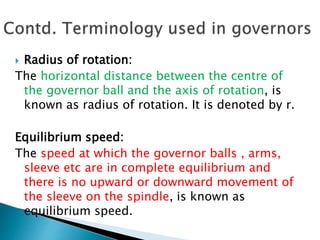
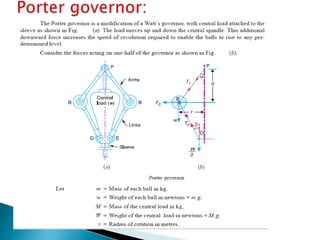
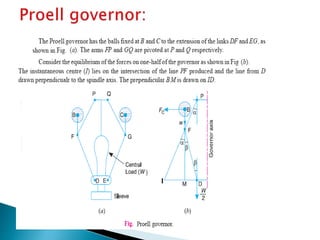
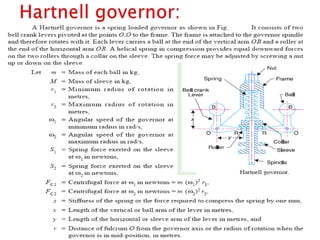
GOVERNORS &
GYROSCOPES
Governors
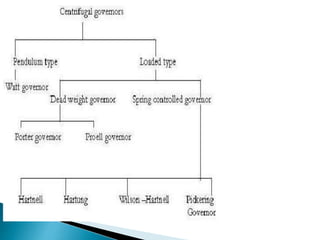
 Types - Centrifugal governors - Gravity
controlled and spring controlled centrifugal
governors –
 Characteristics - Effect of friction -
Controlling force curves.
Gyroscopes
 Gyroscopes –Gyroscopic forces and torques –
Gyroscopic stabilization – Gyroscopic effects
in Automobiles, ships and airplanes.
 Governor is an automatic speed control
mechanism.
 The function of a governor is to maintain the
speed of an engine within specified limits
whenever there is a variation of load.
 Governor keeps the speed of the engine
within certain limits by regulating the fuel
supply as per load requirements.
 If the load on the engine increases, its speed
decreases. So it becomes necessary to
increase the fuel supply by opening the
throttle valve.
 On the other hand, when the load on the
engine decreases, its speed increases and the
fuel supply is to be decreases by closing the
throttle valve , which is operated by a
governor through a mechanism.
 In petrol engines, governor manipulates the
throttle valve and in diesel engines, it
manipulates the fuel pump.
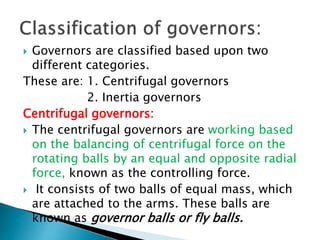
 Governors are classified based upon two
different categories.
These are: 1. Centrifugal governors
2. Inertia governors
Centrifugal governors:
 The centrifugal governors are working based
on the balancing of centrifugal force on the
rotating balls by an equal and opposite radial
force, known as the controlling force.
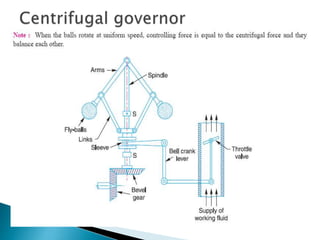
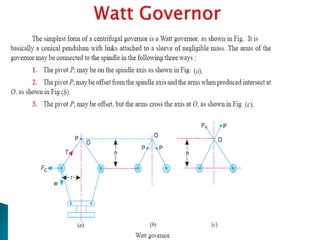
 It consists of two balls of equal mass, which
are attached to the arms. These balls are
known as governor balls or fly balls.
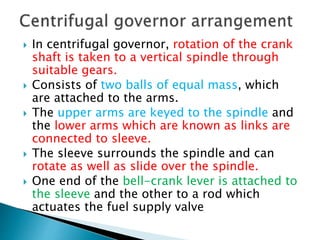
 In centrifugal governor, rotation of the crank
shaft is taken to a vertical spindle through
suitable gears.
 Consists of two balls of equal mass, which
are attached to the arms.
 The upper arms are keyed to the spindle and
the lower arms which are known as links are
connected to sleeve.
 The sleeve surrounds the spindle and can
rotate as well as slide over the spindle.
 One end of the bell-crank lever is attached to
the sleeve and the other to a rod which
actuates the fuel supply valve
 Working based on the balancing of centrifugal
force on the rotating balls by an equal and
opposite radial force.
 When the load on the engine decreases, the
engine and the governor speed increases. This
increases the centrifugal force acting on the balls
and the balls move radially outwards.
 Therefore the sleeve rises upwards, this upward
movement of the sleeve reduces the supply of
fuel and hence the speed is decreased.
 Thus the engine speed falls and comes near
about the mean speed.
 Similarly, when load increases, the speed of
the engine and governor decreases.
 This results decrease of centrifugal force on
the balls.
 Hence the balls move inwards and the sleeve
moves downwards.
 The downward movement of the sleeve
increases the supply of the fuel and hence the
speed is increased.
 Thus the engine speed rises and comes near
about mean speed.
Height of governor :
 It is the vertical distance between the centre of the
governor balls and the point of intersection between
the upper arms on the axis of spindle is known as
governor height. It is generally denoted by h.
 Sleeve lift :
The vertical distance the sleeve travels due to
change in the equilibrium Speed is called
the sleeve lift. The vertical downward travel
may be termed as Negative lift
 Radius of rotation:
The horizontal distance between the centre of
the governor ball and the axis of rotation, is
known as radius of rotation. It is denoted by r.
Equilibrium speed:
The speed at which the governor balls , arms,
sleeve etc are in complete equilibrium and
there is no upward or downward movement of
the sleeve on the spindle, is known as
equilibrium speed.
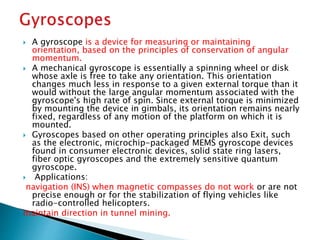
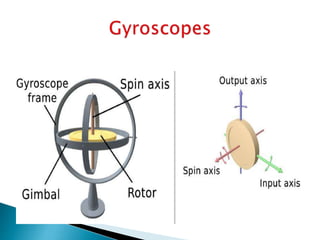
 A gyroscope is a device for measuring or maintaining
orientation, based on the principles of conservation of angular
momentum.
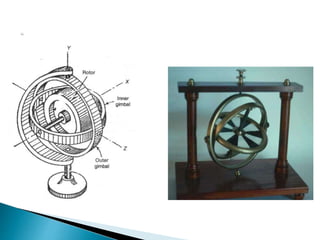
 A mechanical gyroscope is essentially a spinning wheel or disk
whose axle is free to take any orientation. This orientation
changes much less in response to a given external torque than it
would without the large angular momentum associated with the
gyroscope's high rate of spin. Since external torque is minimized
by mounting the device in gimbals, its orientation remains nearly
fixed, regardless of any motion of the platform on which it is
mounted.
 Gyroscopes based on other operating principles also Exit, such
as the electronic, microchip-packaged MEMS gyroscope devices
found in consumer electronic devices, solid state ring lasers,
fiber optic gyroscopes and the extremely sensitive quantum
gyroscope.
 Applications:
navigation (INS) when magnetic compasses do not work or are not
precise enough or for the stabilization of flying vehicles like
radio-controlled helicopters.
maintain direction in tunnel mining.
 Whenever a rotating body changes its axis of
rotation, a couple is applied on the rotating
body(shaft). This couple is known as
gyroscopic couple.
 Gyroscopic couple makes a change in
direction of angular velocity, but the
magnitude of angular velocity remains
constant.
 Gyroscope is used for stabilization and
directional control of a ship sailing in the
rough sea.
A ship, while navigating in the rough sea, may
experience the following three different types
of motion:
 (i) Steering—The turning of ship in a curve
while moving forward
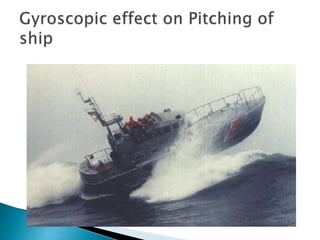
 (ii) Pitching—The movement of the ship up
and down from horizontal position in a
vertical plane about transverse axis
 (iii)Rolling—Sideway motion of the ship about
longitudinal axis.
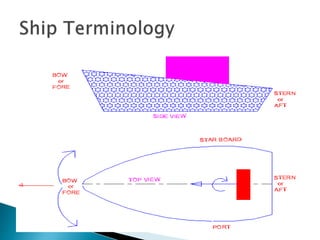
 (i) Bow – It is the fore end of ship
 (ii) Stern – It is the rear end of ship
 (iii) Starboard – It is the right hand side of the
ship looking in the direction of motion
 (iv) Port – It is the left hand side of the ship
looking in the direction of motion
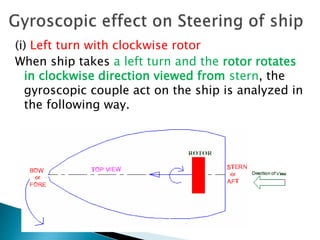
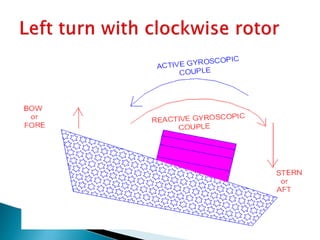
(i) Left turn with clockwise rotor
When ship takes a left turn and the rotor rotates
in clockwise direction viewed from stern, the
gyroscopic couple act on the ship is analyzed in
the following way.
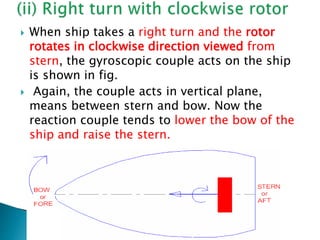
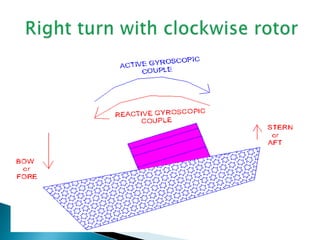
 When ship takes a right turn and the rotor
rotates in clockwise direction viewed from
stern, the gyroscopic couple acts on the ship
is shown in fig.
 Again, the couple acts in vertical plane,
means between stern and bow. Now the
reaction couple tends to lower the bow of the
ship and raise the stern.
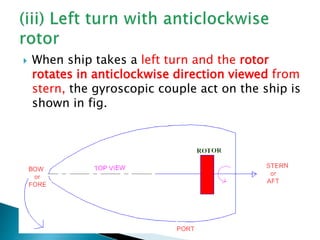
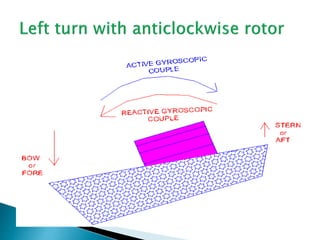
 When ship takes a left turn and the rotor
rotates in anticlockwise direction viewed from
stern, the gyroscopic couple act on the ship is
shown in fig.
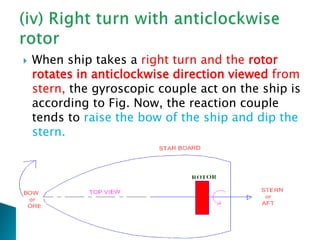
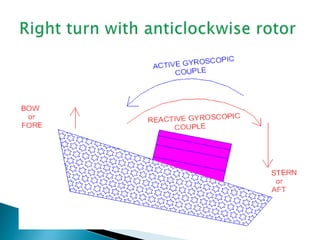
 When ship takes a right turn and the rotor
rotates in anticlockwise direction viewed from
stern, the gyroscopic couple act on the ship is
according to Fig. Now, the reaction couple
tends to raise the bow of the ship and dip the
stern.
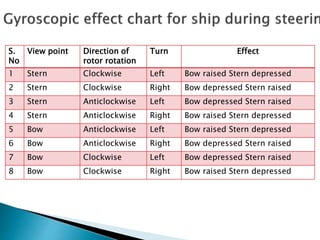
S.
No
View point Direction of
rotor rotation
Turn Effect
1 Stern Clockwise Left Bow raised Stern depressed
2 Stern Clockwise Right Bow depressed Stern raised
3 Stern Anticlockwise Left Bow depressed Stern raised
4 Stern Anticlockwise Right Bow raised Stern depressed
5 Bow Anticlockwise Left Bow raised Stern depressed
6 Bow Anticlockwise Right Bow depressed Stern raised
7 Bow Clockwise Left Bow depressed Stern raised
8 Bow Clockwise Right Bow raised Stern depressed
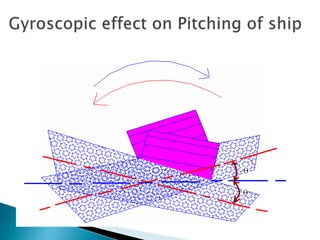
 The pitching motion of a ship generally occurs
due to waves which can be approximated as
sine wave. During pitching, the ship moves up
and down from the horizontal position in
vertical plane about transverse axis.
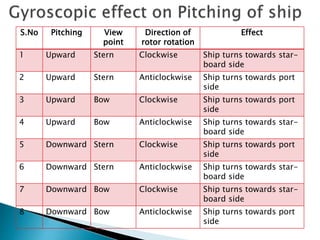
S.No Pitching View
point
Direction of
rotor rotation
Effect
1 Upward Stern Clockwise Ship turns towards star-
board side
2 Upward Stern Anticlockwise Ship turns towards port
side
3 Upward Bow Clockwise Ship turns towards port
side
4 Upward Bow Anticlockwise Ship turns towards star-
board side
5 Downward Stern Clockwise Ship turns towards port
side
6 Downward Stern Anticlockwise Ship turns towards star-
board side
7 Downward Bow Clockwise Ship turns towards star-
board side
8 Downward Bow Anticlockwise Ship turns towards port
side
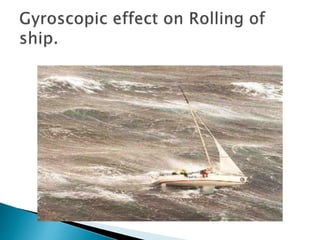
 The axis of the rotor of a ship is mounted
along the longitudinal axis of ship and
therefore, there is no precession of this axis.
Thus, no effect of gyroscopic couple on the
ship frame is formed when the ship rolls.
Dynamics of machines-5

Dynamics of machines-5

  • 1.
  • 2.
    Governors  Types -Centrifugal governors - Gravity controlled and spring controlled centrifugal governors –  Characteristics - Effect of friction - Controlling force curves. Gyroscopes  Gyroscopes –Gyroscopic forces and torques – Gyroscopic stabilization – Gyroscopic effects in Automobiles, ships and airplanes.
  • 3.
     Governor isan automatic speed control mechanism.  The function of a governor is to maintain the speed of an engine within specified limits whenever there is a variation of load.  Governor keeps the speed of the engine within certain limits by regulating the fuel supply as per load requirements.
  • 4.
     If theload on the engine increases, its speed decreases. So it becomes necessary to increase the fuel supply by opening the throttle valve.  On the other hand, when the load on the engine decreases, its speed increases and the fuel supply is to be decreases by closing the throttle valve , which is operated by a governor through a mechanism.  In petrol engines, governor manipulates the throttle valve and in diesel engines, it manipulates the fuel pump.
  • 5.
     Governors areclassified based upon two different categories. These are: 1. Centrifugal governors 2. Inertia governors Centrifugal governors:  The centrifugal governors are working based on the balancing of centrifugal force on the rotating balls by an equal and opposite radial force, known as the controlling force.  It consists of two balls of equal mass, which are attached to the arms. These balls are known as governor balls or fly balls.
  • 8.
     In centrifugalgovernor, rotation of the crank shaft is taken to a vertical spindle through suitable gears.  Consists of two balls of equal mass, which are attached to the arms.  The upper arms are keyed to the spindle and the lower arms which are known as links are connected to sleeve.  The sleeve surrounds the spindle and can rotate as well as slide over the spindle.  One end of the bell-crank lever is attached to the sleeve and the other to a rod which actuates the fuel supply valve
  • 9.
     Working basedon the balancing of centrifugal force on the rotating balls by an equal and opposite radial force.  When the load on the engine decreases, the engine and the governor speed increases. This increases the centrifugal force acting on the balls and the balls move radially outwards.  Therefore the sleeve rises upwards, this upward movement of the sleeve reduces the supply of fuel and hence the speed is decreased.  Thus the engine speed falls and comes near about the mean speed.
  • 10.
     Similarly, whenload increases, the speed of the engine and governor decreases.  This results decrease of centrifugal force on the balls.  Hence the balls move inwards and the sleeve moves downwards.  The downward movement of the sleeve increases the supply of the fuel and hence the speed is increased.  Thus the engine speed rises and comes near about mean speed.
  • 12.
    Height of governor:  It is the vertical distance between the centre of the governor balls and the point of intersection between the upper arms on the axis of spindle is known as governor height. It is generally denoted by h.  Sleeve lift : The vertical distance the sleeve travels due to change in the equilibrium Speed is called the sleeve lift. The vertical downward travel may be termed as Negative lift
  • 13.
     Radius ofrotation: The horizontal distance between the centre of the governor ball and the axis of rotation, is known as radius of rotation. It is denoted by r. Equilibrium speed: The speed at which the governor balls , arms, sleeve etc are in complete equilibrium and there is no upward or downward movement of the sleeve on the spindle, is known as equilibrium speed.
  • 20.
     A gyroscopeis a device for measuring or maintaining orientation, based on the principles of conservation of angular momentum.  A mechanical gyroscope is essentially a spinning wheel or disk whose axle is free to take any orientation. This orientation changes much less in response to a given external torque than it would without the large angular momentum associated with the gyroscope's high rate of spin. Since external torque is minimized by mounting the device in gimbals, its orientation remains nearly fixed, regardless of any motion of the platform on which it is mounted.  Gyroscopes based on other operating principles also Exit, such as the electronic, microchip-packaged MEMS gyroscope devices found in consumer electronic devices, solid state ring lasers, fiber optic gyroscopes and the extremely sensitive quantum gyroscope.  Applications: navigation (INS) when magnetic compasses do not work or are not precise enough or for the stabilization of flying vehicles like radio-controlled helicopters. maintain direction in tunnel mining.
  • 23.
     Whenever arotating body changes its axis of rotation, a couple is applied on the rotating body(shaft). This couple is known as gyroscopic couple.  Gyroscopic couple makes a change in direction of angular velocity, but the magnitude of angular velocity remains constant.
  • 24.
     Gyroscope isused for stabilization and directional control of a ship sailing in the rough sea. A ship, while navigating in the rough sea, may experience the following three different types of motion:  (i) Steering—The turning of ship in a curve while moving forward  (ii) Pitching—The movement of the ship up and down from horizontal position in a vertical plane about transverse axis  (iii)Rolling—Sideway motion of the ship about longitudinal axis.
  • 25.
     (i) Bow– It is the fore end of ship  (ii) Stern – It is the rear end of ship  (iii) Starboard – It is the right hand side of the ship looking in the direction of motion  (iv) Port – It is the left hand side of the ship looking in the direction of motion
  • 27.
    (i) Left turnwith clockwise rotor When ship takes a left turn and the rotor rotates in clockwise direction viewed from stern, the gyroscopic couple act on the ship is analyzed in the following way.
  • 29.
     When shiptakes a right turn and the rotor rotates in clockwise direction viewed from stern, the gyroscopic couple acts on the ship is shown in fig.  Again, the couple acts in vertical plane, means between stern and bow. Now the reaction couple tends to lower the bow of the ship and raise the stern.
  • 31.
     When shiptakes a left turn and the rotor rotates in anticlockwise direction viewed from stern, the gyroscopic couple act on the ship is shown in fig.
  • 33.
     When shiptakes a right turn and the rotor rotates in anticlockwise direction viewed from stern, the gyroscopic couple act on the ship is according to Fig. Now, the reaction couple tends to raise the bow of the ship and dip the stern.
  • 35.
    S. No View point Directionof rotor rotation Turn Effect 1 Stern Clockwise Left Bow raised Stern depressed 2 Stern Clockwise Right Bow depressed Stern raised 3 Stern Anticlockwise Left Bow depressed Stern raised 4 Stern Anticlockwise Right Bow raised Stern depressed 5 Bow Anticlockwise Left Bow raised Stern depressed 6 Bow Anticlockwise Right Bow depressed Stern raised 7 Bow Clockwise Left Bow depressed Stern raised 8 Bow Clockwise Right Bow raised Stern depressed
  • 36.
     The pitchingmotion of a ship generally occurs due to waves which can be approximated as sine wave. During pitching, the ship moves up and down from the horizontal position in vertical plane about transverse axis.
  • 39.
    S.No Pitching View point Directionof rotor rotation Effect 1 Upward Stern Clockwise Ship turns towards star- board side 2 Upward Stern Anticlockwise Ship turns towards port side 3 Upward Bow Clockwise Ship turns towards port side 4 Upward Bow Anticlockwise Ship turns towards star- board side 5 Downward Stern Clockwise Ship turns towards port side 6 Downward Stern Anticlockwise Ship turns towards star- board side 7 Downward Bow Clockwise Ship turns towards star- board side 8 Downward Bow Anticlockwise Ship turns towards port side
  • 40.
     The axisof the rotor of a ship is mounted along the longitudinal axis of ship and therefore, there is no precession of this axis. Thus, no effect of gyroscopic couple on the ship frame is formed when the ship rolls.