 Provides multitude of approaches to energy saving
 Viewed as crucial technology for technological
advancement and novelties in all branches of
economy
 States the target-oriented mechanical application of
objects and structures in a size in the range of 1 and
100 nm
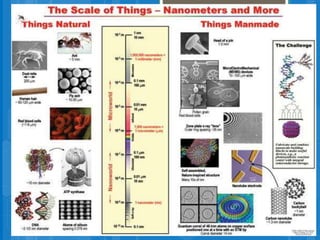
 “Nano” is a Greek word which means “dwarf”
 One nanometre refers to one-billionth of a meter
 One nanometre is about 3 atoms long
 1nm= 10-9
Nanotechnology. SNF. Retrieved 4-12-2014, from http://snf.stanford.edu/Education/Nanotechnology.SNF.web.pdf
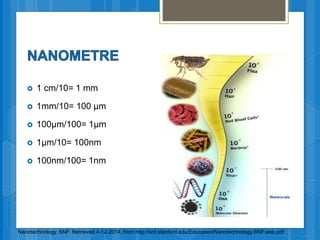
 1 cm/10= 1 mm
 1mm/10= 100 µm
 100µm/100= 1µm
 1µm/10= 100nm
 100nm/100= 1nm
Nanotechnology. SNF. Retrieved 4-12-2014, from http://snf.stanford.edu/Education/Nanotechnology.SNF.web.pdf
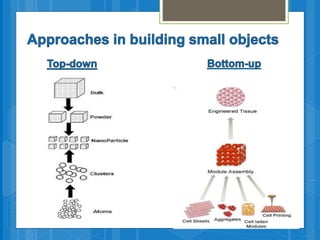
“Building and expending objects, devices, items and
machines at the nanometre scale, making use of
distinctive properties that arise as a result of small
dimensions that occur at that small scale”
Following three things are included in nanotechnology:
 Small size, measured in 100s of manometers or less
 Unique properties because of the small size
 Control of structure & composition on the nm scale
in order to control the properties
Because they are:
 Faster
 Lighter
 Cheaper
 Can get into small spaces
 Energy efficient
 Develop unique properties at small scale
Properties of materials change at nanoscale because of:
 Quantum mechanical effects
 Ratio of surface area-to-volume of structure increases
 Have tiny size, incredible surface area per unit mass, light
weight and are very strong
 Have found applications in field of electronics, coatings,
fuel cells, water filters composites, drugs cancer detection
and treatment etc.
M. Krause. Introduction to nanotechnology. Veritox. Retrieved 4-12-2014, from https://www.aiha.org/aihce07/handouts/rt201krause.pdf
 Batteries store electrical energy
 In rechargeable batteries chemical process is
 reversible
 Batteries are important in many areas
• transport
• portable electronics
• medical devices
• power tools
• Storage of electricity produced by irregular renewable
sources
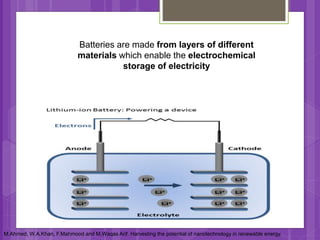
Batteries are made from layers of different
materials which enable the electrochemical
storage of electricity
M.Ahmed, W.A.Khan, F.Mahmood and M.Waqas Arif. Harvesting the potential of nanotechnology in renewable energy.
 Find materials suitable for use as electrodes have high
surface area
 Allows charge to flow more freely
 Resulting in higher capacity and shorter
charge/discharge cycles
 Safety of batteries an important concern
 Replace liquid electrolytes
 Can rupture the cell when overheated
 Nanostructured materials increase surface area for electrolyte materials
 Nanoparticles enhance the conductivity
 reduce the chance of a short circuit
Electrodes
Several types of nanomaterial allow for higher storage
densities of lithium than standard metal or graphite electrodes
 Carbon-coated silicon nanowires
 Carbon nanotubes
 Layered, nanostructured vanadium oxide and manganese
oxide
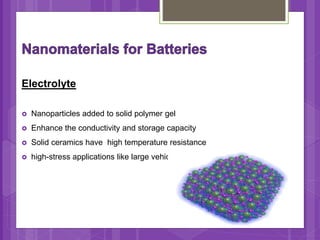
Electrolyte
 Nanoparticles added to solid polymer gel
 Enhance the conductivity and storage capacity
 Solid ceramics have high temperature resistance
 high-stress applications like large vehicles
Coating the electrode’s surface with nanoparticles, nanowires, or other
nanostructures
 Develops anodes with a greater density of locations to which lithium ions
can attach
 Increases the number of stored ions increases the stored electrical power
Changing the atoms to which the lithium bonds
 Changes the electrochemical reaction gives more energy, increasing the
power
Converts a fuel directly into electricity in an electrochemical
reaction
Limitations of fuel cells
 Expensive materials such as platinum are needed for the
electrode catalysts
 Fuels other than hydrogen can cause fouling of the
electrodes
 Hydrogen is costly and difficult to store
 Use platinum nanoparticles instead of solid platinum
surface
 increases efficiency, and allows much less metal to be used
 Support platinum nanoparticles on a porous surface
 further increases the accessibility of the platinum surfaces
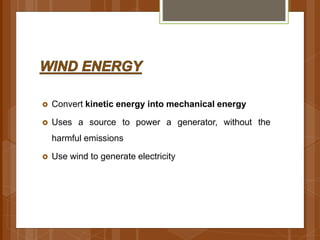
 Convert kinetic energy into mechanical energy
 Uses a source to power a generator, without the
harmful emissions
 Use wind to generate electricity
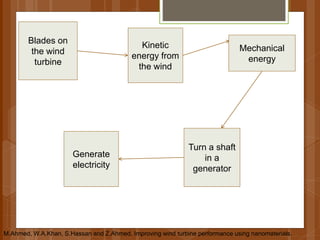
Blades on
the wind
turbine
Kinetic
energy from
the wind
Mechanical
energy
Turn a shaft
in a
generator
Generate
electricity
M.Ahmed, W.A.Khan, S.Hassan and Z.Ahmed. Improving wind turbine performance using nanomaterials.

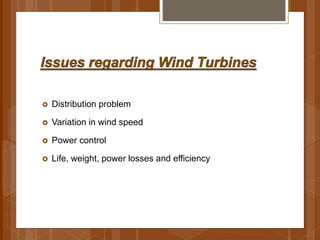
 Distribution problem
 Variation in wind speed
 Power control
 Life, weight, power losses and efficiency
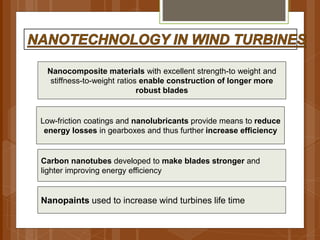
Nanocomposite materials with excellent strength-to weight and
stiffness-to-weight ratios enable construction of longer more
robust blades
Low-friction coatings and nanolubricants provide means to reduce
energy losses in gearboxes and thus further increase efficiency
Carbon nanotubes developed to make blades stronger and
lighter improving energy efficiency
Nanopaints used to increase wind turbines life time
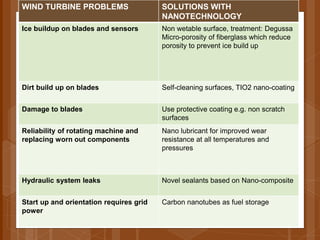
WIND TURBINE PROBLEMS SOLUTIONS WITH
NANOTECHNOLOGY
Ice buildup on blades and sensors Non wetable surface, treatment: Degussa
Micro-porosity of fiberglass which reduce
porosity to prevent ice build up
Dirt build up on blades Self-cleaning surfaces, TIO2 nano-coating
Damage to blades Use protective coating e.g. non scratch
surfaces
Reliability of rotating machine and
replacing worn out components
Nano lubricant for improved wear
resistance at all temperatures and
pressures
Hydraulic system leaks Novel sealants based on Nano-composite
Start up and orientation requires grid
power
Carbon nanotubes as fuel storage
 Promising form of energy storage
 Process is efficient
 Exhaust gas produced is pure water
 Nanotechnology can help by using nanomaterials at
reduced cost
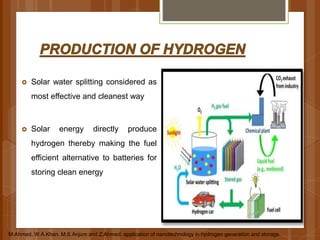
 Solar water splitting considered as
most effective and cleanest way
 Solar energy directly produce
hydrogen thereby making the fuel
efficient alternative to batteries for
storing clean energy
M.Ahmed, W.A.Khan. M.S.Anjum and Z.Ahmed. application of nanotechnology in hydrogen generation and storage.
 Safe and practical storage of hydrogen a major barrier to
widespread use of the fuel
 Storing hydrogen as a compressed gas or liquid requires
extremely high pressures results in expensive tanks and risks
of leaks or explosions
 The production of hydrogen gas requires a large amount of
energy
 Storage of hydrogen gas an issue, as it is highly flammable
in its free gaseous form
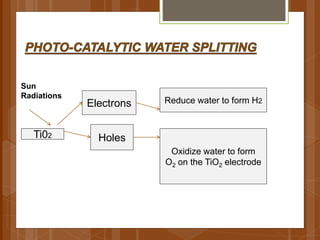
Ti02
Electrons
Holes
Reduce water to form H2
Oxidize water to form
O2 on the TiO2 electrode
Sun
Radiations
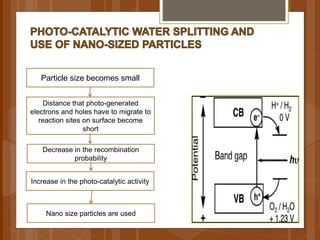
Particle size becomes small
Distance that photo-generated
electrons and holes have to migrate to
reaction sites on surface become
short
Decrease in the recombination
probability
Increase in the photo-catalytic activity
Nano size particles are used
Nanoparticles which are titanium
dioxide, a common white pigment
in its bulk form have strong photo
catalytic activity i.e. the ability to
use the energy from sunlight to
decompose molecules
Mostly applied to self-
cleaning surfaces
The key is :
 To find a material which has
controllable hydrogen affinity
 Absorb and release full capacity of fuel
in shortest time possible
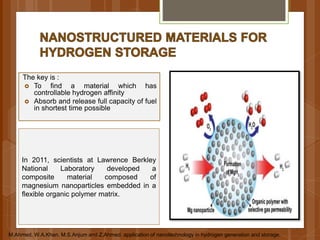
In 2011, scientists at Lawrence Berkley
National Laboratory developed a
composite material composed of
magnesium nanoparticles embedded in a
flexible organic polymer matrix.
M.Ahmed, W.A.Khan. M.S.Anjum and Z.Ahmed. application of nanotechnology in hydrogen generation and storage.
Effect of nanoparticles on heat capacity
of Nanofluids based on molten salts as
PCM for thermal energy storage
• Main aim is to develop a nanofluid with a phase change behavior by
adding different kinds of nanoparticles
• Study of nanofluid thermal characteristics:
• Thermal conductivity
• Thermal capacity
PREPARATION OF NANOFLUIDS
 A binary salt; a mixture of NaNO3 and KNO3 is prepared
 Selected nanoparticles silica, alumina, titania and a mixture of silica-
alumina
 Measurements on thermophysical properties were performed by
differential scanning calorimetry analysis
 The dispersion of the nanoparticles was analyzed by scanning electron
microscopy (SEM).
RESULT OF THE STUDY
 High thermal capacity and high thermal conductivity
 Increase in the specific heat of 15% to 57% in the solid phase
and of 1% to 22% in the liquid phase
The nanofluids (phase change materials) are gaining importance in
many fields
 solar energy power plants
 Solar heating and cooling systems
 energy efficiency buildings
 waste heat recovery systems
Use of Nanotechnology in Solar PV Cell
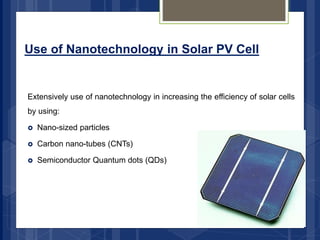
Extensively use of nanotechnology in increasing the efficiency of solar cells
by using:
 Nano-sized particles
 Carbon nano-tubes (CNTs)
 Semiconductor Quantum dots (QDs)
NANO-SIZED PARTICLES
 In solar cells, bulk silicon is converted into discrete, nano-sized
particles
 These particles will show distinct colors depending upon their sizes
 Films of 1 nm blue fluorescent
 Films of 2.85 nm red fluorescent silicon nanoparticles
 They produce large voltage enhancements with improved power
performance
CARBON NANO-TUBES (CNTS)
 Incorporated to a titanium oxide
nanoparticles-based solar cells
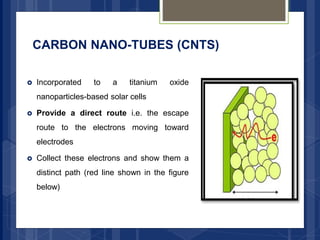
 Provide a direct route i.e. the escape
route to the electrons moving toward
electrodes
 Collect these electrons and show them a
distinct path (red line shown in the figure
below)
Semiconductor Quantum Dots (QDs)
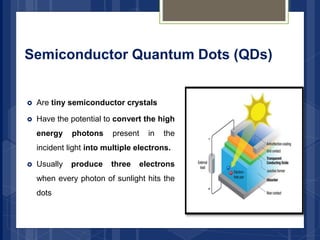
 Are tiny semiconductor crystals
 Have the potential to convert the high
energy photons present in the
incident light into multiple electrons.
 Usually produce three electrons
when every photon of sunlight hits the
dots
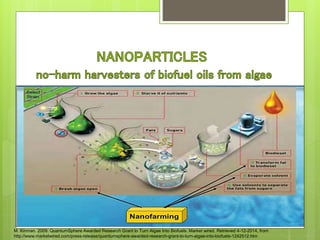
 Algae carbohydrates can be converted into ethanol or they may
be gasified into bio-gas
 However they pose various challenges
 Such challenges can be met with nanotechnology
 Algae have been successfully turned into biogases with the
incorporation of nanocatalysts
M. Kinman. 2009. QuantumSphere Awarded Research Grant to Turn Algae Into Biofuels. Market wired. Retrieved 4-12-2014, from
http://www.marketwired.com/press-release/quantumsphere-awarded-research-grant-to-turn-algae-into-biofuels-1242512.htm
https://www.jyu.fi/fysiikka/en/research/material/compns/resear
ch/index_html/supported.jpg
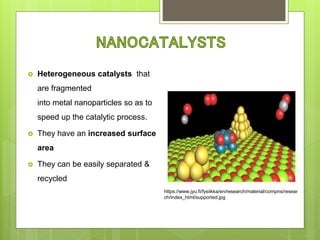
 Heterogeneous catalysts that
are fragmented
into metal nanoparticles so as to
speed up the catalytic process.
 They have an increased surface
area
 They can be easily separated &
recycled
M. Kinman. 2009. QuantumSphere Awarded Research Grant to Turn Algae Into Biofuels. Market wired. Retrieved 4-12-2014, from
http://www.marketwired.com/press-release/quantumsphere-awarded-research-grant-to-turn-algae-into-biofuels-1242512.htm
 Base-catalyzed transesterification reacts lipids with alcohol to
produce biodiesel
 The nanocatalyst spheres are used to replace the commonly used
sodium methoxide as base catalyst
The process is:
 Economical and recyclable,
 reacting at mild temperatures and pressures
 producing cleaner biodiesel
 greatly reducing water consumption and environmental
contaminants
 BiogàsPlus involves application of nanotechnology to improve
biogas production
 The controlled introduction of iron oxide nanoparticles in
organic waste treatment can increase the production of biogas
up to 3 times
 Iron oxide nanoparticles feed the bacteria
 Enhance biological efficacy
2014. Nanoparticle technology triples the production of biogas. Universitat Autònoma de Barcelona. Retrieved 4-12-2014, from
http://www.uab.cat/web/newsroom/news-detail/nanoparticle-technology-triples-the-production-of-biogas--
1345668003610.html?noticiaid=1345676996458
• Move in the human body through
inhalation
• can deposit in human lungs
• reduces the ability of alveolar
macrophages to clean off foreign
particles.
• can lead to various respiratory
inflammation and tissue damage
• Insignificant penetration of TiO2
nanoparticles through the skin
layer.
Nanotechnology as Energy Source

Nanotechnology as Energy Source

  • 3.
     Provides multitudeof approaches to energy saving  Viewed as crucial technology for technological advancement and novelties in all branches of economy  States the target-oriented mechanical application of objects and structures in a size in the range of 1 and 100 nm
  • 4.
     “Nano” isa Greek word which means “dwarf”  One nanometre refers to one-billionth of a meter  One nanometre is about 3 atoms long  1nm= 10-9 Nanotechnology. SNF. Retrieved 4-12-2014, from http://snf.stanford.edu/Education/Nanotechnology.SNF.web.pdf
  • 5.
     1 cm/10=1 mm  1mm/10= 100 µm  100µm/100= 1µm  1µm/10= 100nm  100nm/100= 1nm Nanotechnology. SNF. Retrieved 4-12-2014, from http://snf.stanford.edu/Education/Nanotechnology.SNF.web.pdf
  • 7.
    “Building and expendingobjects, devices, items and machines at the nanometre scale, making use of distinctive properties that arise as a result of small dimensions that occur at that small scale”
  • 8.
    Following three thingsare included in nanotechnology:  Small size, measured in 100s of manometers or less  Unique properties because of the small size  Control of structure & composition on the nm scale in order to control the properties
  • 9.
    Because they are: Faster  Lighter  Cheaper  Can get into small spaces  Energy efficient  Develop unique properties at small scale
  • 10.
    Properties of materialschange at nanoscale because of:  Quantum mechanical effects  Ratio of surface area-to-volume of structure increases
  • 12.
     Have tinysize, incredible surface area per unit mass, light weight and are very strong  Have found applications in field of electronics, coatings, fuel cells, water filters composites, drugs cancer detection and treatment etc. M. Krause. Introduction to nanotechnology. Veritox. Retrieved 4-12-2014, from https://www.aiha.org/aihce07/handouts/rt201krause.pdf
  • 14.
     Batteries storeelectrical energy  In rechargeable batteries chemical process is  reversible  Batteries are important in many areas • transport • portable electronics • medical devices • power tools • Storage of electricity produced by irregular renewable sources
  • 15.
    Batteries are madefrom layers of different materials which enable the electrochemical storage of electricity M.Ahmed, W.A.Khan, F.Mahmood and M.Waqas Arif. Harvesting the potential of nanotechnology in renewable energy.
  • 16.
     Find materialssuitable for use as electrodes have high surface area  Allows charge to flow more freely  Resulting in higher capacity and shorter charge/discharge cycles  Safety of batteries an important concern  Replace liquid electrolytes  Can rupture the cell when overheated
  • 17.
     Nanostructured materialsincrease surface area for electrolyte materials  Nanoparticles enhance the conductivity  reduce the chance of a short circuit
  • 18.
    Electrodes Several types ofnanomaterial allow for higher storage densities of lithium than standard metal or graphite electrodes  Carbon-coated silicon nanowires  Carbon nanotubes  Layered, nanostructured vanadium oxide and manganese oxide
  • 19.
    Electrolyte  Nanoparticles addedto solid polymer gel  Enhance the conductivity and storage capacity  Solid ceramics have high temperature resistance  high-stress applications like large vehicles
  • 20.
    Coating the electrode’ssurface with nanoparticles, nanowires, or other nanostructures  Develops anodes with a greater density of locations to which lithium ions can attach  Increases the number of stored ions increases the stored electrical power Changing the atoms to which the lithium bonds  Changes the electrochemical reaction gives more energy, increasing the power
  • 21.
    Converts a fueldirectly into electricity in an electrochemical reaction Limitations of fuel cells  Expensive materials such as platinum are needed for the electrode catalysts  Fuels other than hydrogen can cause fouling of the electrodes  Hydrogen is costly and difficult to store
  • 22.
     Use platinumnanoparticles instead of solid platinum surface  increases efficiency, and allows much less metal to be used  Support platinum nanoparticles on a porous surface  further increases the accessibility of the platinum surfaces
  • 24.
     Convert kineticenergy into mechanical energy  Uses a source to power a generator, without the harmful emissions  Use wind to generate electricity
  • 25.
    Blades on the wind turbine Kinetic energyfrom the wind Mechanical energy Turn a shaft in a generator Generate electricity M.Ahmed, W.A.Khan, S.Hassan and Z.Ahmed. Improving wind turbine performance using nanomaterials.
  • 26.
     Distribution problem Variation in wind speed  Power control  Life, weight, power losses and efficiency
  • 27.
    Nanocomposite materials withexcellent strength-to weight and stiffness-to-weight ratios enable construction of longer more robust blades Low-friction coatings and nanolubricants provide means to reduce energy losses in gearboxes and thus further increase efficiency Carbon nanotubes developed to make blades stronger and lighter improving energy efficiency Nanopaints used to increase wind turbines life time
  • 28.
    WIND TURBINE PROBLEMSSOLUTIONS WITH NANOTECHNOLOGY Ice buildup on blades and sensors Non wetable surface, treatment: Degussa Micro-porosity of fiberglass which reduce porosity to prevent ice build up Dirt build up on blades Self-cleaning surfaces, TIO2 nano-coating Damage to blades Use protective coating e.g. non scratch surfaces Reliability of rotating machine and replacing worn out components Nano lubricant for improved wear resistance at all temperatures and pressures Hydraulic system leaks Novel sealants based on Nano-composite Start up and orientation requires grid power Carbon nanotubes as fuel storage
  • 29.
     Promising formof energy storage  Process is efficient  Exhaust gas produced is pure water  Nanotechnology can help by using nanomaterials at reduced cost
  • 30.
     Solar watersplitting considered as most effective and cleanest way  Solar energy directly produce hydrogen thereby making the fuel efficient alternative to batteries for storing clean energy M.Ahmed, W.A.Khan. M.S.Anjum and Z.Ahmed. application of nanotechnology in hydrogen generation and storage.
  • 31.
     Safe andpractical storage of hydrogen a major barrier to widespread use of the fuel  Storing hydrogen as a compressed gas or liquid requires extremely high pressures results in expensive tanks and risks of leaks or explosions
  • 32.
     The productionof hydrogen gas requires a large amount of energy  Storage of hydrogen gas an issue, as it is highly flammable in its free gaseous form
  • 33.
    Ti02 Electrons Holes Reduce water toform H2 Oxidize water to form O2 on the TiO2 electrode Sun Radiations
  • 34.
    Particle size becomessmall Distance that photo-generated electrons and holes have to migrate to reaction sites on surface become short Decrease in the recombination probability Increase in the photo-catalytic activity Nano size particles are used
  • 35.
    Nanoparticles which aretitanium dioxide, a common white pigment in its bulk form have strong photo catalytic activity i.e. the ability to use the energy from sunlight to decompose molecules Mostly applied to self- cleaning surfaces
  • 36.
    The key is:  To find a material which has controllable hydrogen affinity  Absorb and release full capacity of fuel in shortest time possible In 2011, scientists at Lawrence Berkley National Laboratory developed a composite material composed of magnesium nanoparticles embedded in a flexible organic polymer matrix. M.Ahmed, W.A.Khan. M.S.Anjum and Z.Ahmed. application of nanotechnology in hydrogen generation and storage.
  • 38.
    Effect of nanoparticleson heat capacity of Nanofluids based on molten salts as PCM for thermal energy storage • Main aim is to develop a nanofluid with a phase change behavior by adding different kinds of nanoparticles • Study of nanofluid thermal characteristics: • Thermal conductivity • Thermal capacity
  • 39.
    PREPARATION OF NANOFLUIDS A binary salt; a mixture of NaNO3 and KNO3 is prepared  Selected nanoparticles silica, alumina, titania and a mixture of silica- alumina  Measurements on thermophysical properties were performed by differential scanning calorimetry analysis  The dispersion of the nanoparticles was analyzed by scanning electron microscopy (SEM).
  • 40.
    RESULT OF THESTUDY  High thermal capacity and high thermal conductivity  Increase in the specific heat of 15% to 57% in the solid phase and of 1% to 22% in the liquid phase The nanofluids (phase change materials) are gaining importance in many fields  solar energy power plants  Solar heating and cooling systems  energy efficiency buildings  waste heat recovery systems
  • 41.
    Use of Nanotechnologyin Solar PV Cell Extensively use of nanotechnology in increasing the efficiency of solar cells by using:  Nano-sized particles  Carbon nano-tubes (CNTs)  Semiconductor Quantum dots (QDs)
  • 42.
    NANO-SIZED PARTICLES  Insolar cells, bulk silicon is converted into discrete, nano-sized particles  These particles will show distinct colors depending upon their sizes  Films of 1 nm blue fluorescent  Films of 2.85 nm red fluorescent silicon nanoparticles  They produce large voltage enhancements with improved power performance
  • 43.
    CARBON NANO-TUBES (CNTS) Incorporated to a titanium oxide nanoparticles-based solar cells  Provide a direct route i.e. the escape route to the electrons moving toward electrodes  Collect these electrons and show them a distinct path (red line shown in the figure below)
  • 44.
    Semiconductor Quantum Dots(QDs)  Are tiny semiconductor crystals  Have the potential to convert the high energy photons present in the incident light into multiple electrons.  Usually produce three electrons when every photon of sunlight hits the dots
  • 46.
     Algae carbohydratescan be converted into ethanol or they may be gasified into bio-gas  However they pose various challenges  Such challenges can be met with nanotechnology  Algae have been successfully turned into biogases with the incorporation of nanocatalysts M. Kinman. 2009. QuantumSphere Awarded Research Grant to Turn Algae Into Biofuels. Market wired. Retrieved 4-12-2014, from http://www.marketwired.com/press-release/quantumsphere-awarded-research-grant-to-turn-algae-into-biofuels-1242512.htm
  • 47.
    https://www.jyu.fi/fysiikka/en/research/material/compns/resear ch/index_html/supported.jpg  Heterogeneous catalyststhat are fragmented into metal nanoparticles so as to speed up the catalytic process.  They have an increased surface area  They can be easily separated & recycled
  • 48.
    M. Kinman. 2009.QuantumSphere Awarded Research Grant to Turn Algae Into Biofuels. Market wired. Retrieved 4-12-2014, from http://www.marketwired.com/press-release/quantumsphere-awarded-research-grant-to-turn-algae-into-biofuels-1242512.htm
  • 49.
     Base-catalyzed transesterificationreacts lipids with alcohol to produce biodiesel  The nanocatalyst spheres are used to replace the commonly used sodium methoxide as base catalyst The process is:  Economical and recyclable,  reacting at mild temperatures and pressures  producing cleaner biodiesel  greatly reducing water consumption and environmental contaminants
  • 50.
     BiogàsPlus involvesapplication of nanotechnology to improve biogas production  The controlled introduction of iron oxide nanoparticles in organic waste treatment can increase the production of biogas up to 3 times  Iron oxide nanoparticles feed the bacteria  Enhance biological efficacy 2014. Nanoparticle technology triples the production of biogas. Universitat Autònoma de Barcelona. Retrieved 4-12-2014, from http://www.uab.cat/web/newsroom/news-detail/nanoparticle-technology-triples-the-production-of-biogas-- 1345668003610.html?noticiaid=1345676996458
  • 51.
    • Move inthe human body through inhalation • can deposit in human lungs • reduces the ability of alveolar macrophages to clean off foreign particles. • can lead to various respiratory inflammation and tissue damage • Insignificant penetration of TiO2 nanoparticles through the skin layer.