Created By:
Rahul B. Kamble.
Rushikesh S. Gadge.
Collage Name:
S.H.JONDHALE POLYTECHNIC
What is Nano Technology ?
Nanotechnology ("nanotech") is the manipulation of
matter on an atomic, molecular,
and supramolecular scale. The earliest, widespread
description of nanotechnology referred to the
particular technological goal of precisely manipulating
atoms and molecules for fabrication of macro scale
products, also now referred to as molecular
nanotechnology.
A more generalized description of nanotechnology
was subsequently established by the National
Nanotechnology Initiative, which defines
nanotechnology as the manipulation of matter with at
least one dimension sized from 1 to 100 nanometers.
 The history of nanotechnology traces the development of the concepts and
experimental work falling under the broad category of nanotechnology.
Although nanotechnology is a relatively recent development in scientific
research, the development of its central concepts happened over a longer
period of time.
 The emergence of nanotechnology in the 1980s was caused by the
convergence of experimental advances such as the invention of
the scanning tunneling microscope in 1981 and the discovery
of fullerenes in 1985, with the elucidation and popularization of a
conceptual framework for the goals of nanotechnology beginning with the
1986 publication of the book Engines of Creation.
 The early 2000s also saw the beginnings of commercial applications of
nanotechnology, although these were limited to bulk applications
of nanomaterial rather than the transformative applications envisioned by
the field.
History Of Nano Technology
Products of Nano
Technology…!
How Does Nanotechnology Work
Fullerenes
The word fullerene describes a molecule at the Nano scale that is made up of
only carbon. Carbon, as we know, is the basis of nature’s construction and,
therefore, also represents our very own construction on nanotechnology.
Fullerenes allow us to build nanostructures, the very foundation of the Nano-
object in question, so that we may then tweak in our own programming and
machinery that will go on to perform marvelous tasks.
Think of fullerenes as the framework at a construction site. In the construction of
a building, you must first lay down the flooring, then erect the beams, setup the
walls, and finally you must add in features such as the roof, doors, and windows.
Fullerenes allow us to lay down the “flooring”, erect the “beams”, and setup the
“walls” of nanotechnology so that designers can then set forth to add in the
commodities.
What is Nanotechnology Used For?
Clothes
Believe it or not, nanotechnology will make it so that we will one day soon be able to
buy clothes that are completely stain proof, waterproof, fireproof, and resistant to
damages. This works by tying the fabrics together at a Nano scale.
Oil
Nanotechnology will revolutionize the oil industry in several important ways. For one,
nanotechnology is able to easily separate oil from water which saves a lot of oil in the
production procedures. In normal oil production, water must be used to force oil out
of the wells, which then leaves an oil-water residue behind which is extremely hard to
separate because the molecules are infused together so precisely. Because of this, oil
companies are often forced to leave behind two barrels worth of oil for every one
barrel they retrieve.
Crime Prevention
 Forensics
Someday soon, forensic personnel will be able to take a handheld device to
the field that will contain an entire laboratory of forensic equipment.
Today, forensic officers must take blood, semen, fingerprint, hair, and
whatever other types of samples they can find at the crime scene back to
the office and wait until the results come in before police can make their
case. In the future, thanks to nanotechnology, they will no longer have to
do that.
 Trackers
Trackers may be used in crime prevention to mark items in stores in case
they are lost or stolen. This will not only prevent people from stealing
items in the first place (because they’ll know that they’ll get caught), but if
something is stolen, the company will be able to track them down.
Theoretically, prisons may also inject prisoners with Nano-trackers in case
they try to escape.
 Bar codes
Nanotechnology will also come in the aid of telling the difference
between authentic items and fake ones. This really helps out with high-
end merchandise like paintings that sell for big bucks. Often, people try
to make duplicates of the painting and pass them off as the original.
Though, today, we have watermarks that can help tell the difference
between real and fake items, people have still managed to come up with
ways around this. Nanotechnology will aid this crime prevention,
though, by creating a tiny dot that’s only a fraction of a nanometer in
size and containing an enormous array of unique colors.
Advantages Of Nano Technology
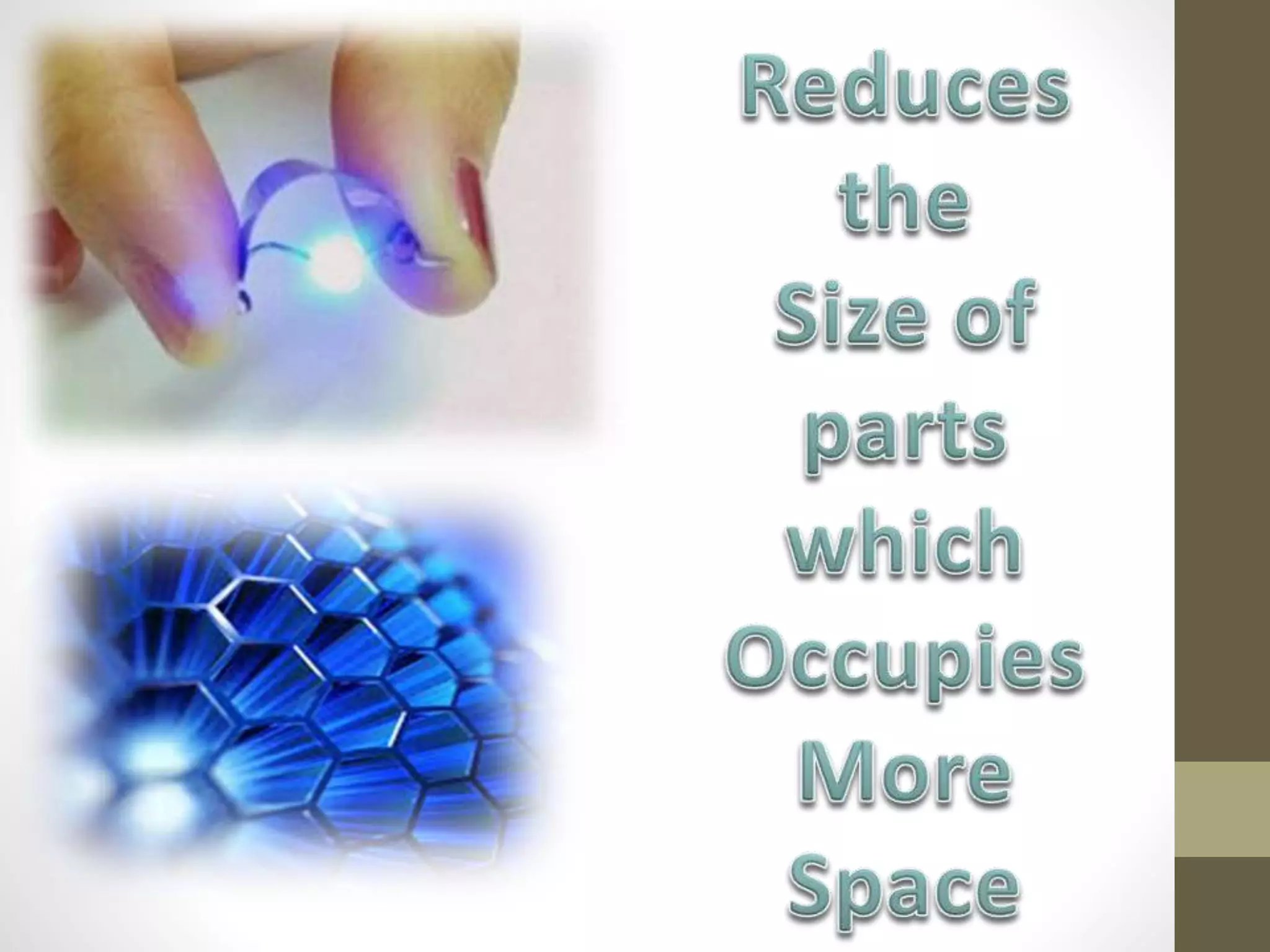
 Reduce the size of any material, machine or equipment
 Can be applied and implemented to almost any application
ever exist
 Reduce the use of energy and resource
 Able to change the basic of technology of human when it's
mature
 Able to secure to economy once its can be fully implemented
Disadvantages Of Nano Technology
 Still at its infancy, just the beginning
 Expensive in current technology
 Lack of common knowledge from many industries and confusion among many
field about its abilities.
 Require huge amount of investment and research but still yield a very limit
result.
 Facing opposition from culture perspective, activists, journalists and even
within the government
Nanotechnology Applications in following Fields.
Medicine
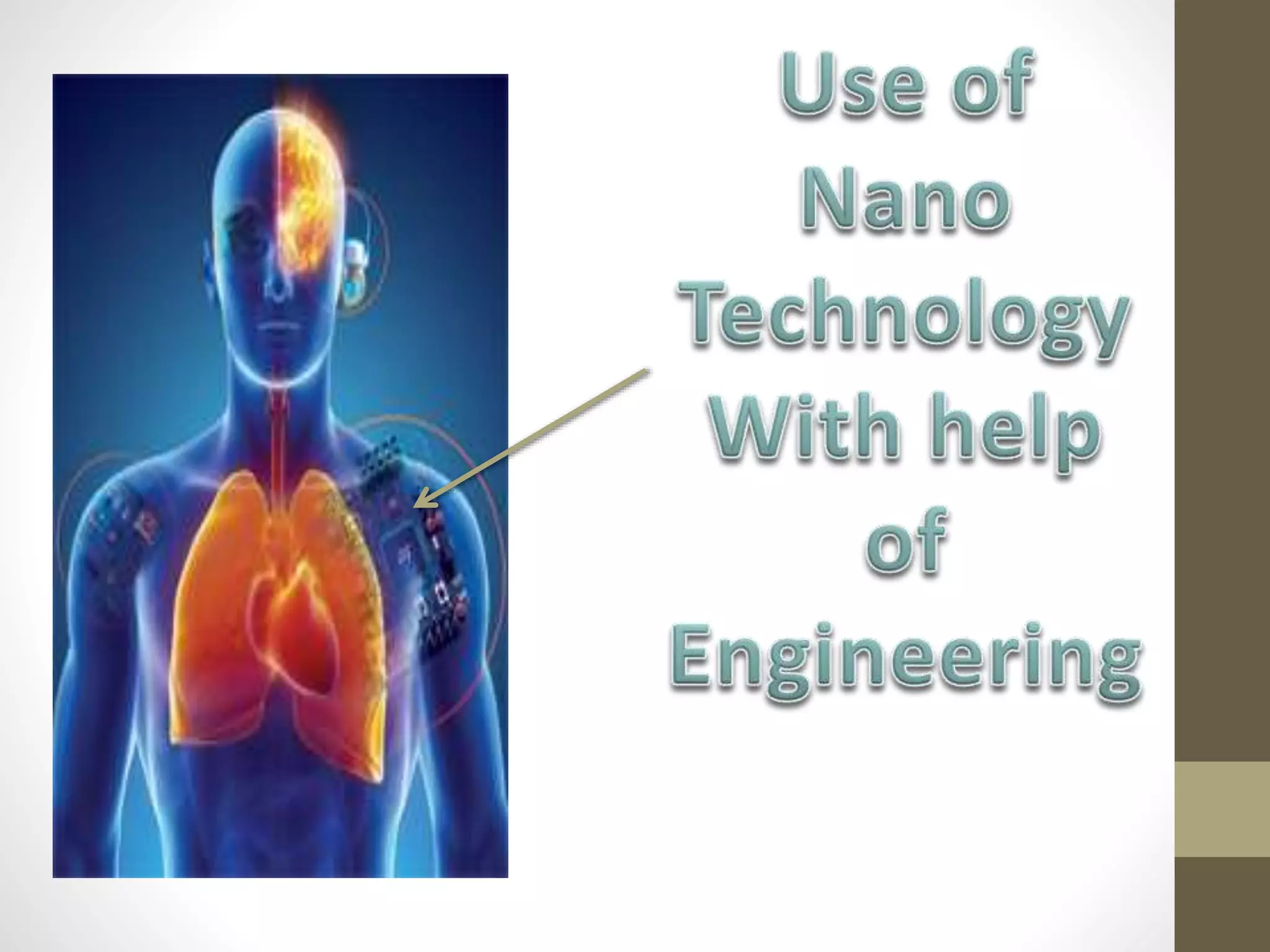
Researchers are developing customized nanoparticles the size of molecules that
can deliver drugs directly to diseased cells in your body. When it's perfected,
this method should greatly reduce the damage treatment such as
chemotherapy does to a patient's healthy cells.
Electronics
Nanotechnology holds some answers for how we might increase the capabilities
of electronics devices while we reduce their weight and power consumption.
Food
Nanotechnology is having an impact on several aspects of food science, from
how food is grown to how it is packaged. Companies are developing
nanomaterial's that will make a difference not only in the taste of food, but also
in food safety, and the health benefits that food delivers.
Fuel Cells
Nanotechnology is being used to reduce the cost of catalysts used in fuel cells to
produce hydrogen ions from fuel such as methanol and to improve the efficiency
of membranes used in fuel cells to separate hydrogen ions from other gases such
as oxygen.
Solar Cells
Companies have developed nanotech solar cells that can be manufactured at
significantly lower cost than conventional solar cells.
Batteries
Companies are currently developing batteries using nanomaterial's. One such
battery will be a good as new after sitting on the shelf for decades. Another
battery can be recharged significantly faster than conventional batteries.
Space
Nanotechnology may hold the key to making space-flight more practical.
Advancements in nanomaterial's make lightweight spacecraft and a cable for
the space elevator possible. By significantly reducing the amount of rocket fuel
required, these advances could lower the cost of reaching orbit and traveling in
space.
Fuels
Nanotechnology can address the shortage of fossil fuels such as diesel and
gasoline by making the production of fuels from low grade raw materials
economical, increasing the mileage of engines, and making the production of
fuels from normal raw materials more efficient.
Nano technology

Nano technology

  • 1.
    Created By: Rahul B.Kamble. Rushikesh S. Gadge. Collage Name: S.H.JONDHALE POLYTECHNIC
  • 2.
    What is NanoTechnology ? Nanotechnology ("nanotech") is the manipulation of matter on an atomic, molecular, and supramolecular scale. The earliest, widespread description of nanotechnology referred to the particular technological goal of precisely manipulating atoms and molecules for fabrication of macro scale products, also now referred to as molecular nanotechnology. A more generalized description of nanotechnology was subsequently established by the National Nanotechnology Initiative, which defines nanotechnology as the manipulation of matter with at least one dimension sized from 1 to 100 nanometers.
  • 3.
     The historyof nanotechnology traces the development of the concepts and experimental work falling under the broad category of nanotechnology. Although nanotechnology is a relatively recent development in scientific research, the development of its central concepts happened over a longer period of time.  The emergence of nanotechnology in the 1980s was caused by the convergence of experimental advances such as the invention of the scanning tunneling microscope in 1981 and the discovery of fullerenes in 1985, with the elucidation and popularization of a conceptual framework for the goals of nanotechnology beginning with the 1986 publication of the book Engines of Creation.  The early 2000s also saw the beginnings of commercial applications of nanotechnology, although these were limited to bulk applications of nanomaterial rather than the transformative applications envisioned by the field. History Of Nano Technology
  • 4.
  • 5.
    How Does NanotechnologyWork Fullerenes The word fullerene describes a molecule at the Nano scale that is made up of only carbon. Carbon, as we know, is the basis of nature’s construction and, therefore, also represents our very own construction on nanotechnology. Fullerenes allow us to build nanostructures, the very foundation of the Nano- object in question, so that we may then tweak in our own programming and machinery that will go on to perform marvelous tasks. Think of fullerenes as the framework at a construction site. In the construction of a building, you must first lay down the flooring, then erect the beams, setup the walls, and finally you must add in features such as the roof, doors, and windows. Fullerenes allow us to lay down the “flooring”, erect the “beams”, and setup the “walls” of nanotechnology so that designers can then set forth to add in the commodities.
  • 7.
    What is NanotechnologyUsed For? Clothes Believe it or not, nanotechnology will make it so that we will one day soon be able to buy clothes that are completely stain proof, waterproof, fireproof, and resistant to damages. This works by tying the fabrics together at a Nano scale. Oil Nanotechnology will revolutionize the oil industry in several important ways. For one, nanotechnology is able to easily separate oil from water which saves a lot of oil in the production procedures. In normal oil production, water must be used to force oil out of the wells, which then leaves an oil-water residue behind which is extremely hard to separate because the molecules are infused together so precisely. Because of this, oil companies are often forced to leave behind two barrels worth of oil for every one barrel they retrieve.
  • 8.
    Crime Prevention  Forensics Somedaysoon, forensic personnel will be able to take a handheld device to the field that will contain an entire laboratory of forensic equipment. Today, forensic officers must take blood, semen, fingerprint, hair, and whatever other types of samples they can find at the crime scene back to the office and wait until the results come in before police can make their case. In the future, thanks to nanotechnology, they will no longer have to do that.  Trackers Trackers may be used in crime prevention to mark items in stores in case they are lost or stolen. This will not only prevent people from stealing items in the first place (because they’ll know that they’ll get caught), but if something is stolen, the company will be able to track them down. Theoretically, prisons may also inject prisoners with Nano-trackers in case they try to escape.
  • 9.
     Bar codes Nanotechnologywill also come in the aid of telling the difference between authentic items and fake ones. This really helps out with high- end merchandise like paintings that sell for big bucks. Often, people try to make duplicates of the painting and pass them off as the original. Though, today, we have watermarks that can help tell the difference between real and fake items, people have still managed to come up with ways around this. Nanotechnology will aid this crime prevention, though, by creating a tiny dot that’s only a fraction of a nanometer in size and containing an enormous array of unique colors.
  • 11.
    Advantages Of NanoTechnology  Reduce the size of any material, machine or equipment  Can be applied and implemented to almost any application ever exist  Reduce the use of energy and resource  Able to change the basic of technology of human when it's mature  Able to secure to economy once its can be fully implemented
  • 12.
    Disadvantages Of NanoTechnology  Still at its infancy, just the beginning  Expensive in current technology  Lack of common knowledge from many industries and confusion among many field about its abilities.  Require huge amount of investment and research but still yield a very limit result.  Facing opposition from culture perspective, activists, journalists and even within the government
  • 14.
    Nanotechnology Applications infollowing Fields. Medicine Researchers are developing customized nanoparticles the size of molecules that can deliver drugs directly to diseased cells in your body. When it's perfected, this method should greatly reduce the damage treatment such as chemotherapy does to a patient's healthy cells. Electronics Nanotechnology holds some answers for how we might increase the capabilities of electronics devices while we reduce their weight and power consumption. Food Nanotechnology is having an impact on several aspects of food science, from how food is grown to how it is packaged. Companies are developing nanomaterial's that will make a difference not only in the taste of food, but also in food safety, and the health benefits that food delivers.
  • 15.
    Fuel Cells Nanotechnology isbeing used to reduce the cost of catalysts used in fuel cells to produce hydrogen ions from fuel such as methanol and to improve the efficiency of membranes used in fuel cells to separate hydrogen ions from other gases such as oxygen. Solar Cells Companies have developed nanotech solar cells that can be manufactured at significantly lower cost than conventional solar cells. Batteries Companies are currently developing batteries using nanomaterial's. One such battery will be a good as new after sitting on the shelf for decades. Another battery can be recharged significantly faster than conventional batteries.
  • 16.
    Space Nanotechnology may holdthe key to making space-flight more practical. Advancements in nanomaterial's make lightweight spacecraft and a cable for the space elevator possible. By significantly reducing the amount of rocket fuel required, these advances could lower the cost of reaching orbit and traveling in space. Fuels Nanotechnology can address the shortage of fossil fuels such as diesel and gasoline by making the production of fuels from low grade raw materials economical, increasing the mileage of engines, and making the production of fuels from normal raw materials more efficient.